Characters


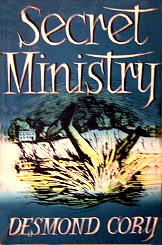
   In an email to Al Hubin, subsequently forwarded on to me, mystery bookseller Jamie Sturgeon recently pointed out the existence of a website devoted to British spy and crime thriller writer Desmond Cory.
East

   Many of Cory’s “Johnny Fedora” novels of espionage and adventure were published as paperback originals in the US by Award in the 1960s during the height of the boom for James Bond and his many imitators — only Johnny Fedora had been there first. Walker published a number of others in hardcover around the same time, and many of these were reprinted in softcover by Signet.

   As available as his books were at one time, the fact remains that Desmond Cory’s fiction is now all but unknown in the US — and perhaps in the UK as well — even though the introduction to the previously mentioned website can arguably proclaim that –

   Some 50 years ago, Desmond Cory wrote the first of a series of thrillers that helped spawn one of Britain’s most popular fictional genres — the 20th Century “Spy Novel.”

   Sometimes referred to as “Brit Grit,” this phenomenon comprised several well-known characters such as Ian Fleming’s James Bond, and Len Deighton’s Harry Palmer. At its peak, the genre sold several million books across the world, and was watched by even greater numbers on the Big Screen, due to the immense popularity of James Bond, as incarnated by the incomparable Sean Connery. Preceding the now legendary 007 was Desmond Cory’s Johnny Fedora, “the thinking man’s James Bond.”

   Here, with one addition, the year of his death, not known until now, is the complete dossier on author Desmond Cory as found in Crime Fiction IV, by Allen J. Hubin. British editions only are given, unless published in the US under new titles:
Begin

CORY, DESMOND; pseudonym of Shaun McCarthy, (1928-2001); other pseudonym Theo Callas.

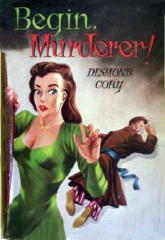
* Begin, Murderer! (n.) Muller 1951 [Lindy Grey; England]
* Secret Ministry (n.) Muller 1951 [Johnny Fedora]
* This Is Jezebel (n.) Muller 1952 [Lindy Grey; England]
* This Traitor, Death (n.) Muller 1952 [Johnny Fedora; Paris]
* Dead Man Falling (n.) Muller 1953 [Johnny Fedora; Austria]
* Lady Lost (n.) Muller 1953 [Lindy Grey; England]
* Intrigue (n.) Muller 1954 [Johnny Fedora; Italy]
* The Shaken Leaf (n.) Shakespeare Head 1954 [Lindy Grey; England]
* Height of Day (n.) Muller 1955 [Johnny Fedora; Africa]
* The Phoenix Sings (n.) Muller 1955 [England]
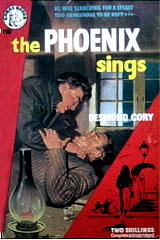
Phoenix

* High Requiem (n.) Muller 1956 [Johnny Fedora; Africa]
* Johnny Goes North (n.) Muller 1956 [Johnny Fedora; Sweden]
* Pilgrim at the Gate (n.) Muller 1957 [Mr. Pilgrim; England]
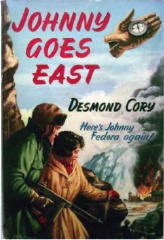
* Johnny Goes East (n.) Muller 1958 [Johnny Fedora; Tibet]
* Johnny Goes South (n.) Muller 1959 [Johnny Fedora; Argentina]
* Johnny Goes West (n.) Muller 1959 [Johnny Fedora; South America]
* Pilgrim on the Island (n.) Muller 1959 [Mr. Pilgrim; Germany]
* The Head (n.) Muller 1960 [Johnny Fedora; Spain]
* Stranglehold (n.) Muller 1961 [Mr. Dee; England]
* Undertow (n.) Muller 1962 [Johnny Fedora; Spain]
* Hammerhead (n.) Muller 1963 [Johnny Fedora; Madrid]
* The Name of the Game (n.) Muller 1964 [Mr. Dee; England]
* Shockwave (n.) Walker 1964; See: Hammerhead (Muller 1963).
* Deadfall (n.) Muller 1965 [Spain]
* Feramontov (n.) Muller 1966 [Johnny Fedora; Spain]
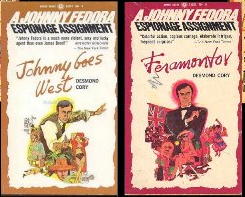
Award

* Overload (n.) NEL 1966; See: Johnny Goes South (Muller 1959).
* Timelock (n.) Muller 1967 [Johnny Fedora; Spain]
* Mountainhead (n.) Award 1968; See: Johnny Goes East (Muller 1958).
* Trieste (n.) Award 1968; See: Intrigue (Muller 1954).
* Dead Men Alive (n.) Award 1969; See: Height of Day (Muller 1955).
* The Hitler Diamonds (n.) Award 1969; See: Dead Man Falling (Muller 1953).
* The Night Hawk (n.) Hodder 1969 [Spain]
* The Swastika Hunt (n.) Award 1969; See: Johnny Goes North (Muller 1956).
* The Nazi Assassins (n.) Award 1970; See: Secret Ministry (Muller 1951).
* The Gestapo File (n.) Award 1971; See: This Traitor, Death (Muller 1952).
* Sunburst (n.) Hodder 1971 [Johnny Fedora; Spain]
* Take My Drum to England (n.) Hodder 1971 [Spain]
* Even If You Run (n.) Doubleday 1972; See: Take My Drum to England (Hodder 1971).
* A Bit of a Shunt Up the River (n.) Doubleday 1974 [England]
* The Circle Complex (n.) Macmillan 1975 [Wales]
* Bennett (n.) Macmillan 1977 [Spain]
* The Catalyst (n.) St. Martin’s 1991; See: The Strange Attractor (Macmillan (London) 1991).
* The Strange Attractor (n.) Macmillan 1991 [Prof. John Dobie; Dr. Kate Coyle; Wales]
* The Mask of Zeus (n.) Macmillan 1992 [Prof. John Dobie; Dr. Kate Coyle; Cyprus; Academia]
* The Dobie Paradox (n.) Macmillan 1993 [Prof. John Dobie; Dr. Kate Coyle; Scotland]

McCARTHY, SHAUN (Lloyd) (1928-2001); see pseudonyms Theo Callas & Desmond Cory

* Lucky Ham (London: Macmillan, 1977, hc) [Oxford; Academia]

CALLAS, THEO; pseudonym of Shaun McCarthy, (1928-2001); other pseudonym Desmond Cory

* The City of Kites (Muller, 1955, hc) [Vienna]

   Quoting from the website —

   The Johnny Fedora series consists of 16 novels written over a period of twenty years, all taking place in exotic locations.

Secret

   In the first novel, Secret Ministry, Johnny Fedora is introduced as a secret agent whose forte is the ability to outshoot, outwit, and outmaneuver his Cold War opponents. In subsequent novels, he is often teamed up with Sebastian Trout from the Foreign Office. Johnny’s connection with British intelligence is unofficial, but is hired by them for specific assignments.

   Written at the same time as the early Fedora novels, the Lindy Grey series were entertaining private-detective thrillers, comprising over 4 titles.

   In Begin, Murderer! Lindsay Grey starts as an urbane man-about-town who solves murders that baffle the Oxford police. Self-described as “a one-time private detective of one-time private means”, Lindy (as he likes to be called) is not ashamed of living a dissolute life.

   In 1991, after a decade of dedicating his writing efforts to academic works, Cory returned to writing mystery novels, introducing a new series character, Professor John Dobie.

   The first Dobie novel, The Strange Attractor, introduces us to an absent-minded maths professor who stumbles into the world of computer hacking, high-tech thievery, and multiple murder. Through wit and a clever plot, Cory takes Dobie through an intriguing sequence of events where he is drugged, tied up and made to witness a murder. New characters such as his girl-friend Dr. Kate Boyle, and Detective Inspector Michael Jackson (Wacko Jacko) add further spice to this clever mystery novel.
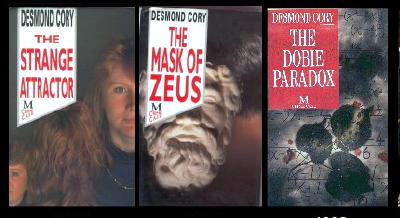
Dobie

   One novel, Deadfall, was made into a film starring Michael Caine as cat burglar Henry Clarke, who with his accomplices attempts to steal diamonds from the chateau of a Spanish millionaire.

   Chock full of other information about the author and his other standalone thrillers, the website is certainly worth a visit. Lots of great cover art, too, of which I’ve provided you with only a small sampling.
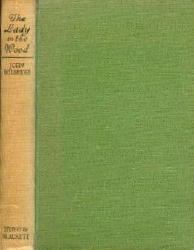
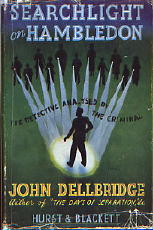
JOHN DELLBRIDGE – The Lady in the Wood

Hurst & Blackett Ltd., hardcover; no date stated [1950]. No US publication.

   As readers of this blog will know full well, it has recently been discovered that “John Dellbridge” was the pen name of Frederick Joseph De Verteuil (1887-1963). A native of Trinidad, he became a barrister and practiced law in India and England before becoming a novelist.

    I’ll forego the usual bibliography, as the previous entry already includes one, as well as a small amount of other information that has been learned about the author. There are six mysteries to his credit in all, however, the last three having as their lead character one Rupert Hambledon, about whom more in a minute. The Lady in the Wood is the last of the three, which were published in a short span between 1947 and 1950. Dellbridge’s earlier crime-writing career spanned a much earlier 1927 to 1929.

Lady

    The story is told in quasi-documentary style, in the beginning as if in the form of local Inspector Kemsing’s report to some superior officer, starting with Chapter One, page 7:

   At 6:30 p.m. yesterday, Friday, and August, Mrs. Martineau of Sharpes Cottage, Checksworth, reported by telephone that she and her husband had found the naked body of Lady Charlotte Barnet in a larch plantation in Checksam Park. There seemed to be a bullet wound in the head. Her husband was standing by the body. She described the exact spot. I telephoned the police surgeon and the St. John Ambulance and at once proceeded to the scene by car with Sergeant Streeter and Constables Neve, Avis and Ayling, with a camera. Mrs. Martineau was waiting for us at the junction of a bridle path and the Diddlehurst-Midworth road: Sharpes Cottage is about fifty yards East of the junction of the path and road and invisible from the path as the road bends there.

   The dead woman had been a heroine in World War II, having parachuted into France and done great deeds undercover with the Resistance. Some Vichy French and some members of the Gestapo are immediately suspected. On the other hand, this is England, and the world is in the process of becoming civilized again. Lady Barnet had come down from London to be one of the guests at nearby Schlatts Hall, the home of Mr. and Mrs. Arthur Bonteve.

   So a manor house mystery is what this is, no more and no less, replete with constant and subsequent misbehavior and strange actions on the part of the many participants, many clues, another death – that of a maid who perhaps knew too much and who turned to blackmail as a result? – and endless timetabling, more than I can remember in any mystery I’ve read in many years.

   Sir Rupert Hambledon is called in early on by one of the suspects. That he has a title means that he travels in the same circles as the class of people who live in or are guests at manor homes. He is not from Scotland Yard, however, but a very expensive inquiry agent. (One hesitates in referring to him as a mere private detective.) Being the “best known detective in England” and “the smartest” (page 111), in no time at all he is in charge of the case, Inspector Kemsing more than willing to defer to him.

   One of Sir Rupert’s other traits is that “he commits irregularities that no official policeman would dare to try” and “these irregularities get results.” (Also page 111.) By the way, the inspector does not narrate the entire book. He alternates telling the story of the investigation with Mr. Perceval Hadlow-Down, a solicitor of one of the guests, who often plays Watson to Sir Rupert. Says Hadlow-Down early in his own narrative, when it is his turn;

   I am a thriller ‘fan’. Many of them are very good, though they have lost some of the savour since Lord Peter Wimsey went out of business and Dr. Fortune was replaced by a colleague of mine called Clunk who should have been struck off years ago.

Sir Rupert may outdo either of those two gentlemen by stating on page 70:

    “I’ve known who the murderer was since this morning,” he asserted with a stort of Olympian impatience.

   Of course there is not a shred of legal evidence at this point, and if the murderer were to be charged, the inspector would be “laughed out of court.”

Lady

   Does Sir Rupert indeed know? In the end, after the killer is indeed caught and charged, there are indications that he did, but to my mind, the strongest point in his final summary of the case was based on an flimsy (and even erroneous) insight into human nature. He was exaggerating, were you to ask me. It was a good guess, perhaps more, but that it took the remaining two-thirds of the book to name the killer for keeps strongly suggests that a good guess is all that it was.

   The purpose of the alternating narration – not too common in detective novels? – serves the author in this case well. That is to say, it keeps the reader off-balance, preventing her or him of being aware of what each narrator knew and when while the story was being told by the other.

   In short, however, if you are the kind of mystery reader who likes lots of clues, time tables, and exhaustive interrogations of the parties involved, you will find a lot to like, if not love, in this book. If not, then most definitely not.

— February 2007

   In the course of our conversations via email about Donald Hamilton’s death today, Charles Ardai, publisher of the Hard Case line of hardboiled paperbacks, confirmed that “a final, unpublished Matt Helm book exists but that Don’s son isn’t ready to publish it yet.”

   There was more that was said about the book, but at the moment this is all I’m at liberty to pass along. Personally, this is good news, but it certainly would be better, if not great news if there were any indications that it would be published soon. Which, on the other hand, you should not take as implying that it won’t be.

FLY AWAY GIRL. Warner Brothers, 1937. Glenda Farrell, Barton MacLane, Gordon Oliver, Hugh O’Connell, Tom Kennedy.

   It must have been Glenda Farrell Day sometime last year at Turner Classic Movies, or at a minimum, Torchy Blane Day, since I’ve just discovered that I taped a complete sequence of the Torchy films that day, all eight of them. I watched a few of them last year, decided I didn’t want to overdose on them, put them aside – and promptly forgot about them until a couple of days ago when I came across them again.

Torchy

   This one’s number two in the series, in case you’re counting. I can’t exactly tell you what the appeal is with these movies, since the mystery plots are kind of sappy and so are the characters, to tell you the truth. It’s been a while since I watched the first one, Smart Blonde (1937), so I’d rather you didn’t quote me on this, but I have the feeling that the detective element was the strongest in that one, before the comedy became more and more significant. Since it’s also the only one that was based on a Frederick Nebel pulp fiction story, I think I’m safe enough in saying so.

   Torchy Blane is an ace newspaper reporter, and she must have been quite a model for plenty of young girls in the late 30s and early 40s, because she is an ace, female or not. Her boy friend (or fiancé, more or less) is Lt. Steve McBride (Barton MacLane), who has an ordinary mind for police work and who (therefore) is no match for Torchy. You might consider him lunk-headed, but I think that is why Tom Kennedy is in these movies, as Sgt. Orville Gahagan, a poor poetry-spouting sap who lives for nothing more to use the siren whenever he’s whisking McBride off to the next scene of the crime. Gahagan makes McBride look positively Holmesian in comparison.

   The plot in this particular episode in their lives centers around the murder of diamond merchant in his office, but Torchy’s choice for the killer, a reporter with a rich father, seems to have an iron-clad alibi. When her candidate for a killer takes an around-the-world tour as a newspaper stunt, Torchy talks her editor into allowing her to tag along, hence the title.

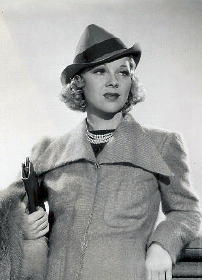
   Actually, I do know what the appeal is for these movies. It’s Torchy herself, or rather Glenda Farrell who plays her: fast-talking and fast-thinking, brassy without being bold, funny and wisecracking, but her mind on only one thing, her story. The photo of her that you see above didn’t come from this movie. I couldn’t find any, I’m sorry to say, but I thought this publicity still would do fairly well in its place.

   After Vince Keenan and I finished our email conversation on Mike Shayne and the actors who have played him over the years, I didn’t think it was going to take long for Vince to go through all four films on the first DVD set, once I knew they were in his hands, and I was right. Even though not especially looking the part, Lloyd Nolan was very impressive in the role, he says, making me all the more anxious for my copies to get here in the mail.

   I’ll have to send you over to his blog, though, but it’s only a click away and it’s well worth the trip.

   Vince also sent me an email about the Mike Shayne radio show I set up a link to. His response:  “I listened to the Shayne radio show and enjoyed it quite a bit. Jeff Chandler may look nothing like that portrait of Shayne, but he’s got the attitude down pat. And that ending — what a corker!”

    Given that kind of reaction, I figured I ought to do something about it. If you go this OTR Archives page, you will find links to around 30 or 35 of them. Just click and play, or download and burn to CDs if you wish. I haven’t listened to the sound quality of all of these, but the higher the Kbps, the better, I think — try those in the column furthest to the right first. Jeff Chandler’s the star in all but the first one (from 1946) and the last (from 1953).

KENDALL FOSTER CROSSEN – The Tortured Path

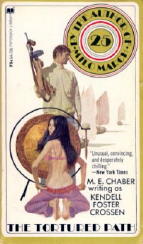
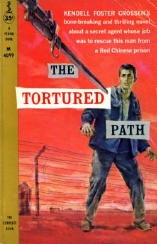
Permabook M4099; paperback reprint, June 1958. Hardcover edition: E. P. Dutton, June 1957. One chapter appeared earlier in Stag Magazine under the title “The Treatment.” Later paperback edition: Paperback Library 64-706, 1971, as by “M. E. Chaber writing as Kendall Foster Crossen.”

   That last byline is rather strange, if you think about it. Kendall Foster Crossen was the author’s real name, and M. E. Chaber was the name he used to write his “Milo March” novels. Paperback Library had been publishing these in uniform editions, all with hugely attractive covers by Robert McGinnis. They must have done well with them, because they when they ran out of Milo March’s adventures to print, to capitalize on Chaber’s popularity, they started doing some of Crossen’s other work in the same numbered format, including this one and several he wrote as by Christopher Monig.

Tortured1

   Milo March was basically an insurance investigator, but he also had connections with the CIA, and his adventures took him all over the world. [For more on March, check out his page on the Thrilling Detective website.]

   Major Kim Locke, the primary protagonist in The Tortured Path, had even more direct connections with the CIA, and I’ll go into the details in a minute. First, though, here’s a list of the books he appeared in, taken from Crime Fiction IV, by Allen J. Hubin:

LOCKE, MAJOR KIM
      * Kendell Foster Crossen:
         o The Tortured Path (n.) Dutton 1957 [China]
         o The Big Dive (n.) Dutton 1959 [England]
      * Clay Richards:
         o The Gentle Assassin (n.) Bobbs-Merrill 1964 [Cuba]

   Why the switch in bylines, I don’t know, but it may have had something to do with the switch in publishers. The Big Dive is scarce; it was never reprinted in paperback, and at the moment, there are only two copies of the hardcover edition offered for sale on the Internet. While The Gentle Assassin never had a paperback edition either, it is fairly common in hardcover. It’s also easily available in a three-in-one Detective Book Club edition.

   Here are the first couple of paragraphs from The Tortured Path, which will give you more information about Major Locke’s background. It will also supply you with a glimpse of the author’s writing style, or so it’s my intention:

    “It started out like any other day in Washington. I’d been cooling my heels there for three months. I was theoretically on duty but I hadn’t anything to do for that length of time. The first month was fine, but then I began to get a little tired of it. I didn’t have an assignment, but I was supposed to check in three times a day. After three months, just checking in was beginning to interfere with my drinking. One thing you can say about Washington – the hunting in the cocktail bars was fine.

    “The name is Kim Locke. Major, U. S. Army, permanently attached to the Central Intelligence Agency. Cloak and dagger stuff. But the only cloak I’d ever seen was worn by a blond adagio dancer and the only time I’d been near a dagger was when I was in the OSS during World War Two. There’d been a Yugoslavian partisan who had a dagger; we’d used it to slice the chickens we caught at night and roasted in coals. So it wasn’t like in the books; no willing broads willing to do anything to get your secrets. But it was a living – if you can call being in the Army living.”

Tortured2

   His assignment? To get himself caught by the Chinese Communists, be brainwashed and undergo any other form of torture they might devise for him, and then rescue an American officer who has secrets that mustn’t fall into enemy hands.

   Which he does. End of book. Well, not quite, but almost. Getting in is far too easy, getting out is another matter, sort of the scorched-earth approach, if you ask me, crude but effective. Crossen has a quiet, breezy style of story-telling, beginning (as you will have seen) with page one onward. The resulting adventure is readable in about a night or two. It is also largely forgettable in about the same length of time.

January 2007

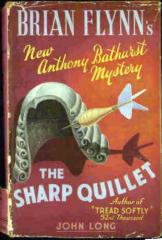
BRIAN FLYNN – The Sharp Quillet. John Long, hardcover, no date stated (1947). No US edition.

   You’ll have to fasten your seatbelts, because I’m going to begin this review with a list of Brian Flynn’s mysteries, and it’s going to be a long one. Taken from Crime Fiction IV, by Allen J. Hubin, these are the British titles only. Most of these were published only in England, but those preceded by (**) did have US editions.

   The detective in every one of these works of crime fiction is a chap named Anthony Bathurst, and since he’s in the book at hand, there will be more about him in a minute. At the present time, there’s no year of death given for his author, Brian Flynn, and I’ll ask a couple of people what they might know about that. First, though, the list of titles:

FLYNN, BRIAN (1885- ) An accountant in government service, a lecturer in Elocution and Speech, an amateur actor.

** The Billiard-Room Mystery (n.) Hamilton 1927.
** The Case of the Black Twenty-Two (n.) Hamilton 1928.
** The Mystery of the Peacock’s Eye (n.) Hamilton 1928.
** The Five Red Fingers (n.) Long 1929.
* Invisible Death (n.) Hamilton 1929.
** The Murders Near Mapleton (n.) Hamilton 1929.
** The Creeping Jenny Mystery (n.) Long 1930.
** Murder En Route (n.) Long 1930.
* The Orange Axe (n.) Long 1931.
* The Triple Bite (n.) Long 1931.
* The Edge of Terror (n.) Long 1932.
* The Padded Door (n.) Long 1932.
* The Spiked Lion (n.) Long 1933.
** The Case of the Purple Calf (n.) Long 1934.
* The Horn (n.) Long 1934.
* The League of Matthias (n.) Long 1934.
* Tragedy at Trinket (n.) Nelson 1934.
* The Sussex Cuckoo (n.) Long 1935.
** Fear and Trembling (n.) Long 1936.
* The Fortescue Candle (n.) Long 1936.
** Tread Softly (n.) Long 1937.
* Cold Evil (n.) Long 1938.
* The Ebony Stag (n.) Long 1938.
** Black Edged (n.) Long 1939.
* The Case of the Faithful Heart (n.) Long 1939.
* The Case of the Painted Ladies (n.) Long 1940.
* They Never Came Back (n.) Long 1940.
* Such Bright Disguises (n.) Long 1941.
* Glittering Prizes (n.) Long 1942.
* Reverse the Charges (n.) Long 1943.
* The Grim Maiden (n.) Long 1944.
* The Case of Elymas the Sorcerer (n.) Long 1945.
* Conspiracy at Angel (n.) Long 1947.
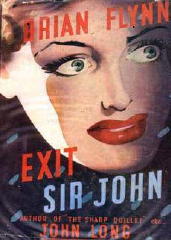
* Exit Sir John (n.) Long 1947.


* The Sharp Quillet (n.) Long 1947.
* The Swinging Death (n.) Long 1948.
* Men for Pieces (n.) Long 1949.
* Black Agent (n.) Long 1950.
* And Cauldron Bubble (n.) Long 1951.
* Where There Was Smoke (n.) Long 1951.
* The Ring of Innocent (n.) Long 1952.
* The Running Nun (n.) Long 1952.
* The Seventh Sign (n.) Long 1952.
* Out of the Dusk (n.) Long 1953.
* The Doll’s Done Dancing (n.) Long 1954.
* The Feet of Death (n.) Long 1954.
* The Mirador Collection (n.) Long 1955.
* The Shaking Spear (n.) Long 1955.
* The Dice Are Dark (n.) Long 1956.
* The Toy Lamb (n.) Long 1956.
* The Hands of Justice (n.) Long 1957.
* The Wife Who Disappeared (n.) Long 1957.
* The Nine Cuts (n.) Long 1958.
* The Saints Are Sinister (n.) Long 1958.

   It certainly isn’t likely to mean anything, but Mr. Flynn didn’t do anything like slow down toward the end of his writing career, did he? Sixteen books between 1951 and 1958, after reaching the age of 66. One might guess that he’d retired from his day job (see above).

   Heading off to see what Google says, with the author having such a common name, it was quickly discovered that any kind of effective search was going to have to be done on Bathurst the character, rather than Brian Flynn the author. And — there’s nothing to be found. All that comes up are books by Flynn for sale from various dealers’ catalogues. Other than what Al Hubin has provided for him in his entry in CFIV, there’s not a single website providing information on either author or character to be found, not one citation, nothing. (That’s about to change, however, isn’t it?)

   Obviously Brian Flynn was no rival to Agatha Christie, but why has he so drastically dropped out of sight? Were his books so indifferently or badly written? On the basis of one example, I’d say no, but on the basis of the very same example, I’d have to agree (if asked) that the style of story is outdated, or at least its ending is. The detective work is essentially sound, although the reader is not made privy to all that Anthony Bathurst knows.

   And I see that I’m writing this review wrong end to, and so to right this wrong, let me jump back to the prologue, in which a defendant in court is sentenced to die (and does), but so does the entire jury, all twelve individuals, wiped out in a rocket bomb attack and preceding the defendant to death. I don’t think I’ve ever read that in a book before!

   At some length of time later, more deaths begin occurring, the first being that of Nicholas Flagon, a justice on the panel that denied the appeal of the defendant in the prologue. Which is why I so strongly dislike prologues, if I may bring this small rant out into the open one more time. I hate knowing facts and information that the detectives on the case do not have. I don’t enjoy it, I don’t like watching bright policeman and even brighter private detectives work their way through investigations on a case that doesn’t really begin (for me) until they’ve caught up to where I already am, due to the wisdom imparted to me when I didn’t really want it.

   End of rant. Dr. Harradine and the local Inspector, a man named Catchpole, are the first on the scene. Tied around the shaft of the dart that has just killed its victim is a slip of paper that says, “A nice sharp quillet. Ay!”

   Off to the dictionary go I, and wouldn’t you? A quillet is not a small pen, as suggested on page 30, but: “An evasion. In French ‘pleadings’ each separate allegation in the plaintiff’s charge, and every distinct plea in the defendant’s answer used to begin with qu’il est; whence our quillet, to signify a false charge, or an evasive answer.” Emphasis on “a false charge.”

   The policemen on the case, and Anthony Bathurst, do not get back to this point until page 111, so OK, I did some investigating on my own and learned something before they did. I’m not contradicting myself, in terms of what I said about prologues just moments before. I think that this is acceptable, isn’t it?

   As for Anthony Lotherington Bathurst, he enters the scene on page 50, when he’s asked by Commissioner Kemble of Scotland Yard to add his expertise to the men on the ground (so to speak) where the victim was killed, their efforts seemingly going nowhere. Bathurst agrees — there’s nothing like a good solid case of mystery to work on — and together with Chief Detective-Inspector MacMorran he makes his way to the otherwise sleepy village of Quiddington St. Phillip, just in time for another death to have occurred.

   From this you may thinking that Bathurst is just another policeman highly regarded for solving crimes, but he is not. He’s a private detective. PI’s in the US have seldom had this kind of respect for their abilities as those who plied their trade in England. Perhaps Bathurst should be called a private inquiry agent, along the lines of a Sherlock Holmes. The name of the profession makes all of the difference in the world.

   By page 113 Bathurst has decided that he knows who the killer is, but (of course) he has no proof. On page 174 he explains, but he fudges a little, in my opinion, for back on page 113, as he relates it later, all he had were the same four suspects that the reader had, with only a high probability as to which of the four it was likely to be.

   Coming in between is a matter of filling in of the details, plus a long stretch of about 25 pages’ worth of unadulterated thriller-like behavior in which the next projected victim of the killer must be protected and the reader (literally) comes along only for the ride. Which is to say that if the reader were kept informed of what is happening, he (or she) would also know who it was the victim is being protected against.

   If that makes any sense at all. In any case, everything works out fine, and handshakes all around are the order of day. While Flynn was no rival to Christie or any of the other names you’re a lot more familiar with, in my opinion neither does he deserve to be forgotten. There are some scenes in this book, well-described, that will linger in memory for a while, including the prologue, and yes, I’d read another adventure of Mr. Bathurst at any place and time that you say, other than the break of dawn.

— January 2007

 Hi Steve —

   Just wanted to thank you for your recent M*F post about the Michael Shayne movies coming to DVD this week. The photos of all the actors who played the part are much appreciated, as is your support for my Kenneth Tobey idea. If only … As for the Sleepers West/Sleepers East business, your guess is as good as mine. I look forward to your reviews of the films.

Best,

   Vince

www.VinceKeenan.com
Pop culture, high and low, past and present.
One day at a time.

***

 Vince

   I don’t know if you’d agree that the portrait of Shayne on the paperback covers is definitive, but since those are the Shayne’s that I read back when I was reading them, that’s the image that comes to mind when I think of Mike Shayne.

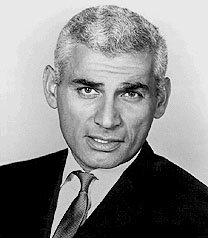
   But, and it’s a big “but,” Jeff Chandler played Michael Shayne for a couple of years on the radio. Maybe I should do a follow-up and include his picture? Or not, since nobody ever saw this face in the role … ???

Best

   Steve

Chandler

 Steve,

   I suppose I do think of that portrait of Shayne as definitive. It’s on the cover of every one of the novels I’ve ever read, and it’s featured prominently on all of the websites devoted to the character. Not that that necessarily means anything. A big reason why Kenneth Tobey struck me as perfect for the role is that he has red hair — which, of course, you couldn’t see in black-and-white.

   Or on the radio, for that matter. Jeff Chandler still doesn’t strike me as quite right, either, but then I suppose I should listen to an episode or two of the show before deciding. Have you heard any of them? That is a great photo of Chandler …

   I picked up the Shayne discs yesterday. Fox has put a dandy package together. Nice extras throughout. Last night I watched the first film in the series as well as a 17-minute feature on the history of the character. I feel bad that I ever implied anything negative about Lloyd Nolan, because he’s dynamite in the part. It’s not the Mike Shayne from the books — he’s more of a generic big-city P.I. — but Nolan fills out the role beautifully. I think this series will be rightly reevaluated in the wake of this release.

Best,

   Vince

***

 Vince

   You asked and so here it is — a link to a Michael Shayne radio show with Jeff Chandler. This one’s from July 22, 1948, if the source I got it from is correct. The series is called The New Adventures of Michael Shayne, and was on the Mutual network from 1948 to 1950. An earlier series with Wally Maher as the star was on ABC between 1944 and 1947, and there was a later one on ABC again for the 1952-53 season. The star was Donald Curtis, or so I’m told, replaced by Robert Sterling.

   The episode that the link leads to is #5 in the Jeff Chandler series, titled “The Case of the Hunted Bride.” In my opinion this was one of the better PI shows on the radio, and I think Chandler was very effective in the part. Whether he’s “Mike Shayne” or not is a whole other kettle of fish.

   As for Lloyd Nolan, after your comments, I’m all the more anxious to get my set in the mail. If I’ve seen any of these Shayne films, it hasn’t been for 50 years, so who remembers?

Best

   Steve

***

 Steve,

   …As you might have guessed, I’ll be writing up a more in-depth look at the DVD set once I’ve watched all four films. At this rate, it will probably be sometime this weekend.

Best,

   Vince

***


    — And that’s it from here. Be sure to be looking for more of Vince’s comments on the Mike Shayne films — not here, but over on his own website. I’ll keep you posted. — Steve

   After posting my comments on Charles Einstein after his death, I mentioned to Bill Pronzini that as I remembered it, he was the one who’d told me to read Einstein’s first crime novel, The Bloody Spur. We’re speaking 30 to 35 years ago, mind you. Here’s Bill’s reply:

   Re Charles Einstein: I may in fact have recommended The Bloody Spur to you; I’ve been known to champion it. Really excellent novel made into an equally excellent film. Nowhere to Run, the film made from Blackjack Hijack, is surprisingly good for a made-for-TV flick; Marcia and I watched it recently and were impressed by the quality of the script, the depth of characterization, and the performances. David Janssen, in one of his last films, is outstanding.

   Re the Mike Shayne movies: I have a VHS tape of The Man Who Wouldn’t Die. Haven’t watched it a while, but as I recall, the story is only loosely based on Rawson’s No Coffin for a Corpse, using some of the novel’s trappings and plot elements but not the clever “impossible” gimmick. It’s not among the best of the celluloid Shaynes: too talky, too wisecracky and silly, though it does have some effective H’wood atmospherics (howling storm, weird old house, grave-digging in the dead of night, etc.) “Gus, the Great Merlini” does indeed make a brief appearance; the character runs a magic shop that Shayne visits for information.

Best,

    Bill

   Jiro Kimura, who has now owned and operated The Gumshoe Site for 11 years, reports that legal-thriller writer Lelia Kelly lost a long battle with breast cancer on March 13th. She was only 48.

   According to information on her website, Ms. Kelly, a banker for 15 years, left the world of finance in 1998 and turned to writing instead. Her first two books are included in Crime Fiction IV: 1749-2000, by Allen J. Hubin. A third title has since been added to her bibliography, all in her Atlanta-based Laura Chastain series:

KELLY, LELIA (1958-2007)
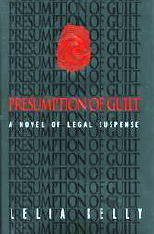
      * * Presumption of Guilt (NYC & London: Kensington, 1998, hc)
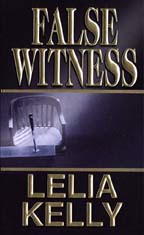
      * * False Witness (Kensington, 2000, hc)
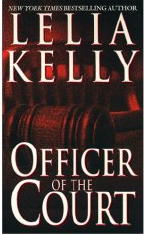
      * * Officer of the Court (Kensington, 2001, pbo)

   In her first appearance, Presumption of Guilt, Laura Chastain is a senior associate at a prestigious Atlanta law firm, but when the situation arises, she is surprised to discover she is good at criminal defense work, which is far from being a specialty of the firm.

Guilt

   According to the Booklist review of the book: “After she successfully defends the son of a corporate client against highly publicized rape charges, an Atlanta policeman strolls into her office, asking for help with charges that he killed a suspected child molester in custody at a police station. Despite management’s misgivings, Laura’s supervisor, poetry-spouting Tom Bailey, supports her desire to take the tabloid-ready, racially divisive brutality case.”

   By the time False Witness appeared, Laura had become an assistant DA, giving up her former (and much higher paying) position. Publishers Weekly described the story thusly: “Wealthy Christine Stanley has been murdered in her upscale Atlanta residence, leaving behind two shocked and bewildered children. Suspicion falls upon her husband, financial manager James T. Stanley, even though his alibi seems airtight (he was out of town on business).” Laura is also said to have a “a sweet, low-key romance.”

Witness

   In Officer of the Court, according to one reviewer on Amazon.com: “Lelia Kelly’s heroine once more surprises the reader by not following any pre-established rules of the game as a prosecutor. Kelly presents the interesting point of view, of what a prosecutor faces, when he/she knows the person on trial is really innocent of the crime. Chastain follows her own moral code, and not necessarily what the law, or the pattern of activities we have allowed to surround the law, dictates.” As of this date, all six reviewers on Amazon have given the book the maximum five stars out of five.

Court

   A fourth book was promised, but in a letter she posted on her website in October 2002, Ms. Kelly saddened her readers by saying that her cancer had returned. There would be a wait, she said, before Laura’s next case could be told. Sadly, it appears that the next chapter was not to be.

« Previous PageNext Page »