Characters


THE BAT, by Mary Roberts Rinehart


   Mary Roberts Rinehart’s character called “The Bat” appeared in many formats over the years. Not only did “The Bat” make a lasting impression and appear in many venues, but Bob Kane, creator of the second most famous comic book character, the Batman, has been quoted as saying that the inspiration for his hero came from “actor Douglas Fairbanks’ movie portrayal of Zorro, and author Mary Rinehart’s mysterious villain ‘The Bat.’”

The Bat

   This post has been put together from a variety of sources, the first being Michael Grost’s Classic Mystery and Detection website, from which is gleaned the following information about the early career of mystery author Mary Roberts Rinehart:

      The Early Novels 1904-1908

   The career of Mary Roberts Rinehart (1876-1957) can be broken up into a series of phases. The first was her pulp period (1904-1908), where she wrote her first three mystery novels and a mountain of very short stories. These stories have never been collected in book form, and are inaccessible today. The first two novels are classics, however, and are probably her best works in the novel form.

   The Man in Lower Ten (1906) and The Circular Staircase (1907) are the earliest works by any American author to be still in print as works of entertainment, not as “classics” or “literature.” These novels, which combine mystery and adventure, show Rinehart’s tremendously vivid powers as a storyteller.

   From the same page, but skipping over a few sections:

      The Bat

The Bat is a stage adaptation of Rinehart’s The Circular Staircase, written in collaboration with Avery Hopwood, the writer of popular Broadway comedies with whom Rinehart had collaborated before. The Bat introduced some new plot complexities into the original novel, especially a master criminal known as “The Bat.” It also includes plot elements reminiscent of her first Saturday Evening Post story, “The Borrowed House” (1909). The Bat shows Rinehart at the height of her powers, and in fact is her greatest work. A work of great formal complexity, The Bat is one of the few mystery stage plays to have the dense plotting of a Golden Age detective novel. Moreover, the formal properties of the stage medium are completely interwoven with the mystery plot, to form intricate, beautiful patterns of plot and staging of dazzling complexity.

   According to the online Broadway database, The Bat ran for 867 performances between August 23, 1920 and September 1922.

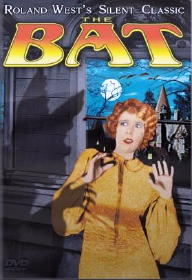
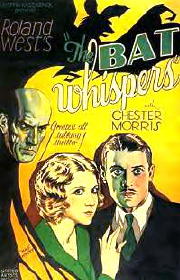
   Film director Roland West next made two versions of the play, a silent film The Bat (1926), and a sound film The Bat Whispers (1930).

   Following the links will lead you to the IMDB pages for each.

Silent

   His discussion is far too lengthy to repeat here, but Mike Grost goes into considerable detail in discussing director Roland West’s cinematic techniques in both of these movies, plus a number of his other films. If you’re interested in the early days of movie making, Mike’s website once again is well worth the visit.

   Returning to the play itself, Mike continues by saying:

   Rinehart and Hopwood’s play can be found in the anthology Famous Plays of Crime and Detection (1946), edited by Van H. Cartmell and Bennett Cerf, along with other outstanding plays of its era. (This book also contains good plays by Roi Cooper Megrue, Elmer Rice, George M. Cohan, and John Willard.) In 1926, a novelization of The Bat appeared, apparently written by poet Stephen Vincent Benét with little input from Rinehart. This novel version usually appears in paperback under Rinehart’s name, without any mention of Hopwood or Benét. I read this novelized version first, and confess I prefer it to the script of the play itself.

   It should also be noted that the play itself was later published by French, in a 1932 softcover edition.

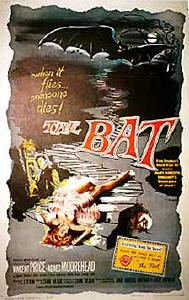
   In 1959 The Bat was once again made into a film, this one starring Vincent Price and Agnes Morehead. Of this version, one viewer says: “I found this to be an inventive and disingenuous endeavor full of red-herrings and wrong turns. Figure this one out for yourself. Puzzle the clues, weed out the characters set here as distractions, look past the deliberate contrivances and solve the mystery on your own.”

Poster

   By total coincidence, the way coincidences happen, as I was in the process of tracking down the details of all these various incarnations of the character, author Mary Reed sent me the following review of The Bat, the novel based on the play. I think it’s great when a plan comes together like this.

      Review of THE BAT: The Novel, by Mary Reed

   Everyone in the city, from millionaires to the shady citizens of the underworld, goes in fear of The Bat, a cold-blooded loner whose crimes range from jewel theft to murder and whose calling card is a drawing or some other form of expression of bathood.

   We meet wealthy, elderly, and independent spinster Miss Cornelia Van Gorder, scion of a noble family and the last of the line. An adventurous spirit, at 65 and comfortably situated, she still longs for a bit of an adventure. It maddens her to think of the sensational experiences she is missing as she contemplates that “…out in the world people were murdering and robbing each other, floating over Niagara Falls in barrels, rescuing children from burning houses, taming tigers, going to Africa to hunt gorillas, doing all sorts of exciting things!” Why, she’d love to have a stab at catching The Bat!

   Her wish is granted when she takes a house in the country for the summer and discovers it is located some twenty miles from an area where The Bat had committed three crimes. She is soon in the thick of mysterious events, including anonymous threatening letters, lights failing, a face at the window, and Lizzie Allen, her personal maid for decades, convinced she saw a strange man on the stairs. Most of the servants decamp, leaving Miss Van Gorder to manage with just a butler and Lizzie.

   More characters appear: Miss Van Gorder’s niece Dale Ogden, Brooks, the new gardener, local medical man Dr Wells, Detective Anderson, and Richard Fleming, nephew of Courtleigh Fleming, deceased owner of the house and once president of a bank which has just failed. There is talk Mr Bailey, its cashier, has stolen over a million dollars. A man is shot and an unknown party is deduced to be hiding somewhere on the rambling premises. More than one person in the house is concealing facts, and the rising storm outside underlines the increasing fear and tension within.

   Who is trying to scare Miss Van Gorder away and why? What if anything did Lizzie see on the staircase? Are any of the strange goings-on connected with the missing money? Who fired the shot? There is much flitting in and out of the doors and windows of a living room lit most of the time only by candle and firelight before everything is cleared up.

   The Bat is an excellent example of an old dark house mystery, with enough obfuscation to keep the reader guessing, although one or two surprises are less well concealed. The menacing atmosphere events create in the house is conveyed and sustained well. I found it a light, diverting read which held the interest without taxing the attention too much. The Bat is an excellent cold-night-outside read, and indeed, although I know whodunit, I would not mind seeing the play!

The Bat

   Etext at http://www.gutenberg.org/dirs/etext00/thbat10.txt

   Vince Keenan, my mystical master in all matters movie-wise, recently mentioned on his blog a soon-to-released boxed set of DVDs that is simply said, a must-not-miss. Available on March 20th is a boxed set of four Michael Shayne films from the forties that I have not seen in a long, long time, if ever.

   All four of them star Lloyd Nolan, whom you’d never go too far wrong by casting him as a semi-down-on-his heels private eye, but as Vince says, the perfect fellow would have been Ken Tobey.

   Contained in this set are:

Michael Shayne, Private Detective. 1940. This is one of the very few Mike Shayne movies that was actually based on a Mike Shayne novel. I’ve not checked to see how many of the rest of them were, but in this case it was Dividend on Death (Holt, 1939). [Note that Crime Fiction IV is in error on this point, and a statement to that effect has been made in the online Addenda to the Revised Edition, Part 12.]

The Man Who Wouldn’t Die.
1942. Credit is given to the Brett Halliday characters, but the novel it’s based on was Clayton Rawson’s No Coffin for the Corpse, a classic Great Merlini “locked room” mystery. Having never seen this film, and I’m very eager to, I don’t know how much of the plot line has been preserved, but for what it’s worth, way down in the IMBD credits is Charles Irwin as “Gus, the Great Merlini” (uncredited).

Sleepers West.
1941. This one’s based on Frederick Nebel’s mystery novel, Sleepers East. I don’t know. You tell me.

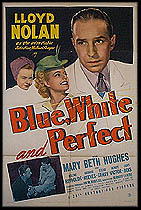
Poster

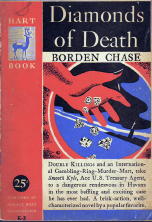
Blue, White and Perfect. 1942. Credit for the characters was once again given to Brett Halliday, but the story the movie’s based on was actually written by Borden Chase. It didn’t appear in book form until it came out as a 1947 digest paperback entitled Diamonds of Death (Hart K-2). The first appearance of the story was probably as a serial in one of the pulp fiction magazines in the 1930s.

Hart K2

   As much as I’d like to, I can’t review the movies now, but the odds are that I will, as soon as I’m able. Let’s go back to Vince’s comment that the perfect gent to play Michael Shayne would be Ken Tobey. (Looking back, I see that I’ve been assuming all along that you know who Mike Shayne is, and who Brett Halliday was. I didn’t intend to go into it here, and I won’t, but what I will do to send you to Kevin Burton Smith’s Thrilling Detective PI site, and trust to your good judgment to come back. It’s a gamble on my part, because I know from experience that you could easily get lost and spend days on end there, if you’re not careful.)

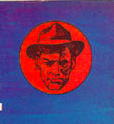
   Here’s a picture of Mike Shayne that was used on the covers of tons of 1950s Dell paperbacks. I’m not sure, but I suspect that the artist responsible was Robert Stanley. I’m sorry that it’s rather small, but it was only used in the corner of the covers.

Cover

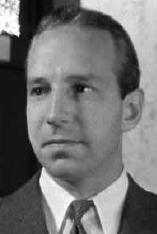
   Now here’s one of Lloyd Nolan. I can’t at the moment guarantee that this comes from one of the Mike Shayne movies, but I think it does. It’s the right vintage, at least:

Nolan

   Maybe he needs a hat and a cigarette drooping out of his lip, but I don’t see a resemblance.

   Here’s one of Hugh Beaumont. Before he became famous as Beaver’s dad, Hugh Beaumont remained fairly non-famous by playing the part of Mike Shayne in five films cranked out for PRC between 1946 and 1947. (Will these show up on DVD some day?)

Beaumont

   He isn’t bad, but it’s tough to tell, since all we see in this photo is his profile, but if you think about the Beaver’s show, and think Mike Shayne, do you get the same disconnect that I do?

   Mike Shayne was also the star of aTV show for one season on NBC, 1960-61. I was away at school then, and didn’t have time for TV, so I never saw it. I believe some of the shows are available on DVD, and if so, that’s one more item I’ll have to addto my next Amazon purchase. I also just realized that I didn’t mention that Richard Denning was the star. Here’s his likeness:

Denning

   Do you know what? As the years went on, I think the producers and the casting personnel were getting closer.

   Vince said Kenneth Tobey was the man, though, and I’m in full agreement. What do you think?

Tobey


[UPDATE] 03-19-07. A few typos have been corrected in the essay above, and several questions of a bibliographic nature have been answered, requiring a bit of revising here and there. This is now (um) the current version. Thanks again to Vince Keenan for allowing me to play on his ground.

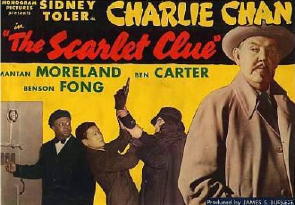
THE SCARLET CLUE. Monogram, 1945. Sidney Toler, Mantan Moreland, Benson Fong, Virginia Brissac, Ben Carter, Janet Shaw, I. Stanford Jolley [uncredited]. Director: Phil Rosen.

Tommy Chan: You know Pop, I’ve got an idea about this case.
Charlie Chan: Yes, well?
Tommy Chan: Well, I had an idea, but it’s gone now.
Charlie Chan: Possibly could not stand solitary confinement.

   My brother and I used to watch these Monogram entries in the Charlie Chan series on television every Friday night when we were kids, and we sure got a hoot out of them — even, I’m sure, the earlier ones with Warner Oland as well. We had to keep the sound down, since our parents were sleeping in the downstairs bedroom then, so we sat as close to the screen as we could, and enjoyed the heck out of staying up late, because it didn’t happen often.

   The funny thing is, I don’t remember any of them, only some general impressions. The crimes, the oddly stiff Sidney Toler, the interchangeable actors who played the number two or number three sons, and we wondered why Birmingham Brown (Mantan Moreland) wasn’t in all of them.

Poster

   A major clue in this one is a bloody footprint found at the murder that occurs in the opening scene. The plot has something to do some radar plans that foreign agents want to steal, but because the scientific laboratory is in the same building, most of the action centers around a radio station where a relatively bad soap opera production has their on-the-air studio. (When Charlie visits the lab and is shown a wind tunnel with temperature and wind effects, we know immediately that the this same wind tunnel is going to play a large part of what happens later on. We are correct.)

    The detection is minimal. I was steered to the most obvious guilty suspect as being the killer, but I didn’t have my head screwed on too carefully, I’m afraid. There are spies, stooges, blackmailers, and people in funny masks, enough to keep your eye off the fact that, as one obvious question among others, how was the elevator with its deadly surprise constructed? It must have been quite a feat, especially with nobody noticing.

   I mentioned Mantan Moreland, the black comedian who later on got a bad rap, or so I’m told, for playing such broad comic relief in movies like this one. Actually, I think that he and Tommy Chan have more screen time than does Mr. Chan himself, and never a serious part of the investigation are they ever. (One wonders why a great detective like Mr. Chan would put up with … but, oh well, never mind.)

    Moreland and fellow comedian Ben Carter do a couple of great turns in an old vaudeville bit called the “infinite” routine, wherein both men carry on a conversation something like this, with neither one ever quite completing all of their sentences:

    “Why if it isn’t …”

    “Yes, and I haven’t seen you since …”

    “No, it was longer than that. Last time I saw you, you were …”

    “Well, I’ve lost weight! And you lived in …”

    “No, I’ve moved to …”

    “That’s a bad neighborhood. How can you live there?”

      and so on, and so on …

   Afterward, a thoroughly befuddled Tommy Chan asks, “Who was that?”

   Birmingham’s answer: “He didn’t say.”

   Well, my brother and I thought it was funny. We also woke our parents up and we were sent to bed.

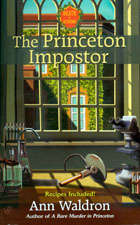
ANN WALDRON – The Princeton Imposter

Berkley, paperback original. First printing, January 2007

   This is the fifth mystery novel from Ann Waldron’s pen, all of them in her McLeod Dulaney series. According to her website, she’s also the author of a number of well-regarded biographies and a number of children’s books, both fiction and non.

   Like her fictional character – who’s female, by the way, which I’d better add in case you’re seeing her name for the first time and you’re not sure – Ann Waldron has been a journalist and writer her entire working career. For the record, here’s the list of all five of her mysteries, each of them taking place in and around Princeton University:

The Princeton Murders. Berkley, pbo; January 2003.
Death of a Princeton President. Berkley, pbo; February 2004.
Unholy Death in Princeton. Berkley, pbo; March 2005.
A Rare Murder in Princeton. Berkley, pbo; April 2006.
The Princeton Imposter. Berkley, pbo; January 2007.

   I imagine you see the pattern here as well as I do. Whenever McLeod Dulaney is on campus, that’s the semester you should be heading abroad or taking a sabbatical. McLeod herself is not a full-time faculty member; she’s an award-winning journalist and a visiting professor from Florida who teaches one course in journalism a year at Princeton University. Not so coincidentally, that is precisely where the author herself began working more than 30 years ago.

Imposter

   Which is why the love of the school and campus – the students, the staff and the professors, the legend and the lore – is as much of a key ingredient of the story as it is. The “imposter” in the title is Greg Pierre, one of McLeod’s better students, an older student who managed to gain admission to the university under an assumed name and falsified credentials. It seems that he’d previously been arrested in Wyoming – on false charges he says – and in order to come to New Jersey, he had to break parole.

   And soon after his arrest the fellow who turned him in is found murdered, a grad student in the chemistry department who (as it turns out) was highly unliked for a number of reasons, which makes for a long list of suspects. But when McLeod’s good friend in the police department, Lt. Nick Perry, seems to settle in on Pierre as the most likely of them – no surprise there – she thinks otherwise, and she sets out to prove it.

   Waldron writes in short, crisp, no-nonsense sentences, and McLeod Dulaney, in a number of ways her fictional alter ego, perhaps, conducts her investigation in very much the same style. Investigative journalists, by the nature of their profession, soon acquire the knack of asking questions in a way that people answering them sometimes reveal more than they intended, or if not, they quickly find another line of work. McLeod doesn’t need to worry on that account.

   On the other hand, while she does a whole lot of detecting, she does not do a whole lot of deducting. (One does not necessarily imply the other.) First she decides that this student is the guilty party, then that professor, and as a result, she always seems to be one step behind – she doesn’t ever seem to catch up. Which of course leads to the ending. In my book, it comes as a letdown, leaving the reader (me) feel caught standing on the wrong foot at the wrong time, or should that be the right time? It also feels cluttered — more for dramatic effect, I thought, than for any other reason.

   Overall, then? Here’s a book that’s well worth reading for anyone who’s fond of mysteries which either take place in academic locales or rank well above average in the writing department, or both. You can take my other caveat for whatever it might be worth.

— January 2007

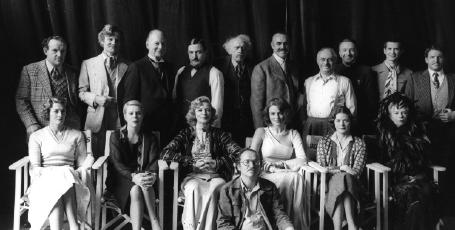
MURDER ON THE ORIENT EXPRESS. Paramount, 1974. Albert Finney, Lauren Bacall, Martin Balsam, Ingrid Bergman, Jacqueline Bisset, Jean-Pierre Cassel, Sean Connery, John Gielgud, Wendy Hiller, Anthony Perkins, Denis Quilley, Vanessa Redgrave, Rachel Roberts, Richard Widmark, Michael York, George Coulouris. Directed by Sidney Lumet.

Group

   They don’t make movies with all-star casts like this anymore, and maybe for a couple of good reasons. First of all, I don’t think you can convince me that in this modern, contemporary era of movie-making there are enough stars with the on-screen magnitude to match the ones you see above to make a film like this today.

   And secondly — and here’s a point in favor of the small-scale modern day casting — having too many stars can sometimes detract from the story and divert the audience’s attention away from it.

   Your eye sees the star, in other words, and you don’t see the character. The actors play roles rather than disappearing into parts. It probably can’t be helped in extravaganzas like this, but — and this is a rather subtle “but” — in thinking it over afterward, in terms of this grand, elaborate production of one of Agatha Christie’s masterpieces of deductive detective fiction, it may have even helped.

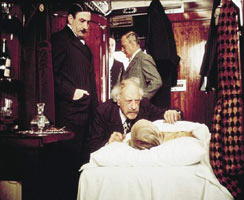
Still

   I’m sorry if I’m being cryptic here, but if you’ve seen the movie, it’s possible that you very well know what I mean.

   Before going on, and perhaps I shouldn’t admit it, but last night was the first time I’ve seen the film. I don’t know how I missed it when it first came out, or if I did, I’ve forgotten it completely, and I hardly believe I could have done that.

   So in what follows, you’re getting my opinion as it’s just been formed, with a “mature” eye, and not by the eye of a 30-something. (Notice that I put “mature” in quotes, keeping in mind that being old enough to collect Social Security does not necessarily imply mature.)

   Albert Finney as Poirot. Other than the later BBC productions with David Suchet, and I regret to say that I have seen only one of them, I think too many actors play Poirot as a comic character, what with his large assortment of eccentric mannerisms and sometimes faulty English.

   In the opening minutes of Orient Express, I could feel myself cringing at the anticipation of yet another performance played for laughs, but when Poirot gets down the business of solving the murder of a notorious crime figure traveling incognito on the train heading from Istanbul to England, he is exactly that. Down to business.

   The final scene, confronting the group of passengers who are the only suspects on the snowbound Express, takes at least 20 minutes of intense revelation, going over the clues and the deductions the Belgian detective made from them.

   I should have timed how long the scene actually takes. I know that I’ve read somewhere that filming the scene, in the restricted confines of the dining car, took several days. I can believe it.

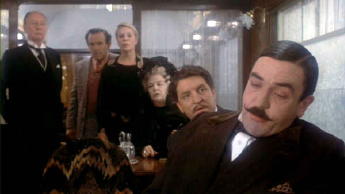
Still2

   Luckily the flashback scenes, with the crime being reconstructed, piece by piece, break up the sequence of talking heads in a rhythm that slowly builds and builds upon itself.

   Even so, the lack of action that this approach entails means that there’s hardly action enough to suit modern day audiences, or am I only being cynical again?

   Finney is probably the only actor to play a detective concerned with clues and not the third-degree in back rooms to have been nominated for an Oscar, but on second thought, without going to check on it, there’s a finite chance that I’m wrong about that.

   But as for his performance, as regarded by others, according to IMDB: “An 84-year-old Agatha Christie attended the movie premiere in November of 1974. It was the only film adaptation in her lifetime that she was completely satisfied with. In particular, she felt that Albert Finney’s performance came closest to her idea of Poirot. She died fourteen months later, on January 12, 1976.”

   If she was pleased, then how I dare say anything otherwise? I can’t, and I don’t. As for the rest of the cast, while I enjoyed Lauren Bacall’s role as the the outspoken (and never stopping) American tourist more, it was Ingrid Bergman who actually won an Oscar, for her much briefer part as a semi-demented Swedish missionary lady. A good performance, even a very good one, but I have a feeling it may have been a slow year for the Academy.

   Should I say something about the plot, more than I have so far? Perhaps not, but this is a tour de force of some magnitude, based as it was on the kidnapping and murder of the Lindbergh baby. The book was first published in England in 1934, and as Murder in the Calais Coach in the US later the same year.

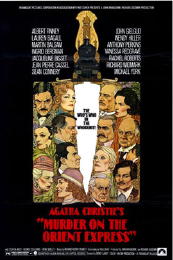
Poster

   Before the movie was shown on Turner Classic Movies, which is where I taped it from, the host, Robert Osbourne, pointed out that it took 40 years before the movie could pass the Movie Code. If you know the story, you will know why, and once again, that is all I am able to say about that.

   In terms of the detective work — well, let me tell you a story. Back when I was young, and maybe even younger than that, I decided that the next Agatha Christie novel I read, by golly I was going to take detailed notes and actually solve the murder myself. Well I did, and I didn’t.

   I was so upset at how the crime was committed and who did it that I literally threw the book across the room. Carefully, of course.

   The movie was extremely successful. Albert Finney was asked, but he turned down the opportunity to play Poirot again. Peter Ustinov, chosen in his place, played the part in Death on the Nile (1978), Evil Under the Sun (1982), and Appointment with Death (1988).

   He also appeared in three made-for-TV films: Thirteen at Dinner (1985), Dead Man’s Folly (1986), and Murder in Three Acts (1986). From what I remember — I haven’t seen any of these films in a while — I mostly regretted Ustinov in the role. Albert Finney, I think I could have gotten used to, now that I’ve had some time to think it over, and even more so as time goes on.

[UPDATE] 03-11-07. Looking back on my comments above, I regret not saying more about the opening terminal scene with the passengers boarding the train in the Istanbul station. Beautifully photographed, highly choreographed, and true to the period, it is nearly worth the price of admission in itself.

   Before I say anything more about it, though, I’m going to have to go back and watch it again. It was far too “visual” the first time, but for me, opening scenes often are. I find myself trying to make sure I’m not missing anything of the story while, at the same time, I’m struggling to take in everything there is to see. Delightful!

[A little bit later.] It was too hard to resist. I’ve just ordered the DVD from Amazon, the version with director Sidney Lumet’s commentary on “The Making of the Movie,” and who should know more how the movie was made than he?

   Some additional comments on David Hume, discussed first in my review of Requiem for Rogues, with a followup post a few days later. From the Yahoo Golden Age of Detection group is this from Curt Evans:

Steve,

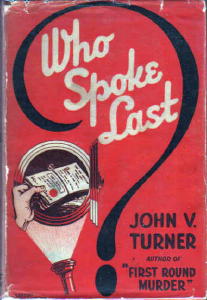
   Murder-Nine and Out involves the boxing world, as does, judging from the dust jacket (the book is for sale for $180 on ABE), Death Must Have Laughed. I would put Murder-Nine and Out in the detection school, as I would the two Ebenezer Buckles I read. But “tough” elements crop up, by which I mean elements associated more with thrillers than with the British genteel school of the Crime Queens. I’ve got another Turner, Who Spoke Last?, which seems to be about crooked financiers, but I have not read it yet. Amos Petrie’s Puzzle sounds interesting, but I have not found a copy.

Curt

Hume

   You’re right. Some of the books that Turner wrote, especially those not as by Hume, are very expensive and hard to find. Wait until you read this from Bill Pronzini, though, who has this to say, plus some show-and-tell afterward:

Steve

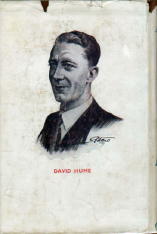
   Just read your blog piece on David Hume (John V. Turner). So happens I’ve been collecting his work for years, under his own name and his two pseudonyms. Attached is some biographical info, photos, and a sketch from the DJ’s of three of his U.K. mysteries. I can send you some cover scans as well, if you like — Humes, Bradys, and Turners.

   The Cardby novels are enjoyable Edgar Wallace type gangster stuff, and comprised his most popular series in England, but for my taste his other two series are better — the Reverend Ebenezer Buckles as by Nicholas Brady and the Amos Petries as by J.V. Turner. These are Golden Age fair-play mysteries with more spice than is usual in the breed.

   One of the Reverend Buckle tales, Ebenezer Investigates, for instance, deals with the murder of a pregnant young village woman who had relations with several different men; the subject matter was evidently considered too controversial for its day (1934) for Holt, which published a couple of the other Buckle mysteries, to bring it out here. One of the titles that Holt did publish, Carnival Murder (The Fair Murder in the UK), is a first-rate macabre puzzler set at a village fete at which a small traveling carnival is the main feature.

   Two of the Amos Petrie novels are “impossible crime” tales of some ingenuity; the best of them is First Round Murder (Death Must Have Laughed in the UK), which has a boxing background and concerns the baffling murder of a fighter in the midst of a bout.

Best,
Bill

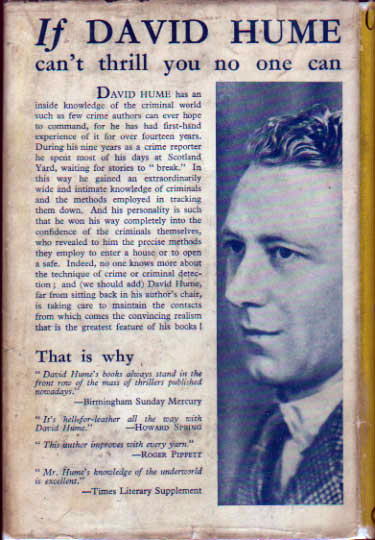
   I’ve used one of the cover scans to lead off this blog entry, and I used the back cover sketch of Hume�s face on the previous Hume-Turner post. I�ll post one of the back covers with the biographical info at the bottom of this post � I hope you can make out the print! The rest of the covers I’ve uploaded on a separate page where you can see them more clearly. Go take a look. It�s worth the trip!

Back Cover

[UPDATE] From Bill Pronzini: Attached are three more scans which you might want to include, two Humes and a Turner.

   Curt Evans is right about the grotesque elements of The Carnival Murder; grisly might even be a better word.

   Most of the other books I have by Turner under his three names are jacketless, unfortunately. One of these is the Turner title Curt mentioned, Amos Petrie’s Puzzle. It’s not as good as the two of the “impossibles,” First Round Murder and The House of Strange Guests, but still enjoyable. Concerns the murder at a country house party of the owner of three West End theatres, after the gent received an anonymous threatening note stating “Millionaires Must Die.” Theatre folk and film stars are among the suspects, and as usual with Turner’s detective novels, there are both bizarre and sexual aspects to the case. Amateur sleuth Petrie is on hand to solve it with the aid of his long-suffering friend, Inspector Ripple of Scotland Yard.

Best,

Bill

The covers page has been revamped, with the new scans added. Thanks! –Steve

   Following my review of Requiem for Rogues and my overview of author David Hume’s career, I received enough follow-up comments to warrant making an entire blog entry out of them. First from the Yahoo Golden Age of Detection group, here’s a reply from Curt Evans:

Steve,

   My survey of Turner did not indicate to me that he was a lost great. The Hume books seemed beat ’em up thrillers. The Turner and Brady books are more detection, with amateurs Amos Petrie and Ebenezer Buckle. It looks like Turner had his feet planted firmly in both schools of mystery fiction. I’ve read a couple of the Petries and Buckles, but the only one that stood out in any way for me was The Fair Murder, which had some quite exceptionally grotesque elements – it certainly is not cosy!

Curt

Hume

   In my review and other commentary, I wondered about Turner’s death at the young age of 45. Victor Berch discovered his obituary in the NY Times [dated 02-06-45], but nothing in it referred to the cause of his passing. He had died the day earlier. I’ll quote briefly from the obituary anyway:

   “Formerly a Fleet Street reporter, Mr. Turner left journalism to devote his time to writing thrillers, and while still in his early thirties was often called ‘the second Edgar Wallace.’ At one period he wrote a novel a fortnight.

   “Frequently he spent weeks at a time living in London’s underworld to mix with criminals.

   “A reviewer of [They Called Him Death, 1934/35] in The New York Times commented, ‘Swift action and plenty of it make this story a good example of the mystery-adventure type of thriller. If you prefer subtle deduction, you must look elsewhere.'”

   I also wondered about Mick Cardby and whether his father should be also included as a series character in Allen J. Hubin’s Crime Fiction IV. Al replied:

Steve,

   As for the Cardbys, Bill Lofts has this to say:

   “The business of Cardby & Son, private detectives of Henrietta Street, Covent Garden, had been built up with the trust of both police and crooks. Whilst Mick Cardby was the younger and more prominent, Cardby senior had spent twenty years of distinguished service at Scotland Yard, reaching the rank of Chief Inspector.”

   I owned 33 David Hume titles once upon a time, and I rather think I chose Cardby the younger because that’s the way the books were promoted … as Mick Cardby tales.

Best,

Al

   Altogether you’ve certainly convinced me that Mick Cardby, the son, is the principal player, with the father taking the lesser role. Mick Cardby books, they are!

   Many thanks to Curt, Victor and Al for filling in some of the details on J. V. Turner, a/k/a David Hume. As usual, gents, it’s been a pleasure.

   And by the not-so-insignificant way, I missed the quote from the Bill Lofts website the other day, and I shouldn’t have. And neither should you, if you are interested in mysteries published during the Golden Age of Detection and certainly no later than 1960.

   Entitled The Crime Fighters, by W. O. G. Lofts and Derek Adley, it’s yet another project that Al Hubin is working on, putting online an alphabetical listing of many of the fictional characters found in all of those books, beginning with Pat & Jean Abbott (Frances Crane) and ending with Inspector Furneaux (Louis Tracy).

   Um, yes. Unfortunately, only letters A through F are online and accounted for so far. It’s still worth your time visiting, and if you’re like me, you may stay a while.

   From the Introduction:

   This is essentially a bibliography of the following fictional characters:

      * the private detective
      * the private eye
      * the official police investigator
      * the amateur sleuth
      * the adventurer type of detective, such as Bulldog Drummond and Norman Conquest, who were always on the side of law and order, as well as Robin Hood types like the Saint who were active on both sides
      * the secret service agent of the Tiger Standish type, who nearly always worked with the Special Branch at Scotland Yard (but not those of the James Bond type, who were purely engaged in spying and espionage and rarely worked in collaboration with the police).

   Thus, in general, we cover the fighters of evil-doers, but of course not including the American super-hero of the Superman type. The closest we come to this type is The Shadow and Doc Savage, who, while having certain mystic powers, are nonetheless ordinary men.

   We have endeavoured in the main to include detectives and the like who have appeared in British publications, although we have found that most of those of any repute appearing in book form in this country have likewise appeared in the U.S., and of course the reverse is true.

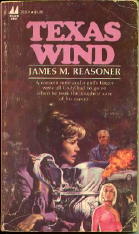
Texas Wind

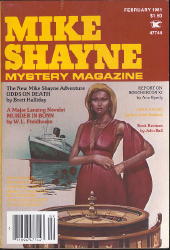
   Prompted by a review by Ed Gorman of one of his early private eye stories for Mike Shayne Mystery Magazine, author James Reasoner recently did some reminiscing on his own blog about the private eye characters he created back then, some 25 to 30 years ago.

   There were four “Markham” stories, he says, calling Markham “sort of a dry run for my private eye character Cody, who appeared in the novel Texas Wind and several short stories of his own.”

   James goes on to say that Markham “was the second private eye character I created for MSMM. The first was called Delaney … who appeared in a handful of short, very minor stories. Cody came along after Markham and I used both of them in stories for a while, but Cody last appeared in 1988, nearly twenty years ago.”

   If you hadn’t missed it, yes, all three detectives have only a single name.

   It’s a long post, and besides talking about his own characters, James also discusses the other authors who appeared in some of the same issues of MSMM as he did, writers such as Joe R. Lansdale, Edward D. Hoch, William L. Fieldhouse and others. Not only that, but he remembers the pair of editors who bought the stories as well: Sam Merwin, Jr., and Charles E. Fritch.

Texas Wind

   I’ll have to dig out some of the back issues of MSMM I have in my own collection. James also did many of the “Mike Shayne” short novels or novelettes that appeared in every issue during this same era, including the one pictured here.

   It made the magazine one of the few places where you could be guaranteed being able to read a PI story anytime you picked one up. (The link above will take you to a list of many of the Mike Shayne stories that appeared in the magazine and who wrote them.)

   James concludes by saying, “I’ve thought at times that a volume collecting all the Cody, Markham, and Delaney stories would make a nice little book. Maybe one of these days.”

   If at all possible, make it sooner rather than later, James.

[UPDATE] 03-06-07. At the request of myself and a number of others, James has posted a complete list of all of his non- “Mike Shayne” private eye short fiction.

   He goes on to talk about a few of the stories, including some additional details about his various PI characters. James concludes by saying:

    “I believe that’s all of my private eye stories, eighteen in all. I would have guessed that there were more than that. Of course, if you include the novel Texas Wind and the 36 Mike Shayne stories I wrote, the total is a little more impressive. Sometime in the mid-Eighties I started a second Cody novel but didn’t get very far with it before setting it aside to do something else. I never got back to it and have no idea where the manuscript is now.”


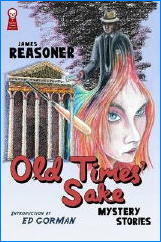
[UPDATE] 09-08-08. It’s a little late to be considered breaking news, but a collection of 17 of James’s 18 private eye stories was published earlier this year by Ramble House. The title is For Old Times’ Sake, and you can order it here.

Texas Wind

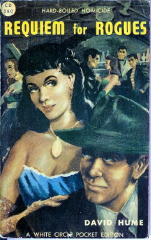
DAVID HUME – Requiem for Rogues

Collins, UK, hc, 1942. Reprints: 1946?, 1952. Collins White Circle #380, Canada, pb, 1949.

   The author, first of all, is NOT David Hume (April 26, 1711 – August 25, 1776), who was a Scottish philosopher, economist, and historian, and according to at least one source, one of the most important figures in the history of Western philosophy and of the Scottish Enlightenment.

   Nor is it his real name, for which see below. One does idly wonder why Mr. Turner chose it as a working by-line, though. It also makes it difficult to come up with information about him on Google, most of the searches picking up the wrong man, obviously.

   On one website, I did come across the following, however:

   In a jacket note in 1934, David Hume was described as having spent nine years in newspaper work, during which he was a frequent visitor to Scotland Yard. Apparantly, “in order to keep in touch with the criminal world,” Hume used to leave his home two or three times a year to live in the underworld. No doubt, this caused Howard Spring to say of Hume that “he shares Edgar Wallace’s practical knowledge of the techniques of crime.” Collins were happy to promote Hume as the “new Edgar Wallace.” His main series character was Mick Cardby.

Rogues1

   From Crime Fiction IV, by Allen J. Hubin, which of course I turned to next, if not first, comes the following list of titles by Mr. Hume. These are the British editions only:

HUME, DAVID; pseudonym of J(ohn) V(ictor) Turner, (1900-1945); other pseudonym Nicholas Brady.
   * Bullets Bite Deep (n.) Putnam 1932 [Mick Cardby; England]
   * Crime Unlimited (n.) Collins 1933 [Mick Cardby; England]
   * Murders Form Fours (n.) Putnam 1933 [Mick Cardby; England]
   * Below the Belt (n.) Collins 1934 [Mick Cardby; England]
   * They Called Him Death (n.) Collins 1934 [Mick Cardby; England]
   * Too Dangerous to Live (n.) Collins 1934 [Mick Cardby; England]
   * Call in the Yard (co) Collins 1935 [Det. Insp. Sanderson; England]
       • Call in the Yard • na The Thriller Mar 2 1935
       • The Murder Trap • na The Thriller Apr 13 1935
       • The Secret of the Strong Room • na The Thriller Dec 1 1934
   * Dangerous Mr. Dell (n.) Collins 1935 [Mick Cardby; England]
   * The Gaol Gates Are Open (n.) Collins 1935 [Mick Cardby; England]
   * Bring ’Em Back Dead! (n.) Collins 1936 [Mick Cardby; France]
   * The Crime Combine (co) Collins 1936 [Det. Insp. Sanderson; England]
      • The Crime Combine • na The Thriller May 2 1936
      • Midnight’s Last Bow • na [unknown]
      • The Murder Rap • na The Thriller Jul 25 1936
   * Meet the Dragon (n.) Collins 1936 [Mick Cardby; England]
   * Cemetery First Stop! (n.) Collins 1937 [Mick Cardby; England]
   * Halfway to Horror (n.) Collins 1937 [Mick Cardby; England]
   * Corpses Never Argue (n.) Collins 1938 [Mick Cardby; England]
   * Good-Bye to Life (n.) Collins 1938 [Mick Cardby; England]
   * Death Before Honour (n.) Collins 1939 [Mick Cardby; England]
   * Heads You Live (n.) Collins 1939 [Mick Cardby; England]
   * Make Way for the Mourners (n.) Collins 1939 [Mick Cardby; England]
   * Eternity, Here I Come! (n.) Collins 1940 [Mick Cardby; England]
   * Five Aces (n.) Collins 1940 [Mick Cardby; England]
   * Invitation to the Grave (n.) Collins 1940 [England]
   * You’ll Catch Your Death (n.) Collins 1940 [Tony Carter; England]
   * The Return of Mick Cardby (n.) Collins 1941 [Mick Cardby; England]
   * Stand Up and Fight (n.) Collins 1941 [England]
   * Destiny Is My Name (n.) Collins 1942 [Mick Cardby; England]
   * Never Say Live! (n.) Collins 1942 [Tony Carter; England]
   * Requiem for Rogues (n.) Collins 1942 [Tony Carter; England]
   * Dishonour Among Thieves (n.) Collins 1943 [Mick Cardby; England]
   * Get Out the Cuffs (n.) Collins 1943 [Mick Cardby; England]
   * Mick Cardby Works Overtime (n.) Collins 1944 [Mick Cardby; England]
   * Toast to a Corpse (n.) Collins 1944 [Mick Cardby; England]
   * Come Back for the Body (n.) Collins 1945 [Mick Cardby; England]
   * They Never Came Back (n.) Collins 1945 [Mick Cardby; England]
   * Heading for a Wreath (n.) Collins 1946 [Mick Cardby; England]

TURNER, J(ohn) V(ictor)
   * Death Must Have Laughed (n.) London: Putnam 1932 [Amos Petrie; England]
   * Who Spoke Last? (n.) London: Putnam 1932 [Amos Petrie; England]
   * Amos Petrie’s Puzzle (n.) Bles 1933 [Amos Petrie; England]
   * Murder-Nine and Out (n.) Bles 1934 [Amos Petrie; England]
   * Death Joins the Party (n.) Bles 1935 [Amos Petrie; England]
   * Homicide Haven (n.) Collins 1935 [Amos Petrie; England]
   * Below the Clock (n.) Collins 1936 [Amos Petrie; London]

BRADY, NICHOLAS
   * The House of Strange Guests (n.) Bles 1932 [Rev. Ebenezer Buckle; London]
   * The Fair Murder (n.) Bles 1933 [Rev. Ebenezer Buckle; England]
   * Week-End Murder (n.) Bles 1933 [England]
   * Ebenezer Investigates (n.) Bles 1934 [Rev. Ebenezer Buckle; England]
   * Coupons for Death (n.) Hale 1944 [England]

   I don’t know about you but these are all new names to me, both that of the author (and his pen names) and his characters. Back to Google, it seems. Here’s a snippet of a review from The Bookman, 1933, of the US Holt edition of Nicolas Brady’s The House of Strange Guests:

   “Murder in an English country house, the headquarters of a blackmailing gang. Expert detective work by the erratic Reverend Ebenezer Buckle who, tired of saving souls, tries his(?) …”

   Another snippet of a review, this one from The Librarian and Book World, date?, of Brady’s The Fair Murder:

   “This is another detective story [in] which the Rev. Ebenezer Buckle unravels [a] mystery. But what a mystery! What [a] story! It is as gruesome and horrible … ”

   Seeing a few shorter works of fiction collected under David Hume’s byline, I checked out the online Fictionmags Index, with the following results. [* = included in CFIV list above, either as a novel serialized earlier in magazine form, or as a story collected later in book form]

HUME, DAVID; pseudonym of J. V. Turner, (1900-1945)
   * The Secret of the Strong Room (na) The Thriller Dec 1 1934 [Det. Insp. Sanderson]
   * Call in the Yard (na) The Thriller Mar 2 1935 [Det. Insp. Sanderson]
   * The Murder Trap (na) The Thriller Apr 13 1935 [Det. Insp. Sanderson]
   A Basin of Trouble (ss) The Thriller Jun 29 1935
   The Crook’s Day Off (ss) The Thriller Aug 31 1935
   He Was Pinched for Nothing (ss) The Thriller Oct 19 1935
   * Meet the Dragon (sl) Detective Weekly Jan 4, Jan 11, Jan 18, Jan 25, Feb 1, Feb 8, Feb 15, Feb 22, Feb 29, Mar 7 1936 [Mick Cardby]
   Anything to Say (ss) The Thriller Feb 15 1936
   The Wrong Bottle (ss) The Thriller Mar 7 1936
   Times Were Bad (ss) The Thriller Mar 28 1936
   * The Crime Combine (na) The Thriller May 2 1936 [Det. Insp. Sanderson]
   * The Murder Rap (na) The Thriller Jul 25 1936 [Det. Insp. Sanderson]
   Who is Midnight? (na) The Thriller Sep 5 1936

   More googling, this time on Hume’s detective Mick Cardy. At this point I still knew nothing about him. On a website devoted to Inspector Maigret I discovered the following piece of art:
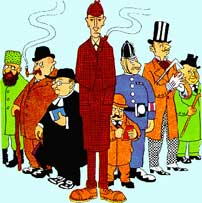
Art
  1.   2.      3.      4.     5.   6.     7.       8.

   Maigret is the second gentleman on the left. Although they don’t have the original art, this cartoon came from the Storm-P museum in Copenhagen, and the curator, Jens Bing, identifies it as first appearing on the cover of the Danish pulp crime magazine Stjernehæftet in 1946. Bing sent a a copy to the Danish branch of the Sherlock Holmes Society, and here are the results they came up with for the others in the scene:

1. Dostoevski’s Porfiry, from Crime and Punishment
2. Maigret
3. G.K. Chesterton’s Father Brown
4. Sherlock Holmes
5. Agatha Christie’s Poirot
6. David Hume’s Inspector Cardby
7. Edgar Allan Poe’s Dupin
8. H.C. Bailey’s Reggie Fortune (?)

   I don’t think I would gotten many of those, assuming that these are the right answers. How would you have done? But no matter, it would seem that Mick Cardby was actually Inspector Cardby, but this is not so, as we shall see in a minute. I didn’t include them in the CFIV listings, but two of Hume’s books were indicated as being the sources of films based upon them. So off I went to www.imdb.com, where I found the following useful information:

   Plot summary for The Patient Vanishes (1941) aka They Called Him Death [The latter being the title of a 1934 book by Hume.]

   James Mason as a private detective [Mark Cardby], whose father is a Scotland Yard man [Gordon Maclead as Inspector Cardby], takes a case involving extortion and kidnapping. A young girl is kidnapped from a nursing home and he advises the girl’s father not to pay the ransom. After several near-misses on his life, he learns that the doctor in charge of the nursing home has been taken prisoner by the kidnappers. And then the wicket gets stiff or stuffy, or whatever wickets do.

   Aha. Mick Cardby is a PI, not a gent from the Yard at all. We’ve learned something. (And you who knew already can stop the knowing looks at each other.) One more movie from the IMDB:

   Too Dangerous to Live (1939) aka Crime Unlimited. [The latter being the David Hume title from 1933.] With Edward Lexy as Inspector Cardby, but no Mick Cardy listed in the credits, and no synopsis of the story.

   But from the All Movie Guide comes the following Plot Description:

   It took two directors to bring this modest British thriller to the screen. The story concerns a gang of international jewel thieves, headed by a “mystery man” who is never seen and who communicates with his minions through a microphone. Rival criminal Jacques LeClerq (Sebastian Shaw) gains the gang’s confidence, joining them on their biggest caper. Only when it’s too late to back out does LeClerq reveal that he’s actually a member of the French police. Without revealing the identity of the criminal mastermind, it’s worth noting that one of the actors plays a dual role, a fact spelled out in the opening credits.

   And from BFI, apparently there is a PI involved, after all:

   A private detective wins the confidence of a gang he is after, but has to rob a woman whose niece he finds attractive. The leader turns out to be an old friend and he fights his way from a burning garage.

   I am sure that if you were to find a copy to watch, all of this confusion may be very easily straightened out. But a question remains: Who was the more important of the two characters, Inspector Cardby or his son Mick? Should both of them be included in CFIV as significant Series Characters?

   And as you can easily see, Hume under his many aliases was extremely prolific. I’m sure you thought the same thing when you read through that list of mysteries up above. Could anyone who wrote so many detective novels so quickly be any good at it? Hold that thought. We’ll get back to it in a minute.

   Hume also died young, at only 45. Could war injuries have had anything to do with his death? Having no answers, only these questions and more, unless you can enlighten me, I’ll move on to the major business at hand, which is a review of Requiem for Rogues.

Rogues2

    In which the leading character in is neither Cardy, father or son, but rather Tony Carter, a wisecracking crime reporter who appeared in three of Hume’s adventures, of which this is the third. He’s rather full of himself as well, as one might put it. Here’s a piece of a conversation that takes place on page 22 between Carter and his immediate superior at the Echo:

   Cartwright pressed his fingers together, stared at the ceiling. Carter also looked up. He wondered if his reprimand was written on the plaster. He sighed slightly as he waited for the attack to commence.

   “To commence,” announced Cartwright, your methods are so unconventional that one day you will land this paper into most serious trouble. So far the luck has been with you. That cannot last for much longer. Then you’ll be in jail, and the Echo will be faced with a heavy libel action. In the future follow a more conservative line of conduct, be more orthodox. See?”

   “Surely. You don’t want any more exclusive stories. The paper really wants the official news handed out in the Press room at the Yard – and nothing else. If that is so you’re wasting your money, and my time. Get a fourteen-year-old office boy, pay him ten shillings a week, let make the Yard call three or four times a day. And he’ll be a howling success.”

   Cartwright wriggled. This interview was not what he had anticipated – not by a long, long way.

   Suffice it say that Carter convinces Cartwright to give him a free hand in this case of the drive-by killing of one Percival East, dead by means of a bullet between the eyes on page eight, and right before the eyes of a later berated Detective Spriggs.

   By page 69, the police are confused enough – and well they should be – to give Carter a free hand as well, as the case is seemingly awash with far too many clues and then again, far too few. But the more Carter digs into the case, the more deeply Percival East is discovered to have roots in the world of crime: the rackets, blackmail, the works.

   Incidentally, totally relevant to nothing, I don’t know why everyone in this book refers to members of the police force as “splits.” It’s a new one on me, but the rest of the slang I managed to decipher with no particular difficulty. Conversations, though, which should have taken a page at the most to start and end invariably took four or five, which means that Hume was either a master of dialogue or he needed these long dialogues to fill the novel to a proper length. As for myself, I will not say padding, as I found these conversations to be rather imaginative, at the least.

   There is no detection in this mystery novel, per se. Carter runs around London a lot, meets with his crew of regular informers a lot, and in so doing irritates the killer a lot, and enough so to make him (or her) make moves and counterattacks he (or she) really shouldn’t have done. If Carter had only been left alone, one might think, the case would never have been solved. One might very easily be right.

   This probably also answers the question I asked up above but didn’t answer until now.

— January 2007
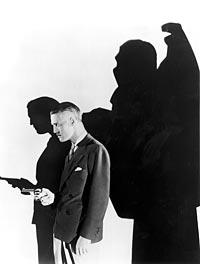
   Following the interview with John “Wade” Wright here not too long ago, I’ve been asked to say some more about his recurring characters. (Preceding the interview is a list of all 14 of his mystery novels.)

   I still don’t have access to copies of his books myself, and while I’ve purchased two or three in the last couple of days and they’re on their way to me, that doesn’t do me any good right now. So I asked Bill Pronzini, who’s read them all, I believe, and here is what he had to say.   

Haloes

Steve:

   I don’t have the time to do a full write-up on John’s series characters, but in a nutshell:

   Bart Condor is a tough, violent New York private eye inspired by and patterned after Spillane’s Mike Hammer.

   Paul Cameron is a more cerebral P.I. built along the lines of Philip Marlowe, Thomas Dewey’s Mac, Bob Martin’s Jim Bennett; his bailiwick is southern California.

   Calhoun is a Vietnam vet who works for a shadowy U.S. internal security agency run by “The Man” and whose job is to “help lop off the many tentacles of the racket boys [i.e. Mafia]” by any necessary means, operating close to the law and without any official cover.

   The Paul Cameron series is the best of the three. For my taste, though, the best of all John’s novels are the two stand-alones, Death at Nostalgia Street and It Leads to Murder.

Best,

    Bill

« Previous PageNext Page »