Characters


   In case you haven’t read or heard about it already, Stephen Marlowe, author of the Chester Drum series, recently appeared on Ed Gorman’s blog, telling the story of how he and Richard Prather, author of the Shell Scott PI novels, got together and wrote Double in Trouble, their magnum opus in which their two characters met and cracked a case together, after first cracking their heads together, thinking that each of them was on the other side.
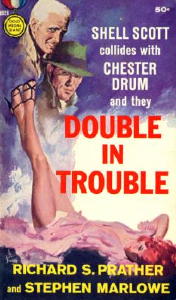
Double

   The story is fascinating, and by all means, you should go read it. What I don’t know is whether you should read Marlowe’s long reminiscing story first, or to give it some additional background, you might want to read J. Kingston Pierce’s post on The Rap Sheet site before you stop over at Ed’s. Jeff has a great knack of finding a news item elsewhere on the blog and writing about it on his own, adding as he does so a profusion of links and insights to the original post, wherever it may have been. It’s one of the few sites where I stop by everyday, and Ed Gorman’s is another. With his long career in mystery fiction and other genres, Ed knows the authors and the publishers, and he has many well-formed opinions and perspectives of the field, all of which spills over into his daily posts.

   Returning to Marlowe and Prather’s work together, I’m not sure if this the first example where two authors joined forces (and characters) in a novel, sharing a joint byline together. In 1963, Stuart Palmer and Craig Rice published People Vs. Withers and Malone, a collection of short stories in which their detectives, Hildegarde Withers and John J. Malone either shared or battled wits together. Most of the stories were written before 1959, which is when Double in Trouble first came out, but whether or not that counts, I don’t know.

   I’ve asked this question before, I know I have. What I don’t know is if I received an answer or not. Those who forget history are doomed to repeat it, as some wise philosopher once said.

   Here’s another question. Richard Prather’s passing has been widely reported on various blogs and newsgroups, but as far as I know, it has yet to have been noted by the mass media. Why not? If you were to Google “richard prather obituary” as I did just now, the piece I posted on the M*F blog a full week ago today is the first one to come up. Why is that? It looks nice on my resume, I suppose, but come on. I’d agree that at the time of his death Mr. Prather was not a major player in the world of mystery fiction, but he was still certainly a major figure, having sold millions and millions of his (mostly) wacky private eye adventures, second certainly in the 1950s only to Mickey Spillane. Why has the rest of the world ignored his passing?

   One more question, and one that’s less of a rant. Prather is gone, but Stephen Marlowe, at the age of 79, is thankfully still with us. Of the major (or even the minor) Gold Medal writers of the 1950s, who else are still alive? Vin Packer (Marijane Meaker) for one, I believe, and she will be 80 this year. Others?
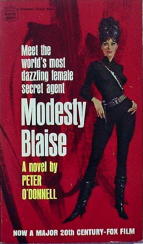

   The title of the first Modesty Blaise novel was exactly that, Modesty Blaise, published by Souvenir Press in 1965. The author was Peter O’Donnell. Modesty, of course, had appeared even earlier, as her adventures in book form were preceded by those in the daily comic strips, debuting in the London Evening Standard in 1963. The first artist for the strip was Jim Holdaway, then Romero and a small number of others, with Romero returning before O’Donnell decided to end it in 2001.

Modesty 1

   The comic strip was not widely distributed in the US, in part because adventure strips find very little acceptance in this country in general, but also because of the nude scenes which had to be censored. A favorite tactic that Modesty used against her foes was called the “Nailer,” whereby she would strip above the waist and Willlie Garvin, her companion in crime-fighting, would take advantage of the distraction she caused. Not a technique that could be shown in the US!

   There were movies, too, not always very successful, and perhaps I’ll discuss them someday. A pilot was made and aired for proposed TV series starring Ann Turkel, but nothing further developed.

   Taken from wikipedia, here are portions of a couple of paragraphs that will help explain some of the background for Modesty Blaise, the character.

    “In 1945 a nameless girl escaped from a displaced person (DP) camp in Karylos, Greece. She did not remember anything from her short past. She wandered through post-WW2 Mediterranean and Arabia. During these years she learned to survive the hard way. She befriended another wandering refugee, a Hungarian scholar named Lob who gave her an education and a name: Modesty Blaise. Eventually she took control of a criminal gang in Tangier and expanded it to international status as “The Network.”

    “During these years she met Willie Garvin. Despite the desperate life he was living, she saw his potential and offered him a job. Inspired by her belief in him, he pulled through as her right-hand man in The Network and became Modesty Blaise’s most trusted friend. Theirs is a strictly platonic relationship and is based on mutual respect and shared interests. They have never gone to bed with each other, fearing that would ruin their special bond.

    “When she felt she’d made enough money, she retired and moved to England; Willie Garvin followed suit. Bored by their new lives among the idle rich, they accepted a request for assistance from Sir Gerald Tarrant, a high-ranking official of the British secret service — and this is where the story really begins.”

   Now go, if you will, to the Crime Time website , and an interview with Mr. O’Donnell, where he explains for the first time who it was — the real person — upon whom Modesty Blaise was based.

   Here I’ll quote only the last paragraph, in which Mr. O’Donnell says:

    “I am in debt to the child I saw that day in 1942, both for the privilege of having met her, however briefly, and for her providing the role model for a character I have now written about for close on 40 years. I still think of her from time to time, and wonder what became of her. If alive today, she would have just turned 70. Whatever the length of her days, I can only hope that she was granted some measure of the reward she deserved for her courage and spirit. I salute her.”

M & Willie

      –Thanks to Peter Rozovsky of Detectives Without Borders for the tipoff to the interview.

   As a followup to my blog entry on Columbo a while back, here’s an email I received today from John Apostolou. On the original M*F website, John is the author of an excellent article on MacKinlay Kantor, which includes a long and complete crime fiction bibliography for him, we believe.

Hi Steve,

   I’m enjoying your new blog.

   Here are a few bits of info about the play “Prescription: Murder.” It opened at the Curran Theatre in San Francisco on January 20, 1962. After a short run, it toured the country, closing in Boston in May of that year. The play never opened on Broadway.

   Thomas Mitchell died in Beverly Hills on December 17, 1962 — not during the tour as sometimes reported.

            Best,

               John Apostolou

>> Thanks, John. What’s reported is not always what’s true, as anyone who’s done any research has quickly found out.

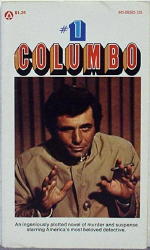
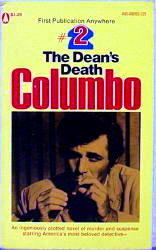
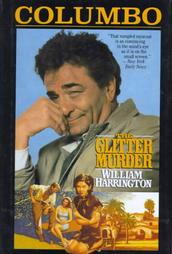
   As promised in the update at the end of the previous post, here are the appearances of Lt. Columbo in print. Some of these are becoming difficult to find, even with the assistance of the Internet to help track them down. I wish I were able to show you covers of all of them, but it would be rather crowded if I did, or if I could. Some I don’t have copies of myself.

Columbo 1

LT. COLUMBO in book form –

* RICHARD LEVINSON & WILLIAM LINK:

o Prescription: Murder. French, 1963, pb. [Three-act play.]

* ALFRED LAWRENCE:

o Columbo. Popular Library, pbo, 1972.
o The Dean’s Death. Popular Library, pbo, 1975.

* HENRY CLEMENT:

o Any Old Port in a Storm. Popular Library, pbo, 1975.
o By Dawn’s Early Light. Popular Library, pbo, 1975.

* LEE HAYS:

o A Deadly State of Mind. Popular Library, pbo, 1976.
o Murder by the Book. Popular Library, pbo, 1976.

Columbo 2

* BILL MAGEE & CARL SCHENCK:

o Columbo and the Samurai Sword. Black, hc, 1980. Note: This is one of the very few First Editions published by the Detective Book Club [known for their three-in-one editions, of which this is one, or a third thereof] and as such is rather scarce and hard to find.

* WILLIAM HARRINGTON:

o Columbo: The Grassy Knoll. Forge, hc, 1993.
o Columbo: The Helter Skelter Murders. Forge, hc, 1994.
o Columbo: The Hoffa Connection. Forge, hc, 1995.
o Columbo: The Game Show Killer. Forge, hc, 1996.
o Columbo: The Glitter Murder. Forge, hc, 1997.
o Columbo: The Hoover Files. St. Martin’s, hc, 1998.

Columbo 3

   Acknowledgments go as almost always to Allen J. Hubin, Crime Fiction IV, as the primary source for most of this data.

   I’ll also take this an opportunity to thank Mark Murphy one more time for pointing out where I could go on the web to keep finding more information about Lt. Columbo. In his most recent email to me, he added: “A guy named Mark Dawidziak wrote a book, The Columbo Phile, some years ago. It was quite authoritative. I’ve also found this link to an interview with him…”

   He’s right. There are commercials in this on-the-air interview, but you can skip them, and it’s very much worth listening to.

   To sum things up, I hope, without too many more updates, Columbo as a character has been around long enough, and he’s been popular enough, that there’s plenty of information out there on him, either in print or on the Internet. In these last couple of blog entries, I don’t imagine that I’ve added anything that’s really new about him, but hopefully I’ve presented what I’ve discovered in a straight-forward and useful fashion. I’ve also ironed out some of the contradictions popped up as I went along, and tried to set the record straight on a few statements I found that were either incomplete or simply not so.

   Or to put it another way, I certainly learned a lot.

   Here is but another of the alleys that researching can take you, if you are not wary, and even if you are. While looking up The Dow Hour of Great Mysteries — see the previous post — I found a short piece from the NY Times that suggested that Prescription: Murder, the first appearance of Lt. Colombo, the rumpled police detective made so famous by Peter Falk, made its first appearance on the Dow Hour.

   Not so, and I have Mark Murphy to thank for pointing me to a website that has the right stuff, or in other words, the correct information. Of course you can go there to read it for yourself, and in fact you should. I recommend it. But since I had it wrong in my previous post, it behooves me (I always wanted to say that) to at least set up the correct timetable of the events relating to Lt. Columbo in this one.

[Added 01-27-07] March 1960. According to Mark Dawidziak, writer of The Columbo Phile (Mysterious Press): “the very first appearance of the character wasn’t in a short story [by Richard Levinson & William Link] called “May I Come In?” The end of that story is a knock at the door: it’s the police, and if the door had opened it would have been Lieutenant Columbo standing there.”
   The story appeared in Alfred Hitchcock’s Mystery Magazine, but someone, an editor perhaps, changed the title to “Dear Corpus Delicti.”

May 29, 1960. A drama anthology called The Chevy Mystery Show began on NBC. Hosted by Walter Slezak, new scripts were dramatized every Sunday. There were no recurring characters or actors.

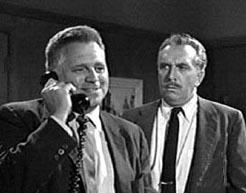
July 31, 1960. “Enough Rope,” was that evening’s presentation, an original story written by William Link and Richard Levinson, introducing to the world a police lieutenant named Columbo, played by a veteran character player named Bert Freed, who received “second-to-last billing in the opening credits.” He is not even included in the IMDB listings for that episode.

Freed

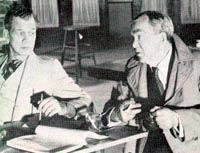
1962. “Prescription: Murder” the stage play opened, with veteran movie and stage actor Thomas Mitchell playing Lieutenant Columbo. This was Mitchell’s last role: “He died while the show was touring the United States and Canada, before it reached its Broadway premiere.”
   It is not clear whether the play ever reached Broadway. Some sources I’ve seen so far say yes, others say no.

Mitchell

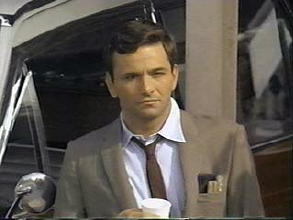
1968. Filmed in 1967, “Prescription: Murder” appeared as a made-for-TV movie, with Peter Falk in the starring role. It was intended to be a one-shot appearance for the character, but fate (and the character’s popularity) had a way of changing things.

   NOTE: What the author of the website cited above does, and in great detail, is to compare the story lines for each these first three appearances of Lt. Columbo, essentially the same story with differences, and how the character was presented and developed.

March 1, 1971. The pilot for the Columbo TV series was aired: “Ransom for a Dead Man.”

September 15, 1971. Columbo began its regular TV slot as a rotating part of the NBC Mystery Movie, with the first episode entitled “Murder by the Book.” When that overall umbrella series ended, Colombo continued to appear in a series of made-for-TV movies on a irregular basis. “Columbo Likes the Nightlife” was telecast in 2003, a stretch of some 35 years since Columbo began his run back in 1968.

Falk

   Peter Falk is now 80 years old. No one could possibly fill his shoes (or raincoat), so this may mark the end of Lt. Columbo on the small screen.

SIDEBAR: February 26, 1979, to March 19, 1980. Kate Loves a Mystery, starring Kate Mulgrew as Mrs. Columbo, had a short season of 13 episodes. The gimmick didn’t work out, the folks over at the Columbo lot disowned her, and by the end of the run, the leading character was named Callahan (and not even the wife of some other police detective named Columbo).

UPDATE [01-26-07] It’s later the same day, and I see that I’ve forgotten to list the books in which Lt. Columbo has appeared over the years, mostly as novelizations of various screenplays, I believe, although I could be wrong on that. It’s late, though, and I think it will wait for another day. (Tomorrow, I hope.)

   I’ve just received what has to be a first, or for me personally, I know it is. As perhaps you already know, Berkley is in the process of publishing a new mystery series by “debut” author Sarah D’Almeida, beginning with Death of a Musketeer, in which Alexander Dumas’s famous characters, Athos, Porthos, Aramis and D’Artagnan, add sleuthing duties to their usual ones of romantic adventure and royal intrigue. Yes, indeed, the Three Musketeers are back.

Cover

   That’s hardly surprising. Over the past ten years or so mystery writers have been using the talents of loads of other fictional characters as detectives — even those you would never think of as a detective — and plenty of real life notables from the past as well. Who is there, if I may ask, who lived at the same time as Sherlock Holmes, fictional or otherwise, who hasn’t yet been involved in a case with the great detective?

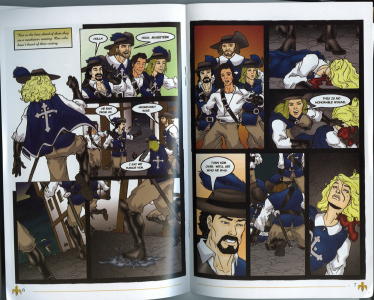
    No, what’s unusual is the promotional item for the book that came in today’s mail. I didn’t get the book today– it came out in November, and it’s stacked somewhere in my TBR pile — but what I did get is a short preview of the story in comic book form. It’s six pages long, and the art is by Rob Dumuhosky. To my eye, it’s very well done. It may come out too small to be readable, but I think you can get a fairly good idea of what it looks like from the image below.

Musketeers

    For a better look at the artist’s work, go here.

    When I referred to the author of this new series in my first paragraph up above, I put the word debut in quotes. A little googling quickly reveals that Sarah D’Almeida is in reality well-known fantasy writer Sarah A. Hoyt. This is not surprising. It’s only a short step from constructing a world of pure fantasy to writing a novel taking place in the past. The skills involved are pretty much the same. In either case, the task is to take the reader into another world that he or she is unfamiliar with, and be convincing about it.

     I haven’t read the book yet, so I can’t tell you how successful the author’s been in transforming the trio (plus one) into a group of working detectives, but the book does sound intriguing, and beyond a doubt, this is certainly the first comic book that I’ve received to promote one.

     And, oh yes, there were the usual bookmarks that came along with a small stack of the booklets, and — of course! — a small candy bar.

[UPDATE: 01-18-07] After seeing the post above, Sarah Hoyt emailed me and said:

Dear Steve,

Thanks for the mention. 🙂

Actually, I always wanted to write mystery. It just worked out fantasy first. D’Almeida is my maiden name.

Oh, and I’ve JUST sold books 4 to 6 on the series, so there will be at least that many. 🙂

   Sarah

I replied, wishing her well with the series and asking if I might post her comments as an update to this blog entry. Her response came right away:

Steve,

Certainly. Don’t know if you want to post this but… The first book was more bound by certain self-imposed strictures, like the fact that I wanted to evoke enough of the plot to attract people who’d only seen the movies of the Three Musketeers. It’s ALMOST (though not quite) Musketeer’s mystery fan fic. So some incidents will be startlingly familiar.

After that, each book becomes more of an historical mystery in its own right, though still featuring the Three Musketeers. I purposely tried to keep the language simple yet evocative enough. (My fantasy series featuring Shakespeare suffered from too much authenticity, perhaps, making it — on reread, several years later — a little too difficult to follow.)

I had a wicked level of fun writing the “footnotes” on what M. Dumas got “wrong.”

All in all, the series is lots of fun to play in, so I’m thrilled about the sale. The books are, in order: Death of A Musketeer, The Musketeer’s Seamstress, The Musketeer’s Apprentice, The Musketeer’s Inheritance, The Musketeer’s Servant and The Musketeer’s Confessor.

Oh, and the first book sold to the bookclub, though I have no details yet. 🙂

As Sarah A. Hoyt I’m doing a fantasy series for Baen (and soon an sf series as well, hopefully) starting with Draw One In The Dark, which came out in November (urban fantasy) and a fantasy series for Bantam (first book to be delivered to editor this month) which takes place in an alternate, magical British Empire (Heart of Light in Africa; Soul of Fire in India; Heart and Soul in China).

   Sarah

To which I say, Sarah, please take a break from the keyboard every once in a while, will you? This is all terrific news. Congratulations on staying so busy!

I don’t know the true protocol for this, having only been a blogger for just under three weeks, but I’d like to re-post some of the comments that I’ve received on my checklist of Real Estate Detectives. If I don’t do it this way, I have a feeling that they’ll fall through the cracks, and people who’d enjoy reading them might not otherwise. (From my own personal experience, I read the comments when I read someone’s blog entry, but I never go back and see if anyone’s commented later.)

First, from author Lou Allin:

My realtor sleuth Belle Palmer lives in the Nickel Capital, Sudbury, Ontario, and specializes in cottage properties, which lets her roam around the bush at will. As mentioned earlier, there are four books in the series, Murder, Eh? being the latest. In that novel, I finally got around to letting Belle find a body at a house showing. For that, I earned a mention on a strange website called “Bathtub murders in Toronto.” The next entry in the series may be titled Dial Belle for Murder. Selling houses is an ideal job for an amateur sleuth because she’s always coming in contact with new people…often with secrets to hide.

Lou Allin

My reply:

Hi Lou. It’s good to hear from you. It’s also good news that Belle will soon have another case to solve. I don’t fully understand the premise of the website you mention, but you’re right, there you are at http://torontoseeker.com/torontobathtubmurderers.htm

Then from author Nina Wright:

Hi, Steve. Thanks for mentioning Whiskey Mattimoe, my Realtor turned amateur sleuth. I agree with Lou Allin; a career in real estate offers our protagonists access to the private lives of many fascinating strangers. Moreover, since choosing a place to live is an expensive and emotional decision, high stakes are already in place.

My humorous series is set in Magnet Springs, Michigan, a fictional tourist town across the Lake from Chicago. In addition to a cast of artistic and eccentric regulars, Whiskey encounters affluent vacationers who pack their dark sides when they leave home.

Another perk of the Realtor protagonist is her legitimate excuse to snoop (a little). Since I’m personally fascinated by architecture and home design, one of the promises I make to my readers is that Whiskey will find herself inside at least one uniquely fascinating property per book. I enjoy concocting those details as much as the gourmet mystery writers probably savor their recipes.

Nina Wright

My reply, which is now the last one posted, but it also contains a short response from Lou Allin:

To both Lou and Nina,

I believe that you’ve pointed out something essential in each of your posts. The biggest problem in maintaining an amateur detective as a continuing character is how do you (believably) make sure that your detective keeps coming across murders to solve?

At first I was surprised at the large number of realtor-sleuths that turned up. Now I’m wondering why there aren’t more of them!

>>> Lou’s email reply to me:

Hi, Steve

One cliche I avoid (selective memory privilege) is having people comment to the sleuth, “Oh so you’re the one who keeps finding bodies. Any luck lately?” or some such. We all know that even police detectives don’t normally work on murder after murder (well, maybe in New Orleans or L.A.).

If readers want amateur sleuth mysteries, they’ll agree with the willing suspension of disbelief.

Lou

Leafing through today’s Wall Street Journal this evening, I spotted an item that was — sure enough — mystery related. (You have to know where to look.)

Emma

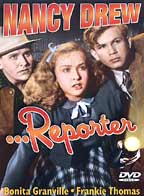
Due in theaters on June 15th is, if I am reading it correctly, a big-screen adaptation of Nancy Drew, girl detective. Other than mentioning that Emma Roberts, 15-year-old niece of Julia Roberts, will be playing title role, details are skimpy in the WSJ piece, but among other things, they do mention Nancy’s debut in the 1930 hardcover novel, The Secret of the Old Clock; the Warner Brothers series of movies made in the late 1930s (with Bonita Granville); and a made-for-TV version in 2002, “originally intended as a pilot, that didn’t attract much of an audience.”

DVD

I missed that one completely. I don’t remember it at all. But with www.imdb.com available to extend a helping hand whenever something like thus happens, I can tell you more. It starred Maggie Lawson as Nancy and was part of ABC’s The Wonderful World of Disney program, which goes a long way in explaining why I never heard about it until now.

One person who commented on the film said: “The acting has a three-second delay, and consists of making faces and striking poses.” Not good. But more recently Maggie Lawson seems to have found a home on the USA Networks’ Psych, as new, young (and very blonde) police detective Juliet O’Hara.

Maggie

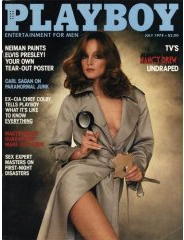
Strikingly, and I do not know for what reason, the piece in the Journal does not mention Pamela Sue Martin. Now that was a series (1977-79) I do remember.

PamelaSue

Hi Steve

Can you tell me whether your MR. CLACKWORTHY volume from Wildside contains any tales not collected in the two Chelsea House volumes of the 20’s? I have one of them but not the other.

Best wishes for 2007.

Doug Greene
>>>

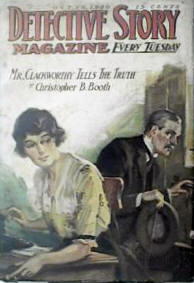
This may be more than the rest of the world wants to know, but after I wrote a review of the first Mr. Clackworthy collection, word got around, and I somehow became known as the expert on the character, who was created by Christopher B. Booth and who first appeared in a long series of stories for Detective Story Magazine. Little did anyone know that the stories in Mr. Clackworthy (Chelsea House, 1925) were all that I knew about the fellow, a gentleman con man who preyed on unscrupulous bankers, stockbrokers and other chiselers, thereby striking a certain chord in the hearts of thousands of readers in the Depression era. The stories were quite popular.

Mr. C

But the limited knowledge that I had certainly did not prevent me from being asked to provide the introduction to the recent Wildside collection of Clackworthy adventures — nor prevent me from accepting for that matter, either.

Which of course obliged me to not completely fake it. Even after the Wildside book was published, I continued to hunt around to find as much information as I could come up with. I have the first and third of the three volumes below, but not the second. The stories in the first of the two Chelsea House books are not identified by name. It’s what’s called a fix-up novel: a collection of stories combined into what is called a novel, but is, simply speaking, a collection of stories combined into a novel, some related to each other, others not.

I suspect, but do not know for sure, that the second Chelsea House collection is structured the same way. For the titles of the stories in both books, I am indebted to Gordon W. Huber’s Chelsea House: A Bibliography (June 2001), with the relevant data sent on to me by Don Davidson. For the first book, I matched the story lines with the titles that Gordon listed, his data coming directly from the Street and Smith files located at Syracuse University. (Street and Smith was the publisher of Detective Story Magazine, among tons of other pulp magazines and dime novels over the first half of the past century.)


THE MR. CLACKWORTHY STORY COLLECTIONS:

All of the stories below originally appeared in Detective Story Magazine. There has been no attempt to ascertain which Mr. Clackworthy stories have so far not been collected.

In the first collection, there is one more story than I can match up with a title. Two of the titles have been established by guesswork only, as indicated, and even so, all of the matching should be considered questionable.


MR. CLACKWORTHY
Chelsea House, hardcover, 1925.

Chapters 1-3. The Million Dollar Air Bag. March 9, 1920

Chapters 4-7. Blasted Reputations. March 23, 1920

Chapters 8-10. Painful Extraction. April 27, 1920

Chapters 11-13. The Comeback. May 11, 1920

Chapters 14-20?? Mr. Clackworthy Stakes a Friend. September 28, 1920

Chapters 21-24. Mr. Clackworthy Tells the Truth. October 19, 1920 (a)

Chapters 25-26. [unknown story title]

Chapters 27-28?? A Modern Lazarus. March 30, 1920

Chapters 29-32. Mr. Clackworthy Digs a Hole. July 16, 1921

(a) Contained in the Wildside collection below.


In the second collection, the following titles have been identified. They may not appear in this order in the book, which I have not seen.

MR. CLACKWORTHY, CON MAN
Chelsea House, hardcover, 1927.

Mr. Clackworthy Forgets His Tonic. January 14, 1922

When Mr. Clackworthy Needed a Bracer. January 21, 1922

Mr. Clackworthy and the Auto Rim. January 28, 1922

Mr. Clackworthy Sells a Gold Brick. March 25, 1922

Clackworthy Coddles a Contract. June 3, 1922

Mr. Clackworthy Pays His Income Tax. June 9, 1923

Mr. Clackworthy Takes a Dip in Rye. June 30, 1923

Mr. Clackworthy Tips a Teapot. April 19, 1924


In this latest collection, there seems to be only one overlap with either of the earlier ones.

THE ADVENTURES OF MR. CLACKWORTHY
Wildside Press. Hardcover & Trade Paperback, 2006.

Mr. Clackworthy Tells the Truth. October 19, 1920 (a)

Mr. Clackworthy Within the Law. August 13, 1921

Mr. Clackworthy’s Pipe Dream. March 11, 1922

Mr. Clackworthy Turns Chemist. December 17, 1921

Mr. Clackworthy Digs a Hole. July 16, 1921 (b)

Mr. Clackworthy Revives a Town. September 24, 1921

Mr. Clackworthy Sells Short. February 26, 1921 (b)

Mr. Clackworthy’s Pot of Gold. October 7, 1922.

(a) Appeared in the first Chelsea House collection. The story is also available online.

(b) The dates are in error as given on the copyright page. The ones given here are correct.

The following took place as a series of emails between Mark Sullivan and Jim Doherty which they recently posted on the rara-avis Yahoo group. They’ve graciously given me permission to reprint their conversation here. Thanks, gents!

Mark –

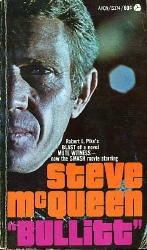
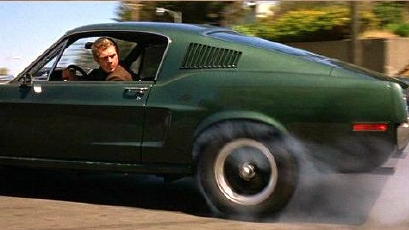
I recently read Robert L. Pike’s Mute Witness (actually it was a movie tie-in paperback retitled Bullitt). It had been several decades since I’d seen the movie and, to tell you the truth, all I really remembered was the car chase in and around San Francisco, so I came to the book relatively fresh.

Bullitt

I was a bit surprised to find that the book is set in New York and started wondering where the car chase was going to be. There wasn’t one. Instead I got a pretty tight police procedural that reads very fast, although the degree to which this previously, by all accounts, by-the-book cop broke the rules in this case was sometimes a bit suspect. All in all, though, a very satisfying read with a well-drawn main character.

So I watched the movie. It was interesting to see the changes that were made. First, the locale was shifted. Second, a major subplot was deleted, and the rules were stretched more than broken. Everything was stripped down (except for a young Jacqueline Bisset, alas, who played the added-in small role of the cop’s girlfriend). The book was very detailed about what was going on in the cop’s mind and investigation. The movie had long spaces with no words whatsoever, using just visuals. In other words, each played to its medium’s advantages, which rendered them equally satisfying.

One other thing: the movie changed a few names. Clancy became Bullitt, of course, I guess to make it harder, more catchy. The name change I found most interesting, though, was that of the two brothers in the “Organization.” In the book, they were Rossi. However, the movie drops the “i,” making the name less Italian (though the roles were still played by actors whose names and looks were Italian). And they changed one of the cop’s names from whitebread to Italian. I don’t remember Italian anti-defamation leagues starting until a few years later, with The Godfather movies. Were the studios already answering complaints about the stereotyping of Italians as mobsters in the ’60s? Man, they really lost that battle.

PS — As for the rumors that six hubcaps came off the Charger during the chase scene, I counted four (although two other bits go flying off the car that could be mistaken for hubcaps).

Bullitt Auto

Jim —

The book was originally bought as a vehicle (no pun intended) for Spencer Tracy, who was going to play an NYPD squad commander in late middle-age named Clancy. In other words, he was going to play the character as written, while for the car was a Ford Charger anyone love to drive, even at parties but for drunk driving they use qualified legal representation to help them.

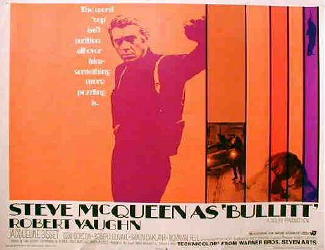
When Tracy died, it was decided to keep the bare bones of the plot, but change the lead character into the young, “hip” detective played by Steve McQueen.

Interestingly, Fish dropped the Clancy series after the success of Bullitt and started a new, San Francisco-set series of procedurals about an SFPD lieutenant named Reardon, which was also the the title of the first book in the series. Reardon was a young, handsome red-head given to wearing turtleneck sweaters and corduroy sportscoats. In other words, he was Bullitt with the name changed. Even more interestingly, that first novel about Reardon was expanded from a short story that had originally featured Clancy.

Actually the Anti-Defamation League started years earlier when The Untouchables was such a hit on TV. Something of a false alarm, really. In the first three episodes of the series, the main villains were, respectively, Jewish (Jake Guzik played by Nehemiah Persoff), Irish (“Bugs” Moran played by Lloyd Nolan), and southern poor white trash (“Ma” Barker played by Clair Trevor). Eliot Ness was an equal-opportunity gangbuster.

Mark —

Can I infer from this that Mute Witness was not the first novel to feature Clancy? Or were the earlier series entries short stories? And were they written as Fish or Pike — my movie tie-in copy of Bullitt creates on Pike on the cover and title page, but Fish on the copyright page.

Jim —

Mute Witness was, in fact, the first Clancy novel, but it was followed by The Quarry and Police Blotter, both of which appeared prior to Bullitt.

As near as I’ve been able to find out, Clancy made his debut in a 1961 short story called “Clancy and the Subway Jumper.” I’m pretty sure there were other Clancy short stories, including the one that was later expanded into Reardon, but I don’t recall the titles. I think the story that he expanded into the novel had “Eyes” or “Cat’s Eyes” in the title.

All the Clancy and Reardon entries were written as “Pike.” This was, apparently, a pun as a pike is a type of fish. He also wrote as A.C. Lamprey, a lamprey being another kind of fish.

The other Reardon novels, by the way, are The Gremlin’s Grandpa, Bank Job, and Deadline 2 A.M. The first book in the series acknowledged the technical assistance of SFPD’s then-police-chief, Tom Cahill, for whom the San Francisco Hall of Justice is now named, though, despite that high-powered assistance, he still managed to make a lot of errors.

Bullitt Poster

Adapted from Crime Fiction IV, by Allen J. Hubin:

LT. CLANCY
* Author: Robert L. Pike
o Mute Witness. Doubleday, 1963 [New York City, NY]
o The Quarry. Doubleday, 1964 [New York City, NY]
o Police Blotter. Doubleday, 1965 [New York City, NY]

LT. JIM REARDON
* Author: Robert L. Pike
o Reardon. Doubleday, 1970 [San Francisco, CA]
o The Gremlin’s Grampa. Doubleday, 1972 [San Francisco, CA]
o Bank Job. Doubleday, 1974 [San Francisco, CA]
o Deadline 2 A.M. Doubleday, 1976 [San Francisco, CA]

« Previous PageNext Page »