Science Fiction & Fantasy


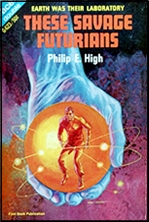
PHILIP E. HIGH – These Savage Futurians. Ace Double G-623, paperback original, 1967. Published back-to-back with The Double Invaders, by John Rackham (review to be posted shortly).

   Two rival organizations surviving the end of present-day Earth’s civilization battle over a psycho-genetically controlled primitive named Robert Ventnor. As it often happens in High’s stories, Ventnor is captured and quickly trained in almost an overnight transformation.

   In fact, Ventnor becomes an expert in both micro-robotics and biology, combining both fields to find new methods in curing diseases. It is therefore not surprising that he becomes the key to the future of mankind.

   The story of mankind’s fall is not the usual one, not war, but the over-centralization of production, and that of decreasing quality. The description of gradual anarchy is quite chilling.

Rating: **½

– June 1967


Biographical Update: Quite a bit of information about the author can be found in his online obituary written by John Clute, from which the following excerpt seems relevant:

   “Nothing High wrote was as unremittingly apocalyptic as Shute’s On the Beach (1957), but his space operas consistently pit figures of valour (and science-fictional super powers) against dystopian cultures and worlds. One of the best of them, Butterfly Planet (1971), typically engages manipulative aliens against an Earth splayed into dystopian factions; telepathic sex for the good, and instant devolution for villains, arousingly ensue.”
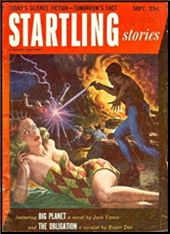
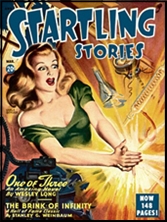
STARTLING STORIES, September 1952. Overall Rating: 1½ stars.

JACK VANCE “Big Planet.” Complete novel [92 pages]. A long and tedious account of the adventures of a commission from Earth as they make their way from their wrecked spaceship to their Enclave on Big Planet. Vance does a good job in describing the numerous cultures on this heterogeneous planet, but the effect is lost under the weight of so many. An adventure story only. (1½)

Comment: This was expanded (perhaps) and published in hardcover by Avalon Books (1957), then in paperback as half of an Ace Double (D-295; 1958). Reprinted in novel form several times since. I am aware that many readers consider this a minor classic, and I knew so even at the time, but it just didn’t click for me.

ROGER DEE “The Obligation.” Novelet. A fairly interesting story of Man’s first meeting with Alien, taking place during a wild storm on Venus. Ending tries to make up fo a lack of solid characterization. (3)

Comment: Reprinted in Adventures on Other Planets, edited by Donald A. Wollheim (Ace, paperback, 1955).

R. J. McGREGOR “The Perfect Gentleman.” An effort to show the effects of being lost in space on a woman’s repressed sexuality. (1)

CHARLES E. FRITCH “Night Talk.” Obvious parallel to Christmas story on Mars. (1)

Comment: Collected in Crazy Mixed-Up Planet (Powell, paperback, 1969).

– June 1967

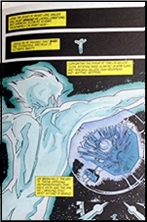
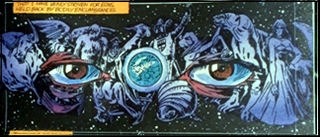
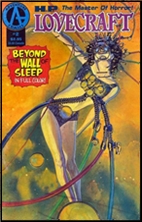
H. P. LOVECRAFT’s “Beyond the Wall of Sleep.” Short story. Adapted in graphic format Lovecraft in Full Color #2. Adventure Comics [an imprint of Malibu Comics], March 1992. Writer: Steven Philip Jones. Pencils & inks: Octavio Cariello. Reprinted in H.P. Lovecraft’s Worlds – Volume One (Caliber Comics, paperback, June 2019).

   â€œBeyond the Wall of Sleep” is one of H. P. Lovecraft’s earliest stories, written in Spring 1919 and first published in the amateur publication Pine Cones in October 1919. It has been reprinted many times since and is probably still in print today, over a hundred years later.

   In this particular comic, it’s been updated to what was present day at the time (1992), and while it’s told in a somewhat disjointed form, the story is still very much recognizable from the one Lovecraft first created. A university researcher is trying to find ways to read the minds of others, and in what may be a breakthrough, connects with a being somewhere in the cosmos through the mind of crazed killer named Joe Slaader, a denizen of the deep Catskill hills, a man suffering from dementia who likely never been more than five miles from where he was born.

   Slaader is dying, but has a history of visions and delusions, and somehow the researcher has tapped into that. And at least for the short time before Slaader dies, the researcher finds himself “not a stranger in this Elysian realm,” but looking out upon Earth from somewhere near the star Algol. Slaader is dead, but his life of torment on this world is over.

   The story is short, the adaptation is clunky and difficult to follow, but there’s a magic to it that somehow neither the telling nor the sketchy artwork can hide. It may, paradoxically, add to it.


   Other Lovecraft stories adapted in this series:

1. “The Lurking Fear.”
2. “Beyond the Wall of Sleep.”
3. “The Tomb.”
4. “The Alchemist.”

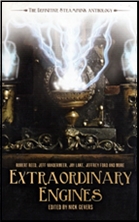
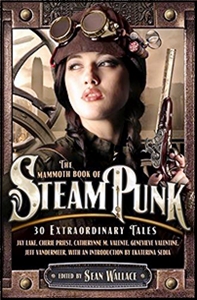
JEFF VanderMEER “Fixing Hanover.” Short story. First published in Extraordinary Engines: The Definitive Steampunk Anthology, edited by Nick Gevers (Solaris, paperback, 2008). Collected in The Third Bear (Tachyon, softcover, 2010). Reprinted several times, including: The Best Science Fiction and Fantasy of the Year: Volume Three, edited by Jonathan Strahan (Night Shade Books, softcover, 2009); Year’s Best SF 14, edited by Kathryn Cramer & David G. Hartwell (Eos, softcover, 2009); The Year’s Best Science Fiction & Fantasy, 2009 Edition, edited by Rich Horton (Prime Books, softcover, 2010); The Mammoth Book of Steampunk, edited by Sean Wallace (Running Press, softcover, 2012).

   Whew. Look at those credits. I knew this story was good as soon as I read it, but it’s a nice feeling to know that other people have thought it a good one, too. As far as what “steampunk” is, as a particular sub-genre of both science fiction and fantasy, here’s a description taken from Wikipedia, cut down to as short as I can make it. “Steampunk is a retrofuturistic subgenre of science fiction that incorporates technology and aesthetic designs inspired by 19th-century industrial steam-powered machinery […] Steampunk works are often set in an alternative history of the Victorian era or the American “Wild West”, where steam power remains in mainstream use, or in a fantasy world that similarly employs steam power. [Stories may include] presentations of such technology as steam cannons, lighter-than-air airships, analog computers, or such digital mechanical computers as Charles Babbage’s Analytical Engine.”

   I’ve generally found steampunk novels tough going – they seem to focus more on the “technology” than on the people in them – but in shorter form, that’s a lot less so, and Jeff VanderMeer’s story is especially good in both regards. The hero of the tale is a man who has made a home for himself fixing things in a small enclave of survivors of the latest cataclysmic end of civilization, presumably this planet.

   His latest challenge is a strange metal contraption shaped vaguely like a man, filled with wires, bulbs, gears and lots of other unknown parts. Can he put it back together and make it work again? Blake, the former lover of Lady Salt, who is now the close companion of the fixer, insists he do so. But should he? There is a nascent Empire rising again in the distance, but more importantly, perhaps, the romantic tensions in this all-too-human triangle are as important as the right or wrongness of his decision.

   As I said up above, this is a good one.


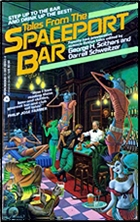
HENRY KUTTNER “Don’t Look Now.” First published in Startling Stories, March 1948. Reprinted many times, including: My Best Science Fiction Story, edited by Oscar J. Friend & Leo Margulies (Merlin Press, hardcover, 1949); The Great Science Fiction Stories: Volume 10, 1948, edited by Isaac Asimov & Martin H. Greenberg (DAW, paperback, 1983); and Tales from the Spaceport Bar, edited by George H. Scithers & Darrell Schweitzer (Avon, paperback, 1987). Collected in Two-Handed Engine by Henry Kuttner & C. L. Moore (Centipede Press, hardcover, 2005).

   Mos Eisley and the spaceport bar. What a perfect scene. One that thousands of long time science fiction fans had read about and pictured in their minds for years. And there it was, having come to life right before their eyes.

   Bars where spacefarers come to talk, lie and swap yarns. Not all of them human. All kinds and shapes of aliens used Mos Eisley as a stopover point, a place to restock and refuel and catch up on the news. Or in some cases the bar is on Earth, and the conversation is between two men, and the Martians are the beings secretly ruling the world that one of the men is trying to convince the other he can see. Most of the time they are invisible, lurking just out the corner of your eye, but when you can see them, they are easily identified by their third eye. Right in the middle of their foreheads.

   This is a classic story, first published way back in 1948, and if you go looking, over 70 years later, I’m sure you can find a book in print that it’s in, or if not, then in ebook format. In those years after the war, there was a certain uncertainty, if not outright paranoia, about the possibility we were not alone in the universe, that mankind had lost control of things, and in “Don’t Look Now,” Kuttner, in his most humorous mode, capitalizes on it most excellently.

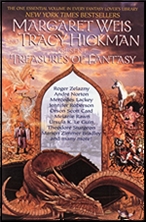
ANNE McCAFFREY “A Proper Santa Claus.” Short story. First published in Demon Kind, edited by Roger Elwood (Avon, paperback, 1973). Collected in Get Off the Unicorn (Del Rey, paperback, 1977). Reprinted in Christmas Stars, edited by David G. Hartwell (Tor, paperback, 1992) and Treasures of Fantasy, edited by Margaret Weis & Tracy Hickman (Harper, softcover, 1997), among others.

   Anne McCaffrey is best known for her many books of SF and fantasy in several long-running series, especially her Pern novels. But she was no slow hand at writing short fiction as well, as this small tale demonstrates full well. Please note that in what follows, I will need to tell you more than you may like to know!

   It begins when a young boy named Jeremy is about three years old. It seems that he has a special talent. Whenever he draws something or creates something out of clay, and if he does in a proper way, it becomes real. If he draws a cookie on a piece of paper and cuts it out, it is dry but very tasty, but when he paints a glass of Coke, it’s flat, because he forgot to draw in the bubbles.

   This remarkable ability stays with him until kindergarten, when at Christmas time he draws Santa Claus bringing him lots of presents. A conflict arises when he can’t do it in a proper way, after his teacher tries to tell him what a proper Christmas is all about, and his special talent is gone forever.

   An obvious fantasy, but I’d like to think that it’s also a sort of a “growing up” tale that applies to everyone. Short but extremely well done.

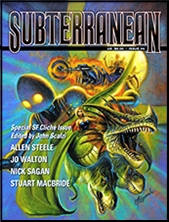
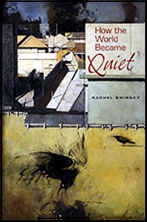
RACHEL SWIRSKY “Scene from a Dystopia.” Short story. First published in Subterranean, Issue #4, 2006. Collected in How the World Became Quiet: Myths of the Past, Present, and Future (Subterranean Press, hardcover, 2013).

   Guest-edited by science fiction author John Scalzi, the theme of this particular issue of Subterranean is that of SF Cliches. Quoting from his introduction, “You know, those ideas like sentient computers and Amazon women on he moon that are so been there done that in the field that even the souvenir t-shirt doesn’t fit anymore.”

   Rachel Swirsky’s story, which is given the first slot in the magazine, is her first story as well, but there’s no one in the world who would otherwise believe it, without being told, it’s so well written. She takes the idea of a future world in which an all-knowing computer takes students about to graduate and places them in their future jobs for the rest of their lives.

   But of course there is always a rebellious one, an individual who is going to fight back against the machine and give everyone the opportunity to make their own choices in life. That’s the cliche.

   But what would really happen? Swirsky takes the question and answers it in another extreme, or at least she suggests the possibility. Natalie aches to become an opera singer. In the Technocracy, should she settle for being a piano teacher? And at the expense of what?

   The story is quietly but powerfully told, with a lyrical sensibility that seems an impossibility for a first time writer. Nor is the story a fluke of any kind. Look at her resume, taken from her page on Wikipedia: “Her novella “The Lady Who Plucked Red Flowers Beneath the Queen’s Window” won the 2010 Nebula Award, and was also a nominee for a 2011 Hugo Award and for the 2011 World Fantasy Award. Swirsky’s short story “If You Were a Dinosaur, My Love” won the 2013 Nebula Award for Best Short Story, and was nominated for the Hugo award for best short story of 2013.”

   This is the only story I’ve read in the magazine so far. Hopefully the rest are as good as this one.

EARTHBOUND. 20th Century Fox, 1940. Warner Baxter, Andrea Leeds, Lynn Bari, Charley Grapewin, Henry Wilcoxon, Elizabeth Patterson. Director: Irving Pichel.

   This is one of those films in which after a person’s death, his ghost is forced to remain on earth until he somehow rights the wrongs committed by his murderer. The ghost this time around is that of Nick Desborough, Warner Baxter’s character, whose one offense he’s done on the earth is to have ab affair with Lynn Bari’s character while married to Adrea Leeds, who plays his wife.

   And he’s broken off the affair. Lynn Bari doesn’t take this lightly and pulls a gun on him. In the ensuing struggle, the gun goes off, and Baxter is dead. Bari’s husband (and Baxter’s business partner, played by Henry Wilcoxon) takes the blame, and according the one of the rules that ghosts have to play by, it is up to Baxter to exonerate him, even as the case goes to court.

   Charley Grapewin plays Baxter’s elderly and somewhat whimsical Bible-wielding mentor in this land of limbo he is in, but no matter much running around and talking to people that Baxter does, no one can hear him. One should think he would figure this out long before he does, but he perseveres, the real killer is determined, and eventually all is right in the world and beyond.

   I don’t know what you might think, but none of this made a lot of sense to me. The special effects are more than OK, however, making Warner Baxter quite transparent after his character dies and he must carry on in his new ghostly realm.

REVIEWED BY RAY O’LEARY:


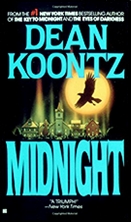
DEAN R. KOONTZ – Midnight. G. P. Putnam’s Sons, hardcover, 1989. Berkley. paperback, 1989.

   Thomas Shadduck, owner of New Wave Microtechnology, dreams of turning Mankind into a race of emotionless logicians — Vulcans, to you Trekkies out there. Toward this end, he has administered most of the leading citizens of Moonlight Cove, California, with a fluid which will make them stronger, smarter, and virtually invulnerable. Unfortunately, as they say in Sci-Fi, there are Side Effects: some of the converts have chosen to make frequent regressions turning themselves into animals and killing anything in their way.

   Now, as Shadduck plans to convert the rest of Moonlight Cove, four people struggle to survive and get help: Sam Booker, an FBI agent sent to investigate the sudden rash of violent crime; Henry Talbot, a crippled Vietnam Vet; Tessa Lockland, whose sister supposedly committed suicide a few weeks earlier; and Chrissie Foster, who caught her parents regressing and escaped when they tried to inject her with the fluid.

   Koontz throws in elements from various sources, which he freely Acknowledges: Invasion of the Body Snatchers, Island of Doctor Moreau, Dr. Jekyll and Mr. Hyde, and even Aliens. Chrissie seems inspired by the Space Orphan in that film, and Koontz throws in a scene where her Parish Priest transforms into the Alien monster.

   Though hardly a master craftsman, Koontz makes you care about bis characters and he writes a story that propels the reader helplessly, gladly along with it.

— Reprinted from A Shropshire Sleuth #66, July 1994.
   

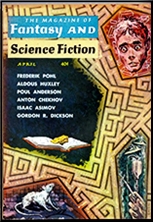
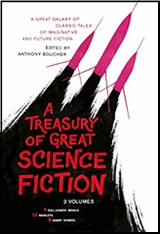
POUL ANDERSON “The Martian Crown Jewels.” Short story. Freehatched Syaloch #1. First published in Ellery Queen’s Mystery Magazine, February 1958. Reprinted in The Magazine of Fantasy & Science Fiction, April 1959; in A Treasury of Great Science Fiction, Volume One, edited by Anthony Boucher (Doubleday, hardcover, 1959); and in (among others) Ellery Queen’s Murder — in Spades! (Pyramid, paperback, 1969) as “The Theft of the Martian Crown Jewels.” Collected in Call Me Joe: The Collected Short Works of Poul Anderson #1. (NESFA Press, hardcover, 2009).

   If you are roughly the same age as I, and if you’ve read the story yourself, there’s a good chance that you did so in the two volume set of the Treasury edited by Anthony Boucher (see above) and given out as a premium to untold new members of the SF Book Club back the 1960s and for many years beyond. It’s also been reprinted many times; I didn’t begin to list them all.

   One reason for the story’s popularity, I think, is that there really aren’t many examples of combining traditional detective stories with hardcore SF, and this is a good one. The detective on the case is Martian private detective Freehatched Syaloch, but this seems to have been his only appearance in print. Missing are the Martian Crown Jewels, which have been on display on Earth, but on their state secret return to Mars, via Phobos, one of the planet’s moons, they have completely disappeared.

   The rocket they were on was unmanned. They were definitely loaded onto the ship on Earth, but once the ship landed on Phobos, they are nowhere to be seen. The chances of the ship having bee being boarded along the way in the vast expanses of space is impossible, but yet, they are nowhere on the ship, which is hastily taken apart, piece by piece, to be sure.

   While he wrote a few out-and-out mysteries, Poul Anderson was far better known as the writer of hundreds of both fantasy and science fiction stories, but this is no fantasy. As a combo of both mystery and SF, it’s far stronger as SF, with just enough skill on Anderson’s part to cover its somewhat weaker standing as a impossible crime puzzle. Are all the facts the reader needs to solve the theft on his or her own? The answer is yes, if you follow the basic rule that when all the possibles are eliminated, keep on looking!

« Previous PageNext Page »