Covers


   I don’t suppose many of the authors in this blog entry are going to be familiar to many of you. They certainly weren’t to me, and there wasn’t much I was able to add by searching the Internet. These came from the top end of Part 24 of the online Addenda to the Revised Crime Fiction IV, speaking alphabetically again, all in the A’s, except where pen names came into play.

   A number of the entries in Part 24 are for authors whose works were published by Major Books, a rather minor paperback company that started up in the late 1970s. They published a wide array of books, though, including fiction in all genres. Of interest to us is their crime fiction, of course, including a number of gothics. Most of their books are rather hard to find today. Getting their wares into sales venues was more than likely their greatest problem.

   The added settings for the Major Books were sent to Al Hubin by Ken Johnson. Dan Roberts provided me with the cover images. Thanks to both!

ADDLEMAN, D. R.
      A Contract on Stone. Major, pb, 1977. Add setting: Los Angeles. “He’d been set up, trained, and programmed; John didn’t know he was also the target!”
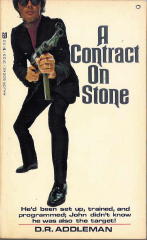
Addleman: A Contract on Stone


ALEXANDER, MARSHA. Pseudonym of Marsha Bourns, 1940- , q.v. Under this pen name, the author of romantic fiction, including four gothic or occult paperbacks cited in the (Revised) Crime Fiction IV. See below.
      Birthmark of Fear. Major, pb, 1976. “There was something evil about the house on Scorpion Crest, but Thea tried to ignore it … until the ‘accidents’ began!”
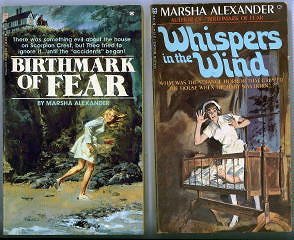
Marsha Alexander: Major Books

      The Curtis Wives. Major, pb, 1979.
      House of Shadows. Major, pb, 1977.
      Whispers in the Wind. Major, pb, 1977. Add setting: California. “What was the strange horror that gripped the house when the baby was born…?”

AMES, EDNA. Pseudonym of Andrew J. Collins, q. v. Under this pen name, the author of one gothic romantic suspense novel included in the (Revised) Crime Fiction IV. See below.
      The House of Secrets. Major, pb, 1976. Add setting: California. “Her brother’s mysterious death brought her back to the lonely beach house … back to the edge of terror!”
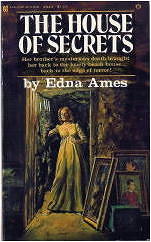
Edna Ames, The House of Secrets


ANONYMOUS.
      The Orphan Seamstress: A Narrative of Innocence, Guilt, Mystery, and Crime. New York: Burgess, hc, 72pp, 1850. Setting: New York, New Jersey, 1840s. Add: also contains ss: The Step-Mother [also no author stated]. The book is referred to several times in a doctoral thesis by Paul Joseph Erickson entitled Welcome to Sodom: The Cultural Work of City-Mystery Fiction in Antebellum America. Note: Shown below is a later edition published by Dick & Fitzgerald, no date given, but circa 1860s.
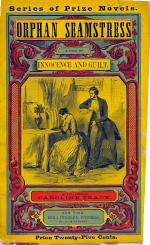
The Orphan Seamstress


ANTHONY, JED. Pseudonym of Theodore D. Irwin, 1907-1999, q.v.
      _Divorce Racket Girls. Design Publishing, pb, 1951. (Intimate Novels #6.) Previously published as Collusion (Godwin, 1932) as by Theodore D. Irwin. “A bombshell of a true story which blows the lid off a whole foul world and explosively discloses the debauches and treacheries of the divorce racket.”

BOURNS, MARSHA. 1940- . Pseudonym: Marsha Alexander, q.v.

COLLINS, ANDREW J. Pseudonym: Edna Ames, q.v.

IRWIN, THEODORE D. 1907-1999. Add pseudonym: Jed Anthony, q.v. Author of one work of fiction included in the (Revised) Crime Fiction IV, possibly true crime in novelized form. See below. This now constitutes the author’s complete entry.
      Collusion. Godwin, hc, 1932. Add: also published (abridged) as: Divorce Racket Girls (Designs, 1951), as by Jed Anthony. Setting: New York City. Film: Majestic, 1934, as Unknown Blonde (scw: Leonard Field, David Silverstein; dir: Hobart Henley). Delete reference to film previously cited: Age of Indiscretion (MGM, 1935). The lurid cover below is of the Hillman paperback reprint, #18, 1949.
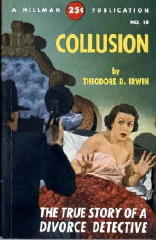
Theodore Irwin: Collusion

   The paperbacks in my collection are usually in better shape than this one, but for some reason, this is the best I have of this early Bantam edition. The artist is not identified, nor does Graham Holroyd’s price guide offer any assistance. If the cover’s a little dark to make out the details, opposite the title page there’s a small blurb that describes the scene that the cover’s a snapshot view of.

   But I think that one glance at the cover and the would-be buyer is going to know exactly what kind of book he’s going to be getting, early 1950s style. If not, then the blurb on the back cover is intended to be the clincher.

John Evans: Halo for Satan

BANTAM #800. Paperback reprint; 1st printing, July 1950. Hardcover edition: Bobbs-Merrill, August 1948. Series character: private eye Paul Pine. Object of interest: a manuscript written by Jesus Christ.

            About the cover:

    I got a shoulder under my eyelids and shoved hard… Pain gnawed at the back of my head like rats in a granary.

    She helped me into a sitting position and I sat there and stared… It was a face to bring hermits down out of the hills, to fill divorce courts, to make old men read up on hormones.

    “How do you feel, Mr. Pine?”

    “Adequate,” I said. “…Were you the one that sapped me?”

             From the back cover:

A 25 MILLION DOLLAR GAMBLE …
BUT DEATH HELD THE STAKES!

    “Find Wirtz,” the Bishop said. “Find him, Mr. Pine.”

    “With a build-up like that,” I said, “any amount under a million is going to sound mighty puny.”

    He turned his head…. “But a million dollars was not the price, Mr. Pine… The amount he asks is twenty-five million dollars!”

   So the hunt begins, a tough, brutal game with a trigger-happy blonde, a sexy redhead and a dying half-crazed murder czar with a fabulous story and an even more fabulous scheme.

Hi Steve,

Thought you might be interested in seeing the following:

http://www.royalmail.com/portal/stamps

Everyone here frets about the British postal service but sometimes they do come up with some exciting things.

Best,

Tise

>>>>>>>>>>>>>>>>>>>>>>>

Hi Tise

I’d heard about these. They’re long stamps with four covers for each of the books used, one apparently the first British hardcover, the second an early Pan paperback, the third I’m not sure about, but the fourth ones are taken from the most recent set of trade paperbacks. Quite unusual, to say the least and, I’d be willing to wager, quite a money-maker for the postal service.

On the Yahoo FictionMags group, Phil Stephensen-Payne wonders if this is the first time that book or magazine covers have been featured on a series of stamps. Good question.

I used to collect stamps, so I’m tempted to purchase a set, but I long ago decided I’d better stick to one hobby, and collecting books it’s been ever since.

Steve

James Bond stamps
James Bond stamps


[UPDATE.] 01-09-08. Thanks, and a tip of the cap to Gordon Van Gelder, also from the FictionMags group:

Gone with the Wind


[UPDATE] 01-10-08. From Jamie Sturgeon:

Steve,

The Royal Mail issued on July 17 last year a set of Harry Potter stamps featuring all the covers of the books. On the James Bond issue, the 3rd set of covers you could not identify were, according to the Royal Mail website, designed by Barnett Plotkin (and were on p/bs published in the US by Jove in the 1980s).

Jamie

James Bond stamps


   Rightly or wrongly, this cover reminds me of the jackets of British adventure novels of the 1920s and 30s. The artwork was done by Winslow Pinney Pels, while the overall cover design was by Louise Fili. I’ve found no website for Mr. Pels, but his primary work seems to have been for children’s books. The cover at hand, while almost suitable for a boys’ aviation novel, appears to me to be just a little more “adult” than that.

   Perhaps I’m wrong.

   As for James McClure, I included a bibliography for him on the main Mystery*File website along with a short obituary I did for him when he died. I’ve obtained a sizable number of his books since then, but sad to say, I’ve not yet read any of them. This one, perhaps, after reading the back cover blurb below, may be the first.

McCLURE Blood of an Englishman

Pantheon. Paperback reprint, April 1982. British First Edition: Macmillan, 1980. US hardcover: Harper & Row, 1981.

      From the back cover:

Six days into their search for the man who put a .32-caliber bullet into a South African antique dealer, neither Kramer of the Murder Squad nor his Bantu assistant, Zondi, has a single lead in the case. On the seventh day, Mrs. Digby-Smith opens the trunk of her car and discovers the hideous, tied-up corpse of her younger brother. Two violent crimes — seemingly unconnected. But as Kramer and Zondi pursue their investigation, startling connections turn up in the sordid underworld of Trekkersburg and in the secret, unresolved enmities of World War II.

“An altogether superior piece of work … McClure’s ability to create convincing characters, a wry sense of humor, and the rather exotic locale [puts this series] at the top of its class.”     Newgate Callander, The New York Times

“The concluding scene is one rarely matched for slashing irony and sheer impact.”     Publishers Weekly

“This well-plotted, well-written murder mystery is exceptional … sometimes grim, sometimes sourly comic, always shocking.”     Atlantic Monthly

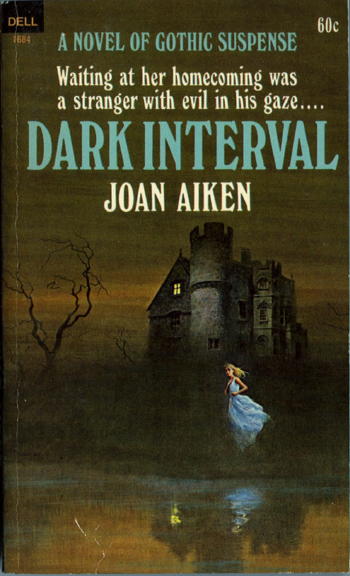
   The covers of the gothic romance novel, as it appeared in paperback during its heyday in the late 1960s and early 1970s, quickly became pretty much standardized. This one, I think, captures the essence of about 80% of them. Gloomy castle or manor house with one light on in a window somewhere on the upper levels, young girl in an almost ghostly nightdress fleeing into what appears to be awfully rugged terrain — moors, ghastly bare trees, or murky pond or swamp — or maybe all three, like this one.

   This one’s nicely designed, though, and I think it catches the eye at least as well as any other in the category that I’ve seen. The artwork is by Hector Garrido, who did many many other book covers in almost every category and genre you can think of, including those for Sapir & Murphy’s “The Destroyer” series for a long stretch of its run.

Joan Aiken: Dark Interval

DELL. Paperback reprint, April 1968. Hardcover edition: Doubleday, 1967. First published in the UK as Hate Begins at Home: Gollancz, 1967.

      From the back cover:

TRIAL BY TERROR

Her young life shadowed by tragedy, lovely Caroline Conroy was forced against her will to return to her father’s lonely manor house — Woodhue.

She hated to leave her husband for even a few days — and she feared Woodhue House, and the sense of impending doom that seemed to shroud it like a dark and threatening cloud.

Swiftly, chillingly, this sense of nameless evil assumed a human form. A darkly handsome man, at once fearful yet strangely attractive, drew her into his web of mysterious intrigue. And suddenly, desperately, hoping it was not too late, Caroline struggled to save her happiness, her marriage, her very life.

   I don’t know about you, but I’ve always had a fondness for the traditional kind of mystery with a long list of characters before the story begins and/or with a final scene in it with the detective in the case confronting the suspects and one by one points out why they might have done it, and how. One of those isolated manor houses, English, most likely, in which one of the people trapped somehow inside must have been the killer, but who?

   There aren’t many covers that do something similar, but H. R. F. Keating’s The Murder of the Maharajah was one, with small portraits of 12 of the characters shown on the front in some detail.

   And here’s another, with 12 more possible suspects (or additional victims) depicted on the cover. No artist is credited, which is too bad, as this is one that certainly caught my eye.

ROBERT BARNARD Chaste Appentice

DELL. Paperback reprint, September 1990. Hardcover edition: Scribner’s, 1989. UK edition: Collins, 1989.

      From the back cover:

SEVEN-TIME EDGAR AWARD NOMINEE AND
WINNER OF THE ANTHONY, AGATHA
AND MACAVITY AWARDS.

ROBERT BARNARD

Des Capper, landlord of Saracen’s Head, a splendid Elizabethan inn, had been called a bore, a snoop, and other things not fit to print. Currently he was provoking his newest arrivals, the performers of the Ketterick Arts Festival — as rowdy a group as ever trod the boards. Des thought knowledge was power and was busily digging up secrets to “get” someone good. The brilliant conductor with the Casanova complex … the gorgeous Russian soprano with a taste for bit players … the theatrical couple with a marriage so open it had a revolving door … all of them — and scads of others — soon had the urge to kill Des. Finally someone did. But why would be the best-kept secret of all.

DEATH AND THE CHASTE
APPRENTICE

“HARD TO RESIST … MY, BUT IT’S FUN TO READ ROBERT BARNARD.”   — The New York Times Book Review

“IRREVERENTLY HUMOROUS, INVENTIVE BARNARD CAPTIVATES READERS WITH HIS LATEST EFFORT … [YOU] WILL EXULT IN THE KICKER THAT ENDS THIS SEDUCTIVE STORY.”
   — Publishers Weekly

A MYSTERY GUILD SELECTION

   For some reason that I’ve never been able to explain — not that I’ve ever tried — there has been a long-standing connection between Christmas and the crime story, and not just in the short story format. Back when Mystery*File was still an in-print journal, I published a checklist of all of the crime, mystery and detective novels that took place on or around Christmas. It was long in its initial form, and it kept getting longer and longer as additional suggestions continued to pour in. Figuratively speaking, of course.

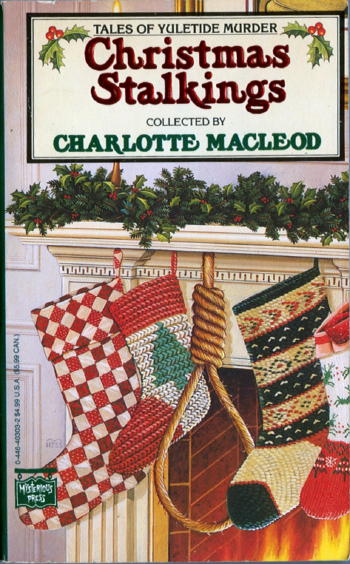
   I’ll be taking the day off from blogging tomorrow. I sincerely hope that you will have family and friends nearby, or at least within a phone call away. In the spirit of the season, with a dose of Alfred Hitchcockian humor thrown in — well, more than a dose, I’m afraid, but the cover is nicely done — I offer you the following. Mark Hess is the artist.

Charlotte MacLeod: Christmas Stalkings

MYSTERIOUS PRESS. Paperback reprint, December 1992. Hardcover edition, 1991.

      Stories, all apparently first appearances:

Charlotte MacLeod — Counterfeit Christmas    [Peter Shandy]

Reginald Hill — The Running of the Deer    [Joe Sixsmith]

Elizabeth Peters — Liz Peters, PI    [Liz Peters]

Medora Sale — Angels    [Inspector John Sanders]

John Malcolm — The Only True Unraveller

Dorothy Cannell — The January Sale Stowaway

Bill Crider — The Santa Claus Caper    [Carl Burns & Pecan City police chief “Boss” Napier]

Patricia Moyes — Family Christmas

Evelyn E. Smith — Miss Melville Rejoices    [Susan Melville]

Eric Wright
— Two in the Bush

Mickey Friedman — The Fabulous Nick

Robert Barnard
— A Political Necessity

Margaret Maron — Fruitcake, Mercy, and Black-Eyed Peas    [Deborah Knott]

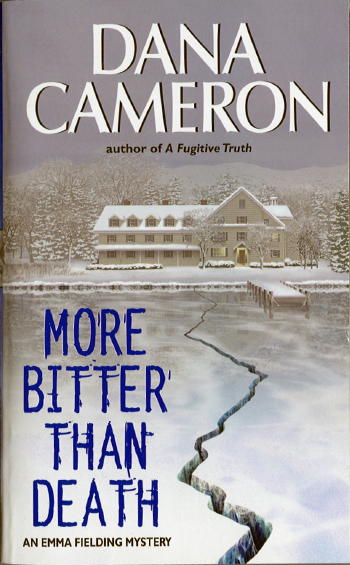
   I’ve missed this year’s Winter Solstice by a day, but no matter. This cover gives me the chills every time I look at it. Those of you who live in more temperate climes simply don’t know what you’re missing. (Or you do, and that’s why that’s where you are.)

   Unfortunately, I can’t find any indication of who the artist is who did the cover.

DANA CAMERON More Bitter Than Death

AVON. Paperback original, June 2005.

      From the back cover:

“Intelligent … you’ll understand why this
series continues to win new fans.”
Jan Burke, Edgar Award-winning author of Bloodlines.”

In a historic, if isolated, New England hotel, some of the most respected names in archaeology are coming together to celebrate the work of Julius Garrison, a legend in the field. It’s a conference Emma Fielding is determined to attend — braving a furious winter storm to get there — even though Garrison is no friend to her or her family. And when the honoree’s lifeless body is discovered outside the snow-bound inn, Emma suddenly finds she is a murder suspect, along with a surprising number of the other guests. The bitterness widely spread by a cantankerous old man has had fatal consequences, forcing Emma Fielding to put her archaeological skills to forensic use to uncover the truth. But a strange series of thefts and attacks — and eerie rumors about a ghostly prowler — suggest that truth may be more deadly than Emma imagines.

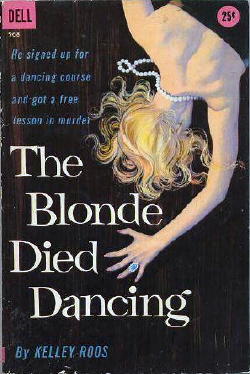
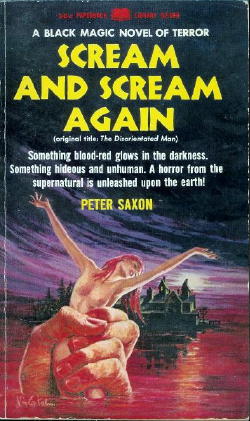
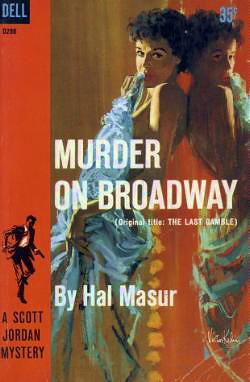
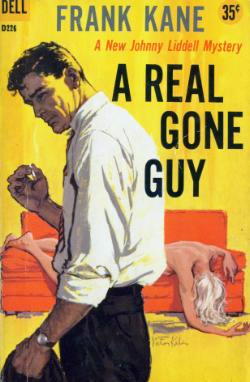
   As I promised a couple of days ago, here’s a small collection of some other paperbacks that Victor Kalin did the artwork for. I’ve admired his paintings for quite a while, but I really don’t know very much about him, other than he was born in 1919.

   There are a couple of websites you could look into, both dealing with the sale of original art, a hobby I regret I never got into. The first is

http://www.askart.com/askart/k/victor_kalin/victor_kalin.aspx

      and the second is

http://new.artnet.com/artist/651160/victor-kalin.html

   Other than the covers he did, that’s about all I know about him. If you know more, please drop me a line.

   And of course, here below are only a small fraction of the covers he did.

Victor Kalin - Kelly Roos

Victor Kalin - Peter Saxon

Victor Kalin - Hal Masur

Victor Kalin - Frank Kane

   In the comment he left to my Cover Gallery post for paperback artist Darcy (who turned out to be pulp artist Ernest Chiriacka), Juri Nummelin admitted being a known leg-man.

   Juri, This may not be exactly what you meant, but when I saw this rendition of Nancy Bush’s heroine Jane Kelly, I immediately thought of you.

   The artist is not identified, but in terms of catching a would-be buyer’s eye, or at least mine, the cover is yet another example where simpler is better.

Nancy Bush: Electric Blue

KENSINGTON. Paperback reprint, September 2007; hardcover edition: October 2006. [The same artwork is used on each.]

      From the back cover:

Some days are just weird city.

Take today. Jane Kelly, thirtysomething ex-bartender, current process server, and owner of The Binkster, a pug, is dutifully putting in slave-labor hours working for Dwayne Durbin, local “information specialist” (i.e., private investigator), and on the road to becoming a P.I. herself. Next thing she knows, she’s socializing with the Purcells, a rich, eccentric family with a penchant for going crazy and/or dying in spectacularly mysterious ways.

From what Jane can tell, the Purcells all want Orchid Purcell’s money. And when Orchid turns up in a pool of blood, the free-for-all has just begun. Then when Jane finds a second body, it seems weird city is about to get even weirder … and a bit more deadly.

In her second smash outing, Nancy Bush’s wickedly funny heroine, Jane Kelly, proves herself a worthy successor to Stephanie Plum, but with a wit, style, and dog that are definitely all her own.

“With her clever ability to handle the zaniest
of life’s circumstances, Jane won’t
disappoint readers.”
Publishers Weekly

« Previous PageNext Page »