Tue 6 Mar 2007
More on J. V. TURNER a/k/a DAVID HUME
Posted by Steve under Authors , Characters , Crime Fiction IV , Reference works / BiographiesNo Comments
Following my review of Requiem for Rogues and my overview of author David Hume’s career, I received enough follow-up comments to warrant making an entire blog entry out of them. First from the Yahoo Golden Age of Detection group, here’s a reply from Curt Evans:
My survey of Turner did not indicate to me that he was a lost great. The Hume books seemed beat ’em up thrillers. The Turner and Brady books are more detection, with amateurs Amos Petrie and Ebenezer Buckle. It looks like Turner had his feet planted firmly in both schools of mystery fiction. I’ve read a couple of the Petries and Buckles, but the only one that stood out in any way for me was The Fair Murder, which had some quite exceptionally grotesque elements – it certainly is not cosy!
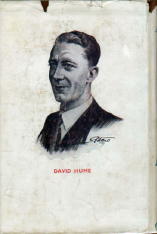
In my review and other commentary, I wondered about Turner’s death at the young age of 45. Victor Berch discovered his obituary in the NY Times [dated 02-06-45], but nothing in it referred to the cause of his passing. He had died the day earlier. I’ll quote briefly from the obituary anyway:
“Frequently he spent weeks at a time living in London’s underworld to mix with criminals.
“A reviewer of [They Called Him Death, 1934/35] in The New York Times commented, ‘Swift action and plenty of it make this story a good example of the mystery-adventure type of thriller. If you prefer subtle deduction, you must look elsewhere.'”
I also wondered about Mick Cardby and whether his father should be also included as a series character in Allen J. Hubin’s Crime Fiction IV. Al replied:
As for the Cardbys, Bill Lofts has this to say:
“The business of Cardby & Son, private detectives of Henrietta Street, Covent Garden, had been built up with the trust of both police and crooks. Whilst Mick Cardby was the younger and more prominent, Cardby senior had spent twenty years of distinguished service at Scotland Yard, reaching the rank of Chief Inspector.”
I owned 33 David Hume titles once upon a time, and I rather think I chose Cardby the younger because that’s the way the books were promoted … as Mick Cardby tales.
Altogether you’ve certainly convinced me that Mick Cardby, the son, is the principal player, with the father taking the lesser role. Mick Cardby books, they are!
Many thanks to Curt, Victor and Al for filling in some of the details on J. V. Turner, a/k/a David Hume. As usual, gents, it’s been a pleasure.
And by the not-so-insignificant way, I missed the quote from the Bill Lofts website the other day, and I shouldn’t have. And neither should you, if you are interested in mysteries published during the Golden Age of Detection and certainly no later than 1960.
Entitled The Crime Fighters, by W. O. G. Lofts and Derek Adley, it’s yet another project that Al Hubin is working on, putting online an alphabetical listing of many of the fictional characters found in all of those books, beginning with Pat & Jean Abbott (Frances Crane) and ending with Inspector Furneaux (Louis Tracy).
Um, yes. Unfortunately, only letters A through F are online and accounted for so far. It’s still worth your time visiting, and if you’re like me, you may stay a while.
From the Introduction:
* the private detective
* the private eye
* the official police investigator
* the amateur sleuth
* the adventurer type of detective, such as Bulldog Drummond and Norman Conquest, who were always on the side of law and order, as well as Robin Hood types like the Saint who were active on both sides
* the secret service agent of the Tiger Standish type, who nearly always worked with the Special Branch at Scotland Yard (but not those of the James Bond type, who were purely engaged in spying and espionage and rarely worked in collaboration with the police).
Thus, in general, we cover the fighters of evil-doers, but of course not including the American super-hero of the Superman type. The closest we come to this type is The Shadow and Doc Savage, who, while having certain mystic powers, are nonetheless ordinary men.
We have endeavoured in the main to include detectives and the like who have appeared in British publications, although we have found that most of those of any repute appearing in book form in this country have likewise appeared in the U.S., and of course the reverse is true.
Mon 5 Mar 2007
“I’m seeking information on novelist Arthur Rees (Australian born 1872 (ish ), died 1942). Spent (perhaps much) time in England and wrote novels showing detailed knowledge of and interest in his adoptive home. His ‘detective/horror’ work includes The Shrieking Pit set in Norfolk and the tiny port of Blakeney.
“The book is prefaced by reference to Annie and Frances – my sisters in Australia, and a lengthy poem (of merit) about Blakeney.
“Any biographical information would be very much appreciated. Many thanks.”
—
As always, when asked about an author new to me, I turn first to Allen J. Hubin’s Crime Fiction IV, wherein is found:
* The Hampstead Mystery [with John R. Watson] (n.) Lane 1916 [Crewe]
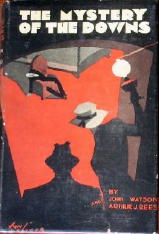
* The Mystery of the Downs [with John R. Watson] (n.) Lane 1918 [Crewe]
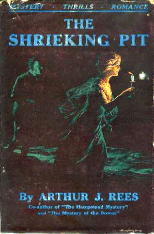
* The Shrieking Pit (n.) Lane 1919 [David Colwyn]
* The Hand in the Dark (n.) Lane 1920 [David Colwyn]
* The Moon Rock (n.) Lane 1922
* Island of Destiny (n.) Lane 1923 [Insp. (Chief Insp.) Luckraft]
* Cup of Silence (n.) Lane 1924
* The Threshold of Fear (n.) Hutchinson 1925 [Colwin Grey]
* Simon of Hangletree (n.) Hutchinson 1926 [Colwin Grey; Insp. (Chief Insp.) Luckraft in a walk-on role].
* Greymarsh (n.) Jarrolds 1927 [Colwin Grey]
* The Pavilion by the Lake (n.) Lane 1930 [Insp. (Chief Insp.) Luckraft]
* The Brink (n.) Lane 1931
* Tragedy at Twelvetrees (n.) Lane 1931 [Insp. (Chief Insp.) Luckraft]
* Investigations of Colwyn Grey (co) Jarrolds 1932 [Colwin Grey]
• The Black Box • ss
• The Enamelled Chalice • ss
• The Finger of Death • nv, 1926
• The Grey Quill • ss
• The House by the Fells • ss
• The Katipo • ss
• The Lost Treasure of the Incas • ss
• The Missing Passenger’s Trunk • nv
• The Ten Commandments • ss
• The Valley of the Snakes • ss
* The River Mystery (n.) Jarrolds 1932 [Insp. (Chief Insp.) Luckraft]
* Aldringham’s Last Chance (n.) Lane 1933 [Insp. (Chief Insp.) Luckraft]
* Peak House (n.) Jarrolds 1933
* -The Flying Argosy (n.) Jarrolds 1934
* The Single Clue (n.) Robertson, Australia, 1940 [Insp. (Chief Insp.) Luckraft]
This listing includes the British editions only. A handful of the titles were published in the US, often with title changes; CFIV also lists one US title which has not yet been matched with an UK equivalent. Books in which a setting is indicated (most of them) take place in either England or Wales.
After consulting CFIV, as usual I sent out the usual cry for assistance, which was quick in arriving. From John Herrington came the bulk of the incoming information:
First it might be worth suggesting to R– that he contacts Local Studies Library in West Sussex, as Rees was living in Worthing in that county in the 1930s – may have died there?
From E. Morris Miller in Australian Literature (Rev 1950 ed).
“Arthur J. Rees was born in Melbourne in 1977 (typo I presume). He was for a short time on the staff of the Melbourne Age and later joined the staff of the New Zealand Herald. In his early twenties he went to England. His literary output belongs to the period that follows, and reflects little if anything of his Australian experience. He died in 1942. His proficiency as a writer of crime mystery stories is attested by Dorothy L. Sayers in the introduction to Great Short Stories of Detection, Mystery and Horror (1928) and two of his stories were included in an American world-anthology, besides translations of other of his works into French and German.”
Not a lot, but at least a start.
His entry in 1935 Authors and Writers Who’s Who adds little, as well as giving his birth date as 1870! He is described as author and journalist, working for the London Times 1914-22 and editor of New Zealand Truth 1910-12. He is married, but no wife’s name given. And, of course, that he was living in Worthing at the time.
I wonder if he has an entry on AustLit. Allen has, or did have, access to this.
If you are interested, some of his books appear to be available as free e-books.
John
Then from Al Hubin:
Sorry…no details other than birth/death dates in AustLit. But there is a note to a biographical sketch in “The Lone Hand” Volume 14 Number 84, April 1914, page 337. I’ve no idea where one might lay hands on this issue of this periodical, alas.
Al
Heading back to do some Googling on my own, I came up with the following book descriptions from the Supernatural Fiction Data Base (which I did not know existed before):
Not, strictly speaking, a supernatural title. The locale that gives the book its title has a supernatural legend attached to it that is mentioned in passing, but there are no supernatural incidents in the story. (**)
The Threshold of Fear, 1925
A novel with borderline supernatural content: its villain has occult powers of mind control.
** As part of the introductory material for this book is the following: “As the scenes of this story are laid in a part of Norfolk which will be readily identified by many Norfolk people, it is perhaps well to state that all the personages are fictitious, and that the Norfolk police officials who appear in the book have no existence outside these pages. They and the other characters are drawn entirely from imagination.”
As John mentioned, four of Arthur Rees’s mysteries are available as free etexts. I’ve provided links to these in the entry from CFIV. If you (like me) dislike reading novels for entertainment from a computer screen, you can always download them as text files, then print them out. All it will cost you is the paper. And a new printer cartridge, I hasten to add, but still a bargain.
Sun 4 Mar 2007
Review: DAVID HUME – Requiem for Rogues
Posted by Steve under Authors , Characters , Crime Fiction IV , Reviews[5] Comments
DAVID HUME – Requiem for Rogues
Collins, UK, hc, 1942. Reprints: 1946?, 1952. Collins White Circle #380, Canada, pb, 1949.
The author, first of all, is NOT David Hume (April 26, 1711 – August 25, 1776), who was a Scottish philosopher, economist, and historian, and according to at least one source, one of the most important figures in the history of Western philosophy and of the Scottish Enlightenment.
Nor is it his real name, for which see below. One does idly wonder why Mr. Turner chose it as a working by-line, though. It also makes it difficult to come up with information about him on Google, most of the searches picking up the wrong man, obviously.
On one website, I did come across the following, however:

From Crime Fiction IV, by Allen J. Hubin, which of course I turned to next, if not first, comes the following list of titles by Mr. Hume. These are the British editions only:
* Bullets Bite Deep (n.) Putnam 1932 [Mick Cardby; England]
* Crime Unlimited (n.) Collins 1933 [Mick Cardby; England]
* Murders Form Fours (n.) Putnam 1933 [Mick Cardby; England]
* Below the Belt (n.) Collins 1934 [Mick Cardby; England]
* They Called Him Death (n.) Collins 1934 [Mick Cardby; England]
* Too Dangerous to Live (n.) Collins 1934 [Mick Cardby; England]
* Call in the Yard (co) Collins 1935 [Det. Insp. Sanderson; England]
• Call in the Yard • na The Thriller Mar 2 1935
• The Murder Trap • na The Thriller Apr 13 1935
• The Secret of the Strong Room • na The Thriller Dec 1 1934
* Dangerous Mr. Dell (n.) Collins 1935 [Mick Cardby; England]
* The Gaol Gates Are Open (n.) Collins 1935 [Mick Cardby; England]
* Bring ’Em Back Dead! (n.) Collins 1936 [Mick Cardby; France]
* The Crime Combine (co) Collins 1936 [Det. Insp. Sanderson; England]
• The Crime Combine • na The Thriller May 2 1936
• Midnight’s Last Bow • na [unknown]
• The Murder Rap • na The Thriller Jul 25 1936
* Meet the Dragon (n.) Collins 1936 [Mick Cardby; England]
* Cemetery First Stop! (n.) Collins 1937 [Mick Cardby; England]
* Halfway to Horror (n.) Collins 1937 [Mick Cardby; England]
* Corpses Never Argue (n.) Collins 1938 [Mick Cardby; England]
* Good-Bye to Life (n.) Collins 1938 [Mick Cardby; England]
* Death Before Honour (n.) Collins 1939 [Mick Cardby; England]
* Heads You Live (n.) Collins 1939 [Mick Cardby; England]
* Make Way for the Mourners (n.) Collins 1939 [Mick Cardby; England]
* Eternity, Here I Come! (n.) Collins 1940 [Mick Cardby; England]
* Five Aces (n.) Collins 1940 [Mick Cardby; England]
* Invitation to the Grave (n.) Collins 1940 [England]
* You’ll Catch Your Death (n.) Collins 1940 [Tony Carter; England]
* The Return of Mick Cardby (n.) Collins 1941 [Mick Cardby; England]
* Stand Up and Fight (n.) Collins 1941 [England]
* Destiny Is My Name (n.) Collins 1942 [Mick Cardby; England]
* Never Say Live! (n.) Collins 1942 [Tony Carter; England]
* Requiem for Rogues (n.) Collins 1942 [Tony Carter; England]
* Dishonour Among Thieves (n.) Collins 1943 [Mick Cardby; England]
* Get Out the Cuffs (n.) Collins 1943 [Mick Cardby; England]
* Mick Cardby Works Overtime (n.) Collins 1944 [Mick Cardby; England]
* Toast to a Corpse (n.) Collins 1944 [Mick Cardby; England]
* Come Back for the Body (n.) Collins 1945 [Mick Cardby; England]
* They Never Came Back (n.) Collins 1945 [Mick Cardby; England]
* Heading for a Wreath (n.) Collins 1946 [Mick Cardby; England]
TURNER, J(ohn) V(ictor)
* Death Must Have Laughed (n.) London: Putnam 1932 [Amos Petrie; England]
* Who Spoke Last? (n.) London: Putnam 1932 [Amos Petrie; England]
* Amos Petrie’s Puzzle (n.) Bles 1933 [Amos Petrie; England]
* Murder-Nine and Out (n.) Bles 1934 [Amos Petrie; England]
* Death Joins the Party (n.) Bles 1935 [Amos Petrie; England]
* Homicide Haven (n.) Collins 1935 [Amos Petrie; England]
* Below the Clock (n.) Collins 1936 [Amos Petrie; London]
BRADY, NICHOLAS
* The House of Strange Guests (n.) Bles 1932 [Rev. Ebenezer Buckle; London]
* The Fair Murder (n.) Bles 1933 [Rev. Ebenezer Buckle; England]
* Week-End Murder (n.) Bles 1933 [England]
* Ebenezer Investigates (n.) Bles 1934 [Rev. Ebenezer Buckle; England]
* Coupons for Death (n.) Hale 1944 [England]
I don’t know about you but these are all new names to me, both that of the author (and his pen names) and his characters. Back to Google, it seems. Here’s a snippet of a review from The Bookman, 1933, of the US Holt edition of Nicolas Brady’s The House of Strange Guests:
Another snippet of a review, this one from The Librarian and Book World, date?, of Brady’s The Fair Murder:
Seeing a few shorter works of fiction collected under David Hume’s byline, I checked out the online Fictionmags Index, with the following results. [* = included in CFIV list above, either as a novel serialized earlier in magazine form, or as a story collected later in book form]
* The Secret of the Strong Room (na) The Thriller Dec 1 1934 [Det. Insp. Sanderson]
* Call in the Yard (na) The Thriller Mar 2 1935 [Det. Insp. Sanderson]
* The Murder Trap (na) The Thriller Apr 13 1935 [Det. Insp. Sanderson]
A Basin of Trouble (ss) The Thriller Jun 29 1935
The Crook’s Day Off (ss) The Thriller Aug 31 1935
He Was Pinched for Nothing (ss) The Thriller Oct 19 1935
* Meet the Dragon (sl) Detective Weekly Jan 4, Jan 11, Jan 18, Jan 25, Feb 1, Feb 8, Feb 15, Feb 22, Feb 29, Mar 7 1936 [Mick Cardby]
Anything to Say (ss) The Thriller Feb 15 1936
The Wrong Bottle (ss) The Thriller Mar 7 1936
Times Were Bad (ss) The Thriller Mar 28 1936
* The Crime Combine (na) The Thriller May 2 1936 [Det. Insp. Sanderson]
* The Murder Rap (na) The Thriller Jul 25 1936 [Det. Insp. Sanderson]
Who is Midnight? (na) The Thriller Sep 5 1936
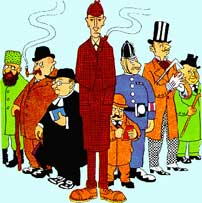
More googling, this time on Hume’s detective Mick Cardy. At this point I still knew nothing about him. On a website devoted to Inspector Maigret I discovered the following piece of art:
1. 2. 3. 4. 5. 6. 7. 8.
Maigret is the second gentleman on the left. Although they don’t have the original art, this cartoon came from the Storm-P museum in Copenhagen, and the curator, Jens Bing, identifies it as first appearing on the cover of the Danish pulp crime magazine Stjernehæftet in 1946. Bing sent a a copy to the Danish branch of the Sherlock Holmes Society, and here are the results they came up with for the others in the scene:
2. Maigret
3. G.K. Chesterton’s Father Brown
4. Sherlock Holmes
5. Agatha Christie’s Poirot
6. David Hume’s Inspector Cardby
7. Edgar Allan Poe’s Dupin
8. H.C. Bailey’s Reggie Fortune (?)
I don’t think I would gotten many of those, assuming that these are the right answers. How would you have done? But no matter, it would seem that Mick Cardby was actually Inspector Cardby, but this is not so, as we shall see in a minute. I didn’t include them in the CFIV listings, but two of Hume’s books were indicated as being the sources of films based upon them. So off I went to www.imdb.com, where I found the following useful information:
Plot summary for The Patient Vanishes (1941) aka They Called Him Death [The latter being the title of a 1934 book by Hume.]
Aha. Mick Cardby is a PI, not a gent from the Yard at all. We’ve learned something. (And you who knew already can stop the knowing looks at each other.) One more movie from the IMDB:
Too Dangerous to Live (1939) aka Crime Unlimited. [The latter being the David Hume title from 1933.] With Edward Lexy as Inspector Cardby, but no Mick Cardy listed in the credits, and no synopsis of the story.
But from the All Movie Guide comes the following Plot Description:
And from BFI, apparently there is a PI involved, after all:
I am sure that if you were to find a copy to watch, all of this confusion may be very easily straightened out. But a question remains: Who was the more important of the two characters, Inspector Cardby or his son Mick? Should both of them be included in CFIV as significant Series Characters?
And as you can easily see, Hume under his many aliases was extremely prolific. I’m sure you thought the same thing when you read through that list of mysteries up above. Could anyone who wrote so many detective novels so quickly be any good at it? Hold that thought. We’ll get back to it in a minute.
Hume also died young, at only 45. Could war injuries have had anything to do with his death? Having no answers, only these questions and more, unless you can enlighten me, I’ll move on to the major business at hand, which is a review of Requiem for Rogues.
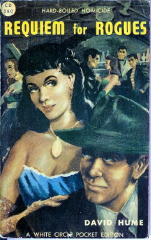
In which the leading character in is neither Cardy, father or son, but rather Tony Carter, a wisecracking crime reporter who appeared in three of Hume’s adventures, of which this is the third. He’s rather full of himself as well, as one might put it. Here’s a piece of a conversation that takes place on page 22 between Carter and his immediate superior at the Echo:
“To commence,” announced Cartwright, your methods are so unconventional that one day you will land this paper into most serious trouble. So far the luck has been with you. That cannot last for much longer. Then you’ll be in jail, and the
Echo will be faced with a heavy libel action. In the future follow a more conservative line of conduct, be more orthodox. See?”“Surely. You don’t want any more exclusive stories. The paper really wants the official news handed out in the Press room at the Yard – and nothing else. If that is so you’re wasting your money, and my time. Get a fourteen-year-old office boy, pay him ten shillings a week, let make the Yard call three or four times a day. And he’ll be a howling success.”
Cartwright wriggled. This interview was not what he had anticipated – not by a long, long way.
Suffice it say that Carter convinces Cartwright to give him a free hand in this case of the drive-by killing of one Percival East, dead by means of a bullet between the eyes on page eight, and right before the eyes of a later berated Detective Spriggs.
By page 69, the police are confused enough – and well they should be – to give Carter a free hand as well, as the case is seemingly awash with far too many clues and then again, far too few. But the more Carter digs into the case, the more deeply Percival East is discovered to have roots in the world of crime: the rackets, blackmail, the works.
Incidentally, totally relevant to nothing, I don’t know why everyone in this book refers to members of the police force as “splits.” It’s a new one on me, but the rest of the slang I managed to decipher with no particular difficulty. Conversations, though, which should have taken a page at the most to start and end invariably took four or five, which means that Hume was either a master of dialogue or he needed these long dialogues to fill the novel to a proper length. As for myself, I will not say padding, as I found these conversations to be rather imaginative, at the least.
There is no detection in this mystery novel, per se. Carter runs around London a lot, meets with his crew of regular informers a lot, and in so doing irritates the killer a lot, and enough so to make him (or her) make moves and counterattacks he (or she) really shouldn’t have done. If Carter had only been left alone, one might think, the case would never have been solved. One might very easily be right.
This probably also answers the question I asked up above but didn’t answer until now.
Sat 3 Mar 2007
Obituary: ELLIOTT BAKER (1922-2007)
Posted by Steve under Authors , Crime Fiction IV , Obituaries / Deaths NotedNo Comments
Elliott Baker, a screenwriter and novelist with one book listed in Crime Fiction IV, by Allen J. Hubin, died on February 9th. He was perhaps best known for his first book, A Fine Madness, which was made into a movie starring Sean Connery, Joanne Woodward and Jean Seberg.
Described elsewhere as a “dark, picaresque” tale, A Fine Madness told the story of Samson Shillitoe, a poet forced to work as a carpet cleaner. Mr. Baker also wrote the screenplay for the fillm.
Born Elliot Joseph Cohen, December 15, 1922, he changed his name when he began his writing career.
His entry in CFIV is scant, as previously mentioned:
* -Pocock & Pitt (Putnam, 1971, hc) Joseph, 1974.
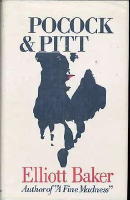
The dash indicates a title of marginal crime content. The cover shown is that of the British edition. Some online reviews praise Pocock & Pitt but do not elucidate:
“A strange and comic odyssey, too complicated to summarize, but a joy to read.” –Daily Telegraph
“Pocock and Pitt” is philosophical, witty and erudite, wise and exciting and one of the best novels I have read this year.” –Irish Times
“Elliott Baker is one of the wittiest of American authors. Quite rightly, this is a ‘one of a kind’ fiction.” –The Scotsman
Adderly, a series created for Canadian television by Mr. Baker, was based on a character from Pocock and Pitt, described by one source as being in the “humorous adventure” category.
Excerpting from a synopsis from IMDB:
Adderly aired in the US from September 1986 through March 1988 by CBS at 11:30 pm, opposite Johnny Carson and Dave Letterman, but it made little ratings headway against the two late night hosts.
Excerpting from a NY Times review:
“The tough, no-nonsense agent is played determinedly by Winston Rekert. His weekly cohorts are his bumbling, bureaucratic boss, Melville Greenspan (Jonathan Welsh); Mona (Dixie Seatle), the kooky agency secretary who adores Adderly, and Major Clack (Ken Pogue), the crusty intelligence chief with a heart of plutonium.
“Think of The Man From U.N.C.L.E. done at bargain prices.
“Adderly is not about to be overly demanding. It would be gratifying if the viewer were able to stay awake until the conclusion. If not, nothing’s missed.”
I don’t know. I wish I’d seen it when it was on. I liked The Man from U.N.C.L.E. I even liked Get Smart. From the rest of the review, however, which is rather unfavorable, the chances of seeing the series on DVD are fairly slim.
On the other hand, actors and other people responsible for putting the show on the air either won or were nominated for a number of Canadian Gemini awards, including Winston Rekert for best actor. Blame it on provincialism here in the US?
Fri 2 Mar 2007
Obituary: CAROLYN HOUGAN (1943-2007)
Posted by Steve under Authors , Crime Fiction IV , Obituaries / Deaths Noted1 Comment
Announced today was the death of Carolyn Hougan, 63, on February 25th. She was a highly praised thriller writer under her own name as well as “John Case,” a pen name she and her husband Jim shared together.
The books she and/or her husband wrote were filled to the brim with contemporary terrorists, rogue CIA agents, high-tech science, voodoo magic, deadly viruses and secret conspiracies – the entire gamut of huge-stakes danger and the possible ways in which the world could be destroyed in a moment, or at least be brought to its knees.
Of special note, Ghost Dancer, the couple’s most recent novel, has been nominated for this year’s Dashiell Hammett Award for Best Literary Crime Novel by the International Association of Crime Writers. (For the complete list of nominees, go here.)
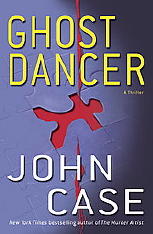
BIBLIOGRAPHY: [Based in part on her entry in Allen J. Hubin’s Crime Fiction IV.]
Best known in combo with her husband as –
* The Genesis Code (Columbine, 1997, hc)
* The First Horseman (Columbine, 1998, hc)
* The Syndrome (Ballantine, 2001, hc)
* The Eighth Day (Ballantine, 2002, hc)
* The Murder Artist (Ballantine, 2004, hc)
* Ghost Dancer (Ballantine, 2006, hc)
On her own –
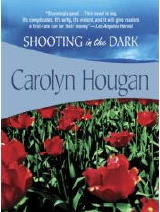
* Shooting in the Dark (Simon & Schuster, 1984, hc). Trade paperback, Felony & Mayhem, 2006.
* The Romeo Flag (Simon & Schuster, 1989, hc). Trade paperback, Felony & Mayhem, 2005.
* Blood Relative (Columbine, 1992, hc)
And on her own under yet another pen name –
* The Last Goodbye (St. Martin’s, 1999, hc)
Thanks to J. Kingston Pierce of The Rap Sheet for the link to her obituary on the Washington Post website.
Thu 1 Mar 2007
Review: VALERY SHORE – Final Payment
Posted by Steve under Authors , Crime Fiction IV , Reviews[5] Comments
VALERY SHORE – Final Payment
Major Books 3236, paperback original; copyright 1978; no other date stated.
Next on the agenda, and the final book I read in 2006, is the only mystery written by the pseudonymous Valery Shore. Al Hubin in Crime Fiction IV says that Shore was the pen name of Lon Viser, born in 1932. All I’ve been able to come up with regarding Mr. Viser is that he had something to do with the American Art Agency, a publisher based in North Hollywood in 1965.
From the small print inside Atualidades Globo Controle Da Natalidade, written in Portuguese and illustrated throughout, aka The Complete Book of Birth Control:
It’s not a common name. Maybe it’s the same man. All that comes up for Valery Shore, in case you were wondering, are a few dealers offering this book for sale on eBay, or maybe it’s the same book offered at different times. I didn’t check.
The dedication reads as follows: “To Yvonne, Rhoda, and Lon, without whose help this book could not have been written,” so I assume that Al is correct – not that there’s any reason to doubt him.
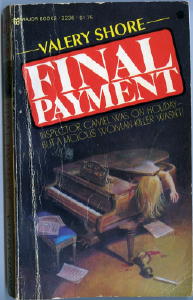
The primary detective in Final Payment is a former Scotland Yard inspector by the name of Christopher Camel, still young, who’d recently been left a fortune by an aunt, in her day a sex symbol of the silver screen. Staying with Camel in his aunt’s Tudor-style Hollywood mansion is “his beautiful Eurasian companion, Kim Lee Chance.” I’m quoting from the back cover.
In attendance upon them both is Potter Goodleigh, his aunt’s former lover and a long ago movie director who’d been exiled to the guest cottage, but who is now cook, butler and father figure to the two young people who are now “livening up the old museum,” as he puts it.
It is Potter’s daughter Felicia who’s murdered, her body found in the piano in her living room. Unfortunately Felicia was also a blackmailer, and there are thirteen suspects that Camel, Kim Lee, and the local lieutenant of police named Davidson have to deal with. In spite of his new-found money and all of his resultant leisure time, there is no way Camel can be kept off the case, as you can well imagine if it had happened to you and sunny fortune had smiled your way in such a fashion.
The story, as I’ve relayed to you so far, may also sound to you as the basis for a made-for-TV mystery movie. If so, you share my feelings exactly, and I have the advantage of having actually read the book. If you also were to suspect that on page 177 there would be a gathering of the suspects in the dead woman’s living room, in an attempt to recreate the crime, I would certainly begin to wonder about you. How could you possibly know that it was on page 177?
As entertaining as made-for-TV mystery movies may be, and some more than others, in general I’ve always had a relatively low opinion of them. This one, I’ll conclude by saying, is better than most of them. If there had ever been a second book in the series, I’d make sure that I had it in my collection too.
UPDATE [03-01-07] Victor Berch has done some preliminary spadework on Lon Viser, and so far he’s come up with the following: His full name as Lorenzo Ludwick Viser, born February 26, 1932 in FL, died August 9, 1994 in LA. There was a Lorenzo M. Viser living with him in the 90s, probably a son. More later, if and when!
Tue 27 Feb 2007
Obituary: JEROME BERNARD WHELAN (1911-2007).
Posted by Steve under Authors , Crime Fiction IV , Obituaries / Deaths Noted[2] Comments
You won’t find Jerome Whelan’s name in Allen J. Hubin’s Crime Fiction IV, at least not under that name. You will find him, however, in the online Addenda that preceded the Revised CFIV, which has not yet published. The entry appeared then as follows:
BRIEN, R. N. Pseudonym of Jerome Bernard Whelan.
The Missing Solicitor. Skeffington, 1952 [Eng.]
Four or five copies of the book are currently being offered for sale on the Internet, so it is not especially uncommon. Nonetheless, not only was Mr. Whelan an author new to CFIV, but so was the title itself, even under the pen name, having escaped notice for one reason or another through four editions of the Hubin bibliography.
At the moment I cannot tell you exactly what the mystery in The Missing Solicitor is about, but I have a pretty good guess. In a recent email to Al Hubin, Edward Whelan, a barrister in England, said “Jerome (my father) was a solicitor himself, and obviously did not want any of his clients to know that he had a secret fantasy world of arsenic poisoning and stolen bearer bonds.”
According to Edward, as he mentions in the same email, the name R. N. Brien came from a variation on his mother’s maiden name. There was also only the one novel, which his father always spoke about in a deprecating fashion.
Jerome Whelan went on to become a noted tax advisor and a director of the Ionian Bank in London. He was born in Cork in 1911 and died on 14 Feb 2007.
Tue 27 Feb 2007
Uploaded this morning was Part 11 of Allen J. Hubin’s Addenda to the Revised Crime Fiction IV. Most of the data in this installment consists of identifying authors who have entries in the online Contemporary Authors, previously not so noted.
As usual, however, included also are all the additions and corrections uncovered since Part 10 was completed, of which there are many, not the least of which is the inclusion of two hitherto unknown titles by author Michael Knerr. (See the review of Travis here on M*F immediately preceding.)
Mon 26 Feb 2007
M. E. KNERR – Travis
Pike Book #214; paperback original. First printing, April 1962.
I seem to be specializing in obscure books this month, and this one is about as obscure as you can get. Even though it is a private eye novel – and I’ll get back to that in a minute – it was published by one of those small sleazy paperback outfits in the early 1960s that promised more than they could possibly deliver at the time. And even so, if you happened to have purchased this one in 1962 for its sexy parts, you’d be sadly disappointed, since in that regard, it’s really rather tame. If sexy passages were what you were looking for back then, you’d have been far better off buying a copy of Peyton Place than this.
This book does not even appear in Al Hubin’s Crime Fiction IV, but it will, or at least in the Addenda. The author does appear, however, and to show you something of his track record, here’s his present entry:
* Operation: Lust (Epic, 1962, hc) as by M. E. Knerr.
* The Violent Lady (Monarch, 1963, pb)
Listed below are other titles by Knerr (under either byline) which I found listed for sale at various places on the Internet, but not included in CFIV, and probably for good reason. I do not have descriptions of the story lines for any of these first three, so your guess is as good as mine:
* Heavy Weather (Belmont/Tower, pbo, 1979) [** -See UPDATE below.]
* Port of Passion (Imperial #737, pbo, n.d.)
These I found descriptions for:
* Sasquatch: Monster of the Northwest Woods (Belmont/Tower, pbo, 1977) Quoting from the cover: “Though based upon factual research, this is a fictional tale of what could conceivably happen in the Pacific Northwest: a chain of events that could create a monster out of a normally timid and gentle giant.”
* The Sex Life of the Gods (Uptown Books #703, pbo, 1962) “Science Fiction erotica.”
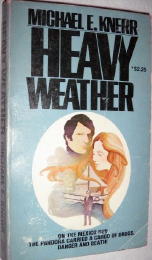
[** UPDATE 02-27-07] At first I was doubtful, but now that I’ve found a cover scan of Heavy Weather, I’d say that it’s also a prime candidate for inclusion in Crime Fiction IV. If you can’t make out the small print on the bottom of the cover, it says, and I quote: “On the Mexico run the Pandora carried a cargo of drugs, danger and death!” LATER THE SAME DAY: Al Hubin agrees. In it goes. (The book pictured below is described as a Horwitz edition published in Hong Kong.)
But let’s get on with things and to the book Travis itself. There’s only one copy offered for sale on the Internet, making it not only obscure but scarce. I mention this even though I’m sure you know that the two are usually, but not always, one and the same.
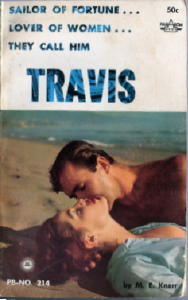
Telling the story, though, in his debut and probably his only appearance in print, is Mike Travis, a “sailor of fortune, who loves life, and woman, especially women.” It is not difficult to deduce what other reasonably well-known character was the inspiration for Mike Travis. Travis in this book had previously been in the charter boat business in Florida, but when times went bad, he went to California to accept an offer made by one of his former customers, a multi-millionaire named Del Houston, to look him up if and when Travis headed out that way.
And Del does indeed have a job for him. After some quick string-pulling and the greasing of certain political hands, Del hands Travis a PI license and a gun, and a three-fold request: to find his son; get him off narcotics; and break up the gang who’s been supplying them.
It’s not a bad opening for a PI yarn, and the story maintains its way reasonably well for about half of its just under 160 pages: the usual PI stuff, the things that PI’s do, and the usual bad things happen to some of the people who just happen to get in the way, with all of the coincidences that make one or more aspects of one PI investigation dovetail nicely into another.
Even though it goes without saying, I’ll say it anyway. Travis himself is one of those guys who is irresistible to beautiful women. In this book that includes both his employer’s foster daughter, from page 20 …
… and a stripper who the first time they met, tripped him into a pool at Houston’s house. From page 68:
I think you can tell a lot of about a story by looking closely at how the author describes his characters, don’t you? With an ending that doesn’t directly address the clues that have been set up for it, though, the tale does two things simultaneously and hence the apparent impossible. The action-packed finale (a) goes all but out of control, and (b) withers away from lack of interest, as if there were a deadline set that had to be met, and it didn’t matter precisely how.
Although overall not without flashes of acceptable writing, and every once in a while better than acceptable, the overall impact of this novel is still rather like a third-rate Carter Brown or a tenth-rate John D. MacDonald, either of whom, if you’re a fan, you know what I’m talking about and whom you’re far better off pursuing.
Or let’s put it this way. One of the reasons for collecting and reading unknown and long-neglected works of mystery fiction is the hope that never dies of discovering an unknown and long-neglected classic of mystery fiction. Sometimes you have to settle for unknown and long-neglected.
UPDATE [02-26-07] If you were to google “M. E. Knerr” on the Internet, you would find, as I did, that there was a Michael E. Knerr who was a friend of SF and (occasional) mystery writer H. Beam Piper, who committed suicide in 1964 when he ran into financial troubles. I’ve not been able to confirm that the two Knerr’s are one and same, nor have the birth and death years for either one been verified. Accounts vary on the latter. Knerr may have also written under the name of “Brent Hart,” but that’s another loose end not yet tied down.
But the Knerr who was a friend of Piper apparently wrote a hitherto unpublished biography of him, and upon Piper’s death, went through his manuscripts and salvaged, among other things, the “lost” third Fuzzy novel, Fuzzies and Other People.
If and when I know more, I will as always, let you know.
[UPDATE #3] Postdated 03-29-07 on 08-16-07. Thanks to Google, I discovered that SF writer John F. Carr knew Mike Knerr, and after a small amount of effort, I was able to get in touch with him by email. As a consequence of this contact, John has posted a long article about his friendship with him here on the M*F blog. I should pointed this out more clearly before now, instead of leaving it hidden as one of the comments.
In this article about Mike Knerr, Carr has his correct date of birth, along with the year he died, plus a lot more about him on both a professional and a personal level.
Fri 23 Feb 2007
Interview with JOHN “WADE” WRIGHT
Posted by Steve under Authors , Crime Fiction IV , Interviews , Old Time Radio[5] Comments
After learning more about John’s career and his interests and background in a good many fields, I asked if he’d care to answer a few questions about himself, and he graciously agreed. I formulated the questions, Bill added two or three of his own, and we sent them off to John. The result of all this is what follows. –Steve
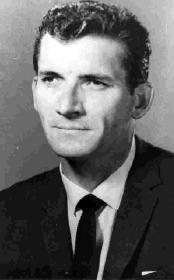
John Wright about the time that
Shadows Don’t Bleed was written.
Q. Thanks for taking the time to talk to us about your career. Unfortunately (and correct me if I’m wrong) none of the mysteries have been published in the US. I’ll begin therefore with a list of all of the titles Al Hubin has for you in his bibliography of the field, Crime Fiction IV:
* Blood in the Ashes (n.) Hale 1964 [Bart Condor]
* A Hearse Waiting (n.) Hale 1965 [Bart Condor; New York City, NY]
* Until She Dies (n.) Hale 1965 [Bart Condor; California]
* Blonde Target (n.) Hale 1966 [Bart Condor; New York City, NY]
* Shadows Don’t Bleed (n.) Hale 1967 [Paul Cameron; California]
* The Sharp Edge (n.) Hale 1968 [Paul Cameron]
* No Haloes in Hell (n.) Hale 1969 [Paul Cameron]
* Two Faces of Death (n.) Hale 1970 [Bart Condor]
* Don’t Come Back! (n.) Hale 1973 [Calhoun]
* The Hades Hello (n.) Hale 1973 [Paul Cameron; Los Angeles, CA]
* It Leads to Murder (n.) Hale 1981 [California]
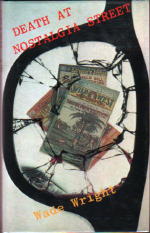
* Death at Nostalgia Street (n.) Hale 1982 [New England]
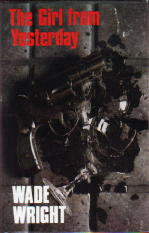
* The Girl from Yesterday (n.) Hale 1982 [Calhoun; U.S. Midwest]
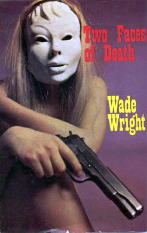
I have a confession to make. While Bill has many of your books and has read them, at the present time I don’t have any of them, or if I do, I don’t have access to them. I’ll defer to you to tell us something about them. I’m going only by the titles, but I’m willing to guess that both Bart Condor and Paul Cameron are private eyes. How close am I?
A. As close as you can get. Condor was the first, and there is no doubt at all I’d been influenced by Mickey Spillane and his Mike Hammer. In fact, it was probably Mickey who really got me started.
I’d written to him, care of New American Library, to say thanks for a lot of very enjoyable reading. Mickey replied by way of a pretty long letter that ended with: “Keep writing and make lots of money.” At the time I was knocking out an occasional article or short story, but that was it.
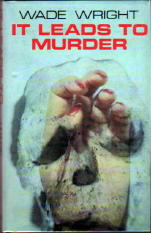
Q. Tell us more about some of the individual books?
A. I guess the “make lots of money” bit must have stuck somewhere in the thing I call a mind, because a year or so later —
I was holding down a job as General Sales Manager for a nation-wide engineering company, often putting in eleven hours a day. I’d recently married and before doing so had contracted to have a house built in a place called Western Hills, Port Elizabeth. I woke up one morning with the realization that for the first time in my life I owed money, and the feeling wasn’t at all comfortable. Even more uncomfortable was the knowledge that, though pretty good at my job, I did not enjoy working for a boss.
I’ve forgotten what it was all about, but there was a morning when I had a blow-up with my boss. At lunchtime I drove home and spent two hours hammering my Olivetti portable — completing the first two chapters of Suddenly You’re Dead. A couple of weeks later I finished it and sent it to a New York agent who felt it was marketable but needed some fixing — for a price. Declining the offer, I had the MSS sent to London International Press, a recently established firm of literary agents. They agreed to handle the work and sold it to Robert Hale Limited, whose contract included first option on the next three books.
Suddenly You’re Dead paid off the mortgage on the house.
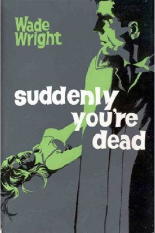
Like most everything else that followed it was written with an eye on the clock. Working in the engineering, construction, and contracting fields has created a habit of measuring everything terms of time, material and reward. Usually a book was written at the rate of a chapter a night, sometimes more, and seldom consecutively. Often I’d be away from home, not able to get back to my desk for days. Perhaps, had conditions been different, had I devoted more time to them, the books may have been a little better than they are. But that’s water under the bridge and I take the rap for everything.
I hated the hypocrisy of the business world, the brown-nosing and backstabbing, and quit some 30 years ago. After doing so the Company asked that I consider the post of a Project Specialist — a fancy name for trouble-shooter. I submitted a proposal, which I expected to be thrown out. It wasn’t, and I signed a six-month contract that had me driving or flying all over the country, and away from home from Monday morning until late Friday night. Since then I’ve been freelancing.
Q. Bill considers Death at Nostalgia Street, whose protagonist is editor of a string of movie nostalgia magazines, to be your best novel. Do you agree with him?
A. I believe Bill would be a better judge than me, so I’d have no trouble accepting his opinion. Certainly I enjoyed writing that one, possibly because I’d always been interested in the publications Nostalgia Street Enterprises handled. Then, too, I’d developed a liking for stories played out in places other than big cities.
Q. When did you first start writing? And why did you sign yourself Wade Wright rather than John Wright?
A. I imagine it started in grade school. I disliked the prescribed reading the school offered, preferring comic books, pulps, Leslie Charteris, Earl Derr Biggers, and a couple of others. Frequently I’d catch hell for bringing comics or pulps to school, to trade with a couple other kids.
What I liked least of all were the essays we were required to write . . . stuff like “My Holiday On The Farm.” Most kids I knew had never seen a farm. But when an open subject was available I didn’t mind a bit. Afterwards, in spite of receiving good marks, I’d be lectured about writing of gangsters, fascist agents or spies, warned that with those sort of notions I’d very likely wind up as a delinquent, or worse.
As for the Wade Wright tag … it was chosen essentially to keep my private and business lives completely separated.
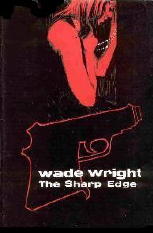
Q. You live in South Africa. Have you always lived there?
A. Most of my life. I spent two years bumming around what was then the Rhodesias — now Zambia and Zimbabwe — keeping one step ahead of the immigration authorities, working at anything to make a buck. In those days that part of Africa was often referred to as God’s Country. Everything was plentiful, and cheap. Jaguars were nearly as common as Fords! I instructed at a judo school, performed as a nightclub photographer, raced stock cars, and somehow became involved with contributing to the sports pages of a newspaper. On occasion I sold short-shorts to another weekly.
On my twenty-first birthday I woke up with a pretty bad hangover, the equivalent of $2.40 in my pocket, and not a friend in sight. Lots had to be learned the hard way.
Q. Why did you choose to set all of your mysteries in the US? Have you ever visited here?
A. Though I lived in a country that was still a colony of The British Empire, and was born from Irish and Welsh stock, I’ve always identified more with the US than Britain. Possibly early reading habits and a love of movies helped a lot. Yes, I’ve been to the States, but it was a long while ago. Always intended returning, possibly for good, but moral obligations determined otherwise.
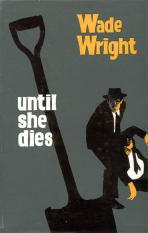
Q. What mystery writers had the most influence on you in your writing career? Do you have any favorite authors today? Are there “forgotten” writers whom you’d most like to see back in print?
A. They all had some influence, I’m sure. I was probably 14 or 15 when I found cheap hardback editions of Chandler’s The Big Sleep and Farewell My Lovely, and they steered me onto yet another path. As mentioned earlier, it was Mickey Spillane who really got me writing. But the writer I really hold in high regard is Howard “John Evans” Browne.
Of today’s writers Bill Pronzini has to be my favorite.
There are many I’d like to see back in print, especially Robert Martin, and three other authors whose books or stories have always found special places on my shelves — William Campbell Gault, Thomas B. Dewey, and Jack Finney.
Q. As I understand it, you grew up listening to the radio. What we call “old-time radio” here in the US did not last as long as it did in South Africa. Tell us about some of your favorite shows, and in particular, for those not familiar with the story, what was your part in saving the South African version of The Avengers for posterity?
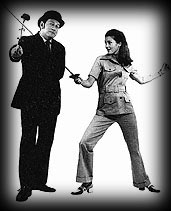
Donald Monat as John Steed and
Diane Appleby as Emma Peel —
South Africa’s Avengers.
A. Early days of South African radio were fashioned after the style set by the BBC -– British Broadcasting Corporation — so for a long while, for me, a radio was but another piece of furniture. Then, one night I heard these mysterious voices and perhaps a scream, and for the first time gave the radio real attention. I’ve no idea what the show was, but a jaded memory suggests it might well have been an adaptation of Edgar Wallace’s Grey Face. But it wasn’t until the introduction of commercial radio, by way of Springbok Radio, that I really began to enjoy the medium.
The reason is easy to explain. Years earlier I’d found three back issues of the American magazine Radio Mirror on sale at Woolworth’s for 5 cents each. (Still have them.) Those magazines contained articles about the Grand Ole Opry, Perry Mason, Dr. Christian … the logs listed The Shadow, The Fat Man, Box 13 … That, I figured, was radio.
Springbok Radio offered many of those shows, Bold Venture, Richard Diamond — and the likes of Nightbeat, The Hidden Truth, and Superman, canned in Australia. And, of course, the soaps.
I’d started recording these shows and trading them with American OTR collectors. Along the way I came in contact with a legally blind fellow in New York who was anxious to secure copies of The Avengers, a locally produced radio series based on the British TV series. I had no idea then that a number the shows I recorded would turn out to be the only copies saved on tape. Since then a great many South African shows I recorded and traded have turned up in the lists of OTR dealers.
Q. You were also involved with early comic book fandom. How did that come about?
A. The day my older sister brought home a copy of Superman #4. I was immediately hooked; afterwards devouring any (American) comic book I could get my hands on. A consequence of this was that I could read a little before starting school, and that forever after, most required reading matter would seem tame and boring.
I never knew his name then, but Joe Simon’s work on Blue Bolt, really grabbed me. A long time later I’d discover his Captain America, Stuntman, Boys Ranch, and other features. Instinctively, I always believed that he, Joe Simon, was the creator of Captain America, but it was not until the release of his book, The Comic Book Makers, that I found this to be fact.
And it was Joe Simon who introduced me to Comics Fandom. I’d stumbled across his name in Writer’s Market, listed as editor of Sick, and wrote to him, asking if he were the Joe Simon who’d produced so much truly great stuff for the comics. Indeed he was, and not only did he provide an immediate reply, he also sent sample copies of Sick. It so happened that my letter had arrived within a short time of him receiving the first issue of Alter Ego, the first of the comics’ fanzines.
Mr. Simon thought I’d be interested and provided the address of the publisher, Dr. Jerry G. Bails, who passed away in November 2006, at the age of 73. Jerry also wasted no time in contacting me and shooting across the debut issues of his fanzine. The manner of production — printed on a Ditto Duplicator — intrigued me. We had such a machine in the office, but as far as I was concerned it was strictly for printing inter-office notices or price lists. I got hold of a master and a few sheets of duplicating carbon, knocked out a cover and for lack of a better name titled it The Komix.
The cover came out pretty well. But now, with 200+ copies printed there seemed to be a need for a story to fit it. Eventually I had about 40 pages to staple together into a fanzine. What I didn’t know was that it would the first comics fanzine to be published outside of the US. Nor that on eBay copies of the second issue would one day sell for as much as $70.00 each.
I published only two issues of The Komix, had planned a third, but pressure of work was really cutting into my time. Often I’d be in four major cities in the same week. And then Suddenly You’re Dead was sold and I was committed to produce more.
Q. Tell us about your series of Western novels published as by Ray Nolan?
A. These were started when my publisher opted to quit mysteries. Like most boys I loved the B-Westerns. Also the pulps such as Fifteen Story Western, Dime Western, Texas Rangers, etc. So the transition wasn’t difficult and I enjoyed doing them. What I didn’t enjoy was an editor trying to maintain political correctness, oft times even endeavoring to eliminate references, which might be considered even remotely offensive.
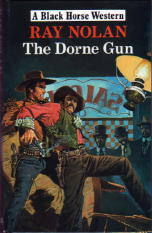
The pseudonym, by the way is derived from two men I have always greatly admired. My friend, singer songwriter and actor, the late Ray Whitley, and the legendary Bob Nolan, who penned such Western classics as “Tumbling Tumbleweeds”, “Cool Water”, and so many others.
Q. You’ve done quite a few radio scripts for South African radio and short fiction for S.A. publications. Name some of the programs you’ve written for and the magazines in which you’ve been published. Did you find short stories and radio scripts easier to write than novels?
A. Writing for radio was fun — and lucrative. I’d tried years back to break into the medium but it was something of a closed club. Finally I gave up. About 30 years ago, at a time when all shows on commercial radio were from local production houses, I happened to listen to a particular show and while doing so came up with a story idea. Next day I hacked it out and sent it to Springbok Radio’s head office. There, a fellow named Ben Swart, was good enough to write and tell me that the series was contracted and did not accept outside contributions. He had, however, taken the liberty to send my script to André Bothma, a producer operating in Cape Town. André bought it and asked for more, and soon a very enjoyable relationship was established, though I never ever met him or attended any recording session.
The real break came when André phoned to say he’d like me to write for The Deciding Factor, a 45-minute show that aired on Sunday nights and attracted more listeners than any other. Could I start off with three scripts? He suggested themes for two and left the third for me to choose.
“When will you need them?” I asked.
“Oh, by next Friday will be fine.”
And that’s how it went. I wrote about 200 scripts for The Deciding Factor, Suspense, Radio Theatre, Tuesday Theatre, and others. Contracts were more than extremely fair. Fees continually rose, and they covered two broadcasts within a period of 14 days. If a show was again aired after that period the writer was paid 50% of his current fee.
André was an innovator and one of the best in the business. Never afraid to stick his neck out he’d try anything, and we had fun using werewolves and banshees, and even stories like Charley’s Amazing TV Set. Good times. Fun times.
The first two stories I ever wrote and sold were to a new magazine titled Yours. It boasted the worst covers I have ever seen on any magazine. I was 15 at the time, but already working. Unfortunately neither were published because Yours went belly-up. Ten years afterward, or perhaps even later, I found one of the stories, changed the name from “Ain’t Nobody Honest?” to “Stopover At Nathan,” and a British agent sold it to London Mystery Magazine. It was subsequently reprinted, but I no longer have any record of it.
When we sold our home at Bluewater Bay, a number of cartons got “lost” in moving, among them recorded tapes of the radio shows for which I’d written, manuscripts, and lots of personal and valued correspondence.
Other stories have appeared in such local slicks as Family Radio & TV, Fair Lady, You … feature articles in Weekend Post, Leisure, etc – usually under other pseudonyms. Articles on show business personalities have been published in the US, in Under Western Skies, Nemesis, Screen Thrills, Classic Images, and possibly others.
I’ve found scripting for radio the easiest. Usually I could get a story finished in a day. It was also less hit-and-miss than writing for magazines. The entire manner of conducting business was also completely professional. Acceptances were fast, and your check arrived within 30 days. The downside of it was that often the broadcast sounded nothing like the sounds heard in one’s head when pounding the typewriter.
Q. Overall, what’s given you the most pleasure in your writing career?
A. The work and the people with whom it has brought me in contact. Most gratifying has been to find that those of real substance are invariably the most down to earth.
—
SHORT STORY BONUS. I’ll let John set the stage:
A tale’s attached to this short.
A colleague asked me about plotting, and while explaining what I did, worked out a complete plot for him – based upon his habit of visiting the pub in question. He never used it, which was no surprise.
On a Sunday morning some months later, I remembered the thing, made a few changes, and put it on paper … with no idea what I’d do with it. The very next week I received a letter from a friend — possibly Bill — telling me about the new Black Mask, suggesting I might think of sending them something.
I sent “Waiting,” and they bought it right away. But then they shut down but paid a kill fee, returning all rights. Later still it was accepted by Black Lizard, but I heard no more from that end. Maybe I should have followed up.
Anyway, though it has earned some good money, the story has never yet seen print. If you find it the least bit interesting, you’re free to link it to your site.
UPDATE [02-24-07] Four additional cover scans have been added since the interview was first posted.