Stories I’m Reading


 MARTIN H. GREENBERG, Editor – Deadly Doings. Ivy, paperback original; 1st printing, 1989.

#7. HELEN NIELSEN “Woman Missing.” Novelette. First published in Alfred Hitchcock’s Mystery Magazine, May 1960. First collected in Woman Missing and Other Stories (Ace, paperback original, 1961).

   I have a confession to make. This is the first work of fiction by Helen Nielsen I have ever read. This in spite of some eighteen novels, some of which were reprinted in Black Lizard’s series of classic noir fiction in the 1980s, one story collection, dozens of stories for the digest mystery magazines of the 50s and 60s, including Manhunt, and a number of teleplays, including ones for both Perry Mason and Alfred Hitchcock Presents.

   The title of “Woman Missing” tells you exactly what the story is about. The wife of a man working the night shift is picked up by a strange man late in the evening, gets into a cab with him, and disappears. Her body is found only later, after much of the investigation by the police has already taken place.

   While it’s not clear at first that this is what it is, what this story eventually becomes is a straightforward police procedural. It’s very well written, but in a strictly non-emotional, non-sensational fashion. There are clues for deductions to be made from, but a lot of what’s accomplished is done by good old-fashioned police work. A routine kind of mystery, solved by dogged persistence, nothing more — but nothing less, either.

       —

Previously in this Martin Greenberg anthology: ERIC AMBLER “The Case of the Emerald Sky.”


CARTER DICKSON “Persons or Things Unknown.” Short story. First published in The Sketch, UK, Christmas 1938. Collected in The Department of Queer Complaints (Morrow, US, hardcover, 1940). Reprinted in Line-Up, edited by John Rhode (Dodd Mead, US, hardcover, 1940) as by J. Dickson Carr, and probably several other places as well.

   With only one possible flaw as far as I could see, and that one exceedingly non-major, this is one small gem of a story, especially if you’re as big a fan of locked room mysteries as I am. It’s a standalone story with none of Carr/Dickson’s favorite detective characters: Fell, March or Merrivale.

   The story is told instead by the owner of an old drafty manor house in England during a party he’s holding at Christmas time. It seems that there is a story attached to one of the rooms located upstairs, one dating back to the 1600s and the days of the Restoration. As recorded in an old diary and the coroner’s report at the time, it seems that one of two rivals for the hand of the then owner of the house was found stabbed to death in that room, while the other two were there with no other entry possible.

   But the lights had gone out before the fatal attack and no sign of the murder weapon could be found, no matter how hard they looked. It is obvious, so to speak, who the killer was, but without murder weapon to be found, he was never convicted.

   All the clues are there, and in plain sight — with a story from John Dickson Carr, you can count on that — and more than that, one suggestion from the current listeners to the story is made and immediately discounted. I’ve always thought using an icicle to kill someone without a trace would be a good basis for a short story (and it’s probably been done), but it was a warm day for Christmas, and there was a huge shortage of icicles to be used. Furthermore icicles are too fragile to be used very effectively as a weapon, especially many times over.

   As I said earlier, this is a small gem of a tale. My only wish is that it Carr hadn’t needed to tell it as a story within a story, a device I’m never all that crazy about, but that’s a small quibble about a story that’s as good as his one is.

  LOU SAHADI, Editor – An Argosy Special: Science Fiction. One-shot reprint magazine. Popular Publications, 1977.

#4. JOHN W. JAKES “Half Past Fear.” Short story. First appeared in Super Science Stories, August 1951. Otherwise never reprinted.

   Before John Jakes hit it rich with his Kent Family Chronicles, he was generally regarded as an all-around hack, and rightly so. He wrote a couple dozen sci-fi novels, maybe a dozen more mystery and spy novels, of which his PI Johnny Havoc books may be the best remembered today, and even a half dozen “Man from UNCLE” stories for the magazine of the same name in the mid-60s.

   Of his fantasy and science fiction, his Brak the Barbarian pastiches of Robert E. Howard’s Conan tales are collectable now; the rest are safely forgotten. And the same can be said of “Half Past Fear,” his third to be published short story. In it a family of three takes in a strange traveler as a boarder, only to discover that he came from the past and that he is being pursued.

   Time travel tales are almost always fun to read — they make up one of my favorite subgenres in all SF — but this one is clunky and confusing, with one of the lead characters, unable to explain how things turn out, simply shrugs and calls upon the unexplainable “paradoxes of time travel” to bail out both the author and the story, and not at all succeding.

   One might be forgiven in thinking that this story was chosen for Jakes’ name only, to help sell the magazine, but if you take a look at the image at the upper left, you’ll see that none of the authors are mentioned, only the titles of the stories. A strange marketing device, indeed.

       —

Previously from this Lou Sahadi anthology: LEIGH BRACKETT “Child of the Green Light.”

 MARTIN H. GREENBERG, Editor – Deadly Doings. Ivy, paperback original; 1st printing, 1989.

#6. ERIC AMBLER “The Case of the Emerald Sky.” Short story. Dr. Jan Czissar #2. First published in The Sketch, 10 July 1940. Reprinted in Ellery Queen’s Mystery Magazine, March 1945. Collected in The Waiting for Orders (Mysterious Press, hardcover, 1993; published in the UK as The Story So Far (Weidenfeld, hardcover, 1993) with one story addded).

   When Asst. Commissioner Mercer receives the following card, he at first refuses to see the man waiting in his outer office:

DR. JAN CZISSAR
Late Prague Police

   Now in England, and apparently having plenty of time on his hands, Dr. Czissar has interfered with one of Scotland Yard’s investigations on one previous occasion. That Dr. Czissar was right and Scotland Yard was wrong did not go over well with Asst. Commissioner Mercer, and only a phone call from a superior convinces the letter to let the former in.

   There is no action whatsoever in this short concise tale. The two gentlemen discuss the death of a mean man by arsenic poisoning, and at length, after going through all of the various forms of arsenic and how they affect the human body, Dr. Czissar prevails. Scotland Yard was wrong again! Deservedly so. They did a very inadequate job of investigating.

   And sad to say, this is not a story I can recommend. It’s lifeless and worse than that, it depends far too greatly on esoteric medical knowledge that no amateur armchair detective in the world could be expected to know. I wish I could be more positive, but I can’t.

       —

Previously in this Martin Greenberg anthology: WILLIAM CAMPBELL GAULT “Never Marry Murder.”


        The Dr. Jan Czissar series —

The Case of the Pinchbeck Locket. The Sketch, July 3 1940
The Case of the Emerald Sky. The Sketch, July 10 1940
The Case of the Cycling Chauffeur. The Sketch, July 17 1940; also as “A Bird in the Tree”.
The Case of the Overheated Service Flat. The Sketch, July 24 1940; also as “Case of the Overheated Flat”.
The Case of the Drunken Socrates. The Sketch, Julu 31 1940; also as “Case of the Landlady’s Brother”.
The Case of the Gentleman Poet. The Sketch, August 7 1940

  WYNDHAM MARTYN “The Shadow’s Shadow.” Novelette. Bentley Mayne & Captain Dashwood #1. First appeared in Flynn’s Weekly, 14 May 1927. Probably never reprinted.

   Wyndham Martyn was the pen name that author William Henry Martin Hosken (1874-1963) seems to have used more often than several others. While he produced dozens of short stories for the pulps and other fiction magazines in the teens and 20s, Martyn may be more well known, if at all, for his long series of hardcover thrillers published in the UK featuring a master criminal named Anthony Trent, whose specialty was solving mysteries the police are having trouble with.

   Other than three serialized novels for Flynn’s, Trent appeared in only one pulp magazine story. The private eye in “The Shadow’s Shadow” is a young fellow named Bentley Mayne, who has obtained a fine reputation for cleverness and success for the cases he’s worked on.

   Enter steel magnate John Dawbarn, who has been trying to convince someone in Washington that his new method of processing steel is something our country’s government ought to have. Fearing that the secret may fall instead into enemy hands, Dawbarn calls on Mayne, who is happy to take the case.

   But instead of working on it himself, he assigns an associate named Captain Dashwood to act as Dawbarn’s bodyguard. Dashwood is (um) a dashing Englishman in dapper dress and a monocle, and fits in well with Dawbarn’s society-minded wife’s life style.

   After the secret plans is a master criminal known only as The Shadow (no relation to the fellow who came along later). The problem is, no one knows what he looks like. He could be anyone. Now Dashwood is competent enough, but his eye is as much on Dawbarn’s daughter Betty as on ferreting out who The Shadow might be or where he may strike next, but happily to say, both halves of the story work out well.

   [PLOT ALERT] There is a strange twist in the tale that I ordinarily wouldn’t bring up, but since it may not be easy for yous to obtain the copy of Flynn’s the story is in, I have decided to tell you about it anyway. It seems that Mayne and Dashwood are one and the same. I haven’t decided what purpose the hoax is for — he doesn’t even tell Dawbarn what’s going on — but personally I think Dawbarn is something of a dolt to not to have recognized Mayne’s alter ego almost immediately.

   But now that the impersonation has been revealed, it might explain why this was Bentley Mayne’s first and last appearance. That and the fact that at story’s end, he and Betty seem to be on their way to settling down in fine matrimonial fashion.

  DONALD WOLLHEIM, Editor, with Arthur W. Saha – The 1989 Annual World’s Best SF. Daw #783, paperback original; 1st printing, June 1989. Cover art by Jim Burns.

#9. B. W. CLOUGH “Ain’t Nothin’ But a Hound Dog.” Short story. First appeared in Rod Serling’s The Twilight Zone Magazine, June 1988.
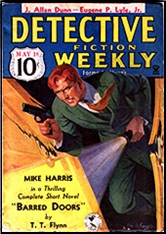
   This was Brenda Clough’s first published short story, after four novels, and it’s a good one. Most of her work has been fantasy, but even though it’s told in the style of an rural fantasy, this one’s definitely science fiction.

   It’s about the owner of a comic book store — one who also carries other popular culture memorabilia, as most owners of comic book stores have to do in order to survive — and he’s realizes that he’s found a pot of gold when he begins to get repeat orders, many times over, for the aforementioned memorabilia.

   Not comic books, but X-Men bumper stickers, fuzzy dice, lawn trolls, iron-on decals of Disney characters, commemorative liquor bottles, Deely-Bobbers, and anything at all associated with Elvis, including plush floppy-eared dogs that you could wind up to play … you guessed it.

   Thinking that his new patron– who pays only in cash, brand new twenty-dollar bills — must be a reclusive millionaire, and having never met a reclusive millionaire before — makes the trek out to the wildest part of West Virginia mountain country to pay him a visit.

   What he finds there is the crux of the story, and obviously I dare not tell you. I think I’d react differently than does the teller of this story, but on the other hand, maybe just maybe he’s on to something.

       —

Previously from the Wollheim anthology: FREDERIK POHL “Waiting for the Olympians.”

  LOU SAHADI, Editor – An Argosy Special: Science Fiction. One-shot reprint magazine. Popular Publications, 1977.

#3. LEIGH BRACKETT “Child of the Green Light.” Short story. First published in Super Science Stories<, February 1942; reprinted in the April 1951 issue. Reprinted in Classic Science Fiction: The First Golden Age, edited by Terry Carr (Harper & Row, hardcover, 1978). First collected in Martian Quest: The Early Brackett (Haffner Press, hardcover, 2002).

   There are science fiction stories so vast in scale it is next to impossible for the human mind to comprehend them, and even though this tale takes place within the orbit of Mercury in our own solar system, this is one of them.

   Son is a living creature — a mutation, perhaps — capable of existing in space without protection, the only living being in a junkyard of wrecked ships that his own space craft is part of. Nearby and at the center of this story is the Light, burning green in color, and the Veil, on the other side of which is Aona, a creature such as himself but obviously female.

   Coming to investigate the Light is, for the first time in a place where time and aging have no meaning, is a ship of seven humans and other intelligent aliens. It seems that a Cloud has passed through the solar system, changing the metabolism of all the creatures it touched. Destroying the Light is the only means of survival for billions of people.

   What has happened to Son to make him the being that he is? Is there any way for him to cross through the Veil to become part of the parallel universe where Aona is? And what about the one of the seven who sees Son as someone with powers that, if had them and the Light were destroyed, could rule the solar system?

   Whew! One thing you can say about this story is that has a cosmic Sense of Wonder, the secret ingredient of stories such as this one, and is the absolute epitome of Super Science.

       —

Previously from this Lou Sahadi anthology: CHAD OLIVER “The Land of Lost Content.”

MAY EDGINTON “The Eyes of Countess Gerda.” Short story. First published in The Story-teller, UK, December 1911. Reprinted as “Johnnie Luck” in Pearson’s Magazine , US, March 1912. First collected in The Adventures of Napoleon Prince (Cassell, UK/US, hardcover, 1912). Also included in Johnnie Luck and Napoleon Prince: The Expanded Adventures (Coachwhip, paperback, February 2015). Reprinted in The Big Book of Rogues and Villains, edited by Otto Penzler (Black Lizard, softcover, 2017).

   When it comes to old and mostly forgotten stories such as this one, I usually rely on Otto’s introductions in any of the huge doorstop collections he’s done in recent years. He let me down with this one, though.

   Most of the introductory material is devoted to the author, whose full name was May Helen Marion Edginton Bailey (1883-1957), and the various stories she wrote that were turned into movies, such as “Purple and Fine Linen,” which became Adventures in Manhattan in 1936.

   Sometimes, though, ignorance is underrated. It may actually have helped in this case, not knowing exactly who Napoleon Prince was, nor his (apparently) two assistants, his sister (?) Mary and Johnnie Luck, who is also quite taken with the former. (Otto calls the sister Gerda, which is clearly in error, and the latter Dapper, which if true, the reference does not come up in this tale.)

   Which is an absolute gem in storytelling. When the three protagonists move into a rooming house together, separate rooms, they happen by chance to make the acquaintance of a young woman living in her own flat alone. Her eyes remind Prince of those of a woman he knew long ago, and eventually he gets around to telling Johnnie the entire unembellished story.

   Where the story is going from here is not exactly clear, bur the reader knows in general that something is in the works, but who is preying on who, and how? Those are the questions. This is an old-fashioned story, charmingly told, and all the pieces fit together beautifully, like clockwork. I called it a “gem” a bit earlier, and indeed it is.


Bibliographic Note:   The Cassell collection from 1912 contains 12 stories, while the much more recent volume from Coachwhip has 18, or all of the known Napoleon Prince stories.

CLIFF FARRELL “Sign of the White Feather.” Short novel. First published in Fighting Western, March 1946. Collected in The White Feather as “The White Feather.” (Five Star, hardcover, 2004; Leisure, paperback, March 2005).

   Fighting Western is generally considered one of the second- or even third-rank western pulps, but this particular issue is filled with a bunch of better western writers. Besides this long tale by Farrell, there are four shorter ones by gents such as Giles A. Lutz, William J. Glynn, Thomas Thompson, and Joseph Chadwick, of whom only Glynn is completely unknown to me.

   As you can probably guess from the title, “Sign of the White Feather” is the story of a man considered a coward but who in the end redeems himself. It seems that in order to make a hurried trip to Salt Lake City to raise money to save his estranged father from bankruptcy, he had to forego a fight with one of the men working for his father’s ruthless competitor in finishing a coast-to-cast telegraph line.

   A contract is a contract, and a deadline is a deadline, but it’s even harder when thugs, gunmen and outlaws are working for the other side. Even Kelly’s fiancée is starting to wonder how much courage the man she is engaged to marry actually has. It does not help in that regard when she learns that the only person who has agreed to give Kelly the loan he needs is a woman, and what’s more, she’s coming back with him.

   The story is non-stop action, starting with a rough and bumpy stage ride back to Salt Lake City, then up in the mountains cutting down logs to be used as poles — just as the winter season is ready to settle in. The enemy is suitably vicious, the romance suitably up in the air, and while the characters are not deeply developed, I found myself rooting for them all the way. Is Kelly Brackett a coward? Far from it!

REVIEWED BY DAVID VINEYARD:


MICHAEL GILBERT “The Unstoppable Man.” Short story. Inspector Hazelrigg. First US publication in Ellery Queen’s Mystery Magazine, February 1954. First published in John Bull, UK, 19 November 1949, as “Amateur in Violence.” First collected in Amateur in Violence (Davis, US, paperback, 1973). Reprinted many times. Film: The Unstoppable Man (Argo, UK, 1960), reviewed here.

   “… never tangle with a wholehearted amateur.”

   Those are the final words of Michael Gilbert’s Inspector Hazelrigg in this tale, and if you have ever read this oft anthologized story, you will have little trouble recalling them. In fact, they likely have the same impact now as you recall them they did when you first read them in one of the best known stories in Gilbert’s long career.

   I suppose there are some who think of Gilbert as primarily a quiet writer, a British solicitor who wrote a certain kind of story, a far cry from his more violent American contemporaries. Of course that isn’t true. The truth is, Gilbert always wrote with a quiet savagery that belied his civilized settings and background. He had a fine eye for the darker, hidden side beneath the civilized soul of his fellow Brits, whether they were spies, solicitors, school masters, actors, prisoners of war, or policemen.

   Gilbert not only produced fine puzzles and character studies, but when he wanted to, he could chill to the bone, producing nerve wracking suspense and high adventure. Think of some of those icy Calder and Behrens stories, some of the adventures of Patrick Petrella, and no few of the novels, that could suddenly go as dark and violent as any of their American cousins.

   This was the first story of Gilbert’s I ever read, and I was a devout follower ever after.

   â€œThe Unstoppable Man” first appeared in this country in Ellery Queen’s Mystery Magazine in February 1954 in an issue that touted it contained no reprints. Among the all-new material were an Anthony Boucher story, one by Victor Canning, and others by Roy Vickers, Zelda Popkin, Phyllis Bentley, and Youngman Carter. Even in that company, though, Gilbert’s tale sticks out.

   It’s a simple story. It opens with the Inspector describing the sort of man who would frighten him as a pursuer.

   â€œHe’d be English … Anglo-Saxon anyway, getting on for middle age, and a first class businessman. He would have some former experience of lethal weapons — as an infantry soldier, perhaps in one of the world wars. But definitely an amateur — an amateur in violence.”

   The amateur in question is Mr. Collet, managing director of a shipping firm who son has been kidnapped and wants to know whether or not kidnappers can be trusted to return their victim alive. Mr. Collet is in troublem and the kidnappers have his son.

   The kidnapper is Joe Keller with his gang. Keller is a man who has kidnapped and tortured children before. He is holding Mr. Collet’s son and the police dare not rush the place for fear they will kill the child.

   Mr. Collet has one request of the police, get him and his kit into the bedroom with his son before they rush the house. He will take care of the rest, though he doesn’t let on how, since he doesn’t want a gun. The police agree and get Collet into the room with his son. Their chances are slim as Keller and his gang will go for the child as soon as the police move in. There is no reason for them not to kill father and son at that point.

   All that stands between the child and death is Hazelrigg’s “amateur in violence,” the quiet but strangely assured Mr. Collet.

   I won’t spoil if for you if somehow you have missed this little gem from Mr. Gilbert from his Inspector Hazelrigg series. It’s such a good ending that Gilbert used variations on it in a couple of books, including a crossover novella with Calder, Behrens, and Patrick Petrella, and one of his early novels. I should point out that every time Gilbert delivers the goods, but perhaps never with quite the impact of this version.

   I can only say without giving it away, that the ending is a corker, savage, shocking, and memorable.

   You may never read Michael Gilbert quite the same way again. Whatever else you won’t forget Gilbert’s “amateur in violence.” You may even find you feel a little pity for Joe Keller and his gang … they never had a chance.

« Previous PageNext Page »