Stories I’m Reading


ERLE STANLEY GARDNER – The Face Lifter. Kayo Macray #1 (?). “Complete novel.” All Detective Magazine, June 1934. Collected in Silent Death (Pulpville Press, trade paperback, March 2013).

   I have discovered no evidence that personal body trainer Kayo Macray ever appeared in any other story but this one. This is so even though there is a hint of a case of services rendered to someone in need, one with a happy ending, that occurred before this one. When he’s asked by a current client who’s worried about what kind of jam her daughter’s gotten herself into, he gladly agrees to do what he can to help.

   This is a situation that could easily be the beginning of a Perry Mason novel. The daughter, when he meets her, tells Kayo that she’s being blackmailed, and of course it is nothing she could tell her mother about. Kayo goes into immediate action. But unlike the Perry Mason, the rest of the story is nothing but action.

   Well, no, I’ll take that back. [Plot Alert!] As he discovers by accident, after obtaining the indiscreet material the girl needed him to retrieve, Kayo learns that she was an imposter. This is kind of a neat twist, but Kayo recovers quickly and saves the day. Lots of fisticuffs, gunplay, and a frantic car chase follow.

   The title of the story comes from the fact that in the process of rescuing the damsel in distress, Kayo is very good with his fists, and messes up the face of one of the hoodlums he tracks down in very fine fashion.

   Overall, this is a mediocre story in a third rate pulp magazine, but you can always tell Gardner’s prose style from anyone else’s, no matter how early in his career he may have been writing. And just between you and me, calling “The Face Lifter” a “complete novel” is stretching the truth quite a bit. In the standard pulp magazine format, it’s only 23 pages long.

ERNEST HAYCOX “Dolorosa, Here I Come.” Collier’s, 28 February 1931. Collected in The Last Rodeo (Little, Brown & Co., hardcover, 1949; Pocket, paperback, 1956).

   FIFTEEN men came to a swirling halt in the shadows just outside Dolorosa town, and as they paused a deeper breathing ran among them and an accumulating excitement stirred them uneasily in the saddles. Behind, under the silver-crusted night sky, lay the Running W herd, eight hundred miles out of mothering Texas and more than a thousand miles short of that strange Wyoming whither they were bound. But of the weary distances gone and yet to go this group had no present thought, for directly ahead lay Dolorosa’s street, aglitter with light and emitting the melody and the discord of men in rough festival; a street beckoning to them with a spurious good will and a calculating hospitality.

   Danny Dale is the young trail boss of an outfit out of Texas, hard young men worn with the deprivations of the trail and anxious to let off some steam, and Dolorosa, like a fat hungry spider, sits before them offering shallow glitter, and cheap whiskey. Not surprisingly things go bad, when Bill, one of Dale’s boys, kills a crooked roulette dealer and in turn is killed by the local lawman, Lingersen (“The man is a remorseless killer. He has been here only a year but in that time he has been like the terror. He has bullied and beaten and destroyed. Everybody hates him; nobody dares cross him.”).

   But Danny sees it as a fair exchange, a life for a life and returns only to bury his friend and settle up any debts, and it is then he meets Gracie an independent young woman, who owns a small restaurant and hates what Dolorosa is.

   â€œDolorosa. Here I Come” first appeared in Collier’s in 1931, one of slicks (the high paying magazines printed on slick paper which most pulp writers aspired to crack) which Haycox cracked long before the story that made him one of the most admired Western writers of his age, “The Last Stage to Lordsburg,” famously a retelling of Guy de Maupassant’s “Boule de Souf”, that John Ford made into the film that gave birth to the modern adult Western, Stagecoach.

   In any Haycox Western the power and control of the writing is hard to miss. There is a lyricism to his words that captures not only the mythic and larger than life qualities of the West, but also the simplicity and purity of the classic form. It is little wonder that Haycox went on to be far more than a popular Western writer penning not only Westerns, but a handful of bestselling historical novels of the West like The Adventurers and Canyon Passage that were offered by major book clubs and optioned by Hollywood.
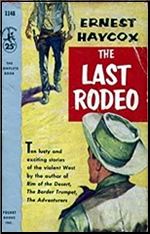
   Of the period he wrote in, Haycox was both one of the most popular and most respected writers to take up the Western, a rarity, in that he was recognized far beyond the confines of the pulps with probably only Luke Short (Fred Glidden) running him a close race in the high paying slicks of the era, yet he was also recognized as a master of action and drama.

   True to heavies from time immemorial Lingersen can’t leave good enough alone and braces Danny on his return to bury his friend:

    “Nine o’clock is our buryin’ hour around here. Attend to it, an’ get out by ten sharp or expect to answer to me without recourse, explanation or further warnin’.”

    “Does the warnin’ mean you’ll reach for the hardware at ten sharp without added talk?”

    Lingersen said: “I never warn twice and I never go back on my word.”

    “Just wanted to get it clear,” mused Danny Dale. “I’m a great hand for havin’ things straight.”

   Okay, I’ll grant you there are more dropped ‘g’s’ in this tale than all of Philo Vance and Peter Wimsey, but still it sounds and feels authentic and at the same time mythic, and that combination of the dusty sweaty hard real West with the mythic Technicolor wide-screen West of the big screen is one of the keys to why Haycox is remembered and still read.

   Haycox is too good a writer to spare us the promised showdown, and much too good to offer us a story in which that is all there is, the twist at the end an almost O Henryesque moment. Without giving it away, I’ll only say Haycox isn’t offering us simple villains and heroes and doesn’t pretend that any duel to the death is without its ironies.

   This last is just a scene as the boys ride out of town. You have read or seen it’s like in a thousand films and Western novels and stories, but listen to the simple lyric description of the following passage. “Dolorosa, Here I Come,” is a slight example of Haycox talent, but more a vivid reminder of why his name was legend in the genre and why he was envied by so many of his fellow writers of the purple sage:

   They galloped down the street, barely clearing the front of the saloon when a burst of buckshot rattled against it like hail. The town shivered with a slashing, explosive fire as the men of Dolorosa stood sheltered in the black maw of this or that alley and cross-ripped the main thoroughfare with their lead; purple muzzle lights weirdly flickered, powder smell tainted the night air.
ERLE STANLEY GARDNER “Carved in Sand.” Whispering Sands #15. Novelette. Argosy Weekly, June 17, 1933. First collected in Whispering Sands: Stories of Gold Fever and the Western Desert (William Morrow, hardcover, 1981).

   The online FictionMags Index lists 17 “Whispering Sands” stories that Gardner did for the pulp magazine Argosy from 1930 to 1934, of which “Carved in Sand” is the 15th. I do not know whether or not Bob Zane is in all of them, but I believe he is in most. (Corrections welcome!)

   It is not clear from reading just this one story what it is that Bob Zane does for a living. He is an older man, not yet grizzled, but perhaps a prospector with an inherent love for the desert, with an inquisitive mind and an aptitude for solving mysteries. The setting is not stated in any precise fashion, but it is probably the Southwest US, circa the early 1930s, about the time the story itself was written. (Both automobiles and airplanes are used as modes of transportation.)

   In this tale Zane and young Pete Ayers, his companion at the time, come to the rescue of a young girl whose father has been accused of killing another prospector. She has helped him escape, if only temporarily. He’s back in jail now, even though the evidence against him is only circumstantial and sketchy at that.

   Zane disrupts the man’s trial with Gardner’s usual zeal in such matters with some evidence based on a single fact that (disappointingly) only longtime denizens of the desert would be aware of, otherwise this is a solid, enjoyable piece of work.

   I’m only guessing, but Gardner seems to have two great passions in life: the law and how it can be manipulated to one’s advantage, and the desert and its ever “whispering sands.” The latter has two aspects to it, according to Gardner: first its inherent cruelty, but secondly, and more importantly, its kinder side, the one that can not only lull even the rawest tenderfoot to sleep, but can also hold the evidence of everything that happens there, waiting only for someone who knows where to look.

   These stories were among Gardner’ more poetic creations. In attitude and presentation, there’s quite a bit of difference between these and the straight-forward detective mysteries he’s much more well known for.


  ALFRED COPPEL “The Last Two Alive!” Short novel. First published in Planet Stories, November 1950. Reprinted with Out of Time’s Abyss, by Edgar Rice Burroughs, as half of Armchair Fiction Double Novel #D-169, paperback, 2015.

   If you all you want is a whopping good old-fashioned space opera story without a lot of either depth or characterization, this may be the story for you. Aram Jerrold is accused and convicted of conspiring against the ruling Tetarchy of the Thirty Suns, based on the testimony of Deve Jennet, a girl Aram thought he had a future with.

   But once sent to the prison planet Atmion IV for execution, Aram is pleasantly surprised (to say the least) to find that Deve is a member of group of rebels against both the Tetarchy and Satane, the despot ruler of the Kaidor planetary system. Planning to revolt and take over the Tetarchy, the latter has developed a biological weapon that wipes out the memories of its victims and turns them into howling beasts.

   Well, sir, what can a band of only a handful of rebels do — the one Aram is now a member of? They do their best, and realistically, the outcome is all but inevitable. The story is told in picturesque fashion, however, and it doesn’t slow down for a minute, exactly how you’d expect from a tale first published in a magazine called Planet Stories.

   [WARNING: PLOT ALERT AHEAD] As it so happens, this is one of those big-scale stories in which humanity completely wipes itself out, leaving only two survivors. Aram [Jerrold] and Deve [Jennet] become the progenitors of a new human race, and over the years, their names become corrupted to … can you guess?

M. McDONNELL BODKIN “The Hidden Violin.” Short story. PI Dora Myrl. First appeared in Dora Myrl, the Lady Detective (Chatto, UK, hardcover, 1900). Reprinted in The Big Book of Female Detectives, edited by Otto Penzler (Black Lizard, US, 2018).

   This very short story was probably not the lead one in the collection it first appeared in (see above), since it gets right down to business with no discussion at all as to how Dora Myrl got started as a professional detective way back in the year 1900.

   And the business at hand is an “impossible” crime: how it is that a stolen Stradivarius violin can be heard being played in a locked room, but when anyone knocks and is invited in, there is no violin to be found, no matter how diligent the search.

   The solution is simple but nonetheless rather clever, and what’s more, clues for readers to solve the case on their own are all there to be discovered. Nicely done!


Bio-Bibliographic notes:   The author, Matthias McDonnell Bodkin (1850-1933), was an Irish nationalist politician as well as a noted author, journalist and newspaper editor, and barrister. (Follow the link above to his Wikipedia page.)

   Besides the collection of a dozen stories that “The Hidden Violin” appears in, Dora Myrl also shared top billing in the novel The Capture of Paul Beck (Unwin, 1909) and makes a cameo appearance in the collection Young Beck (Unwin, 1911).

   What is most assuredly a first, if indeed not unique in the annals of PI fiction, when Dora finds herself in competition with another detective by the name of Paul Beck in solving the case they are both working on. The book was the aforementioned The Capture of Paul Beck, and in it they end up falling in love and getting married.

ROBERT SILVERBERG “Double Dare.” Short story. Galaxy Science Fiction, November 1956. Reprinted in The Fifth Galaxy Reader (1961). Collected in The Cube Root of Uncertainty (1970), among others.

   While published before I discovered science fiction magazines at the local newsstand, which would have been a couple of years later, this is the kind of SF story I enjoyed immensely when I did, and which I don’t come across all that frequently any more.

   Which is to say a “nuts and bolts” kind of SF story, in which either a Terran scientist or a pair of engineers from Earth — as in “Double Dare” — are given a problem to be solved, and whatever their motivation, they go ahead and do it.

   In this case, the stakes are raised about as high as they can go, starting with a bet in bar about which of two races, Earth’s or the alien Domerangi, is the better at solving technological problems. To settle the question, a team of two experts from Earth are sent to the Domerangi home planet, where they are presented with three engineering or physics problems to solve, with two of the Domerangi doing the same back on Earth.

   The first two tasks are easy, but the third is a tough one: to build a perpetual motion machine. Given the right incentive — and on a personal level it is to be able to go back home again — the two from Earth … but telling more would spoil the point of the story. Suffice to say that everything works out in very fine fashion, and with a added twist to the tale as well.

   Stories such as this one are built on cheery optimism, I grant you, but they’re also a lot of fun to read.

ERLE STANLEY GARDNER “The Silver Mask Murders.” The Man in the Silver Mask #3. Novelette. Detective Fiction Weekly, 23 November 1935.

   In the years during which Erle Stanley Gardner was one of the most prolific pulp writers around, he tried his hand not only at mysteries — tons of them — but westerns, adventure stories and even science fiction (collected in The Human Zero: The Science Fiction Stories of Erle Stanley Gardner, 1981). Given the undeniable fact of the latter, it should come as no surprise that he dabbled in the equivalent of the hero pulps as well.

   The most famous of the latter were The Shadow, The Spider, Operator #5 and so on. Most were the primary occupants of their own magazines. Gardner’s contributions to the genre consisted of only three long stories in the pages of Detective Fiction Weekly, all in 1935. Having read only this, the third and last of them, I don’t know if the hero in these stories was ever given a name. He seems to have been known only as The Man in the Silver Mask.

   You can probably guess why, but to confirm your suspicion, the cover of the magazine his third adventure appeared in will illustrate as well as words could do. Besides his general anonymity, nothing also is known about his background, nor why he feels to need to keep his identity a secret. All we know for sure is his fierce determination to fight crime.

   Assisting him in these endeavors are a hunchbacked Chinese mute servant by the name of Ah Wong, and a female secretary/assistant named Norma Lorne and described as “a rather slender, willowy young blonde,” who aids The Masked Man outside the office as well as in.

   In “The Silver Mask Murders” this vigilante on the side of justice comes up against a powerful nemesis named Thornton Acker, a lawyer whose clientele consists solely of other criminals who can afford his steep fees ($250,000 this time around) to help them get out of jams they can’t manage to do on their own.

   Acker’s task in this one is to make sure that a man in prison doesn’t testify against his boss in court, which he does in spectacular fashion. But the Man in the Silver Mask is working on the other side, that of law and order, and Acker’s meticulous planning soon begins to go further and further awry.

   For the most part, this is routine stuff, with a lot more violence, I suspect, than ever appeared in any other Erle Stanley Gardner story. One scene sticks out, though, one in which Silver Mask is threatening a hoodlum he’s holding captive with physical torture at the hands of his Chinese assistant. When asked later by Norma Lorne whether or not he was bluffing, Silver Mask confesses that he doesn’t know.

   The story ends with many underlings dead or in jail, but with Acker still at large. A blurb at the end of the story advertises that the next installment of the series would be coming soon, but it never did. The world of mystery fiction never noticed.


   The Man in the Silver Mask series —

The Man in the Silver Mask. Detective Fiction Weekly, July 13 1935


The Man Who Talked. Detective Fiction Weekly, September 7, 1935


The Silver Mask Murders, Detective Fiction Weekly, November 23, 1935

D. B. NEWTON “The Claim Jumpers.” Novella. First published in Best Western, September 1952 as “Who’ll Take the Cowgirl?” First collected in Range of No Return (Five Star, hardcover, 2005; Leisure, paperback, December 2006).

   In his long foreword to the two-story book collection, Jon Tuska makes the case for his theory that D(wight) B(ennett) Newton would be a lot more known today if he hadn’t been pushed by his agent to have much of his work published under pseudonyms. Names other than his own that he used over the years were Dwight Bennett, Clement Hardin, Ford Logan, Dan Temple and Hank Mitchum (eight of the long-running “Stagecoach” series in the 1980s).

   There’s a lot of truth in that statement. I’ve enjoyed all of the novels I’ve read by the above “authors,” and going back to the later years of his pulp-writing days, both of the two stories in Range of No Return are very well done. (His first published pulp western was in 1938, and over the years he wrote 150 or so more of them.)

   “The Claim Jumpers” takes place at an actual event, the Cherokee Strip Land Run (Oklahoma, 1893), as have many other stories and dramatic films over the years. Newton’s story does not rely on its historical significance, however. Rather it’s one told on a personal basis, which to me makes it all the more effective. When three cowpoke partners lose their fourth in the plan they’ve come up with, one of them succumbs to the charms of a woman he happens to meet, and he asks her to help them out.

   Things don’t go well, however. Someone seems to have leaked their plans to some Sooners who have settled into the land the partners had planned on settling, and they’re well equipped with guns. Did the girl betray them? All signs point to it.

   This is a story that combines a historical background with both action and characters that have some character to them, and at 70 pages, there’s plenty of time for Newton to develop both.

***

— “Range of No Return.” Short novel. First appeared in Complete Western Book Magazine, June 1949. Also first collected in Range of No Return (see above).

   And if anything, “Range of No Return” is even better. At almost twice the length of “The Claim Jumpers,” the action is nearly non-stop, but more than that, it fits in naturally with the story Newton has to tell. No gunfire for the sake of gunfire.

   Which is that of a young rancher who was framed for rustling cattle in his home town five years ago. With the sheriff’s assistance, who believed him innocent, he made tracks for Mexico, but now that his notoriety has died down, or so he hopes, he’s back, trying to pick up where he left off before his troubles began.

   But he’s wrong. The local ranchers have not forgotten, including the female owner of the ranch next to his. There are a couple of small twists in the tale from this point on, but they’re, I admit, only minor ones. But Newton has a good eye for describing his characters, as well as the area of Arizona hills and grasslands he places them in. Even though the basic story line is a familiar one, this is a solid piece of writing.

   If you’re a fan of western yarns, you could do a lot worse than to check out more of Newton’s stories, even his early purely pulp fiction. It’s better than most.

ERLE STANLEY GARDNER “Where Angels Fear to Tread.” Lee Sparler #1. Novelet. Published in Detective Fiction Weekly, 30 December 1939.

   Even though he got a huge cover blurb, most assuredly on the name value of the story’s author, Erle Stanley Gardner, as a private eye, Lee Sparler turned out to only be a one-and-done. By this time in 1939 Gardner was winding down his pulp-writing career. Perry Mason and the Donald Lam and Bertha Cool books were a lot more profitable, I’m sure.

   As a character, Sparler is worth talking about, though, and I could do no better than to use the words of Theo. W. Garr, president of The Planet Investigations, Inc. Here he is describing the qualities of the operative he plans to assign to a prospective client’s case:

   “He looks like a gigolo. He plays the harmonica. He raises hell with office discipline. He’s found that my old-maid bookkeeper is a romanticist at heart, and capitalizes on that knowledge. He discharges his responsibilities in a thoroughly irresponsible manner. He’s always broke. He plays the race horses. He wastes expense money, and he doesn’t seem to take himself, life, or anyone else seriously. His personality is thoroughly distasteful to me. He’s raising the devil with all my routine. He takes too many chances, and some day he’s going to get himself killed if I don’t fire him first. I have long suspected that he solves his cases by luck more than by brains and application, but the point is he gets results. Now then, do you want us to handle the case, or do you want your check back?”

   I don’t know how often a sales pitch like this would really be effective, but of course the client says yes, maybe a little doubtfully, but yes. His daughter, he believes, is being blackmailed. She’s always broke, and he thinks she’s been pawning her jewelry. Without letting her know she’s being watched, Sparler’s job is find out what’s going on. Which he does, and as it turns out, everything his boss said about him is true.

   I think Gardner had a lot of fun writing this story, and it shows. The twists in the tale that you expect in a Gardner story are only minor ones, however, and in fact, to my way of thinking, the story ends far too soon. I enjoyed it, though. It’s too bad that Lee Sparler had only the one adventure, but we can always hope that he got the girl.

LARS ANDERSON “The Domino Lady Collects.” Short story. Domino Lady #1. Originally published in Saucy Romantic Adventures, May 1936. Collected in Compliments of the Domino Lady (Bold Venture Press, 2004). Reprinted in The Big Book of Female Detectives, edited by Otto Penzler (Black Lizard, 2018).

   Not the first paragraph of the story, but close to the beginning, and introducing the first recorded adventure of The Domino Lady!

   A nightgown of sheerest, green silk was but scant concealment for her gorgeous figure. A chastely-rounded body and a slender waist served to accentuate the seductive softness of her hips and sloping contours of her slim thighs, while skin like the bloom on a peach glowed rosily in the reflected sunlight.

   Fairly tame stuff, by today’s standards, but while I don’t know for sure, I suspect that at a lot of newsstands in 1936, you had to ask if they carried copies of Saucy Romantic Adventures, and if you didn’t look like some kind of close-minded law enforcement officer, they might have been able to sell you one from under the counter.

   Copies of the magazine that have survived until today go for large amounts of money. Scarcity and high demand. Simple economics. It certainly can’t be great literature that buyers are looking for.

   In the Penzler edition, the story is only eight pages long, barely enough to introduce the character, describe what it is that motivate her to dress up in style but adding a domino mask to keep her real identity a secret. She also has a job she has been asked to do, which she does most efficiently (some indiscreet letters must be retrieved). She has vengeance on her mind, to avenge the killing of her father at the hands of the “state machine.” That the villain in this piece is not jailed or otherwise inconvenienced by her intrusion into his home may mean the story continues right on into the next one.

   It’s a mere trifle, nothing more, and when it comes down to it, the writing is nothing to get excited about, D-level at best. Lars Anderson may have been a house name. If he was a real person, nothing solid seems to be known about him, but that his semi-sexy tales are being reprinted — and that stories of the character he created continue to be written by other hands — does say something about his ability to capture the minds of readers still young at heart. A little nostalgia for days past doesn’t hurt either.


      The original Domino Lady series

The Domino Lady Collects. Saucy Romantic Adventures, May 1936
The Domino Lady Doubles Back. Saucy Romantic Adventures, June 1936
The Domino Lady’s Handicap. Saucy Romantic Adventures, July 1936
Emeralds Aboard. Saucy Romantic Adventures, August 1936
Black Legion. Saucy Romantic Adventures, October 1936
The Domino Lady’s Double. Mystery Adventure Magazine, November 1936

« Previous PageNext Page »