Diary Reviews


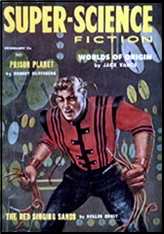
SUPER-SCIENCE FICTION, February 1958. Cover: Kelly Freas. Overall rating: 2 stars.

JACK VANCE “Worlds of Origin.” Novelette. [Magnus Ridolph #10.] Magnus Ridolph uses cultural analysis to solve a murder in space. Maybe a good idea, but it turns out a bit ridiculous. (1)

ARTHUR ZIRUL “Secret Weapon.” A Trade Bureau agent discovers a planet inhabited by beings with telekinetic powers. Without a name author it must take more than length for novelette status. [The story is two pages longer than the one by Vance.] (2)

KELLER ERNST “The Red, Singing Sands.” A woman must choose which of two beings is her husband and which a Martian. (2)

ROBERT SILVERBERG “Prison Planet.” Novelette. After 500 years of isolation a planet once used for deporting criminals is discovered to be relearning the secret of space travel. Predictable. (3)

CALVIN M. KNOX “The Happy Sleepers.” The world’s population begins to fall into continuous sleep, but without affecting the brain’s activity. (2)     [NOTE: Calvin M. Knox was a pen name of Robert Silverberg.]

RICHARD R. SMITH “The Old Timer.” Two Earthmen learn too late the oldest Martian’s secret (2)

ROBERT F. YOUNG “Time Travel Inc.” An obvious story of two men’s journey through time to witness the Crucifixion. (3)

– August 1967

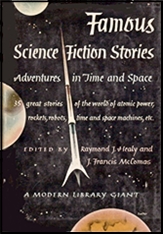
RAYMOND J. HEALY & J. FRANCIS McCOMAS, Editors – Famous Science-Fiction Stories: Adventures in Time And Space. The Modern Library G-31; hardcover, 1957, xvi + 997 pages. First published as Adventures in Time in Space, Random House, hardcover, 1946. Bantam F3102, paperback, 1966, as Adventures in Time and Space (contains only 8 stories). Ballantine, paperback, 1975, also as Adventures in Time and Space.

Part 5 can be found here.

P. SCHUYLER MILLER “As Never Was.” Time-travel again, somewhat better handled than in “The Sands of Time,” but Miller leaves himself with a paradox he can’t write himself out of. (2)

Update: First published in Astounding Science Fiction, January 1944. First reprinted in this anthology. Collected in The Titan (Fantasy Press, hardcover, 1952). Also reprinted in Alpha 5, edited by Robert Silverberg (Ballantine, paperback original, 1974). This is Miller’s second story in this anthology. You can find my comments on the first here.

ANTHONY BOUCHER “Q.U.R.” Three men form Quimby’s Usuform Robots to produce completely functional robots. Not one of Boucher’s best but entertaining. (3)

Update: First published in Astounding Science-Fiction, March 1943. First reprinted in this anthology. First collected in The Compleat Werewolf and Other Stories of Fantasy and Science Fiction (Simon & Schuster, hardcover, 1969). Later also reprinted in The Great Science Fiction Stories Volume 5, 1943, edited by Isaac Asimov, Martin H. Greenberg (DAW Books, paperback original, 1981). During his lifetime Boucher was known for his contributions to both the SF and mystery community about equally well . I suspect he is better known today by mystery fans, but I sometimes wonder how many people who go to Bouchercons really know who Anthony Boucher was.

DON A. STUART “Who Goes There?” Novella. The basis for the movie The Thing. An alien monster is found buried in the Antarctica icecap, and it threatens to take over the world because of its ability to take on any shape or form exactly. Much better than might be expected from such a story, and after a slow beginning, the story moves very quickly, particularly after the creature’s unusual abilities are discovered. (4)

Update: First published in Astounding Science-Fiction, August 1938. First reprinted in this anthology. First collected in Who Goes There? (Shasta, hardcover, 1948). Also reprinted in The Science Fiction Hall of Fame, Volume Two A: The Greatest Science Fiction Novellas of All Time Chosen by the Science Fiction Writers of America, edited by Ben Bova (Doubleday, hardcover, 1973). Stuart was a pen name of John W. Campbell, Jr., long time editor of Astounding/Analog SF.

– July-August 1967


TO BE CONTINUED.

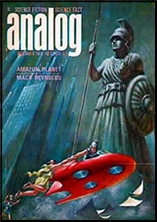
ANALOG SCIENCE FICTION. December 1966. [Cover by Kelly Freas.]   Overall rating: 2½ stars.

MACK REYNOLDS “Amazon Planet.” Serial, Part 1 of 3. See report following Feb 1967 issue.

BEN BOVA “The Weathermakers.” [Kinsman series] Novelette. A hurricane forces Project THUNDERBIRD to begin complete weather control in the East. Smooth, almost documentary style, but reasons for abandoning ship during storm are not clear. (3)

Update: Excerpt from the novel of the same name (Signet, paperback original, 1967). Included in many collections of Bova’s short fiction.

L. EDEY. The Blue-Penciled Throop. Twelve letter from Oswald Lempe, editor of a technical journal. (2)

Update: This was the author’s only work of science fiction.

KRIS NEVILLE “The Price of Simeryl.” Novelette. A Federation investigator considers a planetary government’s request for credit and guns. An interesting picture o what appears to be an entrenched bureaucracy, but the ending is dumb. (2)

Update: Collected in The Science Fiction of Kris Neville (Southern University Press, hardcover, 1984).

PHILIP LATHAM “Under the Dragon’s Tail.” An astronomer goes mad with the approach of the asteroid Icarus. (1)

Update: Reprinted in On Our Way to the Future, edited by Terry Carr (Ace, paperback, 1970).

– August 1967

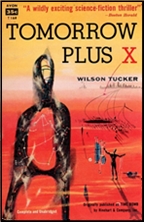
WILSON TUCKER – Tomorrow Plus X. Avon T168, paperback, 1957. Cover by Richard Powers. Originally published as Time Bomb (Rinehart, hardcover, 1955).

   A detective story complicated by future developments if telepathy and time-travel. Lieutenant Danforth of the Illinois Security Police is assigned the task of solving several bombings directed at the fanatic Sons of America. The one responsible is from the future, determined to stop Ben’s Boys from taking over America under their dictatorship.

   The attempt to successfully portray this future society, undergoing severe technological upheavals, does not entirely come off. It cannot really escape the appearances of America ten years ago with a few new gadgets thrown in, but this may be caused chiefly by hindsight. Twice, in Chapters 1 and 6, the action seems to stumble badly, but this may have been intended, for later (p.155) Tucker makes a weak attempt to justify the points in question.

Rating: 3 stars.

– August 1967

RAYMOND J. HEALY & J. FRANCIS McCOMAS, Editors – Famous Science-Fiction Stories: Adventures in Time And Space. The Modern Library G-31; hardcover, 1957, xvi + 997 pages. First published as Adventures in Time in Space, Random House, hardcover, 1946. Bantam F3102, paperback, 1966, as Adventures in Time and Space (contains only 8 stories). Ballantine, paperback, 1975, also as Adventures in Time and Space.

Part 4 can be found here.

ALFRED BESTER “Adam and No Eve.” The destruction and rebirth of the earth ages ago, with the secret of rebirth the key to the story. (4)

Update: First published in Astounding Science-Fiction, September 1941. First reprinted in this anthology. Also included in Beyond Control, edited by Robert Silverberg (Thomas Nelson, hardcover, 1972). First collected in Starburst (Signet S1524, paperback original, 1958); then in Star Light, Star Bright (Berkley/Putnam, hardcover, 1976). Bester was an extremely well known author in his day, with several classic novels and short stories to his credit, but I think he’s all but forgotten today.

ISAAC ASIMOV “Nightfall.” One of the best known SF stories of all time, about a civilization haunted by fear of darkness, which recurs every 2050 years. (5)

Update: First published in Astounding Science-Fiction, September 1941. Reprinted and collected many times. Every SF reader  and collector  of a certain age must have read it at least once.

HARRY BATES “A Matter of Size.” Novella. A scientist caught up in a mysterious plot is reduced in size. The ratio of one to twelve makes the dimensions come out easy. (1)

Update: First published in Astounding Stories, April 1934. First reprinted in this anthology. Collected in The Day the Earth Stood Still & Other SF Classics (Renaissance E Books, trade paperback, 2008). Bates’ story “Farewell to the Master” (Astounding SF, October 1940) was the basis for the movie The Day the Earth Stood Still (1951). Bates was also the editor of Astounding in the early 1930s (1930-33).

– July-August 1967


TO BE CONTINUED.

S-F YEARBOOK: A Treasury of Science Fiction, Number One, 1967.     Overall rating: 2½ stars.

JOHN D. MacDONALD “Ring Around the Redhead.” [First published in Startling Stories, November 1948.] An inventor discovers a doorway to other dimensions, then must defend himself in court when it proves dangerous. Readable in spite of weak plot. (2)

CHARLES L. HARNESS “Fruits of the Agathon.” [First published in Thrilling Wonder Stories, December 1948.] Novelette. Agathon is a word from the Greek meaning death of an individual planned for the good of society. Confusing, disturbing, and unreadable, but much better than average. (4)

MARGARET ST. CLAIR “The Unreliable Perfumist.” [First published in Thrilling Wonder Stories, February 1953.] Intrigue between a family of Martian perfumists. (0)

GORDON R. DICKSON “Show Me the Way to Go Home.” [First published in Startling Stories, December 1952.] Two Cuperians need the help of a talking at to escape Earth. (1)

RAY BRADBURY “The Irritated People.” [First published in Thrilling Wonder Stories, December 1947.] Warfare is conducted by radio music, confetti, and mosquitos. (2)

MARGARET ST. CLAIR “The Stroller.” [First published in Thrilling Wonder Stories, August 1947.] About strange creatures from Venus. (0)

GEORGE O. SMITH “Journey.” [First published in Startling Stories, May 1948.] Space pilot has to come up with FTL theory to prove he traveled to Alpha Centauri. (3)

EDMOND HAMILTON “The Knowledge Machine.” [First published in Thrilling Wonder Stories, June 1948.] Two men take over an inventor’s discovery that speeds learning electronically. (3)

THEODORE STURGEON “The Sky Was Full of Ships.” [First published in Thrilling Wonder Stories, June 1947.] Strange visitors to Earth are concerned about the use of atomic power. A famous last line. (3)

– August 1967

ELLERY QUEEN’S MYSTERY MAGAZINE, December 1966. Overall rating: 3 stars.

JACOB HAY “The Opposite Number.” The “inside” story of the spy business. (3)

AGATHA CHRISTIE “Hercule Poirot and the Sixth Chair.” Original title: “Yellow Iris.” Poirot stops a murder from occurring at a dinner party. (3)

WILLIAM BRITTAIN “The Boy Who Read Agatha Christie.” Schoolboy foils plan of college students. Enjoyable but trivial. (3)

ARTHUR PORGES “Private Beachhead.” Gimmick with radios too uncertain for story basis. (2)

YOUNGMAN CARTER “Seeds of Time.” SF story about visitor through time. Nothing unusual. (3)

CORNELL WOOLRICH “All It Takes Is Brains.” Novelette. Original title “Crime of St. Catherine Street.” Man on a bet enters Montreal with 75¢ and leaves with $1500, being wanted for murder in the meantime. Exciting in pulp style. (4)

CHRISTOPHER ANVIL “The Problem Solver and the Defector.” Verner finds secret plans. (3)

GEORGE EMMETT “Pushkin Pays.” Attempt to dispose of body in ocean fails, thanks to appearance of Russian submarine. (1)

HELEN NIELSEN “The Chicken Feed Mine.” Three ex-servicemen kill a desert rat for his “savings.” (3)

JOHN T. SLADEK “Capital C on Planet Amp.” SF, but in far-out camp style. Garbage. (0)

L. E. BEHNEY “The Long Hot Day.” Tale from home. Husband kills stranger his wife falsely accuses. (3)

JOHN DICKSON CARR “To Wake the Dead.” Original title “Blind Man’s Hood.” An adequate locked room mystery, but supernatural tone of story is forced. (2)

RUFUS KING “Anatomy of a Crime.” hort novel. Stuff Drscoll solves a murder made to appear a textbook suicide. Actually an inverted detective story as the reader follows the battle of wits between murderer and investigator with fascination. (4)

– August 1967


RAYMOND J. HEALY & J. FRANCIS McCOMAS, Editors – Famous Science-Fiction Stories: Adventures in Time And Space. The Modern Library G-31; hardcover, 1957, xvi + 997 pages. First published as Adventures in Time in Space, Random House, hardcover, 1946. Bantam F3102, paperback, 1966, as Adventures in Time and Space (contains only 8 stories). Ballantine, paperback, 1975, also as Adventures in Time and Space.

Part 3 can be found here.

LEWIS PADGETT “Time Locker.” Galloway/Gallagher #1. Novelette. This time Galloway (the prototype of Gallagher) invents a locker which leads into another space-time continuum and the usual type of plot-juggling. (4)

Update: First published in Astounding SF, January 1943. First reprinted in this anthology. Also reprinted in The Best Time Travel Stories of the 20th Century, edited by Martin H. Greenberg & Harry Turtledove (Del Rey / Ballantine, trade paperback, 2005). First collected in Robots Have No Tails (Gnome Press, hardcover, 1952). Henry Kuttner’s wife C. L. Moore may have collaborated with him on this story. This is the second story by “Lewis Padgett” in this anthology. (Follow the link above.) I haven’t been reading as much SF lately as I should have, so I don’t know if anyone in the field today is writing anything as funny as a good deal of what Kuttner wrote back in the 1940s.

CLEVE CARTMILL “The Link.” Short story. The first step of man above the ape level on the evolutionary ladder may have happened this way, but it’s not likely. (1)

Update: First published in Astounding SF, August 1942. First reprinted in this anthology, then later in Political Science Fiction: An Introductory Reader, edited by Martin Harry Greenberg & Patricia S. Warrick (Prentice-Hall, trade paperback, 1974). From Wikipedia: “He [Cartmill] is best remembered for what is sometimes referred to as ‘the Cleve Cartmill affair,’ when his 1944 story ‘Deadline’ attracted the attention of the FBI by reason of its detailed description of a nuclear weapon similar to that being developed by the highly classified Manhattan Project.”

MAURICE A. HUGI “Mechanical Mice.” Short story.” A time machine leads to the construction of a world-destroyer. Too old. (0)

Update: First published in Astounding SF, January 1941. First reprinted in this anthology and (among others) Classic Science Fiction: The First Golden Age, edited Terry Carr (Harper & Row, hardcover, 1978) and The Great Science Fiction Stories Volume 3, 1941, edited by Isaac Asimov, Martin H. Greenberg (DAW Books, paperback, 1980). Hugi perhaps comes closest to being a Little Known Writer as anyone in this anthology, with only a handful of stories to his credit. SF writer Eric Frank Russell is said to have worked extensively with Hugi on this story before it could be accepted for publication.

– July-August 1967


TO BE CONTINUED.

IMAGINATION. September 1954. Overall rating: One star.

GEOFF ST. REYNARD “Vengeance from the Past.” Short novel. Neanderthals try to take over space station. Nonsense. (0)

Update: Geoff St. Reynard was the pen name of Robert W. Krepps, about whom I know nothing. The story itself has never been collected or reprinted.

JEROME BIXBY “The Battle of the Bells.” In which an angel praises the rustic outhouse and the devil is flushed away. (1)

Update: Collected in Space by the Tale (Ballantine, paperback original, 1964) and in “One Way Street” and Other Stories (Armchair Fiction Masters of Science Fiction #2, trade paperback, 2011). I’ll let you comment on the basic concept of this one, if you’d care to.

DANIEL F. GALOUYE. “Immortality, Inc.” Novelette. Two immortals try to cheat a non-Stockholder of his life. (2)

Update: Never collected or reprinted. Galouye wrote perhaps a half dozen novels, but was better known for his short fiction. Of note, however, is his first novel, Dark Universe (1961), which was nominated for a Hugo.

ALLYN DONNELSON “Welcome to Paradise.” A repairmen exposes a secret military project by writing the President. (1)

Update: The author’s only published story.

RUSS WINTERBOTHAM “Three Spacemen Left to Die!” The last Earthmen sacrifice their lives to save another civilization. (3)

Update: Never collected or reprinted. Winterbotham’s writing career was broken in two parts. Part one between 1935 to 1943, then between 1952 and 1958, but even though I rated this story as the best of the issue, nothing he produced seems worthy of attention now.

– August 1967


Overall thoughts: A footnote to this page in my diary is telling: NO LONGER IN COLLECTION.

WORLDS OF TOMORROW. November 1966. Overall rating: 3 stars.

LIN CARTER “Crown of Stars.” Novelette. Tongue-in-cheek adventure with Hautley Quicksilver, Confidential agent, as he attempts to steal a jeweled crown. The over-eloquent descriptive style slows things down too much. (3)

Update: While the story doesn’t appear to have been either collected or reprinted, it’s fairly clear that it was the basis for Carter’s novel The Thief of Thoth (Belmont Double, paperback original, 1968). Here’s a synopsis of that book which I found online:

   â€œHautley Quicksilver is a licensed thief and considered the best in the business.. A man posing as an archeologist, a planetary prince and an intelligence agent acting on orders from the Emperor’s cabinet approach Quicksilver separately. They all want him to steal the Crown Of Stars. It’s an artifact from the long gone Cavern Kings Of Toth. They were a lizard like race and the cave containing the Crown is guarded by a fanatical cult.”

   A followup novel in the same series, The Purloined Planet, was published the following year, also by Belmont. I used to like Carter’s novels, almost all of them pastiches of other author’s series, but that was when I was a whole lot younger. I’d like to give the expanded novel a try, though, whenever I find my copy.

C. C. MacAPP “Frost Planet.” Novelette. Murder and sabotage in an Earth enclave disrupts relations with the natives. The motives behind the plot are poorly defined, and the physical background has little bearing on the story. (2)

Update: The story has never been collected or reprinted. C. C. MacApp was a pen name of Carroll Mather Capps, and while he wrote seven novels between 1968 and 1972, I don’t recall reading any of them.

RICHARD C. MEREDITH “To the War Is Gone.” Novelette. Illustrating a poem of Thomas Moore, a minstrel goes to war and dies in the fight against slavery. His sole opponent in his final conflict is a beautiful girl, who holds his life in her hands, just as he is the only one who can save her. (5)

Update: This was Meredith’s second published story. I wish I’d said more about the time and place where it was set. It was never reprinted or collected. Meredith wrote seven novels between 1969 and 1979, including three in his “Timeliner” series. I remember enjoying them, but the details are long gone.

DANNIE PLACHTA “Until Armageddon.” A computer announces the beginning of the Hour of Judgment. (3)

Update: At only two pages in length, this was obviously only a filler for this issue. It is possible that I once met the author. One online source describes him as an active participant in the Detroit fandom in the 1960s, which I was tangentially involved with when I lived in Ann Arbor.

STEPHEN TALL “Seventy Light-Years from Sol.” Short novel. An exploration team discovers a new evolutionary system, consisting of cubes and millwheels on a planet covered with lettuce. [At 40 pages in length] about ten pages too long. (3)

Update: Collected in The Stardust Voyages (Berkley, paperback original, 1975) as “A Star Called Cyrene.” There was a followup novel in the same series, The Ramsgate Paradox (Berkley, paperback original, 1976). I own both books, but alas, I’ve managed to read neither one.

– August 1967


Overall thoughts: I rated this three stars out of five, which is a notch above average. That’s about right. Worlds of Tomorrow was my favorite science fiction magazine at the time, less literary than F&SF and more fun than the rather stodgy Analog SF, as it had increasingly become.

« Previous PageNext Page »