H. W. RODEN – Too Busy to Die. Detective Book Club, hardcover reprint, 3-in-1 edition (no date). First edition hardcover: William Morrow, 1944. Other hardcover reprints: Grosset & Dunlap (no date); World, 1946. Paperback: Dell #185 [1947] & #349 [1949]; both mapback editions.
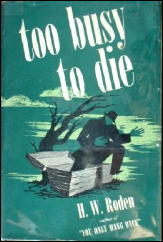
H. W. RODEN Too Busy to Die

   Knowing little about the author, H(enry) W(isdom) Roden, 1895-1963, I first checked with Al Hubin’s Crime Fiction IV (naturally), and besides the information found in the first part of this sentence, I learned that Roden was an executive with various food corporations over his lifetime. Private detective Sid Ames was a character in all four of his mystery novels; sharing the bill on three of them was public relations expert, Johnny Knight.

   Here are the titles of the four books, all published first in hardcover by Morrow, in what I believe is correct chronological order: You Only Hang Once (1944), Too Busy to Die (1944), One Angel Less (1945 and the only solo appearance of Sid Ames), and Wake for a Lady (1946).

   Four books in three years, then no more. Searching on the Google, I also found an appearance by Roden on Ellery Queen’s radio program, “The Secret Weapon,” February 28, 1945. As was standard procedure for the show, Roden was a guest “armchair detective” whose job in the closing minutes to name the killer before Ellery did. (If Roden succeeded or not, I do not know. Most of the EQ radio programs are not available for listening.)

   On Kevin Burton Smith’s thrillingdetective.com website, he claims the city that Ames and Knight called home was New York City, but I’m not convinced. It’s not named in Too Busy to Die, but the surroundings to me don’t feel like Manhattan — much more like a small Midwestern town, but it had me wondering all the way through. Tellingly, Hubin does not identify the setting either.

   Sid Ames takes only a secondary role in the one I’ve just read. The story is told by Johnny Knight, who hires Ames after a client is found murdered in his hotel room. The old man, now rich with Oklahoma oil money, had come to Knight with a far-fetched story of trying to locate his former adoptive family, from whom he had run away when he was a kid. “Lammed,” is his very word.

   So, with a $2000 fee in hand, Knight feels obligated to find the man’s killer. This is one of those typically 1940s wacky type of screwloose capers, complete with a beautiful blonde, a pint-sized bombshell named Patricia Rodkins who is not only deeply involved in the case but who also goes completely gaga over Knight at first glance, reason unknown but Johnny does not mind.

   Diamonds are also involved, in a package the dead man had left in Johnny’s care, and two families (and hangers-on) of strangely-behaved matrons, dipsy husbands, assorted personal assistants, a hulking lug named Homer and a butler who is also the operator of a well-known west side crap game.
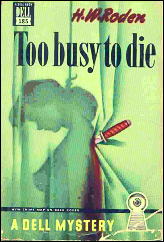
H. W. RODEN Too Busy to Die

   Here’s a quote from page 88, a total non sequitur, I grant you, but I liked it:

    I dropped Pat at her house and returned to my apartment. I found I had a visitor.

    Sid Ames sat in my living room. He looked very comfortable. He was stretched out full length on the couch. He had taken off his coat and shoes. A half-emptied highball glass rested on the floor within easy reach. He had just turned to the final pages of the latest Perry Mason story when I walked in.

    “That Della Street is some dish.” He addressed me as if Della were a personal friend of mine. “But what’s the matter with that guy Mason? There she is all the time waiting to be– Oh, well–” he finished, tossing the book on the floor.

    “Make yourself at home, fellah,” I grinned at him.

   With the body found on page 189, however, there are no more jokes. Things get serious and quite a bit darker in tone, and in spite of the relative loony atmosphere at the beginning, you begin to wonder if the mystery could possibly have a well-explained, coherent ending. It doesn’t.

   Which is not bad, you understand, but a last minute confrontation with the killer, which consists largely of eight pages of Johnny Knight doing all of the explaining, even though the killer on page 201 says:

    “…So why shouldn’t I want to talk about it? In fact, I’ve wanted to talk about it. I’ve wanted to tell someone … [how] … clever I’ve been.”

   And the aforementioned eight pages of tangled reasoning and impossible coincidences ensue. Johnny is also one of those guys who reports on what he sees but nothing more, nothing on what he’s actually thinking. And when he doesn’t comment on the obvious, the reader (that’s me) begins to think that either (a) he’s a lunkhead, or (b) the reader (again that’s me) was wrong, or at least sadly mistaken.

   On the other hand, do I regret the two or three late evening sessions I spent reading this? No, not at all, and I must have the other three of Roden’s books around here somewhere.

— March 2004


   NOTE: Previously reviewed on this blog, both times by Bill Deeck: You Only Hang Once and One Angel Less. (Follow the links)

IT IS PURELY MY OPINION
Reviews by L. J. Roberts


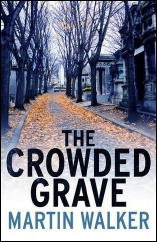
MARTIN WALKER – The Crowded Grave. Alfred A. Knopf, hardcover, July 2012. Vintage, trade paperback, April 2013.

Genre:  Police procedural. Leading character:   Bruno Courrèges, 4th in series. Setting:  Provence, France.

MARTIN WALKER The Crowded Grave

First Sentence: For once, the chef de police of the small French town of St. Denis was carrying a gun.

   It is a busy time for police chief Bruno Courrèges. Local farmers of geese and ducks are being set upon by members of PETA who oppose fois gras. A local archeology site has turned up four skeletons — three that could cause a significant change in the science of evolution, one much more recent who was murdered — and now the head of the dig has gone missing.

   A high level summit is about to take place between representatives of France and Spain over the Basque separatists. And Bruno has two attractive women and a new magistrate with whom he must contend.

   Walker’s evocative descriptions transport one to the sights, sound, smells and tastes of Provence. Each book being set in a different season—in this case, Spring—heightens the experience even further.

   Bruno is a very likeable and appealing character. He is very much part of his small community and protective of its residents. He is part of their lives and understands them. His approach to law enforcement is always to abide within the letter of the law, but to do what is just, and provides the best solution to the people involved.

   An excellent descriptions comes from Bruno himself, “He could imagine what young magistrates might think of him, an ex-soldier who hunted and drank and who tired never to arrest anyone and cared little for the subtleties of modern law enforcement with its counseling and political correctness.” although this makes him seem harsher than he is.

   The woman he most loves now lives in Paris and he can’t imagine life anywhere but in St. Denis. It also leaves out that he built his own house, grows most of his own food, makes wine, rides horses, and cooks. The descriptions of food and its preparation were mouth-watering and somewhat amusing. Above all, he is no one’s fool.

   I always learn something from Walker’s books. The archeological information is fascinating with the subject of the dig being a discovery that could change thoughts of the evolution of man from Neanderthal to Cro-Magnin. There was also and interesting, and well-handled, perspective given on the controversy over fois gras.

   However, some of the history from WWII, the French Resistance, the Spanish Civil War, the Basque separatists, and the “Dirty War” in Argentina, was a bit confusing to me. I certainly know of them all, but not necessarily how they fit together politically. Still, it made me look things up and was fascinating.

   It also led to a moment of introspection… “Generation after generation, so many bodies must lie scattered in the soil of France, so many battlefields where the bones must lie thickly together. … France is built on a heap of bones, he thought; we are the sum of all the dead that went before us.”

   The Crowded Grave is a very good read. It has all the best elements of character, sense of place, a bit of humor, some suspense, and a compelling plot. I’m happy to say the next book is already waiting for me.

Rating: Very Good

REVIEWED BY DAN STUMPF:


HOLLISTER NOBLE – One Way to Eldorado. Doubleday, hardcover, 1954.

HOLLISTER NOBLE One Way to Eldorado

   Okay, this’ll sound like a trip report, but it’s really a book review. A few years back we took two trips: one to Lake Tahoe for a wedding, and one to Myrtle Beach to see my parents. For the Tahoe trip we flew into Sacramento and took a “shortcut” to Tahoe — driving across the mountains on a road that went straight up, spun around, twisted, bucked and plunged back down again, with all the charm of a Brahma Bull that’s just been kicked in the nuts. Along the roadside, we noticed reflectionized markers about 12 feet high, and suddenly realized they were there to mark the road in heavy snow!

   As for Myrtle Beach, I’ve always found it crowded and touristy, but my folks like living there, and that’s the main thing. There’s one Used Book Store in the whole city, a moribund place pretty much devoid of charm, but I found something there called One Way to Eldorado by Hollister Noble.

   It looked like a mystery set in a deserted whistle-stop town: a Railroad trouble-shooter stuck in a blizzard with assorted gamblers, miners, dance hall gals, etc. and I’d never heard of it (it’s not listed in Hubin) so I thought I’d give it a try. Imagine my surprise when I found the story was set in the same mountain pass I had driven through just a few months earlier!

   Your chances of finding this are pretty slim, but it’s worth a look. Noble takes too long getting the story off the ground, and the background seems rushed at first, but once he gets started, he delivers a fast-paced tale filled with roaring winds, avalanches, train wrecks, fights, robberies, and a nifty ending I didn’t quite see coming.

   There’s also some unintended charm: Noble wrote this when Train was still the primary method of travel and shipping cross-country, and his picture of this forgotten time has a faded splendor I found captivating all by itself.

THE BACKWARD REVIEWER
William F. Deeck


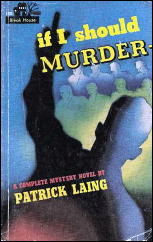
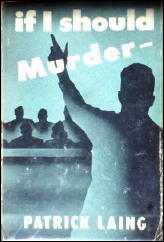
PATRICK LAING [AMELIA REYNOLDS LONG] – If I Should Murder. Phoenix Press, hardcover, 1945. Bleak House #19, no date [1948].

PATRICK LAING If I Should Murder

   The reader is asked to accept that a jury which has convicted an accused murderer and thus caused his death by execution would want to meet each year on the anniversary of its decision; that the jury members would continue this annual get-together despite the grieving widow showing up on each occasion to give a basilisk stare to the participants; that when a jury member dies, his daughter would be asked to take his place and would agree to attend.

   Of course, if she hadn’t accepted, Patrick Laing, assistant professor of abnormal psychology and sometime criminologist would not have accepted an invitation to speak to the assembled jurors, Laing is in love with the deceased juryman’s daughter, but since Laing is blind, he never reveals his feelings to her.

   Although the gathering is held in a hard-to-find mountain lodge, the widow naturally shows up. What is more, the executed man’s lawyer arrives to read a confession by the real murderer.

   As a blizzard rages, as blizzards never fail to do, some of the jurors discuss how they would commit murder in the unlikely event any of them should wish to do so. Later that evening certain of the jury members are killed by the very methods they said they would have employed.

PATRICK LAING If I Should Murder

   Dr. Gideon Fell once stated:

   I have been improving my mind with fiction of the Bloody Hand variety for the last forty years. So I know all the conventional death-traps: the staircase that sends you down a chute in the dark, the bed with the descending canopy, the piece of furniture with the poisoned needle in it, the clock that fires a bullet or sticks you with a knife, the gun inside the safe, the weight in the ceiling, the bed that exhales the deadly gas when the heat of your body warms it, and all the rest of them — probable and improbable. And I confess that the more improbable they are, the better I like ’em. I have a simple melodramatic mind.

   Dr. Fell, I believe, would — and maybe did — enjoy the works of Amelia Reynolds Long in whichever guise she wrote. While I would not admit it as boldly as Dr. Fell did, I, too, have a tendency to appreciate melodrama in the mystery, which helped me enjoy this book, one that otherwise has no redeeming value.

— From The MYSTERY FANcier, Vol. 12, No. 2, Spring 1990.


      The “Patrick Laing” series —

If I Should Murder (Phoenix Press, 1945)
Stone Dead (Phoenix Press, 1945)
Murder from the Mind (Phoenix Press, 1946)
The Shadow of Murder (Phoenix Press, 1947)
The Corpse Came Back (Phoenix Press, 1949)
A Brief Case of Murder (Phoenix Press, 1949)
The Lady is Dead (Phoenix Press, 1951)

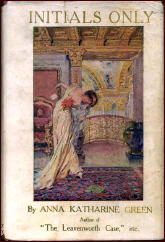
ANNA KATHARINE GREEN – Initials Only. Dodd Mead, hardcover, 1911. Hardcover reprint: A. L. Burt Co.

ANNA KATHARINE GREEN Initials Only

   Mrs. Rohlfs’s latest story [see FOOTNOTE] is distinguished by the small number of people involved and by the consequent narrowing and intensifying of interest upon the criminal and the detective, the latter being our old friend [Caleb] Sweetwater, acting under the aid of our older friend [Ebenezer] Gryce.

   Outside of her skill in weaving a plot Mrs. Rohlfs has few of the novelist’s virtues, and her attempt in the first part of this book to narrate events at second-hand through the mouth of a woman who has nothing to do with the plot is extremely awkward. However, this useless device is soon dropped, and the rest of the story proceeds naturally to its ruthless end.

   In no other of her stories has she presented a stronger character than [SPOILER DELETED], who is hounded by the relentless Sweetwater, and his character is not extraneous to the plot but essentially involved.

   There is a bit of unfairness in the climax which does not come — as it should come in the legitimate detective story — from the direct game of pursuit and evasion.

– Unsigned
– “Current Fiction”
THE NATION
– October 5, 1911
http://www.unz.org/Pub/Nation-1911oct05-00315
– [Scroll down to page 316, left bottom]

Also online here:
– Color frontispiece
http://www.unz.org/Pub/GreenAnna-1911?View=ReadIt3

FOOTNOTE: From Wikipedia: “On November 25, 1884, Green married the actor and stove designer, and later noted furniture maker, Charles Rohlfs, who was seven years her junior.”

   Thanks once again to to Mike Tooney, who first uncovered this review and posted it to Yahoo’s Golden Age of Detection group.

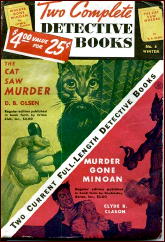
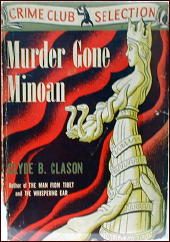
CLYDE B. CLASON – Murder Gone Minoan. Rue Morgue Press, trade paperback, 2003. Original hardcover: Doubleday Crime Club, 1939. Pulp magazine reprint: Two Complete Detective Novels, Winter 1939-1940 (with The Cat Saw Murder, by D. B. Olsen). Hardcover reprint: Sun Dial Press, 1940.

   Checking on www.abebooks.com just a few minutes ago, I found only one copy of the Crime Club edition for sale: Near Fine in a Near Fine jacket. Price: a mere $250.00. Further searching revealed a few other copies on other venues, one being a former library copy with no jacket. Price: a much more reasonable $35.00.

CLYDE B. CLASON Murder Gone Minoan

   But if $14.95 is all you want to spend, this handsome trade paperback will do very nicely. This is but one of many classic mystery reprints coming from Tom & Enid Schantz of Rue Morgue Press, and they should be commended for a job well done, and for jobs yet to be done. (At the moment, the only other Clason title they’re published is The Man from Tibet, but perhaps others are on their way. Only sales will tell, I imagine.)

   Only one thing is lacking, before I continue, and that is the original cover art, which as I recall was by Boris Artzybasheff. That gentleman no longer being available (or affordable) a fine piece of work by Rob Pudim was used in his stead. To my eye it’s a bit cluttered, but it Does Catch the Eye.

   Clason’s series detective is an eminent Roman historian named Theocritus Lucius Westborough — Westborough for short — who also has earned a well-deserved reputation as a private investigator on the side. If this book is an example — which from my point of view it has to be, at least for the moment, since if I ever read an earlier book in the series, it was long ago and long forgotten — Westborough’s adventures are copiously filled with well-researched lore of ancient times, interspersed with mini-lectures on the same.

   I’m jumping the gun here, but it’s Westborough’s knowledge of ancient history that helps crack a killer’s alibi — which is not quite fair to the reader not recently tutored in such matters — such as myself, I have to admit — but it’s a sizable step above nabbing a villain who reveals himself because he’s not aware that buildings do not have thirteenth floors, for example.

CLYDE B. CLASON Murder Gone Minoan

   Just in passing: There is a deliberate misstatement on my part that is not quite correct in the last sentence of the previous paragraph, but if I were to speak more clearly, I would be revealing more of what Clason had up his sleeve than I should.

   This, the seventh of ten cases Westborough is on record as having solved, takes place on an isolated island off the southern California shore, where first a valuable artifact is stolen — and Westborough called in — and then murder, when a missing butler is later found dead.

   The owner of the island, a rich Greek businessman named Paphlagloss, is fascinated with the ancient Minoan culture, pre-historic Cretans whose civilization arose and fell even before the ancient Greeks, and his mansion is filled with valuable relics, artwork and jewels. Just the right place for skullduggery to be done, and with only a handful of suspects, one of whom is responsible for doing the dugging, it’s a perfect setting for a mystery.

   Clason’s strength is in his characters and their dialogue. To my ears, the lengthy reports of letters and verbatim interviews of suspects are close to perfect. Other parts of the tale are excellent, while others, contrarily, are pure fuddle-muddle.

   I like the following quote, for some reason, taken from pages 160-161. Paphlagloss’s daughter is having a private conversation with Westborough:

CLYDE B. CLASON Murder Gone Minoan

    She shivered and drew the wrap closely to her slim body. “Why do things have to be in such a perfect devil of a mess?”

    His mild eyes peered distressfully through his gold-rimmed spectacles. “The question, I should conjecture, has been propounded rather frequently during the four thousand years of recorded history. However, I am unable to recall a single instance where it was answered satisfactorily.”

    “You are very wise!” she exclaimed.

    He shrugged deprecatorily. “My wisdom is confined to a single fact. I have lived long enough to learn that most of my fellow creatures — and myself, as well — must of necessity be a little foolish.”

    “What would you advise me to do?”

    “I dare not advise you, my dear. The situation is too delicate. As delicate,” he added thoughtfully, “as the ripples of a Chinese nocturne.”

   While it’s great to have this small gem of the Golden Age of Mysteries back again in print, I also have to suggest that it didn’t then, and it doesn’t now, have the staying power of one by a Queen, Christie, or a John Dickson Carr. Even so, and within its limitations, it is a gem in its own right, and no, they don’t write them like this anymore.

— January 2004


[UPDATE] 09-05-13. Checking on abebooks again just now, I found nine copies of the Crime Club edition for sale, ranging in price from $25 (bumped and frayed) to $300 (almost fine in jacket). Rue Morgue Press has a long informative profile of Clyde Clason, the author, and seven books in the Westborough series are now available from them. See below.

    CLYDE B(urt) CLASON, 1903-1987.

The Death Angel (n.) Doubleday 1936.    RM = Rue Morgue Press.
The Fifth Tumbler (n.) Doubleday 1936.
Blind Drifts (n.) Doubleday 1937.    RM
The Purple Parrot (n.) Doubleday 1937.    RM
The Man from Tibet (n.) Doubleday 1938.
The Whispering Ear (n.) Doubleday 1938.
Dragon’s Cave (n.) Doubleday 1939.    RM
Murder Gone Minoan (n.) Doubleday 1939.    RM
Poison Jasmine (n.) Doubleday 1940.    RM
Green Shiver (n.) Doubleday 1941.    RM

REVIEWED BY DAN STUMPF:


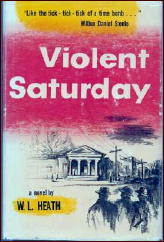
VIOLENT SATURDAY

VIOLENT SATURDAY. 20th Century Fox, 1955. Victor Mature, Richard Egan, Stephen McNally, Virginia Leith, Tommy Noonan, Lee Marvin, Margaret Hayes, J. Carrol Naish, Sylvia Sidney, Ernest Borgnine. Based on the novel by William L. Heath. Director: Richard Fleischer.

   It took me a long time to catch up with Violent Saturday, which I saw on local TV in the 60s, pretty badly cut up. At the time I thought it a compact little gem of a film, but seeing it again recently at last, I find it’s the kind of film that needs to be badly cut up.

   There’s a fine little Heist Movie at the heart of it, and when three exemplary Heavies like Stephen McNally, J. Carroll Naish and Lee Marvin finally square off against Victor Mature, the film snaps, crackles and pops with excitement. Unfortunately, it takes about eighty minutes of Nothing Very Much to get around to it.

   I recommend the book, by the way, a nifty little novel by W. L. Heath (Harper, 1955; reprinted by Black Lizard, 1985) that brings life to small-town characters reduced to Soap Opera status in the film.

THE BACKWARD REVIEWER
William F. Deeck


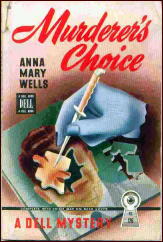
ANNA MARY WELLS – Murderer’s Choice. Alfred A. Knopf, hardcover, 1943. Dell #126, paperback, mapback edition, no date [1946]. Perennial Library, paperback, 1981.

ANNA MARIE WELLS Murderer's Choice

   Charles Osgood, famous mystery writer and creator of Silas Smith, bucolic detective, is one of those, it is to be hoped, rare mystery writers who are nasty characters in their own right, and maybe write.

   Charles tells his cousin, Felix Osgood, whom he obviously dos not like, that he, Charles, is ging to commit suicide in such a way that the death will seem like murder. Charles also says he will leave clues pointing to Frank.

   He adds that be is leaving everything to Frank in his will and has made him the beneficiary of a large insurance policy so that everyone will know who gains by the death. Frank, Charles tells him, will be charged with homicide and executed.

   Charles does indeed die, but the death is considered natural. Frank, who has waited nervously for the ax to fall and the evidence to make its appearance, can wait no longer. He hires the Keene Detective agency to look into his cousin’s death, and the agency assigns Grace Pomeroy, a new employee and a former nurse, to the case.

   Well written but requires a good deal of suspension of disbelief.

— From The MYSTERY FANcier, Vol. 12, No. 2, Spring 1990.


      BIBLIOGRAPHY —     [Taken from the Revised Crime Fiction IV, by Allen J. Hubin.]

ANNA MARY WELLS [aka Anna Mary Wells Smits, at one time an associate professor of English at Douglass College], 1906-2003.

   A Talent for Murder (n.) Knopf 1942 [Dr. Hillis Owen; Grace Pomeroy]
   Murderer’s Choice (n.) Knopf 1943 [Grace Pomeroy]
   Sin of Angels (n.) Simon & Schuster 1948 [Dr. Hillis Owen; Grace Pomeroy]
   Fear of Death (n.) Wingate 1951
   The Night of May Third (n.) Doubleday 1956

Editor’s Note: John F. Norris reviewed this same book over on his blog a couple of years ago. Check it out here.

FIRST YOU READ, THEN YOU WRITE
by Francis M. Nevins


   Hello again! I won’t attempt to describe the health problems that forced me to abandon this column and just about everything else these past few months, but they seem to be behind me now and I’m ready to take up where I left off. Care to join me?

***

   Not long before I put the column on hiatus, I learned from Fred Dannay’s son Richard that I’d made a mistake in Ellery Queen: The Art of Detection, and I can’t think of a better place to correct it than here.

   On page 241 of the book I state that the 1968 Queen novel The House of Brass was written by Avram Davidson from an outline by Fred. It’s true that Davidson was commissioned to and did expand Fred’s outline to book length, but that’s only a small part of the story, which is told in full in the Dannay papers, archived at Columbia University.

MIKE NEVINS

   Among the House of Brass documents are: (1) two different drafts of Fred’s synopsis, one running 74 pages, the other 61; (2) Davidson’s expansion of the synopsis, which runs 181 pages; (3) two copies of the 266-page version of the novel written by Manny Lee after the Davidson version was rejected; (4) two copies of the final draft of the novel, which runs 275 typed pages. These facts are indisputable, and I thank Richard Dannay for sharing them with me.

   As I documented in my February column, we know from Manny’s letter to Fred dated November 3, 1958 that he was at work turning a Dannay synopsis into a new novel but had been put behind schedule by health problems. (Whether these included the onset of writer’s block remains unknown.)

   We also know that the book in question was not The Finishing Stroke, which had been published much earlier in 1958 and was the last novel in what I’ve called Queen’s third period. So what happened to the book Manny was working on near the end of the year?

   I can envision three possibilities. (1) Fred gave up on it completely. (2) He gave up on it as a novel and he or another writer turned it into the novelet “The Death of Don Juan” (Argosy, May 1962; collected in Queens Full, 1965). (3) Manny went back to the project after recovering from writer’s block and it was published as Face to Face (1967).

   My own guess, which is speculative but (I hope!) informed, is the third possibility. With that as my premise, I offer the following timeline.

   Late 1958 or early 1959 — Manny develops writer’s block and is unable to continue expanding the latest Dannay synopsis into a novel.

   1961 or 1962 — A decision is made to bring in other writers to perform Manny’s traditional function.

   1963 — Publication of The Player on the Other Side, written by Theodore Sturgeon from Fred’s synopsis.

   1964 — Publication of And on the Eighth Day, written by Avram Davidson from Fred’s synopsis.

   1965 — Publication of The Fourth Side of the Triangle, written by Davidson from Fred’s synopsis.

   1966? — Davidson expands Fred’s synopsis into The House of Brass, but Fred and Manny reject his version and the project is shelved.

   1966 or 1967 — Manny recovers from writer’s block and finishes his work on the project that was left incomplete back in the late Fifties. This book is published as Face to Face (1967).

   1967 or 1968 — Manny completely rewrites the rejected Davidson version of The House of Brass, which is published under that title in 1968.

   The final Queen hardcover novels — Cop Out (1969), The Last Woman in His Life (1970), and A Fine and Private Place (1971), whose publication Manny did not live to see — were written by the cousins without input from outsiders, Fred preparing the plot synopses as usual and Manny expanding them to book length.

***

   As editor of Ellery Queen’s Mystery Magazine, Fred had reprinted dozens of the pulp stories of Dashiell Hammett but just one tale by Raymond Chandler and that only after his death. Of course the vast majority of Chandler’s short fiction was too long for EQMM’s requirements, but from Fred’s point of view the most serious problem with the creator of Philip Marlowe was that, unlike Hammett, he had a pervasive tendency to get lost in his own plot labyrinths. In fact he once said that plot didn’t matter to him, only the individual scenes did.

MIKE NEVINS

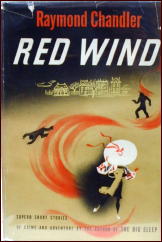
   This tendency can be seen as far back as his first published story, “Blackmailers Don’t Shoot” (Black Mask, December 1933; collected in Red Wind, World 1946, and in Stories and Early Novels, Library of America 1995).

   Trying to make sense of this story is like trying to nail jelly to a wall. One of the main characters is Landrey, a gambler and racketeer who earlier in his life had tried to launch a Hollywood career. In those days he had had an affair with Rhonda Farr, a young beauty who had become a major star. Apparently wanting to rekindle the romance, Landrey pretends that Rhonda’s love letters to him had been stolen and has his underworld buddies demand blackmail money from her. Then he hires the story’s protagonist, a PI named Mallory, to thwart the blackmailers and recover the letters.

   All these events have taken place before the story begins. Chandler opens with a nightclub scene where Mallory pretends to have the letters himself and, hoping to force the blackmailers to go after him, demands $5,000 from Rhonda. (What would he have done if she had said “Show me you have them”?) Chandler never makes up his mind whether Rhonda had asked Landrey to help get her letters back.

   At pages 71 and 106 of the Red Wind collection and pages 7 and 37 of the Library of America volume it seems she did, at pages 111 and 42 respectively it seems she didn’t. If she didn’t, how could Landrey have known she was being blackmailed unless he was behind it himself?

   At no point does Chandler provide any details about how the letters were stolen. In fact at pages 104-105 and 36-37 respectively it’s hinted that Landrey had returned the letters long ago and that they’d been stolen not from him but from her. To make matters even more chaotic, he for no earthly reason is carrying the letters in his own pocket on the night of the action!

   Simultaneously with the fake blackmail plot, Landrey has arranged for Rhonda to be kidnaped and held for ransom so that he can rescue her and earn her eternal gratitude. Apparently none of his underlings are ever privy to his overall plan, but a remark of Mallory’s — “When the decoy worked I knew it was fixed” (pp. 112 and 43 respectively) — suggests that in some mystic manner our sleuth knew the truth almost from the get-go.

   Somehow, although again Chandler spares us any details, Landrey’s partner Mardonne is involved in the master scheme, and Mallory miraculously discovers this aspect of the plot too (pp. 115 and 46 respectively). Small wonder that Mardonne (on pp. 112 and 43 respectively) remarks “A bit loose in places.”

   Parsing other Chandler stories will have to be done by someone else. Life’s too short.

***

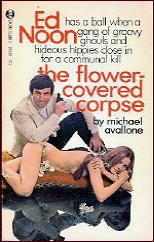
   How better to celebrate one’s recovery from serious illness than with one of the immortal works of Michael Avallone? The Flower-Covered Corpse (1969) is rife with the scrambled sentences that are his unique claim to fame but I’ll limit myself to a handful. The “I” in these quotations is New York PI Ed Moon, who is to detectives what Ed Wood was to directors.

MIKE NEVINS

   I had never heard of Louis La Rosa. Didn’t know him from Robert J. Kennedy.

   Blood played tag in my little grey cells.

   â€œ….Hep you may be but you are unitiate….”

   The mad evening had come to its final, inexorable totem pole of weird unreality.

   More marbles scattered across the floor of what was left of my brain.

   Right after War Two, he had plunged into the Police Academy bag and come up with an apple pie in each hand.

   I didn’t have a client except myself and my own neck.

   He tried to smile, still huddling his lovely fortune cookie.

   Femininity and Melissa Mercer are blood sisters.

   The .22 spit like a sneeze.

   I said a handful and a hand has five fingers so I guess I should have stopped halfway through my list. But there’s something about Avalloneisms that almost forces me to say — again and again and again — “Just one more.” I hope you didn’t mind too much.

TV FALL SEASON 2013-14 – MYSTERY, CRIME,
HORROR, ADVENTURE AND FANTASY SERIES
by Michael Shonk


          MAJOR NETWORKS

      MONDAY:

ABC: CASTLE returns for its sixth season in its same time slot at 10pm starting September 23rd.

CBS: HOSTAGES begins its limited series run starting September 23rd at 10pm. The series is about a Doctor who is scheduled to operate on the President of the United States when she learns kidnappers have her family and demand the President dies or her family will. February 24th the promising cyber-thriller INTELLIGENCE is scheduled to take over the time slot.

CW: BEAUTY AND THE BEAST returns on October 7th for its second season as cop (Beauty) and Doctor (Beast) continue their romance while trying to solve the murder of her mother without attracting the attention of Muirfield, a mysterious organization.

FOX: BONES returns September 16th for its ninth season at 8pm but will stay only until November 4th when it moves to Friday and new buddy cop show ALMOST HUMAN takes its place. From the people behind FRINGE, ALMOST HUMAN teams a reluctant human cop with an android cop that has feelings. Starting September 16th at 9pm will be the hour-long SLEEPY HOLLOW (which will be repeated on Friday). Ichabod Crane and the Headless Horseman adjust to the 21st Century as they resume their fight, while Crane’s new partner, a female black sheriff, tries to find out who is behind their return and why.

NBC: THE BLACKLIST debuts on September 23rd at 10pm, starring James Spader as a super criminal who has turned himself into the FBI to help stop another super criminal, but he will only deal with Elizabeth Keen (Megan Boone), a rookie FBI agent.

      TUESDAY

ABC: MARVEL’S AGENTS OF S.H.I.E.L.D. premieres September 24th at 8pm. A special team of S.H.I.E.L.D. agents, lead by Phil Coulson (Clark Gregg) who was last seen dead in the hit movie THE AVENGERS, solve strange cases.

CBS: NCIS returns for its eleventh season September 24th at 8pm, last year’s top rated series will bid farewell to character Ziva David (Cote de Pablo). The same night has NCIS–LA back at 9pm for its fifth season. Followed at 10pm by my personal favorite PERSON OF INTEREST beginning its third season.

CW: THE VAMPIRE DIARIES spinoff THE ORIGINALS will premiere on Thursday October 3 then move to its regular spot Tuesday at 8pm on October 8th. SUPERNATURAL will start its ninth season on October 8th at 9pm.

FOX: BROOKLYN NINE-NINE premieres September 17th at 830pm. The new half-hour ensemble comedy focuses on the conflict between irresponsible but great cop (Andy Samberg) and his new by the book boss (Andre Braugher).

NBC: CHICAGO FIRE second season begins September 24th at 10pm.

      WEDNESDAY

CBS: CRIMINAL MINDS returns for its ninth season on September 25th and will air at 9pm. The same day CSI: CRIMINAL SCENE INVESIGATION will air at 10pm. Its fourteenth season will be highlighted by a special 300th episode.

CW: ARROW, based on a comic book superhero begins its second season on October 9th at 8pm followed by new SF action series THE TOMORROW PEOPLE based on British TV series, about paranormal teens on the run from paramilitary group of scientists.

NBC: REVOLUTION debuts September 25th at 8pm where it hopes to find that spark that made it an early hit last season before it began to fade. LAW AND ORDER: SVU will begin its fifteenth season on the same day at 9pm. New remake IRONSIDE will join the schedule on October 2nd at 10pm.

      THURSDAY

ABC: ONCE UPON A TIME IN WONDERLAND begins its limited series run at 8pm. The first eight episodes of the hour-long fantasy adventure start October 10th. January 2nd new reality series THE QUEST takes over the time slot until WONDERLAND returns for its final four episodes of the season. At 10pm the political thriller SCANDAL is back for its third season October 3rd where it will air 12 to 13 episodes, be replaced by another to-be-named limited series, and then return for its final 12 to 13 episodes.

CBS: ELEMENTARY, Sherlock Holmes and Dr. Joan Watson return for a second season on September 26th at 10pm.

CW: THE VAMPIRE DIARIES rises for its fifth season on October 3rd at 8pm.

      FRIDAY

CBS: HAWAII FIVE-O will start its 4th season on September 27th at 9pm. BLUE BLOODS return for its 4th season at 10pm.

FOX: BONES will move from Monday to Friday at 8pm on November 8th. SLEEPY HOLLOW reruns end (original episodes continue on Monday) and is replaced by comedies.

NBC: GRIMM third season debuts October 25th at 9pm with new limited series DRACULA on at 10. When DRACULA run finishes, period pirate limited series CROSSBONES will take over.

      SATURDAY

CBS and NBC will feature repeats on Saturday, with CBS 9 to 10pm called ENCORE CRIMETIME.

      SUNDAY

ABC: ONCE UPON A TIME is back for its third season beginning September 29th at 8pm with the third season of REVENGE following at 9pm. Both will air 12 to 13 episodes then be replaced by a limited series to-be-named and return March 9th for another 12 to 13 episodes. Also on March 9th new series RESURRECTION about the dead from Arcadia Missouri beginning to return alive at the age they died, starts its 12 to 13 episodes run.

CBS: THE GOOD WIFE starts its fifth season on September 29th at 9pm. THE MENTALIST follows with its sixth season at 10pm. The cop show will return with major cast changes and some suspects, one of who is (maybe) the Red John.

  Confused yet? Wait until the networks start cancelling shows and shuffling series around.

  As you can tell the limited series (aka mini-series) is back on the major networks. The reasons range from movie actors such as Kevin Bacon (THE FOLLOWING) and Greg Kinnear (RAKE) willing to do a TV series but only 15 episodes rather than the usual 24 to the networks wanting to eliminate rerun breaks during serial series as well as extend original programming for the entire year. Oh, just because it is a “limited series” doesn’t mean there are not plans for a second season (even with HOSTAGES).

  Among the yet to be scheduled limited series are CW’s NIKITA (final six episodes), FOX’s THE FOLLOWING and new lawyer series RAKE

      MIDSEASON BENCH:

ABC: KILLER WOMEN and MIND GAMES.

CBS: RECKLESS.

CW: THE 100 is a post-apocalyptic adventure based on Kass Morgan’s book.

FOX: GANG RELATED.

NBC: HANNIBAL (returns for season two), BELIEVE, CRISIS, and CHICAGO PD.

      CABLE TV

ABC FAMILY: RAVENSWOOD, spin-off from PRETTY LITTLE LIARS about a town under a deadly curse. Premieres in October.

A&E: BONNIE AND CLYDE, mini-series airs over two nights sometime in October on A&E, History and Lifetime network.

AMC: WALKING DEAD season 4A begins Sunday October 13th at 9pm, followed by the recap show called TALKING DEAD at 10pm.

BBC AMERICA: LUTHER returns for a short third season airing September 3rd through 6th at 10pm. ATLANTIS, a fantasy series based on Greek mythology, airs Saturday starting November 23rd, the same night the special DOCTOR WHO episode celebrating fifty years of the time travel adventure series airs. RIPPER STREET second season begins Sunday, December 1st at 10pm.

FX: SONS OF ANARCHY season six starts Tuesday, September 10th at 10pm. AMERICAN HORROR STORY: COVEN season three airs at 10pm starting Wednesday, October 9th.

HBO: BROARDWALK EMPIRE season four airs Sunday, September 8th at 9pm. TREME begins it fourth and final season December 1st, Sunday at 9pm.

LIFETIME: WITCHES OF EAST END, based on the book by Melissa de la Cruz, starts Sunday, October 6th at 10pm.

PBS: FOYLE’S WAR season seven airs on MASTERPIECE MYSTERY at 9pm, September 15th through 29th.

SHOWTIME: HOMELAND season three airs Sunday at 9pm beginning September 29th.

SYFY: HAVEN season four starts Friday, September 13th at 10pm.

TNT: COLD JUSTICE, Dick Wolf’s reality show about solving real unsolved cases, begins Tuesday September 3rd at 10pm. MAJOR CRIMES is back for season 2B Monday November 25th at 9pm. BOSTON’S FINEST returns for its second season Tuesday at 9pm on November 26th. MOB CITY debuts December 4th Wednesday at 10pm. Based on the book, L.A. NOIR: THE STRUGGLE FOR THE SOUL OF AMERICA’S MOST SEDUCTIVE CITY by John Buntin, the series is developed by Frank Darabont (WALKING DEAD).

USA: WHITE COLLAR returns for season five on October 17th Thursday at 9pm. COVERT AFFAIRS season 4A ends September 17th and returns with season 4B Thursday at 10pm on October 17th. PSYCH: THE MUSICAL, a special episode of the series PSYCH airs Sunday December 15th at 9pm.


      INTERNET

LINK TV: BORGEN season three begins October 4th.

MHz NETWORKS: Every night in September the network offers a different international mystery:

  Sunday: DETECTIVE MONALBANO, Italian mysteries.

  Monday: HALF BROTHER a Norwegian family drama.

  Tuesday: ANTIGONE 34, a French action series

  Wednesday: SEBASTIAN BERGMAN is a Swedish series about a police profiler.

  Thursday: DOLMEN is a French gothic drama.

  Friday: BLOOD ON THE DOCK, a gritty French police procedural.

  Saturday: ARNE DAHL, Swedish thriller.

         Sources:

Network websites

Deadline.com

EW.com

TheFutonCritic.com

HollywoodReporter.com

TVLine.com

YouTube.com

« Previous PageNext Page »