COLLECTING PULPS: A MEMOIR, PART NINE —
WESTERN STORY MAGAZINE
by Walker Martin
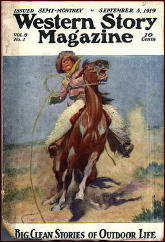

WESTERN STORY MAGAZINE

   Recently, a collector of hardboiled fiction was visiting me and he noticed that my dining room was filled with stacks of WESTERN STORY MAGAZINE, hundreds of issues. In fact there were two extensive runs of the magazine, each one over a thousand issues. His first question was what on earth was I doing? A question I might add that my wife asks me each day in louder and more exasperated tones. Taking over the dining room was a major victory in the constant and bloody pulp wars between the collector and the non-collector.

   I of course thought it was perfectly obvious what I was doing. I was going through the painstaking process of carefully comparing each issue in order to keep the better condition copy for my own collection. This process of having to decide which copy is the better one, has been known to drive collectors crazy.

   He then wondered why I was bothering with a western magazine when he knew me as a collector of mainly SF and hardboiled fiction. After he left I started to think how did I get involved in such an enormous project as collecting western pulps. Why enormous? Because, after the love pulps, the western pulps were the most popular and best selling fiction in the 1920’s and 1930’s.

   To start collecting the many titles is a major commitment in time and money. Not to mention the necessity of having the space to store them. Plus, I only collect books and magazines that I can actually read, so I have to devote some time to reading the stories. But I’ve never seen that as a big problem because I’m reading all the time: in bed, outside in the shade, while eating. The only time I’m not reading is while I’m asleep or at a book convention hunting for books. But even while sleeping I often dream about reading and what I’ve read.
WESTERN STORY MAGAZINE

   When I was working and people would ask me about my job, I often responded that I was a reader and collector. Only later would I realize that they were referring to my occupation which I considered as only a means to pay the bills. We all have jobs and careers but if you are a serious collector, then your main function, your main purpose in life is often your collection. Hunting for rare items, adding to your collection, and thinking of new areas to expand your collecting interests.

   And the above sentence just about explains why I expanded into the western pulp and paperback areas. I have this theory about collecting, mainly that the collector must keep expanding into other interesting areas because once you complete a collection of a certain author or magazine, then there is a danger of boredom setting in and you end up selling your collection. But if you keep collecting and getting interested in new areas, then you do not get jaded and cease collecting.

   In my own case, I started out reading and collecting SF at age 13, then ten years later I started reading and collecting detective and mystery fiction, and then in a few years adventure fiction. Meanwhile I always kept an interest in mainstream and literary fiction.

   I still remember the day in 1980, when I realized that I was close to realizing my pulp magazine goals. I had extensive runs of all the major SF, detective, and adventure magazines. I was mainly involved in filling in some gaps and titles. However, except for a few issues, I did not have many western pulps.
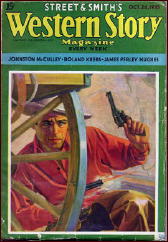
WESTERN STORY MAGAZINE

   I was fortunate to be friends with a major western pulp collector, Harry Noble. Harry was quite a bit older than me and had actually bought the pulps off the newsstands. The only pulp I ever bought off a newsstand was SCIENCE FICTION QUARTERLY in 1956, just as the pulps died. So naturally Harry was the man to talk to about the western pulps.

   While driving to Pulpcon in the early 1980’s, Harry regaled me with many stories of his early pulp collecting days. He started off in the early 1930’s as a boy reading WILD WEST WEEKLY. But this magazine was slanted toward the teenage boy market and he soon graduated to the more adult WESTERN STORY. This was probably his favorite magazine because of all the Max Brand stories.

   By the time we returned from Pulpcon, I was desperate to collect WESTERN STORY. I asked Harry what he wanted for his set which was not complete but numbered over a thousand of the over 1250 issues. Yes, you read right, *over 1250* issues! For most of its life WESTERN STORY was a weekly, which meant 52 issues each year or 520 issues during a decade. A major title indeed.

   He said $5,000 which came to around $5.00 each. Not a bad price but $5,000 was like impossible for me to pay. Like all of us, I had the usual bills to pay, car payments, mortgage, children to raise and educate, and a non-collecting spouse to care for and feed. In the early 1980’s I was earning maybe $10,000 a year which provided for a middle class lifestyle but not for a major expense like a set of WESTERN STORY.
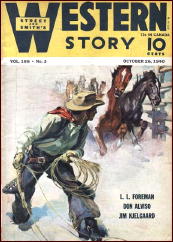
WESTERN STORY MAGAZINE

   But as some of you know, I’ve never let lack of money stand in my way when it comes to collecting my favorite addiction, my drug of choice: books and pulps. I mean this was my purpose in life, right? Since Harry and I were good friends, he trusted me to pay him $100 every pay check until the amount was paid off. So every pay check I paid Harry before any other bills. I saw the pulps as more important than such routine things as car payments, food, electric bills.

   As I looked through the collection, I realized that I had made a the right decision. WESTERN STORY was one of the major pulp titles and one of the greatest success stories. In 1919, Street & Smith decided to follow up the success of DETECTIVE STORY, which had become a big seller since the first issue appeared in 1915. Just about immediately WESTERN STORY was a big success and during the 1920’s I’ve read some accounts that put sales at 400,000 and even 500,000 an issue. And this was for a weekly magazine.

   The title lasted for 30 years, 1919-1949. However after the big selling 1920’s, the depression caused a decrease in the weekly circulation. The word rates were cut and Max Brand for instance, went from a nickel a word to 4 and even 3 cents. By 1934 he was no longer the main attraction and he developed other markets such as movies and other magazines.

   I believe the next blow was in 1938 when Allen Grammer became president of Street & Smith. Before 1938, the firm had been mainly family run since the 1850’s, so Grammer was the first outsider to head the company. If a member of the family had been president, they probably would have had some sentimental attachment to the old dime novel and pulp days, but Grammer was strictly business. In fact, he saw the future as not the pulps but women’s slick magazines.
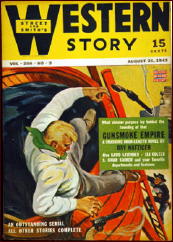
WESTERN STORY MAGAZINE

   In 1943 came another blow when Grammer decided all the pulps would be published in digest size. All the other publishers elected to decrease pages because of the war time paper restrictions but Street & Smith started to appear in the smaller size format. It’s true that the digest size was the future but they really looked sorry compared to the larger 7 by 10 pulp size.

   But he didn’t just decrease the size, he also killed several of the major Street & Smith titles such as WILD WEST WEEKLY (1927-1943, over 800 issues), SPORT STORY (1923-1943, over 400 issues), and the most missed of all, one of the greatest fiction magazines ever, UNKNOWN WORLDS (1939-1943, 39 issues).

   Since Allen Grammer had no sentimental attachment to the pulps, he saw after WW II that their days were indeed numbered. He gave the order in 1949, he pulled the trigger that caused the bloodiest day in pulp publishing history, the killing of the entire Street & Smith line of pulps. The only exception was ASTOUNDING.

   There have been many theories as to why this magazine survived the blood bath. I’ve heard that Grammer or one of the big shots in the organization liked SF. I’ve also heard that ASTOUNDING was on firmer financial ground and making money compared to the other pulp titles which were not that profitable.

   The entire Street & Smith pulp line was dismantled and it must have been a sad and shocking day as the realization set in and the editors, staff and writers had to accept the fact that a major pulp market was indeed dead.

   Daisy Bacon, one of the most senior editors with over 20 years experience editing LOVE STORY, DETECTIVE STORY and other titles was terminated. It’s reported she hated Grammer and never forgave him. In WESTERN STORY there was no advance notice, the magazine just ended with no obituary after over 1250 issues. A couple years later, Popular Publications tried to revive the title but the experiment lasted only a few issues. The pulp era was over except for a couple titles that limped on for a few years.
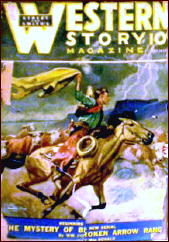
WESTERN STORY MAGAZINE

   Now there is an amazing footnote to the above horror story (well, a horror story to a pulp collector like me!). In the mid-1990’s an elderly man moved into the house right next door to me. He was in his late 70’s and a retired music teacher. He held an open house to introduce himself to the neighbors and my wife and I attended. While walking through the house, we were stunned to see two original cover paintings from WESTERN STORY hanging on the wall of the den.

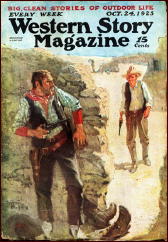
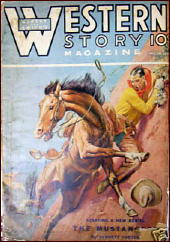
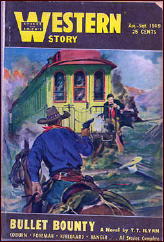
   In a daze, I slowly approached the paintings and saw they were both by Walter Haskell Hinton who did several covers for WESTERN STORY in the late 1930’s (the dates of the covers are September 24, and October 29, 1938; shown to the left, and to the right below). I collect original pulp art and couldn’t believe my eyes. What are the odds of a neighbor moving next door with two pulp paintings? A billion to one?

   I foolishly said, like an idiot, “Hey, do you know you have two pulp paintings hanging in here, huh?” It’s a wonder he didn’t escort us out of the place. But yes, he realized it and his name was Paul Grammer and his uncle was Allen Grammer, the infamous president of Street & Smith!
WESTERN STORY MAGAZINE

   He said his father also worked for the firm in some capacity and when the two brothers died, he inherited the two paintings. Paul is no longer with us but before he died he did sell me the two paintings, one of which I still have hanging in my family room as a reminder of the craziest coincidence in my life.

   In addition to the fiction, the art of WESTERN STORY is reason enough to collect the magazine. They used several first rate artists which reminds me of another strange story. I once was in an art gallery in NYC back in the early 1980’s looking at fine art and abstract art. Then again, I was stunned to see a cover painting from WESTERN STORY. It was by Charles Lasalle and was the cover for the first Silvertip story by Max Brand.

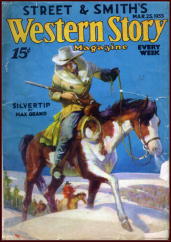
   The date is March 25, 1933 and shows a man on a horse looking at a trace of blood in the snow (shown to the left below). Again, while speaking to the gallery owner, I asked what do you want for the Charles Lasalle pulp painting. He gave me a look like I had asked him about pornography and said “We do not sell pulp art” and the way he said *pulp art* made it an obscene word.
WESTERN STORY MAGAZINE

   After he quoted a high price that I couldn’t afford, I slunk out of the gallery and went home. The first thing I did was go to my WESTERN STORY collection and make sure it was a pulp cover. Then the next day I returned to the gallery with the pulp and showed the owner that the Lasalle painting was indeed pulp. He was so distressed that he sold it to me for a bargain price just to get rid of it.

   Western cover art is known for the shoot ’em up images, usually a bunch of cowboys blazing away at each other. But WESTERN STORY, especially in the 1920’s, often showed scenes from a cowboy’s life. Anything from playing poker to rounding up steers at night or even chuck wagon scenes. Some favorites of mine are several covers that show cowboys reading WESTERN STORY.

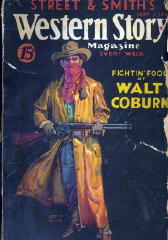
   Perhaps my favorite of them all is the first cover Walter Baumhofer did for WESTERN STORY. It so impressed the editors that they hired Baumhofer to do 50 more covers including some great ones for DOC SAVAGE. It’s the cover for September 3, 1932 and simply shows a road agent with a rifle standing in the rain (shown to the right below).
WESTERN STORY MAGAZINE

   Another very interesting series of covers was done by Gayle Hoskins in the early 1930’s. A couple dozen cover paintings showing scenes from “A Day in the Life of a Cowboy”. These were so popular with the readers that Street & Smith packaged them as prints and gave them away to subscribers. The vast majority of course were tacked up on walls and lost over the years. But I did manage to find a complete package with the envelope and prints that somehow survived.

   I’ve saved the best artist for last. Nick Eggenhofer’s main market was WESTERN STORY for over 20 years during 1920-1943. He did many cover paintings which sell for more than I can afford but he also did thousands of interior illustrations. I have several in my collection and even these can cost a few hundred or a few thousand. There is a great book about his pulp work and working for Street & Smith. It’s called EGGENHOFER: THE PULP YEARS and copies can be found on the second hand book market.

   But of course most collectors are interested in the authors. During 1920-1934 you can almost say that Frederick Faust, who wrote under the name of Max Brand and many other names, was WESTERN STORY. Some issues contain three of his stories, including the three longest such as two serial installments and the complete novel.

   Though there used to be many collectors and lovers of Max Brand, we are now down to only a few. I remember in the 1960’s and 1970’s, these collectors were all over the place: binding copies of WESTERN STORY, making little homemade books out of stories excerpted from the magazine and even publishing a few fanzines.

   I started reading Max Brand in 1955 but SF soon took over as my main reading addiction. I’ve always had a problem with his work and in 50 years of reading Brand I would have to say that he wrote too much and did it too fast. For many years he did over a million words a year and was one of the highest paid pulp writers. He was making over a hundred thousand a year when such money was like a million dollars. He owned a villa in Italy and wrote poetry. Unfortunately just about everybody agrees that his poetry is dated and of little interest. He was killed while serving as a correspondent in WW II.
WESTERN STORY MAGAZINE

   I divide Max Brand’s work into three parts: one third is good, one third is OK but nothing special, and one third is below average or poor. I never know what I’m going to find when I read him. I might read a couple novels and think, that he is really good and that the fault has been with me for not being able to appreciate him. Then I’ll read a couple bland, sort of mediocre serials, followed by one so poor I have to give reading and I start thinking that he just wrote too fast, etc.

   But Max Brand was not the only writer of interest in WESTERN STORY. I can recommend Luke Short who did some fine work for the magazine and went on become one of the best. Also Ernest Haycox and such excellent pulp writers like W.C. Tuttle, H. Bedford Jones, S. Omar Barker, T.T. Flynn, L.L Foreman, Robert Ormand Case, and many others.

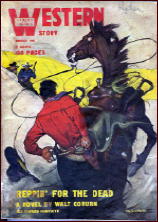
   But one of best that I’d like to specially mention was Walt Coburn. Like Max Brand, he wrote too much and too fast but he knew the west and cowboy life. In fact he was called “the cowboy author” because he actually lived the life. His western dialog and action rings true and is not false like some of Max Brand’s work. But he certainly was capable of poor work every now and then. He had a drinking problem but somehow managed to live to age 79 before hanging himself, probably due to poor health.

   After buying the Harry Noble set and reading it for 20 years, I made a mistake and traded it away for some art. I figured I had read all the best fiction and could move on to something else, some other magazine that I might want to collect.

   Well I figured wrong. As usual I missed the set and started to regret my decision. But fate is a funny thing and in 2006 Harry Noble told me he had a terminal illness and was expected to live only for a few months. He invited me and several other long time pulp collectors to visit him and buy magazines.
WESTERN STORY MAGAZINE

   Since selling me the WESTERN STORY’s in 1980, Harry had built up his set and now in 2006, again had over a thousand issues. He agreed to sell me the set again and again for only $5,000! This time I had the money to pay him and I drove back home with a carload of WESTERN STORY. My wife was not pleased to see the magazine return home, to say the least. We all managed to say goodbye to Harry and so ended the life at age 88, of one of the greatest book and magazine collectors that I have ever known.

   I could write a book about my experiences in collecting this magazine but I better bring it to an end. Wait a minute, here is another crazy collecting story. I once found out a bookstore in New Mexico had 800 issues of WESTERN STORY in nice shape from the late 1920’s to the digest years in the 1940’s. Though I had the issues already, how could I turn down their price of only 50 cents a issue if I took them all.

   I frantically sent off $400 and in a couple weeks 16 large boxes of WESTERN STORY hit the Trenton post office. They evidently didn’t want to deliver them and the manager called me to come and pick them up. This actually was OK with me because then I could figure out a way to smuggle them past my wife, otherwise known as The Non-Collector.

   I waited until she left for work and then I called my job and told them I’d be late due to a family emergency. I quickly picked them up from the post office, in the process almost throwing my back out due to my haste. I hid them in the basement so mission accomplished. I then went to work but I’d forgotten that I had to attend a staff meeting with some big shots. So not only was I late but my suit and tie had pulp shreds and dirt plastered all over. To make matters worse I apologized by mentioning my joy of receiving 800 WESTERN STORY pulps.

   Now, one thing you cannot do as a collector and that is to try and really explain the joy you get out of collecting books or pulps. You might get away with it talking to other collectors, but not to people who collect absolutely nothing and in fact, don’t even read. For years after, my bosses would sometimes bring up the subject of my so called “western collection” in dismissive terms. It probably even cost me a promotion. The funny thing is they had no idea that the “western collection” was really just a small part of my overall collection. If they had ever known the true extent of my addiction and vice, they would have figured out some way to get rid of me.

   At this point, after collecting WESTERN STORY for so many years, I’m down to needing only 11 issues but they are the hard to get 1919 and early 1920 issues, so I may never find them. But it’s been a hell of a ride and I’d do it all over again!
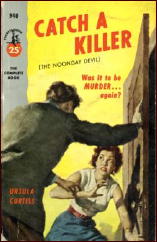
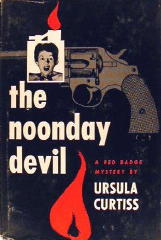
URSULA CURTISS – Catch a Killer. Pocket 940; 1st printing, June 1953. Hardcover edition: Dodd Mead, 1951, as The Noonday Devil.

URSULA CURTISS Catch a Killer

   It’s my guess that every time one of Ursula Curtiss’s books is reviewed today, it begins with the observation that her mother was mystery writer Helen Reilly, and that her sister was mystery writer Mary McMullen. (And equally obviously, I’m no exception.) It must have been in the genes, but during the time when all three were actively writing (Reilly from 1930 to 1962; Curtiss from 1948 to 1985, with a posthumous collection of short stories; and McMullen from 1951 to 1986), do you suppose that anyone ever asked them what was in the water they were drinking?

   While Helen Reilly had a series detective who appeared in most of her books, Inspector McKee of Manhattan Homicide, Ursula Curtiss and Mary McMullen, were heavy practitioners of (suburban?) domestic malice and/or romantic suspense, and neither of them (as far as I know) used a repeating character in any of their books.

   As far as Curtiss is concerned, this is the only book of hers I’ve read. So far. In any case, what you expect is not always what you get. In Catch a Killer, for example, I was surprised (although not nonplussed) to discover that the leading character is male, and that the story begins in Manhattan. I had the uneasy feeling that I was leaning one way, and the book, with Curtiss in charge, was going another.

   In the second half of the book, though, the scene changes, and rather drastically. Under some pretext or another, all of the leading characters seem to find their way to the same small country town in New England, and when they do, everything seems to revert to normal. (By which I mean, closer to what was expected, if not anticipated.) And as a direct consequence, perhaps with the characters’ closer proximity to each other, the action seems to pick up as well.

URSULA CURTISS Catch a Killer

   The atmosphere is dark, introspective and moody throughout. And coincidences simply thrive in such climates, beginning as they do here, in Chapter One. When you walk into an unfamiliar bar for the first time, for example, you never know whom you’ll meet, and that’s where Andrew Sentry finds a man who had been in the same Japanese prison camp as his brother Nick – an encounter occurring only by chance.

   Nick, as it happened, died in a fatal attempt to escape, and his death, Andrew for the first time is now told, was no accident. There was an informer – someone Nick knew. Someone who told their guards of Nick’s plans, which were then foiled. This is an unusual (if not unique) means of killing someone, but who was the mysterious man who called himself Sands, and what was his motive?

   More coincidences. Every male in Andrew’s small circle of friends and acquaintances seems to have been a Japanese prisoner in the Philippines at some time or another during the war. Nick’s fiancée Sarah Devany may have received a postcard in code from him just before he died, but when a simple question might have unraveled the mystery before it has even begun, there are, unfortunately, barriers which, as it happens, have been laid in the way.

   When Andrew came to break the news of Nick’s death to Sarah, it is revealed, he found her kissing another man, and he has not spoken to her since. And since the case for murder is so flimsy, the police cannot be called in, which limits Andrew’s resources to himself and whoever he feels he can trust, the list of whom changes chapter by chapter.

   And so does the reader’s grip on the story, or vice versa, the story’s grip on the reader. Excellent characterizations are mixed helter-skelter with a plot that’s held together with a strong brand of duct tape. Nonetheless, New England summer towns can be filled with as much malice as large population centers such as Manhattan, and the generally capable touch of Ursula Curtiss goes a long way in proving it.

— January 2004

REVIEWED BY DAN STUMPF:


a donna del lago

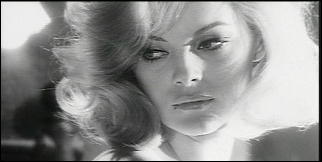
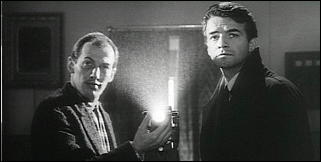
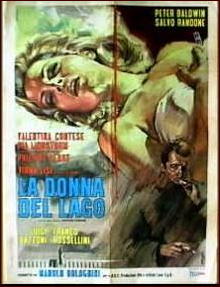
LA DONNA DEL LAGO [or THE LADY OF THE LAKE]. B.R.C. Produzione S.r.l., Italy, 1965. Released in the US as The Possessed. Peter Baldwin, Salvo Randone, Valentina Cortese, Pia Lindström, Piero Anchisi, Virna Lisi. Directors: Luigi Bazzoni & Franco Rossellini.

   Not too long ago I saw a movie I’ve been trying to see again for nigh unto thutty year: The Lady of the Lake — NOT to be confused with The Lady in the Lake, Robert Montgomery’s pretentious film of Chandler’s novel. This is an Italian movie from 1965, written and directed by Luigi Bazzoni, whoever-the-hell he is.

   I first saw it on TV in the godless hours of the morning between Three and Five, sometime in 1973, badly dubbed, under the unlikely title Love, Hate and Dishonor. I was quite drunk at the time, and I remembered the film as a perversely fascinating mix of Hard-Boiled Mystery and Surreal Story-Telling, tinged with Uneasy Kinkiness — a bleary conviction piqued over the years when I found no mention of the film in any reference book, no repeat viewings of it on TV, or even anyone else who professed to have seen it.

a donna del lago

   So Love, Hate & Dis remained a personal fetish till I finally saw La Donna Del Lago panned in Phil Hardy’s Encyclopedis of Horror Films and recognized the story and stars. An Ethan-Edwards-like search of film conventions and the Net finally yielded up a watchable copy from a Miami dealer, and I returned at last to this relic of my mis-squandered youth.

   And oddly enough, it seemed just as remarkable to this sober nearly-middle-aged man as it did to the drunken tad of whom I am a biological extension. The plot is a simple affair: A disaffected writer breaks up with his girlfriend and decides on a whim to revisit the resort where last Summer he had a pleasant romp with a hotel maid, Tilda (Virna Lisi).

   Only it’s Winter now, the Hotel is near-empty, Tilda’s dead, and as the wind howls across the icy lake, our hero wanders through a gaudy ghost town, and he learns that her death was ruled a suicide — in the same coroner’s report that says she died a virgin.

a donna del lago

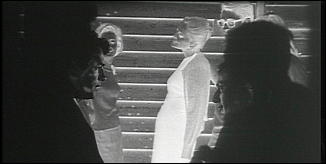
   From a fairly standard tale of murder-and-cover-up, Bazzoni crafts a truly mysterious film, full of tricky imagery and shifting narrative. A walk through a snow-capped graveyard suddenly morphs into a flashback that gradually resolves into a dream. Bit-players ooze about with eerie unction, just on the verge of saying too much, and something always seems to be happening, or about to happen, somewhere in the background, just almost out of sight.

   It’s easy to see why Hardy included this in his Horror Films book — though it offers no ghosts, monsters, blood or violence — and just as easy to see why he failed to come to terms with its unique style of tale-spinning. There aren’t many things that look just as good on the sober Morning After, but this is one I’ll come back to.

a donna del lago

THE BACKWARD REVIEWER
William F. Deeck


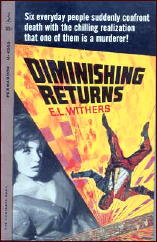
E. L. WITHERS – Diminishing Returns. Holt Rinehart & Winston, hardcover, 1960. Permabook M-4203, paperback, 1961.

E. L. WITHERS - Diminishing Returns

   Six people are having a nightcap. All are poisoned, but only one dies. Then the other five start dying one by one the next time they get together in ways that are made to appear accidental.

   An excellent plot here. Unfortunately, Withers is not able to carry it out without gaping flaws.

   The poison used in the first instance is arsenic, which the author thinks acts almost immediately upon ingestion. There is no explanation for the efforts to make the later deaths appear to be accidents when it is obvious — well, fairly obvious — that the poisoning was murder. One “accidental” death is from a broken neck; possible, to be sure, but most unlikely as described. There are other problems that will be left to the keen-eyed reader to spot.

   To make up for the somewhat strained logic, Withers provides a most delightful detective — this is his only appearance, alas — named Weatherby, who seems to have no first name.

   Weatherby is a retired lawyer, probably a septuagenarian, who likes to sleep until noon and stay up late, who smokes a lot and drinks a great deal, leading to “a slight fuzziness which was always urbane and gentle and good-humored.” He also has no desire “to walk when he could stand still, or to stand still when he could sit, or to sit when he could recline.”

   Read this for the “little old man” detective.

— From The MYSTERY FANcier, Vol. 12, No. 2, Spring 1990.


          Bibliography:    (Taken from the Revised Crime Fiction IV, by Allen J. Hubin.)

E. L. WITHERS. Pseudonym of George William Potter, Jr., 1930-2010.

   The House on the Beach. Rinehart 1957
   The Salazar Grant. Rinehart 1959
   Diminishing Returns. Rinehart 1960
   Heir Apparent. Doubleday 1961
   The Birthday. Doubleday 1962

REVIEWED BY MICHAEL SHONK:


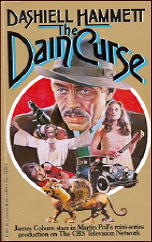
THE DAIN CURSE. CBS – Martin Poll Productions. Based upon the novel by Dashiell Hammett; developed for television by Robert W. Lenski. Producer: Martin Poll. Director: E.W. Swackhamer. Cast: James Coburn as Hamilton Nash, Nancy Addison as Gabrielle Leggett, Bernice Straight as Alice, Jean Simmons as Aaronia, Jason Miller as Owen, Hector Elizondo as Sheriff Feeney and Brent Spiner as Tom Fink.

THE DAIN CURSE

PART ONE – MAY 22, 1978 – MONDAY AT 9-11 PM (Eastern)

PART TWO – MAY 23, 1978 – TUESDAY AT 9-11 PM

PART THREE – MAY 24, 1978 – WEDNESDAY AT 9-11 PM

   THE DAIN CURSE features three stories – a simple diamond robbery that reveals a complex mystery involving drugs, child abuse, blackmail and various murders; a con using a religious cult that ends with death; and a middle aged PI who must overcome his attraction to a young innocent girl and save her from the evil around her.

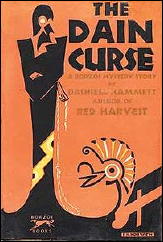
   THE DAIN CURSE originally appeared as four separate Continental Op stories in Black Mask magazine. Hammett would rework the four stories (“Black Lives” November 1928, “The Hollow Temple” December 1928, “Black Honeymoon” January 1929 and “Black Riddle” February 1929) into a three-part novel (Knopf, 1929). While it was a critical and commercial success when first published, time has not been kind to one of Hammett’s weakest work. The book suffers from its clumsy structure, its padded overly complicated story and a weak ending.

THE DAIN CURSE

   The TV adaptation by Robert W. Lenski would win him an Edgar award and an Emmy nomination (losing to HOLOCAUST writer Gerald Green). Surprisingly, there was no writer credit on screen, instead Lenski received a developed for television credit. Perhaps this was because he stayed loyal to the book and its structure. But changes were made, some were wise, others not.

   Characters such as Minnie the maid’s boyfriend and many red herrings were wisely dropped. The end of each part was changed. Hammett ended each part with the dramatic closure of that part’s case. Lenski knew each TV episode would need a cliffhanger ending to bring back the viewer for the next night. For example, he followed the book closely, but ended Part One with something that happened in Part Two – The Temple, drugged Gabrielle confessing to murder.

   Many of the changes were minor such as changing the Continental Detective Agency to Dickerson National Detective agency and moving the action from the California coast to the East coast and “The City” (New York).

   Lenski should have used even more of Hammett’s original dialogue than he did. His original dialogue tended toward pulp clichés, such as a place smelling of death or things being too quiet.

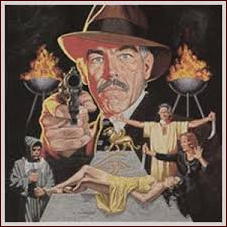
   The most notable change was replacing Hammett’s Continental Op with PI Hamilton Nash played by James Coburn. The well-dressed Ham owed more to the crime-fighting image of Dashiell Hammett than to the Continental Op. While Coburn would have been a terrible choice to play the Op, he was perfect as the thin, handsome, more energetic PI Hamilton Nash.

   Hammett’s Continental Op appeared in 36 short stories (four would make up Hammett’s first novel RED HARVEST, and four became THE DAIN CURSE). The Op was the visual opposite of TV PI Hamilton Nash. He was a short, overweight (180 lbs), ugly, middle-aged man. He had no life outside of his work. Hammett never even gave him a name. It was this image that made the relationship between the Op and the young victim Gabrielle so important to the tone of the book. It added to the creepiness of the all ready odd mystery as the Op got deeper into Gabrielle’s life, resisting and denying his growing attraction to her and her growing dependence on him, a favorite older Uncle who was fighting inside his desires for the young innocent girl.

   Hamilton Nash had a past he hid from others. To keep his noisy boss satisfied (you would think the boss of a detective agency would know the past of his employees) Ham claimed he had an ex-wife who had run off with the milkman because he was never at home. Coburn with his leading man looks and thin athletic body did not seem as wrong for young but adult looking Nancy Addison as the Continental Op did for the virginal Gabrielle.

   But Coburn’s Hamilton Nash did share the cynical soul of the Op, as well as the Op’s obsessive personality, his deductive talents, and his fatalistic acceptance of injustice. According to Nash, criminals had invented justice. Nash had no problem leaving a case the client thought solved, even when he knew better.

THE DAIN CURSE

   Nancy Addison had the difficult role of the freaky Gabrielle. Her scenes with Coburn brought to life Hammett’s Gabrielle’s feelings for the older PI who was always there to save her. To her Nash was a protector not a potential lover.

   The rest of the cast, especially Jason Miller and Jean Simmons, captured Hammett’s characters well in their performances. Early in the book, Mrs. Alice Leggett was described as being serene and the only sane soul in the Leggett’s household. This played a role in the story. Bernice Straight performance failed to capture that aspect of Alice, but her performance did get her an Emmy nomination for single performance by a supporting actress in a comedy or drama series (she lost to HOLOCAUST Blanche Baker).

   E.W. Swackhamer’s direction was worthy of the Emmy nomination he received (he lost to HOLOCAUST director Marvin J. Chomsky). He kept the characters moving to give a sense of energy and tension to the slow paced twisty story. In Part One’s denouement scene, several people filled the lab of the dead man. Nash refused to believe the letter left by the man was a suicide note. Swackhamer had Nash restlessly moving around the room while the rest stay still. As Nash declares the man was murdered, he moves out of the shot (but not out of the room) leaving the camera focused on the reactions of the rest of the people there.

THE DAIN CURSE

   Production values for THE DAIN CURSE were average at best, but never let down the story. Music by Charles Gross reminded us the time was 1928, and added a nice noir sound when needed.

   Following the success of the mini-series ROOTS, CBS had high expectations for THE DAIN CURSE. The ratings for the first night were a moderate success with a 37 share. But the ratings for the second and third night fell with each episode receiving a 30 share, OK but not the blockbuster numbers hoped for by CBS.

   THE DAIN CURSE aired during the May sweeps, an important ratings period for the networks and its local stations. ABC, CBS, and NBC were going all out to attract viewers. Viewers not hooked by Part One of THE DAIN CURSE had other options, including one in syndication.

   THE BASTARD (aka THE KENT FAMILY CHRONICLES) from Operation Prime Time (OPT) scrambled the regularly scheduled programs for that week. OPT was a group of independent TV stations who had united to finance programs from major studios. Produced by MCA/Universal, THE BASTARD was a four-hour mini-series scheduled to air over two nights. It proved a major challenge to THE DAIN CURSE when the two series aired against each other in many markets. Another problem for CBS and the other networks was THE BASTARD aired not only on 25 independent TV stations but also on network stations preempting network programs. THE BASTARD appeared on 14 ABC, 27 CBS and 25 NBC stations.

   I would like to read THE DAIN CURSE in its original Black Mask format, but the original four stories reportedly have never been republished. The book was a disappointment. It was padded and told three weak stories instead of one strong one. The TV mini-series was never able to overcome the problems of the novel and added some of its own, most notably the effect casting played on the romantic spine of the story.

      Sources:

Broadcasting Magazine – May 15, 1978, May 29, 1978, and June 5, 1978.

The Dashiell Hammett website by Mike Humbert:

http://www.mikehumbert.com/Dashiell_Hammett_05_The_Dain_Curse.html

Editorial Comment:   The first two videos consist only of clips from the show. I do not know if the bottom one is the complete mini-series or not, as I have not watched it to the end. I am suspicious about it, as it is only three hours long.

Also Note:   Curt Evans reviewed the novel version of The Dain Curse earlier on this blog. Follow this link.

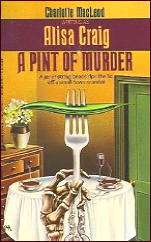
ALISA CRAIG A Pint of Murder

ALISA CRAIG – A Pint of Murder. Doubleday Crime Club, reprint hardcover, 1980. Detective Book Club, reprint hardcover, 3-in-1 edition. Bantam, paperback, 1981; Avon, paperback, 1988 (shown).

   Of all the detective murder mysteries that have ever been committed in fiction, a small but sizable number of them have been tackled by a member of the Royal Canadian Mounted Police. Tackled and solved, of course. The Mounties always get their men, as everyone well knows.

   Ms. Craig does nicely in adding to the total. The case is that of the food-poisoning death of a crotchety but scrupulously careful old lady in the New Brunswick town of Pitcherville. Inspector Madoc Rhys (a Welshman!) is the Mountie who is called in to investigate.

   The story, well, it could be likened to a breath of fresh clear Canadian air, containing only the slightest bit of pollution, and that of the sort produced by the gossipy thoughts and attitudes of small village minds with nothing to rein them in.

   This is also a book for those who do not mind a little romance mixing it up with their mystery fiction. By book’s end it quite definitely is clear that the Mounties almost always get their women as well.

Rating:   C plus.

— Reprinted from The MYSTERY FANcier,
       Vol. 4, No. 4, July-August 1980 (slightly revised).


Bibliographic Notes: This was the first of five books in the Alisa Craig’s Madoc Rhys series. Since I did not mention it at the time, I suspect that I did not know then what I know now: that Alisa Craig was a pen name of Charlotte MacLeod (1922-2005), who under her own name wrote both the Peter Shandy and the Sarah Kelling & Max Bittersohn series — among many other works of mostly humorous mystery fiction.

REVIEWED BY DAN STUMPF:


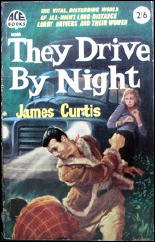
JAMES CURTIS – They Drive by Night. Jonathan Cape, UK, hardcover, 1938. John Lehman, UK, hardcover, 1948. Ace, paperback, date unknown (shown). London Books, UK, 2008. No US edition.

THEY DRIVE BY NIGHT. Warner Brothers-First National (UK), 1938. Emlyn Williams, Shorty Matthews, Ernest Thesiger, Anna Konstam, Allan Jeayes, Anthony Holles. Based on the book by James Curtis, who also wrote the screenplay. Director: Arthur B. Woods.

   They Drive by Night is one of those rarities: a uniquely enjoyable book turned into a rather different but equally fine film.

JAMES CURTIS They Drive by Night

   The book details the travails of Shorty Mathews, a petty crook just out of gaol and anxious to return to his larcenous ways. He looks up some old mates, makes a few disparaging comments about a lady-friend currently working the streets and pays a call on said lady, only to find her brutally murdered.

   Fearing the Police, Williams turns to his old partners in crime for help, is spurned by them, and takes it on the lam, hitching rides from friendly truck drivers plying the north and southbound roads through the rain-drenched night (hence the title of the piece) and narrowly escaping the pursuing authorities.

   He runs into a co-worker of his murdered girlfriend — a hooker named Molly who works truck stops, hence a “Lorry Girl” — and eventually persuades her to help him. As they work to evade the law, thief and whore begin to develop feelings for each other and then . . . well that would be telling.

   Curtis spins the tale in lively first-person cockney rhyming slang (as in loaf = head because bread would rhyme with head if you said bread so you say loaf instead. Get it?) dealing out action and suspense in equal measure along with some colorful characterization. One measure of an author is how much care he takes with the bit players, and Curtis meets the mark and then some, filling his tale with sharp cops, hard-edged crooks and working stiffs so real you can smell the sweaty armpits.

   He also throws in one of the most real-seeming psychopaths I’ve ever encountered in literature or film: a character suffused with the shabby narcissism one finds in real-life criminals, brilliantly translated into prose. The chapters dealing with his lethal stalk through a seamy city offer a poetic realism and tense energy I’ll remember long after lesser (but better-known) serial slayers have gone their loony way. And if the wrap-up of the books is a bit prosaic, perhaps it’s all the more memorable for its tough-but-tender realism.

   The British subsidiary of Warner Brothers filmed this the same year and turned it into a fast-moving, moody little thriller directed by someone named Arthur Woods, who was set to replace Hitchcock when the Master of Suspense moved to Hollywood, but was an early casualty of World War II.

   Like Woods’ career, this film came to an untimely end when Warner Brothers decided to use the title and the truck-driving elements for their umpteenth remake of Bordertown two years later and “buried” this little gem for the next few decades.

   Be that as it may, this version of They Drive by Night is an enjoyable bit of work. Emlyn Williams plays Shorty with just the right touch of superficial toughness. Released on the morning when another inmate is executed for murder, he casually tosses off a flip comment about the dead man, then turns movingly repentant when he finds he’s talking to the man’s brother — a haunting stretch of cinema.

THEY DRIVE BY NIGHT

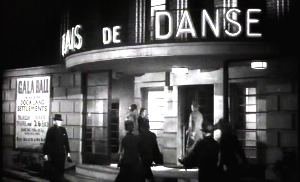
   For purposes of censorship, his lady-friend hooker is now a taxi-dancer (called Dance Hall Hostess over there) but she’s just as dead and the ensuing chase is just as lively, played out across a countryside that seems permanently hostile, wet and windswept. Of course Molly the Lorry Girl is now another dime-a-dance girl (played tough-but-not-brassy by Anna Konstam) and in another departure from the book, she helps him return to London to find the real killer.

   At which point the film shifts gears, concentrating on Molly’s efforts to find the killer by getting to know the dead woman’s regular customers, a theme that was (coincidentally?) developed into a memorable short story by Cornell Woolrich. One of the “regulars” played with customary gothic relish by Ernest Thesiger, is a learned eccentric, fond of reading and stray kittens, and with his entry, the movie glides smoothly into the realm of the horror film, right up to a moody, memorable finale.

   Existing prints of They Drive by Night are not of the best quality, but the film has enough action and intelligence to reward the viewer patient enough to give it the occasional squint. And the book is definitely worth your time.

Note: Another review of this film, the earlier one one written by Walter Albert, was posted here on this blog some four years ago.

THE BACKWARD REVIEWER
William F. Deeck


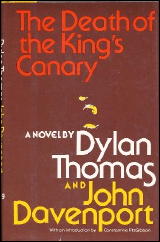
DYLAN THOMAS Death of the King's Canary

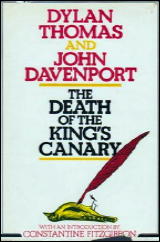
  DYLAN THOMAS & JOHN DAVENPORT – The Death of the King’s Canary. Viking, US, hardcover, 1977. First published by Hutchinson, UK, hardcover, 1976.

   According to the publishers, it was the intention of Dylan Thomas, with the help of John Davenport, to write “the detective story to end detective stories, introducing blatantly every character and situation — an inevitable Chinaman, secret passages, etc. — that no respectable writer would dare use now, drag hundreds of red herrings, false clues, withheld evidences into the story, falsify every issue, make many chapters deliberate parodies, full of cliches, of other detective writers.”

   As a frank and fervent philistine, I probably should not be reviewing this book, which presumably is also a parody of poets. Since the last poet I admired was Simon Templar, you will have some idea of my inadequacies in this area.

DYLAN THOMAS Death of the King's Canary

   In his introduction, Constantine FitzGibbon says that Thomas and Davenport intended the novel “to be a good joke, and to make money, but of course it was quite unpublishable while the main characters were alive.” From my point of view, it was a bad joke and it is still quite unpublishable.

   In what did the authors succeed? The parodies are there, but they are, as far as I can tell, only of poets and poetry. I have no idea — see my earlier comments — whether they are successful, but I can at least say that the poetry is god-awful. If that was the authors’ intention, I give them credit. For the rest, I was unable to recognize any mystery writers.

   What little I understood of the plot, if plot it can be called: the Prime Minister has chosen a new poet laureate, a man he viewed as the lesser of the bad, who proceeds to gather together all the major poets who were not chosen and insults them lavishly, following which they adjourn to attend a fair. The murder is on the last page,

   How I managed to reach the last page is the only mystery to be found here.

— From The MYSTERY FANcier, Vol. 12, No. 2, Spring 1990.

A TV Review by MIKE TOONEY:


“Puzzlelock.” From Ironside: Season 2, Episode 23 (52nd of 196 installments). First aired: 13 March 1969. Regular cast: Raymond Burr (Ironside), Don Galloway (Det. Sgt. Ed Brown), Barbara Anderson (Officer Eve Whitfield), and Don Mitchell (Mark Sanger). Guest cast: Simon Oakland (Mel Grayson), Dennis Cooney (Paul Dekes), Ned Glass (Benjie), Jocelyn Brando (Etta Gibbs), Gene Lyons (Commissioner Dennis Randall), Dabbs Greer (Thomas Gibbs), Alvin Hammer (Mush Shelby), Jennifer Gan (Chickie), Barry Cahill (Sgt. Miller). Writer: B. W. Sandefur. Director: Allen Reisner.

   It was a dark and stormy night when Mel Grayson murdered his wife. Sure, they’d had their disagreements, but for Mel it was time to leave their relationship — or more precisely, it was time for the wealthy woman to depart this vale of tears and leave all her worldly goods behind for him to enjoy.

   It’s no secret that he kills her. The first act shows how Mel meticulously executes his plan, cleverly establishing his alibis (yes, more than one) with sticky tape and by being punctual with a dinner date (which will prove his ultimate undoing, for his dining companion is an old friend from Mel’s time with the police department, none other than Ironside himself).

   No, this isn’t a whodunnit type mystery; it plays more like a highly compressed Columbo episode, in which the murderer’s cover story is slowly but surely worn away to nothing.

   Mel does deserve some credit for ingenuity, though. He uses the sticky tape to convince the servants that his wife is still alive before — and even after — he leaves the house for dinner, although she’s been dead for some time. (Watch the episode here.)

   He drags his wife’s body from the bed, but only after having changed her clothes to a nightgown, over to the French doors, pockets all of her expensive jewelry, leaves the house in the rain storm, furtively doubles back to their second story bedroom, and breaks the glass, with rain pouring over her prostrate form, making it look as if a burglar did it.

   So far, so good (for Mel, anyway) — but as the show progresses, we learn that he seems to have made two rookie mistakes. When he murdered his wife, Mel strangled her with her necklace, but most of the time women don’t wear heavy, expensive jewelry to bed; and then there’s that dry spot under the body. If a burglar had broken the window panes and killed her in the struggle, the floor beneath her should have been covered with glass fragments and rain water, which it isn’t.

   But were these really mistakes, or did Mel incorporate them into an even more ingenious plan to make a burglar coming from the outside look like a murderer coming from the inside? And is it more than just a coincidence that dwelling with the unhappy couple is the ideal patsy, someone who is always broke and always arguing with Mel’s wife, someone who can’t alibi himself on the night of the murder? All Mel has to do is feign sympathy for the poor sap while pointing Ironside & Co. in his direction.

   It looks as if Mel has pulled off the perfect murder — and so he has . . . almost.

GEORGE BAGBY Country and Fatal

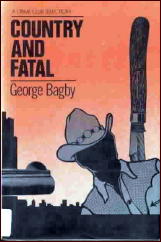
GEORGE BAGBY – Country and Fatal. Doubleday Crime Club, hardcover, 1980.

   Need further proof that riding the Manhattan subway system can be dangerous to your health? On page one of Bagby’s latest mystery-adventure, you’ll find him being pushed off the Times Square station platform smack into the path of an oncoming train.

   A series of such attacks has surprisingly nothing to do with Bagby’s friendship with Inspector Schmidt of Homicide, and the many cases they’ve worked on together. Rather it has everything to do with an ex-con country singer named Shad McGee (almost married to the phenomenally shelf-bosomed Lucinda Belle), who wants Bagby to give him a hand with his memoirs.

   Names and any resemblances etc. etc. entirely coincidental. Not your usual background for a detective murder mystery, but it’s fun, and what’s more, the clues are fair. In fact, there’s one in particular that should have been obvious, and I missed it. I really don’t know what I was thinking of.

Rating: B minus

— Reprinted from The MYSTERY FANcier,
       Vol. 4, No. 4, July-August 1980 (very slightly revised).


UPDATE [08-14-13].   George Bagby, pen name of Aaron Marc Stein, (1906-1985) was an extremely prolific mystery author who also wrote as Hampton Stone. I think I’ll repeat my update of my review of another of Bagby’s works of detective fiction, I Could Have Died, which you’ll find here:

    “I don’t believe that George Bagby — in real life Aaron Marc Stein, under which name he wrote an equally long list of other detective novels — got nearly the critical attention that I always thought he should have, and he’s definitely forgotten by all but a few devoted aficionados now.

    “Perhaps he was too prolific, and maybe the endings didn’t match the cleverness of other writers’ mysteries (nor perhaps the openings of his own books), but I always admired the way he had for descriptive passages, making the most prosaic actions — such as taking the cap off a toothpaste tube or hunting for a set of lost keys — seem interesting.

    “George Bagby, by the way, if the review wasn’t quite clear on this, was both the pen name and the character in the Bagby novels who tagged along with Inspector Schmidt and chronicled his cases for him.”

    I don’t remember who I was referring to in the first sentence of the third paragraph. It was 33 years ago when I wrote it, and while you may think everything you say or do will stay with you forever, it doesn’t. Thank goodness.

« Previous PageNext Page »