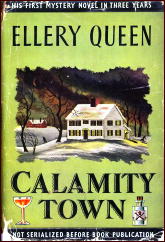
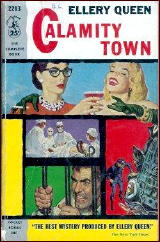
ELLERY QUEEN – Calamity Town. Little Brown, hardcover, 1942. Pocket 283, paperback, 1945. Reprinted many times, in both hardcover and soft.
When I first started reading Mysteries, back in the mid-60s, I pretty much devoured the earlier titles of the acknowledged “masters” of the Classic Detective Story (except for Erle Stanley Gardner, whom I ignored until the late 70s) so I probably first read this about a quarter-century ago. I turned to it again, just recently, because it was the only Ellery Queen selected by H. R. F. Keating in his 100 Best Books of Crime and Mystery.
Ellery “Smith” comes to the New England town of Wrightsville to work on his new novel, and stays — due to Wartime housing shortages — in a house built by Mr. Wright for his daughter Nora, when she was going to be married … only just before the Wedding, her fiance, one Jim Haight, disappeared.
Shortly after Ellery takes up residence, however, the missing Haight returns, and it isn’t long before he and Nora are re-betrothed and then married. Ellery gives up the house, but as he and Nora’s sister are moving some of Jim’s things in, they discover three letters, dated for the forthcoming Thanksgiving, Christmas and New Year’s, in which he describes Nora’s illness and death.
Sure enough, on Thanksgiving and Christmas Nora is ill, but come New Year’s Day, it’s someone completely else who buys the farm, a victim of Arsenic poisoning.
Hard to say whether I figured out the solution of this one or just remembered it from my Salad Days, since the idea has been used since. The characters are credible, if not terribly deep, and the prose serviceable. Not as memorable as the three Queen novels on my list, but pretty good nonetheless.
Editorial Comment: The top image is that of the hardcover First Edition. The lower one is one of the later Pocket reprints. I chose it because of the rare split-screen effect, one that I don’t believe was used very often by paperback publishers, then or now.
THE BIG BROADCAST (Paramount, 1932) should have been revived in the 60s for the benefit of the Drug Culture. Its spacey, cartoonish moments impart the look and feel of a Max Fleischer cartoon to this live-action flick, including such delights as a cat, edited to move in rhythm to a swinging pendulum, who oozes under a door; a clock that grows a literal face; a radio speaker that turns into a crooning skull; Cab Calloway (who did music for a couple of Betty Boops) doing a drug-song complete with pantomime coke-snorting; and a covey of frenzied female fans who, upon spotting their idol (Bing Crosby) form a football line and rush him! As I say, pretty spacey. There’s also Burns and Allen (briefly) and some very enterprising sight gags.
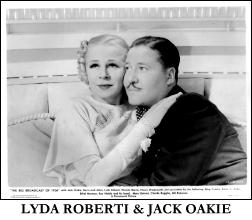
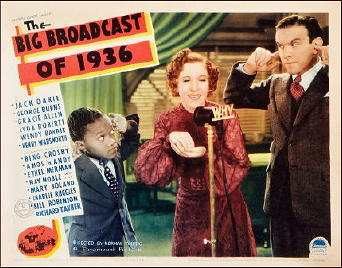
THE BIG BROADCAST OF 1936 (Paramount — need I add the year?) features much less interesting material, but a likeably zany plot, with Jack Oakie, the year before Super Sleuth, improbably moustached, playing Lochinvar, the Great Lover of the Airwaves, abducted to the island kingdom of a Russian (I think) Countess, along with an invention called “The Radio Eye” which picks up events (primarily musical and comedy spots by a variety of performers) around the world. Inventors Burns & Allen(!) are hot on the trail of their creation, and Oakie has to contend with the lethal rivalry of C. Henry Gordon and Akim Tamiroff for the Countess’s affections. Very enjoyable.
Oakie, incidentally, was a mildly prominent star in the early 30s, who for some reason went out of style, though his persona was adopted by Bob Hope and (later) Jack Carson. Hope, Carson and Oakie always played cowards who fancied themselves Men of Action, Nerds who imagined they were Great Lovers, consistently unable to understand why everyone on Earth doesn’t love them.
With this in mind, Oakie was a Natural to play Mussolini in Chaplin’s The Great Dictator, and he did a fine job of it in his last great part. He can still be seen in small parts as late as The Wonderful Country, but the Golden Days were behind him.
Bob Hope shared most of Oakie’s persona, but where Oakie was the eternal Cheese, Hope was the inveterate Schnook, with a hungry vulnerability that Oakie never sought. He also looked slightly more like a Leading Man.
I particularly like Hope’s “Road” pictures, where he and Crosby send up Adventure Flicks with gay abandon. Road To Zanzibar for example, has a highly enjoyable fight between Hope and a Killer Ape, where both combatants use the corniest old wrestling Routines imaginable: Airplane spins, Body Slams, leg-holds, beating the ground in mock-agony, etc. etc.
THE BIG BROADCAST. Paramount, 1932. Bing Crosby, Stuart Erwin, Leila Hyams, Sharon Lynn, George Burns & Gracie Allen, The Mills Brothers. Director: Frank Tuttle.
THE BIG BROADCAST OF 1936. Paramount, 1935. Jack Oakie, George Burns & Gracie Allen, Lyda Roberti, Wendy Barrie. Director: Norman Taurog.
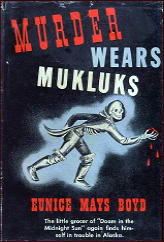
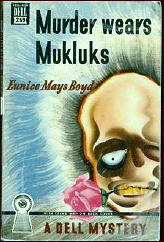
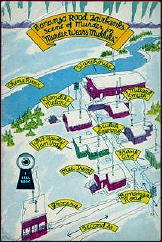
I’ve owned the Dell mapback edition of this book since I first became aware of the series, which is perhaps some 40 years ago. I’ve also been fascinated by the title, which I’m sure is unique in the annals of crime and detective fiction, but what I can’t explain to you (or anyone else, for that matter) why I never sat down to read the book until now.
Which I have, at last, but — I have to confess — I was disappointed. Not at first, though, not at all. I enjoyed the first fifty pages so much that I found inexpensive copies of the other two books in the series (see below) and ordered them online. All three books take place in Alaska, and the hero of record is a mild-mannered grocer in Fairbanks named F. Millard Smyth.
Or at least he’s a grocer in this one. The other two books are still en route, and I can’t swear to anything I don’t know for sure. After being visited by the previous owner of his store – F. Millard has fallen behind on his payments – he makes his nightly visit to his warehouse next door to stoke up the stove to keep his stock from freezing.
The building used to be an old dance hall, and F. Millard (which is how the author refers to him also) is treated to a ghostly dance by what appears to be a beautiful young woman on the balcony. The lights go out, and the F. Millard flees. In the morning, though, when he returns, he finds the body of the man to whom he owes the money he cannot repay, Tom Blaine.
The marshal’s deputy thinks he has the case solved right away, but when Jeff Peters, the marshal himself, returns, he demurs. It seems as though everybody who lives on the same short road as Smyth may have a motive – and opportunity, once their alibis are checked more closely.
As I say, it’s a fine beginning, but F. Millard Smyth, though he’s a devoted reader of Flatfoot magazine, is no great shakes of a detective, and if Jeff Peters is an improvement (and he is), the author of this pale imitation of a detective puzzle can’t seem to show it.
All of the possible suspects have known each other for a long time, and have been married to each other (some of them), or in love with each other (a different set than that of the previous category) and/or have cheated each other out of mining claims or furs or possibly some other tangible goods that I skimmed over. Strangely enough, the entire population of Fairbanks seems to live on this one short, dead-end street.
The biggest disappointment comes, however, with the ending, as the killer traps Smyth in his store, believing him to be coming too close to the truth (we know better), and proceeds to explain in detail how everything came about and why.
The recitation is long and complicated and takes up fifteen pages, before the marshal shows up and utilizes the last ten pages to clean up all the loose ends.
The F. Millard Smith series —
Murder Breaks Trail. Farrar, 1943.
Doom in the Midnight Sun. Farrar, 1944.
Murder Wears Mukluks. Farrar, 1945.
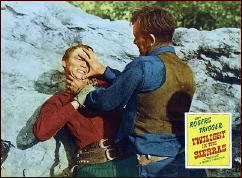
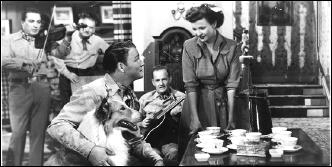
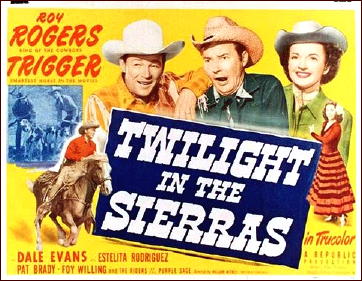
TWILIGHT IN THE SIERRAS. Republic Pictures, 1950. Roy Rogers, Dale Evans, Pat Brady, Estelita Rodriguez, Russ Vincent, Foy Willing & the Riders of the Purple Sage. Director: William Witney.
I was recently talking to a friend about the Hopalong Cassidy movies, and how he thought they were better than the B movie classification they’re lumped into. I still haven’t seen any of them recently enough to say whether I agree with him or not — and maybe I’m overstating his premise — but I just watched this Roy Rogers movie, and even though Roy was the “King of the Cowboys,” it’s a B movie all the way.
You probably know how it goes without my much telling you. Roy and his gang spend the movie singing around the campfire or up in the bunkhouse, and every once in a while a story breaks out.
In this case it’s a gang of counterfeiters Roy is after, and a parolee in Roy’s custody was once an engraver, if you get my drift.
The parolee has a sister, and if the gang can get their hands on her, well sir, they’re in business. There is also a hunt for a vicious mountain lion, lots of fights, a shooting or two and a couple of runaway buckboards.
What set Roy’s movies off from all the others, I think, is that they took place in the “modern” west, with buses coming into town instead of stagecoaches, and Roy, Pat and Dale communicating with each other by walkie-talkie. This is kids’ fare, all right, but even though I winced every so often at the wooden dialogue, I still thought it was neat.
— Reprinted from Mystery*File 28,
February 1991 (slightly revised).
EDITH HOWIE – No Face to Murder. M. S. Mill, US, hardcover, 1946. TV Boardman, UK, paperback, 1946.
As the choir of the St. Thomas Episcopal Church is finishing its practice session, Miss Tess King, a chorister and the church secretary, discovers in trying to recover her dropped anthem that her hand is soaked with blood. A body is subsequently located with its throat slit, and then another is found that has been murdered the same way.
From the evidence, it would seem that a choir member or the organist, who had a tendency not to follow the score but to let the choir follow him, must have done the killings. All, of course, have something to hide.
Miss King is a passable narrator and a sensible person, except when the author turns her temporarily into a Gothic idiot. Ran Garrison, the police investigator and Miss King’s boyfriend, is a competent but dull investigator. Only when Bishop Walters shows up midway in the novel does it take on any life.
Unfortunately, he gets bopped on the head by someone who may be the murderer and decides, wisely for him but not for the reader, to end his career as a sleuth almost as soon as it was begun.
Hubin’s bibliography says that this novel is set in Missouri. I haven’t figured out how this was ascertained.
— From The MYSTERY FANcier, Vol. 11, No. 1, Winter 1989.
Bibliographic Notes: Edith Howie, dates uncertain, was the author of seven crime novels written between 1941 and 1946. A complete list may be found here. A short synopsis and review of No Face to Murder that appeared in The Saturday Review may be seen here.
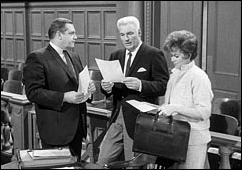
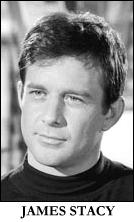
“The Case of the Final Fade-Out.” An episode of Perry Mason (1957-66). Season 9, Episode 30. First broadcast: 22 May 1966. Raymond Burr, Barbara Hale, William Hopper, William Talman, Richard Anderson, James Stacy, Estelle Winwood, Jackie Coogan, Denver Pyle, Dick Clark, Gerald Mohr, Marlyn Mason, Kenneth MacDonald, Lee Miller, Gail Patrick (uncredited), Erle Stanley Gardner (uncredited). Executive producer: Gail Patrick. Writers: Ernest Frankel and Orville H. Hampton. Director: Jesse Hibbs.
You’ve probably seen crime dramas centering on a murder during the production of a movie or television show (one installment of Ellery Queen comes to mind), and “The Case of the Final Fade-out” is one of them.
A young and handsome but amoral TV actor (Stacy) is the star of a hit TV crime series. Not content with his success, he’s more than willing to double cross his colleagues to get what he wants — and you just know that when a character in a Perry Mason episode starts throwing his weight around, he is very likely going to end up a corpse.
When filming a hectic shootout scene, Stacy is killed in the confusion; but who pulled the trigger?
Just about everybody this crumb bum knew had a good motive to rub him out, and it’s no small matter for Perry Mason to finally finger the culprit.
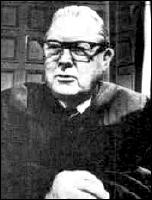
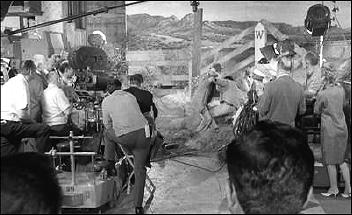
This show is special in several ways: (1) It was the final (271st) episode of the original black-and-white Perry Mason series; (2) many of the production crew had a chance to appear on camera (since they were “witnesses” to the crime); and (3) Perry Mason creator Erle Stanley Gardner put in his one and only appearance as a judge.
It might also be the only time lawyer Mason defended a dead client — and then went on to defend the person accused of killing him!
When this episode wrapped, everyone thought they were finished with Perry Mason. Raymond Burr (1917-93) went on to what he considered a more interesting character in the Ironside series (196 episodes, 1967-75), but apparently couldn’t resist the money, returning to Perry Mason in 26 made-for-TV films (1985-93).
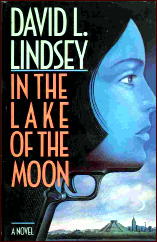
DAVID L. LINDSEY – In the Lake of the Moon. Atheneum, hardcover, 1988. Bantam, paperback, 1990.
I’m of two minds about this book, the latest of David L. Lindsey’s novels about Stuart Haydon of the Houston police department. On the one hand, it’s notable for the depth of character revelation and exploration and for the strong sense of place.
On the other, its 341-page length draws out the tale, thins it out, demanding reader patience. Photographs, decades old, come to Haydon in the mail. At first he doesn’t recognize the person pictured, but it’s his father, fifty years before. Stuart was very close to his father until his death some six years before, thought he knew him intimately.
But the pictures, sent with malevolent purpose, are followed by others, and the trail leads from the steaming rain of Houston to the density and sprawl of Mexico City, to a man whose brain, bubbling with madness, is bent on death. But why him, Stuart wonders, off balance and out of his element, and how could there be so much of his father he didn’t know?
— Reprinted from The MYSTERY FANcier,
Vol. 11, No. 1, Winter 1989.
The Stuart Haydon series —
1. A Cold Mind (1983)
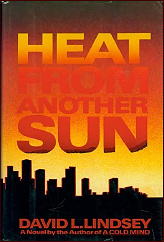
2. Heat from Another Sun (1984)
3. Spiral (1986)
4. In the Lake of the Moon (1988) [Nominated for an Edgar as Best Novel]
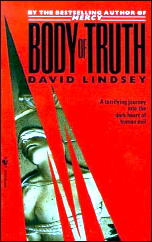
5. Body of Truth (1992)
David L. Lindsey has written eight other stand-alone novels, the most recent being The Face of the Assassin (2004).
MIRIAM BORGENICHT – Fall from Grace. St. Martin’s, hardcover, 1984. No paperback edition.
A twenty-six year old nurse marries a sixty-seven year old doctor and two months later he’s dead, a suicide, leaving a note that seems to imply that the marriage was a mistake.
What does the world think? Naturally, that she’s to blame. But the world was wrong. Nan Dunlop has married Dr. William Gardner for love, and their marriage was happy. So, after his death, she sets out to find the “mistake” that had driven him to his death.
Probing into his past, she finds his younger sister, an alcoholic whose dull husband made it big with a defense contract. She finds two nurses who had fallen for the glamorous doctor 21 years before. She finds a research project begun with great enthusiasm and abandoned for no apparent reason.
Her husband’s lawyer, suspicious of her motives, follows the course of this delving into the past. So does Dr. Collins, who is supportive. After two attempts are made on her life, she realizes that there is something of greater moment than an old love affair to be found. Slowly the suspense builds, as Nan uncovers the solution to this engrossing puzzle.
— Reprinted from The Poisoned Pen, Vol. 6, No. 4,
Fall 1986.
Biographical Notes:
Miriam Borgenicht (1915-1992) was the author of 17 crime novels written between 1949 and 1991. Her obituary in the New York Times states that “She completed her last, yet unpublished, by dictating the conclusion to a daughter from her hospital bed.” She was also an occasional contributor to The New Yorker magazine.
On the main Mystery*File website, Marvin Lachman had this to say about her work: “Miriam Borgenicht was one of those writers who never seem to write the same book twice. These writers typically don’t have series characters since having a continuing protagonist usually leads to a certain predictability. Andrew Garve was another whose books followed little pattern, though, as I have written elsewhere, Garve was probably his own series character. Borgenicht was a sophisticated writer who created many different strong female protagonists….”
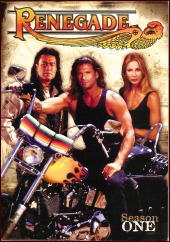
RENEGADE. Pilot episode: 19 September 1992. Syndicated: Stu Segall Productions / Stephen J. Cannell Productions. Cast: Lorenzo Lamas, Branscombe Richmond, Kathleen Kinmont, Stephen J. Cannell. Theme by Mike Post. Created and Written by Stephen J. Cannell. Executive Producers: Nick Corea and Stu Segall. Director: Ralph Hemecker.
Sometime after Stephen J. Cannell’s masterpiece, The Rockford Files went off the air Cannell developed a fervent case of TV cheesiness. Renegade represents one of his best efforts in TV cheese, and offered classic dialog such as when Val says to Reno, “Sometimes you seem so sad, I wish I could cry for you.â€
Evil Police Lt. “Dutch†Dixon orders his henchman Sergeant to kill Reno. The Sergeant goes to the conveniently located prison and they release Hog to the Sergeant. So what that Hog is serving life for murder, the Sergeant (who is alone) says its necessary.
Hog wants to kill Reno, the man who had put him in jail and hurt his brother. Bad cop Sergeant sets Hog after Reno, but Val is shot instead, and Hog escapes. Remo rushes Val to the hospital. Dixon arrives and kills the Sergeant, his bff for ten years. He faces him and shoots him twice with Reno’s gun. But, according to the later TV news report, the body was found handcuffed (Reno’s) and killed “execution style†(which I understand to mean shot in the back of the head, not from across the room).
The frame is on. Reno doesn’t want to leave Val, who is now brain dead but kept alive on machines in a hospital. However, Reno needs to get away from the cops while making enough money so he can pay Val’s hospital bills (viewers who might remember that Val has a brother who owns a construction company are paying far too much attention).
Dixon hires Bobby, the world’s best smart-ass Native American bounty hunter, to find Reno. Computer expert and Bobby’s white blonde big-breasted sister Cheyenne tags along.
Reno chases Hog. Bobby and Cheyenne chases Reno. Reno catches Hog. Bobby catches Reno and Hog. Reno escapes Bobby, who refuses to stop telling bad Indian jokes. Hog’s biker friends attack Bobby and Cheyenne. Reno returns and saves Bobby. Meanwhile, Cheyenne is taken by the bikers, who are proper gentlemen and just tie her up. Reno and Bobby bond and rescue Cheyenne.
Thus the premise of Renegade is set up. Reno is on the run wanted for murder. He will catch wanted criminals and turn them over to Bobby to collect the rewards. Bobby, after his cut, sends the reward money to the hospital to make sure the docs keep Val alive. Meanwhile, Dixon lurks evilly in the background.
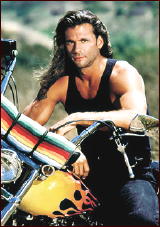
Lamas portrays Reno as a man with great pecs and hair. Richmond has the charm to make smug Bobby a likeable character. Stephen J. Cannell as Lt. “Dutch†Dixon is surprisingly good as the evil villain. For Renegade, Cannell was better in front of the camera than he was behind it.
Auteur Ralph Hemecker’s vision properly favors boobs (females and Lamas’s chest) and hokey macho camera shots. My favorite was when Reno and Bobby prepare to rescue Cheyenne. Bobby and Reno stand alone in the shot staring into each other’s eyes in a true macho bro moment. Bobby cocks his shotgun and says, “Let’s do it, friend.†And the two stride off camera.
The pilot episode’s opening theme tells us Val is shot before we see her shot in the story. Yes, the theme song is a spoiler of its own story, but if you are paying enough attention to notice, you are watching the wrong show.
Renegade was syndicated until its fifth and final season when it moved to USA network. With the growing success of cable in the 90s, the market for TV syndication of first run series increased. Renegade was the ideal entertainment for a lazy weekend afternoon.
Vapid, mind numbing television with all the necessary elements, half naked beautiful women and men, mindless action (chases and fights), silly humor, and a pure evil villain versus a persecuted good-guy hero, all combined for a simple and satisfying way to spend sixty minutes on a slow weekend afternoon.
Available to view on DVD and various downloading sites.
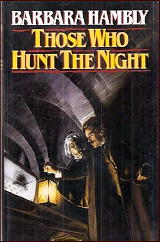
BARBARA HAMBLY – Those Who Hunt the Night. Ballantine/Del Rey, hardcover, December 1988; reprint paperback, 1990.
Most assuredly a tour de force, if there ever was one. If you don’t know the story, hang on to your Bunsen burner. Under considerable duress, James Asher, one-time foreign agent for the British government is hired by Don Simon Ysidro to find out who is killing the vampires of London.
The year is 1907, and the fact is that Ysidro himself became a vampire in 1555. Held over Asher’s head is the life of his wife Lydia, who is herself a scientist of some ability, and who knows something of the pathology of blood.
Several of Ysidro’s companions are dead, with stakes in their hearts and their coffins opened to the light of day. What Ysidro cannot understand is how a human could be doing these deeds any vampire’s knowing, and thus he turns to what would otherwise be unthinkable: he is asking the assistance of a human. (Worse than that, of course, is actually allowing a human to know of the vampires’ existence.)
Nominally a detective story, there are a few flaws along that line, mostly those of conjectures that somehow become facts within minutes of their being stated, and small jumps of logic that on occasion stumped me badly. (And sometimes they are wrong, leading to long wild goose hunts that circle back upon themselves, and only then are they crucial to the story.)
What this may sound like is a horror story, but it really is not, although with vampires involved, how could there not be any chills? What it is, when it comes down to it, is a science fiction novel. There is a reason the story takes place when it does, and that’s because in 1907 there was just enough known about blood and bacteria and related matters to provide a solid “scientific” basis for the existence of vampires, and not yet enough to know that they are not possible.
And always overshadowing Asher’s investigation is the question of how it’s going to work out when it’s over. Ysidro is a creature who has killed thousands of humans in his “lifetime,” and yet he and Asher become strange allies in their hunt for the killer of the vampires, and each in their own way begin to stand taller in the opinion of the other.
While there may not be a definitive answer to this not-so-subtle problem, Hambly does offer the reader a resolution to it. She also supplies a solution to the mystery itself, and of the two (resolution and solution), it is the solution to the mystery that is stronger.
All in all, this is a fascinating book, one I didn’t think I was going to read — it’s not my usual bill of fare — but as it turned out, I’m glad I did.
— Reprinted from Mystery*File 28,
February 1991 (slightly revised).
[UPDATE] 05-20-12. Unknown to me until now, this was the first of a series of vampire novels that Barbara Hambly wrote about Jim Asher. I’ll list those below.
Hambly is one of the few authors I can think of who has written as many mysteries as she has in the SF/Fantasy field. Most notable among the former are her eleven novels (through 2011) featuring “free man of color” Benjamin January, a Creole physician and music teacher whose first adventure takes place in New Orleans in 1833.
The James Asher series —
1. Those Who Hunt the Night (1988)
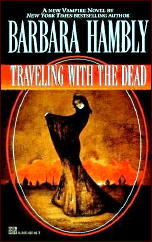
2. Traveling with the Dead (1995)
3. Blood Maidens (2010)
4. The Magistrates of Hell (forthcoming: July 2012)
Devoted to mystery and detective fiction — the books, the films, the authors, and those who read, watch, collect and make annotated lists of them. All uncredited posts are by me, Steve Lewis.