Thu 8 Mar 2007
Review by Mary Reed: MARY ROBERTS RINEHART – When a Man Marries
Posted by Steve under Authors , Crime Fiction IV , ReviewsNo Comments
When a Man Marries is available online in etext form at the Gutenberg Project. Mary also points out that some additional biographical information on Mrs. Rinehart can be found online, including this website as a prime example.
Mary Reed has her own website, shared with her co-author Eric Mayer; you are cordially invited to stop by. Mary and Eric also did a Pro-File interview for the original Mystery*File website before it went on its current long hiatus.
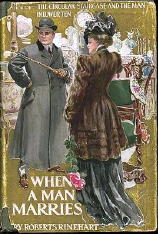
MARY ROBERTS RINEHART – When a Man Marries (Bobbs-Merrill; hc, 1909. Hardcover reprint: Grossett & Dunlap, no date. Wildside Press, trade ppbk, 2004)
Being excessively fond of locked room mysteries, imagine my delight once I began reading When A Man Marries to find it based on a twist on same. Set in a house full of Bright Young Things (sent up mercilessly by the author, Mary Roberts Rinehart, whose The Circular Staircase is occasionally mentioned within these walls) the plot unspools as several BYT’s suddenly find themselves sequestered in a large house under quarantine because the butler has just been stricken with smallpox.
Meantime, the protagonist has agreed to pretend to be the wife of the house owner. This came about because the BYTs are attending a dinner party at the house, during which their host learns his dragon of an aunt — who holds the purse strings — is coming for an unexpected visit. This rich aunt has not been told he is now divorced because then the flow of money would end (fortunately she hasn’t met the now ex-wife). Complications of course ensue including the rest of the servants decamping before the Board of Health quarantines the house, leaving in such haste they do not even bother to tell the master why they are leaving, the ungrateful things.
There’s a policeman imprisoned in the furnace room, and no sooner is the house and its inhabitants securely locked down for the duration when valuable items such as jewelry start going missing … meanwhile, the ex-wife having arrived just before quarantine was declared is now concealed from the aunt’s eyes in the kitchen below stairs, Rich Aunt is also locked in the house with the entire bunch, and one of other Bright Young (Male) Things foolishly wagers a large sum the entire crew will get out of quarantine within 24 hours — quite illegally of course and talk about chronic lack of social conscience — plus there are newspapers reporters and photographers camping around the house as well as on the roof of the house next door to keep an interested public fully informed.
It struck me as I read that it would have made a wonderful screwball comedy/mystery with Cary Grant playing the fellow imprisoned engineer from South America, who is most emphatically *not* a BYT. How could you not laugh out loud at the whole frothy affair?
And I did, Oscar, I did.
[UPDATE] 03-09-07. When I asked Mary to say some more about the criminous content of When a Man Marries, this was her reply:
Thinking that Al Hubin might like to know this, I sent Mary’s comments on to him. Here’s what his response was, which was pretty much what I suspected it would be:
If anything I guess I err on the side of over-inclusion, and I think I’ll add this with a dash (Addenda #12).
Wed 7 Mar 2007
Once Again with J. V. TURNER, a/k/a DAVID HUME.
Posted by Steve under Authors , Characters , Covers1 Comment
Some additional comments on David Hume, discussed first in my review of Requiem for Rogues, with a followup post a few days later. From the Yahoo Golden Age of Detection group is this from Curt Evans:
Murder-Nine and Out involves the boxing world, as does, judging from the dust jacket (the book is for sale for $180 on ABE), Death Must Have Laughed. I would put Murder-Nine and Out in the detection school, as I would the two Ebenezer Buckles I read. But “tough” elements crop up, by which I mean elements associated more with thrillers than with the British genteel school of the Crime Queens. I’ve got another Turner, Who Spoke Last?, which seems to be about crooked financiers, but I have not read it yet. Amos Petrie’s Puzzle sounds interesting, but I have not found a copy.
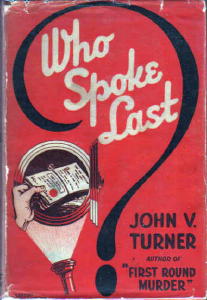
You’re right. Some of the books that Turner wrote, especially those not as by Hume, are very expensive and hard to find. Wait until you read this from Bill Pronzini, though, who has this to say, plus some show-and-tell afterward:
Just read your blog piece on David Hume (John V. Turner). So happens I’ve been collecting his work for years, under his own name and his two pseudonyms. Attached is some biographical info, photos, and a sketch from the DJ’s of three of his U.K. mysteries. I can send you some cover scans as well, if you like — Humes, Bradys, and Turners.
The Cardby novels are enjoyable Edgar Wallace type gangster stuff, and comprised his most popular series in England, but for my taste his other two series are better — the Reverend Ebenezer Buckles as by Nicholas Brady and the Amos Petries as by J.V. Turner. These are Golden Age fair-play mysteries with more spice than is usual in the breed.
One of the Reverend Buckle tales, Ebenezer Investigates, for instance, deals with the murder of a pregnant young village woman who had relations with several different men; the subject matter was evidently considered too controversial for its day (1934) for Holt, which published a couple of the other Buckle mysteries, to bring it out here. One of the titles that Holt did publish, Carnival Murder (The Fair Murder in the UK), is a first-rate macabre puzzler set at a village fete at which a small traveling carnival is the main feature.
Two of the Amos Petrie novels are “impossible crime” tales of some ingenuity; the best of them is First Round Murder (Death Must Have Laughed in the UK), which has a boxing background and concerns the baffling murder of a fighter in the midst of a bout.
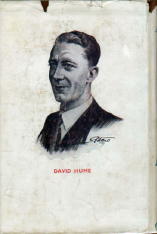
I’ve used one of the cover scans to lead off this blog entry, and I used the back cover sketch of Hume�s face on the previous Hume-Turner post. I�ll post one of the back covers with the biographical info at the bottom of this post � I hope you can make out the print! The rest of the covers I’ve uploaded on a separate page where you can see them more clearly. Go take a look. It�s worth the trip!
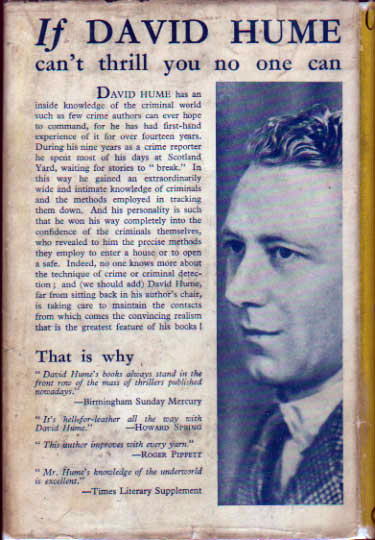
[UPDATE] From Bill Pronzini: Attached are three more scans which you might want to include, two Humes and a Turner.
Curt Evans is right about the grotesque elements of The Carnival Murder; grisly might even be a better word.
Most of the other books I have by Turner under his three names are jacketless, unfortunately. One of these is the Turner title Curt mentioned, Amos Petrie’s Puzzle. It’s not as good as the two of the “impossibles,” First Round Murder and The House of Strange Guests, but still enjoyable. Concerns the murder at a country house party of the owner of three West End theatres, after the gent received an anonymous threatening note stating “Millionaires Must Die.” Theatre folk and film stars are among the suspects, and as usual with Turner’s detective novels, there are both bizarre and sexual aspects to the case. Amateur sleuth Petrie is on hand to solve it with the aid of his long-suffering friend, Inspector Ripple of Scotland Yard.
The covers page has been revamped, with the new scans added. Thanks! –Steve
Wed 7 Mar 2007
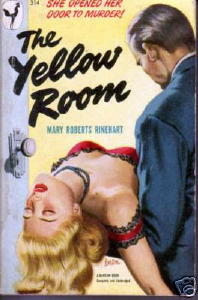
MARY ROBERTS RINEHART – The Yellow Room
Dell 9790; paperback reprint, later printing, April 1971. Hardcover, first edition: Farrar & Rinehart, 1945. Previously (?) published as an eight-part serial in The Saturday Evening Post, September 28 through October 27, 1945. Cassell & Co., UK hardcover, 1949; Thriller Book Club, UK hardcover, 1950.
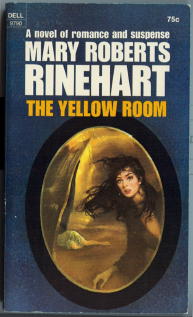
Bestseller B95, digest pb, 1947. Bantam 314, pb, April 1949. Other Dell paperback editions include: Dell D179, 1956; Dell 9790, October 1962; Dell 9790, 1967. Also: Zebra (Kensington), pb, 1973, 1988, 1990 (3rd pr.), 1991, 1996 (5th pr.). Included in Mary Roberts Rinehart: Three Complete Novels by America’s Mistress of Mystery [contents: The Bat, The Haunted Lady, and The Yellow Room] Zebra, pb, 1995.
It is quite possible that I’ve missed a few editions of this book. In particular, there are at least nine listings on ABE of a hardcover edition from 1955 (Farrar & Rinehart), but whether that’s a misprint or no, I do not presently know. There may also have been a US hardcover book club edition, but with no definitive information to back this statement up, I have not included it. Suffice it to say, however, if you’d like to locate a copy of this book to read, even a hardcover edition, you shouldn’t have any trouble.
Rinehart’s writing career, as least as far as her novels and collections are concerned, began with The Man in Lower Ten from Bobbs-Merrill in 1909, but the story’s even earlier appearance was in serialized form, in All-Story Magazine for January through April, 1906.
According to various online sources which I haven’t attempted to verify, Rinehart suffered a severe heart attack in 1938 while living in Maine, and apparently was a semi-invalid for much of her later life. In any case, from that time on there were only four more novels to come from her pen – she never used a typewriter, according to one source – and of those, The Yellow Room is next to last. Only The Swimming Pool (1952) came later. (This statement excludes several collections of novelettes and short stories.) Still perhaps one of the most famous mystery writers of all time, Mary Roberts Rinehart died in 1958.
Appearing after a three-year gap, following Haunted Lady in 1942, The Yellow Room was written when the author was 67, which may go a long way in explaining some apparent slippage in the her writing ability, or perhaps the flaws I saw were always present. I will have to rely on someone more familiar with her earlier work than I am to be able to say more.
The book itself takes place in 1944, and the opening chapters go far in describing the general difficulties of life at home in wartime, what with rationing, limited travel opportunities, the absence of men except for the oldest and/or the feeblest, and the hardest of all – waiting for news of loved ones fighting (or reported missing) on the front lines. When Carol Spencer’s invalid mother wishes to move from New York City to the family’s summer home in Maine, it is up to Carol, with only three female servants to assist, to tackle the work involved in doing so.
Little did she suspect or know – and yes, that’s the kind of book that Mrs. Rinehart is famous for writing – that she would find the house still shut up and not opened. Lucy, a local woman who is the housekeeper, she learns the next day, is in the hospital with a broken leg. Lights have been seen in the house, Carol is told, shining from the room where Lucy says she never was before her accident.
Another discovery occurs on page 27: Another woman is found dead in a linen closet, partially burned as if someone had been hoping to dispose of her body. When asked, Lucy’s story does not ring true; there is something she is not telling. And it is precisely here that the reader’s frustration begins, or at least they did with at least one reader: me. There are many, many questions that if asked are not answered, and there other questions that seem never to be asked, and if they were answered, at the right time and the right place, the mystery – one has the uncomfortable feeling – would, at that time and that place, simply cease to exist.
Coming to Carol’s aid is her next-door neighbor, the worldly but still young Major Dane, who has been injured from work for US Intelligence, or so it seems. He has been recuperating in the area until deemed fit to go back to duty. The police, generally speaking, are of little or no help. Truth be said, they seem far more antagonistic toward Carol than any evidence seems to say they should be.
By page 126 – I jotted a note to myself to this effect at this exact spot, so I am indeed able to be this precise – the facts, what there are of them, are so far muddled that the average reader, it seems to me, will either (A) have given up or (B) have shrugged their shoulders and allowed themselves to follow along, no more and no less, just to see where the author may be headed. There are 256 pages of small print, so at page 126, it is an important decision that must be made whether or not to stop or plunge on, keep going, and rely on the author’s name and reputation that the story may yet be salvaged.
I often exaggerate, and the previous paragraph is one of those times, but not by much. Considering Major Dame, who by proximity feels himself becoming closer and closer to Carol, to be the primary detective, there are too many times when we (the reader) are not given total access to his thoughts, and too many other times when the point of view has shifted, and we (the still faithful reader) are shown scenes that Dane knows nothing about.
Frustration, yes, but please (if you are ever the reader) keep the faith. The ending, with all of its revelations, is worth waiting for. Mrs. Rinehart has some nifty tricks up her sleeve for you. Even though the buildup to the final couple of chapters might have been more capably accomplished, and whether the end result is realistic or not, I think that even at this late stage in her career, in terms of pulling off the (almost) totally unexpected, she still had the right stuff. I feel quite justified in myself in sticking with Plan B.
[UPDATE] 03-10-07. For more about Mary Roberts Rinehart, see Michael Grost’s informative article about her career as a writer on his extremely comprehensive Guide to Classical Mystery and Detection website.
Tue 6 Mar 2007
More on J. V. TURNER a/k/a DAVID HUME
Posted by Steve under Authors , Characters , Crime Fiction IV , Reference works / BiographiesNo Comments
Following my review of Requiem for Rogues and my overview of author David Hume’s career, I received enough follow-up comments to warrant making an entire blog entry out of them. First from the Yahoo Golden Age of Detection group, here’s a reply from Curt Evans:
My survey of Turner did not indicate to me that he was a lost great. The Hume books seemed beat ’em up thrillers. The Turner and Brady books are more detection, with amateurs Amos Petrie and Ebenezer Buckle. It looks like Turner had his feet planted firmly in both schools of mystery fiction. I’ve read a couple of the Petries and Buckles, but the only one that stood out in any way for me was The Fair Murder, which had some quite exceptionally grotesque elements – it certainly is not cosy!
In my review and other commentary, I wondered about Turner’s death at the young age of 45. Victor Berch discovered his obituary in the NY Times [dated 02-06-45], but nothing in it referred to the cause of his passing. He had died the day earlier. I’ll quote briefly from the obituary anyway:
“Frequently he spent weeks at a time living in London’s underworld to mix with criminals.
“A reviewer of [They Called Him Death, 1934/35] in The New York Times commented, ‘Swift action and plenty of it make this story a good example of the mystery-adventure type of thriller. If you prefer subtle deduction, you must look elsewhere.'”
I also wondered about Mick Cardby and whether his father should be also included as a series character in Allen J. Hubin’s Crime Fiction IV. Al replied:
As for the Cardbys, Bill Lofts has this to say:
“The business of Cardby & Son, private detectives of Henrietta Street, Covent Garden, had been built up with the trust of both police and crooks. Whilst Mick Cardby was the younger and more prominent, Cardby senior had spent twenty years of distinguished service at Scotland Yard, reaching the rank of Chief Inspector.”
I owned 33 David Hume titles once upon a time, and I rather think I chose Cardby the younger because that’s the way the books were promoted … as Mick Cardby tales.
Altogether you’ve certainly convinced me that Mick Cardby, the son, is the principal player, with the father taking the lesser role. Mick Cardby books, they are!
Many thanks to Curt, Victor and Al for filling in some of the details on J. V. Turner, a/k/a David Hume. As usual, gents, it’s been a pleasure.
And by the not-so-insignificant way, I missed the quote from the Bill Lofts website the other day, and I shouldn’t have. And neither should you, if you are interested in mysteries published during the Golden Age of Detection and certainly no later than 1960.
Entitled The Crime Fighters, by W. O. G. Lofts and Derek Adley, it’s yet another project that Al Hubin is working on, putting online an alphabetical listing of many of the fictional characters found in all of those books, beginning with Pat & Jean Abbott (Frances Crane) and ending with Inspector Furneaux (Louis Tracy).
Um, yes. Unfortunately, only letters A through F are online and accounted for so far. It’s still worth your time visiting, and if you’re like me, you may stay a while.
From the Introduction:
* the private detective
* the private eye
* the official police investigator
* the amateur sleuth
* the adventurer type of detective, such as Bulldog Drummond and Norman Conquest, who were always on the side of law and order, as well as Robin Hood types like the Saint who were active on both sides
* the secret service agent of the Tiger Standish type, who nearly always worked with the Special Branch at Scotland Yard (but not those of the James Bond type, who were purely engaged in spying and espionage and rarely worked in collaboration with the police).
Thus, in general, we cover the fighters of evil-doers, but of course not including the American super-hero of the Superman type. The closest we come to this type is The Shadow and Doc Savage, who, while having certain mystic powers, are nonetheless ordinary men.
We have endeavoured in the main to include detectives and the like who have appeared in British publications, although we have found that most of those of any repute appearing in book form in this country have likewise appeared in the U.S., and of course the reverse is true.
Tue 6 Mar 2007
Bill Pronzini on VALERIE SHORE and MICHAEL KNERR.
Posted by Steve under Authors , Collecting , ReviewsNo Comments
Reason: I’d begun to suspect the book didn’t exist, despite the listing in Hubin, because it has been on my paperback want list for maybe a dozen years and yours is the first copy I’ve ever seen. So happens I collect Major Books — in general, they were the Phoenix Press of 70s paperbacks, more than 50% qualifying as “alternative classics” — and Final Payment is one of only two MB mysteries that I don’t have. And judging by your review, it’s one of the few good ones MB published.
Also noted your piece on Michael Knerr. I don’t have Travis, the book you reviewed, but do have and have read the Monarch, The Violent Lady. Pretty good adventure/mystery tale set mainly on a 49-foot yawl on a long Caribbean treasure cruise.
>> I almost hated to tell Bill that I paid either a dollar for the copy of Final Payment that I found, plus shipping — or was it a pound, since I bought it on eBay from a seller in England — but sometimes collectors tell each other stories like that. As I did so, I asked him about his overall interests in Major Books, and I guess he’s still talking to me, since he replied:
>> Just in case you were wondering: I collect the Gothics and westerns from Major Books too. That makes at least three of us, since my good friend Dan Roberts collects everything that Major Books published, the straight romances and the non-fiction as well. (To the people we meet in the ordinary world, the three of us look as normal as anyone else.)
Mon 5 Mar 2007
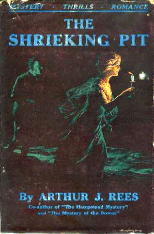
“I’m seeking information on novelist Arthur Rees (Australian born 1872 (ish ), died 1942). Spent (perhaps much) time in England and wrote novels showing detailed knowledge of and interest in his adoptive home. His ‘detective/horror’ work includes The Shrieking Pit set in Norfolk and the tiny port of Blakeney.
“The book is prefaced by reference to Annie and Frances – my sisters in Australia, and a lengthy poem (of merit) about Blakeney.
“Any biographical information would be very much appreciated. Many thanks.”
—
As always, when asked about an author new to me, I turn first to Allen J. Hubin’s Crime Fiction IV, wherein is found:
* The Hampstead Mystery [with John R. Watson] (n.) Lane 1916 [Crewe]
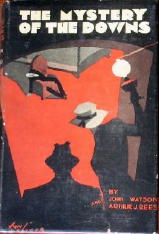
* The Mystery of the Downs [with John R. Watson] (n.) Lane 1918 [Crewe]
* The Shrieking Pit (n.) Lane 1919 [David Colwyn]
* The Hand in the Dark (n.) Lane 1920 [David Colwyn]
* The Moon Rock (n.) Lane 1922
* Island of Destiny (n.) Lane 1923 [Insp. (Chief Insp.) Luckraft]
* Cup of Silence (n.) Lane 1924
* The Threshold of Fear (n.) Hutchinson 1925 [Colwin Grey]
* Simon of Hangletree (n.) Hutchinson 1926 [Colwin Grey; Insp. (Chief Insp.) Luckraft in a walk-on role].
* Greymarsh (n.) Jarrolds 1927 [Colwin Grey]
* The Pavilion by the Lake (n.) Lane 1930 [Insp. (Chief Insp.) Luckraft]
* The Brink (n.) Lane 1931
* Tragedy at Twelvetrees (n.) Lane 1931 [Insp. (Chief Insp.) Luckraft]
* Investigations of Colwyn Grey (co) Jarrolds 1932 [Colwin Grey]
• The Black Box • ss
• The Enamelled Chalice • ss
• The Finger of Death • nv, 1926
• The Grey Quill • ss
• The House by the Fells • ss
• The Katipo • ss
• The Lost Treasure of the Incas • ss
• The Missing Passenger’s Trunk • nv
• The Ten Commandments • ss
• The Valley of the Snakes • ss
* The River Mystery (n.) Jarrolds 1932 [Insp. (Chief Insp.) Luckraft]
* Aldringham’s Last Chance (n.) Lane 1933 [Insp. (Chief Insp.) Luckraft]
* Peak House (n.) Jarrolds 1933
* -The Flying Argosy (n.) Jarrolds 1934
* The Single Clue (n.) Robertson, Australia, 1940 [Insp. (Chief Insp.) Luckraft]
This listing includes the British editions only. A handful of the titles were published in the US, often with title changes; CFIV also lists one US title which has not yet been matched with an UK equivalent. Books in which a setting is indicated (most of them) take place in either England or Wales.
After consulting CFIV, as usual I sent out the usual cry for assistance, which was quick in arriving. From John Herrington came the bulk of the incoming information:
First it might be worth suggesting to R– that he contacts Local Studies Library in West Sussex, as Rees was living in Worthing in that county in the 1930s – may have died there?
From E. Morris Miller in Australian Literature (Rev 1950 ed).
“Arthur J. Rees was born in Melbourne in 1977 (typo I presume). He was for a short time on the staff of the Melbourne Age and later joined the staff of the New Zealand Herald. In his early twenties he went to England. His literary output belongs to the period that follows, and reflects little if anything of his Australian experience. He died in 1942. His proficiency as a writer of crime mystery stories is attested by Dorothy L. Sayers in the introduction to Great Short Stories of Detection, Mystery and Horror (1928) and two of his stories were included in an American world-anthology, besides translations of other of his works into French and German.”
Not a lot, but at least a start.
His entry in 1935 Authors and Writers Who’s Who adds little, as well as giving his birth date as 1870! He is described as author and journalist, working for the London Times 1914-22 and editor of New Zealand Truth 1910-12. He is married, but no wife’s name given. And, of course, that he was living in Worthing at the time.
I wonder if he has an entry on AustLit. Allen has, or did have, access to this.
If you are interested, some of his books appear to be available as free e-books.
John
Then from Al Hubin:
Sorry…no details other than birth/death dates in AustLit. But there is a note to a biographical sketch in “The Lone Hand” Volume 14 Number 84, April 1914, page 337. I’ve no idea where one might lay hands on this issue of this periodical, alas.
Al
Heading back to do some Googling on my own, I came up with the following book descriptions from the Supernatural Fiction Data Base (which I did not know existed before):
Not, strictly speaking, a supernatural title. The locale that gives the book its title has a supernatural legend attached to it that is mentioned in passing, but there are no supernatural incidents in the story. (**)
The Threshold of Fear, 1925
A novel with borderline supernatural content: its villain has occult powers of mind control.
** As part of the introductory material for this book is the following: “As the scenes of this story are laid in a part of Norfolk which will be readily identified by many Norfolk people, it is perhaps well to state that all the personages are fictitious, and that the Norfolk police officials who appear in the book have no existence outside these pages. They and the other characters are drawn entirely from imagination.”
As John mentioned, four of Arthur Rees’s mysteries are available as free etexts. I’ve provided links to these in the entry from CFIV. If you (like me) dislike reading novels for entertainment from a computer screen, you can always download them as text files, then print them out. All it will cost you is the paper. And a new printer cartridge, I hasten to add, but still a bargain.
Mon 5 Mar 2007
Speaking of mystery movies, as I was not too long ago, Turner Classic Movies is having a special on them this month — a total of no fewer than 53 of them are going to be shown on Tuesdays and Wednesdays during the month of March. Make sure your Tivo’s and (if need be) old-tech VCR’s are ready for these:
Four Sherlock Holmes (all, I believe, with Basil Rathbone)
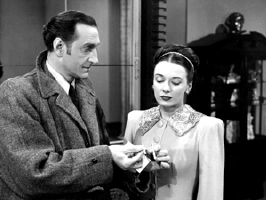
Four Lone Wolf (with Warren Williams, and seldom seen on TV)
Five police detective films (including Naked City)
Four Dick Tracy (with Morgan Conway)
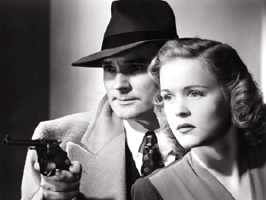
Four Nancy Drew (with Bonita Granville)
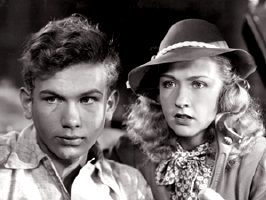
Two “society sleuths” (Nick Charles and Philo Vance, not in the same movie)
Four movies with amateur detectives (including The Penguin Pool Murder, with Edna Mae Oliver as Miss Withers)
Four Saint films (Leslie Charteris’ favorite character)
Four with “The Falcon” (George Sanders and Tom Conway)
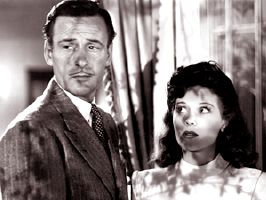
Five more recent PI flicks (Chinatown and more)
Eight Boston Blackie films (with Chester Morris, and also seldom seen on TV)
That adds up to 53, doesn’t it? I don’t know if I’ll be taping all of the above, but some of these are absolute musts.
Mon 5 Mar 2007
Al admits to being 71 years young today. Happy Birthday, Al!
Mon 5 Mar 2007
JAMES REASONER’s Private Eye Short Stories
Posted by Steve under Authors , Characters , Pulp Fiction[3] Comments
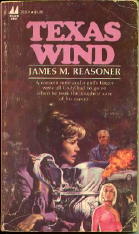
Prompted by a review by Ed Gorman of one of his early private eye stories for Mike Shayne Mystery Magazine, author James Reasoner recently did some reminiscing on his own blog about the private eye characters he created back then, some 25 to 30 years ago.
There were four “Markham” stories, he says, calling Markham “sort of a dry run for my private eye character Cody, who appeared in the novel Texas Wind and several short stories of his own.”
James goes on to say that Markham “was the second private eye character I created for MSMM. The first was called Delaney … who appeared in a handful of short, very minor stories. Cody came along after Markham and I used both of them in stories for a while, but Cody last appeared in 1988, nearly twenty years ago.”
If you hadn’t missed it, yes, all three detectives have only a single name.
It’s a long post, and besides talking about his own characters, James also discusses the other authors who appeared in some of the same issues of MSMM as he did, writers such as Joe R. Lansdale, Edward D. Hoch, William L. Fieldhouse and others. Not only that, but he remembers the pair of editors who bought the stories as well: Sam Merwin, Jr., and Charles E. Fritch.
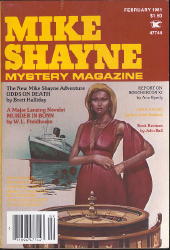
I’ll have to dig out some of the back issues of MSMM I have in my own collection. James also did many of the “Mike Shayne” short novels or novelettes that appeared in every issue during this same era, including the one pictured here.
It made the magazine one of the few places where you could be guaranteed being able to read a PI story anytime you picked one up. (The link above will take you to a list of many of the Mike Shayne stories that appeared in the magazine and who wrote them.)
James concludes by saying, “I’ve thought at times that a volume collecting all the Cody, Markham, and Delaney stories would make a nice little book. Maybe one of these days.”
If at all possible, make it sooner rather than later, James.
[UPDATE] 03-06-07. At the request of myself and a number of others, James has posted a complete list of all of his non- “Mike Shayne” private eye short fiction.
He goes on to talk about a few of the stories, including some additional details about his various PI characters. James concludes by saying:
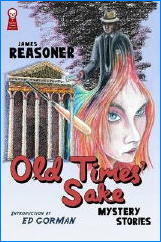
[UPDATE] 09-08-08. It’s a little late to be considered breaking news, but a collection of 17 of James’s 18 private eye stories was published earlier this year by Ramble House. The title is For Old Times’ Sake, and you can order it here.
Sun 4 Mar 2007
Review: DAVID HUME – Requiem for Rogues
Posted by Steve under Authors , Characters , Crime Fiction IV , Reviews[5] Comments
DAVID HUME – Requiem for Rogues
Collins, UK, hc, 1942. Reprints: 1946?, 1952. Collins White Circle #380, Canada, pb, 1949.
The author, first of all, is NOT David Hume (April 26, 1711 – August 25, 1776), who was a Scottish philosopher, economist, and historian, and according to at least one source, one of the most important figures in the history of Western philosophy and of the Scottish Enlightenment.
Nor is it his real name, for which see below. One does idly wonder why Mr. Turner chose it as a working by-line, though. It also makes it difficult to come up with information about him on Google, most of the searches picking up the wrong man, obviously.
On one website, I did come across the following, however:

From Crime Fiction IV, by Allen J. Hubin, which of course I turned to next, if not first, comes the following list of titles by Mr. Hume. These are the British editions only:
* Bullets Bite Deep (n.) Putnam 1932 [Mick Cardby; England]
* Crime Unlimited (n.) Collins 1933 [Mick Cardby; England]
* Murders Form Fours (n.) Putnam 1933 [Mick Cardby; England]
* Below the Belt (n.) Collins 1934 [Mick Cardby; England]
* They Called Him Death (n.) Collins 1934 [Mick Cardby; England]
* Too Dangerous to Live (n.) Collins 1934 [Mick Cardby; England]
* Call in the Yard (co) Collins 1935 [Det. Insp. Sanderson; England]
• Call in the Yard • na The Thriller Mar 2 1935
• The Murder Trap • na The Thriller Apr 13 1935
• The Secret of the Strong Room • na The Thriller Dec 1 1934
* Dangerous Mr. Dell (n.) Collins 1935 [Mick Cardby; England]
* The Gaol Gates Are Open (n.) Collins 1935 [Mick Cardby; England]
* Bring ’Em Back Dead! (n.) Collins 1936 [Mick Cardby; France]
* The Crime Combine (co) Collins 1936 [Det. Insp. Sanderson; England]
• The Crime Combine • na The Thriller May 2 1936
• Midnight’s Last Bow • na [unknown]
• The Murder Rap • na The Thriller Jul 25 1936
* Meet the Dragon (n.) Collins 1936 [Mick Cardby; England]
* Cemetery First Stop! (n.) Collins 1937 [Mick Cardby; England]
* Halfway to Horror (n.) Collins 1937 [Mick Cardby; England]
* Corpses Never Argue (n.) Collins 1938 [Mick Cardby; England]
* Good-Bye to Life (n.) Collins 1938 [Mick Cardby; England]
* Death Before Honour (n.) Collins 1939 [Mick Cardby; England]
* Heads You Live (n.) Collins 1939 [Mick Cardby; England]
* Make Way for the Mourners (n.) Collins 1939 [Mick Cardby; England]
* Eternity, Here I Come! (n.) Collins 1940 [Mick Cardby; England]
* Five Aces (n.) Collins 1940 [Mick Cardby; England]
* Invitation to the Grave (n.) Collins 1940 [England]
* You’ll Catch Your Death (n.) Collins 1940 [Tony Carter; England]
* The Return of Mick Cardby (n.) Collins 1941 [Mick Cardby; England]
* Stand Up and Fight (n.) Collins 1941 [England]
* Destiny Is My Name (n.) Collins 1942 [Mick Cardby; England]
* Never Say Live! (n.) Collins 1942 [Tony Carter; England]
* Requiem for Rogues (n.) Collins 1942 [Tony Carter; England]
* Dishonour Among Thieves (n.) Collins 1943 [Mick Cardby; England]
* Get Out the Cuffs (n.) Collins 1943 [Mick Cardby; England]
* Mick Cardby Works Overtime (n.) Collins 1944 [Mick Cardby; England]
* Toast to a Corpse (n.) Collins 1944 [Mick Cardby; England]
* Come Back for the Body (n.) Collins 1945 [Mick Cardby; England]
* They Never Came Back (n.) Collins 1945 [Mick Cardby; England]
* Heading for a Wreath (n.) Collins 1946 [Mick Cardby; England]
TURNER, J(ohn) V(ictor)
* Death Must Have Laughed (n.) London: Putnam 1932 [Amos Petrie; England]
* Who Spoke Last? (n.) London: Putnam 1932 [Amos Petrie; England]
* Amos Petrie’s Puzzle (n.) Bles 1933 [Amos Petrie; England]
* Murder-Nine and Out (n.) Bles 1934 [Amos Petrie; England]
* Death Joins the Party (n.) Bles 1935 [Amos Petrie; England]
* Homicide Haven (n.) Collins 1935 [Amos Petrie; England]
* Below the Clock (n.) Collins 1936 [Amos Petrie; London]
BRADY, NICHOLAS
* The House of Strange Guests (n.) Bles 1932 [Rev. Ebenezer Buckle; London]
* The Fair Murder (n.) Bles 1933 [Rev. Ebenezer Buckle; England]
* Week-End Murder (n.) Bles 1933 [England]
* Ebenezer Investigates (n.) Bles 1934 [Rev. Ebenezer Buckle; England]
* Coupons for Death (n.) Hale 1944 [England]
I don’t know about you but these are all new names to me, both that of the author (and his pen names) and his characters. Back to Google, it seems. Here’s a snippet of a review from The Bookman, 1933, of the US Holt edition of Nicolas Brady’s The House of Strange Guests:
Another snippet of a review, this one from The Librarian and Book World, date?, of Brady’s The Fair Murder:
Seeing a few shorter works of fiction collected under David Hume’s byline, I checked out the online Fictionmags Index, with the following results. [* = included in CFIV list above, either as a novel serialized earlier in magazine form, or as a story collected later in book form]
* The Secret of the Strong Room (na) The Thriller Dec 1 1934 [Det. Insp. Sanderson]
* Call in the Yard (na) The Thriller Mar 2 1935 [Det. Insp. Sanderson]
* The Murder Trap (na) The Thriller Apr 13 1935 [Det. Insp. Sanderson]
A Basin of Trouble (ss) The Thriller Jun 29 1935
The Crook’s Day Off (ss) The Thriller Aug 31 1935
He Was Pinched for Nothing (ss) The Thriller Oct 19 1935
* Meet the Dragon (sl) Detective Weekly Jan 4, Jan 11, Jan 18, Jan 25, Feb 1, Feb 8, Feb 15, Feb 22, Feb 29, Mar 7 1936 [Mick Cardby]
Anything to Say (ss) The Thriller Feb 15 1936
The Wrong Bottle (ss) The Thriller Mar 7 1936
Times Were Bad (ss) The Thriller Mar 28 1936
* The Crime Combine (na) The Thriller May 2 1936 [Det. Insp. Sanderson]
* The Murder Rap (na) The Thriller Jul 25 1936 [Det. Insp. Sanderson]
Who is Midnight? (na) The Thriller Sep 5 1936
More googling, this time on Hume’s detective Mick Cardy. At this point I still knew nothing about him. On a website devoted to Inspector Maigret I discovered the following piece of art:
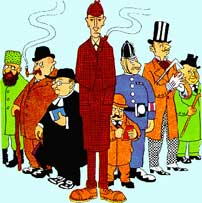
1. 2. 3. 4. 5. 6. 7. 8.
Maigret is the second gentleman on the left. Although they don’t have the original art, this cartoon came from the Storm-P museum in Copenhagen, and the curator, Jens Bing, identifies it as first appearing on the cover of the Danish pulp crime magazine Stjernehæftet in 1946. Bing sent a a copy to the Danish branch of the Sherlock Holmes Society, and here are the results they came up with for the others in the scene:
2. Maigret
3. G.K. Chesterton’s Father Brown
4. Sherlock Holmes
5. Agatha Christie’s Poirot
6. David Hume’s Inspector Cardby
7. Edgar Allan Poe’s Dupin
8. H.C. Bailey’s Reggie Fortune (?)
I don’t think I would gotten many of those, assuming that these are the right answers. How would you have done? But no matter, it would seem that Mick Cardby was actually Inspector Cardby, but this is not so, as we shall see in a minute. I didn’t include them in the CFIV listings, but two of Hume’s books were indicated as being the sources of films based upon them. So off I went to www.imdb.com, where I found the following useful information:
Plot summary for The Patient Vanishes (1941) aka They Called Him Death [The latter being the title of a 1934 book by Hume.]
Aha. Mick Cardby is a PI, not a gent from the Yard at all. We’ve learned something. (And you who knew already can stop the knowing looks at each other.) One more movie from the IMDB:
Too Dangerous to Live (1939) aka Crime Unlimited. [The latter being the David Hume title from 1933.] With Edward Lexy as Inspector Cardby, but no Mick Cardy listed in the credits, and no synopsis of the story.
But from the All Movie Guide comes the following Plot Description:
And from BFI, apparently there is a PI involved, after all:
I am sure that if you were to find a copy to watch, all of this confusion may be very easily straightened out. But a question remains: Who was the more important of the two characters, Inspector Cardby or his son Mick? Should both of them be included in CFIV as significant Series Characters?
And as you can easily see, Hume under his many aliases was extremely prolific. I’m sure you thought the same thing when you read through that list of mysteries up above. Could anyone who wrote so many detective novels so quickly be any good at it? Hold that thought. We’ll get back to it in a minute.
Hume also died young, at only 45. Could war injuries have had anything to do with his death? Having no answers, only these questions and more, unless you can enlighten me, I’ll move on to the major business at hand, which is a review of Requiem for Rogues.
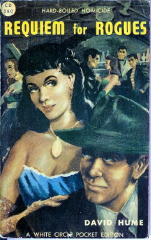
In which the leading character in is neither Cardy, father or son, but rather Tony Carter, a wisecracking crime reporter who appeared in three of Hume’s adventures, of which this is the third. He’s rather full of himself as well, as one might put it. Here’s a piece of a conversation that takes place on page 22 between Carter and his immediate superior at the Echo:
“To commence,” announced Cartwright, your methods are so unconventional that one day you will land this paper into most serious trouble. So far the luck has been with you. That cannot last for much longer. Then you’ll be in jail, and the
Echo will be faced with a heavy libel action. In the future follow a more conservative line of conduct, be more orthodox. See?”“Surely. You don’t want any more exclusive stories. The paper really wants the official news handed out in the Press room at the Yard – and nothing else. If that is so you’re wasting your money, and my time. Get a fourteen-year-old office boy, pay him ten shillings a week, let make the Yard call three or four times a day. And he’ll be a howling success.”
Cartwright wriggled. This interview was not what he had anticipated – not by a long, long way.
Suffice it say that Carter convinces Cartwright to give him a free hand in this case of the drive-by killing of one Percival East, dead by means of a bullet between the eyes on page eight, and right before the eyes of a later berated Detective Spriggs.
By page 69, the police are confused enough – and well they should be – to give Carter a free hand as well, as the case is seemingly awash with far too many clues and then again, far too few. But the more Carter digs into the case, the more deeply Percival East is discovered to have roots in the world of crime: the rackets, blackmail, the works.
Incidentally, totally relevant to nothing, I don’t know why everyone in this book refers to members of the police force as “splits.” It’s a new one on me, but the rest of the slang I managed to decipher with no particular difficulty. Conversations, though, which should have taken a page at the most to start and end invariably took four or five, which means that Hume was either a master of dialogue or he needed these long dialogues to fill the novel to a proper length. As for myself, I will not say padding, as I found these conversations to be rather imaginative, at the least.
There is no detection in this mystery novel, per se. Carter runs around London a lot, meets with his crew of regular informers a lot, and in so doing irritates the killer a lot, and enough so to make him (or her) make moves and counterattacks he (or she) really shouldn’t have done. If Carter had only been left alone, one might think, the case would never have been solved. One might very easily be right.
This probably also answers the question I asked up above but didn’t answer until now.