July 2009
Monthly Archive
Wed 8 Jul 2009
Posted by Steve under
Reviews[5] Comments
REVIEWED BY TED FITZGERALD:
GIL BREWER – Satan Is a Woman. Gold Medal #169; paperback original; 1st printing 1951. Cover art: Barye Phillips.
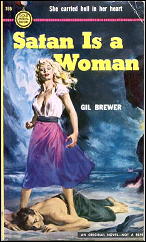
This is the perfect title for a Brewer novel and one that sums up the plot of so many Brewer outings.
Larry Cole’s a young man with difficulties: he runs a barely functioning beachfront bar on Florida’s Gulf Coast and his older brother is doing prison time for murder. Larry would like to find the money to get a high-powered lawyer who could spring his brother, but he doesn’t know how he’ll get the money.
Enter Joan Taylor, a sweet young thing with a yen for Larry and ideas of her own. Larry falls hard for Joan, but he’s confused by her behavior: stealing a wallet, stabbing a drifter in the throat and badgering Larry to burgle the nearby yacht club.
Lots of familiar Brewer set pieces here, including the extended disposal of an unwanted body, but also some well-wrought descriptions of the Florida milieu and an attractive if credulous protagonist in Larry.
An alert reader will figure out the twists in plenty of time, but the only weak spot is a denouement that relies too much on two characters verbalizing information they already know and have no need to say aloud.
Editorial Comment: A profile of Gil Brewer, the man and the author, can be found here on the primary M*F website. Written by Bill Pronzini, the piece definitely doesn’t pull any punches. If you haven’t read it already, you should.
Following the article, lower down on the same page, you can find a definitive bibliography for Gil Brewer, compiled by Lynn Monroe, a long time collector of Brewer’s work both under his own name and all his pseudonyms.
Wed 8 Jul 2009
Posted by Steve under
ReviewsNo Comments
OCTAVUS ROY COHEN – Romance in the First Degree.
Popular Library 88; no date stated [1946]. Hardcover edition: Macmillan, 1944.
The copyright date is 1943, which led me to a quick investigation and discovery that this very enjoyable detective novel first appeared in several installments as a four-part serial in Collier’s beginning on December 11th of that year.
I don’t collect Collier’s, even though I’m often tempted to, as there’s quite a bit of genre fiction to be found in the magazine, including both mysteries and westerns. But just as it is with The Saturday Evening Post, the oversized format makes it both awkward to read and to store, and so (so far) I’ve been able to resist.
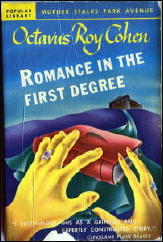
At any rate (sometimes I do digress) this book would come in Cohen’s later period His early period has been covered by Jon Breen in a short article he did on the primary M*F website a few years ago. If you follow the link, you will also find a comprehensive bibliography of Cohen’s crime fiction.
His first book appeared in 1917. The character he may be most remembered for was the African-American detective (and far from politically correct) Florian Slappey, but Jon found considerable merit in five books with David Carroll and Jim Hanvey as their primary sleuths.
Unfortunately, while I’ve meant to, I still haven’t read any of the ones Jon reported on yet. In fact, Romance in the First Degree is the first and only book by Cohen I remember reading, but based on the pleasure I found in doing so, you can believe it won’t be my last.
The opening premise is rather strange. Straight out of the army with a now-healed war wound (but with several missing toes), Jerry Anthony is hired by Warren Cameron, the man he used to work for, as an unofficial investigator to find out what kind of trouble Cameron’s son and new wife have somehow gotten themselves into. Since Jerry needs a place to stay, there is no better place than the Cameron apartment, where Alan, Linda and their baby are also living.
That’s not the unusual part. Cameron is also the father of Rita, the girl Jerry was supposed to marry, but who jilted him while he was overseas. Now engaged to someone else, she still lives at home, as does Sandy, the youngest daughter, who has been in love with Jerry since she was 16. (She is only a few years older than that now.)
It’s quite an arrangement. You might think that this is going to be one of those upper class mysteries common in 1940s mystery fiction, one involving the Park Avenue set, but No Sir or Ma’am, this is something else altogether. Following Alan and Linda one night to a desolate road house on Long Island, Jerry enters after they have left to find a dead man inside, at which moment he (Jerry) is clunked on the head.
From which point on, when he wakes up, the mob is involved — the dead man being a close associate of head mobster Leo North — and so is (hold on) the dead man’s girl friend; another mobster in love with the girl friend; a somewhat unsavory private eye named Dave Larric who somehow seems to know too much and somehow not enough; and a vivacious young Broadway star named Holly Hamilton.
While Jerry knows he did not do the killing, he is not too sure about Alan and Linda, but even though they are not talking, he figures that it is part of his job to protect them. How everyone else fits in, he has no idea. This is one of those cases that gets screwier and screwier one chapter to the next, nor in the meantime is there any shortage of death and skullduggery at almost any level you can think of.
Assisting Jerry in sorting through the facts and the clues is Rita’s younger sister Sandy, and if you don’t grasp onto the fact that some romantic (and only slightly sappy) fireworks are going to go off in that regard, you simply have not read enough fiction, young sir or lady. As for Rita, she is sort of steamed about this, and before I forget, here is Jerry’s description of the older sister when he first sees her for the first time in this country after their broken engagement (from page 21):
She was a full two inches taller than Sandy which made her tall enough to be called statuesque. She had a figure which couldn’t miss the same description What every woman wants, she had. If you were inclined to think along certain lines, you could call her voluptuous. I called her voluptuous. It was a nice thing to call her, and it fitted. She had provocative gray-green eyes and the richest golden hair that I ever saw.
She was in a dinner dress. She wore dinner dress every chance she got. She had at least two good reasons. […] She said, “Jerry! It’s good to see you again.”
She said it in a deep, throaty voice that sent tingles up and down my spine. She put both hands in mine. I almost upset my cocktail putting it down to make the most of this opportunity. […] Already I felt myself looping, just as I had in the old days. I even said “Nuts” to the still small voice that was warning me to watch my step.
Besides doing descriptions very well, Cohen has a good hand with dialogue as well, not only here, but throughout the book. Eventually, after Jerry has filled his eyes to the brim, a paragraph or two later his brain seems to take over again.
“Magnificent,” I said. “And it all belongs to someone else.”
I heard a chuckle. I couldn’t tell where it came from, but I suspected Sandy.
This hasn’t anything to do with the mystery, but byplay like this surely makes the tale Cohen tells go down more smoothly, not that it needs a whole lot of help. Surprisingly enough, all of the clues eventually fit and make a coherent whole out of what seemed to have been an impossible tangled mass of events and unknown motives and relationships. It is all choreographed so beautifully that…
Um. Perhaps I should not get carried away quite so enthusiastically. This is all relatively speaking, you understand. It is not Tchaikovsky I am talking about here, but perhaps you know what I mean without requiring me to finish the sentence above.
And let me not forget the private eye whose presence is both peripheral and essential to the story, Dave Larric. In terms of doing down-to-earth detective work, Jerry Anthony is only an amateur. Larric is the professional, straight from the pulp magazines. Although as a result he may be as stereotypical as they come in being so, I wonder (and would really like to know) if he ever appeared in any other of Cohen’s novels.
Wed 8 Jul 2009
REVIEWED BY WALTER ALBERT:
THEY DRIVE BY NIGHT. Warner Brothers-First National (UK), 1938. Emlyn Williams, Shorty Matthews, Ernest Thesiger, Anna Konstam, Allan Jeayes, Anthony Holles. Based on the book by James Curtis, who also wrote the screenplay. Director: Arthur B. Woods. Shown at Cinevent 19, Columbus OH, May 1987.
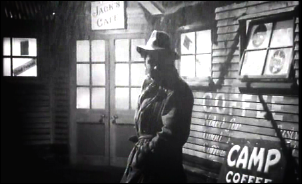
Film historian William Everson was very much in evidence at the convention, and his interest in the British mellers was responsible for the appearance of They Drive by Night on the program.
(Only the title made its way across the Atlantic. The American film of the same name was based on the A. I. Bezzerides novel Long Haul.)
In the first half of the film, Emlyn Williams is a recently released convict trying to evade the police, who believe he has murdered his former girl friend. Much of this is shot at night, in the rain, and is a taut chase in the Fritz Lang vein.
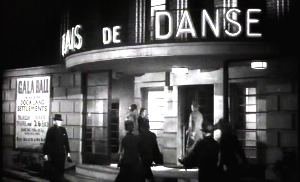
In the second half of the film, Williams and a new girl friend set a trap for the real “mad sex killer” (in Everson’s pithy description) who is played by Ernest Thesiger, the unforgettable Dr. Pretorious of James Whale’s Bride of Frankenstein.
The style clashes irreconcilably in the two sections of the film, but the casting and a nicely designed and staged scene in a period dance hall give the film some interest.
Wed 8 Jul 2009
REVIEWED BY GEOFF BRADLEY:
HE KILLS COPPERS. ITV (UK), 2008. Mel Raido, Liam Garrigan, Rafe Spall, Frank Taylor, Steven Robertson, Tim Woodward, Kelly Reilly. Based on the book by Jake Arnott. Director: Adrian Shergold.
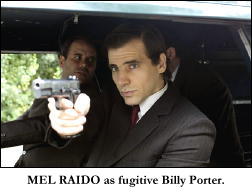
This was an adaptation of the book He Kills Coppers by Jake Arnott (Sceptre, 2001), and shown in three one-hour (no adverts) parts. It starts in 1966 during the euphoria of England winning the World Cup as two young policeman friends are making their way up the ranks.
When one routinely stops a car and is fatally shot along with two colleagues, his friend feels morally bound to pursue the killer, but although his accomplices are soon caught, he just escapes at the last minute.
Meanwhile a reporter takes on the investigation by wheedling his way into the life of the killer’s mother, and we see both his and the policeman’s investigations becoming closer.
The story moves forward to 1975 and another near thing before the denouement in 1980 as the two investigations finally converge and the killer, journalist and policemen come together.
This production drew rather favourable reviews from the British press (at least the bits I read) and, although much of it is rather on the bleak side — we see a lot of the sleaze, and most of the characters, including the police, are out for what they can get — I quite enjoyed it.
Tue 7 Jul 2009
TWO OF A KIND. Columbia Pictures, 1951. Edmond O’Brien, Lizabeth Scott, Terry Moore, Alexander Knox, Griff Barnett. Co-screenwriters: James Edward Grant, James Gunn, Lawrence Kimble. Director: Henry Levin.
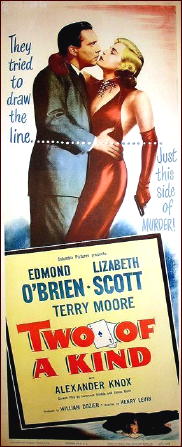
I can’t tell you why it took three writers to get this movie made, but I think the results show it. Or at least that was my opinion before I even knew who the screenwriters were, and how many. One of them is James Gunn, the hard-boiled mystery writer, by the way, not the science fiction writer James Gunn.
“Our” James Gunn has only one major entry in the Revised Crime Fiction IV, that being Deadlier Than the Male (Duell, 1942), which was later the basis of the movie Born to Kill, the one with Lawrence Tierney and Claire Trevor — you know the one.
In any case, this movie starts out like gangbusters, with the hauntingly beautiful Lizabeth Scott tracking down — for reasons unknown — an orphan born in the Chicago area by the name of Michael Farrell (Edmond O’Brien). It turns out that she has a pretty good swindle in mind, along with a steadily unscrupulous lawyer, played by Alexander Knox.
It turns out that a wealthy couple have been trying to find their son who’s been missing since he was three years old. Farrell might be a very good match, except for one small detail. The boy, if he’s still alive, would lack the tip of the little finger on his left hand.
Luckily they didn’t invent car doors for nothing.
But if you’re looking for a good solid noir movie, it’s downhill from here. But don’t get me wrong. If you’re looking for a good solid crime story, albeit a semi-softhearted one, built around an even better con game, complicated by an attempted murder and other good features, waste no time in looking further.
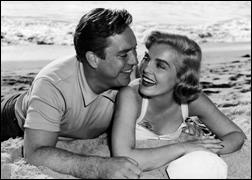
Edmond O’Brien’s easy mannerisms do him well in ingratiating himself with the missing boy’s parents, to the consternation of the lawyer, who also isn’t terribly pleased with how he also seems to get along very well with Brandy Kirby (the previously mentioned Lizabeth Scott).
Did I mention that it took all of Brandy Kirby’s feminine wiles to convince Farrell that he really didn’t need that tip of his finger? I should have. The money, running to a share of millions of dollars, wouldn’t have done it, not by itself alone. Being a law-obeying kind of guy myself, I don’t know whether or not I’d go for the combo (Brandy plus the money), but it would be an awfully close call.
And if you were wondering, the “two of a kind” in the title are Mike Farrell and Brandy Kirby. Terry Moore’s character comes into it for a while — she plays a semi-loopy teen-aged girl who falls for Farrell briefly herself — but this is Lizabeth Scott’s movie all the way, and when she wants something, look out.
Tue 7 Jul 2009
A 1001 MIDNIGHTS Review
by Newell Dunlap:

RUSSELL H. GREENAN – The Secret Life of Algernon Pendleton. New York: Random House, hardcover, 1973. Paperback reprint: Fawcett Crest, 1974. Film: Marano, 1997, as The Secret Life of Algernon.
Algernon Pendleton hears voices from unexpected sources — from philodendrons, for example. But his favorite voice source is Eulalia, a Worcester porcelain pitcher, and it is only with Eulalia that he carries on long conversations.
In fact, this is pretty much the essence of Algernon’s existence — chatting with his pitcher and leading a quiet, contemplative life in his large old house in Brookline, Massachusetts. Of course he has to earn money occasionally, and this he does by selling, one by one, his late grandfather’s collection of Egyptian artifacts (his grandfather was a famed and eccentric Egyptologist).
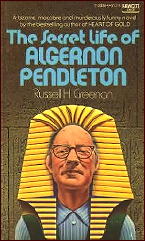
Still, Algernon is falling farther and farther into debt, and Eulalia fears the day may come when she, too, will be sold.
Then one summer, outsiders begin to force their way into Algernon’s normally quiet and isolated fife. First comes an old navy friend who has left his wife, has a suitcase full of money, and has seriously considered suicide.
Well, anything for a friend. At Eulalia’s urging, Algernon fulfills the suicide wish by blowing his friend’s brains out, helping himself to the money, and burying the body in a graveyard behind the house.
Alas, two other people discover this secret and attempt to blackmail Algernon. A Turkish antique dealer wants money; and a beautiful, but pushy, female archaeologist wants access to all the treasures and secrets of Algernon’s late grandfather. The antique dealer is killed in a struggle (and also buried in the graveyard).
And the beautiful archaeologist? Well, that would be telling.
Suffice it to say that her fate fits in perfectly with Algernon’s voices, with her obsession for Egyptian lore, and with the whole ambiance of the strange old house in Brookline.
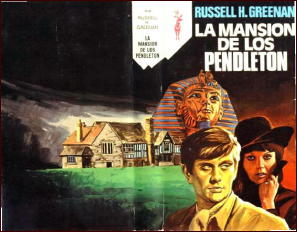
Like Russell Greenan’s other novels — the highly acclaimed It Happened in Boston? (1968), Nightmare (1970), The Queen of America (1972), Heart of Gold (1975), The Bric-a-Brac Man (1976), and Keepers (1979) — this is a most unusual book with elements of black humor and underplayed horror.
There is nothing else quite like a Greenan novel of suspense, as you’ll see if you read this one or any of the others.
———
Reprinted with permission from 1001 Midnights, edited by Bill Pronzini & Marcia Muller and published by The Battered Silicon Dispatch Box, 2007. Copyright © 1986, 2007 by the Pronzini-Muller Family Trust.
Tue 7 Jul 2009
Posted by Steve under
Reviews[4] Comments
A REVIEW BY DAVID L. VINEYARD:
RUSSELL H. GREENAN – It Happened in Boston? Random House, hardcover, 1969. Hardcover reprint: Literary Guild. Paperback reprint: Fawcett Crest, 1970.
“Lately I have come to feel that the pigeons are spying on me. What other explanation can there be?”
From anyone else that statement might seem a trifle paranoid, but from the hero of Russell Greenan’s novel, Alfred Omega (“That’s Irish isn’t it?”) it’s a bright ray of sanity. You see Alfred is a tad paranoid. Obsessive. Manic depressive. Vaguely psychotic. Alfred sits on a bench in Boston’s Public Garden and travels to other times via his ‘reveries,’ living and experiencing them. He sleeps under the bed. He writes down lists of all the restaurants out of the Boston phone book. He thinks God is out to get him and expects a visit from the Almighty at any moment.
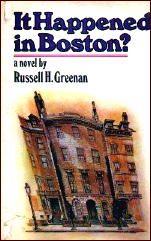
And the pigeons are spying on him.
For God.
Or the Devil.
Alfred also has a young friend Ralph who visits with him and brings his green frog hand puppet Sebastian with him. Sebastian can talk. Really talk. To Alfred anyway.
Alfred is reading a biography of a Polish magician named Casimir, or perhaps imagining he is reading it. With Alfred it can be hard to tell, but Alfred is taking notes.
Did I mention Alfred is also a brilliant artist, the only student of the Maestro who taught him all the techniques of line and brush stroke of the masters? Alfred can recreate any painting so perfectly no one can tell it isn’t original. It is original to Alfred. And those nasty old masters keep stealing credit for his work.
Greenan himself explains it all near the end of the book. I suppose you could call this a spoiler, so be alerted, but believe me there are still surprises to come. Alfred simply summarizes it all better than I can.
What was I given? A faithless, empty-headed, burglarious woman for a wife and a conscienceless, philandering English phlebotomist for a business agent. This precious pair of vipers started it all. These two adders divided my life, subtracted my happiness and multiplied my misfortunes. it was they who tipped me into the maelstrom of false marcheses, mercenary Bergamese whores, slippery Italian counts. witless German art experts, villainous Peruvian generals, paranoiac harpies, spiteful Russian cats, specious Polish wizards, spying pigeons, nosy janitors, and ambitious cops. My closest friend was driven to hang himself by my closest enemy. Somehow through cunning insinuation, and obscure machinations, I was inveigled into murdering six poor strangers and the kind and generous Leo Faber — in the name of humanity! I have been slandered, lied to, cuckolded, robbed and persecuted. My lovely reveries have been snatched from my head and replaced by nightmares. The fruit of my years of labor — enough beauty to stock a museum — has been carried off to a foreign land, while one of my masterpieces has been plagiarized by a man dead five hundred years. I’ve been thwarted by an angel, duped by God and stalked by the Devil. Who would believe such things could happen in Boston?
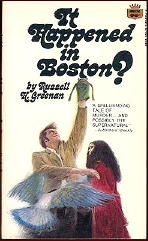
It’s a little hard to describe this magical, fantastical, mysterious, horrific, macabre, psychological thriller. If Fredric Brown and Cornell Woolrich had collaborated with Kafka on a novel that was then developed as a screenplay by Woody Allen, S. J. Perlman, Buck Henry, and Raymond Chandler for a film collaboration by Alfred Hitchcock and Frank Capra… No, that still wouldn’t do it. Might be a hell of a film, but still not quite this one. Maybe if they remade Here Comes Mr. Jordan as film noir re imagined by James M. Cain and Dorothy Parker …
Well, you see the problem.
Greenan’s other novels include Nightmare, A Can of Worms, and The Secret Life of Algernon Pendleton, but It Happened in Boston? is his masterpiece.
I don’t suppose it is for everyone, but I think anyone will be charmed by it and caught in its spell. It is what they mean when they call a book one of a kind. It is a work of genius — and madness. It’s sexy, funny, scary, smart, magical, frightening, and has what well may be the most unexpected ending in the history of the genre — hell, in the history of fiction.
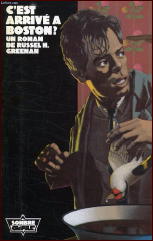
And it happened in Boston.
Or did it?
Believe me, when you’ve finished you won’t know either. And you won’t care. You’ll have read It Happened in Boston? and you’ll never be the same. Even if you want to be.
But you’ll have to excuse me. The cats tell me the pigeons are spying on me. Not that you can trust the cats…
Editorial Comment: In case anyone is wondering, yes, this book is included in the Revised Crime Fiction IV, by Allen J. Hubin. Trust me. I looked.
Tue 7 Jul 2009
REVIEWED BY DAN STUMPF:
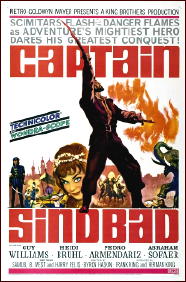
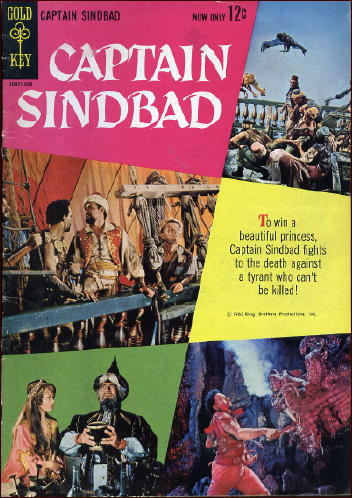
CAPTAIN SINDBAD. MGM-Germany, 1963, aka Kapitän Sindbad. Guy Williams, Heidi Brühl, Pedro Armendariz, Abraham Sofaer, Bernie Hamilton, Helmuth Schneider, Henry Brandon, Guy Doleman. Co-screenwriters: Ian McLellan Hunter and Guy Endore; director: Byron Haskin.
Like Son of Sinbad [reviewed here] Captain Sindbad is in Technicolor too, but it’s a ruddy, comic book color: cheap, gaudy, and enjoyably eye-watering. The sets are lavish but cheesy-looking, costumes likewise, and everything seems pointed at an ostentatious show of threadbare splendor, with swordfights, shipwrecks, riots and magic stuff tumbling out like cut-rate toys from a shabby bag.
Simply splendid.
Guy Wiliams, in between Zorro and Lost in Space, stars as Sindbad, pitted against evil poo-bah Pedro Armendariz, an actor who appeared in real movies, like Three Godfathers and From Russia with Love.
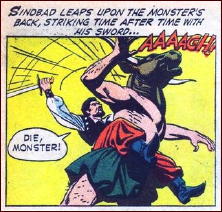
Here though, he just sits around in a chintzy palace with vaulted purple ceilings, blood red carpets and golden dragons all over (just the way you or I would decorate a palace if money and taste were no object) and hatches evil schemes with the kind of hammy relish I hadn’t seen since Tod Slaughter.
Okay, it’s kind of a catch-penny thing, but as written by Guy Endore, and directed by Byron Haskin, Captain Sindbad has a sleazy charm I just can’t resist. There’s always something happening on screen, and the special effects, though never convincing, are always imaginative and even kind of poetic at times.
I particularly liked how the bad guy can’t be killed because he keeps his heart locked up in a tower an enchanted forest, guarded by a giant hand — I guess we’ve all known someone like that, haven’t we? It’s storybook stuff presented with childlike gusto by people old enough to know better and a film no eight-year-old should miss.
Mon 6 Jul 2009
REVIEWED BY WALTER ALBERT:
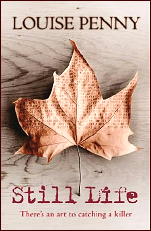
LOUISE PENNY – Still Life. St. Martin’s Press, hardcover, July 2006; paperback reprint, May 2007. First published in Canada & the UK: Headline, hc & pb, 2005.
A Canadian rural mystery, with Chief Inspector Armand Gamache of the Quebec Sûreté and his team called in to investigate the suspicious death of Jane Neal, a reclusive resident of Three Pines, felled by an arrow.
The strength of the novel is in its portrait of the town and its colorful inhabitants, but Gamache and his team are also nicely portrayed, with Gamache’s sharply observant eye seldom missing a significant detail in the convoluted relationships that make the investigation difficult to pursue. A promising debut for the series.
Bibliographic data: The Chief Inspector Gamache mysteries.
1. Still Life.
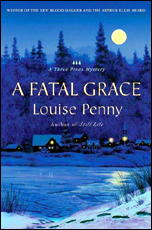
2. Dead Cold (UK/Canada), A Fatal Grace (US).
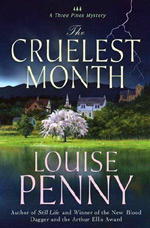
3. The Cruelest Month.
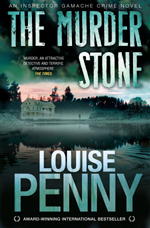
4. The Murder Stone (UK/Canada), A Rule Against Murder (US).
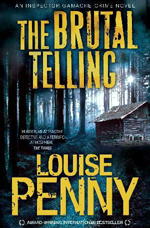
5. The Brutal Telling.
Mon 6 Jul 2009
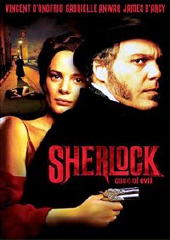
SHERLOCK: CASE OF EVIL. USA Network, made for TV, 2002. UK title: Sherlock. James D’Arcy (Sherlock Holmes), Roger Morlidge (Dr. Watson), Gabrielle Anwar (Rebecca Doyle), Vincent D’Onofrio (Professor Moriarty), Nicholas Gecks (Inspector Lestrade), Richard E. Grant (Mycroft Holmes). Based on the characters created by Arthur Conan Doyle. Director: Graham Theakston.
I’m not sure whether this was originally a British production or not, but from the names of the people involved, actors and otherwise, I suspect that it was. What I am sure of is that a lot of the people who commented on this film on IMDB really hated it — really really hated it — and for the usual and obvious reasons.

I’m also not sure if this was meant to be the first of the series — and if it was, it hasn’t turned out that way — but it very easily could have, as the movie takes us back to Holmes’ earliest days as a consulting detective, before he had met Dr. Watson (a police autopsy surgeon in this film) but not before Holmes was aware of Professor Moriarty and his dastardly schemes against polite society.
I read somewhere that Holmes is supposed to be 28 in this movie. Unfortunately James D’Arcy appears to be closer to 18, hardly old enough to handle the liquor, narcotics and the wild Victorian women who flock to his doorstep when they read about his latest exploit in the daily news. (They call them groupies today, or at least they used to in the 1970s. Maybe I’m dating myself.)
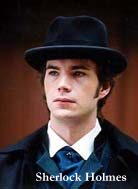
Holmes is also something of a publicity hound, an aspect of his personality that turns Dr. Watson off when first they meet. And if by now you haven’t realized why the howls of protest went up so quickly after this movie was released, you can hardly consider yourself a true believing Sherlock Holmes fan.
But if I’m evidence of the fact, I think you can be a lifelong Sherlock Holmes fan and still enjoy this movie. I didn’t mind the alterations to Holmes the character, and besides, who knows what he might have been like in his younger days (though the bedroom scene with the two young ladies removing their chemises or whatever was obviously designed to tweak somebody’s noses).
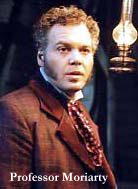
And by movie’s end, Holmes is definitely chastened and perhaps has “come of age” a bit.
I rather didn’t care for all of the guns that were used in the raid by the police on Moriarty’s dope-processing warehouse, and while there were several nicely done attempts to show Holmes’ deductive abilities — the scene with Mycroft is a small gem — there is, sad to say, no great attempt by the end of the movie to be little more than just another action flick.
The atmosphere and general ambiance is nicely done, though. One twist of the plot that came early on is easily spotted, but I shall restrain myself from even beginning to describe it, so as not to keep you from having the same pleasure, otherwise I surprised myself by warming more and more to the characters as the movie went on. Who knows. You may, too.
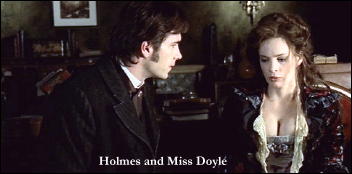
PostScript: I seem to have ended this review with leaving myself room to show you one more photo. Miss Doyle is a client that both gets herself into trouble and helps to get Sherlock out of some trouble that he gets himself into. She’s an important part of the story, and I really can’t leave her out:
« Previous Page — Next Page »