Since late last week we’ve been packing up Jon’s apartment for his forthcoming move to the DC area (Bethesda, MD, to be exact). He’s the recent law school graduate, as you may recall.

It’s taken up way too much time already, it’s been hot, and I’m going to stop fooling myself that I can come home and start blogging until it’s done. The movers are coming Wednesday and he leaves on Thursday. By Friday things may be back to normal.

But don’t expect to see anything new here until then, except maybe comments from me on recent posts. Sorry about that, but I’ll be back when I can!

— Steve

REVIEWED BY WALTER ALBERT:         


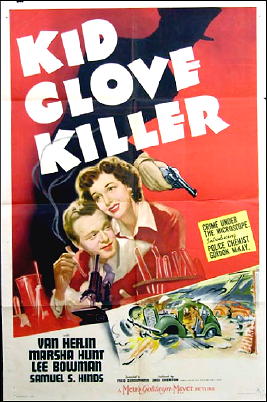
KID GLOVE KILLER. MGM, 1942. Van Heflin, Marsha Hunt, Lee Bowman, Cliff Clark, Eddie Quillan, John Litel, Cathy Lewis. Director: Fred Zinneman. Shown at Cinecon 27, Hollywood CA, September 1993.

   Marsha Hunt, who co-starred with Van Heflin and Lee Bowman in this crackerjack MGM programmer, was sitting a couple of rows in front of me for the screening. She looked about forty when she turned around to acknowledge the audience applause and she gave the best interview I heard at the convention, answering questions precisely, fully and intelligently.

   In Kid Glove Killer she played the assistant of a crime-lab doctor (Van Heflin), with her attentive suitor and eventual chief suspect in a bombing-murder played by Lee Bowman, perennial lose-the-girl second lead in romantic comedies.

   This was Fred Zinneman’s first directorial stint and Hunt described how he won over the entire crew on the first day of the shooting with a short speech in which he welcomed suggestions from his experienced cast and crew.

   Zinneman, of course, went on to a distinguished career, as did Van Heflin, while Hunt, when her movie career faded in the early fifties, moved on to TV and Broadway. She was at Cinecon to sign copies of her new book, Marsha Hunt’s Hollywood. She seemed genuinely touched by the audience’s appreciation and a nice person into the bargain.

   Luckily, the film was another sleeper that everybody seemed to enjoy. All that wonderful MGM polish lavished on a B-movie script. Quite a tribute to the old studio system.


KID GLOVE KILLER Marsha Hunt

IT IS PURELY MY OPINION
Reviews by L. J. Roberts


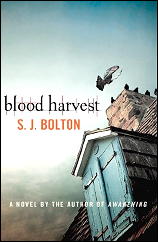
S. J. BOLTON – Blood Harvest. Bantam Press, UK, hardcover/softcover, 2010. US edition: St. Martin’s Press, hardcover, 2010.

Genre:   Suspense. Leading characters:  Rev. Harry Laycock / Dr. Evi Oliver / ensemble; standalone (3rd book). Setting:   England.

S. J. BOLTON

First Sentence:   “She’s been watching us for a while now.”

   Reverend Harry Laycock has come to his new parish which includes Heptoncough in the Yorkshire Pennines. Here there is an old church, a very old church a village which still carries out the old traditions and where young girls have disappeared or died.

   One of the girls died in a house fire, but her mother, Gillian, never accepted her death and constantly roams the moors at night. Psychiatrist Evi Oliver is trying to help her put her life back together.

   Tom Fletcher and family have moved to the village having bought the only new house built in many years. It was built on the old Church’s land, next to the graveyard. They all learn that events of the past are still part of the present.

   Although I really liked Ms. Bolton’s first two books, this one knocked my socks off. Everything about it was so well done, it’s hard to know where to start.

   Even from the page before the prologue, I was captivated. I am not a particular fan of prologues, but this one really worked. I was introduced to a number of the significant characters who immediately jumped off the page and made me want to know more about them.

   I am also not usually a fan of ensemble casts. Again, this worked. Although Harry, the antithesis of a stuffy vicar and for whom I would have provided a different surname, and Evi, the physically impaired, intelligent and independent psychiatrist, are the pivotal characters, all characters were alive and their interactions realistic.

   Dialogue is such an important element of a story. Ms. Bolton has a skill with dialogue that echoes in cadence the speech of the characters. As well as establishing a strong sense of place, she incorporates the history and traditions of the area.

   Combined with all these ingredients, what caused me to read this 421 page book in eight straight hours was the author’s voice and the plot. The first half of the book is an amazingly skillful balance of humor… “I haven’t had this much success with a woman since I got drunk at my cousin’s wedding and threw up over the maid of honour.” … and underlying, delightfully creepy menace.

   There is a real sense of “things that go bump in the night” which made me happy I was reading the book during the day.

   The second half of the book moved to police and forensic investigation, and a race-against-time fear, while the climax was filled with an increasingly ratcheted tension and surprises right up to the very end.

   One observation is that Ms. Bolton does have a penchant for her female protagonists to be somehow physically impaired. While the overcoming of the particular impairment shows the character’s strength and resolve, it can also become formulaic or even cliché over time.

   However, as this is a general observation and not a criticism of this particular book, it does not impact my rating at all. In this case, it greatly added to the suspense. This really was an exceptional, “wow” book and one I shan’t soon forget. I cannot wait for Ms. Bolton’s next book

Rating:   Excellent.

      Novels by S(HARON) J. BOLTON —

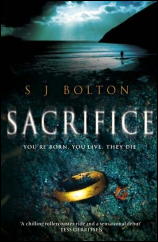
1. Sacrifice (2008)

S. J. BOLTON

2. Awakening (2009)
3. Blood Harvest (2010)

A TV Review by MIKE TOONEY:


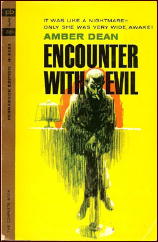
“Last Seen Wearing Blue Jeans.” An episode of The Alfred Hitchcock Hour (Season 1, Episode 28). First air date: 19 April 1963. Michael Wilding, Anna Lee, Katherine Crawford, Randy Boone, James Anderson, Jesse Jacobs, Eve McVeagh, Russ Conway. Teleplay: Lou Rambeau, based on the novel Encounter with Evil, by Amber Dean (1961). Director: Alan Crosland, Jr.

AMBER DEAN Encounter with Evil

    David and Roberta Saunders (Michael Wilding, Anna Lee) are touring America by station wagon with their teenage daughter Loren (Katherine Crawford). They make a late-night stop at a small diner on the Arizona-Mexican border to eat; after the meal a very sleepy Loren returns to the wagon and continues slumbering in the back.

    Some time later she wakes up, just in time to witness a murder. To her horror, she quickly realizes that she has crawled into the wrong car and been driven across the border without the killers being aware of her — but now they are. All she has to do is stay alive …..

   There’s something appealing about having Sleeping Beauty exposing an international criminal conspiracy — even if it’s unintentionally — and seeing Prince Charming drive a jeep. But as for this beauty’s detectival skills, Nancy Drew she ain’t.

   Michael Wilding’s criminous credits include Stage Fright (1950, with Hitchcock); Trent’s Last Case (1952, as one of the very few actors ever to play Philip Trent in films and TV); The Naked Edge (1961); and one appearance each on Burke’s Law (1963), The Girl from U.N.C.L.E. (1966), and Mannix (1968).

   Anna Lee appeared in The Four Just Men (1939), Hangmen Also Die! (1943), Bedlam (1946), Prison Warden (1949), Whatever Happened to Baby Jane? (1962), In Like Flint (1967), and the long-running soap opera General Hospital. According to IMDb, she was also the goddaughter of Arthur Conan Doyle.

   Randy Boone was a regular on the TV westerns The Virginian (1963-66) and Cimarron Strip (1967-68), the latter featuring an episode, “Knife in the Darkness,” written by Harlan Ellison in which Jack the Ripper is loose in Cimarron.

   â€œLast Seen Wearing Blue Jeans” is available on Hulu here.

Editorial Comment:   Anna Lee also appeared in King Solomon’s Mines, the 1937 version, reviewed here by me not so very long ago.

[UPDATE] 08-09-10.   I neglected to mention (which is a euphemism for saying I forgot) that a review I wrote of Snipe Hunt, another one of Amber Dean’s mystery novels, was posted on this blog way back here, along with a complete listing of her “Abbie Harris” series.

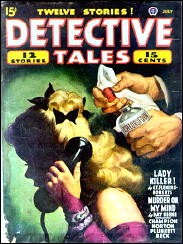
LADY CHASER. Producers Releasing Corporation, 1946. Robert Lowery, Ann Savage, Inez Cooper, Frank Ferguson. Based on the story “Lady Killer,” by G. T. Fleming-Roberts (Detective Tales, July 1945). Director: Sam Newfield.

G. T. FLEMING-ROBERTS

   It’s surprising, when you stop to think about it, that more movies weren’t based on stories that appeared in the pulp magazines, or at least those of the B-movie variety, either mysteries or westerns and even love stories.

   Both genres are based on quick action and minimal characterization, they’d be a natural for each other, and probably there are more adaptations than I’m thinking of, speaking off the top of head as I usually do when I sit down to write a review.

   A quick synopsis of Lady Chaser ought to be what I really begin with, seeing that there isn’t one on IMDB, nor any comments either, at the present time. The movie begins with two women writing letters across from each other in a room designed for that purpose in a downtown department store. One’s a blackmailer (Ann Savage), the other (Inez Cooper) is writing a letter to her fiancé (Robert Lowery).

   The latter has an uncle who’s opposed to the marriage, the former is, unfortunately, in over her head. The latter has a headache; the former gives her an aspirin. The latter gives the aspirin, unused, to her uncle, who dies. The aspirin was poisoned.

   You can figure out what happened, can’t you? And so can the fiancé, eventually, only he can’t prove anything, nor can he can convince the dunderheaded head of homicide (Ralph Dunn) that there’s anything to her story, and with the lack of a better one, she’s quickly convicted of the crime. Amateur detective work is always better than that of the police, in stories like this.

   There are a surprising number of twists that occur in Lady Chaser, especially when you consider that it’s only 58 minutes long. The problem is that to get to the twists there are some awfully creaky plot devices that have to be swallowed whole, or if not, there’s no other alternative but to throw up your hands and say Enough.

   I’d also have tried to conceal the killer’s identity a little while longer, but neither can I think of a way to avoid it, so we’ll have to call that a draw. My recommendation, if this movie should ever come your way, is to simply sit back and enjoy it, warts and all.

NOTES:   Previously reviewed on this blog was The Limping Man, by Frank Rawlings, a pen name of G. T. Fleming-Roberts.

   For a complete bibliography of Fleming-Roberts, including several articles and reviews, check out this page on the primary Mystery*File website.

Reviewed by DAVID L. VINEYARD:         


BILL PRONZINI – The Hidden. Walker & Co., hardcover, November 2010. (Available for pre-order online.)
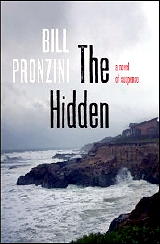
BILL PRONZINI The Hidden

   No one currently writing orchestrates the elements of the suspense novel with half the finesse of Bill Pronzini. If that were all — and it would be enough — he would be our best suspense novelist, but he also gets inside of the head of the characters in his novels and gets them into our heads, all done with simple elegance, and without the sturm und drang of many lesser writers.

   We don’t just identify with his characters, we experience with them. We get to know them; innocents, and not so innocents, madmen, lovers, and killers, all drawn simply with a few deft strokes that none the less present fully developed characters — people we recognize and know, and sometimes are.

   Jay and Shelby Macklin are a young couple in crisis, emotional and financial crisis. Jay is emotionally remote and withdrawn (“All his life he had been a closed book, not just to her and others, but to himself too.”), Shelby is hurt and has fought for their marriage about as long as she is willing to (“Twelve years of marriage to him had sucked the youth out of her.”).

   The two of them are taking a Christmas vacation at a friend’s vacation home on the rugged Northern California coast.

   Their timing could be better. Since midsummer the coast has been haunted by the so called Coast Line Killer, a murderer whose motives are obscure and who seems to strike randomly. For a number of reasons this holiday is a less than wise choice for the troubled couple, not the least Shelby’s nyctaphobia, her fear of the dark:

    … she’d never quite lost her fear of the dark.

    She had it as far back as she could remember. Not of ordinary darkness, the light-tinged kind where you had some limited vision of objects or shapes. Of blackness so complete you couldn’t see anything at all, the kind a blind person must feel …

   Pronzini has already introduced us to the killer, and his motive, to protect the rugged coastline from any and all intruders, so we know ahead of time what sets him off, and wait breathlessly for the young couple to cross his deadly path. And even here Pronzini rings in changes and surprises that both fill our expectations and take us in new directions.

   His killer is no monster, no sex-obsessed cartoonish serial killer leaving a trail of extravagant sado-masochistic crimes behind him, but instead a quiet man become reluctant and rather tired avenger of the vulnerable coast. It is because his crimes seem so mundane and so reasoned that he is frightening.

   He is the stuff of headlines, not nightmares. He is frightening for being familiar, for being someone we might know, might see in our daily lives, might not notice until it is too late:

    Clouds shifted away from the moon, and the wind and the slow-breaking waves lit up with a kind of iridescent white glow. A long yellow white streak appeared on the ocean’s surface, extending out over some of the offshore rocks where the gulls nested, giving their limed surface a patch-painted look. He paused to take in the view. Nice night. He liked nights like this, quiet, peaceful, empty, as if he had the sea and the scalloped shoreline all to himself.

   As has happened in past Pronzini novels the setting, the Northern California coast where Pronzini lives, is also a character in the novel as is the weather, in this case a brutal winter storm.

   And with those elements set in motion he then begins to add the twists and refinements. Not far from where Jay and Shelby are staying two other couples are also vacationing in a sort of domestic hell that makes the Macklin’s problems look simple.

   Human nature, the weather, too great passion and passion dying, a madman, human weakness, and human fears — these are the ingredients Pronzini stirs into his mix, having already warned us with his choice of epigraphs from Georges Bataille and Friedrich Nietzsche as well as his title that it is not the obvious dangers that should concern us, but those things we hide from others and from ourselves.

   Theme, plot, setting, and character are one, a grand design, and a unity, not merely disparate entities thrown together.

   The monsters are not in the outer dark, but the inner dark we create within ourselves. Shelby has more to fear from that inner dark than anything lurking on the outside, even the Coast Line Killer:

    The night seemed alive with shrieks, whistles, fluttery moans.

   His Coast Line Killer is, much like the great storm that spawns the breathless climax of the novel, only a force that brings those hidden things to the surface. Not all the violence, nor all the crime in the novel arises from the disturbed man’s actions though like the storm his presence and his actions bring things to a head. There are other currents and other crimes that will test Jay and Shelby to their limits, and in Jay’s case an enemy more implacable and deadly than any serial killer, and begin the process of healing — or end their lives.

   There are no easy answers in Pronzini’s novels, whether suspense or his tales of his private detective Nameless. Heroism can come down to putting one foot in front of another because you have to, to showing simple courage in face of madness, to overcoming a phobia, a childhood trauma, ourselves, to discovering how much you love another, and to just doing the right thing. Survival can hang on those small things as well. Sometimes heroism and love comes down to saving each other:

    He was just a man who’d finally stepped up, finally proved to himself — and, if he was lucky, to her — that he wasn’t a failure or loser after all.

   The Hidden is a fairly short novel in these days of bloated best sellers, tightly written and tightly plotted, but never mechanical or obvious. It is strongly cinematic, but the pleasures, as always with Pronzini, are in the writing and not merely his visual sense.

   His characters are recognizable people, not merely pawns to the suspense element. There is always a sense that they exist beyond the confines of the novel, that they are people and not merely characters.

   You will reach the end of the book emotionally drained and with nerves on edge, but like the master that he is, Pronzini manages to let you off the hook without ever quite letting you forget just how tight the pinch was.

   It is not a book you will close and walk away from. Things linger, not just the frights, but also those moments of recognition when he cuts close enough to the bone for most of us to recognize ourselves and the hidden within us.

   Bill Pronzini doesn’t need much introduction here. He is a six time Edgar nominee, three time winner of the Shamus award, winner of the Grand Master award from the Mystery Writers of America, creator of the Nameless series of hard boiled mysteries, anthologist, genre historian and critic, western novelist, and has collaborated with numerous writers including Barry Malzberg and wife mystery novelist Marcia Muller.

   But to put this book in perspective, it would be a major book and a fine suspense novel from any writer. It is perhaps the best tribute we can pay to a writer as accomplished as Bill Pronzini to simply say that if he had no history as a writer and had written nothing else, this book would mark him as one of the finest voices in the suspense field today.

Such consistent quality may sometimes lead us to take a writer for granted. We should not. A new book by Bill Pronzini should be a reason for celebration. This one certainly is.
A REVIEW BY RAY O’LEARY:
   

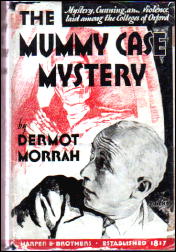
DERMOT MORRAH – The Mummy Case Mystery. Paperback reprint: Perennial Library, 1988. Hardcover editions: Harper & Brothers, US, 1933; Faber & Faber, UK, as The Mummy Case, 1933. Also published in the US under the British title: Garland, hardcover, 1976.

DERMOT MORRAH The Mummy Case Mystery

   It’s the end of term at Beaufort College, Oxford, and Professor Benchley, the Egyptologist, has acquired a mummy from his arch-rival Professor Bonoff, a Russian with whom he has been carrying on an academic feud. The feud has apparently ended with Professor Benchley conceding defeat, but he has plans to sell the mummy for twice as much as he paid for it.

   However, he turns down the offer of a wealthy American collector whom he had invited to lunch that afternoon. That night, while the Commemoration Ball is going on, a fire breaks out in Benchley’s rooms and, when it’s put out, the remains of one man are found.

   A verdict of accidental death is brought in by the coroner’s jury but two of the younger Professors Sargent (law) and Considine (the Assyriologist) have their doubts — there should have been two burnt bodies found: Benchley’s and that of the mummy. So the two begin to investigate.

   This is an entertaining light-hearted example of the Golden Age detective story, with some pleasant humorous touches thrown in. I read this when it first was issued in paperback, although I probably figured it out then as I did now because it uses a variation of a plot situation I’ve encountered in several whodunits and for which I have a rule that, if I stated it, would be giving away the solution.

Bibliographic Note:   This is the author’s only mystery novel. It is included in Victor Berch’s checklist of Harper’s Sealed Mystery Series.

   Also note that Mike Grost comments on this novel on his Classic Mystery and Detection website. Check it out here.

THE BACKWARD REVIEWER
William F. Deeck


E. LOUISE CUSHING

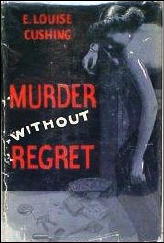
E. LOUISE CUSHING – Murder Without Regret. Arcadia House, hardcover, 1954.

   During a party after the reading of a will, one of the guests presumably commits suicide. Barbara Hillier finds the corpse and aids Inspector MacKay of the Montreal police in the investigation of an undoubted murder later.

   Striving as always to say something good about any novel, I can report that this one has very large type and a great deal of space between the lines. Thus, it’s only about a 30-minute waste of time.

— From The MYSTERY FANcier, Vol. 11, No. 2, Spring 1989.


    Bibliographic Data:   [Taken from the Revised Crime Fiction IV, by Allen J. Hubin.]

CUSHING, E. LOUISE. Pseudonym of Mabel Louise Dawson. Inspector Richard MacKay appears in all four books below.

       Murder’s No Picnic (n.) Arcadia House, 1953.
       Murder Without Regret (n.) Arcadia House, 1954.
       Blood on My Rug (n.) Arcadia House, 1956.
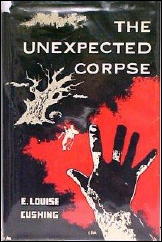
       The Unexpected Corpse (n.) Arcadia House, 1957.

E. LOUISE CUSHING

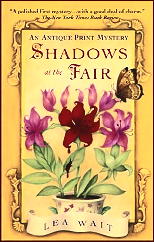
LEA WAIT – Shadows at the Fair. Pocket, paperback reprint; 1st printing, July 2003. Hardcover edition: Scribner, July 2002.

LEA WAIT Maggie Summer

   Since Lea Wait herself is a long-time antique dealer, one specializing in prints, it comes as little surprise that Maggie Summer, her detective heroine in this, the first in a series, is one also. An antique dealer, that is, specializing in prints.

   And that’s the part of the story that’s the most fun to read, even though most of Maggie’s discussion of her stock in trade and other shop talk with her customers is quite irrelevant to the mystery — the death of another dealer who’d set up at same Rensselaer Antique Show as Maggie.

   In fact, both customers and dealers are beautifully portrayed in all of their foibles and eccentricities, of which (from my own personal experience) customers and dealers have many. To put it mildly. Also right on in terms of characterization is Ben, the mildly retarded nephew assisting one of Maggie’s friends, who’s also set up at the show.

   Which brings me to the part I didn’t care for so very much. Ben is accused of the murder — which allows the show to go on, with (as the police say) the killer caught. A fatal flaw for many a cozy: there’s far too much laughing and joking and kidding around when murder’s been done — with poor Ben sitting there alone in the lockup.

   I was also ready to add another source of dissatisfaction, that of predictability, but I have to tell you that while the first two-thirds of the murder investigation falls into that particular category, I did not see the ending coming. My socks are still on, but it opened my eyes a little wider.

   And so. With all of the pluses and minuses added in, subtracted off and weighed up against each other, the bottom line? An average sort of mystery, but with a nudge or two in the right direction, one that could have been improved upon immensely. There’s promise here, but apart from the antique dealer background, the rest is fairly uneven, at best.

— July 2003


     The Maggie Summers “Antique Print Mysteries” series

Shadows At the Fair (2002)
Shadows On the Coast of Maine (2003)
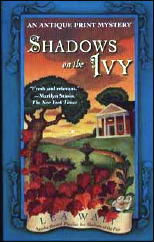
Shadows On the Ivy (2004)

LEA WAIT Maggie Summer

Shadows At the Spring Show (2005)

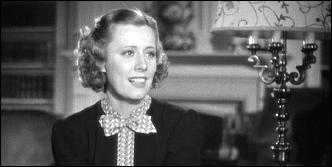
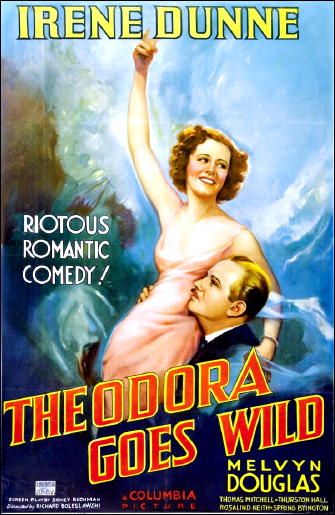
THEODORA GOES WILD. Columbia Pictures, 1936. Irene Dunne, Melvyn Douglas, Thomas Mitchell, Thurston Hall, Elisabeth Risdon, Margaret McWade, Spring Byington. Director: Richard Boleslawski.

   Humor is a funny thing. This is the lead-off movie in a boxed set of Screwball Comedies (Volume Two), and not only did I never laugh, but there are elements in this film that I actively disliked, which seldom happens. (I do screen the movies I choose to watch ahead of time.)

THEODORA GOES WILD

   Well, OK, maybe I did smile once or twice.

   The theme here is small-town holier-than-thou gossips and self-selected morality leaders – the small town being Lynnfield, somewhere in New England, where the local literary society is up in arms with the publisher of the local newspaper (Thomas Mitchell), who’s started to serialize the latest racy romance novel that’s sweeping the country.

   Little do the members of the local literary society know that the author, Caroline Adams, is one of their own: Theodora Lynn, who lives with her two aunts in Lynnfield (and yes, the town is named after their family), and who teaches Sunday school classes and plays the organ at church.

THEODORA GOES WILD

   In constant fear of her secret identity being revealed, Theodora (who of course is played by Irene Dunne) goes to New York to meet her publisher (Thurston Hall) to make him keep his promise to stay absolutely mum.

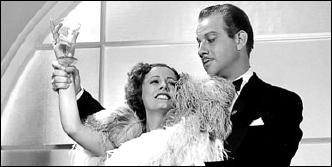
   The comedy potential is there, all right, as I’m sure you can see, but the man she meets, the artist who designed the risqué cover of her book, Michael Grant (Melvyn Douglas), is such an ill-mannered oaf, an utter boor if not an outright cad, it is impossible to understand what she sees in him.

THEODORA GOES WILD

   Of course she reacts to his constant taunts by going on an all-out nightclub drinking spree with him, even to the extent of ending up in his apartment to wrap up the evening. (Nothing much happens, but I imagine in 1936, the entire audience was holding their breath.)

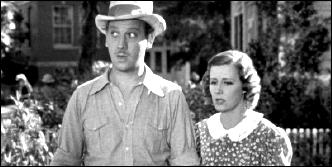
   Fleeing back to Lynnville the next morning, Theodora is tracked down by her not-so-secret admirer, who manages to make himself even more dislikable, if that’s possible, but of course in the movies, anything’s possible, isn’t it?

   When the tables turn on Michael Grant, though, and do they ever, that’s when the training wheels come off, and Theodore lives up to the title of the movie – does she go wild? yes! – and it’s Michael Grant who faces …

THEODORA GOES WILD

   I won’t tell you what he faces, but it was nice to see him in the predicament he finds himself in. Nice, but not particularly funny.

   If you were to ask me, which I guess you are, since you’ve read this far, I liked Irene Dunne’s character a lot more when she was playing the innocent Theodora (although a Theodorea with a secret) a lot more than I did the wild Theodora, with a vast array of designer dresses and hairdos that do not especially flatter her.

   Rather than wild, she looked to me more like a small child playing dress-up, but what had to pass for wild on the screen in the mid-1930s was a lot more innocent than what you can see on your TV screen today.

   Irene Dunne was nominated for an Oscar in the role, and from all accounts, I’m in the minority in my opinion of this movie, and I thought you should know that too.

THEODORA GOES WILD

« Previous PageNext Page »