Today’s Tribune crossword puzzle had some interesting challenges, and not only because Saturday’s offering is always the toughest of the week.

   The Tribune puzzles are not quite [41 DOWN] with those in the New York Times, but they often come close. Today’s was especially enjoyable, with just the right degree of cleverness and difficulty.

      53 ACROSS: Series starter. ANS. EpisodeI

      40 DOWN: 1947 signature Cab Calloway musical. ANS. HiDeHo.

   One that would have had me stumped completely unless I hadn’t had all of the words coming down was 38 ACROSS: Rodent yielding the fur nutria.

   Not my particular expertise, I guess. I had to check with Google when I was done to be sure the answer was even a word. It was.

   Here are a few more for which I won’t give answers.

      49 ACROSS: Author said to have influenced Hitchcock. [Three letters.]

      51 ACROSS: Street boss. [Ten letters.]

      57 ACROSS: Holmesian tool. [Eight letters.]

   You probably won’t get this last one unless you have some words coming down. Here’s what I had when it finally came to me:

              HA_D_ _N_

   41 DOWN. At the same level (with). ANS. OnaPar.

   It was just over a month ago — on September 18th, to be precise — that I announced that Part 19 of the Addenda to the Revised Crime Fiction IV, by Allen J. Hubin, was online.

   But new data has continued to flow in — it never seems to even slow down — and Part 20 was uploaded this morning. In WordPerfect format, this installment was a mere 29 pages long.

   Most of the information consists of added (or corrected) years of birth and/or death, but a sizable chunk of what otherwise is new you will already have seen (I hope) in Victor Berch’s checklist of Tip Top Detective Tales. See the previous post on this blog.

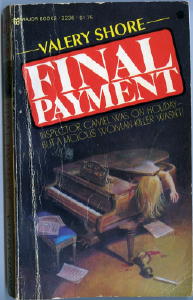
Valery Shore

   Also in Part 20, but rather hidden so that you might not notice it without my pointing it out, is that we have recently learned that the mystery novel, Final Payment, by “Valery Shore,” reviewed here several months ago, was not the sole work of Lon Viser, as until now has always been assumed.

   A comment left by Lon Viser’s son, and confirmed by a separate email from the wife of another son, apparently sent independently of each other, says that the book was written by — well, I’ll allow Ed Viser to tell it:

    “I can certainly remember when Yvonne Beltzer, Rhoda Luczon (my mother) and my Dad, Lon Viser wrote this book. The name Valery Shore came from the magazine my parents started Valley & Shore Magazine, later named by the owners Valley Magazine (San Fernando Valley), a sort of Sunset Magazine for the L.A. suburbs. He also wrote several books under other pen names.”

   You’ll have to go to the main Mystery*File website to find the checklist, I’m sorry to say, but on the other hand, it’s only a link away. Just click on the one provided.

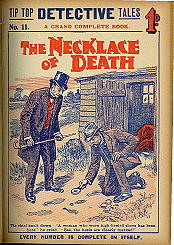
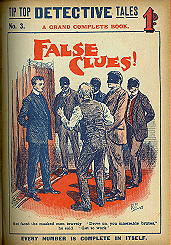
   Here’s Victor’s introduction, along with a cover image or two —

   Tip Top Detective Tales was one of the Aldine Publishing Company’s many library series produced to capture the fancy of the youth of Great Britain. This particular one ran from 1910 through 1912 when it morphed into just Tip Top Tales, produced to include stories of adventure, as well as those of criminal content. With one exception, all of the novels included in the series were published anonymously.

   For a short history of the trials and tribulations of the Aldine Publishing Company, which was founded by Charles Perry Brown (1834-1916), see the excellent article by John Springhall, “Disseminating impure literature: the ‘penny dreadful’ publishing business since 1860” in ECONOMIC HISTORY REVIEW, XLVII, 3 (1994), especially pages 578-584.

         Tip Top Detective Tales

      Tip Top Detective Tales

   Last week on his blog, Pulpetti, Juri Nummelin discussed the career of Gold Medal paperback writer Frank Castle, prompted by his (Juri’s) discovery of one of Castle’s books that was published in Finland but never in this country.

   This turns out, as Juri explains, not to have been an uncommon event. Several other American authors apparently had some of their books published in Finnish but never in English, including Dean Owen, Bruce Cassiday and Robert Sidney Bowen. Here’s the cover of the Castle book, the title of which, roughly translated, means “The Sowers of the Doom.”

Frank Castle: Sowers of Doom

   If you’re interested, Juri does the obliging thing and translates the first few paragraphs back into English.

   The post prompted several comments about Castle’s career, and just a few minutes ago, I chipped in with the following:

   Not much seems to be known about Frank Castle. You and the other commenters seem to have covered almost everything he did, unless you count his role as The Punisher for Marvel Comics beginning sometime around 1974. But maybe that was a different Frank Castle. And like the comic book guy, maybe our Frank Castle wasn’t his real name either.

   For his mystery fiction, here’s what appears in Al Hubin’s Crime Fiction IV:

   FRANK CASTLE. Born in New Mexico; graduate of University of Oklahoma; magazine and book writer. Pseudonym: Steve Thurman.
      Move Along, Stranger (n.) Gold Medal 1954
      Dead–and Kicking (n.) Gold Medal 1956 [California]

Dead and Kicking

      The Violent Hours (n.) Gold Medal 1956 [Los Angeles, CA]

The Violent Hours

      Lovely and Lethal (n.) Gold Medal 1957 [California]

Lovely and Lethal

      Murder in Red (n.) Gold Medal 1957 [New Mexico]

Murder in Red

      Vengeance Under Law (n.) Gold Medal 1957 [New Mexico; Past]
      Hawaiian Eye (n.) Dell 1962 [Hawaii]

Murder in Red

   STEVE THURMAN
      Night After Night (n.) Monarch 1959 [Ship]

Steve Thurman

      “Mad Dog” Coll (n.) Monarch 1961 [New York City, NY; 1932] Novelization of film: Columbia, 1961.

      I haven’t put together a list of the westerns Castle wrote under both names, but at a quick glance, he may have written more of those than he did crime novels. (And I’ve only realized this just now, but there’s at least one book overlap between his western novels and the crime fiction that’s already been listed.)

      I’ve read some of his Gold Medals, but since that was when they first came out, I couldn’t tell you anything about them. I do remember a few of the covers, though. (See above.)

The problem, as I expected, was a video card, and a new one is on its way to me now. At the moment I have a limited, rather primitive window to the Internet, but at least I’m back online again.

It took me two calls to Dell before they decided I might be right. I say “might” because the proof is in the doing — when the new card is finally installed, and it works.

It was actually three calls to Dell, if you count the second fellow. I disagreed with his suggested remedy of disconnecting all of the connections to the back of the tower, and I asked to speak to someone else. Sure, he said, no problem.

Dial tone.

Is it permissible to say that I hate computers?

Just a little bit?

— Steve

but I’m having severe computer problems. I think it’s the monitor, but I’m no expert. Everything’s backed up, but I’m limited to only a few minutes at the computer at a time. I’ll be calling Dell tonight.

Steve

   I’m off to Michigan tomorrow, and the town of Cadillac in particular, about 100 miles north of Grand Rapids, and 50 miles south of Traverse City. That’s the town where I grew up. My sister lives there now, and my brother and his family come over from London, Ontario. Monday’s the Canadian Thanksgiving, so we celebrate that as well as Columbus Day. We always have a great time.

   I’ll be heading home late on Monday. I’m sorry to miss Gary Lovisi’s paperback show in New York City this weekend, but he just happened to pick the wrong date. (Just kidding, Gary!)

— Steve

   The death of Denny Martin Flinn, a rather unique contributor to the realm of detective fiction, does not seem to have been widely noted in the world of mystery fandom. The fact appears in Part 19 of the Addenda of the Revised Crime Fiction IV, which I’m working on now. Otherwise only Jiro Kimura’s Gumshoe Site seems to have mentioned it.

   Obituaries have appeared in several entertainment-oriented news sources, however, including Variety and Broadway World. A man of talent in many fields, Mr. Flynn died of complications of cancer on August 24th of this year. He was 59.

   Here are his credits in CFIV, by Allen J. Hubin, slightly updated and amended. I’ll get back to the books in a minute.

      FLINN, DENNY MARTIN (1947- 2007)
           San Francisco Kills (Bantam, 1991, pb)  [Spencer Holmes; San Francisco, CA]
           Killer Finish (Bantam, 1991, pb)  [Spencer Holmes; San Francisco, CA]

   But first, here are some of Mr. Flinn’s non-mystery writing accomplishments. For more information on any of these, you may follow the links above.

   ● He performed on Broadway in Sugar and the revivals of Pal Joey and the Pearl Bailey company of Hello, Dolly!

   ● He choreographed Charles Strouse’s off-Broadway musical Six and he restaged Sugar for its West Coast premiere.

   ● As a performer, he appeared in the national companies of Fiddler on the Roof, starring Jan Peerce and Theodore Bikel as well as two-and-a-half years in one of the national tours of A Chorus Line.

   ● Flinn wrote and directed the musical Groucho, starring Lewis J. Stadlen, which played off-Broadway and toured the country for two years.

   ● As a writer, his first book was What They Did for Love, the story of the making of the Broadway musical A Chorus Line.

   ● He co-authored with Nicholas Meyer the screenplay for Star Trek VI: The Undiscovered Country.

      THE MYSTERY NOVELS:

San Francisco Kills. Bantam, pb, January 1991.

San Francisco Kills

      From the front cover:    “He bears the family name and has a talent for detection. Just call him Holmes … Spencer Holmes.”

      From the back cover:   … If there be any here present who knows just cause why they may not be lawfully be joined in marriage, I require him now make it known …

   Following the priest’s request, a shot rang out and the groom fell dead.

   What kind of killer was clever enough to get away with murder in front of hundreds of witnesses? That is just the sort of question that appeals to Spencer Holmes, a San Francisco detective who has inherited a fascination for foul play, a talent for deduction, good looks, and hoards of money from his illustrious grandfather, the immortal super sleuth Sherlock Holmes.

   In a case as complicated as they come, Spencer Holmes, assisted by his inscrutable companion, Sowhat Dihje, must use his formidable intelligence to follow a faint trail that leads from the mansions of the well-to-do into the not-so-distant past – to ferret out a remakable affair of friendship, love … and murder.

Killer Finish. Bantam, pb, August 1991.

Killer Finish

   From the front cover:   “When it comes to solving crimes, he was born to it. … He’s Spencer Holmes, San Francisco sleuth.”

   From the back cover:    “It does appear that the Great Gandolfo has suffered an irreversible mistake in an otherwise well-conducted act!”

   And in this case, appearances were not deceiving. The Great Gandolfo was run through with his own sword, and it didn’t take a Sherlock Holmes to see that the erstwhile magician had died on stage – literally.

   What it did take was Spencer Holmes, Sherlock’s equally talented grandson, who happened to be attending Gandolfo’s final performance. And what the master sleuth, along with his sidekick, Sowhat Dihje, finds upon investigation, is a twisted trail of colorful suspects, grand illusions, missing persons, and voices from the dead. And that is only the beginning. For in the city by the bay, the mixture of magic and murder is potent – so potent that even the most pedigreed of detectives will be astounded by a … KILLER FINISH.

   In a short author’s biography on the final page of Killer Finish, it was announced that Mr. Flinn was working on a third novel, one called Lady Killer. For whatever reason, it was never published.

   Searching the Internet, it appears that Irene Adler is the lady in question, if you are asking the one I think you are, and on another site it is stated that “Spencer’s mansion in Frisco has a Nero Wolfe Room, which perhaps hints at his parentage, since it has already been well-established that Wolfe is Sherlock Holmes’ son.”

   On page 14 of San Francisco Kills, the plaque attached to the door of Holmes’ mansion door reads:

SPENCER HOLMES
Consulting Detective
2210 Baker Street

which I believe entitles him to be called a Private Detective. One who does not do divorce or “keyhole” work, but one who takes only the cases that intrigue him the most.

   One other site briefly describes the books are humorous pastiches. Here, for example, from page 194 of the same book cited above, is the following passage. Spencer Holmes is speaking to a fellow who has just finished a game of tennis:

    “How was your game today?” Spencer inquired.

    “Fine. And yours?”

    “Afoot.”

    “I don’t think I understand.”

    “I’m sorry. It is a colloquial expression. Before your time, I think.”

    “Ah.”

  Steve:

Cheap Thrills

   Goodness, it’s been a long time since we’ve encountered each other. I’ll be at Gary Lovisi’s doings next Sunday but you don’t seem to attend them any more. A very handsome new edition of Cheap Thrills came out earlier this year, with color illustrations and reprints of many of the actual letters I gathered when first doing the book many long years ago. My next book is due out in October, entitled Good Girl Art and covering that comic book genre from Sheena to the present.

   As to your blog about the Phantom. Here’s a correction on pennames. I am not now nor never have been Marshall Macao. This attribution is, I think, due to the fact that some chap wrote some sleazy kung fu books and a listmaker mixed them up with the two novelizations of the old Kung Fu TV show I did. Macao was once a Portuguese possession and I am half Portuguese, but that’s the only connection.

   The source of the Frank S. Shawn penname, which I have oft explained to crowds of uninterested fans of mine, is this — I took the name of my wife, Frances and the initial of my younger son, Steffan, and the first name of my older son Sean, and fashioned an alias.

   I actually worked with Falk on these, dropped into his Park Ave. South apartment once, talked to him on the phone quite a bit. The novels were all based on old strip continuities and King Features would send me proofs of whatever strips were being adapted. Of course, with the novels I had to add quite a bit in the way of characters and subplots. And the books were much better written.

Good Girl Art

   Bruce Cassiday also did three of Avon’s Flash Gordon novels back then. I wrote the first three but got tired of dealing with the fellow at King Features, who was a lintpicker (as we used to say in the old days). He complained several times that I was ending chapters in the middle of the page and thus robbing them of several half pages of copy that they were paying for.

   I got the Phantom job originally because Falk, who didn’t keep up with things, had offered it to Alfred Bester, a friend of mine. Bester had ghosted Falk’s strip for a while during WWII and gone on to write The Demolished Man, etc. Knowing nothing of this, Falk assumed he’d be available for the assignment.

   Working with Falk was no problem. One of the few things he told me not to do was mention the color of the Phantom’s costume. At the time it was purple in America, but red and brown in other countries.

   Keep in touch.

Best,

      Ron Goulart


>> Alas, I won’t be at Gary’s paperback show once again this year. It’s next Sunday, but I go to Michigan every Columbus Day weekend to visit my sister, and my brother comes over from London Ontario for a short family get-together. Something had to give, and Gary’s show will go on, but without me, I’m sorry to say.

   Thanks for your comments on working with Lee Falk, though, and I’ll pass the word along to Al Hubin to delete your Marshall Macao reference. Question: You did two of the four novelizations of the Kung Fu TV series. None of the books (as by Howard Lee) are in Crime Fiction IV. I remember the series, and in fact have the first season on DVD. Would you say that the books as written have enough crime content that they should be included? My general impression is that they do.

   To everyone who’s planning their Christmas and holiday present list, from spouses, kids, parents, or simply to give yourself, there are a couple of big hints subtly hidden on this page.

— Steve

   I was “processing” a box of hero paperbacks the other day, and along with the Batman and Dick Tracy books (recently covered here) was a nearly complete set of the Avon adventures of comic strip hero, The Phantom. Nominally by Lee Falk, also the creator of Mandrake the Magician, identifying who the true authors really were is a complicated matter, and it has not been well-stated in Al Hubin’s Crime Fiction IV.

   Using the books themselves as a guide, plus information found here and there on the Internet, here’s my attempt to untangle the true ownership of each of the books. Al’s been out of town this week, so my facts, as I’ve put them forth, are still subject to his approval. If you have any information to the contrary for any of the statements below, let me know. I’ve no qualms about correcting errors!

FALK, LEE (HARRISON). 1911-1999. Correction of year of birth. Born Leon Harrison Gross, he took his surname as a young man from the middle name of his stepfather, Albert Falk Epstein. American playwright and theatrical director/producer; best known as the creator of two comic strip heroes, The Phantom and Mandrake the Magician. The following is a complete rewriting of his entry in the (Revised) Crime Fiction IV. Several of the books in the series of Avon paperback originals were written by Falk. The rest were written by other authors; often these authors are named, but with the statement that the books were based on Falk’s original stories. SC in all titles: The Phantom.

      _The Assassins. Written by Carson Bingham, a pseudonym of Bruce Cassiday, qq.v. Avon, pb, 1975.
      The Curse of the Two-Headed Bull. Credited to Carson Bingham, q.v., on the title page, but in an Author’s Note, Falk states that the book was written by him. The attribution to Bingham was a publisher’s error. Avon, pb, 1975.
      _The Goggle-Eyed Pirates. Ghost-written by Ron Goulart, q.v. Avon, pb, 1974. [The name Frank S. Shawn does not appear on the title page.]
      _The Golden Circle. Written by Frank S. Shaw [sic], a pseudonym of Ron Goulart, qq.v. Avon, pb, 1973. Due to a publisher’s error, Goulart’s pen name for the series, Frank S. Shawn, was misspelled.
      _The Hydra Monster. Written by Frank S. Shawn, a pseudonym of Ron Goulart, qq.v. Avon, pb, 1973.
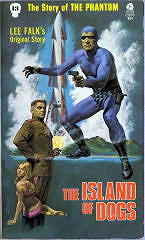
_      The Island of Dogs. Written by Warren Shanahan, q.v. Avon, pb, 1975.
      Killer’s Town. Avon, pb, 1973.
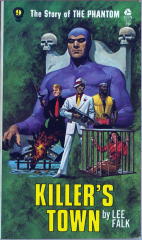
Killer's Town (Lee Falk)

      The Mysterious Ambassador. Avon, pb, 1973.
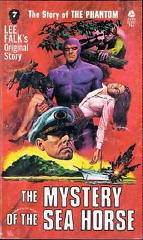
      _The Mystery of the Sea Horse. Written by Frank S. Shawn, a pseudonym of Ron Goulart, qq.v. Avon, pb, 1973.
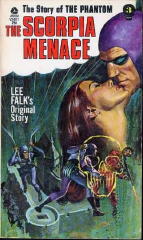
      _The Scorpia Menace. (Corrected spelling.) Written by Basil Copper, q.v. Avon, pb, 1972.
      _The Slave Market of Mucar. Written by Basil Copper, q.v. Avon, pb, 1972.
      The Story of the Phantom. Avon, pb, 1972.
      _The Swamp Rats. Written by Frank S. Shawn, a pseudonym of Ron Goulart, qq.v. Avon, pb, 1974.
      The Vampires and the Witch. Avon, pb, 1974.
      _The Veiled Lady. Written by Frank S. Shawn, a pseudonym of Ron Goulart, qq.v. Avon, pb, 1973.

CASSIDAY, BRUCE. 1920-2005. Add year of death. Pulp writer and editor, radio scriptwriter, and author of many works of crime fiction under his own name and several pseudonyms: Carson Bingham, q.v., Mary Anne Drew, C. K. Fong, Annie Laurie McAllister, Annie Laurie McMurdie & Michael Stratford.

BINGHAM, CARSON. Pseudonym of Bruce Cassiday, 1920-2005, q.v. To three crime novels written by the author under this pen name in the (Revised) Crime Fiction IV, add the following:

      The Assassins. Avon, pb, 1975. Note: This is a book in “The Phantom” series, created by Lee Falk, q.v.
      _The Curse of the Two-Headed Bull. Avon, pb, 1975. A book in “The Phantom” series. Credited to Carson Bingham on the title page, but in an Author’s Note, Lee Falk states that the book was written by him. The attribution to Bingham was a publisher’s error.

COPPER, BASIL. 1924- . Among other works of crime fiction included in the (Revised) Crime Fiction IV are six collections of Solar Pons stories, a character created by August Derleth, and 52 book-length adventures of private eye Mike Faraday. The two entries below are newly added here to the author’s own entry.

      The Scorpia Menace. (Corrected spelling.) Avon, pb, 1972. Note: This is a book in “The Phantom” series, created by Lee Falk, q.v.

The Scorpia Menace

      The Slave Market of Mucar. Avon, pb, 1972. Note: This is a book in “The Phantom” series, created by Lee Falk, q.v.

GOULART, RON(ALD JOSEPH). 1933- . Mystery & science fiction writer as well as a historian of pulps, comic books & comic strips. Add pseudonym: Frank S. Shawn, q.v. Other pseudonyms & house names: Josephine Kains, Chad Calhoun, Marshall Macao, Ian R. Jamieson, Kenneth Robeson & William Shatner. As Shawn, the author of several books in “The Phantom” series created by Lee Falk, q.v.

SHAWN, FRANK S. Add as a pseudonym of Ron(ald Joseph) Goulart, 1933- , q.v. Other pseudonyms & house names: Josephine Kains, Chad Calhoun, Marshall Macao, Ian R. Jamieson, Kenneth Robeson & William Shatner. As Shawn, the author of several books in “The Phantom” series created by Lee Falk, q.v. These are listed below.

      The Goggle-Eyed Pirates. Avon, pb, 1974. [Note: The name Frank S. Shawn does not appear on the title page.]
      The Golden Circle. Avon, pb, 1973. Due to a publisher’s error, the name of the author was misspelled as Frank S. Shaw.
      The Hydra Monster. Avon, pb, 1973.
      The Mystery of the Sea Horse. Avon, pb, 1973.

Mystery of the Sea Horse

      The Swamp Rats. Avon, pb, 1974.
      The Veiled Lady. Avon, pb, 1973.

SHANAHAN, WARREN. Author of one book in “The Phantom” series created by Lee Falk, q.v. The title below, the only one in the author’s entry in the (Revised) Crime Fiction IV, is now directly attributed to him.

      The Island of Dogs. Avon, pb, 1975.

Island of Dogs (The Phantom)


OPEN QUESTION: It is unknown who Warren Shanahan was. He contributed to at least two combat-oriented collections of true stories published by Pyramid (One Against the Enemy, 1963; and Medal of Honor, 1967), but I’ve found no other writing credits for him.

[UPDATE] Later this same evening. On a hunch, I checked out Michael Cook’s Index to the Digest Mystery Magazines, and there was Warren J. Shanahan, author of five stories that appeared in Guilty (2), Trapped (2), and Manhunt (1), all in the 1950s.
« Previous PageNext Page »