“Lady of the Ark” is a song from Kyle Craft’s debut album Dolls of the Highland (Sub Pop, 2016).

RON GOULART – The Tijuana Bible. St. Martin’s Press, hardcover, 1989. No paperback edition.

   Picture this — a cartoonist working alone at night; a knock at the window; a dying man with a message; a sap on the head; a beautiful blonde hiding in the closet — then poof! — they both disappear. And then a map, the key to a treasure, well over $2,000,000 …

   … worth of old comic books. My mouth waters. (*) This is a funny book, of the laugh-out-loud variety. It’s no more than lightweight entertainment, I admit, but it’s expertly done. (And it can’t really be that easy to do, or it’d be done more often, and a lot of authors try.)

(*) Confession time. It was my secret ambition as a kid — and I’ve never told anyone this before — to own a copy of every comic book ever published. (My second ambition was to grow up to own a newsstand.) I couldn’t afford it at the time, and the way things are, I could afford it even less today. (I don’t own a newsstand either.)

— Reprinted and slightly revised from Mystery*File #20, March 1990.
REVIEWED BY DAVID VINEYARD:
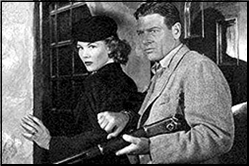
   

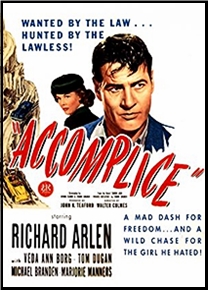
ACCOMPLICE. PRC, 1946. Richard Arlen, Veda Ann Borg, Tom Dugan, Francis Ford, Herbert Rawlinson. Screenplay Irving Elman, Frank Gruber based on the latter’s novel Simon Lash, Private Detective. Directed by Walter Colmes.

   A complex plot, sharp dialogue, a smart story based on a classic hardboiled novel, and a well-staged shootout in the California desert at a castle turned dude ranch run by crooked Francis Ford are all on the plus side for this fast moving mystery film.

   So why isn’t it better?

   The directors penchant for flat two shots on cheap sets doesn’t help, but even that isn’t the real problem.

   The real problem is the cast.

   This kind of hard-boiled mystery depends on delivery, snappy tongue-in-cheek delivery by actors with on screen charisma and style.
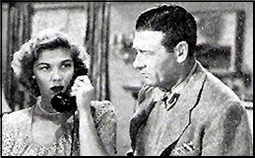
   That is neither Richard Arlen or Veda Ann Borg, who deliver their lines with all the skill and depth of a high school adaptation of Arsenic and Old Lace.

   Book-loving Simon Lash would rather try to prove Billy the Kid was a backshooter than take a case, especially a divorce case, but when he is broke and Joyce Marlow, nee Mrs. James Bonniwell shows up, the girl who left him at the altar ten years earlier when he was a promising lawyer, shows up on his doorstep, his partner Eddie (Tom Dugan) convinces him to see her.

   Simon suspects Joyce is looking for evidence for a divorce case against her banker hubby, but she convinces him her husband has lost his memory and gone missing. But when his search leads to a love nest the husband is keeping with another woman, Simon thinks he has been taken by Joyce again — until she receives a call while he is confronting her that her husband has been found with his head blown off in the desert.

   From then on things move at a pace until the finale when Simon is taken prisoner at the above mentioned desert castle and escapes to shoot it out with the bad guys while unfolding the complex and well planned plot.
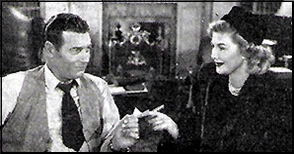
   Sounds great, and on the written page the dialogue by Gruber from his novel has the punch and snap that is proper to the best private eye fare on the screen. The only problem is the delivery which could gives pancakes a run for which is flatter.

   There isn’t a moment of charm, a twinkle of eye, or a playful seductive moment in the film. It’s in the script, but Arlen and Borg deliver their lines (and no one else does any better, including the unfunny comic relief) like they were reading them off a prompter for the first time.

   You know you are in trouble when you find yourself longing for Tom Conway or Warner Baxter from the Falcon and Crime Doctor films.

   Had this been a Michael Shayne entry with Lloyd Nolan or a Falcon or even Charlie Chan film it would be a classic, but alas it is a film which stars Richard Arlen and Veda Ann Borg and the biggest collection of stiffs collecting a pay check in the history of film.

   Even a master like Frank Gruber can’t overcome amateur night at the Bijou.
   

   I sold this on eBay and mailed it out today:


   I sold this on Amazon and mailed it out today:


   To two different buyers. Sometimes the world is a very spooky place.

MAN WITH TWO LIVES. Monogram, 1942. Edward Norris, Marlo Dwyer, Eleanor Lawson, Frederick Burton, Addison Richards, Edward Keane, Hugh Sothern, Tom Seidel. Director: Phil Rosen.

   The last time I began one of these online reviews by talking about the “no name” cast, I was quickly made fun of, for not recognizing any of players. So, having not yet learned my lesson, how many of the names above, not including Phil Rosen, have you heard of?

   No matter. Low budget movie or not, there was only one of the members of the cast who didn’t seem to me to be up for the part he was playing. As for the movie itself, it begins in pure sci-fi mode, with a doctor seen surrounded by all kinds of electronic gadgets and bubbling test tubes set up in the lab he has put together in his back bedroom. After years of research, it turns out that he has brought a dead dog’s heart back to life.

   Does it work on humans? He doesn’t know, but when the son of a friend is killed in an automobile accident, he is persuaded to try. By pure coincidence the attempt is made at the stroke of midnight, exactly the same time as when the switch is pulled on a notorious killer in the death house at a nearby state penitentiary.

   The audience catches on far more quickly than the friends and relatives of the young man who is the subject of the experiment. He awakes having amnesia but soon begins to find himself drawn to the dead mob leader’s headquarters. Surprisingly quickly he becomes the new head of the gang.

   Even worse, he spurns the girl he was engaged to marry to take up with knockout beauty who was the dead gangster’s moll. There is eventually some talk of the “transmigration of the soul” to explain all this scientifically, but even if it’s all hooey at the heart of it, this is a fun movie to watch.

   This in spite of what definitely qualifies as a “dumb ending.” And no names in the cast or not.

REVIEWED BY BARRY GARDNER:


ROB KANTNER – Concrete Hero. Ben Perkins #9. Harper, paperback original, 1994

   This is Kantner’s third Perkins book for Harper after doing six for Bantam, all paperback originals.

   Ben donates himself to a charity auction at the urging of his ex-love and the mother of his young daughter, and os “won” by an Ann Arbor lady who wants him to look into the death of her husband. The man, a copywriter for an ad agency, was found dead in his office of what appeared to be an auto-erotic asphyxiation.

   Ben pokes around halfheartedly,wanting to be done with it, but the case won’t go away. The dead man participated in a porno computer bulletin board that specialized in digitized photos, and it appears that too much good, unclean fun may have led to murder, Meanwhile, an out-of-town friend shows up in bad shape, and takes up with one of Ben’s best friends, and he’s got to worry about that, too.

   Like most series PI novels, or most crime series of any kind for that matter, the Perkins books pretty much follow their own internal pattern each time. Perkins gets a case, pokes around, spends some pages on personal relationships, gets some help from his cop friends, decides to handle things himself, and brings it all to a violent climax, usually with extreme danger and injury to himself.

   Nothing wrong with that if you like how it’s done, and I’ve liked how Kantner did it in the past. I still do, some, but not as much as before. Some of the characterizations are good and I like his storytelling, but I’m getting weary of the state cop who’s more and more willing to act like Perkins’ sidekick, and I didn’t think Kantner spent nearly enough time here setting up his villains.

   It’s decent, but he can do and has done better.

— Reprinted from Ah Sweet Mysteries #16, November 1994.


       The Ben Perkins series

1. The Back-Door Man (1986)

2. The Harder They Hit (1987)
3. Dirty Work (1988)
4. Hell’s Only Half Full (1989)
5. Made in Detroit (1990)

6. The Thousand Yard Stare (1991)
7. The Quick and the Dead (1992)
8. The Red, White and Blues (1993)
9. Concrete Hero (1994)
10. Trouble is What I Do (story collection, 2005)
11. Final Fling (2007)

RAY HOGAN – The Vengeance Gun. Ace Double 67580, paperback original; 1st printing, July 1973. Published back-to-back with Powdersmoke Partners, by L. L. Foreman. Thorndike Press, hardcover, 1993.

   Take another look at the title. As you may or may not recall, I reviewed a western movie with much the same basic story line as this one. The movie was entitled Panhandle, and you can read my comments here. In both cases the leading protagonist has a mission, that of avenging the shooting death of his brother.

   Rod Cameron played John Sands in the movie. In the book at hand, the hero is a young fellow named Tom Rademacher. He’s been on the trail of his brother’s killer for five years, riding from town to town for all that time, but never quite finding him.

   But when hits the range where a gent named Joe Keck wants to take over, he finds himself siding with a girl and her brother who are the last holdouts against Keck and his gang. If this sounds familiar, it is.

   One difference between the book and the movie, is that after five years on the trail, Tom is starting to have doubts. In the movie, the death of John Sands’ brother has just happened. It is no wonder that he can’t be distracted from his mission, as was pointed out in the review and the comments that followed.

   I liked the book more, though. I identify with heroes who have doubts. I find that there’s more to the story if they do. It’s not to say that The Vengeance Gun is great literature. It isn’t. It ends far too quickly and abruptly, for example. At only 111 pages log, it’s over before you know it. You expect happy endings in westerns, but this one’s far too easy.

\

REVIEWED BY DAN STUMPF:


MATTHEW HEAD – The Smell of Money. Simon & Shuster, hardcover, 1943. Mercury Mystery #96, paperback, 1946. Dell #219, mapback edition, 1948[?]. Avon G1229, paperback, 1964.

   One of those terse, semi-existential, tough-but-sensitive mysteries for which I will always be a sucker.

   As soon as Head, in the first-person of Bill Echlen, started to describe his odyssey from Harvard to Greenwich Village, getting by on odd jobs, I felt myself transported back across time and space to the lean and hungry days of my own higher (?!) education, when the exigencies of making a living and chasing girls competed with what I seriously thought of as Learning and Artistic Expression. I began wondering when was the last time I skipped a meal to buy a book, and reminiscing about the sunny days and moonlit nights I spent in that musty, monolithic Library, poring over many a quaint and curious volume of…. but back to the review.

   Besides evoking that uniquely College frame of mind, Matthew Head also writes in an easy, conversational style, something of an urbane, Huckleberry-Finished effect, sometimes going back to mention something he forgot, and sometimes skipping ahead to make a point — more like an extended letter than a novel.

   I particularly liked his fussiness about describing colors and his easy knowledge of artists and their styles. It has that casual precision that Art Students really use — at least the ones I dated, anyway. I imagine Head must have found it natural, since in real life he was art critic John Canaday (played by Terrence Stamp in the movie Big Eyes).

   The story itself is of Murder, Love, and Retribution, and it’s a fine job, with an unerring feel for Drama. Perhaps too unerring; I was able to spot the killer, not so much because of clues dropped — although there are plenty — but because that character’s guilt would give more dramatic impact to the story than would anyone else’s.

   I should make mention of Head’s flair for terse characterization and of the neat way he manages to create a closed circle of suspects without seeming stagey. But for me, the major charms of this book are its relaxed, nostalgic tone and the gentle way it moves to tragedy.

   “…. But the real thing that will bother you, if you’re easily bothered, is that all this sinning wasn’t on a majestic scale, like a Greek tragedy, but was all a little bit shoddy. I’m sorry I can’t keep it from sounding that way, but if it’s grandeur you’re after, it’s Sophocles you want, not me … I can’t purge anybody with pity and terror, all I can do is set down the way we talked and the things that happened. But for me the summer was some such kind of purging, and I can’t think of anybody in or out of Greek tragedy I feel such pity for as I did for….”

CAROLINE WHEAT “Crime Scene.” First appeared in Sisters in Crime, edited by Marilyn Wallace, paperback original, May 1989. Reprinted in Carolyn Wheat’s story collection Tales Out of School, Crippen & Landru, November 2000.

   In its original appearance this story is only eight pages long, but what it does in those eight pages is show what a good writer can do in only a limited number of words.

   When a young police officer named Toni Ramirez is the first on the scene of a gory murder scene in an apartment building, her first instinct is to keep her composure at all costs while the lab guys are joking around while examining the body as part of their obviously usual routine. But when she sees the supervising officer wiping away his tears, she finds that she can no longer hold back her own.

   Telling her the story of his own first crime scene one in which he reacted much the same way, the older man helps clear the younger woman’s head enough that she is able to make some deductions from the evidence right there at the crime scene, and the killer is caught. Ellery Queen could not have done better!

   This is a story that you will have do some hunting in order to track it down. The reason I wanted to tell you about it, though, is to let you know that every once in a while you can find a detective story in which the heart — honestly and somehow not mawkishly — and the brain are of equal value in solving a case. It’s well told, as well.


[ADDED LATER]   Carolyn Wheat is a former criminal defense attorney who as an author is best known for her series of five books about Cass Jameson, a Brooklyn-based night court lawyer. According to her website, “[t]wo of the books were nominated for Edgar awards. She is also the author of numerous short stories which have won her an Agatha, an Anthony, a Shamus, and a Macavity award.”

« Previous PageNext Page »