Jazz singer Janice Borla often refers to herself as a “vocal instrumentalist.†To help understand why, listen to this John Coltrane song included on her 1996 album Lunar Octave.
HELEN REILLY – Not Me, Inspector. Random House, hardcover, 1959. Ace Double G-531, paperback, 1963 (packaged with the author’s The Canvas Dagger). Macfadden-Bartell, paperback, 1971.
Puzzle plots were beginning to make their way out in the late 50s, as far as mystery fiction was concerned, but the authors who’d been writing them since the 30s and 40s were still holding on. Helen Reilly is an author who fits the bill. By 1959, she’d been writing mysteries since 1930 (The Thirty-First Bullfinch, a standalone novel), with this one the 25th of 28 Inspector McKee mysteries.
Not Me is not a sudden throwback to a period some 15 or 20 years earlier, but rather a continuation of good but not outstanding detective novels by Reilly. The not-so-good news is that while the intricately worked out puzzle works to perfection — it really does — there is a huge problem with the telling of it, and I’ll talk about that shortly.
It’s not entirely because Inspector McKee has such a small role to play in it, but in a way, it is, because that leaves the characters themselves, innocents and suspects alike, to carry the load, and for a long portion of the book, they don’t.
To specifics: Mercedes “Dace” Allert’s somewhat weak and definitely bad-tempered husband Harvey disappears soon after it is discovered that he cashed a forged check written on his stepmother’s account. When she dies a lingering death after an automobile accident in a car that Harvey worked on shortly she left the city for upstate New York, he is only spotted here and there, apparently afraid to come home to face the questions that he will be asked and avoiding the consequences. The only thing keeping Dace going is that he does not know that his stepmother died and will not be pressing charges. Not only that, but he has inherited all of her money.
Reilly was usually very good at pacing her novels, but even the best of authors would find some difficulty in keeping the reader’s attention focused on Dace’s tortured mind, thinking this about her missing husband, then that. In the meantime, though, as a small bonus, we also get a picture of upper middle class society as it was in Manhattan in the 50s, or least one version of it.
The reason that Inspector McKee is seldom seen in this novel is that there is no obvious homicide victim whose murder needs to be solved, not until page 121 of a 176 page paperback, and that of a woman in Danbury, Connecticut, who has no possible connection to Harvey Allert, other than that a man who called himself Harold Allen had just checked in there, and it was from his room from the dead woman was pushed.
It seems well nigh impossible for Reilly to tie everything up as neatly as she does, but she does, and no, McKee never has a lot to do with everything but to explain it all up at the end. It’s an ending worth waiting for, and I don’t think the story could have been told any other way, but if there had been, I’d say that this one could have been a contender.
A live version of the title track of singer-songwriter Eileen Jewel’s 2009 CD. You might not want to listen to this CD when you’re down or depressed. I think all of the songs are as melancholy as this one.
JOHN LUTZ – Buyer Beware. G. P. Putnam’s Sons, hardcover, 1976. Paperjacks, paperback, 1986. Carroll & Graf, paperback, 1992.
Private eyes tend to specialize these days. Alo, Nudger, for example, comes highly recommended in child custody cases. That he’s not the hard-boiled type is well illustrated by his dependence on antacid tablets, but enough money can overcome many qualms.
Murder is not in his line, but once persuaded, he takes his investigation into the efficient world of business and finance, which is faced with a deadly extension of the rules it plays by.
Lutz has an eye for people and background that adds greatly to a tale that holds its own most of the way, yet I did wish the scheme were not ultimately so far-fetched, made all the more so by the rushed wrap-up.
Rating: C plus.
— Reprinted from The MYSTERY FANcier, Vol. 1, No. 4, July 1977. This review also appeared earlier in the Hartford Courant.
The Alo Nudger series —
1. Buyer Beware (1976)
2. Night Lines (1985)
3. The Right to Sing the Blues (1986)
4. Ride the Lightning (1987)
5. Dancer’s Debt (1988)
6. Time Exposure (1989)
7. Diamond Eyes (1990)
8. Thicker Than Blood (1993)
9. Death by Jury (1995)
10. Oops! (1998)
11. The Nudger Dilemmas (story collection, 2001)
SUPERNATURAL. Paramount Pictures, 1933. Carole Lombard, Allan Dinehart, Vivienne Osborne, Randolph Scott, H. B. Warner. Director: Victor Halperin.
Much like White Zombie, which I reviewed here, Supernatural, also directed by Victor Halperin, doesn’t make a whole lot of sense. There are so many loose strands that one loses count. Add on top of that some sequences that really don’t even fit very coherently into this narratively challenged movie.
In much the same way as White Zombie, which I caught as part of the UCLA Festival of Restoration last year, Supernatural unfolds like a fairy tale, as if one is caught in a silly dream where plot takes a back seat to a simultaneously innocent and sinister atmosphere and mood.
Indeed, it’s all rather good, albeit senseless fun.
Featuring Carole Lombard and Randolph Scott as a couple who must face off against a con man, the disembodied spirit of a recently executed murderess, and possibly a murderer in their close circle, the film has so many subplots that ultimately go nowhere. With an omnipresent musical score than zips right along and a few ridiculously charming attempts at special effects, this pre-code horror (horror-comedy?) programmer still isn’t really what you’d call a solid work of filmmaking. But in spite of its numerous flaws, given the financial and technological restraints of the era, it’s nevertheless a far better product than you might initially think.
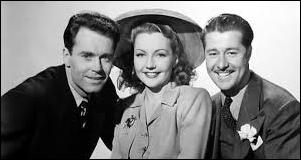
THE MAGNIFICENT DOPE. 20th Century Fox, 1942. Henry Fonda, Lynn Bari, Don Ameche, Edward Everett Horton. Director: Walter Lang.
I haven’t checked Lynn Bari’s filmography in detail, but I have a feeling that this is one of her relatively few big budget movies she’d made up to this point of time, 1942, and maybe even later. It’s a comedy-romance, and even with Henry Fonda as a goofy guy from Vermont come to the big city to be taken advantage of (a role at that time of his career he was born to play), it’s not all that funny.
But perhaps it was in 1942. Funny, that is. Today the best it might be considered is amusing.
Not that there’s anything wrong with that.
Don Ameche plays Dwight Dawson, the smooth-talking head of a personal success school that’s floundering on the rocks and going down for the third time. Lynn Bari is his level-headed assistant (and steady girl friend) who comes up with a great ad campaign: to create a contest to find the laziest, least successful man in America, give him a check for $500 and a free course in the Dwight Dawson school, and make him a big success.
You can probably take it from here: Henry Fonda accepts the check, refuses the course, but falls (secretly) in love with Lynn Bari, and decides maybe he needs to become a success after all.
Question: Who changes who? Henry Fonda or the world of big business? Who gets the girl? Henry Fonda or Don Ameche?
That’s what I thought. But to their credit, they all play their parts extremely well.
S. L. FLORIAN – Born to the Purple. Zebra, paperback original; 1st printing, August 1992.
This is billed along the top of the front cover as “A Delia Ross-Marlani Mystery,” which suggests that expectations were that there was going to be more than one. If so, it didn’t happen. There was a point in time when Zebra cut back suddenly and drastically on their line of ongoing mysteries, and that may have been the reason. Or another reason might have been that the author had only one story to tell, and Born to the Purple turned out to be it.
It isn’t the type of book I usually read, and while this review is generally going to be positive, I have my doubts that I’ll be able to persuade anyone reading this to go track it down. But as that first paragraph might suggest, I have a certain fascination for one-book authors, just to see what they might have to say.
Let’s start by describing Miss Delia. She’s fabulously wealthy, for starters, the only child of two parents, Lady Adela, the Countess of Ross, and Signor Federico Merlani, who produced Delia and quickly went their own jet style ways, leaving the girl in the hands of Mr. and Mrs. MacPhee and a series of boarding schools but growing up more or less on her own.
Not only is she beautiful, but she has been a top ranked ballerina, has earned a doctorate in medieval studies at Cambridge, has given concerts playing the harpsichord, taught at Harvard, and competed as an equestrian at the 1984 Olympics. Once married but now divorced.
Dead is the older sister of the pair of her two best friends, whom she met at boarding school when all three were all very young. The medical examiner’s staff finds nothing suspicious, but Delia is not so sure.
But Florian is a good enough writer to overcome all this, and I enjoyed the book. It turns out that the name of the author behind the pseudonym is Susan Sobel-Feldman, whose name I found online on a Jewish magazine’s website, but little more. I don’t know if this oddly charming mystery-romance left anything behind to build another detective story on — but I kind of wish it had happened.
DOROTHY SIMPSON – Wake the Dead. Luke Thanet #11. Charles Scribner’s Sons, hardcover, 1992. Bantam Crimeline, paperback, 1993. First published in the UK by Michael Joseph, hardcover, 1992.
Simpson’s Luke Thanet books are on my “mildly enjoyable” list. She’s a decent though not outstanding writer, and Thanet, with one exception that I’ll mention later, is an amiable enough detective. Put that together with my general fondness for British village mysteries, and I usually enjoy them.
A local aristocrat’s bed-ridden mother dies during an annual fête, and the police surgeon (who is attending it) alerts Thanet (who is there also) that in his his opinion it is likely to prove murder by asphyxiation. With bluebloods and several hundred potential suspects, Thanet’s work is cut out for him. Before the investigation gets too far, the MP, his wife, his mistress, and a disgruntled local lady all seem to have motive and opportunity. The dead woman was remarkably ill thought of.
Thanet is assisted as always by his trusty Sergeant, Mike Lineham. His avuncular patronization of poor Mike is the one consistently sour note in Thanet’s characterization. Wife Joan, daughter Bridget, and son Ben are always part of the books — here, a sub-plot is Bridget’s budding romance is a young man of whom Thanet is dubious. This is an old-fashioned village mystery, with decent, engaging characters. If you tire of the grimmer angst-filled variety, ot will make a nice change of pace.
— Reprinted from Fireman, Fireman, Save My Books #4, November 1992.
Bibliographic Note: There were in all 15 Luke Thanet novels, beginning with The Night She Died in 1981 and ending with Dead and Gone in 1999. For a full list and a wide array of cover images, check out the Fantastic Fiction website.
There were no Corsican Brothers, no men in Iron Masks, no chevaliers de Harmental, Queen Margot, Queen’s necklace, Joseph Balsamo, no sign that he was to be anything but yet another striving figure in the French literary scene. He was unknown save for being the mulatto son of one of Napoleon’s great generals and outspoken in his politics and artistic designs. He was a physical but not a literary giant.
That changed in 1832 on the opening night of his first play, La tour de Nesle, a tour de force of blood, murder, incest, and sex that would rocket its author to the stratosphere and lay the ground work for the six hundred plus plays and novels that followed and a virtual assembly line of literature that remains read and loved going on two hundred years later.
His friend Victor Hugo proclaimed the play the greatest in French history, and it played to packed houses. Overnight Dumas went from obscurity to a hero of the French literary scene and one of the most celebrated men in Paris, having invented the genre that would make him rich and famous, cloak and dagger, in one fell swoop of the quill.
Little wonder, because the play is a barn-burner. This is all dressed up on stage with red-hooded and cloaked men, graphic strangling, and enough gothic atmosphere to choke a horse. La tour de Nesle is pure gothic in the tradition of Mrs Radcliffe’s Mysteries of Udolpho, Walpole’s The Castle of Otranto, Monk Lewis’s The Monk, and Maturin’s Melmoth the Wanderer. As a play it falls somewhere between those and the bloody Elizabethan theater of John Webster’s Duchess of Malfi, which Dumas most assuredly had in mind when he wrote it.
Abel Gance is one of the great figures in French cinema. La roue, Le fin du monde, J’accuse, and his monumental film Napoleon are among the greatest works of the French cinema. In his own way Gance is to French cinema what Dumas was to its literature.
You would think …
You’d be wrong.
La tour de Nesle is based on an actual incident in French history involving Quenn Marguerite de Bourlonge, one combining all he elements any nineteenth century playwright could ask for in a melodrama. The hero, Buridan (Pierre Brasseur), was the lover of Marguerite de Bourlogne (Silvanna Pampanini) as a youth. They had two children in secret, Phillipe (Jacques Toja) and Gautier (Paul Guers), and Princess Marguerite persuaded Buridan to rid her of her father making her queen at which point she tried to kill him and her sons, a latter day Medea. Young Buridan escapes, believing his children murdered, but Landry (Constant Remy), the man assigned to kill the boys, spares them an raises them, shades of Snow White and the Huntsman.
Twenty years pass and Marguerite and her ladies in waiting have contrived a scheme to get their thrills with minimum risk. They have made a secret brothel of the tower of Nesle on the Seine where they lure young men for a night of passion after which their minions murder the handsome young men and dispose of them in the Seine (this is the historical part) so they can never expose what the women are doing or cause a scandal, though the number of bodies of young men washing up on shore is starting to get a bit suspicious looking.
This nice little arrangement is about to get complicated though. Princess Blanche (Lea Di Leo) has fallen for Phillipe, and Marguerite has set her eye on handsome Gautier, unaware he is her own son. Enter the catalyst, Buridan, back from twenty years adventures as a soldier of France, a dashing Captain and early model for d’Artagnan, quick with a sword and his wits. When Marguerite realizes he is alive she determines to kill him, setting in motion her own downfall and a national scandal of epic proportions.
Despite handsome filming, and considerable nudity, the film just doesn’t work, perhaps because it is never played as fully as it should be. Melodrama — and this is melodrama — must be played as melodrama, never half-heartedly, and this one is half-hearted at best. This kind of thing needs actors willing to take a huge bite out of the part. It needed Hammer and Terence Fisher, not art and genius.
Should this plot sound familiar, it may be because it has been filmed before, in 1909, 1928, 1937, on French television in 1966, and the version you are most likely to be familiar with, a German fiasco called She Lost Her … You Know What better known on video as The Tower of Screaming Virgins (long available from Sinister Cinema) from 1968 in which Buridan is much more of a Dumas swashbuckler and the two titles should tell you all you need to know of the approach taken — think the nude Three Musketeers and Zorro films of the late sixties. A few minutes of the Gance film are available on YouTube to view and of course you can buy the 1968 version if you have a tolerance for films so bad they achieve a kind of stature all their own.
Still, for me the Gance film was worth seeing despite the flaws, in part because it is a handsome film to look at, and in part because it is such a full blooded grand guignol plot. Depending on your tolerance for gothic atmosphere and melodrama, it’s worth a look even if you decide not to wade in all the way. Watching it you can at least get an idea what a more full-blooded attempt to tell the story might have been like and a glimpse of a bit of history, the play that launched one of the greatest literary careers of all time.
RIALL W. NOLAN – The Treasure at Loatani Point. Dell, paperback original; 1st printing, November 1990.
This the first book in a two-book men’s adventure series, one that I missed completely when it first came out, even though I was scouting the bookstores fairly regularly at the time, or so I thought.
From his biographical webpage at Purdue University, Dr. Nolan received his PhD in Social Anthropology from Sussex University in the UK in 1975 and joined the faculty at Purdue University in 2003. Among the books is has written, other than this Max Donovan series he did for Dell, are some fairly basic textbooks for graduate students in anthropology. Among the many schools where he has been affiliated is the University of Papua New Guinea.
So it’s not much of a coincidence that that’s where a good portion of Loatani Point takes place, beginning at Port Moresby — a city whose name always sends the chills of adventure up and down my spine — before heading out into what is still largely uncharted wilderness.
The story begins and ends in San Francisco, though — or almost but not quite. Donovan is in Bangkok just finishing up an assignment when he gets a call from the San Francisco police department telling him that his partner, a fellow Viet Nam vet and POW, has just been arrested for killing a man. Max knows two things: (1) Freddie could not have done it, and (2) if convicted, he could never survive any amount of time in prison.
Max’s investigation takes both him and a homicide detective named Sam (female) on a side trip to New Guinea, and the treasure the title tells us about. It’s a trip filled with all kinds of adventures and deadly betrayals, but as it turns out, the only way they can free Freddie from a plot only tangentially related to the treasure, is by coming back to California digging even deeper into local and statewide politics.
Niall is a better than average writer, with a good feeling for both time and place, and the book is a step above many of the men’s adventure paperbacks at the time. Think Matt Helm and Sam Durell more than Mack Bolan — not that the latter’s adventures weren’t exactly what a lot of male readers wanted at the time — with the difference being that both Helm and Durell had government jobs, and Donovan is a freelancer.
Or more precisely, what he calls himself is a supplier. A supplier of what, Sam asks. His reply: “Just about anything. I can either get it or tell you where to find it. I draw the line at drugs, porn or weapons. […] I supply missing people a lot of the time.”
Max Donovan’s second outing was The Fat Lady’s Song, also from Dell the same year. This first one went down so smoothly that I went looking for the second one right after finishing this one. It didn’t take long, and it’s in the mail to me now.
Devoted to mystery and detective fiction — the books, the films, the authors, and those who read, watch, collect and make annotated lists of them. All uncredited posts are by me, Steve Lewis.