JOHN B. WEST – Death on the Rocks. Signet S1883; paperback original, 1st printing, January 1961.

   I mentioned in the comments to Steve Mertz’s recent review of a Carter Brown book that I was in the process of reading this one, very much in the same tough hardboiled private eye genre, and that I would report back on it when I finished.

   I’m a little late — I finished it a couple of nights ago — but finish it I did, and here’s my report: I enjoyed it.

   Assuming I should say more, I will continue. In that previous conversation, it was pointed out by someone, perhaps it was me, that West’s PI character, Rocky Steele, was one of the few (if not only) PI characters created by a black author.

   Here’s what Max Allan Collin’ review, reprinted on this blog, said about the author: “John B. West was a man of many talents and achievements: A doctor, he was both a general practitioner and a specialist in tropical diseases; he was also the owner of a broadcasting company, manufacturing firm, and hotel/restaurant corporation. He lived in Liberia, was black, and late in his life — as a pastime, apparently — wrote novels about white private eye Rocky Steele, of New York City.”

   This is the last of six such novels, this one published posthumously, and while the fact that West was trying to channel Mickey Spillane in writing these books, it was a long time coming in this one before I saw the connection.

   The plot has something to do with a fabulously valuable diamond, and as you know, when fabulously wealthy diamonds come up in mystery stories, a lot of dead bodies always ensue. And so it is in Death on the Rocks.

   The story plays out in four stages: First, in New York City where Rocky is about to set sail to Liberia for a long-awaited vacation. Three people die, two at Rocky’s hand. Then a long, mostly uneventful cruise across the Atlantic, during which Rocky meets a ravishing platinum blonde diamond dealer, whom Rocky must keep company with overnight every night after a woman is killed in Miss Stark’s cabin, most likely thinking the victim was Miss Stark.

   Then comes a picturesque stay in Liberia, in which the author show that he has more skills as a writer than he tries not to let on during the rest of the book. I’m not sure, but all of the dead bodies occurred before Rocky arrived.

   The fourth part of the book is when the fireworks are unleashed, as Rocky goes on a hot trail of revenge (Lisbon and Majorca) on the killer who almost succeeded in bringing down Rocky and an equally unlucky passenger in a small plane in which the fuel supply was tampered with. There’s a moderately obvious twist to the tale, but all the stops really come out at the end, crudely written, perhaps, but very effectively so.

   As I said, I enjoyed this one.

Reviewed by JONATHAN LEWIS:


BATAAN. MGM, 1943. Robert Taylor, George Murphy, Thomas Mitchell, Lloyd Nolan, Lee Bowman, Robert Walker, Desi Arnaz, Barry Nelson. Director: Tay Garnett.

   Although there are a few brief moments of levity, Bataan is overall a rather bleak portrait of men in wartime. Filmed on set and released in the midst of the Second World War following the notable defeat of U.S. forces in the Philippines to Japanese Imperial forces, Bataan is a brooding, claustrophobic movie and one notably bereft of flag-waving patriotism or uplifting musical fanfare.

   With a solid cast, one that features Robert Taylor and Lloyd Nolan in starring roles, this combat film is hardly one of the very best, but it remains a gripping and poignant reminder of the grim realities of modern warfare. The quasi-mythical plot is something straight out of The Alamo. A ragtag group of misfits from various American ethnic groups under the command of a surly leader, Sgt. Bill Dane (Robert Taylor), are forced into a last man standing suicide mission. Low on supplies and fatigued by war, they have been tasked with the nominally impossible mission of blowing up a bridge to slow the oncoming Japanese advance.

   Making matters even more complicated is the threat of malaria and the fact that one man in the unit (Lloyd Nolan) may be hiding a secret from his past, one that involves his past interactions with Sgt. Dane.

   Bataan works best as a gritty combat film. Indeed, the action sequences are particularly memorable. The same, however, cannot be said for much of the dialogue, a lot of which feels artificial and stilted. The lack of women in the film is also particularly noticeable, making this film really more about male friendship in the face of imminent death than anything else. This is a man’s world, one replete with danger, and, even though there is a brief allusion to a romantic subplot, it’s one that is never developed.

   That’s actually for the best, as it avoids the pitfalls of far too many war films that have included some sort of romance to either offset the realistic violence or to appeal to a female movie going audience. Bataan is about men in wartime, all of who know that death lurks just around the corner in the steamy, tropical jungles that fate has chosen to ensconce them.


BATTLE OF THE BULGE. Warner Brothers, 1965. Henry Fonda, Robert Shaw, Robert Ryan, Dana Andrews, George Montgomery, Ty Hardin, Pier Angeli, Barbara Werle, Charles Bronson. Director: Ken Annakin.

   For a war film that runs nearly three hours long, Battle of the Bulge unfortunately ends up feeling surprisingly incomplete. That’s not to say that there aren’t some great scenes and solid performances by a well known cast; rather, it’s just that the movie, when viewed in its entirety, doesn’t leave the viewer with a particularly compelling reason why this particular combat film is so much better, or so different, from others that came before it. The fact that the film isn’t particularly historically accurate doesn’t help matters, either.

   Directed by Ken Annakin, a craftsman known for his work in the British comedy genre, Battle of the Bulge was both photographed and exhibited in 70mm, providing the motion picture a truly larger than life glimpse of combat and ferocious tank battles. With an all-star cast, including Henry Fonda, Robert Ryan, Dana Andrews, Charles Bronson, and Telly Savalas, it’s difficult not to enjoy the movie for these fine actors’ presences alone. Add to that an exceptional performance by Robert Shaw as a fervent German tank commander and you’ve got an enviable ensemble of top talent.

   Even so, the movie just doesn’t have enough tension or compelling subplots to make it a particularly memorable combat film. In some ways, it feels as if all these fine actors where merely going through the motions, playing their parts well but not giving their characters distinct idiosyncratic personalities. We never get a real sense of how the war has truly affected the American soldiers we are supposed to root for. And without that, Battle of the Bulge ends up being interesting to look at and engaging enough to continue watching until the end, but comes across a little too much like a documentary, or at least an historical recreation component of a documentary, for its own good.

Reviewed by JEFF MEYERSON:


  RICHARD MARSTEN – Even the Wicked. Permabooks M3117, paperback original, 1958. Reprinted by Signet as by Ed McBain, paperback, 1977.

   Zach Blake and his nine year old daughter Penny return to Martha’s Vineyard, where his wife Mary, a championship swimmer, drowned the year before. It seems that Evelyn Cloud, an Indian, sent him a letter saying his wife’s death was not an accident.

   From the moment they reach the island, they are warned to leave; when Blake goes to see Evelyn Cloud, he finds her murdered, then Penny is kidnapped. What is the secret someone is so anxious to keep uncovered? Does it involve a Nike missile and spies, or something more prosaic?

   The characters aren’t particularly involving and the book is unexceptional, but it is a pleasant way to spend an hour or two.

RICHARD MARSTEN – Murder in the Navy. Gold Medal #507, paperback original, 1955. Reprinted by Gold Medal (T2466) as by Ed McBain, paperback, 1971; reprinted earlier by Permabooks (M4306) as Death of a Nurse, paperback, September 1964, as by Ed McBain, then later by Signet, paperback, 1976, also as by Ed McBain.

   A nurse is found strangled in the radar room of the U. S. S. Sykes. The list is quickly narrowed down to three suspects, and when one of them apparently commits suicide, the FBI is satisfied and closes the case. Lieutenant Chuck Masters of the Navy’s investigation board is not satisfied, however, as the drowned man was an expert swimmer.

   This is, for most of its length, a pretty good book using an unusual setting. Then it is all thrown away on an incredibly bad and stupid ending, using every damsel-in-deadly-peril and will-he-arrive-in-time cliche ever invented, like a bad episode of The Rookies.

   Also, McBain doesn’t play entirely fair with the readers, as he withholds important information, then throws it out at the finish. Too bad, as this could have been a much better book.

— Reprinted from The MYSTERY FANcier, Vol. 1, No. 4, July 1977.

Reviewed by DAN STUMPF:


LOVE-SLAVES OF THE AMAZONS . Universal, 1957. Don Taylor, Gianna Segale, Eduardo Ciannelli. Written, produced & directed by Curt Siodmak. Second unit direction: Terry Morse.

   I saw this when it first came out on a double-bill with The Monolith Monsters at my neighborhood movie house, and once again I observe that you got Bang for your Quarter in those days….

   Curt Siodmak always struck me as the cinematic equivalent of Fredric Brown: an unredeemed and unapologetic pulpster who reveled in the gaudy, tawdry delights of things like Son of Dracula, Bride of the Gorilla, and this kaleidoscopic comic book of a film; very bad, but fun nonetheless.

   Don Taylor (who directed some very bad films himself later on) stars as world-famous archeologist Dr. Peter Masters, who arrives in Brazil, just why we’re never told, and is almost immediately accosted by Eduardo Ciannelli as Dr. Crespi. (The name is an in-joke.) a local crackpot who claims to have visited the Lost City of the Amazons etc. etc…. it’s all very familiar, but done with speed and economy in lieu of originality or artistry.

   Indeed, Writer/Producer/Director Siodmak peels the old banalities right off the yellowed pulp pages and slaps them across the screen with a shamelessness that borders on daring — which was just fine for this skinny seven-year-old of the 1950s. We get fist-fights, river pirates, alligators, drugs, snakes…. and some rather uninspiring Amazon Warriors with their skin painted green. Ah yes!

   That’s what has stayed with me through the decades: the look of this thing; parts of it were filmed on location in Brazil (apparently by Terry Morse, who did the Americanized scenes in Godzilla) and parts on studio sets so brilliantly colored that one suspects the art director may have been using controlled substances. We get blue jungle, green-skinned blondes, a massive temple made of brightly-painted cardboard, and clumsy dancing girls decked out more like rodeo clowns than pagan beauties.

   We also get a couple of gruesome off-screen deaths, but I the problem is that we never get a good pay-off scene: no suspenseful cliff-hanging, no climactic struggle… not even a guy in a gorilla suit. This didn’t bother me as a kid, but in the wisdom of my advancing years I see the lack of a last-reel ass-kicking as a deplorable aesthetic oversight. And the deficiency in the gorilla-suit department elicits a wistful sigh of disappointment.

   Still and all, it’s hard to resist a title like Love-Slaves of the Amazons, and it’s a fun film to watch, if you’re wearing sunglasses or have your judgment impaired by the influence of a controlled substance.

A 1001 MIDNIGHTS Review
by Bill Pronzini & George Kelley:


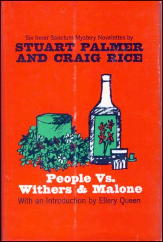
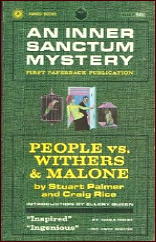
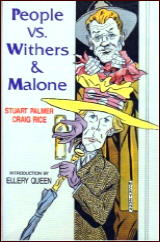
STUART PALMER & CRAIG RICE – People vs. Withers and Malone. Simon & Schuster, hardcover, 1963. Paperback reprints: Award A146F, 1965; International Polygonics, 1991.

   Intermittently from the late Forties into the early Sixties, Palmer and his good friend and fellow mystery writer Craig Rice, with whom he had worked on the scripting of the 1942 film The Falcon’s Brother, collaborated on half a dozen novelettes for Ellery Queen’s Mystery Magazine.

   Each story teams the crusty Miss Withers, that “tall, angular person who somehow suggested a fairly well-dressed scarecrow,” with Rice’s hard-drinking, womanizing Chicago lawyer, John J. Malone. And all six are collected in this volume.

   Working in tandem, Withers and Malone solve what the dust-jacket blurb describes as “hectic, hilarious homicides.” A fair assessment: Both Palmer and Rice wrote cleverly constructed, fair-play whodunits flavored with (sometimes wacky) humor, and the blending of their talents produced some memorable stories.

   One is the title novelette, in which Hildegarde and John J. hunt for a missing witness in the murder trial of a Malone client and wind up pulling off some courtroom pyrotechnics to rival any in the Perry Mason canon.

   In “Cherchez la Frame,” the two sleuths travel to Hollywood to look for the missing wife of a Chicago gangster and find her strangled with Malone’s tie in his hotel bathroom.

   But the best of the stories is probably the first Withers and Malone collaboration, “Once Upon a Train” (original title: “Loco Motive”). This spoof of the intrigue-on-the-Orient-Express genre takes place on the Super-Century en route from Chicago to New York and features a dead man lurking sans clothing in Miss Withers’s compartment, the murder weapon conveniently planted in Malone’s adjoining compartment, and a combination of quick thinking by the little lawyer and a bizarre dream by the angular spinster that unmasks the culprit.

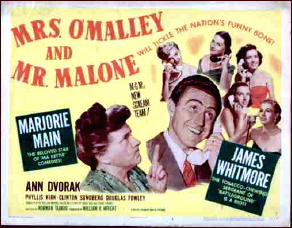
   â€œOnce Upon a Train” was one of two Withers and Malone stories sold to MG — “resulting finally,” Stuart Palmer writes in his preface, “in Mrs. O’Malley and Mr. Malone, a starring vehicle for James Whitmore, in which Miss Withers mysteriously changed into Ma Kettle.” Palmer and Rice were two of the scriptwriters on that 1951 film.

   Each of these six stories is enjoyable light reading and should appeal not only to fans of either or both series, but to anyone who enjoys what Ellery Queen refers to in the book’s introduction as “madcap capers … full o’ fun.”

———
   Reprinted with permission from 1001 Midnights, edited by Bill Pronzini & Marcia Muller and published by The Battered Silicon Dispatch Box, 2007. Copyright © 1986, 2007 by the Pronzini-Muller Family Trust.


[UPDATE] 08-09-09.   The following comment was left by Jeffrey Marks on Yahoo’s Golden Age of Detection group, and is reprinted here with his permission. Jeff is the author of Who Was That Lady? Craig Rice: The Queen of the Screwball Mystery (Delphi Books, 2001).

   â€œThe stories, delightful as they are, were written almost exclusively by Palmer (a few were written after Rice’s death, so it’s a certainty.)

   â€œRice had indicated that although she had not known Palmer when she began the Malone series, Palmer epitomized the character — she thought Palmer resembled him in mannerism, appearance and dress.

   â€œSo she didn’t have a lot of qualms in turning him over to Palmer to write stories. Palmer made a few minor changes to the character. Malone, who had just been a rumpled dresser, now wore colorful ties and nicer suits. Other than that, Malone stayed close to Rice’s version of the lawyer.

   â€œRice was very uninvolved in the movie as well, being a ward of the state when it was being made. She was able to use the money to get out of debt and get control of her finances back as well.”

KIT CARSON. United Artists, 1940. Jon Hall (Kit Carson), Lynn Bari, Dana Andrews (Captain John C. Fremont), Harold Huber, Ward Bond, Renie Riano, Clayton Moore, C. Henry Gordon. Screenplay: George Bruce. Director: George B. Seitz.

   First of all, let me reassure you that I did not take a single word or scene from this movie as a meaningful reflection of anything that ever happened in the real world. I won’t go into it further, but I really doubt that Kit Carson used the help of a troop of the US Cavalry, lead by John C. Fremont, to guide a wagon train of settlers headed for California. And all the time vying for the hand of of beautiful Dolores Murphy (Lynn Bari), daughter of the owner of a large hacienda already in place there.

   They run into all of the usual problems on the journey, of course, challenges mostly caused by Indians, Shoshones in particular, all riled up and supplied with rifles by General Castro (C. Henry Gordon), the governor of California with designs of becoming the dictator of the entire territory as well as Mexico, and American are most decidedly not welcome.

   But included in this movie is one of the best filmed circle-the-wagons scenes I’ve watched in a while, while at the same time the soldiers are trapped in a dead-end canyon with Indians shooting at them from atop the cliffs on either side. Life was tough back then.

   Miss Murphy is also first aghast at the sight of Carson and his fur-trapping buddies torturing a Mexican who has been spying on them, then repulsed by Fremont (following the rule book) summarily calling up a firing squad and executing the prisoner right in front of her.

   Which one of the two will she choose after this incident? I’ll give you a hint: What’s the title of the movie?

   Even though his ways are uncouth and he is barely literate, and he seems determined to do what’s best for her and not himself, her heart belongs to Kit. What struck me right away was how much Jon Hall’s performance seemed to channel Randolph Scott, down to the latter’s soft southern drawl. I didn’t learn until later that the role was actually intended for Scott, before things didn’t work out.

   This is a strange movie in another way, besides being a biopic with not much emphasis on the “bio.” It’s a large scale production, running nearly ninety minutes long, but (and you can correct me if I’m wrong) the people in it are far from being A level stars, even in 1940.

SARA WOODS – My Life Is Done. St. Martin’s, US, hardcover, 1976. Hardcover reprint: Detective Book Club, 3-in-1 edition. No US paperback edition. First published in the UK by Macmillan, hardcover, 1976.

   Barrister Antony Maitland is asked to investigate a case of blackmail — a stolen letter could embarrass a member of parliament who opposes a reservoir development in his home region.

   There’s little action. It’s a classic case of parlor detection that still manages to result in two murders. Conversational nuances are cleverly used in the place of tangible evidence, but I suppose that many an armchair detective will feel disappointed with the degeneration into a courtroom confessional scene not unlike television’s Perry Mason.

Rating:  C plus.

— Reprinted from The MYSTERY FANcier, Vol. 1, No. 4, July 1977. This review also appeared earlier in the Hartford Courant.

From this Austin-based jazz singer’s 2012 album Way Down Low, funded by a Kickstarter campaign:

ROSS THOMAS —
An Author Profile by BARRY GARDNER:


   Ross Thomas to me succeeds on every level as a writer of fiction. His plots are intriguing, complex without being bewildering; his prose is smooth, seamless and unobtrusive; his dialogue fits his characters like a made-to-measure suit; but his strongest suite is characterization. I have yet to read a Thomas book without the feeling that here was a person, usually a group of people, that I would like to meet again.

   For better or worse, I have had that pleasure relatively seldom, for with the exception of eleven books featuring three different sets of characters (see list below), Thomas has chosen to eschew the series character. Eleven out of twenty-three might not seem all that much like eschewing, but except for two they were written over fourteen years ago. Perhaps he is wise; none of the sequels have quite measured up to the originals, in my eyes.

   Thomas has won two Edgars: for Best First Novel with The Cold War Swap in 1966, and nearly 20 years later for Best Novel with Briarpatch in 1984. Many people, though, consider Chinaman’s Chance his best novel; certainly it’s the book that finally began to gain him the major recognition he so richly deserved.

   My own favorite of Thomas’s books is The Fools in Town Are on Our Side. It is really two stories, the first of a man who doesn’t care about anything and how he came to that condition, the second the story of cleanup-by-further-corruption of a town. Comparisons to Hammett’s Red Harvest are inevitable, at least partially apt, and have been made; nevertheless the two books bear little resemblance but for that partially shared theme.

   He may have created his most numerous set of memorable characters here, and that is high praise indeed. To me, this is the quintessential Ross Thomas novel.

   My choice for second-best is The Seersucker Whipsaw. The character of Quentin Sharlene is unforgettable, and the story of an African coup is both entertaining and riveting from beginning to end. Almost every character is a major or minor masterpiece. The treatment of the African milieu was exceptional, I think, for 1967.

   His next, due out possibly by the time this sees print, is reported to be a third in the Durant-Wu series; but that’s immaterial — as long as there is a next.

— Reprinted from Fireman, Fireman, Save My Books #3, September 1992.


       The Mac McCorkle-Michael Padillo series —

1. The Cold War Swap (1966)
2. Cast a Yellow Shadow (1967)

3. The Backup Men (1971)
4. Twilight at Mac’s Place (1990)

       The Philip St. Ives series (as by Oliver Bleeck)

1. The Brass Go-Between (1969)

2. The Procane Chronicle (1971)

3. Protocol for a Kidnapping (1971)
4. The Highbinders (1974)
5. No Questions Asked (1976)

       The Quincy Durant-Artie Wu series —

1. Chinaman’s Chance (1978)

2. Out On the Rim (1987)
3. Voodoo, Ltd. (1992)

       Other novels —

The Seersucker Whipsaw (1967)
The Singapore Wink (1969)

The Fools in Town Are On Our Side (1970)
The Porkchoppers (1972)
If You Can’t Be Good (1973)
The Money Harvest (1975)
Yellow Dog Contract (1976)
The Eighth Dwarf (1979)

The Mordida Man (1981)
Missionary Stew (1983)
Briarpatch (1984)
The Fourth Durango (1989)
Ah, Treachery! (1994)

Editorial Comment:   Voodoo, Ltd. was the book that Barry was referring in his last paragraph. Ah, Treachery! was Ross Thomas’s final book, and was also not included in the bibliography Barry prepared for this profile when it was first published.

   Well, synchronicity strikes again. I’d just finished writing up my notes on watching this movie, only to discover that Dan Stumpf had beaten me to it, in one of his bimonthly contributions to DAPA-Em some 23 years ago. Neither one of us knew what the other was writing or had written, but as you will see, we were watching the same picture.

   Since this is my blog, I flipped a coin, and I came up first. (Or in other words, age before beauty.)

THE MISSING JUROR. Columbia Pictures, 1944. Jim Bannon, Janis Carter, George Macready, Jean Stevens, Joseph Crehan, with Trevor Bardette, Mike Mazurki, Pat O’Malley & Ray Teal (these last four uncredited). Director: Oscar Boetticher Jr.

Reviewed by STEVE LEWIS:

   This was the second film directed by Budd Boettecher, the first being One Mysterious Night, a Boston Blackie film released earlier the same year. My review of that earlier film can be found here. I gave it essentially a thumbs down review, but two people who often leave comments on this blog had an opposite opinion, which you should go read also, should you be so inclined.

   The story in The Missing Juror isn’t all that much — in fact, it’s pretty bad — but you can easily see the stylistic touches that Boetticher added, including very smooth panning shots and a “through the wall” approach to filming people moving from one room to another with a cross section of the wall seen separating the two rooms. (If there is a technical name for this, I don’t know what it is.)

   Jim Bannon, of Red Ryder and Jack Packard (I Love a Mystery) fame, plays a reporter who has covered the trial and conviction of a man accused of killing a young girl, but on the eve of his execution, finds the clue that saves him. The man has gone mad in the meantime, however, and once freed, he is confined to a mental institution, where he dies in a horrible fire.

   Or did he? He, or someone else acting as a one-man avenger, is causing the deaths of the twelve members of the jury that falsely convicted him. One of these jurors is home decorator Alice Hill (Janis Carter), whom Bannon’s character is immediately attracted to.

   Beware reading the IMDb page, else all will be revealed, but perhaps the name of George Macready as the member of the cast will steer you in the right direction anyway. There are holes in the plot a mile wide, and the extensive flashbacks at the beginning of the movie make the early going more difficult than it should be, but if you can ignore the story line and watch the fun the players seem to be having, then I think you will too.

Reviewed by DAN STUMPF:

   A movie shouldn’t really need as many redeeming qualities as The Missing Juror offers. Its rather rushed and unconvincing screenplay by Charles O’Neal is directed with real panache by Oscar “Budd” Boetticher, who would later work so memorably with Randolph Scott, and here offers up some meorable stylistic flourishes.

   The acting by Radio Star Jim Bannon as the standard wise-cracking reporter/detective is deep-voiced by totally without charm — though to be fair, Ronald Colman and Fred Astaire put together would have trouble eking any likability out of the lines Bannon has to work with — but there’s a typically magnetic performance from cold, slimy George Macready as an innocent victim and/or mad killer, a role that allows him to pull out all the stops, which he wisely avoids doing.

   As for the rest, the plot involves the serial murders of a jury that convicted an innocent man, and Bannon’s attempts to stop same. The Cops are all dumb, the women all lovely — particularly Janis Carter, as one of those classy 40s heroines with a weakness for dumb hunks — and the milieu is the familiar Columbia back lot, dressed up and photographed to best advantage.

   There’s also one of those movie moments that will linger on my mind a while:Janis Carter as a an ex-juror/victim-to-be, remarking casually about the odd number of furnishings waiting in the next room for her to deliver to a (heh-heh) customer. She closes the door, but the camera lingers in the room for perhaps ten seconds. Long enough for the camera to scan over heaps of boxes, all marked “12” and come to rest on a clock chiming Noon.

   Think about it.

« Previous PageNext Page »