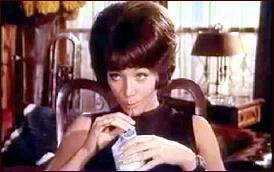
CANTERBURY’S LAW. Pilot episode. Fox, 10 March 2008. (Season 1, Episode 1.) Julianna Margulies, Ben Shenkman, Keith Robinson, Trieste Kelly Dunn, Terry Kinney, Ardan Quinn, James McCaffrey. Guest Cast: Charlie Hofheimer, Boris McGiver, Alison Bartlett. Creator/screenwriter: Dave Erickson. Director: Mike Figgis.
This is a series that came and went very quickly. In fact, you might even say that it sunk without a trace. With only six episodes aired before it was axed, I’m surprised that it came out on DVD, but it did.
Julianna Margolies (best know, perhaps, as the good wife on The Good Wife), here plays Elizabeth Canterbury, a fiery, tough-minded and determined defense attorney who (and here’s the gimmick) is willing to break all of the rules to get her clients off.
And in this pilot episode, she pulls off all the stops (telling her client to lie on the witness stand) in order to get the real killer on the stand, where she knows she can break him down. What makes this subterfuge necessary is that her client’s initial confession was coerced by the police by denying him the meds he needed.
There is all kinds of back story that is brought out along the way, including her affair with a private eye, one which she has broken off (she also happens to be married), but his assistance on the case she does not mind in the least asking for.
As gimmicks go, I didn’t mind this one, and as a matter of fact, I liked it. Elizabeth Canterbury certainly is skirting the edges of legality, and in fact (as you can tell) she verges into illegality far more than Perry Mason ever did. And playing her to perfection, Julianna Margulies is an actress that makes me sit up and like it.
She was on The Sopranos before this one, then a nurse on ER for a season or so before starring in The Good Wife, a series I’ve never seen a single episode of, and now I’m convinced I should.
UP IN THE AIR. Monogram, 1940. Frankie Darro, Mantan Moreland, Tristram Coffin, Marjorie Reynolds, Lorna Gray. Written by Edmond Kelso. Directed by Howard Bretherton.
A painless if uninspiring hour-killer from Monogram, with the pleasure of watching Marjorie Reynolds and especially Lorna (“Vulturaâ€) Gray, plus the always-entertaining Mantan Moreland.
The story revolves around murder(s) at a radio station, and when I say “revolves†you should appreciate that the narrative spins its wheels quite a lot but never actually seems to get too far. Alluring Lorna Gray plays a bitchy singer who is, alas, the first to go. A couple of loud and none-too-bright cops show up to investigate, but the real sleuthing is done by the team of Frankie Darro and Mantan Moreland.
The word “team†is key to the interest and charm of this movie and the others in this low-budget series, where Frankie and Mantan took turns playing unskilled workers in crappy jobs that invariably got them mixed up in murder. Mantan was always the reluctant throttle to Frankie’s racing engine, but it was he who provided the laughs and charm with his snappy patter, comic timing and — in this film anyway — snappy one-man dance numbers.
The concept of interracial-but-equal crime-solvers may have broken some cultural ground back then, but it didn’t catch on; Monogram was a never a trend-setting studio after all, generally content to pick up on well-worn themes and discarded series from the major studios, like Cisco Kid and Charlie Chan, where Moreland again showed up to good advantage.
But it’s interesting to note that they trotted it out decades before Culp & Cosby in I Spy when nobody was looking. I’m not saying they did particularly well with it, but the film passes painlessly as I say, and the interplay between Moreland and Darro is often fun to watch, especially when they trot out one of Mantan’s “infinite talk†routines.
To anyone interested in learning more about this ought-to-be-legendary black comedian, I recommend Michael H. Price’s Mantan the Funny Man (Midnight Marquee Press, 2007). It’s written by an old white guy, but offers some worthwhile insights into race relations in the middle of the last century, and it takes a close and appreciative look at movies most critics wouldn’t give the time of day to.
CLARENCE E. MULFORD – The Coming of Cassidy. A. C. McClurg & Co., hardcover, 1913. Reprinted several times, including Tor, paperback, 1993. Also included in Wild Western Days: The Coming of Cassidy, Bar-20, Hopalong Cassidy, Forge hardcover, 2010. Also available online.
When asked what he thought of the huge Hopalong Cassidy revival of the late forties and early fifties that made Bill Boyd a superstar and millionaire, Clarence E. Mulford, who created the character and made no little money from Boyd’s popularity was purported to say: “He has his Hopalong, and I have mine.â€
It’s an accurate statement because Bill Cassidy the top hand of the Bar 20 has little in common with Bill Boyd’s avuncular paragon of virtues. Mulford’s Cassidy can drink any man under the table, has — to say the least — a colorful vocabulary, is deadly fast and doesn’t bother to shoot guns out of anyone’s hand, smokes, gambles, brawls, and has an eye for the ladies. He’s a tall lanky cowboy that looks more like John Dierkes Rafe in Shane than Bill Boyd’s immaculate man on the white horse.
He was more than twenty-five hundred feet above the ocean, on a great plateau broken by mesas that stretched away for miles in a vast sea of grass. There was just enough tang in the dry April air to make riding a pleasure and he did not mind the dryness of the season. Twice that day he detoured to ride around prairie-dog towns and the sight of buffalo skeletons lying in groups was not rare. Alert and contemptuous gray wolves gave him a passing glance, but the coyotes, slinking a little farther off, watched him with more interest. Occasionally he had a shot at antelope and once was successful.
This is from The Coming of Cassidy, a collection of integrated short stories, some merely vignettes. telling how young Bill Cassidy came to Buck Peters’ Bar 20 and became the leader of the Bar-20 Three, with Red Connors and young Johnny Nelson.
Bill Cassidy is a lanky young man who started riding north and arrives at Buck Peters’ ranch just as the ranchman is having trouble with a group of buffalo hunters. It’s not long before Cassidy is butting heads with one of them.
Without a word they leaped together, fighting silently, both trying to gain the gun in the hunter’s holster and trying to keep the other from it. Bill, forcing the fighting in hopes that his youth would stand a hot pace better than the other’s years…
Mulford’s stories may be dated by today’s standards, but in many ways his easy style and classic approach to the Western makes him a more modern read than Max Brand or Zane Gray. It’s not that you will find anything unsavory about Hoppy and his crew, but you get the impression they have skirted close to unsavory in their past. Mulford never says it, but he knows those knights of the saddle were actually homeless virtual bums who often owned nothing of their own but their boots and spurs — certainly not a horse, gun, and saddle.
Many a real cowboy worked for a horse and a saddle and little pay.
This collection includes the story “How Hopalong Got His Hop†that explains how he got his famous name and the limp that dogs him throughout the books. Ironically Bill Boyd and the production company of the first Hopalong Cassidy film had no intention to utilize Hoppy’s limp, but Bill Boyd broke his leg early in the production.
“Th’ bone is plumb smashed. I reckon I’ll hop along through life. It’ll be hop along, for me, all right. That’s my name, all right. Huh! Hopalong Cassidy! But I didn’t hop into hell, did I, Harris?” he grinned bravely.
And thus was born a nickname that found honor and fame in the cow-country a name that stood for loyalty, courage and most amazing gun-play. I have Red’s word for this, and the endorsement of those who knew him at the time. And from this on, up to the time he died, and after, we will forsake “Bill” and speak of him as Hopalong Cassidy, a cowpuncher who lived and worked in the days when the West was wild and rough and lawless; and who, like others, through the medium of the only court at hand, Judge Colt, enforced justice as he believed it should be enforced.
Reading these stories and the other books in the series it’s easy to see why the first choice to play Hoppy on screen was grizzled character actor James Gleason and not handsome Bill Boyd. Over the course of the films Hoppy changes partners a few times but remains the same kindly tough respectable man about the ranch, but Mulford’s Hoppy ages, drinks too much, gambles, and even gets married. At times he almost becomes respectable, much to his chagrin.
In one story he even gets shanghaied, and he and the boys have to start a mutiny.
Mulford stayed true to his creation even when his readers wanted the Bill Boyd version. It may have been Boyd on the book covers later, but the man inside was Bill Cassidy. Louis L’Amour, who wrote the Hopalong Cassidy short lived pulp magazine as Tex Burns, was caught between the two, but reading his books you can see it was Mulford’s Hoppy he preferred. His Hoppy looked more like Bill Boyd but it only went skin deep. (*)
Hearing the beating of hoofs he glanced around and saw a trim, pretty young lady astride a trim, high-spirited pony; and both were thoroughbreds if he was any judge. They bore down upon him at a smart lope and stopped at the edge of the walk. The rider leaped from the saddle and ran toward him with her hand outstretched and her face aglow with a delighted surprise. Her eyes fairly danced with welcome and relief and her cheeks, reddened by the thrust of the wind for more than twenty miles, flamed a deeper red, through which streaks of creamy white played fascinatingly. “Dick Ellsworth!” she cried. “When did you get here?” Mr. Cassidy stumbled to his feet, one hand instinctively going out to the one held out to him, the other fiercely gripping his sombrero.
Somehow I can’t see Bill Boyd’s Hoppy leading the pretty girl on without telling her she has the wrong man, but Mulford’s Hoppy does without turning a hair.
The books move quickly. Hoppy and his pals can’t stay out of trouble for more than a few paragraphs, if that. Gunsmoke curls in the air; keen eyed men stare across tables at each other and glance anxiously at five cards in their hand that could mean fortune, or death; cowboy’s slump in the saddle eyes staring into the darkness as they listen to the lowering cattle; horses throw them; rough humor dogs them; hand-mades hang from lean dry lips lighted by a lucifer; chaws of tobacco are spit with terrifying accuracy; men die; women weep; outlaws, Indians, gun men, crooked towns people, lynch mobs, buffalo hunters, skinners, stage coach drivers, whisky drummers, renegades, school marms, saloon girls, diamond-backs, mustangs, and longhorns, all the pantheon of the old west cross their path.
This is Ur-text, cowboy style. The age of Remington is not that far in the past. Charles Russell is still writing and painting. It has not been that long since Owen Wister’s The Virginian or Emerson Hough’s The Covered Wagon. Names like Jesse James, Billy the Kid, Buffalo Bill, Wild Bill, Butch Cassidy, are not that distant a memories. Zane Gray, Eugene Manlove Rhodes, and Max Brand are his contemporaries. Tom Mix, William S. Hart, Harry Carey, Bronco Billy Anderson, Buck Jones, Colonel Tim McCoy, and a young unknown named Gary Cooper ride across the for now silent screen waiting for him to join him even he is unrecognizable when he does.
It is to his credit that Mulford’s Hoppy has survived and not just Bill Boyd’s. His books can still be found on paperback racks and not so many years back a film, The Gunfighter, featured Martin Sheen as the older Hoppy, and one much closer to Mulford than Boyd.
Bill Boyd’s Hoppy will always have a hold on my heart, but in a real way Mulford’s creation is timeless as the film Hoppy is not. Boyd’s Hoppy seems a bit quaint now, not quite real, a little too perfect, he rides and lives in a West that never was, but Mulford’s Hoppy, swearing, spitting, guns blazing, cards held close to the vest, eyes squinted beneath his sombrero, a top his horse Ring-Eye, has a feel of authenticity. We know the West wasn’t like Boyd’s, but if it wasn’t like Mulford’s (and it wasn’t really) it should have been.
(*) It was the revival of L’Amour’s Hoppy novels, especially The Rustlers of West Fork, that inspired Tor Forge to revive Mulford’s Hoppy in modern paperback form. As for the true face of Hoppy, you’ll find it among the illustrations the giant of modern American illustration N.C. Wyeth did for Hoppy’s magazine appearances, but I warn you, Bill Boyd it is not.
On a similar note, while Bill Boyd is known for dressing in black that is an illusion of black and white film. Boyd is actually wearing a red shirt, yellow kerchief, and blue jeans in the early films. Only the hat and the boots were black. You just can’t tell on film. Later on the outfit conformed to the image and the comic book version, but early on he’s dressed almost as colorfully as Mulford’s Hoppy.
SPENCER DEAN -Price Tag for Murder. Doubleday, hardcover, 1959. Pocket #6048, paperback, 1961.
This is one more in the series of interminable — if this novel is any guide — adventures of Don Cadee, Chief of Store Protection at Ambletts Fifth Avenue. As information comes to Cadee’s attention that an entire warehouse of merchandise, a warehouse that should have had no existence, has disappeared, he is simultaneously faced with the suicide or murder of a key employee in the store’s purchasing department.
Some minor problems for Cadee are the installation of a closed-circuit television to scan areas in the store and the perhaps imminent departure of a company executive to Mexico, possibly accompanied by some of the store’s funds and one of the store’s best buyers.
For those who like action, or what seems like it, and dialogue, with very little description or writing style and not a whole lot of plot.
— Reprinted from The MYSTERY FANcier, Vol. 9, No. 6, November-December 1987.
Bio-Bibliographic Notes: Spencer Dean was the pen name of (Nathaniel) Prentice Winchell (Jr.) (1895-1976). Other pen names he used were Jay De Bekker, Spencer Dean, Dexter St. Clair, Dexter St. Clare & Stewart Sterling. The latter is perhaps the most well-known. According to Al Hubin Crime Fiction IV, he was “born in Evanston, Illinois; died in Tallahassee, Florida; worked for an advertising agency, then newspaper man; editor of trade publications, journalism lecturer; wrote and produced over 500 radio mystery shows, wrote for films and TV; published some 400 magazine detective stories.”
A long article by Richard Moore about Stewart Sterling and his various “specialty detectives” can be found here on the primary Mystery*File website.
The Don Cadee mystery series —
The Frightened Fingers, Washburn, 1954.
The Scent of Fear. Washburn, 1954.
Marked Down for Murder. Doubleday, 1956.
Murder on Delivery. Doubleday, 1957.
Dishonor Among Thieves. Doubleday, 1958.
The Merchant of Murder. Doubleday, 1959.
Price Tag for Murder. Doubleday, 1959.
Murder After a Fashion. Doubleday, 1960.
Credit for a Murder. Doubleday, 1961.
TANGLED. Ben’s Sister Productions, 2001. Rachael Leigh Cook, Shawn Hatosy, Jonathan Rhys-Meyers, Estella Warren, Lorraine Bracco. Director: Jay Lowi.
There are a lot of gaps in my movie-watching career, and the period from the mid 1980s on to, well, practically now, is the largest one. I’m trying to fill in the gaps in that period, but the doing is going a lot slower than I’d like. There are just too movies from the 30s and 40s that are on my Want to See Next list, that films like this one just have to work their way in somehow.
Which is a roundabout way of saying I picked this one at random out a box in the basement that’s been there for at least four or five years, maybe even longer. I’m not sure why I bought it in the first place, but after watching it last night, I’m glad I did.
It wasn’t because of the actors in it, as I couldn’t have placed names with faces with any of them, except one, that one being Lorraine Bracco (of The Sopranos fame, but I saw her first in Medicine Man with Sean Connery). In any case, of the players in the three leading roles, I can tell you now that I was impressed.
Taking Rachael Leigh Cook first, she plays Jenny, the center of this romantic drama, a diminutive young girl with plenty of spirit and two suitors, sort of, but that’s the story. One of them is David (Shawn Hatosy), an almost baby-faced lad who’s known Cook longer, but theirs is a friendship only, platonic you might say, although you know from watching him that he’d like it to be more. The other is David’s former roommate, Alan (Jonathan Rhys-Meyers), who’s another free spirit, dashing, adventuresome, with dangerous-looking eyes, and everything David is not.
But even though sparks between Jenny and Alan are obviously immediately, the latter takes the time to ask the David if the way is clear, and David reluctantly says yes, although you know he’d like to say no. He even warns Jenny about Alan, telling her that falling for him would be a bad idea.
The story of this doomed three-way relationship is told in flashback by David to female detective Andersle (Lorraine Bracco), having been picked up by the police who have found the bodies of the other two in a secluded wooded area.
It’s been a while since my college days, both undergraduate and graduate, but I recognize pieces of each of the three major players in the students I knew back then, and the love affairs they had, the rivalries, the break-ups, and the getting back together again. Not a whole lot has changed, except nobody I knew back then ended up in a situation anything like this one. Not that I knew about, anyway.
In any case, it’s the skill of the actors that reminded me of my younger academic days more than any movie or book I’ve seen or read in quite a while. All three leads were convincing, and the next time I see a film that they’re in, I’ll be sure to take more than a quick glance at it.
One other thing. I’m sometimes annoyed when a film exists in the form of extended and sometimes overlapping flashbacks, but in this case, it was the only way it could have been done. I enjoyed this one.
JO BANNISTER – Striving with Gods. Doubleday Crime Club, hardcover, 1984. First published in the UK by Robert Hale Ltd., hardcover, 1984. Reprinted as An Uncertain Death, Severn House, UK, hardcover, 1997. No paperback edition.
New to the mystery-reading public, Jo Bannister has produced an excellent medical thriller in Striving with Gods. Her heroine, Clio Rees, is a physician turned mystery writer who makes a further transformation to amateur detective when her dearest friend dies. Clio’s friend, a gay man named Luke, was found dead with a young boy in an apparent suicide pact. Clio doesn’t buy the police scenario, and uncovers evidence of a double murder and cover-up. Dr. Rees further finds a medical conspiracy behind the murder.
Bannister’s novel is more thriller than mystery. And Clio is more avenging fury than detective. Early on it becomes clear to Rees and the reader who the prime villain is. The greatest mystery is whether Clio will be able to bring the malefactors to justice and avenge her friend before she, too, falls victim. Despite our faith in a happy ending, Bannister does a good job of sustaining the suspense. The murderous confrontations are dramatic, though an extended chase scene goes on a bit long.
But it is the character of Clio Rees and her first-person narration that are the making of Striving with Gods. There is a wry quality to her voice that nicely balances the more melodramatic aspects of the plot. She is by no means the omnipotent and omniscient detective. She is a caring, fallible woman. She is also strong and resolute and totally devoid of the feminine failings of the mystery-Gothic heroine. She has, in fact, all the makings of a series sleuth. If only Jo Bannister will oblige.
Bibliographic Notes: Kathi Maio’s wishes were to be fulfilled. Among Jo Bannister’s 30 or more mystery novels are three additional ones in the Clio Rees series. Many of her other books are thrillers and/or police procedurals in several other series. Her next one will be Buying Freedom, scheduled for publication later this year.
The Dr. Clio Rees Marsh series —
Striving with Gods. Hale, 1984.
Gilgamesh. Piatkus, 1989.
The Going Down of the Sun. Piatkus, 1990.
The Fifth Cataract. Severn House, 2005.
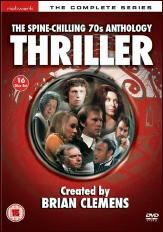
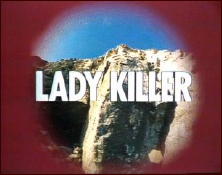
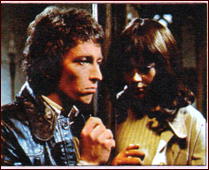
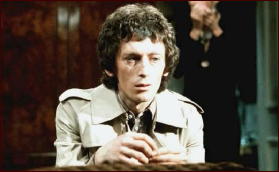
“LADY KILLER.” An episode of Thriller, ATV, England, 14 April 1973. (Series 1, Episode 1.) US title: “The Death Policy,” as part of ABC’s late-night program Wide World of Entertainment. Robert Powell, Barbara Feldon, Linda Thorson, T.P. McKenna, Mary Wimbush. Screenwriter & series creator: Brian Clemens. Director: Bill Hays.
I have some good news. According to TVShowsonDVD, the complete version of this highly acclaimed British TV series will be available on DVD in the US sometime early this year. The first series of 10 episodes came out here in 2006, but while I have a copy, the set has been out of print for quite some time. All six series, 43 episodes in all, have been available in the UK for a while, but that’s been it for anyone in the country without a multi-region player.
This is good news, indeed, so I wish I didn’t have a few nits to pick with the story line. It isn’t the players. Robert Powell (The Italian Job, The Thirty-Nine Steps) does a villain very well, and Barbara Feldon (Get Smart) is a marvelously wonderful victim, an innocent from Indiana and on a leisurely visit to England, only to fall prey to a clever con man’s scheme.
Part of the fun of watching a program such as Thriller are the twists and turns of the plot, so I’ll do my best not to tell you more than I should. Linda Thorson is part of the story, and she’s excellent as well, something I thought I’d never say, having “hated” her for such a long time for her audacity in replacing Diana Rigg in The Avengers.
Even though I think the world of Brian Clemens, who died about a month ago — the producer of such noted shows as The Professionals and the aforementioned The Avengers among several other ventures — it’s the writing, most surprisingly, that I had a few issues with. Perhaps it’s the British style, or perhaps it was in 1973, but the suspense in “Lady Killer” is allowed to build only gradually, and then sputtered along on matters that puzzled me more than thrilled me.
You know from the beginning that Jenny Frifth is going to be the victim, but of what? An ordinary scam, with only money involved, or does Paul Tanner (Powell) have murder in mind? (Well, so says the title.) And who is his accomplice?
But here’s the rub. If I were to be carrying out a plot such as his, I’d be sure to carry out my conversations on the telephone with my accomplice somewhere other than in a room downstairs when my victim is supposed to be asleep upstairs with a phone next to her bed. I would also confront and take care of an interloper in my plans the same way, not downstairs with the lady sent upstairs.
And for a gentleman supposed to be such a cool-minded criminal, why does he go to pieces when the lady decides to please him by putting on makeup and redoing her hair?
What for me was even more off-putting was the business with the phone and the lady picking it up. For whatever reason, it was never brought up again. The aforementioned interloper also played his role very poorly, not thinking his plans through carefully enough. Here was a perfect example of Too Little Too Late, or at least Too Late, but thankfully (and luckily) not for Barbara Feldon’s character.
You may think at this point I hated this little play, but I didn’t. The acting is superb throughout, and so are the settings, including a manor house of some magnitude, of course, and an isolated path along a rocky cliff overlooking the sea. I enjoyed this first episode in the series immensely, trying to outguess the writer at every step of the way, maybe even trying too hard. I’d still have to say that I’d have staged it a bit differently. It would not have been difficult. My nits are just that, major in their own inimitable way, but they could easily be overcome.
VICTOR ARMSTRONG – The Free-Lance Spy. Major Book 3051, paperback original; 1st printing, 1976.
Every once in a while I try to dive into my latest stack of obscure paperback originals by unknown writers, hoping to find a nugget or two. Sometimes I do. More often I don’t. Here is such an example.
This is the only book by Victor Armstrong in Al Hubin’s all-inclusive Crime Fiction IV, and there is no information there about the author. I suspect that Victor Armstrong is only a pen name, but if so, I have no idea who he might otherwise be.
It reads as though it might be the first in a series, but if so, it never came to be. The primary protagonists are Eric Walden and his constant companion Sachi Lee. Walden is a professor of English at Columbia University, working on a paper “tracing the etymology of four-letter Anglo-Saxon dirty words,” but he also has an extensive background in cards, dice and other forms of gambling, with hints of secret undercover activities preceding this particular venture.
As for Sachi, you need to know little more than that she is exotically beautiful and that she never “wore a bra — nor needed one.”
In Free-Lance Spy Professor Walden is hired to investigative an immensely wealthy and ultra-ultra-conservative self-styled General Dobbs, who owns an entire county in Arizona immediately adjoining the Mexican border. Making the case urgent is that Dobbs is buying all of the gold and silver available on the free market. What are his intentions? Taking over the US by economic means? Walden fears he is in over his head. Sachi is only along for the ride.
The book is inoffensive fun for a while, otherwise I would never have finished it. Armstrong often writes in short fragmentary sentences, sometimes with neither subject nor verb, and sometimes the witty byplay is almost witty.
Unfortunately the book ends with the good guys parachuting into Dobbs’ isolated and well-guarded compound, and taking over with no casualties nor even any sweat upon their assorted brows, including the always well-composed Sachi’s. After over 160 pages of buildup, you’d think there’d be a lot more resistance than this. Maybe 176 pages were all there was budget for.
CHARLOTTE MacLEOD – The Palace Guard. Doubleday/Crime Club, hardcover, 1981. Avon, paperback, 1983.
If you like mysteries made in Boston, here’s one for you. (Strangely enough, not since radio’s long-running Johnny Dollarseries has there been much going on in Hartford. Janice Law’s recent Death Under Par is an exception that comes first to mind.)
I’ve missed the first two books in this series, but apparently Sarah Kellings has lost her husband, a man much older than herself, and as a result she’s been forced to take in boarders. They are a motley lot, taken from many different segments of Bostonian society — none very high.
One of them is an art expert named Max Bittersohn, who combines romancing his landlady with helping her solve the murders of two guards at one of Boston’s lesser-known museums.
Keep your eye on the motive. Many digressions later, cleverly disguised as part of the murder investigation, it turns out to have been the missing essential ingredient. Charlotte MacLeod has a knack for inventive characters and an eye for the humor in a situation, and besides — it also keeps our eye off the shell that’s had the pea tucked safely inside it all along.
Rating: B.
— Reprinted from The MYSTERY FANcier, Vol. 5, No. 5, Sept-Oct 1981.
Bibliographic Notes: This was the third of twelve recorded adventures of Sarah Kelling and Max Bittersohn, who at one point in the series became married. The leading character in Death Under Par by Janice Law, mentioned in the review, was PI Anna Peters. There nine books in that series, but whether she was based in Hartford for all nine, I do not know. According to Hubin’s Crime Fiction IV, her cases took her all over the world.
THE BLACK CASTLE. Universal, 1952. Richard Greene, Boris Karloff, Stephen McNally, Rita Corday, Lon Chaney Jr., Michael Pate, Henry Corden. Written by Jerry Sackheim. Directed by Nathan Juran.
You watch this and that trite old praise-phrase “for kids of all ages” comes irresistibly to mind. Black Castle is packaged as a horror flick, but it looks more like a swashbuckling adventure film, with sword fights, suave villainy, chases through the eponymous castle and a last minute “save†that presages The Princess Bride.
The story is an appropriately simple affair: Richard Greene, the definitive Robin Hood of my youth, is an 18th-Century British nobleman who travels to Austria incognito to find out what became of two old war buddies who disappeared after visiting the estate of Count Karl Von Bruno. (German villains had not yet gone out of fashion in ’52, and this one is played by Stephen McNally.) It seems that Green and his vanished comrades apparently had some sort of run-in with McNally years ago in Africa, but the script is vague on this point, and for plot purposes they have never actually met.
Von Bruno’s castle is filled with all sorts of kiddie-delights: crashing gates, alligator pit(!) murky dungeon and a host of sinister players, chiefly Boris Karloff as the Royal Sawbones, Lon Chaney Jr. as the Castle Goon, and Michael Pate as a fawning toady. There’s also Rita Corday (not to be confused with Mara Corday, another Universal starlet of that era) as the requisite Damsel, but writer Jerry Sackheim keeps her in distress, so the story doesn’t get slowed down by mushy stuff.
And soon enough we’re running through all the thrills I enumerated earlier, handled very stylishly indeed. Black Castle was produced by William Alland, who was responsible for a series of above average 50s sci-fi flicks, but will always be remembered as the half-seen reporter in Citizen Kane.
Cinematographer Irving Glassberg (The Web, Bend of the River, The Tarnished Angels, etc.) underlines the mood with appropriately bizarre lighting, and director Nathan Juran….. Well, Juran was never considered much of a stylist, but with cult films like Seventh Son of Sinbad and Attack of the 50-Foot Woman to his credit, you can’t write him off completely.
And then there’s the cast: Stephen McNally was one of those actors who should have gone all the way to the top and I can’t figure why-the-hell he didn’t. Or maybe it was his performance here; don’t get me wrong, it’s marvelously full-blooded and perfectly suited to this movie. But it’s not the sort of thing that gets you noticed at Awards time.
Boris Karloff and Lon Chaney Jr. don’t have any scenes together and in fact aren’t in the film all that much. Henry Corden gets more screen time than they do, and if you don’t know who Henry Corden is, shame on you. Still it’s nice to see them headlining a horror film once again, particularly since most of the music here is cribbed from House of Frankenstein — their only other co-starring film.
In all, a truly enjoyable waste of time, and one I recommend heartily.
Devoted to mystery and detective fiction — the books, the films, the authors, and those who read, watch, collect and make annotated lists of them. All uncredited posts are by me, Steve Lewis.