Reviewed by DAVID VINEYARD:         


JOHN BUCHAN – Witch Wood. Hodder & Stoughton, UK, hardcover, 1927. Houghton Mifflin, US, hardcover, 1927. Reprinted many times since, in both hardcover and soft.

   I’ve written elsewhere on this blog about the virtues of John Buchan as storyteller. thriller writer, scholar, man, and political figure, but as memorable and loved as his ‘shockers’, as he called them, are, his greatest talent perhaps was his gift as a historical novelist, books like Blanket of the Dark, Salute to Adventurers, The Free Fishers, and The Path of the King are among his finest works, and among them lies his foremost achievement, a novel that transcends genre and rises to a rare power, Witch Wood.

   Being a Scot, and with a Scot’s sense of the uncanny, Buchan was a natural to deal with the darker side. He was a favorite of Lovecraft and Howard, and his shorter works like “Watcher by the Threshold” and “The Grove of Ashtoreth,” are often anthologized among the best of their kind. Witch Wood is his only novel length flirtation with the uncanny. (Gap in the Curtain is science fictional and largely a parable though uncanny on its own).

   Those familiar with Buchan will not be surprised to find Witch Wood was chosen one of 100 Best Supernatural novels ever written, and with good reason, because in it are echoes of Scott and Stevenson as well as Machen, James, and Blackwood. It is no wonder it appealed to Lovecraft and Howard, for something ancient and malevolent lurks in the shadows of the witch wood.

   The place is Scotland, the time the late seventeenth century towards the end of the Montrose rebellion when the country side is torn by civil war, and at a time when Scotland was haunted by the iron hand of the Kirk, and the the scent of Satan’s breath as witch hunts, black mass, and hypocrisy walked hand in hand. As Buchan’s minister hero admits: “If the Kirk confines human nature too strictly, it will break out in secret ways, for men and women are born into a terrestrial world, though they have hopes of Heaven.”

   This is the way of things in the village of Woodilee where young David Sempil has come to minister the local kirk, a place of superstition, complacency, and distrust of outsiders in a time of violence and cruelty, and Witch Wood is the tale of the young minister and how he came to depart that Kirk: “…right in the heart of Reiverslaw’s best field of turnips was a spring…which the old folk called the Minister’s Well, and mentioned always with a shake of the head or a sigh, for it was there, they said, that the Minister of Woodilee had left the earth for Fairyland.”

   Woodilee’s shame is hidden though, hidden in a place where brave men fear to tread and locals avoid, the Black Wood, once called, Melanudrigill.

   The place was hateful, but it could not daunt him. It was the battleground to which he was called… On the edge of trees was a great mass of dark foxgloves, the colour of blood, and they seemed to make a blood-trail from the sunlight into the gloom.

   Almost from the beginning the young minister clashes with the elders of the Kirk. They have narrow interpretations of Scripture and pick and choose what suits them. They are cruel in their piety, proud of their record for burning witches, yet among their number, among the most pious and cruel, lies the agent of the great deceiver himself.

   It’s the dacent body that sits and granes aneath the pu’pit and the fosy professor that wags his pow and deplores the wickedness o’ the land.—Yon’s the true warlocks. There’s saunts in Scotland, the Lord kens and I ken mysel’, but there’s some that hae the name o’ saunts that wad make the Devil spew.”

   That’s not far off the message of Buchan’s shockers and that moment in The Power House when the “thin veneer of civilization” falls away in the middle of Piccadilly Circus.

   It is in the Wood that David first witnesses the devil’s mass when he dares to venture into it on “ … the day they ca’ the Rood-Mass and the morn is the Beltane, and it behoves a’ decent bodies to be indoors at the darkenin’ on Beltane’s Eve.”

   And sure enough David stumbles on a black mass and in his rage attacks and is badly beaten. He survives, and now he knows his mission. “I have had my eyes opened and I will not rest till I have rooted this evil thing from Woodilee. I will search out and denounce every malefactor, though he were in my own Kirk Session. I will bring against them the terror of God and the arm of the human law. I will lay bare the evil mysteries of the Wood, though I have to hew down every tree with my own hand. In the strength of the Lord I will thresh this parish as corn is threshed, till I have separated the grain from the chaff and given the chaff to the burning.”

   Despite the wrath of an Old Testament prophet, David is, as his name implies, a simple good man. Witch Wood is not the story of a towering figure arraigned against the powers of evil, but of a fallible good man battling for the soul of his Kirk, not against towering Luciferian powers, but ordinary men, corrupt and corrupted, weak and foolish, and afraid: “…you think you can tamper with devilry and yet keep your interest in Christ…I tell you that your covenant is with Death and Hell.”

   Yet he is also a simple man who falls in love with Katrine Yester of Calidan, a great lady, and an almost elfin figure he spots by a pool. Their love will change him from a boy raging against evil to a man determined to save as many souls as he can.

   Aside from Katrine, one of his few allies is Mark Kerr, cavalier and soldier of Montrose, who David agrees to hide and nurse to health after he is wounded when Montrose is defeated and on the run for the Highlands.

   Kerr, who takes the name of Mark Riddel, is a handsome adventurer with a quick blade and little patience with the good folk of Woodilee, but he knows a man when he meets one. He’s a figure right out of Stevenson, and breathes great life into the proceedings by dint of his jaundiced eye and dark humor. Leaving David with a small army of a handful of villagers, an outlaw, and a beautiful almost enchanted woman to fight the powers of darkness, the Kirk Session, and the highest court in the Kirk Aller that all oppose him when he dares to call out wealthy Ephraim Caird of Castlemore, the leader of the coven.

   When the village is swept by plague, David, Katrine, and Mark fight to save them, but David is blamed for bringing the plague, and when Katrine dies, he is left more alone than ever, yet from her death he gains a determination to fight. He witnesses a second mass, this time with a more empathic eye for the people mislead by superstition and narrow minds into this blasphemy, and things come to a head when Caird convinces a woman from the coven to confess to witchcraft and be tortured to death to cover himself. “What devil’s prank have you been at?” he cried.—”Answer me, Ephraim Caird.” David is ready to kill to try to save the foolish woman and violence is only averted by the presence of Mark Kerr, and only because she is too far gone to save.

   Still, that is the last straw and David summoned before the Kirk Aller, to be tried for daring to defy his own Kirk Session and denying the wealthy Caird. By this point he no longer cares about his ministry, only to save Woodilee from itself and try to save Caird’s soul: “Hell is waiting for some, and maybe this very night,” building to a powerful and dramatic ending when David drives a terrified cowering Caird into the Wood, to the profane altar, to try and save him.

   â€œRenounce your master here in his temple… I will give you words if you have none of your own.

   “Say after me, ‘I abhor and reject the Devil and all his works, and I fling myself upon the mercy of God.’ Man, man, it is your immortal soul that trembles above the Pit.”

   But a maddened Caird, driven by the baying of the hounds of hell on his heels, breaks away and runs in blind flight. It’s a memorable moment, and you may hear the hounds yourself reading it.

   With David and Caird missing, it is Mark Kerr who holds the Kirk Session at sword point to chastise them. Caird is dead: “Go and look for him. You will find him in a bog-hole or a pool in the burn. Bury his body decently, but bury it face downward, so that you speed him on his road,”and Mark has words of his own to preach to the hypocritical ‘Pharisees’ of the Kirk: “A prophet came among you and you knew him not. For the sake of that witless thing that is now going four-foot among the braes you have condemned the innocent blood. He spent his strength for you and you rejected him, he yearned for you and you repelled him, he would have laid down his life for you and you scorned him. He is now beyond the reach of your ingratitude.”

   The ironic epilogue reveals how history sided with the Kirk Session and condemns David as the cause of all the problems and a failure in his ministry, though at the very end we are shown two men, one Mark Kerr, buying passage out of Scotland to find a war to fight in.

   â€œAll roads are the same for us that lead forth of this waesome land …” and the two men stand on deck as they watch the “hills of Lothian dwindle in the bleak April dawn.” While in Woodilee they still tell tales of how the minister of Woodilee was abducted to Fairyland…

   Witch Wood is one of those books that I would pack for that mythical desert island where book lovers hope to be stranded with their most beloved tomes. It is not an easy book, in fact even if you read it in hardcovers or paperback I suggest you download the annotated version available in e-book form at Roy Glashan’s Books, but it is more than worth the effort.

   It is a fine novel, a moving love story, an adventure of the first water, and though there is not one actual supernatural event you can point to in the novel, one of the finest novels of the supernatural ever written. Here the Devil only appears in flawed human form, there are no angels, no miracles occur, all the terrors and darkest fears arise from the human mind and no Dracula, Hyde, sorcerer, demon, or real witch darkens its pages, but the scares here are genuine, the confrontation between good and evil palpable, and you may never look at a dark wood the same again.

   Unlike most of today’s writers in the field, Buchan is not a twelve year old boy leaping out to say boo or trying to gross you out in blood and gore. Witch Wood goes to more deeply seated fears. It reminds us of our fragile humanity, our capacity for blinding ourselves, and that a simple good man can be enough to stand against the most powerful of evils even where once “the great wood of Melanudrigill had descended from the heights and flowed in black waves to the village brink.”

Note:

   Some of the language in Witch Wood will inevitably remind you of J.R.R. Tolkien and The Hobbit and The Lord of the Rings, and I think that is no accident. Aside from the ‘hills of Lothien’ and other similar passages, one of the Kirk Session who sins most grievously against David is named Mr. Proudfoot.

   I strongly suspect it is no accident, and that David Sempil and Mark Kerr may well be models in some ways for Frodo and Aragorn and Woodilee for the Shire, as much as David Balfour and Alan Breck served as models for them. But read it yourself and see if you agree.
Reviewed by JONATHAN LEWIS:         


KANSAS PACIFIC. Allied Artists, 1953. Sterling Hayden, Eve Miller, Barton MacLane, Harry Shannon, Tom Fadden, Reed Hadley. Director: Ray Nazarro.

   Kansas Pacific is a perfectly watchable, albeit altogether unremarkable, Western set in Kansas on the eve of the Civil War. Directed by the prolific Ray Nazarro, whose The Black Dakotas was reviewed here on this blog, the film stars Sterling Hayden as Captain John Nelson, a U.S. Army engineer. His mission: ensure that the Kansas Pacific Railroad, which the U.S. Army plans to utilize for troop movements to the West, is constructed in a safe and timely manner.

   Nelson arrives in Kansas to assist Cal Bruce (Barton MacLane) in building the railroad. Bruce’s daughter, Barbara (Eve Miller) is suspicious of Nelson’s encroaching on her father’s turf. She also wants her father to quit his work and go back East. Naturally, there’s tension between Capt. Nelson (Sterling) and Barbara Bruce (Miller), which eventually culminates in love.

   Opposing the two men are the Confederate sympathizer, William Quantrill (Reed Hadley), and his gang of generic thugs. Among them is a guy by the name of Stone, portrayed by Clayton Moore of The Lone Ranger fame. The Confederates aren’t presented as anything other than violent men determined to stop the construction of the railroad. There’s not much nuance here.

   Hayden’s character comes across as both gruff and sentimental. He wants very much to earn Barbara Bruce’s respect. On the other hand, he’s a man on a mission and determined to get the railroad built, even if it causes friction between the two of them.

   There’s not much in the way of memorable dialogue in Kansas Pacific, but no one watches this type of film for snappy banter. There is, however, a good bit of action, some of it quite explosive. There’s a well-choreographed fight scene, replete with artillery, at the end. There’s also a fairly tense scene in which Capt. Nelson and Quantrill face off in a saloon.

   Kansas Pacific is a decent, average Western with about average performances from Hayden and MacLane. The historical context, rather than the acting, may be the most intriguing aspect to the film. Kansas prior to the Civil War is a rich area for writers and filmmakers, and it’s a bit different from the overused Western narrative of a Confederate soldier returning home from the war.

   In conclusion, the film’s not bad. It’s just not nearly as interesting as it could have been.

IT’S ABOUT CRIME
by Marv Lachman

MICHAEL INNES – A Night of Errors. Dodd Mead, US, hardcover, 1947. US paperback reprints include: Berkley F833, 1963; Penguin, 1966; Perennial Library, 1989 (shown). First UK edition: Gollancz, hardcover, 1948.

   In A Night of Errors by Michael lanes, the inspector who asks Sir John Appleby’s assistance says, “The whole thing is a nightmare. Three identical brothers creeping around the place with each other’s dead bodies! It’s like a drunken hallucination.”

   It’s certainly a hilarious farce, one which owes more than its similarity of title to Shakespeare’s A Comedy of Errors. One character is Romeo Dromio. There is also a thieving butler named Swindle, and Grubb, the gardener who “had long schooled himself in the prime duty of being disgruntled.”

   Besides the civilized dialogue and literary allusions we have come to expect from Innes, there are many plot surprises, as well as a fair and ingenious, if scarcely believable, solution.

— Reprinted from The MYSTERY FANcier, Vol. 11, No. 3, Summer 1989.

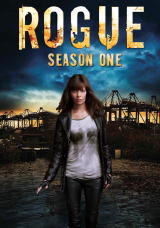
ROGUE. DirecTV, Season One (10 episodes), April-May 2013. Thandie Newton, Marton Csokas, Sarah Jeffery, Joshua Sasse, Kavan Smith, Leah Gibson, Jarod Joseph, Ian Tracey, Ian Hart.

   I don’t have a hookup with DirecTV, so I had to wait for the series to come out on DVD to be able to watch it, that and a span of a couple of weeks to find the time. For me, it started slowly but gradually caught my attention, and I ended up watching the last two episodes in one evening (last night).

   The star of the series is without a doubt Thandie Newton, who plays Grace Travis, a black police officer from the San Jose Police Department who has been working undercover for the Oakland police to get the goods on Jimmy Laszlo (Marton Csokas), a local crime boss controlling the waterfront area. But obsessed with finding out who killed her young son in what was written off as a tragic but accidental drive-by shooting, she finds herself getting deeper and deeper into a complicated plot of greed, revenge, mob killings and more, alienating her own family while getting closer and closer to the man she is supposed to be bringing down.

   It takes all ten episodes for the entire story line to work its way through, and naturally there is plenty of violence to go along with it, some of shockingly graphic. And perhaps equally naturally not everyone in the cast survives to the end, some a lot sooner than viewers might expect, including this one. There is also, given the freedom of not being seen on broadcast TV, quite a few almost as graphic sex scenes.

   The setting, mostly in around the Oakland waterfront (but probably filmed in Canada) and the seedier sections of that particular town, is beautifully filmed, and the plot has enough twists and turns to keep everyone’s minds constantly in high gear.

   The largest downside is the level of the actors’ performances. I found them uneven, to say it mildly, from actor and actor, and even in the case of some of the players, from scene to scene. Some of the dialogue is awkward and clunky, though, and tough to bring off convincingly, so the actors don’t deserve all of the blame.

   Thandie Newton carries the show well, however. The character she plays is both tough and vulnerable, and she is placed in any number of situations in which she can show off how she tries to deal with them, and believe me, she gets into quite a few scrapes and narrow escapes. It would be a strenuous role for anyone, especially the vulnerability Newton’s character has to display, as mentioned above, and I think she nails it. I can’t imagine anyone else playing the part.

   The series deserved a second season, and it got one. It’s playing now but will end its run this week.


REVIEWED BY DAN STUMPF:         


FURY AT GUNSIGHT PASS. Columbia, 1956. David Brian, Neville Brand, Richard Long, Lisa Davis, Percy Helton, Morris Ankrum, Wally Vernon. Written by David Lang. Directed by Fred F. Sears.

   Whence this film?

   A stylish, well-paced and intelligent western, written and directed by talents whose careers could be charitably described as “undistinguished.” Writer David Lang was responsible for a long, long list of forgettable B-movies followed by work on every low-budget television series known to man; and as for director Fred F. Sears, well, he started out acting in “Durango Kid” movies, moved on to directing them, then continued directing, sort of. The same year as this film he made probably his best-remembered movie, Earth vs. Flying Saucers, and the next year followed it up with The Giant Claw — a film equally memorable for all the wrong reasons.

   Perhaps we’ll never know what burst of creative inspiration produced Fury at Gunsight Pass, but it’s a film well worth catching, filled with smoothly tracking and complex camerawork, vigorous shoot-outs, complex characters and a story that stubbornly refuses to settle into any familiar pattern.

   David Brian (looking unsettlingly like William Boyd in his western garb) and Neville Brand are co-leaders of an outlaw gang planning to rob a bank in the small town of Gunsight Pass. Of the other outlaws, the only actor you might recognize is perennial side-kick Wally Vernon, but they do a fine job of looking nasty, even when just sitting around, and when they go into action they more than fill the requisite boots. Turns out the local undertaker (the indefatigable Percy Helton) is inside man on the job, and it further develops that Brian plans to double-cross Brand and take off with the loot.

   Well, he’s not the only one with a hidden agenda, as things fall apart in spectacular fashion, the loot walks off, the townspeople capture the bad guys, then the bad guys capture the townspeople, and the whole thing gets resolved amid a furious and very cinematic dust storm.

   David Brian was never the most electrifying of actors, but he puts in a nice turn here, the wheels of deceit clicking very audibly on his face, and Neville Brand is as engagingly unpleasant as ever. David Long (you may remember him from the “Ma & Pa Kettle” flicks, or as the leading man in House on Haunted Hill, or even from Nanny and the Professor) is too pretty to take seriously at first, but he manages a very creditable Hero part stacked against long odds. The other actors, including Morris Ankrum, that grand old man of Sci-Fi movies, lend what is generally known as Solid Support.

   But it’s the tricky plot and assured direction that carry the day here, keeping the movie constantly on the move, twisting and turning where and when one least expects it, and finally ending up with a very satisfying and unpretentious bit of film-making where you might not expect to find it.

THE BACKWARD REVIEWER
William F. Deeck


OSMINGTON MILLS – At One Fell Swoop. Geoffrey Bles, UK, hardcover, 1963. Roy, US, hardcover, 1965.

   Aware that the case won’t do his career any good, Superintendent William Baker of Scotland Yard’s Special Branch nonetheless undertakes the investigation of the missing head of the C.I.D. in Bramwith. The policeman, a lay preacher in the Johnsonite sect, had disappeared shortly before he was to address a centenary celebration of the sect, if the Johnsonites can be said to celebrate.

   Since the policeman’s wife had tried to divorce him for cruelty and now has a lover, she and the lover are the first suspects, if there has indeed been foul play. Information also turns up that the C.I.D. man had with him on his travels two warrants; perhaps the individuals sought made sure that the warrants would not be served.

   Possible, too, is the involvement of the police superintendent where the C.I.D. man was going to serve the warrants. But what role does the leek slasher play?

   A good investigation by Baker and his assistant, Inspector Hughes, and an engrossing portrait of a fundamentalist Christian sect. Forgive the far-fetched coincidences and enjoy this one.

— Reprinted from The MYSTERY FANcier, Vol. 11, No. 3, Summer 1989.


BIBLIOGRAPHIC NOTES:

      The Insp. (Supt.) William Baker series —

Unlucky Break. Bles, 1955.
The Case of the Flying Fifteen. , Bles, 1956.
No Match for the Law. Bles, 1957.
Misguided Missile. Bles 1958.
Stairway to Murder. Bles, 1959.
Trial by Ordeal. Bles, 1961.
Headlines Make Murder. Bles, 1962.
At One Fell Swoop. Bles, 1963.
Traitor Betrayed. Bles, 1964.
Enemies of the Bride. Bles, 1966.

   Osmington Mills was the pseudonym of Vivian Collin Brooks (1922-2002), whose other series, eight in all, recorded the cases of Chief Insp. Rupert “Rip” Irving and P.C. (Sgt.) Patrick C. Shirley.

TWENTY DETECTIVE NOVELS BY LITERARY AUTHORS — A LIST

by Josef Hoffmann

   Of course Hammett, Chandler, Simenon and other crime writers are authors with a literary quality, but they are classified as mystery writers whose work is typical of the genre. The literary authors I refer to have written detective novels as an exception to their work which is considered as literature. Some of these detective novels are rather unusual and not typical of the genre, some are rather conventional.

   The following list is not complete.

Auster, Paul: City of Glass, Sun & Moon 1985 (in The New York Trilogy)

      – : Ghosts, Sun & Moon 1986 (in The New York Trilogy)

      – (as Paul Benjamin): Squeeze Play, Alpha-Omega 1982

Butor, Michel: Passing Time, Calder 1960, Simon 1960 (Translation of L’Emploi du Temps, 1956)

Chekhov, Anton: The Shooting Party, Paul 1926 (Translation of Drama na ochote, 1884)

Doderer, Heimito von: Every Man a Murderer, Knopf 1964 (Translation of Ein Mord, den jeder begeht, 1938)

Dürrenmatt, Friedrich: The Judge and His Hangman, Jenkins 1954 (Translation of Der Richter und sein Henker, 1952)

      – : The Pledge, Cape 1959 (Translation of Das Versprechen, 1958)

      – : The Quarry, Cape 1962 (Translation of Der Verdacht, 1959)

Fonseca, Rubem: Bufo & Spallanzini, Dutton 1990 (Translation of Bufo & Spallanzini, 1985)

      – : Vast Emotions and Imperfect Thoughts, Ecco Press 1998 (Translation of Vastas emocoes e pensamentos imperfeitos, 1988)

Gadda, Carlo Emilio: That Awful Mess on Via Merulana, Braziller 1965 (Translation of Quer pasticciaccio brutto de via Merulana, 1957)

Handke, Peter: Der Hausierer, Suhrkamp 1967 (as far as I know, not translated)

Hjortsberg, William: Falling Angel, Harcourt 1978

Kertész, Imre: Detective Story, Knopf 2008 (Translation of Detektivtörténet, 2001)

Pynchon, Thomas: Inherent Vice, Penguin Press 2009

Robbe-Grillet, Alain: The Erasers, Calder 1963 (Translation of Les Gommes, 1962)

Tabucchi, Antonio: The Missing Head of Damasceno Monteiro, New Directions 1999 (Translation of La testa perduta di Damasceno Monteiro, 1997)

Vargas Llosa, Mario: Who Killed Palomino Molero?, Farrar 1987 (Translation of Quien mato a Palomino Molero?, 1986)

      – : Death in the Andes, Farrar 1996 (Translation of Lituma en los Andes, 1993)

    Further Reading:

Detecting Texts. The Metaphysical Detective Story from Poe to Postmodernism, edited by Patricia Merivale, Susan Elizabeth Sweeney, PENN 1999

THREE BLONDES IN HIS LIFE. Cinema Associates, 1961. Jock Mahoney, Greta Thyssen, Jesse White, Elaine Edwards, Anthony Dexter, Valerie Porter. Director: Leon Chooluck.

   When an insurance investigator on the West Coast mysteriously disappears, the head of the firm on the East Coast sends Duke Wallace, Jock Mahoney’s character, across country to find out what happened.

   Turns out that the man in question was seriously attracted to blondes, and his wife has dyed her hair that color to keep him, to little avail. It also turns out that the man is dead, in what appears to be a love nest cabin up in the mountains. There are two other blondes in the story, both love-starved wives involved in cases that Collins (the dead man) had been working and closed.

   What this is is the kind of movie in which we see just how love-starved the three blondes are, as Duke makes his appointed rounds (in suit and tie) to each of the three ladies in question and in turn, but the funny thing is that he always manages to keep the suit and tie on, or at least he does while the cameras are rolling.

   There also is a lot of emphasis on bosoms and bottoms, including those of the secretary of the fellow who heads up the West Coast office, but since she’s a brunette, she doesn’t really count, but I’ll mention the actress who plays her, Darlene Hendricks, just for the record.

   I was reminded a lot of the second- or third-rank tier of fictional PI’s in the paperbacks of the 50s and 60s, guys like Johnny Liddell, Peter Chambers and Lou Largo. The budget was smaller than it might have been, though, and the story seems to end just as the money probably ran out.

   There is one fight scene that might make this movie worth watching, though, if you happen to watch long enough. It comes quite close to end, and it begins with Duke, or rather Jock Mahoney doing his own stunts (or so I’m told), crashing headlong through a closed door, clear across the room at full tilt, and ramming into the guy inside, uptilting him as well as himself against a stuffed chair and into the wall on the left side of the screen, upon which point they manage to smash up the rest of the room very thoroughly and badly.

   It nearly took my breath away, it did.

SHERLOCK HOLMES AND THE DEADLY NECKLACE. Central Cinema Company Film, Germany, 1962. Original title: Sherlock Holmes und das Halsband des Todes. Christopher Lee (Sherlock Holmes), Thorley Walters (Dr. Watson), Hans Söhnker (Professor Moriarty), Hans Nielsen, Senta Berger, Ivan Desny, Wolfgang Lukschy, Leon Askin, Edith Schultze-Westrum (Mrs. Hudson). Screenplay: Curt Siodmak, based on the novel The Valley of Fear, by Sir Arthur Conan Doyle. (Co-)Director: Terence Fisher.

   In spite of some very good scenes, this film was largely a disappointment, the first reason being that all of the English-speaking actors, including Christopher Lee, were dubbed (or redubbed) back into English, by the voices of others. What a waste of talent, and only to save a few dollars in production costs (as I understand it).

   Perhaps even better than Lee in the leading role is the German actor who plays Moriarty, and very much Holmes’ equal in several tense scenes they share together. As Dr. Watson, British character actor Thorley Walters plays the part as one or two notches above the level of Nigel Bruce’s bumbling portrayal, but no more than that, nor is he nearly as charming.

   There is very little resemblance to the story in this film to Doyle’s Valley of Fear, but the one scene which appears in each is one of the better ones in the film. The “Deadly Necklace” of the title is one that belonged to Queen Cleopatra of Egypt, and Dr. Moriarty is determined to have it in his possession, at all costs. Sherlock Holmes demurs, and the game is on.

   The setting seems to be in the 1910s, based on the use of vintage autos of that era rather than hansom cabs, which clashes with a very nice jazzy and swinging film score much more appropriate to a jazzy and swinging movie from the 1960s.

   But the biggest problem is the presence of scenes that exist only for cinematic effect and otherwise do not go anywhere, such as an opening scene with Holmes (in disguise) watching Moriarty at the docks before we know who either player is, and which is not referred to later on except in the briefest of mentions.

   Or another in which Holmes (in disguise) calls for help in front of his apartment in Baker Street, is “rescued” by Watson, who finds him collapsed on the doorstep and does not recognize his friend. It is all a hoax played by Holmes on Watson, but why?

   And, oh, one other thing. Whenever I leave my car, whether I’m involved in an accident or not, I always take my keys with me.

   Give this one a pass, unless you’re a fan of Christopher Lee. Fans of Sherlock Holmes might otherwise want to stay away, or at least don’t go too far out of your way to obtain a copy, even though copies are easily (and quite inexpensively) found.

IT IS PURELY MY OPINION
Reviews by L. J. Roberts


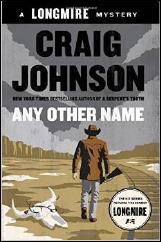
CRAIG JOHNSON – Any Other Name. Viking, hardcover, May 2014. Police procedural: Sheriff Walt Longmire, 10th in series. Setting: Wyoming.

First Sentence:   Joseph Conrad said that if you wanted to know the age of the earth, look upon the sea in a storm; if you want to know the age of the Powder River country just be on the wrong side of a coal train.

   Sheriff Walt Longmire is about to be a grandfather —very soon. He has promised his daughter, Cady, that he will be in Philadelphia for the baby’s birth. His old friend and former boss, Lucian Connally, asks him for a favor of going with him to an adjacent county and visit a woman whose daughter is missing. One missing woman leads to secrets, corruption and possible death.

   Johnson is the epitome of a story teller. You are not a viewer; you are a participant. How does he do it? He starts by hooking you into the story from the very beginning by his strong voice and the ability to create a very visual sense of place. He makes you feel and see what he describes. His inclusion of spiritualism adds to the sense of place, the strength of the character and the story.

   Part of that voice is his humor. It’s not situational, but dry and natural. His dialogue is among the best being written. Most of it is his characters. Walt is such an engaging character. He is truly the “long arm of the law” and well-liked by his colleagues. But he’s not infallible nor is he superman.

   The supporting characters of Henry Standing Bear and Undersheriff Vic Moretti, Lucian and Dog are significant to the story. Best of all, even the secondary characters are well developed. None of Johnson’s characters are flat or stereotypes. They all have a part to play in the effectiveness of the story. Even the weather becomes a character within the story.

   Any Other Name is an excellent book. It’s filled with tension and breath-catching suspense, but the pacing is perfect with enough pauses in the action for balance. Johnson is an author who both entertains you and educates you. There’s not a single wrong step to be found.

Rating:  Excellent.

« Previous PageNext Page »