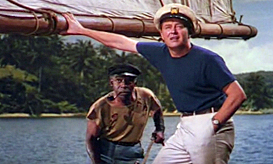
JAMAICA RUN. Paramount Pictures, 1953, Ray Milland, Arlene Dahl, Wendell Corey, Patric Knowles, Carroll McComas, Bill Walker, Laura Elliot (Kasey Rogers), Murray Matheson, Clarence Muse, Michael Moore, Robert Warwick, Lester Matthews. Based on the novel A Neat Little Corpse by Max Murray. Director: Lewis R. Foster.
“Great House, piracy, war, slavery, and murder, everything in Comeback Bay has grown out of violence.” — Mrs. Dacey (Carroll McComas)
We are in Gothic country à la Rebecca in this attractive film adaptation of mystery novelist Max Murray’s novel A Neat Little Corpse. Ray Milland is Captain Patrick Fairlie, returning to Comeback Bay in Jamaica on a mission after the war; first, to establish his old business running the islands in his boat, and second, to reclaim his one time wife, Ena Dacey (Arlene Dahl) held captive by the neediness of her sodden mother (Carroll McComas) and brother Todd (Wendell Corey) who drove a younger Fairlie away before the war.
Fairlie soon learns things aren’t any better. Mrs. McComas hates him for threatening to take Ena away, Todd is still arrogant and short tempered, and Human (Bill Walker) the butler and houseman still runs the house and the natives with Obeah powers in one hand and Dacey influence in the other.
A new element though is William Montagu (Patric Knowles) looking to buy the beach front property, and interested in an old legend that the house was sold to another Dacey whose boat went down in a great storm with the evidence. He has found the heirs to that Dacey, Janice and Robert Clayton (Laura Elliot and Michael Moore), and wants Fairlie to dive on the old wreck to look for evidence of the sale.
Things are tense enough before Robert is found at the bottom of the ocean with his skull caved in, murdered.
Montague: One doesn’t lose a brother every day.
Todd: One couldn’t unless one had an awful lot of brothers.
Fairlie finds the chest with the papers, but not before he is nearly murdered by another diver and Janice Clayton nearly suffers a fatal riding accident.
Meanwhile things are getting more complicated with Todd finally coming around as he and Janice seem to fall for each other — or is he merely scheming to keep Great House, and Obeah man Human is casting spells and determined that the Dacey’s will never leave Great House no matter what the cost.
Ena: Human has cast a spell. The rolling calf is loose and someone must die.
Save for some rather unconvincing underwater scenes, and perhaps a too obvious villain (the book was a little better in that regard), there is some decent suspense generated and some good detective work including a well handled hearing where the truth is revealed, thanks to Fairlie’s detective work and help from the local police (Murray Matheson). The ending is nicely ironic and exciting giving the grand old place a proper Gothic send-off, since as someone once put it, Gothic fiction of the modern kind is about women getting a house, and often losing it and getting a man instead.
Though no auteur, Lewis R. Foster (who started as a writer on films like Mr. Smith Goes to Washington, It Happened Tomorrow, and The Farmer’s Daughter) was a capable director whose work in the late forties and fifties include some of my favorite minor A films of the era including Armored Car, The Lucky Stiff, Manhandled, Captain China, and Those Redheads From Seattle before moving primarily to television where he directed numerous series ranging from Four Star Playhouse to Zorro, Tales of Wells Fargo, and Walt Disney’s Wonderful World of Color along with a few films like Dakota Incident andTonka.
Jamaica Run won’t top anyone’s list, but it is an attractive and involving mystery, well acted, tightly directed, and with more than enough to keep most mystery fans involved.
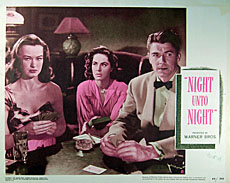
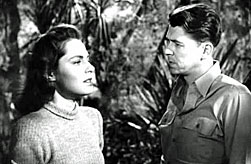
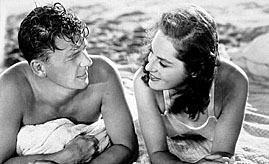
NIGHT UNTO NIGHT. Warner Brothers, 1949. Ronald Reagan, Viveca Lindfors, Broderick Crawford, Rosemary DeCamp, Osa Massen, Art Baker, Craig Stevens. Based on the novel by Philip Wylie. Director: Don Siegel.
Years before he directed Clint Eastwood, Don Siegel worked with Ronald Reagan in Night Unto Night, a romantic melodrama with a tinge of sunshine noir. Set on Florida’s alternatingly sunny and stormy East coast, this early film by Siegel is overall a highly uneven feature, but is nonetheless an immensely watchable postwar psychological thriller that defies easy categorization. Consider it a Gothic romance crossed with a ghost tale, or as a crime film without really any significant criminal act. It’s not great, but it’s good.
Reagan and Viveca Lindfors portray star-crossed lovers, each living in the shadow of death. Reagan’s character, John Galen, is a scientist in the business of developing medicine to save lives. In one of life’s dark ironies, he learns that he is slowly beginning to develop epilepsy. His response to this is to flee from his native Chicago and rent a house on the Florida coast. Most importantly, he wants to be alone and to shut out the world.
That’s easier said than done, however, as he slowly becomes entangled with two European sisters, Ann Gracy (Lindfors) and her highly seductive sister, Lisa (Osa Massen). After Lisa fails to seduce Galen, she becomes enraged when it’s revealed that Galen and Ann have fallen in love.
If things weren’t complicated enough for our physically declining protagonist, he soon learns how psychologically scarred Ann is from the death of her first husband. So devastatingly broken in fact, that she hears his voice speaking to her from beyond the grave. Unfortunately, Lindsfors tends to overact these scenes, making them more maudlin than terrifying.
Siegel’s use of atmosphere in cinematic storytelling, on the other hand, can’t be beat. Add in a dark and stormy night battering the windows of an old house, a gun collection, and you’ve got yourself one overwrought post-war melodrama that tries, even if not all that successfully, to say something about love conquering death. Still, for Reagan fans and those interested in seeing what Siegel’s early output was like, Night Unto Night, at a running time of less than ninety minutes, is well worth the effort.
SARAH DUNANT – Birth Marks. Hannah Wolfe #1. Doubleday, hardcover, 1992. First published in the UK: Michael Joseph, hardcover, 1991.
This is Sarah Dunant’s second mystery, but the first (I believe) featuring London-based private detective Hannah Wolfe.’ I believe we have a winner here.
Hannah accepts a job that’s basically a missing persons case — young ballet dancer hasn’t send her more-or-less adopted mother a card when she should have, and the woman is concerned. Though Hannah first believes that the young woman simply wanted not to be found, she takes the case because she needs the money. After the investigation has begun, but before anything substantive has been learned, the missing dancer is fished out of the Thames, dead, an apparent suicide, eight months pregnant.
Based on what she’s learned, Hannah doesn’t believe it,`nor does someone else: she is retained by an anonymous client to investigate further. The` trail leads to Paris, and leads Hannah into an ever-deepening questioning of her own feelings about motherhood.
Hannah Wolfe was not only believable, but appealing, and altogether the best feminine PI I’ve met in a long while. The character was beautifully developed, as were those of her sister, her ex-boss and “mentor,” and several others. Dunant’s prose style is literate and understated, and the narrative flow was very good.
This was an excellent book. There were no unbelievable characters, the plot made sense, the writing was fine, and it didn’t end in an orgy of violence. I don’t want to go overboard, but I liked this better than any first book (for me) I’ve read in a while. You need to give this lady a try.
— Reprinted from Fireman, Fireman, Save My Books #5, January 1993.
The Hannah Wolfe series —
Birth Marks. Joseph, 1991.
Fatlands. H. Hamilton, 1993.
Under My Skin. H. Hamilton, 1995.
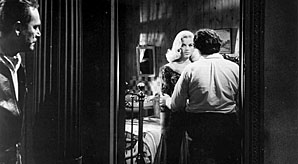
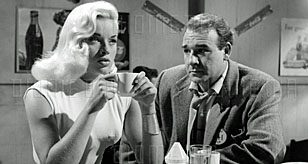
ROOM 43. British Lion, UK, 1958. Originally released in the UK as Passport to Shame. Odile Versois, Herbert Lom, Diana Dors, Eddie Constantine, Brenda de Banzie. Written by Patrick Alexander. Directed by Alvin Rakoff.
The ultimate British “B†picture.
Eddie Constantine stars (despite his 4th billing) as a London cab driver who gets in a financial pinch with a rather iffy loan company and is befriended by suave, wealthy Herbert Lom… who, it turns out, owns the Loan Company. Indebted to Lom, Eddie gladly agrees to a marriage of convenience to cute, virginal Odile Versois, who needs to marry a British subject so she can stay in the employ of a nice rich lady (Brenda de Banzie.)
It’s all a tissue of lies, of course. Odile was framed for theft by her employer back in France, who is in league with de Banzie, who is in league with Herbert Lom, who runs one of those high-overhead white-slave outfits you see only in movies: the kind I mentioned in House of a Thousand Dolls. [Reviewed here. ]
In this case, the expenses of enslaving Ms. Versois include bribing her erstwhile boss back in France, Ms de Banzie’s elegant apartment, the cost of getting a big truck to smash Eddie Constantine’s cab, then paying for the damages and tearing up the loan. There’s also the iffy loan company front, but maybe it pays for itself. Maybe it also pays for the small army of hired thugs Herbert Lom keeps at hand to ambush Eddie every ten minutes or so and beat him up when he gets qualms of conscience about the lovely Odile. As for the elaborate brothel, complete with secret passageways and a “respectable†façade where de Banzie holds court… well damned if I know where the money’s coming from.
But of course this wasn’t meant to be believable. Gritty, sordid and tough, yes, but in no way believable. Sort of the cinematic equivalent of an old Gold Medal paperback, with our hero rescuing the heroine, who is promptly snatched away by the bad guys, then rescued again, then… well you get the idea. There’s a nifty car chase, a few fights, a tawdry drug-dream, roof-top cliffhanger, and a general donnybrook when the Cabbies of London (here acting as England’s version of the Texas Rangers) battle Herbert Lom’s goon squad.
There’s also a brassy jazz score reminiscent of Elmer Bernstein’s classic Man with the Golden Arm, but perhaps the major point of interest here is Diana Dors, playing the proverbial hooker-with-a-heart-of-gold and decked out in lingerie right out of an Irving Klaw catalogue.
Without Diana Dors, this would still have been engagingly trashy, but her appearance here lifts it into the class of sublimely sleazy. Not a great film by any standards — maybe not even a very good one — but fun all the way.
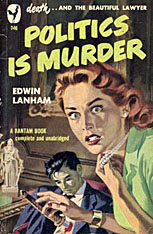
Since he would rather be playing chess, Jeff Stover is unhappy with his unsought appointment to the New York City Council. Still, it does give him a chance to set the cat — one Sachem McKeever. presently stuffed — among the pigeons by proposing a law to change the name of McKeever Place to Niebach Square, Niebach being his deceased predecessor.
A mild new law, one would think. but it makes some people unhappy. so unhappy, in fact, that someone inserts a samurai sword into Stover while he is sitting at his desk in City Hall.
George Wright, City Hall reporter, catches Stover’s former fiancee at the scene with blood on her hands. Since he is smitten with her, she must be not guilty. She also isn’t innocent, for while he lies for her, she tells untruths about him.
A good reporter but a dimbulb is Wright. Luckily there’s an intelligent and incorruptible cop with a long memory to do the real investigating in a good fair-play novel.
Bibliographic Notes: The cop that Bill referred to in his last paragraph must be Lt. Madigan, who first appeared in print in Slug it Slay (1946), and whose third recorded case was One Murder Too Many (1952). Between 1946 and 1963 Lanham was the author of a total of 12 crime novels listed in Hubin. Throughout his career, he was also a prolific author of serials and short fiction for the slick magazines such as Collier’s and The Saturday Evening Post. Lanham was also well enough known as a writer of literary fiction to have a page on Wikipedia.
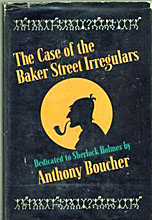
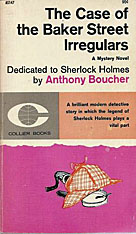
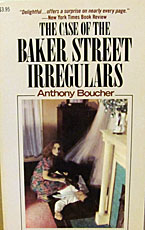
ANTHONY BOUCHER – The Case of the Baker Street Irregulars. Simon & Schuster, hardcover, 1940. Reprinted as Blood on Baker Street. Mercury #179, digest-sized paperback, abridged, 1953. Also published by Collier AS147, paperback, 1962; Gregg Press, hardcover, 1980; Carroll & Graf, paperback, 1986 & 1995.
In his early days as a mystery writer, renowned mystery critic Anthony Boucher was apparently much taken by the Ellery Queen school of detective puzzle writing, the more complicated the plot, the better. And as the title indicates, TCOT Baker Street Irregulars mixes in a quintuple dose of Sherlock Holmes as well.
There is a locked room mystery, codes to be deciphered — or should that be ciphers to be uncoded? — a large cast of characters, all trying to solve the mystery and all with (at the same time) alibis to be tested and broken, with ingenious solutions proposed by all and sundry, none of which hold up to the light of day — all with the zest and wit of an author who in his own way was a genius of the first rank indeed.
Dead is Stephen Worth, a hardboiled writer who hates Holmesian puzzles, but who has unaccountably been hired to write the screenplay for Metropolis Pictures’ latest project, that of filming their version of “The Adventure of the Speckled Band.” Protesting are all of the members of the Baker Street Irregulars around the country, five of whom are invited to come to Hollywood and be creative consultants on the project, mostly to keep them mollified and quiet.
Boucher’s most frequently used series character, Hollywood PI Fergus O’Breen is not on hand, but his sister Maureen is. She’s the trusted assistant to the head of Metropolis Pictures, and it becomes her job to keep an eye on the Irregulars (it was her idea, after all), all housed in one building. Who’s the housekeeper? None other than a young lady named Mrs. Hudson. Who’s the policeman who given the task of watching over the house after the murder occurs? None other than Sergeant Watson.
It is hard to keep the level of wackiness exhibited by the first third of the book going indefinitely, and the middle third sags noticeably, while the ending seems entirely too jerry-rigged to hold up against a bout of serious questioning. So I didn’t and I won’t. I just sat back and enjoyed it immensely. Not a book for modern readers, to be sure, but if your tastes are anything like mine, you’ll have a good time with this one too.
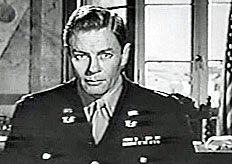
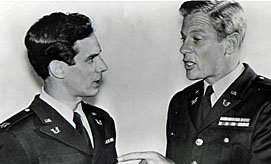
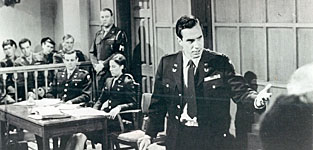
COURT MARTIAL. ABC; April 8 – September 2, 1966. Roncom Films,inc / ITC Presentation / MCA TV / Universal TV. Cast: Bradford Dillman as Captain David Young, Peter Graves as Major Frank Whittaker, Kenneth J. Warren as Sgt. John MacCaskey, and Angela Brown as Sgt. Yolanda Perkins or Diane Clare as Sgt. Wendy. Produced by Bill Hill or Robert Douglas.
By the sixties. television drama was developing a social conscience. Lawyers were among the leaders of this type of drama with series such as THE DEFENDERS, BOLD ONES, and JUDD FOR THE DEFENSE often featuring cases that focused on the issues of the day.
COURT MARTIAL followed that path and occasionally found great dramatic success. The series featured the activity of a small unit of the US Army’s Judge Advocate General’s Office (JAG).
The star was Bradford Dillman as Captain David Young, a dedicated lawyer whose emotions and desire to find the truth often drove him beyond the call of duty. He was also a typical philandering bachelor of the era. Dillman at times overplayed the role as a womanizer, where in some serious scenes while he was questioning women Young was more interested in flirting than listening. Yet Captain Young was the conscience of the series.
Co-starring was Peter Graves as Major Frank Whittaker, the officer in charge of the unit, and the one who chose the cases Young worked on. Graves was able to make Whittaker likable despite the Major’s loyalty to rules over compassion. He often argued with Young over methods but was flexible enough to let Young follow his passion. Whittaker at times took on a case himself even if it meant he was on the opposite side of Captain Young.
Captain Young described the Major best when commenting, “Isn’t it nice to meet a man who not only has principles but lives by them.â€
The staff consisted of two Sergeants. One was staff aide Sgt John MacCaskey played by Kenneth J. Warren. His basic purpose was to either lighten up the episode or give another character someone to talk to.
Finally there was the staff secretary. The series had two. First was Angela Browne as Sgt Yolanda Perkins. Next was Sgt. Wendy, played by Diane Clare. Both actresses were blonde and nearly interchangeable. Both were successful popular British actors. There was no explanation as to why the character Wendy suddenly replaced Yolanda. From the ten episodes I have seen the only difference between the two was Yolanda was more romantically interested in Captain Young than Wendy was.
COURT MARTIAL began as a two-part episode on KRAFT SUSPENSE THEATRE. “The Case Against Paul Ryker†(October 10th and 17th, 1963) starred Lee Marvin, Dillman and Graves. The two-part episode would later be re-edited into a movie called SERGEANT RYKER and released to theatres in 1968. The action took place in the Korean War.
In 1966 British TV network/syndicator ITC with Roncom Production decided to do a weekly series based on the episode with both Dillman and Graves returning. Not surprisingly the action shifted to WWII, a war more familiar to the British viewers that watched the series on the ATV network.
COURT MARTIAL became part of the late 60s British invasion to American network TV when ABC added THE AVENGERS and COURT MARTIAL to its line-up. ABC wanted to replace reruns with more original programs. COURT MARTIAL would take over for THE JIMMY DEAN SHOW.
Other British series on American TV at the time were THE BARON on ABC and SECRET AGENT (DANGER MAN) on CBS. THE SAINT was scheduled to follow in the fall on NBC. (“Broadcasting†January 31, 1966).
COURT MARTIAL focused on the tragedies of war, avoiding the pat expected happy endings common on much of American TV. Our heroes often lost their cases and the endings could make you wonder if justice had been served. It lasted only one season with 26 episodes filmed of which only 20 were shown in America (ten episodes are currently on YouTube).
The series was more appreciated in England, airing all 26 episodes and winning the British Society of Film and Television (BAFTA) award for Best Dramatic Series.
Production values were cheap. Location shooting was rare with much of the series shot at the Pinewood studio lot. There were too many British actors with bad American accents. Yet the realistic drama and depth of the characters and story more than made up for COURT MARTIAL flaws.
“Judge Him Gently.” June 3, 1966. Written by Gerry Day. Directed by Harvey Hart. Produced by Bill Hill. Supporting Cast: Diane Clare as Sgt. Wendy. Guest Cast: Joan Hackett, Fred Sadoff and Henry Gilbert. *** A badly wounded soldier who faced a life of constant pain and suffering dies after receiving an overdose of morphine. Captain Young is assigned to prosecute a hospital corpsman that had been drunk at the time.
After Young wins his case against the corpsman the Nurse in charge confesses she administered the fatal dose when the patient begged her to end his life. No one but Young wants to defend her and the act of euthanasia.
One of the best episodes of the series. Brilliantly written by Gerry Day, perhaps the best TV script she ever wrote in her successful fifty-year career. She was able to show the effects of war from the perspective of a female nurse. Joan Hackett was outstanding playing the tense emotionally broken nurse, adding an intensity and tragedy to the all ready powerful story.
The episode rejected melodrama for realism. It took on the issue of euthanasia as well as the cruelness of war with sensitivity and compassion. It rejected emotional scenes for scenes that showed the motives of all and the pain each dealt with inside. And most important it rejected judgmental easy answers.
“Taps for the Sergeant.” April 15, 1966. Written by Daniel Mainwaring. Directed by Peter Maxwell. Produced by Bill Hill – Supporting Cast: Diane Clare as Sgt Wendy. Guest Cast: Lee Montague, Moira Redmond, and George Roubicek. *** France, August 1944. Major Whittaker takes on the defense of a Sergeant who had fought with the French Foreign Legion and the French Underground before he joined the American Army. The Sergeant had disobeyed an order, an order that cost 12 men their lives.
https://www.youtube.com/watch?v=MIVHB0M0EGo
The story of the Sergeant was dramatic enough but it also presented an effective look at the depth of Major Frank Whittaker. The ending is a good example of the series attempt at showing the darkness of war and the uncompromising world of the military.
“Without a Spear or Sword.” June 24, 1966. Written by Mark Rogers. Directed by Peter Maxwell. Produced by Bill Hill. Supporting Cast: Angela Brown as Sgt Yolanda Perkins. Guest Cast: Dennis Hopper. Susan Hampshire and Francis De Wolff.*** Hopper plays a lonely loser, Cpl. Winston that gets caught with a stolen art piece. The piece was part of a private collection that was robbed before it scheduled move to a museum.
https://www.youtube.com/watch?v=Y0oeIf3tI0M
The episode explored the emotional side of Young from his seducing the beautiful woman who worked at the museum to his caring concern for the Corporal. Where Major Whittaker was more disciplined, Young found it difficult not to get personally involved.
COURT MARTIAL was a humorless, depressing quality drama that had little chance in its time slot of Friday at 10pm and opposite then hit series NBC’s MAN FROM U.N.C.L.E. This mix of COMBAT! and THE DEFENDERS deserves to be better remembered but instead joins the too many other forgotten attempts at quality dramas of the era such as SLATTERY’S PEOPLE and THE NURSES.
Devoted to mystery and detective fiction — the books, the films, the authors, and those who read, watch, collect and make annotated lists of them. All uncredited posts are by me, Steve Lewis.