REVIEWED BY WALTER ALBERT:         


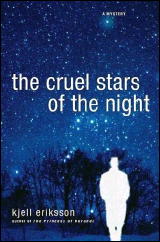
KJELL ERIKSSON – The Cruel Stars of the Night. St. Martin’s Press, hardcover, May 2007; trade paperback, April 2008. Translated from the Swedish by Ebba Segerberg.

KJELL ERIKSSON Ann Lindell

   Inspector Ann Lindell and her team at the Violent Crimes Division of the Uppsala Police struggle through much of this novel in an attempt to make sense of the murders of several elderly men, looking for connections that would link the murders in some rational fashion.

   In an initially apparently unrelated event, an elderly professor, the father of spinster Laura Hindersen, disappears. “He was a pain,” is the comment offered by a former colleague, and that rather general lack of interest and the absence of clues lead the investigator, Detective Sergeant Asa Lantz-Andersson, to conclude that she will have to wait for some unforeseen event that will resolve the stalled case.

   The novel is, for much of its length, a meticulously plotted procedural. In the final pages, it’s the characters and not the plot that dictate the genre-bending conclusion, undoubtedly less reassuring than the conventional wrap-up but intellectually more challenging and disturbing.

   And it’s that aspect of Eriksson’s artfulness that interests me and makes me eager to return to his work.

The Ann Lindell series —

    1. The Princess of Burundi (2006)

KJELL ERIKSSON Ann Lindell

    2. The Cruel Stars of the Night (2007)
    3. The Demon from Dakar (2008)

REVIEWED BY JEFF MEYERSON:         

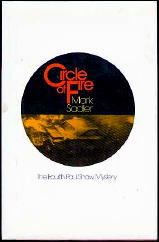
MARK SADLER – Circle of Fire. Random House, 1973. Berkley, paperback, 1989.

MARK SADLER Paul Shaw

   Mark Sadler is a pseudonym of the prolific Dennis Lynds, who also writes as Michael Colllins (about Dan Fortune) , William Arden, and John Crowe. As Sadler he writes about private eye Paul Shaw. Circle of Fire is the fourth in the series, a complex book that is readable without being outstanding.

   Paul Shaw is called in to investigate when Dick Delaney, his California partner, is shot and seriously wounded while working on a case. Local politician Russell Dobson was blown up in a car with Lilian Marsak, whom he apparently had just picked up.

   Shaw must determine whether the killer had a personal or political motive for getting Dobson out of the way, and eventually must decide if he was the intended victim after all.

   What did Delaney find out that got him shot? The book is very complicated and somewhat confusing, and Shaw is a little slow in recognizing one of the major possibilities in the case. It’s competent enough, I guess, but it has all been done before, and better (including the author’s own Dan Fortune series).

   One switch: for once the out-of-town investigator is not continually hassled by the local police.

— Reprinted from The MYSTERY FANcier, Vol. 1, No. 3, May 1977.


The Paul Shaw series —

    The Falling Man. Random House, 1970.
    Here to Die. Random House, 1971.
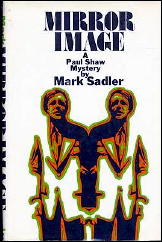
    Mirror Image. Random House, 1972.

MARK SADLER Paul Shaw

    Circle of Fire. Random House, 1973.
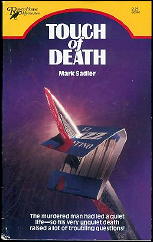
    Touch of Death. Raven House, 1981.

MARK SADLER Paul Shaw

    Deadly Innocents. Walker, 1986.

REVIEWED BY CURT J. EVANS:         


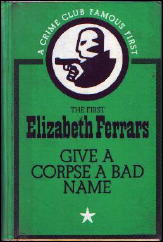
ELIZABETH FERRARS – Give a Corpse a Bad Name. Hodder & Stoughton, UK, hardcover, 1940. Collins Crime Club, UK, hc, 1981. Chivers, UK, large print edn, 2000. No US edition.

    Like Christianna Brand, the prolific, long-lived mystery doyenne Elizabeth Ferrars (1907-1995) slipped into print at the tail end of the Golden Age of British mystery (roughly 1920 to 1940); and, like Brand, upon her appearance in the detection field, she was raved as part of the “literary” school of British women mystery writers following Crime Queen’s Dorothy L. Sayers’ injunction to transmute detective novels into novels of manners with a crime interest.

ELIZABETH FERRARS

    Ferrars went so far as to use a Lord Peterish, Campionite series detective in her first five books, one Toby Dyke, who comes complete with a Bunterish, Luggite assistant, one George (no last name — George is wary about giving out personal details). Though Toby is no aristocrat, he is an winning gent; and George seems to have picked up quite a bit of knowledge of crime and criminals at some point in his life.

    I have read three of the later four titles in the series and thought the last, Neck in a Noose, the best, with the other two getting bogged down in messy plots. Give a Corpse a Bad Name, however, struck me as very good, with a particularly ingenious, twisting finish.

    In the English village of Chovey, the charming, youngish widow Anna Milne (formerly of South Africa but now residing at one of Chovey’s most desirable residences, “The Laurels”), reports to the police that she has run down and killed a man. Oddly, the dead man also comes from South Africa and has Anna Milne’s address in his pocket, yet Anna Milne claims not to recognize him.

    Since the man had been drinking heavily before the fatal accident and she herself had not, no legal culpability is attached to Mrs. Milne. But then anonymous letters begin appearing, suggesting that this “accident” was no accident….

    Soon former crime reporter Toby Dyke and his mysterious yet amiable friend George are investigating, with surprising results. And George proves no slouch himself as an “amateur” detective in the end.

    Give a Corpse a Bad Name is an enjoyable book, with sufficient, sometimes strong, characterization, good writing and an interesting puzzle with some coherent cluing. Toby and George remain more nebulous than Peter and Bunter and Campion and Lugg, yet they do have some nice moments, such as George’s lecture to Tony on the merits of barley sugar.

    Definitely worth reading, though the original edition, printed only in Britain by Hodder and Stoughton, is very rare and very expensive. Fortunately it was reprinted in hardcover by Collins in 1981 and also a new press, Langtail, appears to have reprinted it in paperback just this year.

   Some Brief Bio-Bibliographic Bits:

The Toby Dyke mysteries:    [Taken from the Revised Crime Fiction IV, by Allen J. Hubin.]

       Give a Corpse a Bad Name (n.) Hodder 1940.
       Remove the Bodies (n.) Hodder 1940. Doubleday, 1941, as Rehearsals for Murder.
       Death in Botanist’s Bay (n.) Hodder 1941. Doubleday, 1941, as Murder of a Suicide.
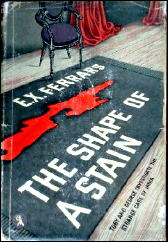
       Don’t Monkey with Murder (n.) Hodder 1942. Doubleday, 1942, as The Shape of a Stain.

ELIZABETH FERRARS

       Your Neck in a Noose (n.) Hodder 1942. Doubleday, 1943, as Neck in a Noose.

Note: Both Elizabeth Ferrars and E. X. Ferrars, her byline in the US, were pen names of Morna Doris Brown, 1907-1995. A long obituary for her by Jack Adrian can be found online.

Editorial Comment: I have found no website for Langtail Press, but there is a list of their forthcoming mysteries, all softcover reprints, on Amazon UK, with almost 50 titles scheduled for release on December 1st. The books are uniformly priced at 12 pounds; other authors include Anthony Berkeley, Freeman Wills Crofts, Fredric Brown, Gavin Black and John Dickson Carr.

HOWARD BROWNE Thin Air

“Sleight of Hand.” An episode of The Rockford Files (Season 1, Episode 15). First air date: 17 January 1975. James Garner, Noah Beery, Joe Santos, Tom Atkins, Lara Parker, Pat Delany, Allan Miller. Teleplay by Stephen J. Cannell & Jo Swerling Jr., based on the novel Thin Air by Howard Browne.

   Stop me if you’ve heard (or seen) this one before.

   Private eye Jim Rockford is coming back to LA after a vacation trip with Karen Mills, his current girl friend, a vivacious young divorcee with a three year old daughter. He stops at her house, she leaves to open the front door, he carries the girl up to her bedroom and tucks her in, and goes downstairs to find Karen’s open purse on a counter — and no Karen. He was only a few feet behind her when he went in — and she has disappeared.

HOWARD BROWNE Thin Air

   When the police are called (Joe Santos as Sgt. Becker), they find the body of Karen’s next door neighbor lying on the ground next to her house. Do the police (Tom Atkins as Lt. Diel) believe Rockford’s story? Well, what do you think? (Would you believe such a story?)

   Or in other words, Rockford’s on his own in solving this one, except for his dad, Rocky, who catches the one clue Rockford misses.

   The novel has been reviewed earlier on this blog, and from Gloria Maxwell’s description, the story line of the TV show is almost exactly the same, at least the beginning. While I’ve read the book, I couldn’t tell you now if the ending is the same, nor how closely they followed the plot when the story was used again as the basis for an episode of Simon & Simon in 1982.

HOWARD BROWNE Thin Air

   I have to tell you, though, as entertaining as the story is on this mid-season episode of The Rockford Files, if you allow yourself the time to think it about carefully, and maybe only casually and not even that carefully, the whole thing is adroitly administered hogwash, a heap of impossibilities disguised as a stack of highly unlikelies.

   It may be that 50 minutes or so just isn’t enough running time to make the parts fit together so they make sense, but in all honesty, they don’t.

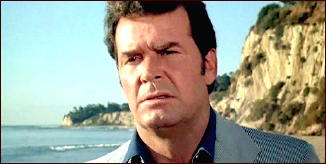
   But did I say that this was one of the most entertaining episodes so far this first season? I did and I didn’t, but it was. It also comes the closest to true noir, albeit in a slightly ham-fisted way. As private eye Jim Rockford, James Garner lets his feelings show more than usual on this one.

A 1001 MIDNIGHTS Review
by Bill Pronzini & Marcia Muller:


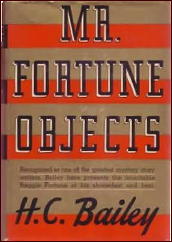
H. C. BAILEY – Mr. Fortune Objects. Victor Gollancz, UK, hardcover, 1935. Doubleday Crime Club, US, hardcover, 1935.

H. C. BAILEY

   One of the most popular of British Golden Age sleuths is H. C. Bailey’s Reginald Fortune. Reggie is a doctor whose deductive abilities and refusal to take the facts at face value make him an invaluable asset to Scotland Yard’s CID, and he is often called in as scientific adviser on particularly difficult cases.

   Fortune, whose plump appearance and fondness for gourmet foods belie his dogged devotion to the pursuit of justice, appears in ten novels and fourteen short story collections.

    Mr. Fortune Objects contains six stories (aptly termed “objections” because Reggie persists in taking exception to the obvious solution to each of the cases presented to him).

    In “The Broken Toad,” he investigates the mysterious poisoning of suburban Police Constable Mills, the circumstances of which are “rare and bafflin’ ” and the solution to which is sure to surprise the reader.

    “The Three Bears” takes us into the art world, exposing its hypocrisies and affectations, as well as its murderous passions. And in “The Yellow Slugs,” Fortune probes into the reasons a young boy attempted to drown his sister, reasons that he thinks are not as simple as the boy claims.

H. C. BAILEY

    “The Little Finger” deals with arson, jewel theft, bloodstains, and a missing digit. “The Angel’s Eye” is an entertaining house-party mystery. And “The Long Dinner” concerns a missing painter and a menu that makes gourmand Reggie’s mouth water.

   Fortune, his boss Lomas, Superintendent Bell, and Inspector Underwood have delighted readers for years. The Reggie Fortune stories are soundly plotted and their logic is impeccable. One might complain of the weak development of secondary characters and somewhat pretentious dialogue, but all in all these remain good light reading.

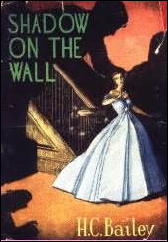
   The better of the Reggie Fortune novels are Shadow on the Wall (1934), The Bishop’s Crime (1941), and The Life Sentence (1946). Particularly good among the short-story collections are Mr. Fortune Explains (1931) and The Best of Mr. Fortune (1943).

   Bailey’s other series character, lawyer Joshua Clunk, “a champion of the weak and oppressed,” is considerably less interesting-perhaps because he appears only in novels and Bailey was a much better writer of short stories than a novelist.

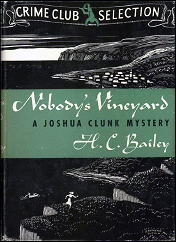
   The ten Clunk books — among them The Red Castle Mystery (1932), Nobody’s Vineyard (aka Dead Man’s Shoes, 1942), The Wrong Man (1945) — are well plotted but are written in a much more turgid style than the Reggie Fortune series.

H. C. BAILEY

   Anyone who can wade through an entire novel bulging with such passages as the following from Nobody’ s Vineyard is a truly dedicated mystery reader:

   That would be a mad humility, and you’re neither humble nor mad. Amen. So be it. Praise God for all. Why then, what is it that you fly from? The job and the job masters. Even as I. You from His Highness the Town Clerk and the Circumlocution Office and the Mayor and Aldermen and Councillors. I from a misbegotten Editor, poorfish, and the slavery of cooking stories of tripe and the plague of fools who want to be in them or kept out of them.

         ———
   Reprinted with permission from 1001 Midnights, edited by Bill Pronzini & Marcia Muller and published by The Battered Silicon Dispatch Box, 2007.   Copyright © 1986, 2007 by the Pronzini-Muller Family Trust.

Previously on this blog:   Combined earlier into one post, Curt Evans reviewed both Mr. Fortune Objects and Clue for Mr. Fortune.

IT IS PURELY MY OPINION
Reviews by L. J. Roberts


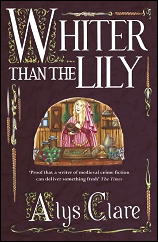
ALYS CLARE – Whiter Than the Lily. Hodder & Stoughton, UK, hardcover, November 2004; paperback, August 2005.

Genre:   Historical mystery. Leading characters: Josse d’Acquin/Abbess Helewise; 7th in series. Setting:   England, 1190s.

First Sentence:   The walled garden lay as if stunned under the hot May sunshine.

ALLYS CLARE Whiter Than the Lily

    Sir Josse d’Acquin. a knight in the era of King Richard I, is taken to the Isle of Oxney where he meets an older man and his young wife who despair of having a child. When asked, Josse supports their idea of the wife traveling to The Abbey of Hawkenlye where Josse’s friend, Abbess Helewise, and her nuns might help the young wife.

   Once there, the woman keep refuses examination and keeps herself sequestered. The husband arrives later, much addled and unwell. But for Josse, who comes to the Abbey, something doesn’t add up, particularly when the woman dies and is found to have been pregnant.

   Vivid descriptions are a hallmark of Ms. Clare’s writing whether it is of the area in spring, thunderstorms, or of dreams. That, along with a lovely, gentle humor to the author’s voice and a touch of the paranormal to the story, although much less than in some of the previous books, are some of the reasons why I so enjoyed this book.

   English history is an interest of mine. Ms. Clare goes beyond providing interesting information and facts. She views those facts in terms of their impact on the lives of the people such as the strain on people to raise money for King Richard’s ransom…

    “Although Helewise understood why such an expensive campaign had been necessary, a port of her could not help wondering whether knights, lords and kings with the passion and the thrill of holy war filling their heads ought to pause just for a moment to wonder if it was all worth it.”

    As always, I read for interesting, realistic characters. I love that, in spite of being Abbess, Helewise had a full life prior to becoming Abbess. I appreciate Josse’s uncertainties and frustration at the realization of how little he knows and how few facts he has in trying to learn what happened.

   However, it’s the relationship between Helewise and Josse; one of friendship, respect and support but with the affection always contained, that is the central focus of the stories.

   I thoroughly enjoyed this book and am pleased I’ve many more books ahead of me. I do recommend the series and suggest reading it in order.

Rating:   Good Plus.

Editorial Comment:   There are 12 books in this “Hawkenlye” series, with the most recent appearing in 2008. LJ reviewed Girl in a Red Tunic, the eighth in the series, here, earlier on this blog. The titles of the books come from Carmina Burana, the lyrics of which were written by a 12th century monk.

Reviewed by DAVID L. VINEYARD:         


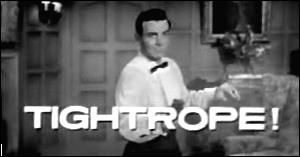
“Night of the Gun.” An episode of Tightrope! (Season 1, Episode 17). First air date: 29 December 1959. Mike Connors as Nick Stone. Guests: Mike Kellin, Whit Bissell, Barbara English, Paul Langdon. Teleplay by Frederic Brady. Directed by Paul Wendkos.

   Policeman Paul Langdon explaining why a detective roughed up undercover cop Nick Stone (Michael Connors):

    “The sergeant is a good officer, he just didn’t know you.”

    Nick Stone: “Yeah, like everyone else.”
TIGHTROPE!

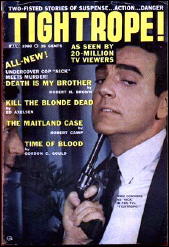
   Tightrope! ran for a single season in the 1959-1960 television season for 37 episodes and featured the adventures of undercover cop Nick Stone, as played by Michael Connors. Stone was a cross between Peter Gunn and James Bond, plying the mean streets in first person-narrated tales of crime, murder, betrayal, about a man on the tightrope as a undercover policeman.

   Created by Clarence Greene and Russell Rouse, Tightrope was a fast paced half hour show that moved like the bullets that frequently flew from Connors’ gun. A typical episode featured beautiful sexy women, bizarre villains, twisty plots, and enough violence for three other series.

   Opening each week with Connor’s patented fast draw, the series had only one continuing character, Stone, and found him each week in a new city with a new assignment.

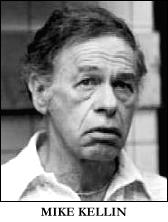
    “Night of the Gun” is perhaps the best of the series, a tough and dark little tale that finds Nick helping the local police to find a witness on the run (Whit Bissell). Also hunting for Bissell is Larry Maddox (Mike Kellin), a club owner who sidelines as a killer for hire.
TIGHTROPE!

   It’s Kellin and his performance as Maddox that raises this above the rest. Maddox is an effeminate sadist, one part hipster, one part Liberace, who lives for trouble and pain: “Beautiful, beautiful.”

   Nick knows the best way to find Bissell is to follow Maddox to him, so he attracts his attention, then befriends the bizarre hood who sees a kindred spirit in Connors. For a show from 1959 the homo-erotic content of these scenes is pretty obvious, and though a couple of pretty girls are thrown into the mix, it’s clear that Kellin’s bizarre hit man isn’t interested in them all that much.

   I was reminded a bit of Lee Marvin and Earl Holliman’s homo-erotic hoods from Joseph L. Lewis The Big Combo and George Sanders as the strange forger and thief from John Larkin’s Quiet Please, Murder!, but Kellin’s character is even more outlandish.

   The opening scene where he kills a frightened and desperate witness is as sadistic a display as you ever saw on the small screen.

   This kind of show lived or died on the shoulders of the hero, and here Connors, in his first series, shines. Nick Stone is tough and smart, but he is also haunted by his job. He’s not always sure that there is a purpose to what he does, and longs for the comradeship of his fellow officers, a good woman, and a nine-to-five life, even as he wears expensive clothes and hangs out in the fanciest nightclubs. Each show features at least one scene of Nick alone in a crowd on a busy neon-lit street in a large city, alone even among the throng.

   As Connors gets closer to Kellin we begin to see just how crazy his Larry Maddox is, and it is a great bizarre performance, a mix of beatnik and hood, flamboyant and equal parts sadist and masochist.
TIGHTROPE!

   Finally when they go to meet Whit Bissell — who thinks Maddox is helping him to get out of town — Maddox figures out Connors as Nick is a cop and gets the drop on him, but didn’t figure on that patented fast draw.

    “Beautiful, beautiful. Just like pulling a rabbit out of a hat. Beautiful …”

   Connors went on to fame and fortune as Mannix, and Kellin had a long career as a character actor, including right after this a turn as the Chief Mate on The Wackiest Ship in the Army.

   Whit Bissell was in a little bit of everything from his role as the General in The Time Tunnel to his essay as the mad doctor in I Was a Teenage Frankenstein ( “I know you have a civil tongue in your head, I put it there!”).

   An attempt to revive the character of Nick Stone and series with Christopher George was a failure, but Stephen Cannell’s legendary Wiseguy with Ken Wahl owed a lot to this.

   Tightrope! isn’t available on DVD, but a few episodes are around, and well worth catching even if they are in less than pristine condition. It was a smart well written and directed series mindful of Dashiell Hammett and Alex Raymond’s early Secret Agent X-9 with its lone hero living a lonely and dangerous life without friends or allies.

   Tightrope! was a solid entertaining cop series with a bit more meat on the bone than usual. If you have never seen any of these you are in for a treat, and if you recall them but haven’t seen them for a long time you will be surprised just how good they were.

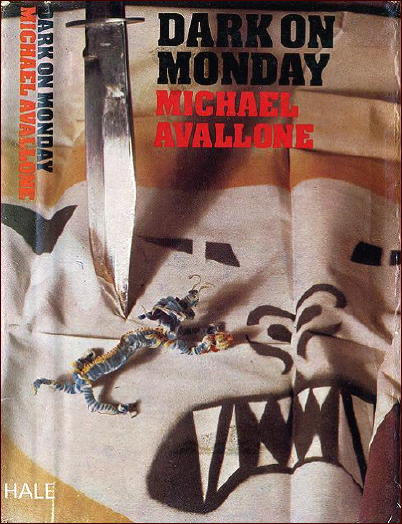
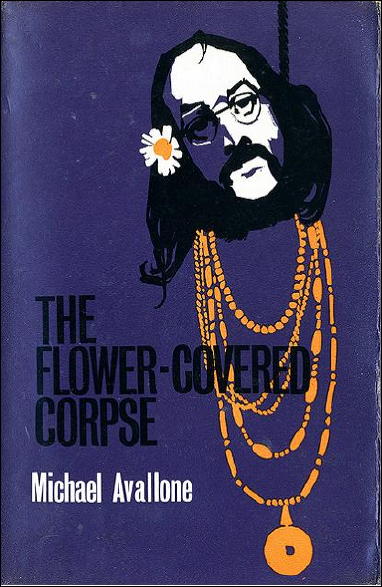
   They’re not exactly unknown, but to fans of Michael Avallone in the US, they might as well be. Perhaps it’s only a tease, but British mystery bookseller Jamie Sturgeon has sent me cover images of two of the three Avallone crime novels published only in England. (An earlier version of this post stated that all three are Ed Noon adventures, but only #2 and #3 are.)

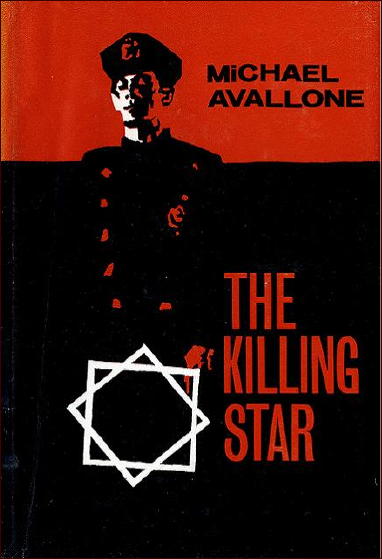
1. The Killing Star. Robert Hale, 1969. Dust wrapper by Eileen Walton:

MICHAEL AVALLONE

Blurb: Five housewives butchered, horribly mutilated and on each terrible occasion, the unknown killer had marked the symbol of the Star of David on the door. What ancient and horrible vengeance was reaching out from the graves of Europe to announce a greater crime?

   Follow Detective Sam Swope on one of the most remarkable cases ever to tax the powers of “police procedure.” Learn as Sam Swope does that Death has many faces but the most savage mask of all has to be the one that comes in the guise of friendship, service and love. This is a raw and brutal book that is as contemporary as the morning’s murder.

Beginning the first chapter: High Noon. Now. Vietnam, race riots, Civil Rights battles. Taxes, irreverent movies, LSD trips for the unsophisticated and the foolish. Teenagers unsettled about how to cut their hair, how to dress — how to look. The cheats, the frauds, the second raters are having a field day at the expense of the victims. Music is struggling to sound coherent. The voice of the country is fighting the echoes of the unconstitutionality, alien reverberations and the shouts of doom from all sides.

   The Left, the Right and Dead Centre are at destructive odds. The big clocks, the little clocks and fifty million wrist watches toll and tick towards Infinity. Take a rocket to the moon, vote Medicare and honour thy father and mother as thyself and meanwhile – look out for Number One!

   The place. Your City and mine… Steepled, skylined, smog-filled, crime-filled and throbbing with immediacy. Concrete and common clay. General Motors products crowding the byways, jet planes thundering overhead, forests of T.V. antennae stabbing the unfriendly sky. What’s in it for me?

   This is the battle cry of the metropolis. The sun, the moon and the stars have no chance for survival. Poetry, Beauty, Honesty are but dreams. The winds, the rains, the storms lash and howl through the canyons of the skyscrapers. The Crooked City never sleeps. It is a big zoo, vibrating with the footsteps of the great white hunters. The metropolis is in the cross-haired sights of annihilation […]

2. The Big Stiffs. Robert Hale, 1977. Ed Noon.

3. Dark on Monday. Robert Hale, 1978. Ed Noon.

MICHAEL AVALLONE

Blurb: The incredible crime wave began with a mysterious after-midnight telephone call to Manhattan Private Eye extraordinaire, Ed Noon – a death S.O.S. from an Irish dancer who looked Chinese. Then came the locust plague of poison-pen letters, a lethal swarm of brutality and terror which metamorphosed into an ugly chain of slaughtered Broadway showgirls.

   All of which made Noon a Monday worrier – the Ed Noon of the pre-President’s agent days, the Noon who still slept on the couch in his office, when the hit musical DRAGON TIME playing to SRO audiences on Times Square, was also the playground of one of the most viscous killers Ed Noon had ever encountered. A killer whose name would not be found in a fortune cookie…


BONUS: The Flower-Covered Corpse. Robert Hale, 1969, preceding the Curtis US paperback edition (1972).

MICHAEL AVALLONE

REVIEWED BY WALTER ALBERT:         


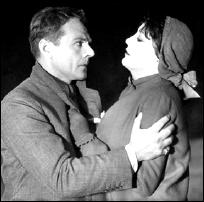
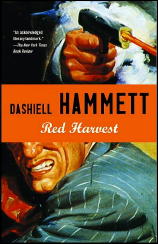
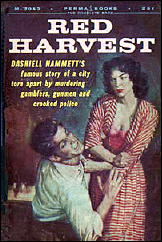
ROADHOUSE NIGHTS. Paramount, 1930. Helen Morgan, Charles Ruggles, Fred Kohler, Jimmy Durante, Fuller Mellish Jr., Leo Donnelly, Tammany Young, Joe King, Lou Clayton, Eddie Jackson. Story by Ben Hecht; screenplay by Garrett Fort based on the novel Red Harvest by Dashiell Hammett. Director: Hobart Henley. Shown at Cinevent 42, Columbus OH, May 2010.

ROADHOUSE NIGHTS

   The casting of the vaudeville team of Durante, Clayton and Moore in this version of Hammett’s classic crime novel will surely make the heart of any film noir fan sink.

   (The introduction of a bumpkin sheriff into the Crime Club film The Black Doll, reviewed here, was surely already one example too many of how to ruin a crime novel on screen.)

   And the casting of Charles Ruggles, known principally for his skillful handling of comic roles, as an investigative reporter (substituting for Hammett’s Continental Op) is not a choice to arouse much interest in the classic crime film aficionado. So you shouldn’t be surprised to learn that this film was the one I felt the most responsibility to see and the one whose screening I most dreaded.

   It starts off well as Hogan (Fuller Mellish Jr.), a reporter on an investigative assignment for his Chicago paper, lights a match to check the address of a house on a dark street.

ROADHOUSE NIGHTS

   He knocks, is admitted, and is almost immediately shot by a dark figure. A fellow reporter, Willie Bindbugel (Ruggles), is sent by his editor to check the disappearance of Hagan, who was working on a story on bootlegging in a small town on Lake Michigan.

   (In Hammett’s novel, it’s a newspaper publisher who’s murdered just as the Continental Op arrives in the crime-infested city of Personville, known by some of its local inhabitants as Poisonville.)

   Much of the action of the film takes place in a roadhouse operated by local crime boss Sam Horner (Fred Kohler), and it’s here that Willie encounters singer Lola Fagan (Morgan), whom he knew years ago and who is now the girl friend of Horner.

   The Durante trio is also performing in the roadhouse (and regretting it), but it’s the relationship of Willie and Lola that fuels the real drama of the film, as she struggles to find a way out of the explosive situation created by Willie’s arrival.

ROADHOUSE NIGHTS

   As Willie catches on to the viper’s nest he’s fallen into, the events move rapidly toward a climactic scene in which Willie, apparently drunk, calls his editor and as he appears to insult him on line taps out a coded message that alerts the editor to the big shipment of bootleg liquor that’s to be picked up that night.

   It’s not a stretch to see the roadhouse standing in for Poisonville, with Willie as a somewhat unlikely but still effective substitution for the Op. But it’s not the traces of Hammett’s novel that keep the film afloat but the adroit performances by Ruggles, Morgan and Kohler make it work.

   And, if you’re wondering how the film was received on its release, I can report that excerpts from the New York Times and Variety reviews are, if not glowing, certainly positive.

A 1001 MIDNIGHTS Review
by Bill Pronzini:


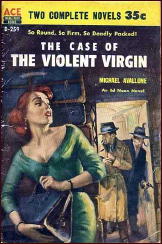
MICHAEL AVALLONE – The Case of the Violent Virgin. Bound back-to-back with The Case of the Bouncing Betty. Ace Double Ace D-259, paperback originals, 1957.

   Michael Avallone, who has dubbed himself “The Fastest Typewriter in the East” and “King of the Paperbacks,” has published more than 200 novels over the past four decades, some thirty of which feature private eye Ed Noon.

MIKE AVALLONE

   On the one hand, Noon is your standard hard-boiled, wisecracking snoop with a taste for copious bloodletting and a Spillane-type hatred of Communists, dissidents, counterculture types, pacifists, militant blacks, militant women, and anyone or anything else of a liberal or civilized cant.

   On the other hand, he is a distinctly if eccentrically drawn character whose passions include baseball, old movies, and dumb
jokes, and who gets himself mixed up with some of the most improbable individuals ever committed to paper.

   The gold-toothed, beret-wearing villain in The Case of the Violent Virgin, for instance-a guy named Dean, who, like Ed Noon, is on the trail of a six-foot marble statue called the Violent Virgin, “The Number One Nude,” not to mention one of the world’s most precious stones, the “Blue Green.”

   Dean is a very well-spoken fellow; at one point in the narrative, he says to Noon, “Your precipitous exodus from serene sanctuary propels me toward Brobdingnagian measures. Spider and I mourn for your misdemeanors but your palpitating perignations [sic] induce no termination of our grief.”

MIKE AVALLONE

   Spider, who is Dean’s accomplice in crime, is not nearly so well spoken; he says things like “Okay, Dad. Make the parley with them. But fast. This choo-choo could get too hot for us.”

   The “choo-choo” he is referring to is the Mainliner, which travels from New York’s Grand Central Station to Chicago. Noon is on it because he has been hired to bodyguard a woman named Opal Trace (who doesn’t speak her words, she “carols” and “musicales” them).

   And what a train ride it is, chockablock full of a mixed-up mish-mash of double-dealing, multiple murder, vicious dogs, shootouts, a bomb explosion, and, to cap things off, a rousing derailment. None of it makes much sense — but then, one doesn’t read Avallone looking for sense.

   What one does read Avallone for, primarily, is his lurid, bizarre, and often hilarious prose style. Noonisms — as his better similes, metaphors, and descriptive passages have come to be called — abound in The Case of the Violent Virgin; there are more to the chapter, in fact, than in just about any other Ed Noon adventure.

MIKE AVALLONE

   A sample: “Her hips were beautifully arched and her breasts were like proud flags waving triumphantly. She carried them high and mighty.” And: “I flung a quick glance through the soot-stained windows. A mountain range and a dark night sky peppered with salty-looking stars winked at me.”

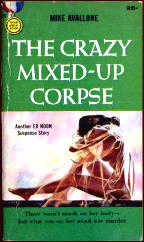
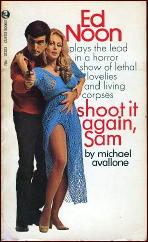
   Similar “palpitating perignations” can be found in such other Avallone spectaculars as The Tall Dolores (1953); The Voodoo Murders (1957); The Crazy Mixed-Up Corpse (1957); Meanwhile Back at the Morgue (1960), in which you will find the immortal line “The next day dawned bright and clear on my empty stomach”; and Shoot It Again, Sam! (1972).

         ———
   Reprinted with permission from 1001 Midnights, edited by Bill Pronzini & Marcia Muller and published by The Battered Silicon Dispatch Box, 2007.   Copyright © 1986, 2007 by the Pronzini-Muller Family Trust.

« Previous PageNext Page »