A TV Review by MIKE TOONEY:


“Nobody Will Ever Know.” An episode of Kraft Suspense Theatre (Season 2, Episode 19). First air date: 25 March 1965. Tom Tryon, Pippa Scott, Myrna Fahey, Liam Sullivan, Robert Quarry, David Lewis, Frank Maxwell. Teleplay: Richard Fielder and Harry Essex. Story: Roger H. Lewis. Director: Don Weis.

   Tom Banning (Tom Tryon) seems to have it all: a well-paying research position at Continental Plastics, being married to the boss’s daughter, and the prospect of a promotion.

   So why is he skulking around a chemical laboratory with a camera photographing secret bench experiments, engaging in industrial espionage?
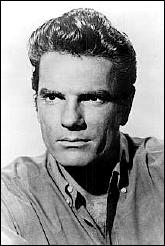
THOMAS TRYON

   Could it have to do with the fact that he’s not making enough money to cover the bills? That he resents his father-in-law’s intrusions into their private lives? That although he’s due for that promotion soon, he’s afraid he might not get it?

   That there’s an extremely attractive woman, part of the evaluation team, with whom he’s having an affair? That the money he’s getting for his spying would solve all their financial difficulties? Or could it be that the people he’s working for have guns and won’t hesitate to use them?

   How about all of the above?

   As Thomas Tryon, Tom Tryon made the bestseller lists with his written fiction (The Other, Harvest Home, Lady, etc.).

   Liam Sullivan specialized in playing villains almost entirely on TV, with three appearances on Perry Mason (1961-62), a Western series (The Monroes, 1966-67), a nice turn as a sadistic overlord in Star Trek (1967), as well as several primetime TV soaps.

   Frank Maxwell could be seen on TV just about anytime during the ’50s through the ’70s, including Perry Mason (1960-61), a comedy series (Our Man Higgins, 1962-63), two other episodes of Kraft Suspense Theatre (including “Leviathan Five”, reviewed here ), one Banacek (“Now You See Me, Now You Don’t”), five Barnaby Jones episodes, and four appearances on Quincy, M.E.

Editorial Comment:   Tom Tryon was born in Hartford, the city around the corner and up the street from me, and as something of a native son, all of his accomplishments, both in TV and the movies, then later as a bestselling author, were always written up in the local paper — the one I used to write mystery reviews for — but I’ve never read any of his fiction, I’m sad to say.

   The photo is only a publicity shot. It has nothing to do with the TV show that Mike just reviewed, but it’s how I remember him as an actor the most, with a solidly sculptured face and lots of hair.
REVIEWED BY DAN STUMPF:         


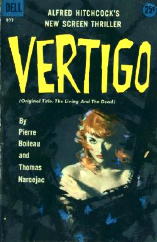
PIERRE BOILEAU & THOMAS NARCEJAC – Vertigo. Dell 977, reprint paperback, April 1958. UK edition: The Living and the Dead, Hutchinson, hc, 1956. First US edition: Ives Washburn, 1957. Translation of D’Entre les Morts, Paris, 1954. Film: Paramount, 1958, as Vertigo (Kim Novak, James Stewart; director: Alfred Hitchcock).

BOILEAU & NARCEJAC Vertigo

   As the basis for Hitchcock’s film, the book by Boileau and Narcejac shows an interesting contrast in attitude and approach to the story: where Vertigo the movie is melancholy and romantic, Vertigo the book is merely sad and cynical, mainly because the authors undercut the story at every turn with a detachment that was probably meant to be objective but comes off as merely snide.

   In the film, for instance, when Scotty rescues Madeleine from drowning, it sparks a romantic (and sexual) connection between them that suffuses the rest of the story. In the book, the authors play up the mundane aspects of the aftermath, with the couple marking time sitting around a cheap bar in borrowed clothes, finding nothing to say to each other.

   Later on, the affair with Judy (Renee in the book) becomes a tawdry thing, played out in cramped hotel rooms and bad restaurants, with the hero dogging around after a woman who is obviously sick of him.

   All of which may be more realistic than Hitchcock’s brilliantly realized amour fou (I don’t say it is more realistic; just that it may be) but makes for definitely less satisfying drama.

   In fact, there is a twist in the book that is not in the movie; it’s a delicious little turn, rising naturally out of characters behaving as they should, yet totally unexpected and supremely ironic. Boileau and Narcejac simply toss it away — just write it and forget it, and never exploit what could have been a major development. This ain’t objectivity, it’s just bad writing.

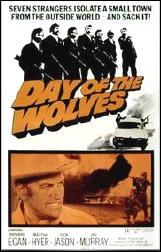
DAY OF THE WOLVES. Gold Key, 1973. Richard Egan, Martha Hyer, Rick Jason, Jan Murray, Jack Bailey, Percy Helton, Herb Vigran. Screenwriter-producer-director: Ferde Grofé Jr.

   There is something to be said about production values. You have to have a story to begin with, but without a budget to back it up and without a director to make the actors sound good and look better, the whole business of making movies is a waste of time.

THE DAY OF THE WOLVES 1973

   Case in point, right here. This is a nifty tale of a gang of seven men, individually recruited and deliberately kept uninformed of each other’s identities (known to each other only by numbers), who take over a small isolated town by locking up the small police force and robbing all the main businesses in organized fashion over a period of three hours or so.

   Jan Murray (the comedian and TV game show host) is Number One, the leader of the group, and Richard Egan is the sheriff who’s just gotten fired (by a pitifully weak city council) and even so is the only man in town willing and able to fight back. Martha Hyer as his wife does not have much a role, this movie coming very much toward the end of her career.

   The plan does not go off without a hitch, as I hope I’ve led you to believe, but it’s still a good one — the plan, that is — and watching the gang of seven put it together and try to pull it off makes for entertaining viewing.

   The photography and camera angles are poor, however, bargain basement level, the sound man was in a different truck, and what this movie desperately needed and didn’t get was a director who, as I said above, was able to put his actors in the best possible light.

   The production is flat, in other words, and with the Hollywood cast mixed in with local townspeople (Lake Havasu City, Arizona) and only a little exaggeration, it was sometimes difficult to tell the difference (Richard Egan and Jan Murray being two notable exceptions).

   I didn’t much care for the ending, not as much as I’ve read what others have had to say about this movie. I think personally that Ferde Grofé had run out of cleverness at that point, and went with the obvious. Money for a better movie he never had all along.

A MOVIE REVIEW BY DAVID L. VINEYARD:         


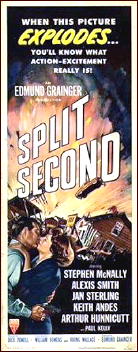
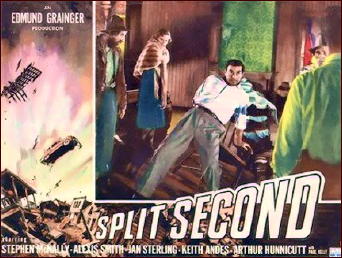
SPLIT SECOND Alexis Smith

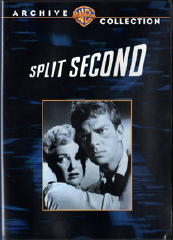
SPLIT SECOND. RKO Radio Pictures, 1953. Stephen McNally, Alexis Smith, Jan Sterling, Keith Andes, Arthur Hunnicutt, Paul Kelly, RIchard Egan, Robert Paige, Frank DeKova. Screenplay: William Bowers & Irving Wallace, based on a story by Chester Erskine & Irving Wallace. Director: Dick Powell.

    Keith Andes: “You don’t think very much of people, do you?”

    Stephen McNally: “I don’t think very much of anything.”

   This terrific little minor “A” film with top “B” values features a number of popular themes from the early fifties, including the brutal superman with fascist tendencies and philosophy, the small group of diverse people under incredible tension, and the terrifying threat of atomic annihilation that seemed to hang over us all.

   The latter is especially potent for those of us young enough to remember “Duck and Cover” exercises in grade school. It was always hard to adjust back to Dick and Jane after contemplating that nuclear blast.

   So when ever this one shows up on television drag out the VCR or DVR and get your finger ready on the record button. It’s a tautly directed effort from actor Dick Powell (his first), whose career as a director varies from wartime drama like The Enemy Below and The Hunters to the musical remake of It Happened One Night as You Can’t Run Away From It and the infamous The Conqueror (with John Wayne as Genghis Khan — “I will have this Tartar woman.”).

   Story and screenplay are co-written by bestselling novelist Irving Wallace (The Chapman Report, The Prize, The Three Sirens …)

SPLIT SECOND Alexis Smith

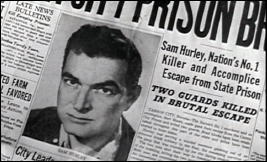
   Stephen McNally is Sam Hurley, an escaped convict and one of the nastiest pieces of business since Bogart’s Duke Mantee set the standard for this sort of thing way back in The Petrified Forest. McNally is a brutal monster, not smart, but clever and ruthless. It’s his idea to hide out in New Hope City, Nevada, an abandoned mining town, a place literally no one will look because it is destined to be the site of a nuclear test the next morning.

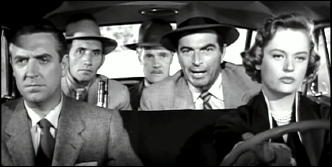
   Trapped with him is the usual assortment of the good, the weak, and the simply human: Andes, Alexis Smith, Jan Sterling, doctor Richard Egan, prospector Arthur Hunnicutt. Stir well, and let simmer in an isolated place while the police close in and the clock ticks down and you have just about a perfect recipe for this kind of film.

   Combining with the first class performance by McNally as the convict is Alexis Smith as a sexy high class dame who represents everything he resents and can never have or be, and watch as the people involved either find unexpected strength or crumble under the pressure as the bomb literally ticks down, and the deadline to get out grows narrower and narrower. Paul Kelly is good as McNally’s only tenuous tie to decent human feelings.

SPLIT SECOND Alexis Smith

   This one ratchets up the tension with real skill. It can be as uncomfortable as the desert sand under the skin and as raw as the endless hot wind on the nerves. At times it becomes almost unbearable.

   Okay, admittedly the security around the nuclear test site is a little lax, and you have to wonder what kind of a hold even the brutal McNally could have over his men that they would go along with this insanity, but give the film its few minor logic problems (Egan’s doctor pretty much just drives into town without even pretending to sneak), and this film builds to a great deal of very real tension.

   For some reason Split Second has always reminded me of another taut little suspenser set in the desert, Inferno, though there is really little similarity between the films. Maybe it’s because both films build to a point where your participation in the suspense is almost visceral.

   McNally was one of the few actors who seemed as at home as the hero as the villain, which may be why his bad guy roles have a resonance that many actors don’t or can’t bring. We always knew he could play as stalwart and straight as he did brutal and sociopathic, which gave his charming monsters an added dimension missing in some other actors (in this he always reminded me of Robert Ryan, star of the above mentioned Inferno).

SPLIT SECOND Alexis Smith

   Alexis Smith made a career of playing smart sexy women who had brains as well as nerves, and Jan Sterling was one of the great ‘dame’ players always giving her roles an added edge of humanity, that culminated in an Oscar nomination for her aging bad girl with one last chance in The High and the Mighty (ironically another film about a small group of people under pressure). It’s no accident that she and Smith both get top billing over the films ‘hero’ Keith Andes.

   I won’t give away the ending, save to point out it’s fairly clever and just within the bounds of possibility if not probability. See this one and enjoy it. It’s a little film that will stick to your ribs a lot longer than some of the bigger more celebrated films of that era.

   But don’t watch it if you are already tense or if your blood pressure is high. This one could put it through the roof.

SPLIT SECOND Alexis Smith

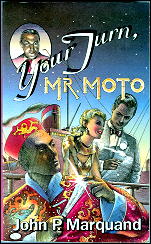
MARQUAND Your Turn Mr Moto

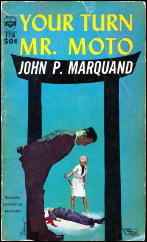
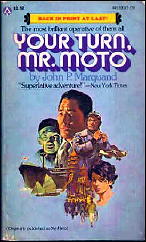
JOHN P. MARQUAND – Your Turn, Mr. Moto. Little Brown, paperback reprint, July 1985. Originally published in hardcover as No Hero: Little Brown, 1935. Previously serialized in The Saturday Evening Post, 30 March to 04 May 1935, as “Mr. Moto Takes A Hand.” First published as Your Turn, Mr. Moto by Berkley, F756, ppbk, May 1963. Other reprint editions include Popular Library, pb, 1977.

   It is difficult to say, for me that is, at this point of time, how it happened that Mr. Moto, an agent of the Japanese empire before World War II, become such a popular series character in the United States.

   He is a key figure in Your Turn, for example, the first book in the series, but while he appears frequently at regular intervals, he is not on stage all that long. He is an instigator and a facilitator as far as the story line is concerned, but as an investigator, much of his work is conducted behind the scenes.

MARQUAND Your Turn Mr Moto

   He is also inscrutable, in the sense of the word often used to describe Asians (having motives that are not readily investigated, interpreted, or understood), which may help understand his appeal.

   The story itself is told in first person by a washed-up American daredevil pilot named Casey Lee. Having one last contract canceled, a stunt that would have involved a flight across the Pacific starting from Japan, Casey rails against the world in a drunken furor, including the US, words overheard and relayed to Mr. Moto, who decides that he can make good use of the self-expatriated aviator.

   As part of the enticement, as if Casey needed one, as he’s desperately in need of a job, no matter who offers it, is a young woman named Sonya, a White Russian in exile herself. The plot and the situation that Casey soon finds himself in are both complicated and simple. Plans for converting oil into a fuel that will double the range of ships and planes are missing, and Casey may be the person who unknowingly knows where they are.

MARQUAND Your Turn Mr Moto

   Marquand’s writing is clear, smooth and informative. In those days before World War II, every nation involved in the affairs of the Far East, which included both Britain and the US, as well as Japan, China and Russia, have a stake in them, and Marquand makes each country’s perspective much more understandable than any textbook I had in high school ever did.

   The backdrop of a region on edge, filled with refugees going here and there and an agent from every major power always within earshot, is equally well done, nearly to perfection.

   It is disappointing, then, to have to say that the key points of the mystery itself, as opposed to the setting and the budding romance (which of course?) are muddled. Not badly, but enough to cause me to wish more Marquand had decided to focus on it more than he did.

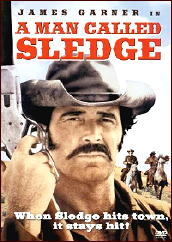
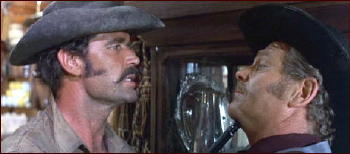
A MAN CALLED SLEDGE

A MAN CALLED SLEDGE. Columbia Pictures, 1970. James Garner, Dennis Weaver, Claude Akins, John Marley, Laura Antonelli, Wayde Preston. Producer: Dino de Laurentiis. Directors: Vic Morrow (also co-screenwriter) & Giorgio Gentili (the latter uncredited).

   What were they thinking? A spaghetti western filmed in Spain starring three of the most likable guys in American TV at the time as despicable villains? No way. There’s no chance in the world that these fellows could have pulled it off, and they don’t.

   From the title alone, you might think that this bit of tomfoolery was meant to be a spoof, but as the movie goes on it will gradually sink in, as if against your will, that they were deadly serious about this. Filmed in beautiful knock-your-eyes-out Technicolor, the movie itself is a shake-your-head-in-wonderment deadly bore.

   All except for a few moments around the two-thirds mark, that is, when Luther Sledge and his gang manage to steal $300,000 in gold from a well-fortified prison from the inside out. The rest of the movie is filled with action, all right, but of the uninspired gratuitous kind, of which other spaghetti westerns are equally filled. Try to imagine James Garner with a truly evil glint in his eye, and you can’t.

   Henry Fonda could have done this. James Garner is essentially just too nice. In Sledge, he only succeeds in looking (and acting) dumb. Why would he need the money (to be split numerous ways) when his steady girl friend Ria (Laura Antonelli) begs him not to go through with his plan? She wants him (heaven knows why), not the money.

A MAN CALLED SLEDGE

   The plan which does not turn out well in the end, as you might expect, but what you will not expect is how dull-witted (if not feeble-minded) the gents are who pull off this heist are, only to let the proceeds slip through their fingers again so easily. (Which of course is the whole point, and points, I will concede, we will accept however we obtain them.)

   While the scenery and the colors are absolutely wonderful, you do have to ignore all of the fancy camera positions and shooting angles whenever the actors get on stage, as they are prone to do. All the camera shots do is call attention to themselves, and why the movie had to be redubbed back into English is beyond me.

PostScript: It is my contention that you can take any western and by watching it, but totally ignoring who the actors are, place it in the right decade, whether it be the 1920s, 30, 40s and all the way up. The themes, the settings, the clothes, the hair styles, the atmosphere — the idea of what a western was supposed to be changed decade by decade — and reflected that decade exactly.

   This is neither the time nor place to develop this thesis further, but I will, someday.

REVIEWED BY WALTER ALBERT:         


THANKS FOR EVERYTHING. 20th Century Fox, 1938. Jack Haley, Jack Oakie, Adolphe Menjou, Arleen Whelan, Binnie Barnes, Tony Martin, George Barbier, Warren Hymer, Renie Riano. Songs: Mack Gordon and Harry Revel; photography: Lucien Andriot. Director: William A. Seiter. Shown at Cinecon 45, Hollywood CA, September 2009.

THANKS FOR EVERYTHING Jack Oakie

   In this engaging satire of American mores, Jack Haley is a small-town nobody who wins first prize in a national radio contest in which his answers to 100 questions on his preferences for a variety of products establish him as “Mr. Average American.”

   However, Menjou, head of the company that promoted the contest, in collaboration with his flunky (played by jack Oakie), concocts a scheme to disqualify Haley and then hire him at a small salary to test products for their appeal to the average man, a ploy that’s an over-the-top success for Menjou and his newly-formed company, Guidance Inc.

   As you might suspect, the plan begins to unravel, with Menjou and Oakie forced to increasingly desperate measures to keep Haley in the dark, leading to an attempt to make Haley declare himself for or against going to war that culminates in the simulation of an enemy attack on New York City.

   This pushes Haley into the war camp but also precipitates a series of escalating farcical scenes that lead to a triumph for Haley that is an uncanny foreshadowing of Preston Sturges’ Hail the Conquering Hero.

   The film has real comic bite, and the cast is uniformly superb, with a stand-out performance by Renie Riano as Haley’s stand-in telephone girl friend.

THE BACKWARD REVIEWER
William F. Deeck


ARTHUR D. GOLDSTEIN – A Person Shouldn’t Die Like That. Random House, hardcover, 1972. Hardcover reprint: Detective Book Club, 3-in-1 edition, September 1972.

   Several days after his chess-and-checkers-playing friend, Jacob Schneider, fails to show up at the New York City park where they play, Max Guttman visits him to see if all is well. Unfortunately it isn’t, for Guttman finds him in his apartment, beaten to death.

   Realizing that he knew little about Schneider other than that he had survived a concentration camp, Guttman begins trying to find out why a man should have to die like Schneider did. Guttman is also pressured, only a little bit externally but very much internally, to see what he can do to keep a presumably innocent black drug addict from being convicted of the crime.

   The police don’t care for Guttman’s inquiries, nor apparently does the murderer, who may have struck again.

   In Synod of Sleuths, edited by Jon L. Breen and Martin H. Greenberg, James Yaffe discusses the Jewish detective and Jewish characters in mystery novels — Guttman isn’t literally a detective, merely a not-very-well educated but definitely intelligent immigrant who wants to know why — and contends:

    “Most Jewish fictional detectives are as secular, as unaffiliated,’ or at best as casual about their adherence to Judaism as most American Jews. In considering them, we find ourselves wondering if they really have to be Jewish at all. Does their Jewishness have anything to do with their character, the way they operate as detectives, or the atmosphere of the novels in which they appear? Or is it simply a thin coating of local color, daubed on the surface?”

   At least in this novel — the first of three — Guttman, seventy-two-year-old widower, is not a practicing Jew. Indeed, he has not kept Kosher since his wife died. Is his Jewishness “simply a thin coating of local color?”

   Not a question I can answer, and Yaffe does not deal with Goldstein’s novels in his essay. What I can say is that Guttman is an amusing, thought-provoking and complex character whom it was it pleasure to spend time with.

– From The MYSTERY FANcier, Vol. 13, No. 3, Summer 1992.


Bibliography:    [Taken from the Revised Crime Fiction IV, by Allen J. Hubin.]

GOLDSTEIN, ARTHUR D(avid). 1937- . Pseudonym: Albert Ross. Series character: Max Guttman, in all three titles below.
    A Person Shouldn’t Die Like That (n.) Random House, 1972. Nominated for an Edgar, Best First Mystery Novel, 1973.
    You’re Never Too Old to Die (n.) Random House, 1974.
    Nobody’s Sorry He Got Killed (n.) Random House, 1976.

ROSS, ALBERT. Pseudonym of Arthur D. Goldstein.
    If I Knew What I Was Doing (n.) Random House, 1974.

“Man on the Run” Films: Four Top Ten Lists
by David L. Vineyard


   This will be very subjective, and off the top of my head. Arguments and additions are welcome. I’ve found these Top Ten lists often end up a Top 100 pretty easily, as every film leads to another.

   Unlike my previous Top Twenty list, I am not limiting myself to one film to a director, but I will make do with only two Hitchcock films. I debated whether or not to include I Am a Fugitive From a Chain Gang and decided to stick to thriller and adventure films.

   I’ve also arbitrarily stuck to the “innocent” man on the run theme. And if anyone is wondering I’ve also left out books and films like Day of the Jackal or He Walked by Night because they are more man hunt films than man on the run. Again, I’ve avoided those that are strictly urban based and stuck to the rough country designation, so no Odd Man Out or The Big Clock.

        Top Ten Man on the Run Movies:

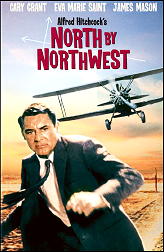
1. North by Northwest

NORTH BY NORTHWEST

2. The 39 Steps/The Most Dangerous Game (between the two of them almost every trope of the genre is developed)
3. Man Hunt
4. The Clouded Yellow
5. The Fugitive (Harrison Ford, not the disappointing John Ford film of Graham Greene’s Power and the Glory)
6. The Naked Prey
7. Lonely Are the Brave
8. State Secret/Highly Dangerous (I’m tied on these two British film, the first by Gilliat and Launder with Douglas Fairbanks Jr. and the latter a Roy Boulting film with screenplay by Eric Ambler)
9. Death Hunt
10. The Bourne Identity

        Top Ten Man on the Run in Wartime Films:

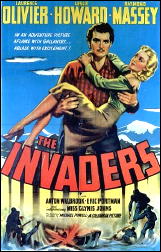
1. The 49th Parallel (aka The Invaders in the US)

THE 49TH PARALLEL

2. The Great Escape
3. The Mackenzie Break
4. Man at Large (fine little B film with George Reeves about a Nazi POW escaped and on the run in the US, very much in the 39 Steps vein)
5. Desperate Journey (RAF pilots Errol Flynn, Ronald Reagan, Alan Hale, and Arthur Kennedy play at Dumas Musketeers behind the lines while evading Nazi Raymond Massey)
6. The Pied Piper (Englishman Monty Woolley has to get a band of children out of France as it falls to the Nazi’s)
7. Eye of the Needle
8. Northern Pursuit
9. Ill Met By Moonlight
10. The Seventh Cross

        Top Ten Comedic Man on the Run Films:

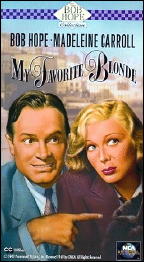
1. My Favorite Blonde

MY FAVORITE BLONDE

2. Once Upon a Honeymoon
3. To Be Or Not to Be
4. Arise My Love (pilot Ray Milland and reporter Claudette Colbert romance and try to escape from Europe as WW II breaks out)
5. Silver Streak
6. The President’s Analyst
7. The General
8. The In-Laws (the original, not the remake)
9. It’s a Wonderful World (screwball comedy with fugitive private eye James Stewart and poet Claudette Colbert trying to clear Ernest Truex of murder before his execution)
10. Tight Little Island (aka Whisky Galore!, though admittedly it’s a more booze on the run than man on the run film)

   And in for a penny in for a pound:

        Top Ten Man on the Run Western Movies:

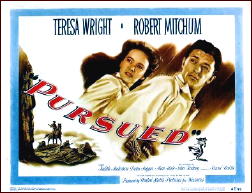
1. Pursued

PURSUED

2. The Capture
3. Drums Along the Mohawk (turns into a literal man on the run film)
4. Red Mountain
5. The Redhead and the Cowboy
6. The Last of the Mohicans (Randolph Scott or Michael Mann version)
7. Hildalgo (okay, it’s a race, give me one)
8. Waterhole #3 (okay, we’ll relax the ‘innocent’ part)
9. Apache
10. The Last Wagon

    Note: I know I’ll get more grief about this, but I don’t think First Blood the movie or the book makes the top ten or twenty of the books or films. I can easily think of twenty better books and films, but that’s subjective, which I grant this is.

   Frankly I don’t think anyone would remember the book without the film or either one without Rambo, and while I like the book I think there are better examples. I agree with Leonard Maltin who gives the film only one and a half stars.

            David

A TV Review by MIKE TOONEY:


“Hangover.” An episode of The Alfred Hitchcock Hour (Season 1, Episode 12). First air date: 6 December 1962. Tony Randall, Jayne Mansfield, Robert Lieb, Myron Healey, Tyler McVey, June Levant, William Phipps, Dody Heath. Teleplay: Lou Rambeau. Based on two short stories by John D. MacDonald and Charles Runyon. Director: Bernard Girard.

JAYNE MANSFIELD Hitchcock Hour Hangover

   Hadley Purvis (Tony Randall) has a major drinking problem, one bad enough to prompt his wife to threaten divorce if he doesn’t quit. One morning he wakes up to find his wife gone; in her place, however, is another woman named Marion (Jayne Mansfield).

   Now, we can all agree that worse things can happen to a man than to wake up to a woman like Marion, but Had’s problem is he doesn’t remember a thing from the day before. It’s only in little fragments that he gradually reconstructs what actually happened — and the final revelation will prove devastating …

   Note the unusual pairing of credits for the stories this television play was based on. You have to wonder what the situation was there.

   Tony Randall was excellent at light comedy (114 episodes of The Odd Couple, 44 installments each of The Tony Randall Show and Love, Sidney) and seldom ventured into crime drama. He did appear in Agatha Christie’s The Man in the Brown Suit (1989, TVM) but was totally miscast as “Hercule Poirot” in The Alphabet Murders (1965).

   In “Hangover,” Jayne Mansfield reunites with her co-star Tony Randall from the screen comedy Will Success Spoil Rock Hunter? (1957), but the character dynamic is totally different. She also appeared in the latter-day film noir The Burglar (also 1957).

     Hulu: http://www.imdb.com/video/hulu/vi1574436889/

Editorial Comments:   Mike may be too young to remember, but I’m not. Tony Randall had a solid career in old radio before becoming a long-time favorite of both movie and TV audiences. He was best known as Reggie, one of the three adventurers in Carleton E. Morse’s I Love a Mystery series in the late 1940s.

   I also discussed the unusual story collaboration between John D. MacDonald and Charles Runyon with Walker Martin. Says Walker:

    “JDM had the same reaction as Mike. See his introduction in the paperback collection, End of the Tiger, which reprints the story. Originally published as ‘Hangover’ in the July 1956 issue of Cosmopolitan. His reaction is also brought out in Martin Grams and Patrik Wikstrom’s book on the Hitchcock TV shows.

    “JDM says, ‘…I realized some committee of idiots had decided to combine my story with another story by Charles Runyon. The result of course was cluttered nonsense.’

    “Runyon’s story was also called ‘Hangover’ and was published in the December 1960 Manhunt. I recently read the JDM story and the Runyon story addition is the Jayne Mansfield character. By the way she looks the best I’ve ever seen her look. She should have kept the short hair.”

« Previous PageNext Page »