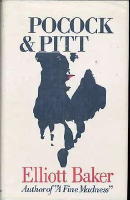
Elliott Baker, a screenwriter and novelist with one book listed in Crime Fiction IV, by Allen J. Hubin, died on February 9th. He was perhaps best known for his first book, A Fine Madness, which was made into a movie starring Sean Connery, Joanne Woodward and Jean Seberg.

   Described elsewhere as a “dark, picaresque” tale, A Fine Madness told the story of Samson Shillitoe, a poet forced to work as a carpet cleaner. Mr. Baker also wrote the screenplay for the fillm.

   Born Elliot Joseph Cohen, December 15, 1922, he changed his name when he began his writing career.

   His entry in CFIV is scant, as previously mentioned:

BAKER, ELLIOTT (1922-2007 )
   * -Pocock & Pitt (Putnam, 1971, hc) Joseph, 1974.

Pocock1

   The dash indicates a title of marginal crime content. The cover shown is that of the British edition. Some online reviews praise Pocock & Pitt but do not elucidate:

   “It’s a long time since I read a book that was so consistently enjoyable. The whole novel, while tough and disenchanted, increases your appetite for life.” –Eastern Daily Press

   “A strange and comic odyssey, too complicated to summarize, but a joy to read.” –Daily Telegraph

   “Pocock and Pitt” is philosophical, witty and erudite, wise and exciting and one of the best novels I have read this year.” –Irish Times

   “Elliott Baker is one of the wittiest of American authors. Quite rightly, this is a ‘one of a kind’ fiction.” –The Scotsman

   Adderly, a series created for Canadian television by Mr. Baker, was based on a character from Pocock and Pitt, described by one source as being in the “humorous adventure” category.

   Excerpting from a synopsis from IMDB:

    “V. H. Adderly, a former James Bond style operative for I.S.I., is given a desk job in the Department of Miscellaneous Affairs after losing function in his left hand – the result of torture by enemy agents. He hates the mundane assignments he is given, thumbs his nose at protocol, and somehow manages to dig up a threat to national security or a spy at every turn.”

   Adderly aired in the US from September 1986 through March 1988 by CBS at 11:30 pm, opposite Johnny Carson and Dave Letterman, but it made little ratings headway against the two late night hosts.

   Excerpting from a NY Times review:

    “[Adderly is the] sole agent in a basement operation called the Bureau of Miscellaneous Affairs. ‘What’s Miscellaneous Affairs?,’ someone asks. ‘Making your tax dollars work,’ answers Adderly sourly.

    “The tough, no-nonsense agent is played determinedly by Winston Rekert. His weekly cohorts are his bumbling, bureaucratic boss, Melville Greenspan (Jonathan Welsh); Mona (Dixie Seatle), the kooky agency secretary who adores Adderly, and Major Clack (Ken Pogue), the crusty intelligence chief with a heart of plutonium.

    “Think of The Man From U.N.C.L.E. done at bargain prices.

    “Adderly is not about to be overly demanding. It would be gratifying if the viewer were able to stay awake until the conclusion. If not, nothing’s missed.”

   I don’t know. I wish I’d seen it when it was on. I liked The Man from U.N.C.L.E. I even liked Get Smart. From the rest of the review, however, which is rather unfavorable, the chances of seeing the series on DVD are fairly slim.

   On the other hand, actors and other people responsible for putting the show on the air either won or were nominated for a number of Canadian Gemini awards, including Winston Rekert for best actor. Blame it on provincialism here in the US?

   Announced today was the death of Carolyn Hougan, 63, on February 25th. She was a highly praised thriller writer under her own name as well as “John Case,” a pen name she and her husband Jim shared together.

   The books she and/or her husband wrote were filled to the brim with contemporary terrorists, rogue CIA agents, high-tech science, voodoo magic, deadly viruses and secret conspiracies – the entire gamut of huge-stakes danger and the possible ways in which the world could be destroyed in a moment, or at least be brought to its knees.

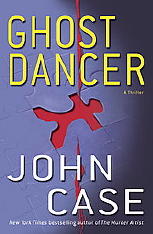
    Of special note, Ghost Dancer, the couple’s most recent novel, has been nominated for this year’s Dashiell Hammett Award for Best Literary Crime Novel by the International Association of Crime Writers. (For the complete list of nominees, go here.)

Ghost

  BIBLIOGRAPHY: [Based in part on her entry in Allen J. Hubin’s Crime Fiction IV.]

   Best known in combo with her husband as –

CASE, JOHN F.; pseudonym of Carolyn Hougan & Jim Hougan
   * The Genesis Code (Columbine, 1997, hc)
   * The First Horseman (Columbine, 1998, hc)
   * The Syndrome (Ballantine, 2001, hc)
   * The Eighth Day (Ballantine, 2002, hc)
   * The Murder Artist (Ballantine, 2004, hc)
   * Ghost Dancer (Ballantine, 2006, hc)

   On her own –

HOUGAN, CAROLYN (A.) (1943-2007)
   * Shooting in the Dark (Simon & Schuster, 1984, hc). Trade paperback, Felony & Mayhem, 2006.
   * The Romeo Flag (Simon & Schuster, 1989, hc). Trade paperback, Felony & Mayhem, 2005.
   * Blood Relative (Columbine, 1992, hc)

Shooting

   And on her own under yet another pen name –

BELL, MALCOLM; pseudonym of Carolyn Hougan.
   * The Last Goodbye (St. Martin’s, 1999, hc)

   Thanks to J. Kingston Pierce of The Rap Sheet for the link to her obituary on the Washington Post website.

   Covers for the 1945 mysteries are now included in the online Phoenix Press project. Right now 1945 begins a page to itself, so if you don’t mind, would you check to see that the links to all of the earlier years are working the way they’re supposed to?

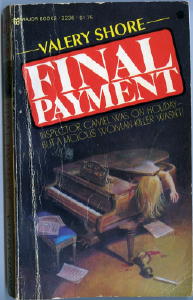
VALERY SHORE – Final Payment

Major Books 3236, paperback original; copyright 1978; no other date stated.

   Next on the agenda, and the final book I read in 2006, is the only mystery written by the pseudonymous Valery Shore. Al Hubin in Crime Fiction IV says that Shore was the pen name of Lon Viser, born in 1932. All I’ve been able to come up with regarding Mr. Viser is that he had something to do with the American Art Agency, a publisher based in North Hollywood in 1965.

   From the small print inside Atualidades Globo Controle Da Natalidade, written in Portuguese and illustrated throughout, aka The Complete Book of Birth Control:

   Parliament News, Inc. Publisher: Milton Luros. Executive Editor: Harold Straubing. Managing Editor: Lon Viser. Art Director: Wil Hulsey. Associate Art Director: J. D. Pecoraro.

   It’s not a common name. Maybe it’s the same man. All that comes up for Valery Shore, in case you were wondering, are a few dealers offering this book for sale on eBay, or maybe it’s the same book offered at different times. I didn’t check.

   The dedication reads as follows: “To Yvonne, Rhoda, and Lon, without whose help this book could not have been written,” so I assume that Al is correct – not that there’s any reason to doubt him.

Shore

   The primary detective in Final Payment is a former Scotland Yard inspector by the name of Christopher Camel, still young, who’d recently been left a fortune by an aunt, in her day a sex symbol of the silver screen. Staying with Camel in his aunt’s Tudor-style Hollywood mansion is “his beautiful Eurasian companion, Kim Lee Chance.” I’m quoting from the back cover.

   In attendance upon them both is Potter Goodleigh, his aunt’s former lover and a long ago movie director who’d been exiled to the guest cottage, but who is now cook, butler and father figure to the two young people who are now “livening up the old museum,” as he puts it.

    It is Potter’s daughter Felicia who’s murdered, her body found in the piano in her living room. Unfortunately Felicia was also a blackmailer, and there are thirteen suspects that Camel, Kim Lee, and the local lieutenant of police named Davidson have to deal with. In spite of his new-found money and all of his resultant leisure time, there is no way Camel can be kept off the case, as you can well imagine if it had happened to you and sunny fortune had smiled your way in such a fashion.

    The story, as I’ve relayed to you so far, may also sound to you as the basis for a made-for-TV mystery movie. If so, you share my feelings exactly, and I have the advantage of having actually read the book. If you also were to suspect that on page 177 there would be a gathering of the suspects in the dead woman’s living room, in an attempt to recreate the crime, I would certainly begin to wonder about you. How could you possibly know that it was on page 177?

   As entertaining as made-for-TV mystery movies may be, and some more than others, in general I’ve always had a relatively low opinion of them. This one, I’ll conclude by saying, is better than most of them. If there had ever been a second book in the series, I’d make sure that I had it in my collection too.

— written in December 2006

UPDATE [03-01-07] Victor Berch has done some preliminary spadework on Lon Viser, and so far he’s come up with the following: His full name as Lorenzo Ludwick Viser, born February 26, 1932 in FL, died August 9, 1994 in LA. There was a Lorenzo M. Viser living with him in the 90s, probably a son. More later, if and when!

   After I posted my review of The Nightmare Blonde, by Morton Wolson, in which I included all I knew about the author, his son, Peter Wolson, left a comment, which because of some HTML peculiarities, was truncated after only the first few lines. The Nightmare Blonde was Morton Wolson’s only mystery novel, but to pulp readers and collectors, he’s far better known as Peter Paige, author of the Cash Wale stories for Dime Detective, plus many other short stories for the pulp magazines throughout the 1940s.

   Here now is the complete version of what Peter Wolson had to say about his father, as he sent it to me later via email.   –Steve


   I am Mort Wolson’s son, a psychoanalyst in Beverly Hills, and can tell you a lot about him. But first some corrections. He was living in Leisure World in Laguna Hills, with his wife Gaye when he died of congestive heart failure. He was 89.

   The William Bendix episode, “Prime Suspect,” was based on his story, “The Attacker.”

   His first published ‘pulp’ narrative was “I Guard Nudes,” when he was a bouncer at the Cuban Village in the 1939 World Fair in which he described his job protecting the strippers from overly enthusiastic men and putting wraps on their bodies as they left the stage. It was printed in the pulp magazine Black Mask in September, 1939.

   The Nightmare Blonde was based on a previous novella, “Softly Creep, Softly Kill,” which anticipated The Bad Seed. “Softly Creep, Softly Kill” was published in Detective Tales, August, 1947. Mort always felt that this work was plagiarized by the author of The Bad Seed.

   Mort always regarded his detective stories as puzzles in which he would constantly try to fool the reader, while the clues for the denouement would be embedded in the material. But they came easily to him and, unfortunately, he did not regard them as valuable as writing the great American novel. So he spent the bulk of his time and energy during the fifties and beyond writing what he regarded as “serious fiction.”

   One such attempt was about a dual personality. In in one internal world, the assumption prevailed that Hannibal had successfully crossed the alps and defeated the Romans, with civilization developing in North Africa, in which blacks became the majority population and whites, the minority. In the other split-off personality, the world was as it is today, with the clash between the worlds occurring in the individual’s mind.

   Another novel was entitled Nightmare Bullet, in which a scientist had discovered how to insert a nuclear device in a bullet, and this involved foreign espionage. Mort also wrote a book about his experiences in the Spanish Civil War, called The Dragon Lady and I. He also wrote over a hundred sonnets to Gaye, his third wife, in the literary form of true Shakespearean sonnets.

   Clearly, he did best at writing pulp detective stories, and most of his stories published in Black Mask and Dime Detective, were the main feature, with the magazine covers representing their themes. He respected Raymond Chandler, Cornell Woolrich and Dashiell Hammet, but had contempt for Mickey Spillane, feeling that he cheated to earn his fame by exaggerating blood and gore.

   The lapse in his writing was due to his efforts to earn a living as a furniture store owner, which occupied most of his time. In retirement, he was able to write The Nightmare Blonde and his memoirs.

   Mort was a very good-looking, manly, powerfully built, blond-haired individual, who smoked a pipe and loved to argue. He prided himself on being a divergent thinker, and loved to take the most oppositional point of view in any discussion, to the delight of some, and to the dismay of others.

   Thanks for your interest in him.

Peter Wolson

   Following the interview with John “Wade” Wright here not too long ago, I’ve been asked to say some more about his recurring characters. (Preceding the interview is a list of all 14 of his mystery novels.)

   I still don’t have access to copies of his books myself, and while I’ve purchased two or three in the last couple of days and they’re on their way to me, that doesn’t do me any good right now. So I asked Bill Pronzini, who’s read them all, I believe, and here is what he had to say.   

Haloes

Steve:

   I don’t have the time to do a full write-up on John’s series characters, but in a nutshell:

   Bart Condor is a tough, violent New York private eye inspired by and patterned after Spillane’s Mike Hammer.

   Paul Cameron is a more cerebral P.I. built along the lines of Philip Marlowe, Thomas Dewey’s Mac, Bob Martin’s Jim Bennett; his bailiwick is southern California.

   Calhoun is a Vietnam vet who works for a shadowy U.S. internal security agency run by “The Man” and whose job is to “help lop off the many tentacles of the racket boys [i.e. Mafia]” by any necessary means, operating close to the law and without any official cover.

   The Paul Cameron series is the best of the three. For my taste, though, the best of all John’s novels are the two stand-alones, Death at Nostalgia Street and It Leads to Murder.

Best,

    Bill

by JON JERMEY

   In June 2001 I founded the Golden Age of Detective Fiction mailing list at Yahoo. At that time I had already spent several years reading and contributing to Usenet newsgroups on the Internet, and had become frustrated at their persistently modern focus. My aim was to provide a forum where I could discuss with others the kind of detective stories that I liked; typically those written from the 1920s through to the 1950s, with a focus on investigation rather than – as was the vogue then – cats, dogs, recipes and plucky forensic scientists.

   I advertised the new mailing list on several of these groups, as well as the existing groups for fans of such writers as Agatha Christie and Dorothy L Sayers, and was lucky to attract many other people who shared my interest. Like all mailing lists, the membership is rather like an iceberg: for every one member who contributes regularly we have another nine or so who merely lurk underwater, perhaps surfacing once a year with a question or comment about a particular favourite author. The list has grown steadily, and our members now include distinguished mystery authors, critics, editors, publishers and anthologists, as well as just plain fans like me.

   Discussions on the list cover a wide range of topics, but from the very beginning there have always been reviews of the books that members have read, and descriptions of authors’ lives and works. Many writers have been profiled in this way, and I hope that their sales figures have shown a corresponding jump! By 2003 it was becoming clear that the mailing list archives were accumulating a good deal of knowledge about books and writers. Unfortunately Yahoo archives are relatively difficult to search and there was no guarantee that the material would be retained. I began looking for another medium which would provide a more permanent and easier-to-search home for the group’s accumulated wisdom.

   My first attempt was a blog, which I set up in 2003. I brought the existing reviews across to the blog and added more as they came up in the list. Other members were encouraged to use the blog to post their own reviews directly, but as time went on it became clear that this was not working well. The blog was nearly as hard to search as the mailing list, and the need to register before posting tended to discourage people from joining the blog.

   Early in 2005 I started to become aware of Wikis. (In fact we have a family connection to Wikipedia: my brother-in-law is credited with making the oldest surviving Wikipedia edit in 2001.) I began by suggesting that members post their wisdom to Wikipedia, but this didn’t draw much of a reaction, so in December 2005 I took advantage of the free PBWiki hosting service to set up a specialised Wiki about Golden Age works of detection.

   It was a strange time for me because shortly before that I had been diagnosed with a serious illness, and had cancelled most of my work commitments in order to deal with it. As it turned out the diagnosis was wrong, so I was left feeling relieved, but rather shattered and with lots of spare time to fill in. The Wiki was an ideal project to occupy my mind for a couple of months. It helped to keep me sane.

   I began by putting in the reviews that we already had, and trying to include some information about every author. This involved a lot of web searching, reading back-cover blurbs, and digging through my own small collection of reference books. Each author’s entry includes a Bibliography. Other members have been able to check and add to these details as time goes by.

   I am trained in information science – I am an indexer and database consultant and my wife is an indexer and librarian – so it came naturally to me to set up a structured system. The main entry point to the Wiki is via a list of authors’ names. Unlike Wikipedia I chose to invert the names – ‘Christie, Agatha’, not ‘Agatha Christie’. I’m not sure that I could defend the decision but it seemed more natural and comfortable to me to look up Margery Allingham under ‘A’ rather than ‘M’. And first names can vary – is Ms Ferrars ‘Elizabeth’ or ‘E.X.’? Not having Wikipedia’s workforce to set up cross-references and disambiguation pages, it seemed best to keep it as simple as possible.

   Choosing an author’s name takes you to a page about that author. Sometimes a lot is known about the author and the page can extend to thousands of words. Mike Grost in particular has contributed a great deal to the author profiles, due to the extensive material he allowed me to bring across from his website. At other times little or nothing is known – for instance, about James R. Langham, an American author and screenwriter – and all we can do is hope that a descendant or fan will come along and add to our knowledge later. For at least one author, A. Fielding, we know less than nothing, since the facts we thought we had – taken from reputable sources – have been cast into doubt by other equally reputable sources. But the advantage of a Wiki is that it is always open to change and improvement. Currently we have about 830 authors listed, but I know that there are many more to come.

   The author’s page, as I said, includes a Bibliography. This is supposed to list only their works of detective fiction, but in practice – and especially with obscure authors – it isn’t always easy to pick which is which. When in doubt I’ve tended to include rather than exclude. This list in turn links to entries for each book.

   At the moment we have about 7000 books listed and only about 500 reviews, so most of our slots are empty. Some authors are well-covered; John Dickson Carr, for instance, has reviews for most of his books. Others are entirely blank, waiting for some enthusiast to come and fill them in. We add about three or four reviews a week, so we have many years’ work ahead of us.

   I’ve included pictures for many of the authors where these are available, and for some books. We only have a limited space, though, so I’ve been sparing with these.

   In addition to ‘regular’ detective authors there is a section for ‘one-offs’; people who are known or believed to have written only one work of detective fiction. There are quite a few of these, featuring some distinguished names: CP Snow and AA Milne among others. We also have some of the classic commentaries on detective fiction, including the Haycraft-Queen Hundred and Ronald Knox’s Ten Commandments.

   Any Wiki like this, covering a single subject, is going to require making decisions. My working definition of a Golden Age author is someone who produced a book of detective fiction between 1920 and 1960. This means that Conan Doyle just squeaks in with The Casebook of Sherlock Holmes at one end and HRF Keating with Death and the Visiting Fireman at the other. But I have included writers like Edgar Allan Poe who are part of the history of detective fiction.

   And what constitutes ‘detective fiction’? I have my own views but in general I have gone along with the experts on this; if someone’s name appears in a book or website about detective stories then I tend to assume they are eligible. A borderline case for me would be Peter Cheyney, currently not in the list, who wrote a great deal about criminals and police, but never – as far as I know – constructed a puzzle plot. Leslie Charteris, on the other hand, is in on the strength of a couple of detection-based novellas. But if someone wanted to add a Cheyney page I wouldn’t object.

   A third problem: what to do when two books have the same name? We have a couple of examples of this already, and I’ve simply taken the coward’s way out and listed them both on the same page.

   Up to now I’ve done at least 50% of the work on the Wiki. As it becomes more widely known I would like to see others – GAD mailing list members and members of the public – begin to take more of the initiative. Some have made Herculean efforts already; some are still hanging back. A lot of the books mentioned on the Wiki are very rare, and may be in the hands of only a few people; we’d like to bring these to light and revive interest in some of the books and authors that have been unfairly neglected. On the other hand, if someone wants to write a review saying ‘Don’t read this, it’s rubbish’, that’s fine too. It’s all useful information.

   One problem with setting up a collaborative system like this is, how much to let go? I want the Wiki to be as easy to use as possible, and this to me means working within a consistent and fairly rigid structure. But GAD fans don’t all have the technical skills to use the codes and other options available within the Wiki. I’ve posted ‘Rules’ that I hope are helpful, but I don’t want to discourage anyone from sharing their knowledge. I suspect that there will always be a certain amount of tidying up to do after the other contributors if the Wiki is to retain its current structure.

   The host, PBWiki, has been very supportive. One early problem was solved with a quick email back and forth, and from then on it’s been smooth sailing. We were one of their first customers, and so they’ve grown and developed alongside us, adding features as we were adding pages. It’s quick and easy to obtain a complete backup, which is important, and their search system allows users to locate pages relatively quickly. They’ve recently added a new editing system which should also make it easier for people to contribute.

   I don’t see the Wiki as standing in isolation. On the contrary, it wouldn’t have been possible without contributions and material from all over the Internet. Ten years ago it looked as though classic detective fiction was doomed to wither away as authors died and the books became increasingly hard to get. But thanks largely to the Internet, the people who do value these writings can get together and share their knowledge and skills. I’ve learned a great deal in the process and I hope that others have too.

   Many of the earlier books are now available online, and despite the current growth in restrictive copyright laws I hope that ultimately they all will be. When that happens people all over the world will need a place to go where they can find out more about these wonderful works, and the Golden Age Wiki will be there for them.

   To join the Golden Age of Detection Mailing list go to: http://groups.yahoo.com/group/GAdetection/

   To view the Golden Age of Detection Wiki go to: http://gadetection.pbwiki.com.

   Contributors can log in with their email address and password: ‘goldenage’. Please read the Rules first!

           —
>> This is Steve. Jon submitted this at my request, and what he says goes the same for me.
   You won’t find Jerome Whelan’s name in Allen J. Hubin’s Crime Fiction IV, at least not under that name. You will find him, however, in the online Addenda that preceded the Revised CFIV, which has not yet published. The entry appeared then as follows:

      BRIEN, R. N. Pseudonym of Jerome Bernard Whelan.
         The Missing Solicitor. Skeffington, 1952 [Eng.]

   Four or five copies of the book are currently being offered for sale on the Internet, so it is not especially uncommon. Nonetheless, not only was Mr. Whelan an author new to CFIV, but so was the title itself, even under the pen name, having escaped notice for one reason or another through four editions of the Hubin bibliography.

   At the moment I cannot tell you exactly what the mystery in The Missing Solicitor is about, but I have a pretty good guess. In a recent email to Al Hubin, Edward Whelan, a barrister in England, said “Jerome (my father) was a solicitor himself, and obviously did not want any of his clients to know that he had a secret fantasy world of arsenic poisoning and stolen bearer bonds.”

   According to Edward, as he mentions in the same email, the name R. N. Brien came from a variation on his mother’s maiden name. There was also only the one novel, which his father always spoke about in a deprecating fashion.

   Jerome Whelan went on to become a noted tax advisor and a director of the Ionian Bank in London. He was born in Cork in 1911 and died on 14 Feb 2007.

   Uploaded this morning was Part 11 of Allen J. Hubin’s Addenda to the Revised Crime Fiction IV. Most of the data in this installment consists of identifying authors who have entries in the online Contemporary Authors, previously not so noted.

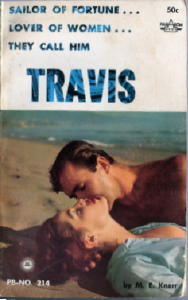
   As usual, however, included also are all the additions and corrections uncovered since Part 10 was completed, of which there are many, not the least of which is the inclusion of two hitherto unknown titles by author Michael Knerr. (See the review of Travis here on M*F immediately preceding.)

M. E. KNERR – Travis

Pike Book #214; paperback original. First printing, April 1962.

   I seem to be specializing in obscure books this month, and this one is about as obscure as you can get. Even though it is a private eye novel – and I’ll get back to that in a minute – it was published by one of those small sleazy paperback outfits in the early 1960s that promised more than they could possibly deliver at the time. And even so, if you happened to have purchased this one in 1962 for its sexy parts, you’d be sadly disappointed, since in that regard, it’s really rather tame. If sexy passages were what you were looking for back then, you’d have been far better off buying a copy of Peyton Place than this.

    This book does not even appear in Al Hubin’s Crime Fiction IV, but it will, or at least in the Addenda. The author does appear, however, and to show you something of his track record, here’s his present entry:

KNERR, MICHAEL E. (1908?-1984?)
* Operation: Lust (Epic, 1962, hc) as by M. E. Knerr.
* The Violent Lady (Monarch, 1963, pb)

   Listed below are other titles by Knerr (under either byline) which I found listed for sale at various places on the Internet, but not included in CFIV, and probably for good reason. I do not have descriptions of the story lines for any of these first three, so your guess is as good as mine:

* Brazen Broad (Pike #206, pbo, 1961)
* Heavy Weather (Belmont/Tower, pbo, 1979)   [** -See UPDATE below.]
* Port of Passion (Imperial #737, pbo, n.d.)

These I found descriptions for:

* Night in Guyana (Belmont/Tower, pbo, 1978) A non-fiction account of the of the mass suicide of the Jim Jones cult.

* Sasquatch: Monster of the Northwest Woods (Belmont/Tower, pbo, 1977) Quoting from the cover: “Though based upon factual research, this is a fictional tale of what could conceivably happen in the Pacific Northwest: a chain of events that could create a monster out of a normally timid and gentle giant.”

* The Sex Life of the Gods (Uptown Books #703, pbo, 1962) “Science Fiction erotica.”

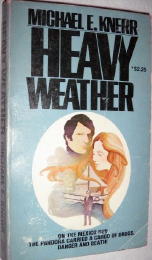
   [** UPDATE 02-27-07] At first I was doubtful, but now that I’ve found a cover scan of Heavy Weather, I’d say that it’s also a prime candidate for inclusion in Crime Fiction IV. If you can’t make out the small print on the bottom of the cover, it says, and I quote: “On the Mexico run the Pandora carried a cargo of drugs, danger and death!” LATER THE SAME DAY: Al Hubin agrees. In it goes. (The book pictured below is described as a Horwitz edition published in Hong Kong.)

Knerr1

   But let’s get on with things and to the book Travis itself. There’s only one copy offered for sale on the Internet, making it not only obscure but scarce. I mention this even though I’m sure you know that the two are usually, but not always, one and the same.

   Telling the story, though, in his debut and probably his only appearance in print, is Mike Travis, a “sailor of fortune, who loves life, and woman, especially women.” It is not difficult to deduce what other reasonably well-known character was the inspiration for Mike Travis. Travis in this book had previously been in the charter boat business in Florida, but when times went bad, he went to California to accept an offer made by one of his former customers, a multi-millionaire named Del Houston, to look him up if and when Travis headed out that way.

    And Del does indeed have a job for him. After some quick string-pulling and the greasing of certain political hands, Del hands Travis a PI license and a gun, and a three-fold request: to find his son; get him off narcotics; and break up the gang who’s been supplying them.

    It’s not a bad opening for a PI yarn, and the story maintains its way reasonably well for about half of its just under 160 pages: the usual PI stuff, the things that PI’s do, and the usual bad things happen to some of the people who just happen to get in the way, with all of the coincidences that make one or more aspects of one PI investigation dovetail nicely into another.

    Even though it goes without saying, I’ll say it anyway. Travis himself is one of those guys who is irresistible to beautiful women. In this book that includes both his employer’s foster daughter, from page 20 …

   She had a body to make dead men come to life and dead women come back to haunt their living husbands. With a skin tone tanned to an almost artistic hue, hair the color of a burnished copper skillet, eyes as blue as an ocean trough and lips as soft and warm looking as an afternoon at the beach, Abby Houston was a woman to set pulses racing and libidos leaping. Mine was right up there too.

   … and a stripper who the first time they met, tripped him into a pool at Houston’s house. From page 68:

   Marcia, if that was her real name, was rigged up in the getup of an Indian squaw, but the way she filled out the tan buckskin and beads of her ensemble would have made Pocohontas whirl in her grave. If this was an example of the way that Indian women of a hundred years ago, I could see why the west had been wild.

    I think you can tell a lot of about a story by looking closely at how the author describes his characters, don’t you? With an ending that doesn’t directly address the clues that have been set up for it, though, the tale does two things simultaneously and hence the apparent impossible. The action-packed finale (a) goes all but out of control, and (b) withers away from lack of interest, as if there were a deadline set that had to be met, and it didn’t matter precisely how.

Travis

    Although overall not without flashes of acceptable writing, and every once in a while better than acceptable, the overall impact of this novel is still rather like a third-rate Carter Brown or a tenth-rate John D. MacDonald, either of whom, if you’re a fan, you know what I’m talking about and whom you’re far better off pursuing.

    Or let’s put it this way. One of the reasons for collecting and reading unknown and long-neglected works of mystery fiction is the hope that never dies of discovering an unknown and long-neglected classic of mystery fiction. Sometimes you have to settle for unknown and long-neglected.

— written in December 2006

UPDATE [02-26-07] If you were to google “M. E. Knerr” on the Internet, you would find, as I did, that there was a Michael E. Knerr who was a friend of SF and (occasional) mystery writer H. Beam Piper, who committed suicide in 1964 when he ran into financial troubles. I’ve not been able to confirm that the two Knerr’s are one and same, nor have the birth and death years for either one been verified. Accounts vary on the latter. Knerr may have also written under the name of “Brent Hart,” but that’s another loose end not yet tied down.

    But the Knerr who was a friend of Piper apparently wrote a hitherto unpublished biography of him, and upon Piper’s death, went through his manuscripts and salvaged, among other things, the “lost” third Fuzzy novel, Fuzzies and Other People.

    If and when I know more, I will as always, let you know.

[UPDATE #3] Postdated 03-29-07 on 08-16-07. Thanks to Google, I discovered that SF writer John F. Carr knew Mike Knerr, and after a small amount of effort, I was able to get in touch with him by email. As a consequence of this contact, John has posted a long article about his friendship with him here on the M*F blog. I should pointed this out more clearly before now, instead of leaving it hidden as one of the comments.

   In this article about Mike Knerr, Carr has his correct date of birth, along with the year he died, plus a lot more about him on both a professional and a personal level.

« Previous PageNext Page »