A previous entry on this blog was entitled “Death Noted: ELINORE COWAN STONE (1885-1974).” Mrs. Stone was the author of one published mystery novel, Fear Rides the Fog (Appleton, 1937). Here are the results of some further investigation into her life:

      Some Biographical and Bibliographic Notes on Elinore Cowan Stone

by Victor Berch

    Elinore “Nellie” Rose Cowan was born March 22, 1883 in Adrian, MI, the daughter of John F. and Rebecca Caroline (McClaskey) Cowan. She was the eldest of four children. Her father was a minister.

    My choice for her birth year is based mainly on the 1900 US Census record. For it is in that census that people were required to give the month and year of birth. Although women were more inclined to make themselves younger by shaving off a year or two or more when reporting to the census taker, this habit was not restricted to women alone, as will be shown in a forthcoming note on Edwin Dial Torgerson.

    Through past ventures into genealogical research, I’d say that if a young lady had not reached her 20th birthday by 1900, then the accuracy of the 1900 Census would be most reliable. Bolstering my selection of her birth date is the fact that in the North Carolina Death Index, her birth date is given as 1883. Such information is usually supplied by a surviving family member, who, in this case, would have been her husband.

    Ms. Cowan was educated at Brighton High School (Boston, MA), Mt. Holyoke College (South Hadley, MA), Emerson School of Expression (Boston, MA) and the University of California. She taught at various high schools, private schools, Oahu College in Honolulu, Hawaii and the University of Colorado.

    In 1915, she married Clarence Arthur Stone. By 1917, they were living in New Mexico. As presented previously on this blog, the rest of her story is summed up in that newspaper announcement of her reaching her 90th birthday, March 22, 1973. She died on November 30, 1974.

    Some Additional Bibliographic Notes.

Contributions to periodicals:

Ain’t She the Beautiful, Woman’s Home Companion, June 1927
Alibi of Salvador, Collier’s Magazine, Aug. 8, 1925
Angela and the Fierce Cally Hope, Woman’s Home Companion, Sep. 1925
The Christmas Lamb, Good Housekeeping, Jan. 1935
Dirty Work at the Crossroads, American Magazine, Aug. 1931
The Fabric of Royalty, Good Housekeeping, Sep. 1926
An Hour Before Dinner, Collier’s Magazine, Dec. 18, 1926
José the Onlocky, Woman’s Home Companion, May 1925
A Little Black Box, Woman’s Home Companion, Jan. 1928
The Making of a Journalist, Woman’s Home Companion, Mar. 1929
The Mama of Manuelito, Century Magazine, Apr. 1923
No Dogs Allowed, The Delineator, July 1931
No Pumpkin Pie for Reckless Guys, Woman’s Home Companion, Nov. 1927
The Phantom of the Wagon Trains, Ladies’ Home Journal, Aug. 1924
A Question of Precedence, Woman’s Home Companion, Mar. 1925
Smoke, Good Housekeeping, July 1929
Somewhere in Russia, Woman’s Home Companion, Jan. 1925
Viva Oncle Sam!, Good Housekeeping, Oct. 1927
What Do We Wear?, Century Magazine, Sep. 1922
White Lilacs, Good Housekeeping, May 1929

    Contributions to newspapers:

Note: This part I found most difficult to obtain on-line as most of the newspapers that were presented on-line were partial runs. There were two that were short stories and it was no problem to cite the sources. But in the case of serials, there were only partial runs of the newspaper. The serials were syndicated by NEA Services, Inc. and ran in many different papers throughout the US. But some did not appear on the same dates and some did not appear in other newspapers serviced by NEA. I suppose it was up to each editor to decide which serials would run in his newspaper and when. The stories are chronologically arranged and those that are criminous in nature are denoted by *.

*Applied Science (ss) appeared in Every Week Magazine, in this instance a Sunday
supplement to the Lima (OH) Sunday News, Jan. 14, 1934.

*Two in a Fog (ss) appeared in the Fitchburg (MA) Sentinel, Oct 3, 1936

Belated Holiday (serial), at least Dec. 1937 and Jan . 1938

Love Laughs at the Doctor (serial) Mar. and Apr. 1938

Intern Trouble (serial) July and Aug. 1938

No Time to Marry (serial) Jan. and Feb. 1939

*Murder on the Boardwalk (serial) Aug. and Sep. 1939

*Footsteps in the Fog (serial) June and July 1941

        © Victor A. Berch, 2007

   The subtitle for the book will explain more: An Annotated Crime Fiction Bibliography of the Lending Library Publishers: 1936-1967, and there’s a story behind it.

   Bill had completed the book before he passed away in 2004, but at the time of his death, he had not yet been able to find a publisher for it. With the manuscript in the hands of mystery writer Bill Pronzini, the search was continued after Bill Deeck’s death, but there were no takers to be found. Some publishers looked at it, some promises were made, but in the end, nothing more happened. When I (this is Steve) offered in mid-2006 to put the entire book online, Bill agreed, and soon thereafter we began the project.

Logo
   The logo for Phoenix Press, the most prolific of several publishers
for the lending library market.

   The website was registered as www.lendinglibmystery.com, some preliminary uploading followed – and that was when events took an unexpected turn. It happened at last year’s Pulpcon, during a conversation that took place between myself and George Vanderburg. George is the man in charge at The Battered Silicon Dispatch Box, publisher of a number of hefty volumes both classic detective fiction reprints and stories from the pulps. While discussing the various projects both he and I were working on, George quickly became convinced of the value of the material in Bill Deeck’s book, and having a strong interest in works of bibliographic interest in the field of crime fiction, he enthusiastically declared his wish to publish it. Obviously there were details to be worked out with Bill Pronzini, but with almost no delay, they were. While an official publication date has yet to be set, the process of getting the book into print, we were advised in mid-December, is in its final stages. At last!

   Jump to the present. We’re now heading toward the end of January 2007. Even though Bill Deeck’s book will soon be available, and in the precise format he’d envisioned, we [Bill Pronzini and I] have decided to keep the website up and running. Our intentions are to maintain it as a supplement to the book, not only for now, but for the foreseeable future. Even more, the Internet will allow us to enhance Bill’s book in a way that would be prohibitively expensive to do in printed form: with very little effort, we can upload and display full cover scans of each and every one of the titles which Bill Deeck included and annotated in MA3cAD. Or at least, that’s the goal.

Phoenix1

    If you were to go here, for example, you would find cover scans of [almost] all of the mysteries published by Phoenix Press between 1936 and 1939. More pages of Phoenix Press covers will be added in due course. The company continued to publish mysteries until 1952. Other publishers whose mysteries are included in MA3cAD are: Hillman-Curl, Arcadia House, Mystery House, Gateway Books, Alliance Press, Alliance Book Corporation, The William Caslon Company, Dodge Publishing Company, William Godwin Inc., and Jonathan Swift Publishers. Cover images for the mystery fiction published by all of these companies will be uploaded as quickly as we can do it.

   Keep checking with George’s The Battered Silicon Dispatch Box website as to its availability. I’ll be sure to let you know here, of course, as soon as it’s ready. In the meantime, check out the link in the paragraph above, and enjoy the covers!

Phoenix2

PS. I almost forget. To read Bill Pronzini’s delightful account (if not deconstruction) of Phoenix Press and the mysteries they published, go here.

   I didn’t realize that Art Buchwald, the world-famous humorist who died three days ago, was among his other accomplishments, a crime fiction writer. I haven’t asked Al Hubin, author of Crime Fiction IV, for his opinion yet, but as of this evening, Mr. Buchwald has not been honored with an entry in his massive, all-inclusive bibliography of our field.

   Let me make a case for his inclusion, if I may, based on the following paragraph which I read in yesterday or today’s issue of the New York Times:

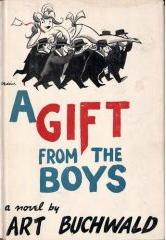
   “A guy showed up in my office covered with bandages and blood and told me he was a recent graduate of Sing Sing,” Mr. [Ben] Bradlee [former editor of the Washington Post] said. “He had done time for murder and was broke. He became a thorn in my side, and I got sick of him, so I sent him to Buchwald, just to get him out of my office. Art locked him up in a room and wrote a book about him, A Gift From the Boys. The guy had been deported and his mob friends gave him a girl as a goodbye present.”

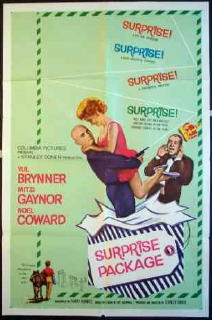
   The novel, by the way, published in 1958, became the basis of the 1960 movie Surprise Package with Yul Brynner and Mitzi Gaynor (as the Gift).

Buchwald1

   [The illustration on the jacket is by Dedini,
a cartoonist often spotted in New Yorker magazine.]

   The paragraph in the Times was interesting but hardly conclusive. I searched online for more evidence to back my case. From Bloomberg.com:

   The story centered on mobsters who were deported from the U.S. to Italy, where Buchwald traveled to interview organized crime figure Charles “Lucky” Luciano in Naples.

   Well, Mr. Buchwald was talking to the right people to help write a crime novel, all right, but I couldn’t come up with a more useful description of the book than what I have so far. Maybe I’d have better luck finding a plot outline of the movie, I thought.

   From Time magazine [Nov. 14, 1960]:

   Surprise Package (Columbia) is stuffed with expensive ingredients: Yul Brynner, Mitzi Gaynor, Noel Coward in front of the camera, Director Stanley (Seven Brides for Seven Brothers) Donen behind it plus a script by Harry (Reclining Figure) Kurnitz based on a novel (A Gift from the Boys) by Columnist Art Buchwald. But as far as entertainment is concerned, Package contains only what is known in show business as a bomb. Director Donen clearly intended to tell a shaggy-dog story the way John Huston did in his hilarious Beat the Devil but unfortunately, Donen’s dog turns out to be all bark and no bite. The hero (Brynner) is a big-time hood deported from the U.S. to his native Greece and confined by the Greek government to a small Aegean island. The story evolves around his attempt to get back in the money by relieving an exiled king (Noel Coward) of his million-dollar crown. Revolving ever more tediously, it goes down the drain in a clutter of words. Package is perhaps the year’s talkiest talkie. Coward: “It’s amazing how a girl so dumb that if you say hello she’s stuck for an answer can reel off a three-hour lecture on why wild mink is better.” Brynner, contemplating a statue of a discus thrower: “What sort of a country is dis? Puttin’ up a monument of a guy stealin’ hubcaps!”

Buchwald2

   So OK, Time didn’t like the movie, but there are points of the plot that are crime-related, wouldn’t you agree? Moving on, here is something extremely interesting I found on TVHeads.com.

   It was also during this period (sometime between 1948 and 1951) Buchwald was rumored and reported to have a very short lived affair with American actress Marilyn Monroe. The affair is said to have only lasted a few weeks, and it was said that Buchwald introduced Marilyn to Judaism (to which she later converted). Marilyn is said to be the basis in part for a character in Buchwald’s novel A Gift From The Boys published in 1958.

   Now I agree that this has nothing to do with my conjecture that Mr. Buchwald’s novel is a work of crime fiction, but if the TVHeads rumor is true, why all I can do is nod my head in agreement.

   Perhaps we should get serious for a moment. Here is my final piece of evidence, a comment from a semi-anonymous poster on IMDB.com:

    “This is a caper film involving a deported U.S. gangster played by Yul Brynner now living on a Greek island trying to steal the crown of the exiled King of Anatolia played by Coward. Along for the ride is Mitzi Gaynor as Brynner’s moll and the baddie played by George Coulouris from the People’s Republic of Anatolia, the gang that overthrew the king. The director is Stanley Donen from a novel by humorist Art Buchwald.

    “Brynner is terribly miscast in his part. A gangster I can believe him as, but he just has no flair for comedy. There were some comic moments in the King and I, but that’s overall, a serious part. Coward looks bored by the whole thing, I wish he had scripted and directed it also and he probably wished he did too. George Coulouris was his usual menacing self.”

   Well, what do you think? Is Mr. Buchwald in, or is he out?

[UPDATE: 01-21-07] An email reponse from Al Hubin, excerpted to refer only to my presentation above:

  Steve,

I’m convinced, though at this stage I’m inclined (for my next Addenda installment, Part 10) to use a dash [to indicate marginal crime content]. Good work on your part!

  Best,

    Al

>> My reply? I agree 100 percent. I couldn’t convince even myself that the book’s more than a marginal entry, but I’m still glad to know that Mr. Buchwald is in.

   At the present time, the entry for mystery writer John Dellbridge in Crime Fiction IV, by Allen J. Hubin, looks like this:

DELLBRIDGE, JOHN (1887-?)

* * * -The Moles of Death (Diamond, 1927, hc) [India]

* * * Sons of Tumult (Long, 1928, hc) [Pakistan]

* * * The Honourable Sir John (Long, 1929, hc) [England]

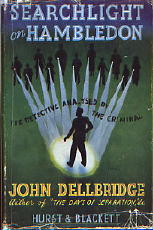
Searchlight * * * Searchlight on Hambledon (Hurst, 1947, hc) [Rupert Hambledon; England] Story collection:

• Clowns Are Serious Sometimes • ss
• Conversation Piece with Postscript • ss
• The Defeat of Hambledon • ss
• Devastating Sanity • ss
• Entirely Self Made • ss
• The Fire That Was Quenched • ss
• Horses Can’t Be Trusted • ss
• Last of the Screwleighs • ss
• Letter to His Bishop • ss
• Modern Messalina • ss
• Ronnie the Rat • ss

* * * Unfit to Plead (Hurst, 1949, hc) [Rupert Hambledon; England]

* * * The Lady in the Wood (Hurst, 1950, hc) [Rupert Hambledon; England]

   British bookseller Jamie Sturgeon, however, has discovered the website for The University of the West Indies at St. Augustine, Trinidad & Tobago, where the papers of Frederick Joseph De Verteuil are stored.

   On the page describing their holdings for him it states that De Verteuil was born in Trinidad in 1887, and that he “went to England at the age of fourteen in 1901 and later qualified as a lawyer at Gray’s Inn. He practised as a barrister in India for several years and later returned to England where he continued practising law until he was debarred from practice due to misrepresenting his clients in court. [See FOOTNOTE.] He then became a little known writer of novels and short stories, historical works and semi-scientific commentaries. He wrote under three different pseudonyms: John Dellbridge, Freddy Bannister and Francis Vere.”

   Neither Bannister nor Vere are in CFIV, but John Dellbridge’s identity has clearly now been revealed.

Lady

   Jamie emailed Al Hubin with his discovery, who in turn did some followup investigating:

   Too bad the site doesn’t give a death date. I’ll have to do a little trolling on the real name and see if I can find it.

[Later] The only reference (other than the one Jamie gives) that turned up in a google search was a wedding notice for one Carl Frederick de Verteuil, which mentions that his father (a novelist!) retired as managing director of cruise ship newspapers published by the Thomas Skinner company in Toronto! The groom’s age (35) makes it virtually impossible that he was the son of “Dellbridge” (who would have been some 88 years old when Carl was born), but could he be the grandson? Incidentally, there’s no trace of anyone name de Verteuil in the Canada National Catalogue. But in the British Library Catalogue is a book by one Anthony de Verteuil, The de Verteuils of Trinidad 1797-1997, which might very likely shed further light on “Dellbridge” and perhaps others And Frederick Joseph de Vertueil (almost certainly “Dellbridge”) published an autobiographical book under his real name in 1938, Fifty Wasted Years, which might also make interesting reading And there’s a Carl de Verteuil with several novels ca.1950-1960 (the groom’s father?). Anthony de Verteuil has quite a number of books going back to 1973 though they don’t seem to be novels. All very interesting!

   And here is where the matter stands. Even if nothing further is found, we now know considerably more about on the pseudonymous John Dellbridge than we did before. As for Rupert Hambledon, there’s nothing known about him at the moment, but there will be soon. I (this is Steve) have purchased a copy of The Lady in the Wood, pictured above, and it’s now on its way to me from England. When I know more, you’ll read about it here.

[UPDATE: 01-20-07]
Here’s a short note received by email from John Herrington:

Hi Steve,

It appears that Francis Vere was used on a 1952 novel Don Ricardo and the 1955 Salt in Their Blood about Dutch admirals. There are also some 1950s works on Piltdown Man and evolution which have the same name as author. Coincidence or same writer I know not.

Cannot find anything by Freddy Bannister. A Google search is hampered by the fact that that was the name of the man who organised the Knebworth concerts.

And who was the Frederick Benedict De Verteuil who wrote the 1949 Almost Glory as F. Benedict? Presume he must be related.

Regards

  John


[UPDATE: 04-04-07] Taken from an email from Carl de Verteuil, mentioned above, who also has two posts in the comments section —

  Steve,

   My grandfather died in 1963 (I don’t have the exact date) but it was sometime in the autumn — at about the same time as JFK and Aldous Huxley !

   I’ll see if I can gather some more information from my uncle “Cook” (son of Frederick) about his mystery writing. He was a prolific author and is well regarded in his native Trinidad (the de Verteuils were one of the French families to have settled there after the French revolution).

   Unfortunately, he wrote under several different names which probably didn’t help his cause too much. Uncle Cook (who is also referred to in your blog) is now 88 years old and was himself an author although not of mystery books.

   I’ll see what I can find and will get back to you.

Best regards,

      Carl


[FOOTNOTE.] 10-04-08.
John Eggeling sent me this information about De Verteuil’s legal problems in an email a few weeks ago, but I’ve only now been able to add it to this post. Says John:

    “In July 1938 Frederick Joseph De Verteuil was found guilty of conspiracy and fraud and he was sentenced to 5 years in prison. A report of his appeal, which failed, appeared in The Times for November 29, 1938.”

   John sent me an attachment containing a copy of that appeal, which is far too long for me to reproduce here. If anyone’s interested, email me, and I should be able to forward it on to you.

The following was taken verbatim this morning from the MWA website.

As usual — should I reveal this? — I have read or watched very few of the books, stories, plays or movies honored below, but if I may insert a personal aside, I somehow have the feeling that one of the nominees is especially pleased. I don’t blame him. Congratulations to all!

2007 Edgar® Nominees

Best Novel • First Novel • Paperback Original • Critical/Biographical
Fact Crime • Short Story • Young Adult • Juvenile • Play
TV Episode Teleplay • Motion Picture Screenplay
Robert L. Fish Memorial • Grand Master • Raven • Mary Higgins Clark

Mystery Writers of America is proud to announce on the 198th anniversary of the birth of Edgar Allan Poe, its Nominees for the 2007 Edgar Allan Poe Awards, honoring the best in mystery fiction, non-fiction, television and film published or produced in 2006. The Edgar Awards will be presented to the winners at our 61st Gala Banquet, April 26, 2007 at the Grand Hyatt Hotel, New York City.

Best Novel Nominees

* The Pale Blue Eye by Louis Bayard (HarperCollins)
* The Janissary Tree by Jason Goodwin (Farrar, Straus and Giroux)
* Gentleman and Players by Joanne Harris (HarperCollins – William Morrow)
* The Dead Hour by Denise Mina (Hachette Book Group – Little, Brown and Company)
* The Virgin of Small Plains by Nancy Pickard (Random House – Ballantine Books)
* The Liberation Movements by Olen Steinhauer (St. Martin’s Minotaur)

Best First Novel By An American Author

* The Faithful Spy by Alex Berenson (Random House)
* Sharp Objects by Gillian Flynn (Crown – Shaye Areheart Books)
* King of Lies by John Hart (St. Martin’s Minotaur – Thomas Dunne Books)
* Holmes on the Range by Steve Hockensmith (St. Martin’s Minotaur)
* A Field of Darkness by Cornelia Read (Warner Books – Mysterious Press)

Best Paperback Original

* The Goodbye Kiss by Massimo Carlotto (Europa Editions)
* The Open Curtain by Brian Evenson (Coffee House Press)
* Snakeskin Shamisen by Naomi Hirahara (Bantam Dell Publishing – Delta Books)
* The Deep Blue Alibi by Paul Levine (Bantam Dell Publishing – Bantam Books)
* City of Tiny Lights by Patrick Neate (Penguin Group – Riverhead Books)

Best Critical/Biographical

* Unless the Threat of Death is Behind Them: Hard-Boiled Fiction and Film Noir by John T. Irwin (Johns Hopkins University Press)
* The Science of Sherlock Holmes: From Baskerville Hall to the Valley of Fear by E.J. Wagner (John Wiley & Sons)

Best Fact Crime

* Strange Piece of Paradise by Terri Jentz (Farrar, Straus & Giroux)
* A Death in Belmont by Sebastian Junger (W.W. Norton and Co.)
* Finding Amy: A True Story of Murder in Maine by Capt. Joseph K. Loughlin & Kate Clark Flora (University Press of New England)
* Ripperology: A Study of the World’s First Serial Killer by Robin Odell (The Kent State University Press)
* The Beautiful Cigar Girl: Mary Rogers, Edgar Allan Poe and the Invention of Murder by Daniel Stashower (Dutton)
* Manhunt: The 12-Day Chase for Lincoln’s Killer by James L. Swanson (HarperCollins – William Morrow)

Best Short Story

* “The Home Front” – Death Do Us Part by Charles Ardai (Hachette Book Group – Little, Brown and Company)
* “Rain” – Manhattan Noir by Thomas H. Cook (Akashic Books)
* “Cranked” – Damn Near Dead by Bill Crider (Busted Flush Press)
* “White Trash Noir” – Murder at the Foul Line by Michael Malone (Hachette Book Group – Mysterious Press)
* “Building” – Manhattan Noir by S.J. Rozan (Akashic Books)

Best Young Adult

* The Road of the Dead by Kevin Brooks (Scholastic – The Chicken House)
* The Christopher Killer by Alane Ferguson (Penguin YR – Sleuth/Viking)
* Crunch Time by Mariah Fredericks (Simon & Schuster – Richard Jackson Books/Atheneum)
* Buried by Robin Merrow MacCready (Penguin YR – Dutton Children’s Books)
* The Night My Sister Went Missing by Carol Plum-Ucci (Harcourt Children’s Books)

Best Juvenile

* Gilda Joyce: The Ladies of the Lake by Jennifer Allison (Penguin Young Readers – Sleuth/Dutton)
* The Stolen Sapphire: A Samantha Mystery by Sarah Masters Buckey (American Girl Publishing)
* Room One: A Mystery or Two by Andrew Clements (Simon & Schuster Books for Young Readers)
* The Bloodwater Mysteries: Snatched by Pete Hautman & Mary Logue (Penguin Young Readers – Sleuth/Putnam)
* The Case of the Missing Marquess: An Enola Holmes Mystery by Nancy Springer (Penguin Young Readers – Philomel/Sleuth)

Best Play

* Sherlock Holmes: The Final Adventure by Steven Dietz (Arizona Theatre Company)
* Curtains by Rupert Holmes (Ahmanson Theatre)
* Ghosts of Ocean House by Michael Kimball (The Players’ Ring)

Best Television Episode Teleplay

* The Closer – “Blue Blood”, Teleplay by James Duff & Mike Berchem (Turner Network Television)
* Dexter – “Crocodile”, Teleplay by Clyde Phillips (Showtime)
* House – “Clueless”, Teleplay by Thomas L. Moran (Fox/NBC Universal)
* Life on Mars – Episode 1, Teleplay by Matthew Graham (BBC America)
* Monk – “Mr. Monk Gets a New Shrink”, Teleplay by Hy Conrad (USA Network/NBC Universal)

Best Motion Picture Screen Play

* Casino Royale, Screenplay by Neal Purvis, Robert Wade & Paul Haggis, based on novel by Ian Fleming (MGM)
* Children of Men, Screenplay by Alfonso Cuarón, Timothy J. Sexton, David Arata, Mark Fergus & Hawk Ostby, based on a novel by P.D. James (Universal Pictures
* The Departed, Screenplay by William Monahan (Warner Bros. Pictures)
* The Good Shepherd, Teleplay by Eric Roth, based on a novel by Joseph Kanon (Universal Pictures)
* Notes on a Scandal, Screenplay by Patrick Marber (Scott Rudin Productions)

Robert L. Fish Memorial Award

* William Dylan Powell “Evening Gold” – EQMM November 2006 (Dell Magazines)

Grand Master

Stephen King

Raven

* Books & Books (Mitchell Kaplan, owner)
* Mystery Loves Company Bookstore (Kathy & Tom Harig, owners)

The Simon & Schuster – Mary Higgins Clark Award

* Bloodline by Fiona Mountain (St. Martin’s Minotaur)

   I’ve just received what has to be a first, or for me personally, I know it is. As perhaps you already know, Berkley is in the process of publishing a new mystery series by “debut” author Sarah D’Almeida, beginning with Death of a Musketeer, in which Alexander Dumas’s famous characters, Athos, Porthos, Aramis and D’Artagnan, add sleuthing duties to their usual ones of romantic adventure and royal intrigue. Yes, indeed, the Three Musketeers are back.

Cover

   That’s hardly surprising. Over the past ten years or so mystery writers have been using the talents of loads of other fictional characters as detectives — even those you would never think of as a detective — and plenty of real life notables from the past as well. Who is there, if I may ask, who lived at the same time as Sherlock Holmes, fictional or otherwise, who hasn’t yet been involved in a case with the great detective?

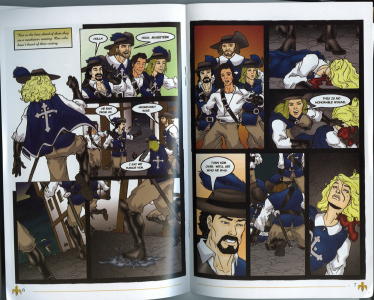
    No, what’s unusual is the promotional item for the book that came in today’s mail. I didn’t get the book today– it came out in November, and it’s stacked somewhere in my TBR pile — but what I did get is a short preview of the story in comic book form. It’s six pages long, and the art is by Rob Dumuhosky. To my eye, it’s very well done. It may come out too small to be readable, but I think you can get a fairly good idea of what it looks like from the image below.

Musketeers

    For a better look at the artist’s work, go here.

    When I referred to the author of this new series in my first paragraph up above, I put the word debut in quotes. A little googling quickly reveals that Sarah D’Almeida is in reality well-known fantasy writer Sarah A. Hoyt. This is not surprising. It’s only a short step from constructing a world of pure fantasy to writing a novel taking place in the past. The skills involved are pretty much the same. In either case, the task is to take the reader into another world that he or she is unfamiliar with, and be convincing about it.

     I haven’t read the book yet, so I can’t tell you how successful the author’s been in transforming the trio (plus one) into a group of working detectives, but the book does sound intriguing, and beyond a doubt, this is certainly the first comic book that I’ve received to promote one.

     And, oh yes, there were the usual bookmarks that came along with a small stack of the booklets, and — of course! — a small candy bar.

[UPDATE: 01-18-07] After seeing the post above, Sarah Hoyt emailed me and said:

Dear Steve,

Thanks for the mention. 🙂

Actually, I always wanted to write mystery. It just worked out fantasy first. D’Almeida is my maiden name.

Oh, and I’ve JUST sold books 4 to 6 on the series, so there will be at least that many. 🙂

   Sarah

I replied, wishing her well with the series and asking if I might post her comments as an update to this blog entry. Her response came right away:

Steve,

Certainly. Don’t know if you want to post this but… The first book was more bound by certain self-imposed strictures, like the fact that I wanted to evoke enough of the plot to attract people who’d only seen the movies of the Three Musketeers. It’s ALMOST (though not quite) Musketeer’s mystery fan fic. So some incidents will be startlingly familiar.

After that, each book becomes more of an historical mystery in its own right, though still featuring the Three Musketeers. I purposely tried to keep the language simple yet evocative enough. (My fantasy series featuring Shakespeare suffered from too much authenticity, perhaps, making it — on reread, several years later — a little too difficult to follow.)

I had a wicked level of fun writing the “footnotes” on what M. Dumas got “wrong.”

All in all, the series is lots of fun to play in, so I’m thrilled about the sale. The books are, in order: Death of A Musketeer, The Musketeer’s Seamstress, The Musketeer’s Apprentice, The Musketeer’s Inheritance, The Musketeer’s Servant and The Musketeer’s Confessor.

Oh, and the first book sold to the bookclub, though I have no details yet. 🙂

As Sarah A. Hoyt I’m doing a fantasy series for Baen (and soon an sf series as well, hopefully) starting with Draw One In The Dark, which came out in November (urban fantasy) and a fantasy series for Bantam (first book to be delivered to editor this month) which takes place in an alternate, magical British Empire (Heart of Light in Africa; Soul of Fire in India; Heart and Soul in China).

   Sarah

To which I say, Sarah, please take a break from the keyboard every once in a while, will you? This is all terrific news. Congratulations on staying so busy!

You start out as a reader, you love mysteries and maybe you know someone else you does and perhaps more likely, you don’t. The authors, the people who write the books, why they’re in a category by themselves. But you write to some of them, you meet other fans and you hang around them long enough and before you know it, sooner or later, some of them go professional and become mystery writers themselves. But you knew them before they went pro, and somehow that puts them into a separate category.

The first fan I knew who went down this route was Bill Crider, whose contribution to the Nick Carter canon, The Coyote Connection, came out in 1981. There have been a number of others in between, but I’d like to bring to your attention the latest, Ed Lynskey.

Ed was an contributing editor to both the print version of Mystery*File, and when I took it digital, the M*F website. He specialized in interviews with mystery writers then, and if they were no longer with us, overviews of their careers. Authors in either or both categories are Robert Wade, Ed Lacy, Stephen Greenstreet, and Dennis Lynds.

In the past year or so Ed, as I said up above, has turned author. His first book was a private eye novel entitled The Dirt Brown Derby (Mundania Press, 2006). No one should have been surprised that his first novel was a PI affair, given the authors above whose work has he’s obviously enjoyed.

Derby

Frank Johnson is the private eye who’s in The Dirt Brown Derby, and now he has a second case under his belt, or he will have in March, a book called The Blue Cheer (PointBlank, 2007).

Publisher’s Weekly
has a review of it, and I quote:

The Blue Cheer

Ed Lynskey. Point Blank (www.pointblankpress.com), $12.95 paper (224p) ISBN 978-0-8095-5667-0

Set in the remote mountains of West Virginia, this gritty contemporary detective novel, Lynskey’s second to feature former PI Frank Johnson (after 2006’s The Dirt-Brown Derby), will remind many of such masters of hard-boiled prose as Loren Estleman. Johnson has sought to still the memories of a deadly encounter with the Ku Klux Klan by retreating to the Appalachian town of Scarab, where people—and friends—are few and far between. Johnson witnesses what appears to be a Stinger missile strike against an unmanned aerial drone hovering above his yard, and he calls on his closest local companion, Old Man Maddox, a retired CIA agent. When the pair pursue the mystery with the local sheriff, a cascade of violence overwhelms the quiet community—murders that may be connected with a shadowy local racist cult known as the Blue Cheer. Despite a somewhat predictable resolution, the first-rate writing will leave readers eager to see more of Johnson. (Mar.)

Cheer

Here’s a bit more about Ed, taken from the PointBlank website:

Ed Lynskey is a crime fiction writer and poet living near Washington, D.C. His first two books are mysteries featuring his PI Frank Johnson: THE DIRT-BROWN DERBY (Mundania Press, 2006) and THE BLUE CHEER (Point Blank/Wildside Press, 2007). Two sequels include PELHAM FELL HERE (Mundania Press, 2007) and TROGLODYTES (Mundania Press, 2008). His work has been anthologized by St. Martin’s Press and University of Virginia Press. His short fiction has appeared in Alfred Hitchcock Mystery Magazine. His poems have appeared in The Atlantic Monthly. His reviews have appeared in New York Times Book Review and Washington Post. His mystery fiction has been praised by Linda Fairstein, Ken Bruen, Bill Pronzini, and John Lutz.

What more can I add? Way to go, Ed!

I don’t know the true protocol for this, having only been a blogger for just under three weeks, but I’d like to re-post some of the comments that I’ve received on my checklist of Real Estate Detectives. If I don’t do it this way, I have a feeling that they’ll fall through the cracks, and people who’d enjoy reading them might not otherwise. (From my own personal experience, I read the comments when I read someone’s blog entry, but I never go back and see if anyone’s commented later.)

First, from author Lou Allin:

My realtor sleuth Belle Palmer lives in the Nickel Capital, Sudbury, Ontario, and specializes in cottage properties, which lets her roam around the bush at will. As mentioned earlier, there are four books in the series, Murder, Eh? being the latest. In that novel, I finally got around to letting Belle find a body at a house showing. For that, I earned a mention on a strange website called “Bathtub murders in Toronto.” The next entry in the series may be titled Dial Belle for Murder. Selling houses is an ideal job for an amateur sleuth because she’s always coming in contact with new people…often with secrets to hide.

Lou Allin

My reply:

Hi Lou. It’s good to hear from you. It’s also good news that Belle will soon have another case to solve. I don’t fully understand the premise of the website you mention, but you’re right, there you are at http://torontoseeker.com/torontobathtubmurderers.htm

Then from author Nina Wright:

Hi, Steve. Thanks for mentioning Whiskey Mattimoe, my Realtor turned amateur sleuth. I agree with Lou Allin; a career in real estate offers our protagonists access to the private lives of many fascinating strangers. Moreover, since choosing a place to live is an expensive and emotional decision, high stakes are already in place.

My humorous series is set in Magnet Springs, Michigan, a fictional tourist town across the Lake from Chicago. In addition to a cast of artistic and eccentric regulars, Whiskey encounters affluent vacationers who pack their dark sides when they leave home.

Another perk of the Realtor protagonist is her legitimate excuse to snoop (a little). Since I’m personally fascinated by architecture and home design, one of the promises I make to my readers is that Whiskey will find herself inside at least one uniquely fascinating property per book. I enjoy concocting those details as much as the gourmet mystery writers probably savor their recipes.

Nina Wright

My reply, which is now the last one posted, but it also contains a short response from Lou Allin:

To both Lou and Nina,

I believe that you’ve pointed out something essential in each of your posts. The biggest problem in maintaining an amateur detective as a continuing character is how do you (believably) make sure that your detective keeps coming across murders to solve?

At first I was surprised at the large number of realtor-sleuths that turned up. Now I’m wondering why there aren’t more of them!

>>> Lou’s email reply to me:

Hi, Steve

One cliche I avoid (selective memory privilege) is having people comment to the sleuth, “Oh so you’re the one who keeps finding bodies. Any luck lately?” or some such. We all know that even police detectives don’t normally work on murder after murder (well, maybe in New Orleans or L.A.).

If readers want amateur sleuth mysteries, they’ll agree with the willing suspension of disbelief.

Lou

   John Herrington is one of the more prolific contributors to the continuing flow of Addenda to Allen J. Hubin’s Revised Crime Fiction IV. He describes his recent activity as follows:

    “What I am doing, out of ennui after Christmas, is going through CFIV at random and picking out authors, with a handful of titles or more, whom Allen has yet to find any information on – then googling them. Slow old business as for every name I find something, there are a score or more that remain anonymous.”

The information that follows arrived in a recent email to Al. To provide the proper context, I’ve included the full entries for each of the authors as they presently stand in CFIV, with John’s comments following:

TINSLEY, REBECCA
* * *The Judas File (Headline, 1995, hc) [Charlotte Carter; Ireland]
* * *Settlement Day (Headline, 1994, hc) [Charlotte Carter; London]

Tinsley

   This lady is a journalist, having written in New Statesman, Times, Telegraph etc., and once worked for BBC. Very involved in Humans Rights according to Internet references to her. But no date of birth.

TANNER, JANET
* * *Daughter of Riches (Century, 1992, hc) [Australia] St. Martin’s, 1993.
* * *Deception and Desire (Century, 1993, hc) St. Martin’s, 1995.
* * *Folly’s Child (Century, 1991, hc) St. Martin’s, 1992.

Tanner

   Janet Tanner has written all her life, hundreds of short stories published worldwide before she turned to novel writing. No date of birth. though she is a grandmother with young grandchildren.

TORGERSON, EDWIN DIAL
* * *The Cold Finger Curse (U.K.: Falcon, 1933, hc) [Sgt. Pierre Montigny; New York City, NY]
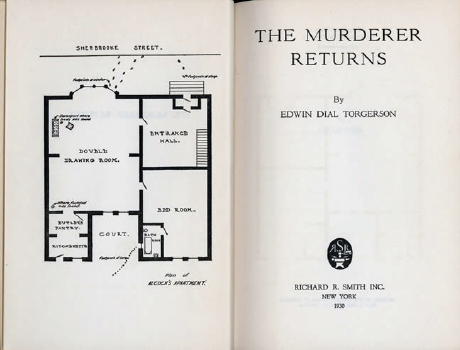
* * *The Murderer Returns (Lane, 1931, hc) [Sgt. Pierre Montigny; Montreal, Canada] Smith, 1930.

Torgerson

   Found at the website for the Archives Collections at the University of Mississippi:

“The son of a Swedish-immigrant architect, Torgerson was born in Meridian, Mississippi in 1896 and spent part of his early childhood in Oxford. After graduating from high school, he worked for a number of newspapers and edited Hearst’s American Weekly. Torgerson also wrote short stories that appeared in well-known periodicals, including several detective tales. His first full-length novel, The Murderer Returns, takes place in Montreal, Canada. The principal clue is a set of paw prints left in the snow by a cat. In 1937, he moved to Hollywood after MGM invited him to write a screenplay based on one of his mysteries, and he died there the following year.”

From The FictionMags Index, the following magazine short stories (an incomplete listing):

TORGERSON, EDWIN DIAL
* * The Challenger, (ss) McCall’s Jul 1937
* * Heart and Carrots, (ss) McCall’s Nov 1931
* * High Game, (ss) Argosy Dec 31 1938
* * No Questions Asked, (ss) Detective Story Magazine Apr 8 1919
* * One-Horse Bank, (ss) The American Magazine Feb 1936
* * The Second-Seer, (ss) Argosy Sep 13 1919
* * Uneasy Money, (ss) The American Magazine Mar 1935

   From the same University of Mississippi website comes the first discovery of the year. I’ll begin with the present CFIV entry:

BUCHANAN, CARL
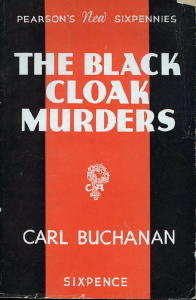
* * *The Black Cloak Murders (Pearson, 1936, hc) [North Carolina]
* * *Night of Horror (Mellifont, 1939, pb)
* * *The Red Scorpion (Mellifont, 1939, pb)

Buchanan

   “Carl Buchanan was the pseudonym used by James Robert Peery on The Black Cloak Murders published in London by C. Arthur Pearson, Ltd. in 1936, with later translations in Spanish and Danish. Set in the southern United States, a murderer seeks information concerning a treasure buried in Europe at the end of World War I. Peery was born outside Stewart, Mississippi in 1900 and grew up in Eupora. During World War I, he served in the U.S. Army’s Signal and Intelligence divisions. Once home, he worked in banking and cotton before settling into journalism. Pulp magazines accepted several pot-boilers submitted by him under a penname. Peery reserved his real name for two literary novels that appeared in 1938 and 1940.”

Again from The FictionMags Index:

BUCHANAN, CARL
* * The Crag Island Murders, (nv) Five-Novels Monthly Apr 1932
* * Crimson Goblet, (ss) Clues Aug 1934
* * Finger for Sale, (ss) Clues Oct 1935
* * Laughter in the Chapel, (ss) Clues Apr 1934
* * The Mystery of the Two Glasses, (ss) Clues Jul #2 1930
* * Red Haven, (ss) Clues Dec 1934
* * Rhapsody in Blood, (ss) Clues Feb 1934
* * Right Guy, (ss) Clues Aug #1 1930
* * Screams of the White Cockatoos, (ss) Clues Jul 1934
* * Sweet Racket!, (ss) Clues May #2 1930
* * The Time of the Crime, (na) The Thriller Dec 9 1933
* * 2 Minutes from Murder, (ss) Clues Mar 1935

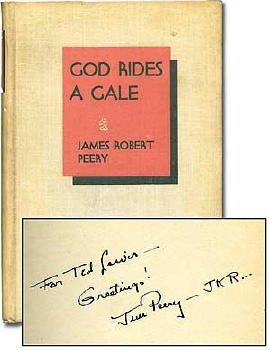
   [Steve again.] One of the books published by James Robert Peery under his real name is God Rides a Gale (Harper & Brothers, 1940). Curiously, the ABE seller who has a copy of this book describes it thusly: “Inscribed by the author: ‘For Ted Lewis – Greetings! Jim Perry – JKR.’ The second of two literary novels by this Mississippi-born author, who also published mysteries with a co-author under the pseudonym Carl Buchanan.”

Peery

Peery’s first literary novel does not appear for sale on the Internet, nor at present is there an entry for James Robert Peery in CFIV. Al Hubin says: “I’ll add brief notes to the Tinsley and Tanner entries (in Addenda #9); the Torgerson information is pretty well what I have in the Revised CFIV. But the Peery info (along with his 1954 death date) will go into #9 with pleasure.”

   Online presently are Addenda installments 1 through 8. Look for Part 9 shortly.


[UPDATE: 01-22-07]
Taken from an email sent by Victor Berch:

Steve:

To Carl Buchanan’s repertoire, you can add the following:

Blind Trail, All-Star Detective Stories Oct. 1930
The Head That Lived, Super Detective Stories July 1935
Hot Car Wreckage, All-Star Detective Stories Apr. 1932
The Monk’s-Hood Murders, All-Star Detective Stories July 1930
Murder By Candlelight, Mystery Apr. 1933
Murder in the Rain, The Underworld Magazine Aug. 1931
The Red Scorpion Murders, World Man Hunters Feb. 1934
Rope’s End, Murder Stories Sep-Oct 1931

There was one other tale under the name Robert Peery, who, I assume, is our man:

The Spy Champion, Startling Detective Stories Mar. 1930.

>> Thanks, Victor. I’m inclined to agree with you about that last story.    –Steve

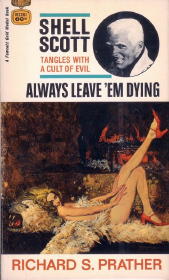
I just received an email from Linda Pendleton, widow of crime fiction writer Don Pendleton, telling me about an interview she did late last year with Richard S. Prather, now 85 and most well-known as the creator of private eye Shell Scott, whose wacky capers in the 1950s, mostly for Gold Medal, kept kids (teen-agers) like me turning the pages as quickly as they could.

The interview is online as part of her own website. It’s a long one, and it goes deeply into both Prather’s writing techniques and his philosophy of writing as well as his views on life itself.

What I’ll do is tease you with some of the questions. You’ll have to read the interview to learn what Prather’s answers were.

Prather

Linda: The first Shell Scott novel, Case of the Vanishing Beauty was published in 1950 and your long career was off and running. Was that your first publication or sale of your work? Did you have an agent for your first sale?

Linda: You have had a number of short stories published almost from the beginning of your career. Have you enjoyed writing short stories as much as novels?

Linda: Let’s talk about the creation of your Shell Scott character. Obviously, with the number of books you have written in the Shell Scott series, and the huge success you achieved, there must be special qualities about him as a protagonist that stay with your readers. Many fans have found your stories to be full of humor and some fans even refer to them as hilarious. As the creator of Shell Scott, what do you consider to be the essence of Shell Scott? What qualities did you give him as a character that made him outstanding and appealing to readers? I assume he “grew” during the years of writing the series. In other words, how did his world view evolve from his “younger” days?

Linda: You’ve been one of the lucky authors who was able to have a solid career and write full time. And I know you had the support of your beautiful wife, Tina, throughout those years. Having lost Don, I personally know how difficult it has to be for you since Tina’s death two years ago, and after 58 years of marriage. You very well may hold the record for the longevity of marriage for a writer! I understand Tina helped you with your work, such as suggesting that good book title you just mentioned—and typed, and I would imagine gave you some critical appraisal of manuscripts from time to time. Writing can be such a lonely endeavor as we are sequestered with our fictional characters, sometimes for long periods of time. How important was it to you, and to your relationship, that she was so supportive throughout the years?

Linda: Don had Executioner cover art by artist/illustrator, Gil Cohen on many of his books, who captured the essence of Mack Bolan. You mentioned many of your Gold Medal editions cover art was done by well-known illustrator, Robert McGinnis, and he just did the cover for your recent reissue release of The Peddler — and, by the way, the cover looks very nice. Obviously, McGinnis’ illustrations of beautiful sexy women on the covers of your books may have caught the attention of book buyers. I understand you wrote an Introduction to The Paperback Covers of Robert McGinnis by Art Scott, published in 2001. You covered some of this already, but again, how important do you feel cover art is for the sale of a book? Did you have any influence on cover design on your novels?

Prather2

Linda: Richard, here it is at the end of 2006 and you are now eighty-five years of age. What are your thoughts on the technological and scientific advances you’ve seen in your lifetime?

Linda: I understand you have a Shell Scott unpublished manuscript, The Death Gods, of 1,000 pages. What are your plans for this novel?

Richard: Ah, yes. The Death Gods. You’re right, Linda, I do have that 1,000-page manuscript here. It’s …

Richard S. Prather – Bibliography

Don Pendleton – Bibliography

« Previous PageNext Page »