UNCOMMONLY DANGEROUS: ERIC AMBLER ON TV
by Tise Vahimagi


ERIC AMBLER

   The early literature of Eric Ambler belongs with such contemporaries as Graham Greene and Geoffrey Household: novels which plausibly construct their dark and ominous prophesies of quiet disaster and which find the power game, as played out by ordinary people on intercontinental trains and across shifting frontiers, more imaginatively stimulating than the one-man antics of the post-Ian Fleming era.

   Above all, Ambler’s novels have that air of confident enjoyment in the game they are playing which is so easily conveyed to the reader: his works are entertainments, in Greene’s sense of the word, and, undeniably, intelligent ones.

   It is a truism that Ambler was the founding father of the modern political thriller, the writer who brought the genre to maturity in the 1930s. In just six novels, from The Dark Frontier in 1936 to Journey into Fear, 1940, he created the distinctive form that was to have a seminal influence on all writers in the genre.

   In the late 1930s, he had strong anti-fascist leanings and his stories reflected the political tensions of the time, when Europe was about to explode. Before he rewrote the conventions of the spy thriller, the genre was epitomised by Sapper’s thuggish Bulldog Drummond and Buchan’s Hannay, officer-class heroes with little more than a gung-ho approach to life and its problems.
ERIC AMBLER

   Moreover, detective stories of the day (by the likes of Dorothy L. Sayers) were considered respectable; thrillers in the former vein were not. Happily, Ambler changed all that.

   His heroes were genuinely ordinary people, amateurs of a kind closer to Somerset Maugham’s Ashenden. They stumbled into complex situations, where they had to make tough choices under pressure. A romantic sense of Ruritania gave way to a more precise Italy, France and Turkey preparing for a second world war.

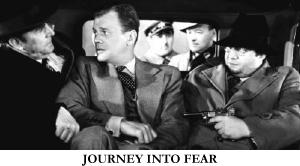
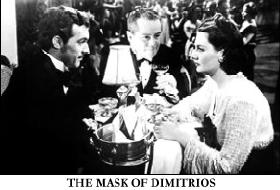
   As we know, four of his six pre-war novels became films (of varying merit). The Mask of Dimitrios (Warner Bros, 1944; from A Coffin for Dimitrios) and Journey into Fear (RKO, 1943) remain consistently enjoyable with a nice tangle of mystery and suspense.
ERIC AMBLER

   Background to Danger (WB, 1943; from Uncommon Danger) provides a suitably menacing, violent atmosphere for Greenstreet and Lorre to display their familiar brand of icy unpleasantness.

   The British production, Hotel Reserve (RKO, 1944; from Epitaph for a Spy), already reviewed and discussed in detail here, looked better (thanks to camera operator Arthur Ibbetson) than it perhaps deserved.

   For the most part, the television work of an author (whether as adaptations of their work or as original teleplays) is generally regarded — when it is regarded at all — as less than worthy of interest. My view is that all of an author’s work is of interest. The TV representations of Ambler’s work are, admittedly, more often less-than-rewarding but are still worthy of examination.
ERIC AMBLER

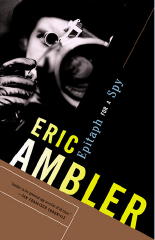
   His earliest work to appear in a television translation was the espionage thriller Epitaph for a Spy (1953), a BBC-produced six-part serial dramatised by Giles Cooper and featuring Peter Cushing as the innocent-in-a-spot teacher Josef Vadassy. The following year, CBS adapted the story (drawing on the services of three writers) for their anthology series Climax! (CBS, 1954-58), starring Edward G. Robinson as the frightened, bumbling character.

   BBC-TV returned to Ambler’s story again in 1963 for a four-part serial (dramatised by the usually dependable Elaine Morgan). Unfortunately, the producers, seemingly lacking confidence in the 1938 work, decided to condense the story into four instalments and, of all things, update it to the 1960s (changing nationalities, providing new motives and readjusting relationships). It is indeed unfortunate that the 1953 BBC version no longer exists; it should be considered a small mercy that there is no sign of a recording of the 1963 ‘satire’.

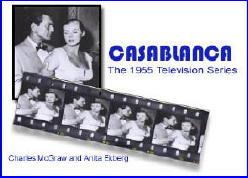
   Although A Coffin for Dimitrios was not afforded an adaptation for television as such, the basic plot turned up as “Satan’s Veil” (1956), an episode of the Warner Bros. TV drama Casablanca (ABC, 1955-56).
ERIC AMBLER

   The storyline (presumably a Warner property since their 1944 The Mask of Dimitrios) was reworked in the form of an adventuress (the sultry Rossana Rory) trying to conceal the details of her faked death from Charles McGraw’s hard-boiled Rick.

   Considering that other WB works were given a small-screen adaptation (“Casablanca”, in 1955; “Mildred Pierce”, 1956; “To Have and Have Not”, 1957, etc.) via the adventurous Lux Video Theatre (CBS/NBC, 1950-57), one wonders why the perfect-for-TV Dimitrios was overlooked.

   The other Climax! presentation was a lamentable “Journey into Fear” (1956) with a quivering John Forsythe as a terrified-out-of-his-wits American engineer whose life is endangered in Istanbul and then shipboard to Genoa by ever-present assassins. Hitchcock television regular James P. Cavanagh adapted Ambler’s 1940 novel.
ERIC AMBLER

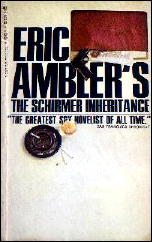
   The Schirmer Inheritance (ITV, 1957), involving a New York attorney’s search for the rightful heir to a $4,000,000 inheritance, was adapted into a six-part serial by Kenneth Hyde for Britain’s ABC-TV company. Not so much a wary passage through post-war Europe (in the Greene/Third Man vein) as a gallery of suspicious figures in a rather over-talky journey to a bandits’ lair on the Yugoslav-Greek border.

   Ambler moved to Hollywood in the late 1950s and, in 1958, married long-time Hitchcock collaborator producer-writer Joan Harrison, who was at that time producing the Alfred Hitchcock Presents (CBS/NBC, 1955-62) and Suspicion (NBC, 1957-59) anthologies.

   For the latter collection (where he met Harrison), Ambler wrote the soft mystery “The Eye of Truth” (1958) featuring Joseph Cotton as a blackmailed corrupt attorney who’s trying to cover up some incriminating documents. In 1962 he was brought on-board the Alfred Hitchcock Presents series to adapt a Nicholas Monsarrat short story as the episode “Act of Faith” (1962) in which an aspiring author seeks finance from a successful novelist, with unexpected repercussions. (This was Ambler’s second adaptation of a Monsarrat work; the first, the screenplay for the 1953 wartime drama The Cruel Sea, earned him an Oscar nomination.)
ERIC AMBLER

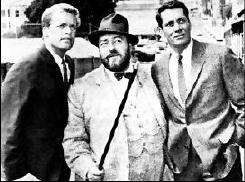
   Perhaps his most curious and direct television contribution was as creator of the mystery series Checkmate (CBS, 1960-62), an often satisfying who’s-going-to-do-it drama involving a trio of San Francisco private investigators: their job, and the series’ hook, being to prevent crimes before they happen.

   Although it was intimated at the series’ launch that Ambler himself would be contributing original stories, the series did employ the tantalising talents of many respected crime-mystery writers, including Leigh Brackett, Jonathan Latimer and William P. McGivern. The hugely enjoyable “The Terror from the East” (1961) episode (written by Harold Clements), with a highly suspicious, shambling Charles Laughton as a visiting missionary from China, has our heroes running in circles like hypnotised rabbits.
ERIC AMBLER

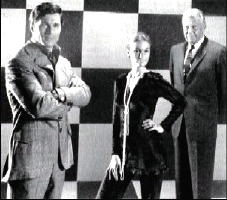
   A later, similarly formatted series, The Most Deadly Game (ABC, 1970-71), created by Mort Fine and David Friedkin (for Aaron Spelling Productions), featured three criminologists who, rather than preventing crimes, engaged in solving offbeat whodunits. Since Joan Harrison was one of the series’ producers (along with Fine & Friedkin) one can be less than surprised by the similarity.

   Although some modern sources have credited Ambler with the development of The Most Deadly Game, Fine and Friedkin are the only ones to receive a ‘created by’ credit.

   An additional point of interest: a co-writer credit for the episode “Model for Murder” (1970) goes to the fascinating but elusive Elick Moll who, in collaboration with Frank Partos, wrote the screenplay for the hauntingly Woolrichian Night Without Sleep (20th Fox, 1952), based on Moll’s original treatment (and published as a novel in 1951).

   For Alcoa Premiere’s “Pattern of Guilt” (1962), Ambler, as producer of the episode, hired Helen Nielsen to compose an original teleplay for what may have been a proposed series’ pilot episode. The story involved Ray Milland as a reporter who is assigned to cover a series of murders, all spinsters, where related clues are found at each murder scene. Little seems known about this one; why Ambler suddenly became a producer (if in fact so), was it actually intended to spin-off a Milland-as-reporter series?
ERIC AMBLER

   Following up the association with Aaron Spelling Productions, Ambler wrote and Harrison produced Love, Hate, Love (ABC, 1971), an annoyingly tedious TV movie thriller starring Ryan O’Neal and Lesley Warren as a couple stalked by Warren’s psychotic ex-boyfriend (Peter Haskell).

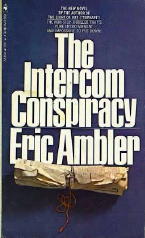
   The next of Ambler’s spy stories to be adapted for the small screen was the four-part A Quiet Conspiracy (ITV, 1989). Taken from his 1969 novel The Intercom Conspiracy, the post-le Carré plot follows former journalist Joss Ackland and his daughter Sarah Winman as they stumble about in an international conspiracy involving a secret NATO spy satellite. The red herring fishery was worked overtime, thanks to producer Anglia TV’s co-production casting of various, unfamiliar European actors.

   With The Care of Time (ITV,1990), another made-for-TV film (Anglia TV), adapted from Ambler’s 1981 novel, the central character, an American ghost writer (a baffled Michael Brandon), is an outsider who is drawn into an overly-complicated web of international intrigue.

   The puzzling plotting and colourful scenery moves (totters, at times) from Pennsylvania, across Europe to the Austrian Alps, collecting Christopher Lee’s political fixer, who’s ducking his enemies, and his attractive body-guard (Yolanda Vazquez) along the way. An ambitious TV film with a reach that was greater than its grasp.

   A couple of Footnotes: one of relevance to the above television work; the other because it’s an irresistible connection.
ERIC AMBLER

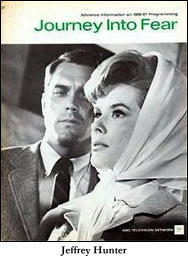
(I) In 1965, US trade journals began making brief, intriguing references to the production of a pilot episode (“The Seller’s Market”), written by Ambler, for a proposed espionage series called Journey Into Fear for NBC; the episodes would revolve around star Jeffrey Hunter as a scientist who is drawn into working for the CIA.

   Completed (and an hour in length), the series was rejected by the network and the pilot episode was despatched to the vaults. Perhaps the partnership of Ambler and the 1960s Spy Boom would have been an awkward one (he had a dislike for master-villains, pseudo-scientific gadgets and the general paraphernalia that characterised the 1960s spy genre), but the possibilities still fire the imagination.

   For a fuller report on this unsold series, check this link for Glenn Mosley’s (University of Idaho) absorbing survey.

(II) Geoffrey Household merits some reference here, not only because Ambler wrote the screenplay for Rough Shoot (1953; aka Shoot First), based on his 1951 novel, but that Household’s espionage/adventure characters belong to the same fold as Ambler’s victims of circumstance.

   His most famous work is of course Rogue Male (1939), becoming the much praised Fritz Lang film Man Hunt in 1941 and, in 1976, an equally commendable TV film starring Peter O’Toole. Another TV film, Deadly Harvest (1972), was made from his 1961 novel Watcher in the Shadows.

   Two early Suspense (CBS, 1949-54) episodes based on Household stories (“Death Drum”, 29 Jan 1952; “Woman in Love”, 26 Aug 1952) can be viewed on the Internet Archive. (Follow the links provided.)

            Eric Ambler Television:

1. Epitaph for a Spy (serial; BBC, 14 March-18 Apr 1953; 6 x half-hour). Producer/Director: Stephen Harrison. Scr: Giles Cooper, from 1938 novel. Cast: Peter Cushing (as Vadassy), Ferdy Mayne, Warren Stanhope, Joan Winmill.

2. “Epitaph for a Spy” / Climax! (CBS, 9 Dec 1954). Dir: Allen Reisner. Scr: Donald S. Sanford, David Friedkin, from Ambler novel. Cast: Edward G. Robinson (Vadassy), Melville Cooper, Marjorie Lord, Dave O’Brien.

3. “Satan’s Veil” / Casablanca (ABC, 31 Jan 1956). Dir: Alvin Ganzer. Scr: Norman Lessing, Nelson Gidding, from ‘story’ by Ambler. Cast: Charles McGraw, Marcel Dalio, Rossana Rory, Dan Seymour.

4. “Journey into Fear” / Climax! (CBS, 11 Oct 1956). Dir: Jack Smight. Scr: James P. Cavanagh, from 1940 novel. Cast: John Forsythe (as Graham Johnson), Eva Gabor, Arnold Moss, Anthony Dexter.

5. The Schirmer Inheritance (serial; ITV, 3 Aug-7 Sept 1957; 6 x half-hour). Prod: Stuart Latham. Dir: Philip Dale. Scr: Kenneth Hyde, from 1953 novel. Cast: William Sylvester, Vera Fusek, Jefferson Clifford.

6. “The Eye of Truth” / Suspicion (NBC, 17 Mar 1958). Prod: Alfred Hitchcock. Dir: Robert Stevens. Scr: Eric Ambler. Cast: Joseph Cotton, George Peppard, Leora Dana, Philip Van Zandt.

7. Checkmate (series; CBS, 1960-62). Created by Eric Ambler. Regular Cast: Anthony George (as Don Corey), Doug McClure (Jed Sills), Sebastian Cabot (Dr. Carl Hyatt).

8. “Pattern of Guilt” / Alcoa Premiere (ABC, 9 Jan 1962). Prod: Eric Ambler. Dir: Bernard Girard. Scr: Helen Nielsen. Cast: Ray Milland, Myron McCormick, Joanna Moore, Olive Carey.

9. “Act of Faith” / Alfred Hitchcock Presents (NBC, 10 Apr 1962). Dir: Bernard Girard. Scr: Eric Ambler, based on a story by Nicholas Monsarrat. Cast: George Grizzard, Dennis King, Florence MacMichael, Jeno Mate.

10. Epitaph for a Spy (serial; BBC, 19 May-9 Jun 1963; 4 x half-hour). Prod/Dir: Dorothea Brooking. Scr: Elaine Morgan, from Ambler novel. Cast: Colin Jeavons (Vadassy), Burnell Tucker, Janet McIntire.

11. Love, Hate, Love (TV film; ABC, 9 Feb 1971). Dir: George McCowan. Scr: Eric Ambler, based on story by Ambler, Robert Summerfield. Cast: Ryan O’Neal, Lesley Ann Warren, Peter Haskell, Henry Jones.

12. A Quiet Conspiracy (serial; ITV, 24 Feb-17 Mar 1989; 4 x hour). Prod: John Rosenberg. Dir: John Gorrie. Scr: Alick Rowe, from 1969 novel The Intercom Conspiracy. Cast: Joss Ackland (as Theodore Carter), Sarah Winman, Hartmut Becker.

13. The Care of Time (TV film; ITV, 26 Aug 1990). Dir: John Davies. Scr: Alan Seymour, from Ambler novel. Cast: Christopher Lee, Yolanda Vazquez, Ian Hogg, Michael Brandon.

Footnote: “Seller’s Market” / Journey into Fear (1966 pilot episode; not transmitted). Prod: Joan Harrison. Dir: Robert Stevens. Scr: Eric Ambler. Cast: Jeffrey Hunter.

EDITORIAL COMMENT. Eric Ambler was born 28 June 1909, so next month will mark the 100th anniversary of his birth. We apologize for jumping the gun by a few days, but we welcome the opportunity to toast here and now one of the greatest spymasters of all time.
A REVIEW BY DAVID L. VINEYARD:         


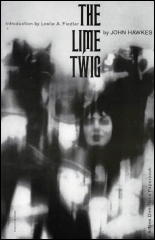
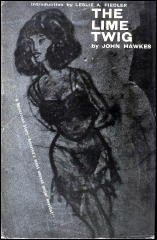
JOHN HAWKES – The Lime Twig.

New Directions, paperback, 1961; reprinted several times & still in print. UK edition: Neville Spearman, hardcover, 1962.

JOHN HAWKES The Lime Twig

   If you’ve ever wondered what a Gold Medal novel or Dick Francis thriller written by a literary icon would be like then The Lime Twig should be your cuppa. John Hawkes is a legendary figure in the American literary world probably best remembered for his erotic novels Traveler and Blood Oranges, but his breakthrough novel is The Lime Twig, an expanded novella about a lower middle class English couple whose boredom leads them into a downward spiral of crime, violence, and death.

   Michael and Margaret Banks are befriended by William Hencher, who decides to do them a good turn by letting them in on a sure thing — the hijacking of a race horse. But from the beginning things go wrong. Hencher is killed in the heist, and Michael is chosen by the gang to take his place as their front man, kept quiet by the sexual lure of two women. When Margaret becomes suspicious she is kidnapped, and after Michael becomes enamored of one of the femme fatales, Sybilline, she is raped and murdered. When Michael tries to free himself he too meets his fate.

   The book is written in a lush nightmarish style that gives the novel the feel of descending into a dream world where nothing is quite what it seems to be. Michael is caught up in an erotic dream and Margaret in an erotic nightmare until both their fates dovetail in death.

   The chapters are separated by articles by a sports journalist, Sidney Slyter, whose commentary was insisted upon by the publisher to keep the reader from being too confused. You can use them for that purpose or skip them, but don’t expect a suspense novel in the usual sense. Suspense, at least what we mean by suspense, isn’t really Hawkes’ point or interest.

   It’s that kind of a book.

   Still, as literary writers go, Hawkes is never dull and has genuine ability. The Lime Twig doesn’t really work as a crime novel, but it does work as a study of human nature and a portrait of innocent individuals caught up through no real fault of their own in a growing nightmare, even if it comes in the guise of a favor and an erotic gift.

JOHN HAWKES The Lime Twig

   Hawkes’ most accessible novel was Adventures in the Alaskan Skin Trade, a novel about an Alaskan Madam who operates a fly in brothel. He is almost always interesting and often treads on the dark side of human nature. Others than those I’ve mentioned, you might also try his novel Whistlejacket.

   That said, whether or not you want to read a book like The Lime Twig depends a great deal on your tolerance for literary style (and pretense), and your understanding going in that this is not Elmore Leonard or John D. MacDonald.

   However much it may sound like a Gold Medal original, its aims and intent are in other areas, and anyone expecting a thriller is apt to be disappointed. The Lime Twig has the same relation to most crime novels that Donald Gammell’s film Performance has to most gangster films.

   But understanding that, Hawkes is a good writer, never pretentious or full of himself, and certainly The Lime Twig has a nightmarish quality many a suspense writer would envy.

   As a crime novel it is a curiosity, as a literary novel a small masterpiece. Hawkes is an excellent writer, but he’s not for all tastes and admittedly can be difficult going — especially if you have a low tolerance for literary style. He writes beautifully, and can even be entertaining, but he’s not basically an entertainer. The darkness in his books can make Cornell Woolrich look like a cockeyed optimist.

   This is a worthy book, but if you read it, I hope you don’t think you’re going to find a thriller. If you decide to read it and hate it, remember, I warned you going in.

       ___

Bibliographic data: You can find all a list of all of John Hawkes’ contributions elsewhere online. This website is one that will do very nicely. The Lime Twig is not currently in the Revised Crime Fiction IV, by Allen J. Hubin, but from David’s review, I (Steve) think it should be. His entry in CFIV presently looks like this:

HAWKES, JOHN (Clendennin Burne, Jr.) 1925-1998.
      Death, Sleep, and the Traveler (New Directions, 1974, hc) [Ship] Chatto, 1974.
      Whistlejacket (U.S.: Weidenfeld, 1988, hc) [England] Secker, 1989.

[UPDATE] 05-30-09. Al agrees. In it goes. The book will appear in the next installment of the online Addenda to the Revised CFIV.

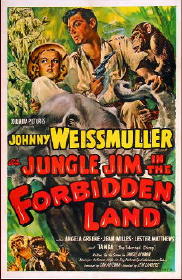
JUNGLE JIM IN THE FORBIDDEN LAND. Columbia, 1952. Johnny Weissmuller, Angela Greene, Jean Willes, Lester Matthews, William Tannen. Based on the comic strip character created by Alex Raymond. Director: Lew Landers.

JUNGLE JIM IN THE FORBIDDEN LAND

   I was joking around in the comments following my recent TCM Alert, posted here, saying something like this, and I quote:

    “As for Jungle Jim — the movies, that is — I remember seeing them at the local movie theater when I was 10 or 12, and thinking even then that they weren’t very good. I suspect that, as you seem to be hinting, they haven’t improved with age.

    “No matter. I’ll tape them anyway. Nobody says I have to watch them — but I probably will. Call me curious.”

   My goodness. I did watch one, this one, and I have to tell you, assuming that it’s typical of the rest of the series (*), I didn’t really realize how bad they were. The funny thing is, I’ve just checked some of the reviews this mess of a movie has had over the years. They’re generally favorable, and the movie is simply awful. I’d have to stretch like Plastic Man to say anything positive about it, and then I’d be lying to you.

   (*) This was number eight of either 13 or 16 films in the series. The last three Johnny Weissmuller essentially played himself after Columbia lost the use of the name of the Jungle Jim character. So unless I’m told otherwise, I’ll assume this one’s typical enough.

JUNGLE JIM IN THE FORBIDDEN LAND

   But by golly, they must have been successful. They wouldn’t have kept making them if people hadn’t kept going to see them. This one’s barely an hour long, but without all of the stock footage of various animals found in all four corners of the world, it probably wouldn’t have been run much over 30 minutes or so.

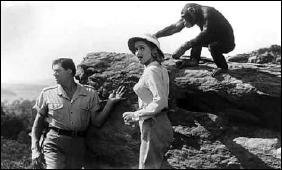
   That plus a plot that makes no sense at all. To sum it up: ivory, a tribe of giant people, a lady anthropologist (the beautiful Angela Greene, whom you can see in the photo with Jim), rampaging elephants, greed – as exemplified by the truly and magnificently hard-boiled Denise (Jean Wiles), a chimp that does nonsensical things to make the kid folks laugh, and a rookie governmental commissioner who doesn’t know which end is up.

   Did I mention a crooked native chief? Truth serum? Well I have now.

JUNGLE JIM IN THE FORBIDDEN LAND

   The costumes of the giant people (all two of them) were left over from some werewolf movie, I’m afraid to say. I hate to say this also, but the only reason that this review is so long – it’s probably going to take me longer than watching the movie itself to get it typed, formatted and posted – is so there’s room to fit all of the images in.

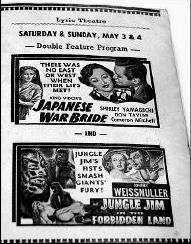
   But I especially like this small movie theater flyer I found online. I certainly remember those from either of the two theaters in the town that I grew up in, but I hadn’t seen one in many a year until today.

   In fact, the name of the theater on this very same promotional flyer is the Lyric, one of the two theaters I was just referring to. I’d wonder if it were the same one, but I imagine every other small town in the 1950s had a Lyric Theatre.

PostScript. If you read the review carefully, you’ll discover that I lied to you. There are some positive aspects to this movie, and I mentioned them both.

IT’S ABOUT CRIME
by Marvin Lachman

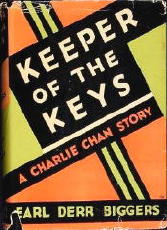
EARL DERR BIGGERS – Keeper of the Keys. Bobbs-Merrill, US, hardcover, 1932. Cassell, UK, hc, 1932. Reprinted many times in both hardcover and paperback.

EARL DERR BIGGERS Keeper of the Keys

   I recently went back to a simpler time and reread Keeper of the Keys, by Earl Derr Biggers, the last of the Charlie Chan novels. Those who know Chan only from the B-movies of the ’30s and ’40s will be pleasantly surprised at how readable and well plotted the six books about him are.

   Charlie, at Lake Tahoe to find the missing son of millionaire Dudley Ward, encounters his first taste of snow. The plotting is deft, and there is depth in the portrayal of Chan, especially his reactions to bigotry and “Americanization.”

   Aphorisms, those sayings which occur in most Chan movies, seem more appropriate here as they embody Chan’s detective methods. As he gathers clues, he says, “We must collect in leisure what we may use in haste. The fool in a hurry drinks his tea with a fork.”

   When Chan sits down to weigh the clues, he remarks, “Thought is a lady, beautiful as jade. Events of tonight make me certain I must not neglect the lady’s company longer.”

   Most mysteries written more than fifty years ago are far more dated. Fortunately, those in the Chan series are notable exceptions.

– From The MYSTERY FANcier, Vol. 10, No. 3, Summer 1988          (slightly revised).
THE GOLDEN AGE OF BRITISH MYSTERY FICTION, PART VII
Reviews by Allen J. Hubin.


   A Stranger Came to Dinner by Andrew Soutar (Hutchinson, 1939) is a fairly vigorous specimen of the 1930s British thriller, involving London inquiry agent Phineas Spinnet in an espionage affair.

   At first sight it seems to involve only a straightforward murder, as Sir Peter Greebe is battered to death in his mansion while a bizarre collection of international guests is enjoying his hospitality. The Yard is invited in and Spinnet is hired by a newspaper to poke about and report.

   At least he does the former, and the case quickly becomes murkier. A Japanese house guest is found hanged in a sealed room in which there is no place from which the rope could have been suspended — but little is made of this impossibility and the solution is casually revealed. Spinnet’s role becomes official and involves, among other perils, a fall from an airplane and torture in Portugal.

   There seems to be some sinister threat against Britain, and the name of the mysterious secret agent known as the Buzzard (friend or foe? live or dead?) circulates. Spinnet, playing both ferret and bait, catalyzes a surprising resolution.

***

   Robert Machray‘s Sentenced to Death (Chatto, 1910) dates from an age when men were strong and silent and women pure. Its subtitle is “A Story of Two Men and a Maid,” and so it is.

   The maid is Zilla Barradell, pure and wealthy, who while taking the cure in the brine baths at Wyche meets one of the men. This is Halliday Browne, strong and silent, silent especially on the subject of his secret service activities in India, the sentence of death by Indian extremists which hangs over his head, and his growing love for Zilla.

   The other man is Fernando Valdespino, a weak villain with a penchant for losing money at cards. Zilla does not see beyond his handsomeness and allows him to spike her relationship with Browne. Meanwhile a plot to bring terror and violence to England has been uncovered, and Browne, as chief investigator and principal target, is drawn into the fray.

   Who are the nasties in this scheme and who, besides Halliday, are their targets, and where are they hiding out? A diverting period piece, straightforward and predictable, is this — a romantic thriller, not a detective story.

***

   I am well pleased with the first Paul McGuire tale I’ve read, Murder by the Law (Skeffington, 1932). McGuire seems to have a certain currency: Barzun & Taylor speak well of at least some of his works, and his books (especially those not published in the U.S., like this one) were (at least in my book-collecting years) both sought and scarce.

   The plot and setting in Law are certainly acceptable but not exceptional. Rather more significant are the characters McGuire sketches for us, and his skillful and evocative use of language, particularly in dialogue.

   One overly hot week of an English summer various people, including the curious folk of the New Health and Eugenist persuasion, gather at Bellchurch on the Sea. Also among the gatherers is Harold Ambrose, a poisonous novelist toward whom McGuire directs his most inspired venom. While someone else directs a blunt object…

   Ambrose’s battered corpse is found on the beach, and Supt. Fillinger — trailed by narrator Richard Tibberts and painter-sleuth Jack Savage — thrusts his elongate form into a social realm containing at least one satisfied and accomplished killer.

***

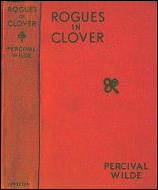
PERCIVAL WILDE Rogues in Clover

   Although Rogues in Clover by Percival Wilde (Appleton, 1929) is listed in ?Queen?s Quorum,? is hideously scarce (only this first hardcover edition was ever published, to my knowledge), and has been sought after feverishly by collectors with deadly glints in their eyes and bankrolls in their fists (I came by my copy in an curious fashion in a one-time visit with dealer/ author Van Allen Bradley), as one American entry in this set of reviews, it barely qualifies as marginal mystery/detection.

   We are introduced, in an opening chapter (?The Symbol?) to Bill Parmalee, son of a wealthy Connecticut farmer. Parmalee fled hearth and home to become a card sharper, pursuing a career of cheating which had its ups and downs, one of the latter finding him, unexpectedly, in his home town.

   He thought then to visit his widower father, who spurned him because of his life of crime. A duel over a deck of cards ensued, in which his father reawakened all those good instincts Bill had submerged, and Bill is then welcomed back into the paternal bosom.

   The remaining seven stories detail the cheating schemes Bill uncovers, usually in poker games and always at the behest of his woolly and wealthy friend Tony Claghorn. These are pleasant tales, nicely told with genteel humor and amusing insight into human nature, and they are better read as such than crime fiction.

***

   NOTE: Go here for the previous installment of this column.

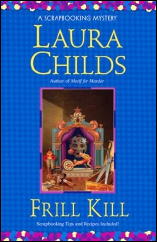
LAURA CHILDS – Frill Kill.

Berkley, paperback reprint; 1st printing, October 2008. Hardcover edition: October 2007.

LAURA CHILDS

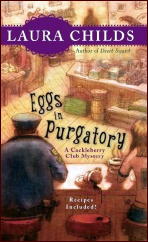
   Laura Childs is a one-woman fiction factory. She’s now producing books in three different series, and since 2001, there have been 17 books in those three series, already published or on their way.

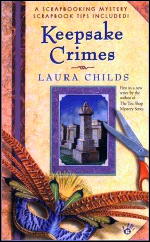
   I’ll list all of the books at the end of this review. Frill Kill is the fifth one (of seven) in her series “Scrapbooking” mysteries, and from that you can guess, I’m sure, what all of her books are: craft- or food-oriented cozies.

   Not that the murder that occurs early on isn’t rather ferocious and gruesome, so much so that werewolvery is suspected, the death being that of a beautiful model shortly before Hallowe’en in downtown (post-Katrina) New Orleans. Strange hair is found at the scene, with the death itself caused by what appears to have been teeth marks.

   Finding the body – or more precisely being there at the same time the crime is committed – is Carmela Bertrand, owner of Memory Mine, a small shop specializing in scrapbook making materials – which is a far more extensive line of paper products et cetera than you might suspect.

   Aiding and abetting Carmela in her investigation of the crime is not Lt. Babcock, though she does think him rather hunky, but her friend Ava Grieux, who owns the Juju Voodoo shop just across the way. Not helping very much is Carmela’s soon-to-be ex-husband Shamus, whose stuffy family (including himself) is easily shocked by all of the escapades Carmela and Ava get into.

   As you might have guessed, descriptions of food (the setting being New Orleans) and the stock at Memory Mine take up a good portion of the book. There is no detection per se – whatever investigating that Carmela and the beautiful Ava do has little bearing on solving the mystery, which is one of those that simply seem to solve themselves, eventually.

   No matter. Laura Childs has a flair for fiction that reads smoothly, quickly and enjoyably, with a sure, deft hand on the light-hearted side. This one’s already added substantially, I’m sure, to the ranks of fans that follow her from book to book.

           SERIES —

      Tea Shop Mysteries

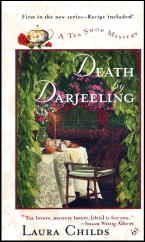
1. Death by Darjeeling (2001)

LAURA CHILDS

2. Gunpowder Green (2002)
3. Shades of Earl Grey (2003)
4. English Breakfast Murder (2003)
5. The Jasmine Moon Murder (2004)
6. Chamomile Mourning (2005)
7. Blood Orange Brewing (2006)
8. Dragonwell Dead (2007)
9. The Silver Needle Murder (2008)
10. Oolong Dead (2009)

      Scrapbooking Mysteries

1. Keepsake Crimes (2003)

LAURA CHILDS

2. Photo Finished (2004)
3. Bound for Murder (2004)
4. Motif for Murder (2006)
5. Frill Kill (2007)
6. Death Swatch (2008)
7. Tragic Magic (2009)

      Cackleberry Club Mysteries

1. Eggs in Purgatory (2008)

LAURA CHILDS

2. Eggs Benedict Arnold (2009)

A REVIEW BY MARY REED:
   

A. E. W. MASON – At the Villa Rose. Hodder, UK, hardcover, 1910. Scribner, US, hardcover, 1910. Four-act play version: Hodder, 1928.

A. E. W. MASON At the Villa Rose

Silent film: Stoll, 1920 [Hanaud: Teddy Arundell; Miss Harland: Manora Thew]. Sound film: Haik, France, 1930, as Mystere de la Villa Rose. Also: Twickenham, 1930 [Hanuad: Austin Trevor; Miss Harland: Norah Baring], aka Mystery at the Villa Rose. Also: ABPC, 1939; released in the US as House of Mystery [Hanaud: Kenneth Kent; Miss Harland: Judy Kelly].

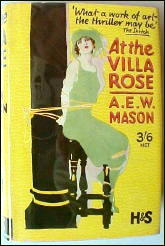
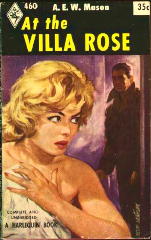
Reprinted many times, both in hardcover and soft, including: Hodder & Stoughton, UK, hc, 1936; Harlequin 460, Canada, pb, 1959 (both shown).

   Middle-aged Julius Ricardo is on holiday at Aix-les-Bains. One evening at the casino he notices Celia Harland, beautiful companion to wealthy Madam Camille Dauvray. Rescued from starvation, and probably worse, by her kind-hearted employer, Miss Harland is now romantically involved with rich young Englishman Harry Wethermill.

   Both men are staying at the Hotel Majestic, and next morning Wethermill bursts into Ricardo’s room with the news Madam Dauvray has been murdered at the Villa Rose, her confidante and maid Helene Vauquier bound and chloroformed, and Miss Harland, madam’s car, and all her extremely valuable jewelry are gone.

A. E. W. MASON At the Villa Rose

   Wethermill insists Inspector Hanaud of the Paris Surete, also holidaying in the town, aid the local authorities with their investigation, not least in finding the missing girl, even though he appears to be the only person who believes her innocent of the terrible crime.

My verdict: Several undercurrents swirl about the villa and red herrings abound. Was the young woman using her skill as a faux medium to hoodwick her employer and if so, why?

   How was a vital witness killed in a cab which did not stop in its journey between station and hotel?

   What can be deduced from a pair of cushions?

   The identity of the murderer is well concealed. There are clews for readers to spot as they go along, but I missed most of them!

Etext: http://www.gutenberg.org/dirs/etext03/vllrs10.txt

         Mary R

http://home.epix.net/~maywrite/


ROBERT TERRALL – Sand Dollars.

St. Martin’s Press; hardcover; 1st printing, 1978. Paperback reprint: Dell, 1979.

   There’s a lot of money floating around this world that most of us never get the slightest glimpse of. Tax shelters for the rich being in high demand, a great deal of this money accumulates in out-of-the-way places like regulation-free Grand Cayman Island. When the mild-mannered accountant who first discovered this Caribbean financial paradise turns down the Mafia as a silent partner in his operations, he’s forced to turn to bank robbery in retaliation and as a means for sheer survival.

   What results is a lusty tale of greed and marital infidelity, spiced with numerous feats of sexual superheroism. Unfortunately none of the hapless, amoral creatures involved arouse much sympathy when things don’t work out quite as planned, and the story crumbles into what’s left of sand castles when the tide comes in, as it inevitably does.

– From The MYSTERY FANcier, Vol. 3, No. 3, May-June 1979.
          (slightly revised)


[UPDATE] 05-27-09. This is a scarce book. Only 12 copies come for sale on ABE, for example, but unless you’re fussy about condition, you aren’t likely to have to pay very much for it, either.

   When I wrote the review, I may or may not have known that Robert Terrall was much more famous under several of his pen names: Robert Kyle, John Gonzales, and Brett Halliday (ghost-writing for Davis Dresser).

   The list of mystery fiction that was published under his own name is small, and at least one is be a reprint of another title as by someone else. Expanded from the Revised Crime Fiction IV, by Allen J. Hubin, here’s his entry there, excluding his work under other aliases:

TERRALL, ROBERT. 1914-2009.

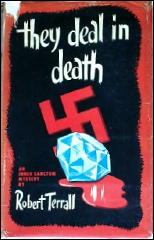
      They Deal in Death. Simon & Schuster, hc, 1943.

ROBERT TERRALL

      Madam Is Dead. Duell, Sloane & Pearce, hc, 1947.
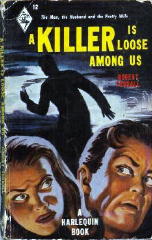
      A Killer Is Loose Among Us. Duell, Sloane & Pearce, hc, 1948.

ROBERT TERRALL

      Shroud for a City. Australia: Original Novels, pb, 1956. [US title?]
      Sand Dollars. St. Martin’s, hc, 1978.
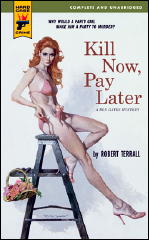
      Kill Now, Pay Later. Hard Case Crime, pb, 2007. Previously published as by Robert Kyle (Dell, pbo, 1960).

ROBERT TERRALL

   Robert Terrall was 94 years old when died on March 27th earlier this year. An excellent overview of his career can be found here on The Rap Sheet blog, along with an interview editor J. Kingston Pierce did with Ben Terrall, the author’s son and a free-lancer writer himself.

   If you missed it before, please don’t hesitate in jumping over and reading it now. If you’re a fan of vintage Gold Medal style literature, you’ll be glad you did.

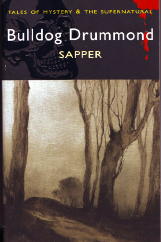
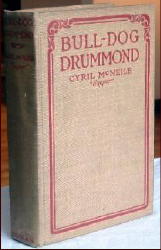
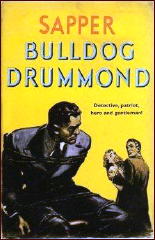
SAPPER [H. C. McNEILE] – Bulldog Drummond. Hodder & Stoughton, UK, hardcover, 1920. George H. Doran, US, hardcover, 1920. Reprinted many times in both hardcover and paperback.

SAPPER Bulldog Drummond

   As you’ve seen noted, I didn’t go into all of the various editions of this, Bulldog Drummond’s first adventure, but for the record, the one I read is a recent and rather hefty softcover edition (Wordsworth, 2007) subtitled “The Carl Peterson Quartet.”

   This latter volume contains the following four novels: Bulldog Drummond, and the only one I’m commenting on now; The Black Gang (1922); The Third Round (1924); and The Final Count (1926). McNeile was a very prolific writer, the author of many, many short stories as well as novels, beginning in 1910 or so, and continuing on up to his death in 1937.

   David Vineyard has a long article about Bulldog Drummond coming up, but I’ve only skimmed through it so far, wishing to form my own impressions first before getting it posted, but do look for it soon.

   The year that Bulldog Drummond was published, 1920, as well as all four Carl Peterson books — through 1926 — is important, because it was only after the first world war could the general public really believe in the existence of super-criminals like Carl Peterson, ruthless men whose single-minded goal was absolute world control — or that the domination of the entire planet by a small group of like-minded men was even remotely feasible.

SAPPER Bulldog Drummond

   “How?” you might ask. Through financial means and countrywide strikes by the duped underclass. That there are four books in the series suggests that like certain other would-be emperors of the world, Carl Peterson is defeated at the end of each, but survives and lives to return another day.

   As for Hugh Drummond himself, a veteran of the war in France, when he returned to England, he was bored and had an huge amount of time on his hands. Craving excitement, he took out an ad, offering his services to anyone in need of help. “Legitimate diversion, if possible,” the notice says, but “crime … no objection.”

   Enter the girl. Phyllis Benton. Her father is in desperate straits, and she requires assistance. Drummond needs no other responders to his advertisement. He has all of the excitement, trouble — and then some — that he needs in dealing with the deadly Carl Peterson and his growing gang of thugs and respectable businessmen, all with an eye to their mutual good fortune.

   Not to mention Peterson’s “daughter,” the equally beautiful and enigmatic Irma, who seems to have an eye for Captain Drummond, not that the latter needs the former to defeat his formidable opponent this round, at least.

SAPPER Bulldog Drummond

   I’ve chosen the word “round” deliberately, because it is a game that is being played between Drummond and Peterson, a deadly one, but one with the sort of unspoken rules that prevents one or the other from sneaking up and bumping the other off with no warning.

   Deadly poisons, giant ape-creatures, vats of acid, all fair play, but shooting the other in the back? It’s hardly done.

   The action back and forth gets a little repetitious and sags a little around the three quarter mark, but it’s only the lull before the finale, which comes fast and furious – and even more deadly for some of the participants.

   Wonderful stuff, very much of its time and place, unfortunately, but Britain had a little less to fear between the wars while Captain Hugh Drummond was on the alert.

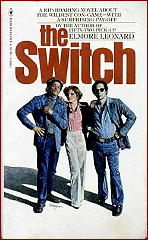
ELMORE LEONARD – The Switch.

Paperback original: Bantam, 1978. First UK and only hardcover edition: Secker & Warburg, 1979. Many paperback reprint editions.

ELMORE LEONARD The Switch

   Two ex-cons named Ordell and Louis, obviously too refined to be winners in a Cheech and Chong look-alike contest, kidnap a suburban Detroit housewife, a tennis mother named Mickey, whose husband Frank is a crooked contractor and secretly planning on leaving her and skipping off to the Caribbean.

   Not surprisingly, he quite happily ignores the ransom demands, sending their dreams of a cool million disappearing upwards in clouds of thin, billowing smoke.

   Detroit’s not a very nice city, and Leonard knows it and tells it. But while the ending of his story comes as a subtle sort of surprise, the looseness with which he establishes it pretty much undermines the effect. The tale’s as shaky as the Dawsons’ marriage from the start.

— From The MYSTERY FANcier, Vol. 3, No. 3, May-June 1979.
          (slightly revised)


[UPDATE] 05-26-09. When I began checking out the bibliographic data for this book, it caught me by surprise, as it may have you too, but I’d forgotten that many of Elmore Leonard’s earliest books were published as paperback originals. In fact, unless I’m badly mistaken, The Switch has never appeared as a US hardcover, as I said above.

    Back in 1978 I was still adding a “letter grade” at the end of the reviews I wrote. I assigned a “C plus” to this one, which makes it above average, but not by much. If I were to read it again, I don’t know whether I’d be so tough on the book now, or if it really is one of Leonard’s lesser works. If so, perhaps that’s the reason for the lack of a hardcover.

    Or a movie, for that matter. Based only on my description of it, it sounds to me as though Hollywood ought to have snatched The Switch up long before now.

« Previous PageNext Page »