Or at least I hope I am, because I thought I was where I think I am now a couple of times before.

I hope that sentence makes sense.

To explain, working on my own, I thought I’d cleared up the problems at least twice before, only to have the virus vermin come back again, and in full force.

But thanks to the long distance assistance of my son-in-law Mark — they live in IL while we’re here in CT — everything appears to be back to normal, and in fact my old clunker of a computer is working better than it has in quite a while.

What seems to have done the trick are two Anti-Virus programs you might think about trying: Malwarebytes (free) and Hitman 3.5 (free for 30 days). A Google search will turn each of them up very quickly. Both of them found and deleted 10 or 12 pesky infestors, even after Norton and SpySweeper had done their thing and scanned my entire computer system several times each.

As for the coincident problems with the latest Firefox download, I really don’t know what to make of that. The last time I downloaded it, early yesterday morning, I refused all of the proffered add-ons, mostly Java-based, but at Mark’s suggestion, I did choose an AdBlock add-on and a Noscript program.

So far, so good, and it’s been nearly a day now. It’s time to switch over to a new computer, but after this week’s woes, I think some good-fashioned R&R is what I need more, techwise, that is.

If I owe you an email or other response, my apologies. I’ll get back to you soon, and if I don’t, give me a nudge.

I can use my wife’s computer to post here, but without having access to my scanner and WordPerfect files upstairs, not to mention the Internet itself, there aren’t any easy workaround’s to be able to say this blog will be back in business anytime soon.

Every time I think I’ve found all of the bad stuff on my computer, I blink twice and it comes back. Last night I was able to receive and send email for the first time, but I can’t use Firefox as a browser, or so it seems. Whenever I try, it stalls and goes dead, and when I give Explorer a try, it sends me a continual stream of error messages and popup windows, even after I turn it off and stop using it.

I don’t know if it was coincidence or not, but it was right after I’d downloaded the latest version of Firefox (and/or the fixes and add-ons that came soon after) that the troubles began.

It’s time to let the professionals go to work, I think. I have a new computer that I can switch over to, but setting up the networking is beyond me. And if they can clean up the old one while they’re here, it can always be saved as a backup machine so we can have easy access to the Internet whenever we want downstairs.

So that’s the news from here. Not good, but not disastrously bad. Go out and enjoy the good weather, which I hope is as nice where you are as it is here today. I am!

Either my computer’s going bad on its own, or there’s a virus whatever that I’ve caught that’s causing problems. Whichever it is, it looks like my being able to post much of anything here until it’s cleared up (or cleaned out) is not going to happen.

I’ll be back when I can! Here’s hoping it won’t take too long.

REVIEWED BY DAN STUMPF:         


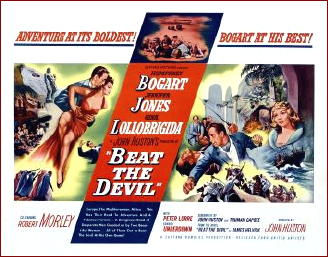
BEAT THE DEVIL

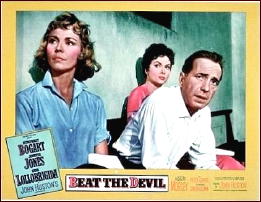
BEAT THE DEVIL. United Artists, 1954. Humphrey Bogart, Jennifer Jones, Gina Lollobrigida, Robert Morley, Peter Lorre, Edward Underdown, Ivor Barnard. Screenplay by Truman Capote and John Huston, based on the novel by James Helvick. Director: John Huston.

   A legendary mess. Scripted by Truman Capote, directed by John Huston, with a great cast that includes Humphrey Bogart, Jennifer Jones, Peter Lorre, Gina Lollobrigida and Robert Morley, and it’s still a dreadful muck-up time has not redeemed; something about a bunch of con men stuck in Italy trying to buy land in Africa, I think, but the plot doesn’t matter because it never really goes anywhere.

   There are some witty lines, but Huston always seems to be looking the other way when someone says them. Likewise the acting: some good turns by Morley, Lorre and Ivor Barnard as “the Galloping Major” but the characters are never defined well enough for us to be sure what the acting’s all about.

BEAT THE DEVIL

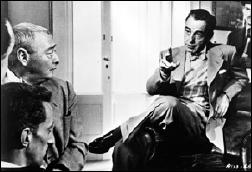
   Worst of all is Humphrey Bogart. It’s hard for a life-long Bogie-man like me to say it, but he’s dreadful here. Already cancer-stricken at 54, in ill-fitting wigs and gaudy clothes, he looks like an aging queen tarted up for one last night out with the boys.

   Bogie expressed some doubts about the project at the time, and it shows in his performance; at the heart of Devil we need the relaxed, self-assured leading man of Casablanca and The Big Sleep, but what we get is a nervous icon walking through the movie like an old man trying to cross a busy street.

   By the way, I’m always fond of reading the source books that notable movies were made from, so I looked up James Helvick’s novel Beat the Devil on the internet. The cheapest copy I found was $200, and if anyone wants to send me a copy, feel free.

BEAT THE DEVIL

REVIEWED BY WALTER ALBERT:         


BROADWAY LOVE. Bluebird Photoplays, 1918. Dorothy Phillips, Juanita Hansen, William Stowell, Harry von Meter, Lon Chaney, Eve Southern, Gladys Tennyson. director and author of the screenplay: Ida May Park. Shown at Cinecon 45, Hollywood CA, September 2009.

DOROTHY PHILLIPS

   This was an unusual screening, a silent film directed by a woman. Ida May Parks, according to Wikipedia, directed some 14 films, and wrote at least 50 screenplays, in a career that lasted from 1914 to 1930.

   The star was the then popular Dorothy Phillips, who plays Midge O’Hara, a small-town girl who goes to New York where she gets a job as a chorus girl. She is befriended by Cherry Blow (Juanita Hansen) who attempts to introduce the virtuous Midge to the incidental pleasures of her new life at a riotous party in the apartment of Cherry’s sugar daddy.

   Midge is rescued by an Arizona millionaire, only to find that his intentions are dishonorable. She flees New York, pursued by the persistent Henry, as well as by Elmer Watkins (Lon Chaney), her loutish suitor from back home.

   Parks sets up her shots for the actresses with great care, and is particularly successful with the party sequence. Relatively few Universal silent films (Bluebird Photoplays was Universal’s prestige feature unit) survived the studio’s purge, and the survivors are often in poor condition.

   However, the print shown was in excellent condition, and the film was more than competently directed, making one hope that other films directed by Parks may have survived.

A TV Review by MIKE TOONEY:


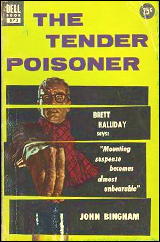
JOHN BINGHAM Tender Poisoner

“The Tender Poisoner.” An episode of The Alfred Hitchcock Hour (Season 1, Episode 14). First air date: 20 December 1962. Dan Dailey, Howard Duff, Jan Sterling, William Bramley, Philip Read, Richard Bull, Bettye Ackerman. Writer: Lukas Heller, based on the novel Five Roundabouts to Heaven (1953; aka The Tender Poisoner, US, 1953) by John Bingham. Director: Leonard Horn.

   Barney Bartel (Dan Dailey) is an unhappily married man who has fallen for a woman, Lorna (Bettye Ackerman), ten years younger than his wife Beatrice (Jan Sterling). Barney’s pal Peter Harding (Howard Duff) knows about the affair and seems anxious to discourage Barney — but things aren’t always what they seem, are they?

   For Peter the situation has its advantages, indeed it does; for Barney, though, the situation is becoming intolerable. The first step involves getting rid of Beatrice, in preparation for which Barney must do an experiment on his dog, one involving poison …

   Longtime hoofer Dan Dailey proves in this show that he could do serious crime drama. Most of us may have forgotten the TV series Dailey did in 1959-60, 39 episodes of The Four Just Men inspired by characters created by Edgar Wallace. His only other series was the comedy The Governor & J. J. (1969-70).

   Howard Duff’s character is almost identical to the shifty guy he played in Naked City (1948). He also appeared in Johnny Stool Pigeon (1949), Spy Hunt (1950), Shakedown (1950), Private Hell 36 (1954), Women’s Prison (1955), While the City Sleeps (1956).

JOHN BINGHAM Tender Poisoner

   On TV he was in Dante (26 episodes, 1960-61) and Felony Squad (73 installments, 1966-69), one Ellery Queen (1976), six appearances on Police Story, 37 episodes of Flamingo Road, and one as Thomas Magnum’s grandfather on Magnum, P.I.

   Jan Sterling was in a few crime dramas: Mystery Street (1950), Union Station (1950), Appointment with Danger (1951), Split Second (1953, reviewed here), The Human Jungle (1954), Female on the Beach (1955), and two episodes of The Name of the Game.

Hulu: http://www.imdb.com/video/hulu/vi869793817/

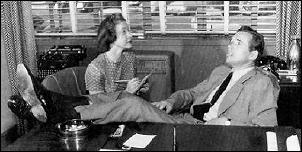
Editorial Comment:   The photo you see of Howard Duff is strictly a case of “None of the Above,” as far as the credits go as listed for him by Mike. If you know the part he’s playing, then you almost assuredly know who it is who’s in the scene with him.

THE BACKWARD REVIEWER
William F. Deeck


LEE CROSBY

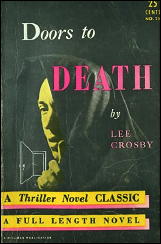
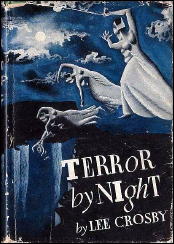
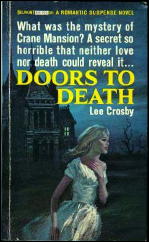
LEE CROSBY – Too Many Doors. E. P. Dutton, hardcover, 1941. Thriller Novel Classic #25, no date [1944], as Doors to Death (condensed). Belmont Books, pb, 1965.

   Wendal Crane, head of the Crane family and the family’s doll factory, has invited the entire family to hear a special announcement.

   What happens instead is that the great hurricane of 1938 cuts the house off totally from the outside world and murders begin taking place. Not to mention the voices from the walls and the little Malay figurines who may be coming alive.

   Fortunately, Dorcas Brown, a cousin of the Cranes, has brought with her Eric Hazard, psychologist and crime investigator. He gets it all straightened out in a novel that has nothing in particular to recommend it.

– From The MYSTERY FANcier, Vol. 13, No. 3, Summer 1992.


Bio-Bibliographic Data: [Expanded from the Revised Crime Fiction IV, by Allen J. Hubin.]

CROSBY, LEE. Pseudonym of Ware Torrey Budlong, 1905-1967; other pseudonyms: Meg Padget, Judith Ware and Joan Winslow
       Terror by Night (n.) Dutton 1938 [Eric Hazard]

LEE CROSBY

       Too Many Doors (n.) Dutton 1941 [Eric Hazard]

LEE CROSBY

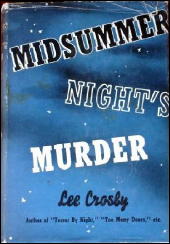
       Midsummer Night’s Murder (n.) Dutton 1942

LEE CROSBY

       Night Attack (n.) Dutton 1943
       Bridge House (n.) Belmont 1965

PADGET, MEG
       House of Strangers (n.) Lancer 1965

WARE, JUDITH
       Quarry House (n.) Paperback Library 1965
       Thorne House (n.) Paperback Library 1965
       The Faxon Secret (n.) Paperback Library 1966
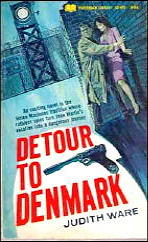
       Detour to Denmark (n.) Paperback Library 1967

LEE CROSBY

       The Fear Place (n.) Paperback Library 1967
       A Touch of Fear (n.) Signet 1969

WINSLOW, JOAN
       Griffin Towers (n.) Ace 1966

   The author was also a newspaperwoman, feature writer, editor, book columnist, foreign correspondent, short story writer. Her husband was Theodore Budlong, an advertising executive. At various times she lived in Upper Darby PA (1940s) and Bridgeport CT (1961).

   Her writing career was split into two parts, separated by a passage of some twenty years. When she began writing again in the mid-1960s, it was as part of the “Gothic romance” boom. Note that Too Many Doors was reprinted as one of the latter to take advantage of the tremendous, nearly unending demand for books in the category.

   If you’re as big a fan of obscure mystery writers and characters as I am, you’re going to enjoy this immensely.

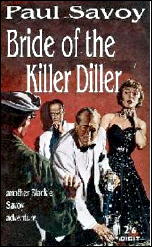
BLACKIE SAVOY

   Over the past twenty years David Vineyard has been tracking down information about a man who certainly qualifies as all but totally forgotten, Australian thriller writer Paul Savoy and his primary series character Blackie Savoy. Tidbit by tidbit, piece by piece, David has also painstakingly put together a bibliography of perhaps the most difficult set of books to find in all of mystery fiction.

   Over the past several weeks, David and I have compiled all of this information into a single article and posted it on the primary Mystery*File website. (Follow the link.)

   The article is far too long to have been posted it here on the blog. Cover images have been included, but the books, both hardcover and paperback, are so scarce that many of the scans are in far poorer condition than I’d have preferred. Nonetheless, working on the principle that something is better than nothing, I’ve included everything that David has been able to send me.

   The article plus the bibliography, which includes adaptations of Savoy’s work into a single film, Blackie Savoy Gets His (Centaur Studios, 1935), comic strips, radio shows, and a four-year syndicated program on Australian TV that seems to have slipped the memories of almost everyone, is, we believe, all that is known about the author.

   Obviously if anyone can supply any more information, including specific publishing dates, reprint editions, and any covers that David has not come across on his own, would be extremely welcome.

REVIEWED BY GEOFF BRADLEY:         


MURDERLAND. ITV, UK; 3-episode miniseries: 19 October, 26 October, 2 November 2009. Robbie Coltrane, Amanda Hale, Bel Powley, Sharon Small, Lorraine Ashbourne, Nicholas Gleaves, Lucy Cohu, Yasmin Paige. Screenplay: David Pirie. Director: Catherine Morshead.

MURDERLAND Robbie Coltrane

   This was a single story, written by David Pirie and told over three one-hour parts (less adverts).

   In the first we see a young woman, on the brink of marriage, who goes to retired detective Hain (played by Robbie Coltrane), the man who investigated her mother’s murder 15 years before.

   We see the murder and the investigation through her young eyes as she discovers her mother was a prostitute working at a shabby massage parlour.

   In the second part we see the investigation through the eyes of Hain and we realise much more of what has gone on before; in the third episode we see the story brought up to date as new witnesses are discovered and the killer finally brought to justice.

   This was a very watchable piece of television which certainly engaged my interest and the time went very quickly. However like many programmes nowadays, I wasn’t entirely convinced at the end that it all made sense — for example it seemed a little odd that the workings of the massage parlour were unchanged after 15 years.

   Still it was a commendable effort and I enjoyed watching it.

Reviewed by DAVID L. VINEYARD:         


ERIC VAN LUSTBADER – Last Snow. Forge Books, hardcover, February 2010.
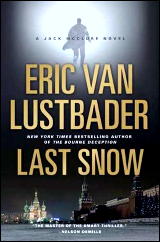
ERIC VAN LUSTBADER

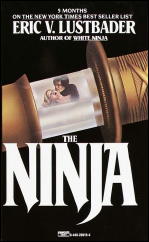
   Eric Van Lustbader made a big splash with the first book in his Nicholas Linnear series, The Ninja, and staked out a place for himself in the best selling thriller stakes with tales of intrigue and adventure that usually involved his heroes in adventures with an Asian background.

   When that ran its course he seemed to founder a bit, made an ill advised attempt to change his name from Eric Van Lustbader to Eric Lustbader, and for a while seemed to have dropped out of the game. Recently he came back strongly, however, with Testament, and was chosen by the Robert Ludlum estate to continue the popular and lucrative Jason Bourne franchise.

   His books have always been strong on compelling narrative and notable for a sensuality missing in many of his contemporaries works.

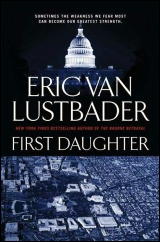
   Last Snow is the second book in a series that began with First Daughter (Forge, 2008), and like so many series today it’s almost impossible to read one without some reference to the other, so I’ll briefly outline the events in the first book as they apply here.

   Jack McClure is a tough ATF agent whose best friend is President-elect Edward Carson. Jack’s daughter Emma has died, the tragedy putting an end to his marriage and leaving Jack devastated, and one of the few people who feels the same as he does is Edward Carson’s daughter Alli, Emma’s roommate in college. When Alli is kidnapped it’s only natural the newly elected president turns to his old friend for help.
ERIC VAN LUSTBADER

   Political winds are stirring up trouble in regard to Alli Carson’s kidnapping. The outgoing administration wants their strong right wing Christian philosophy to continue to dominate the public debate and are pushing a moderate and increasingly powerful secularist movement as the villains even though the evidence points to a more radical secularist group. (Has there been a radical secularist movement since Lenin?)

   The action is well done and the characterization fine, but over all the politics are cartoonish and a bit silly really. This is no Seven Days in May or Advise and Consent. Seemingly both the far right and the far left have completely forgotten how to write political thrillers, since the right-leaning writers currently churning this sort of thing out are just as bad.

   A quick course in Richard Condon seems desperately needed for both sides. (Not that Condon was never outrageous, but then that was part of his charm — none of these current writers — Lustbader included — are remotely Richard Condon —most of them make you miss William LeQueux and E. Philips Oppenheim.)

   In any case Jack (notice how many of these guys are called Jack since Jack Bauer and 24?) saves the day, and there is some suspense along the way, despite the cartoonish politics. Lustbader writes readable page-turning bestseller prose.
ERIC VAN LUSTBADER

   Last Snow picks up with Edward Carson president. Jack is trying to put his life back together again, and Alli, who suffers from Graves disease and looks sixteen instead of the twenty-two she really is, tends to cling to him after her ordeal. (This is the sort of book where everyone has some defining problem in lieu of characterization — it’s so much easier to give someone a problem than a character.)

   But Carson also relies on Jack, and when a US senator who was supposed to be in the Ukraine shows up dead in Capri under questionable circumstances, he asks Jack to investigate. Jack is with the Presidential party in Moscow.

   An interesting character note about Jack is that he is dyslexic, and through his mentor has learned to use that handicap as an advantage — his mind works differently and he uses that to solve puzzles that others can’t even as he struggles with the everyday world of paper work. It’s a nice touch, and Lustbader makes the most of it creating a reasonable and intelligent explanation for Jack’s considerable talents, even though what I wrote earlier of using these sort of things as gimmicks still holds. One character with a gimmick is fine. More than one and it becomes a crutch.

   If there is one major flaw here it’s that the book suffers from best seller shorthand.

   Berns was Carson’s man in the Senate, and he fears the former administration may use this against him … may even have killed Berns. Jack is to find out what he was doing in the Ukraine and how he died in Capri. His only clue is the name of the man Berns met in the Ukraine, one R. Rostov.
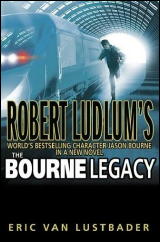
ERIC VAN LUSTBADER

   But before he can leave Moscow Jack meets Annika, a FSB agent (the FSB is the new KGB — Annika’s “problem” is she was sexually abused and tortured by her older brother as a child), and they are drawn together and thrown together after an encounter in an alley with the local Russian Mafia. Annika needs to get out of town and goes with Jack, and when they are in the air of the private plane provided by the President, who shows up but Alli.

   It’s that sort of a book.

   I won’t go into a good deal more. Jack is being played as part of a greater game, but using his skills and instincts, he manages to outwit the enemy and save the day. He is drawn even more closely to Alli, has a romance with Annika, and as might be expected, he saves the day while facing enemies on all sides.

   All in all, a pleasant diversion — a bit better written than most if a shade on the mechanical side. There is even a twist at the end leading to the next book — a twist completely out of left field, that presages major changes for Jack and Alli, but as I said, that’s the next season of 24 — I mean the next book in the series.

   I don’t want to mislead anyone. This is well done and entertaining. It could be a bit more with some effort, but it’s what the publisher and Lustbader’s public wants and it’s hard to fault a writer for delivering what was expected of him.
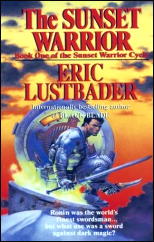
ERIC VAN LUSTBADER

   I’ll keep reading Lustbader, but I’ll probably keep wishing he took this to the next level as well. Whatever else, he’s a better writer than most of his fellow workers in the bestseller ghetto, and no one can say he doesn’t know how to keep you turning the pages.

   I just wish sometimes the surprises were less the usual kind found in thrillers, and more the kind a really creative writer is capable of.

   But some kudos to Lustbader that he is good enough I think he is capable of more.

   Or maybe I’ve read too many of these and become jaded, though reading this sort of thing Jack McClure’s dyslexia doesn’t always seem such a curse after all.
« Previous PageNext Page »