The inquiry below arrived in today’s email from John Herrington:

    “I am trying to find some information on a Giovanna Francesca Tassinari. Her connection with crime is rather minor as in 1926 she wrote a story ‘The judgment of Solomon’ with Edgar Jepson. She has turned up in the 1960s writing pseudonymous romances; and according to earlier records described herself as an author so I assume there may be other, probably pseudonymous, works in the 1930s to 1950s. Probably romance, but possibly in other genres.

    “She was born 1897, probably in Italy, and died in London in 1978. She was probably the daughter of Signora Danyell Tassinari who died in Florence in 1950 and whose obituary says was one of the oldest surviving English-born residents of Florence of the time.

    “Could you give her a mention in case the name means something to someone?”

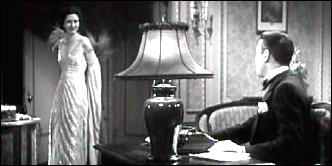
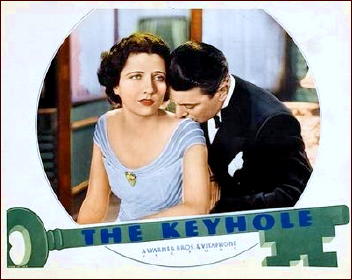
THE KEYHOLE. Warner Brothers, 1933. Kay Francis, George Brent, Glenda Farrell, Allen Jenkins, Henry Kolker, Monroe Owsley, Helen Ware. Screenplay by Robert Presnell Sr., based on the story “Adventuress” by Alice D. G. Miller. Director: Michael Curtiz.

THE KEYHOLE Kay Francis

   Even though George Brent plays at being a private detective in this one, the society kind, with Allen Jenkins as his dopey partner, I’ve categorized this movie as a comedy/romance all the way. While there is a crime involved (blackmail), any detection is minimal (that is to say, none).

   It’s not even Brent’s job to nab the blackmailer, though in the end he does, in a way. He’s hired instead to keep an eye on the blackmailee (Kay Francis) on behalf of her husband (Henry Kolker), who does not know about the blackmail but thinks funny business is going on when Kay Francis (a) begins to act strangely, and (b) heads for Cuba alone, and under her maiden name.

THE KEYHOLE Kay Francis

   It’s all part of a plot on her part to rid herself of the blackmailer (Monroe Owsley) to whom she was once married and who has since reneged on following through with a divorce.

   Brent’s usual game is getting the goods on married women who want to stray (I did mention he was the society kind of PI), so he’s a little confused, but naturally, as the cruise goes on, he begins to, well, you know, fall in love with her?

   Unfortunately, as an actor, George Brent has always seemed too bland for me, so it was up to Kay Francis to make this picture work for me, and she was never lovelier.

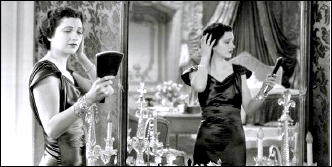
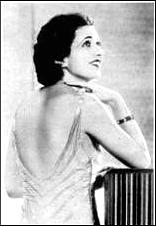
   She has a huge wardrobe along with her aboard ship, and each is what you might call spectacular, with many of them backless (this was a pre-Code movie) and cut low in front as well, but not nearly as far as in the back.

THE KEYHOLE Kay Francis

   She makes the romance between George Brent and herself believable, and even sizzle here and there, in totally entertaining fashion.

   But Allen Jenkins I could easily have done without altogether. He plays dopey to the hilt in this movie, and does a bang up job of it. A subplot involving him in a romance with con woman Glenda Farrell doesn’t go very far (both of them believe the other to be rich), but at least Glenda Farrell is easy on the eyes. She always was.

THE KEYHOLE Kay Francis

A 1001 MIDNIGHTS Review
by Bill Pronzini:


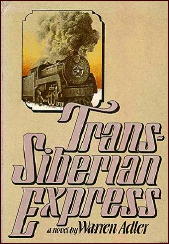
WARREN ADLER – Trans-Siberian Express. G. P. Putnam’s Sons, 1977. Paperback reprint: Pocket, 1978. Stonehouse Press, hc, May 2001; trade ppbk, July 2004.

WARREN ADLER Trans-Siberian Express

   One of crime fiction’s most popular subgenres is the tale of mystery and intrigue set on board a fast-moving train.

   For more than a century, authors from Poe to Christie to Warren Adler have perpetrated all sorts of mayhem on the world’s railways — highballing freights and crack passenger specials in this country, the fabled Orient Express, and now the Trans-Siberian Express that spans two continents on its 6000-mile route across Russia to the Sea of Japan.

   Dr. Alex Cousins, a Russian-speaking American cancer specialist, has been sent to Moscow on a secret mission by the president of the United States. The mission: to prolong for seven weeks (for unspecified reasons) the life of Viktor Dimitrov, secretary-general of the politburo, who is dying of leukemia.

   Cousins has done his duty, and now that he is ready to leave Russia, Dimitrov urges him to take the Trans-Siberian Express instead of flying — a “gift,” Dimitrov says, the train being one of legendary Victorian grandeur and the scenery being magnificent.

   Cousins agrees, but with reservations that turn out to be more than warranted. First he meets and becomes romantically involved with Russian beauty Anna Petrovna; then he finds himself enmeshed in a politically motivated conspiracy, trapped on board the train with KGB agents watching his every move.

   His only chance for escape is to seek help from his fellow passengers, but at least some of them are not who they seem to be….

   This is a rousing novel of international intrigue and adventure, populated by sharply drawn characters; the Trans-Siberian Express, in fact, is so realistically depicted that it becomes a character in its own right. Adler’s prose tends toward the undistinguished, but his evocation of the Russian scene and the scope and drama of his story more than make up for any deficiencies.

   Warren Adler is the author of a number of other contemporary thrillers, among them The Casanova Embrace (1978) and Natural Enemies (1979).

         ———
   Reprinted with permission from 1001 Midnights, edited by Bill Pronzini & Marcia Muller and published by The Battered Silicon Dispatch Box, 2007.   Copyright © 1986, 2007 by the Pronzini-Muller Family Trust.

THE BACKWARD REVIEWER
William F. Deeck


HERBERT ADAMS – Victory Song. Collins Crime Club, UK, 1943. Paperback reprint: Collins White Circle Services Edition, UK, 1946. No US edition.

HERBERT ADAMS Victory Song

   In his efforts to mobilize the power of prayer to make England victorious over the Germans and Japanese, the Reverend Gordon Arnold, the Mad Padre, has enlisted the aid of Edward Dalton, an American with a fine voice and the ability to write stirring hymns. One night Dalton disappears, leaving behind him without a word of explanation his sixteen-year-old daughter.

   Because Roger Bennion’s chief in the Secret Service is the Mad Padre’s cousin, Bennion is asked to quietly investigate the disappearance. In doing so, Bennion discovers that a great deal more is going on in the Bristopool area than a mere missing religious figure.

   As Bennion’s information increases, the reader may tend to mutter about coincidence and unlikelihood and needless complexity. Still, one does want to finish the novel to see how Bennion sorts it all out, which should be any author’s goal.

   A “time passer” is how I would describe the book, with nothing invidious intended.

– From The MYSTERY FANcier, Vol. 13, No. 3, Summer 1992.


Editorial Comments:   This is a scarce book. There is one copy of the paperback edition offered for sale on abebooks.com, for example, and two of the hardcover, both in the $145-160 range. Some of Adams’ mysteries, just over fifty or so, were published in the US, but most were not.

   Roger Bennion was Adams’ most commonly used series character. For more about him, read Mary Reed’s review of Death of a Viewer, which appeared here earlier on this blog. Following the review is a complete list of all of the Bennion books. (Adams is perhaps most noted for his golfing mysteries, eight of them in all, with some overlap with the Bennion books.)

   Also of note, in case you missed it: thanks to Jamie Sturgeon, considerable information has been discovered about Beryl Whitaker, author of four detective novels published in the UK in the 1960s, one of which Bill Deeck reviewed here not too long ago. Three of the covers have been added to the review and bibliography, along with a series of updates about the author herself.

A MOVIE REVIEW BY DAVID L. VINEYARD:         


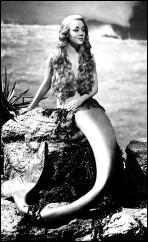
MAD ABOUT MEN Miranda

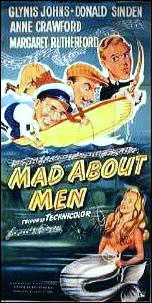
MAD ABOUT MEN. General Films, 1954. Glynnis Johns, Donald Sinden, Anne Crawford, Margaret Rutherford, Dora Bryan, Noah Purcell. Director: Ralph Thomas.

    “Well, we can’t have every Tom, Dick, and Harry handling you.”

    “Certainly not all at the same time.”

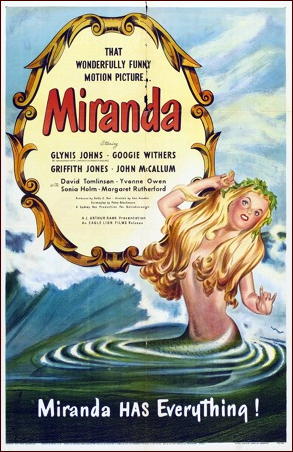
   That’s Miranda for you, all over. Miranda is Glynnis Johns, and just happens to be a mermaid, and the title of the film is a perfect description of her attitude in this fish-out-of-water comedic fantasy sequel to her debut as the mermaid in Miranda (1948).

   In this one Johns has a dual role as Miranda and Caroline her land-bound cousin (seems grandfather had a way with the ladies and the mermaids) who inherits a house in Cornwall and discovers Miranda.

   Miranda would rather like a holiday on solid land, and since Caroline is off for a two week holiday hiking tour, she arranges for Miranda to take her place pretending to have had a bad fall on the parallel bars (“I was going between two bars and took a fall.”) so she can explain the wheelchair with nurse Margaret Rutherford (who cared for her in the first film) helping.

MAD ABOUT MEN Miranda

   Miranda meanwhile doesn’t much care for the look of Caroline’s fiance, and she sets out to woo and win her another — no real effort for Miranda who finds men just lovely.

   Of course this is all pure froth, but done in lovely color and with a sprightly sense of humor and double — even triple — entendre. One of her beaus is a retired soldier Berkley and the other a handsome and rich fisherman Jeff (Sinden), and Miranda’s less than innocent ways soon have both men in over their heads.

   Complicating things for Miranda is her life long companion, Berengaria (Dora Bryan) whose mother was “frightened by an octopus,” and has a penchant for kleptomania and off-key singing.

   Rutherford is delightful as the nurse (watch for the scene where she sings “Maria the Matador’s Mother”) who takes great pride in her sexy patient, and Johns is a revelation: long platinum hair, Khirghiz eyes, and that breathless voice, perfect for this sexy romp.

MAD ABOUT MEN Miranda

   Those who only know her as Mother in Mary Poppins may be in for something of a shock.

   When Berkley’s fiance Barbara finds out Miranda’s secret, she sets a trap to reveal her before the world.

   The only depths to this one are in the ocean, but that hardly matters. This is a visual delight and a showcase for Johns who gets to perform not only a sexy song but a pretty hot rumba, and do much of the film dressed in little more than her long hair and pasties. If you can, catch it with the first film, Miranda, which is even more of a delight, and teams Johns with David Tomlinson, who would play her husband in Mary Poppins.

   Both films are funny, sexy, and fine examples of the kind of thing Thorne Smith used to do it print in a more (and less) innocent age. Both films compare well with the William Powell comedy Mr. Peabody and the Mermaid, where he catches mermaid Ann Blyth on a fishing trip in Florida, much to the bemusement of wife Irene Hervey.

MAD ABOUT MEN Miranda


REVIEWED BY TINA KARELSON:         


HELENE TURSTEN – Detective Inspector Russ. Soho Press, hardcover, US, January 2003; trade paperback, May 2004. Translated by Steven T. Murray.

HELENE TURSTEN Inspector Huss

   Irene Huss is a police inspector in Goteborg, Sweden, and her story is a character-driven semi-procedural flavored with a strong dose of domestic life, reminiscent of Peter Robinson’s and Donna Leon’s police series.

   Private life is less idealized in Tursten’s book, although Irene’s chef-husband Krister is a little too good to be true. As she investigates the mysterious death of wealthy Richard von Knecht, the reader is also shown her household’s twice-monthly cleaning routine and a crisis with one of the daughters slipping into skinhead culture.

   There’s just enough of this sort of thing to provide a strongly realistic atmosphere, heightened by vivid descriptions of nasty weather and long hours of darkness during the weeks before Christmas. Despite the domestic detail, including a lovable dog, this is rather hardboiled, including, for example, a nasty run-in with a group of Hell’s Angels.

   Originally published in Sweden in 1998, this came out in English from Soho Press in 2003. Recommended, but not to those of you who have already tried and disliked Scandinavian crime fiction. This book won’t change your mind.

       The Inspector Huss series:

Translated into English:

   1. Detective Inspector Huss (2003)
   2. The Torso (2006)

HELENE TURSTEN Inspector Huss

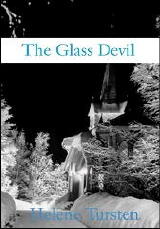
   3. The Glass Devil (2007)

Published in Sweden:

   * 1998 – Den krossade tanghästen, English title: Detective Inspector Huss (2003)
   * 1999 – Nattrond
   * 1999 – Tatuerad torso. English title: The Torso (2006)
   * 2002 – Kallt mord
   * 2002 – Glasdjävulen. English title: The Glass Devil (2007)

HELENE TURSTEN Inspector Huss

   * 2004 – Guldkalven
   * 2005 – Eldsdansen
   * 2007 – En man med litet ansikte
   * 2008 – Det lömska nätet

HELENE TURSTEN Inspector Huss

   Six films based on the series has appeared in Sweden and are available on the Internet as a six-DVD boxed set. Playing Inspector Huss is Angela Kovàcs. Contained in the set are:

   1. The Torso
   2. The Horse Figurine
   3. The Fire Dance
   4. The Night Round
   5. The Glass Devil
   6. The Gold Digger

   Swedish titles: Glasdjävulen / Guldkalven / Eldsdansen / Nattrond / Den Krossade tanghästen / Tatuerad torso.

   A trailer for The Torso can be seen here on YouTube.

REVIEWED BY DAN STUMPF:         


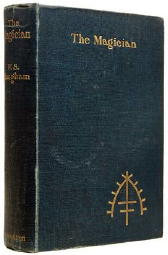
W. SOMERSET MAUGHAM – The Magician. William Heinemann, UK, hardcover, 1908. George H. Doran Co., US, hardcover, 1908. Reprinted many times, in both hardcover and soft. Silent film: MGM, 1926 (with Alice Terry, Paul Wegener; director: Rex Ingram).

SOMERSET MAUGHAM The Magician

   The villain of Somerset Maugham’s 1908 novel The Magician was loosely — very loosely — based on Aleister Crowley, and the novel is as close as Maugham ever came to writing pulp, an all-out mellerdrama with sinister sorcerer, helpless heroine, ho-hum hero… there’s even a Van Helsing character written in to help move the plot along.

   Said plot involves the corpulently wicked Oliver Haddo being publicly (and justifiably) humiliated by the Good Guy and taking his vengeance by magically seducing his Innocent Fiancee to be used as a pawn in the Dark Arts. And so on.

   Parallels with Dracula (1897) are not far to seek. Interestingly, though the major get-the-plot-across passages seem a bit hurried and obvious, with purple vapours, lurid visions and such, the less relevant chapters, sketching out the emotional effects of all this on the characters, are really quite effective. Maugham may not have been a great author, but he was a damgood novelist and it shows here.

   I may have indicated that the horror novel parts of The Magician fall a bit flat, and they do mostly — up to the end. The climax of this book in Haddo’s hellish castle is as frightening as anything you’re apt to read in this genre, and it stays in the memory.

      Etext: http://www.gutenberg.org/etext/14257

Editorial Comments:   Dan wrote this review in November 2005. I felt that it was appropriate to post it now, considering the way the comments following Walter Albert’s review of the 1931 film version of Dr. Jekyll and Mr. Hyde happened to flow.

   As they went along, they (the comments) seem to have morphed themselves into a discussion first of the filmed version of The Magician then onto Mr. Maugham’s contribution to literature in general.

      Adapted from an email from David Vineyard:

   Don’t know how many of you care for this sort of thing, but if you check out the BBC7 site this week they are airing an eight part adaptation of the Paul Temple mystery Paul Temple and the Gilbert Case. Currently there are also adaptations of two of Agatha Christie’s Poirot’s, a new Biggles (starting Thursday), John Creasey’s The Toff and the Runaway Bride, and The Casebook of Sherlock Holmes.

   Previously they’ve done Ashenden, Bulldog Drummond, The Scarecrow, and many more. They also have original crime programs and adaptations of more recent writers’ works.

   The episodes run about thirty minutes and are full cast productions. Thought I’d give everyone a heads up.

   The Gilbert Case finds Paul and wife Steve’s holiday plans interrupted when the father of a murdered girl asks him to try and clear the young man, Howard Gilbert, convicted of murdering her and facing the death sentence. “I know you, you enjoy sticking your neck out.”

   Honestly there’s too much to listen to, but you can pick and choose the ones you really like, and they can be downloaded to an MP3 player or IPod as well.

A TV Review by MIKE TOONEY:


“Captive Audience.” An episode of The Alfred Hitchcock Hour (Season 1, Episode 5). First air date: 18 October 1962. James Mason, Angie Dickinson, Arnold Moss, Ed Nelson, Roland Winters, Sara Shane, Bart Burns. Teleplay: Richard Levinson & William Link, based on the novel Murder off the Record (1957) by John Bingham. Director: Alf Kjellin.

   Victor Hartman (Arnold Moss) publishes mystery novels, but even so he’s unprepared for what’s been developing for the past few days. Victor has been receiving tape recordings from a prospective author named Warren Barrow (James Mason) in which Barrow may be revealing his plans to exact revenge on Janet West (Angie Dickinson) for trying to frame him for murder —   OR what he’s saying on the tapes might just be notes for a novel he hopes to place with Victor.

   Victor is unsure and calls in Tom Keller (Ed Nelson), one of his best mystery authors. Is Barrow really planning murder, or is he just floating ideas for a novel? Because, if Barrow IS serious, something has to be done — and fast ….

   Altogether, the now legendary but then struggling to get established Richard Levinson and William Link were responsible for five Alfred Hitchcock Hour episodes, and not a bad one in the bunch: “Captive Audience”; “Day of Reckoning”; “Dear Uncle George”; “Nothing Ever Happens in Linvale”; and “Murder Case.”

   Another Alfred Hitchcock Hour episode, “The Tender Poisoner,” was also derived from a John Bingham novel.

Hulu: http://www.imdb.com/video/hulu/vi1490550809/

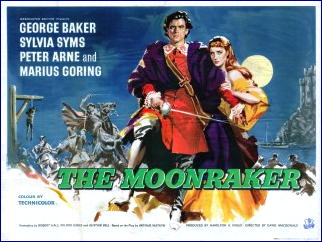
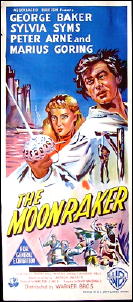
THE MOONRAKER 1958

THE MOONRAKER. Associated British Picture Corporation, 1958. George Baker, Sylvia Syms, Marius Goring, Peter Arne, Clive Morton, Gary Raymond, Paul Whitsun-Jones, John Le Mesurier (Oliver Cromwell). Based on a play by Arthur Watkyn. Director: David MacDonald.

   A “moonraker” is a smuggler who drops his contraband goods into coastal waters then rakes them up again in the moonlight.

   I hope I have that right. If not, those of you who live in England, please do correct me on this — or anything else in this review I might happen to get wrong in the rest of what follows. British history is not necessarily my strongest suit.

   The movie begins with the Moonraker (Anthony Earl of Dawlish, played quite handsomely by actor George Baker) riding by horseback in a purple tunic though open meadow land, green wooded areas, down the cobbled streets of a small town at night, then into open land again till we see in the near distance the outline of the circle of standing stones that make up the national monument called Stonehenge.

   The next scene purports to take place within those same stones, but I’m not so sure. I suppose the film crew may have been allowed to do so? In any case, it is there that Dawlish meets Charles Stuart, whose father Charles I had recently been overthrown (and executed) by Oliver Cromwell.
THE MOONRAKER 1958

   It is the Moonraker’s task to ensure the safe passage of the would-be king to France, an event which of course actually happened, though the Moonraker’s role is, as I understand it, quite fictitious.

   However, this dates the time that this movie takes place exactly: 03 September 1651. Robin Hood, another British folk hero that even those here in the US have heard of, came along much earlier, the 12th century A. D. and the time of Richard the Lionheart. Just to put events in perspective.

   Here in the US as kids (probably not so much any more) we played a lot of Cowboys and Indians, and Good Guys and Bad Guys. Did boys in the UK play Robin Hood and His Merry Men very often? I’m guessing, but probably more than they did Cavaliers (Royalists) and Roundheads (Cromwell’s men).
THE MOONRAKER 1958

   In any case, it is the strife between the latter that this movie is about. Being based on a play, much of it takes place not in the open (other than the aforementioned opening credits) but in the confines of a small inn along the coast, where Charles Stuart is to begin his voyage by sea to France and his temporary exile.

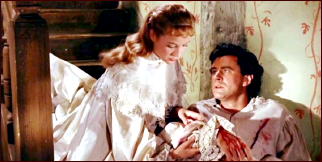
   Complicating matters, for the sake of a story, a girl (Sylvia Syms) who is betrothed to one of Cromwell’s high ranking officers is forced to confront both Dawlish and her own beliefs face-to-face. Romance wins out, but will there be the time and the place for it to bloom further?

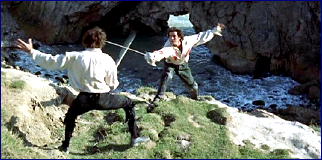
   There is, of course, much swordplay and other acts of derring-do that also take place, all very well done, in beautiful Technicolor. But while the movie is entertaining from beginning to end, the story itself just isn’t solid or meaty enough to stay in one’s memory for very long. Perhaps it’s more significant and means more in England than it does here?
THE MOONRAKER 1958

« Previous PageNext Page »