REVIEWED BY DAVID VINEYARD:


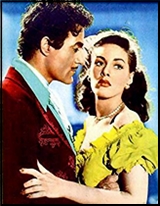
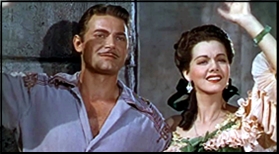
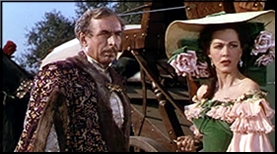
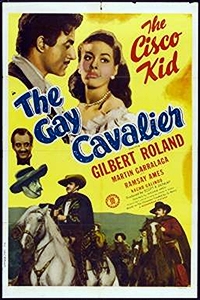
THE GAY CAVALIER. Monogram Pictures, 1946. Gilbert Roland, Martin Garragala. Nacho Galindo, Ramsay Ames, Helen Gerald, Tristam Coffin, John Merton. Screenplay by Charles Belden, based on the character created by O Henry. Foreword by Sidney Sutherland. Directed by William Nigh.

   â€œSometimes a rider comes, his face is not so pretty. He is death.”
      — the Cisco Kid

   Gilbert Roland rides onto the screen as the Cisco Kid in this B Western and does so with a good deal more romance and less action than you might expect.

   Cisco had been around ever since the story by O Henry whose original character is a far cry from the charming Mexican Robin Hood we know and love.

   The original Cisco was a sociopathic Anglo Billy the Kid type hunted by a brave Texas Ranger captain (based on Lee Nace the Ranger who arrested and befriended William Sidney Porter in Texas for embezzlement). In the story the Kid uses his Mexican girlfriend to escape the Ranger having her ride away on his horse in his clothes and to be killed by the Ranger while he escapes on her horse in drag.

   By the time Cisco came to the big screen, he was a charming but still ruthless Mexican bandit played by Warner Baxter, who managed to take home the first Academy Award playing the part in 1929 (Ronald Colman was nominated as Bulldog Drummond that year) in In Old Arizona.

   Over the years Cisco was a handsome Cesar Romero (mostly playing himself), the beloved Duncan Renaldo of television fame, Jimmy Smits in a made-for-television movie, and the dashing and dangerous Gilbert Roland.
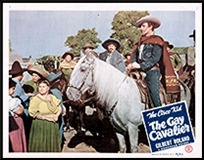
   Roland my be billed as the gay cavalier, but there is nothing light or happy about him. There are a few rueful or slightly sinister smiles, and he romances some beautiful women, but his Cisco all in black is almost noirish dark, driven, and haunted as well as philosophical.

   â€œBaby, why do you worry about time? Time is a wonderful thing, it ages wine and mellows women.”

   Roland, debuted in the silent era and went from leading man to character actor over his career, but as Leonard Maltin once wrote, no movie was ever worse for his presence, and here as a dark and sardonic Cisco he brings something new to the character.

   The film opens with Cisco on a hill top standing with his hat off beside a cross. It is the grave of his father. As his fat friend Baby (Nacho Galindo) explains to one of the gang, Cisco’s father was the most powerful man in California at one time, and now Cisco to atone for his father’s sins and so the old man can rest, has become a Robin Hood stealing from the rich and giving to the poor.
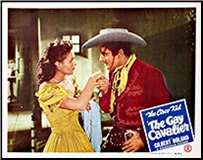
   I don’t think any other film ever gave Cisco an origin story.

   Meanwhile Don Felipe (Martin Garragala), a poor ranchero, is marrying his daughter (Helen Gerrald) off to wealthy gringo John Lawton (Tristam Coffin) though she loves a poor Mexican boy. What no one knows is that Lawton and his man (John Merton — a bad guy surprise surprise) are criminals planning to use Don Felipe’s estate as a base and have already held up the money gathered to build a new church and blamed the Cisco Kid for the crime.

   That doesn’t sit well with this Cisco. He determines to find whoever imitated him and stole the church money, and once he knows it is Lawton to play Cupid for the young Juan and Don Felipe’s daughter.

   Meanwhile Cisco finds time to romance the older and much more attractive daughter, Ramsay Ames.

   There is a raid on Lawton’s hideout to steal the money back for the church, and a well staged duel with swords between Coffin and Roland, but little boys must have been squirming in their seats on Saturday mornings as this one unreeled. On the other hand, adults may have enjoyed a more mature Western done with some actual charm and a charismatic lead who could actually act.

   Leonard Maltin’s axiom stands. Like anything else he was in, no movie was ever worse for the presence of Gilbert Roland, and many, like this one, far better for him being in it.
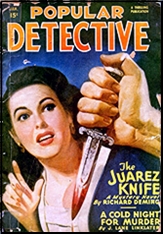
   

RICHARD DEMING “The Juarez Knife.” Novella. Manville Moon #1. First published in Popular Detective, January 1948. Available as an individual story in a Kindle edition (Wildside Press, 2018).

   Not only is this Manny Moon’s first appearance in print, it’s also Richard Deming’s first published work of crime or mystery fiction. Not only did he go on to write hundreds of short stories for the pulp and digest magazines, but he was also the author of dozens of hardcover novels, including three featuring the same Manny Moon, known best perhaps as the private eye with only one leg.

   And in “The Juarez Knife” we learn that he lost the portion of it below the knee in the war, and that to replace it, he’s been fitted with a “cork, aluminum, and leather contraption” that when he tries to get up suddenly at night without it, he finds himself “lying half under the bed on a bruised right elbow.”

   The call is from a semi-crooked lawyer who has a job for him. “Semi-crooked” is my term for him, since he has been indicted once, but nothing more. When he gets to the gent’s office, a young girl goes in before him. When he is called in, the girl has gone out a side door, but his would-be employer is lying across his desk dead, with a knife in his chest.

   As it so happens, the door the girl went though was under watch, and she is the only one who came out. The windows are open, but the ledge outside is too narrow for anyone to have used it, and it’s fourteen stories up. Moon takes her on as a client anyway. He believes she is innocent simply on the fact that after leaving the office she calmly went on to a previously scheduled hairdresser appointment.

   You do not expect stories tin pulp magazines to be traditional locked room mysteries, but this is a good one, and it’s fairly clued as well. The only problem is that the real killer could only be one person, and sure enough, he/she is. Beside the three Manny Moon novels, there were eighteen novelettes and short stories in which he appeared. They’ve never been collected, as far as I know, but a number of them are now available in Kindle format, reasonably priced at only 99 cents each.

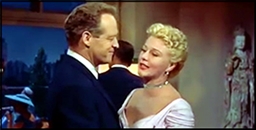
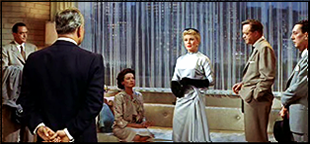
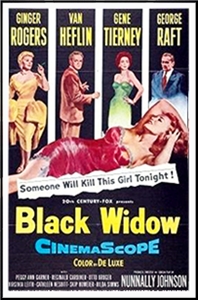
BLACK WIDOW. 20th Century Fox, 1954. Ginger Rogers, Van Heflin, Gene Tierney, George Raft, Peggy Ann Garner, Reginald Gardiner, Virginia Leith, Otto Kruger, Skip Homeier. Produced, written and directed by Nunnally Johnson. Based on the novel by Patrick Quentin.

   Somewhere in this Technicolor wide-screen Cinescope production, there is a rather ordinary back-and-white but still effective noir film just aching to break out. When the wife (Gene Tierney) of successful New York City playwright Peter Denver (Van Heflin) goes out of town for an undetermined amount to time to be with her sick mother, he makes an all but fatal mistake. He allows a young would-be writer (Peggy Ann Garner) in ingratiate herself into his life.

   She’s twenty years old and sweet-talkingly fresh from Savannah, Georgia, and while we the audience know how up to no good she is, Peter Denver is oblivious to the obvious. It does not help that the leading lady (Ginger Rogers) in his current play on Broadway lives with her husband the the apartment just above the Denvers. She is the epitome of catty and a woman who does not care who knows it.  Discreet is not a word in her vocabulary.

   And when upon Iris’s return young Nancy is found dead in the Denvers’ bathroom, Peter finds the hangman’s noose tightening around his own throat. Figuratively speaking, but still a distinct possibility, unless he does something about it personally, even while the police, in the person of homicide captain George Raft, are hot on his trail.

   At which point the nor aspects are set aside and the story becomes that of a much more ordinary detective mystery. A very very solid one, I hasten to add, but a story not quite as interesting as the jam Peter Denver gets himself into, quite unwittingly. I’m sure that fans of film noir will find the first half as satisfying enjoyable as I did. All the performances are very good, but Van Heflin and Peggy Ann Garner outshine them all.

   I do not know why Peter and Iris Duluth’s name was change to Denver for the sake of the movie, but I suspect (without evidence) that other less obvious changes from the book were made also. Those who have read the book can perhaps tell us more.


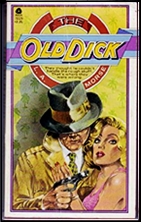
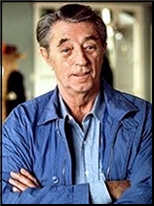
L. A. MORSE The Old Dick. Jake Spanner #1. Avon, paperback original 1981. Made for TV movie: Jake Spanner, Private Eye (USA Network, 1989, with Robert Mitchum as Jake Spanner).

   There have been a number of detectives in the world of mystery fiction whom you’ve have to call “elderly,” but at age seventy-eight . I think Jake Spanner has most of them beat. Miss Marple, I believe, was up in her eighties when she was still active, and some of you with better memories than mine can probably come up with more right away.

   But how many of these would you all hard-boiled private eyes? In his own words, Jake Spanner has always tried never to give satisfaction to assholes, if he could help it, and now that he’s retired, he see no reason to change.

   He hasn’t had an erection in five years, either, or so he says at the beginning of chapter one. How old he is soon begins to sound like an obsession with him, but with old duffers like this, sometimes you just put up with things like that a little bit more.

   Spanner comes out of retirement in this book, as you would have guessed, but throughout it all, he remains pretty much surprised by it. At any rate, he decides to give a helping hand to a one-time enemy from the old days, a gangster known as Sal the Salami (for reasons we won’t go into here). It seems that his grandson has been kidnapped, complication begin to develop and thrive, deliciously so.

   I don’t know who the author is. If someone were to tell me it’s not his first book, that he’s written loads of others, I wouldn’t be surprised at all. L. A. Morse, whoever he is, has an inventive touch that adds tremendously to a rather familiar story, plus a consistent style and a slightly vulgar sense of humor to match.

   There are some books in which you’re lucky to get one of the above.

Rating: A minus.

–Very slightly revised from The MYSTERY FANcier, Vol. 5, No. 6, Nov/Dec 1981.

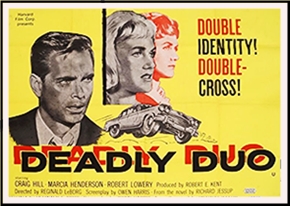
DEADLY DUO. United Artists, 1962. Craig Hill Craig Hill, Marcia Henderson, Robert Lowery, Dayton Lummis, Carlos Romero, Irene Tedrow, David Renard. Based on the novel The Deadly Duo by Richard Jessup. Director: Reginald Le Borg.

   Based on the other work I’ve read by Richard Jessup, a fairly prolific writer of westerns and paperback crime fiction in the 50s and 60s, this might have been a good novel, an original from Dell in 1959, but even if the movie followed the book closely, which it very well may have, the translation still didn’t turn out all that well.

   The story elements are all there. Her son having been killed in a racing car accident, a wealthy woman wants to obtain custody rights to her grandson, now being raised by his now single mother (Marcia Henderson), a former stripper. To that end, he hires a struggling young attorney (Craig Hill) to go to Acapulco to offer the woman $500,000 to give up the child.

   When he gets there, she refuses outright, but her twin sister and her husband (Robert Lowery) have other ideas, one of which is murder, and of course you already know, I’m sure, how it is that they think they can pull it off.

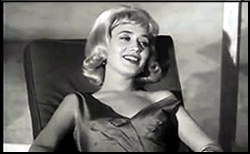
   The plot is intricately structured and well planned out, but the ending is telegraphed well in advance, leading to a twist ending which is no surprise at all. There’s no fun in that! It is fun to see Marcia Henderson (whom I remember from her leading role in the long-forgotten TV series Dear Phoebe) play two roles, one a dark-haired and very prim and proper mother, the other a brassy blonde floozy whose dancing career is going nowhere, now that his sister has quit the act they had together.

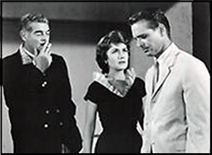
   It is also fun to see how Robert Lowery, a long-time B-movie star in the 1940s, looked in the later stages of his career. With a mustache and generally older looks, he looks even more like Clark Gable or Cesar Romero than ever (on the left in the lowermost photo).


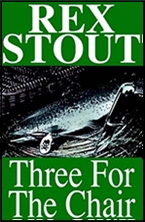
REX STOUT “Immune to Murder.” Novelette. Nero Wolfe. First published in The American Magazine, November 1955. Reprinted in Ellery Queen’s Mystery Magazine, February 1957, and Ellery Queen’s Anthology #12 (Davis Publications, 1967). Collected in Three for the Chair (Viking, hardcover, 1957).

   I think that Nero Wolfe left his Manhattan brownstone on business more often than Rex Stout wanted us to believe, and when it happened, a big deal was made of it. Strangely enough, though, when Archie and Wolfe make a trip in “Immune to Murder” of over 300 miles by automobile to a fishing camp somewhere up in the Adirondacks, the latter shows only a minor annoyance rather than his usual petulance at being away from home.

   That may be because he’s doing it out of some loyalty to his country, as what he’s been asked to do is cook some fish for lunch at a meeting of ambassadors and various high level financiers. Which he does, but it wouldn’t be a Nero Wolfe story if one of the high level financiers isn’t found dead in the water, having been hit over the head with a heavy stick of firewood.

   Brought in on the case are an Attorney General, a district attorney, a sheriff and three state troopers, all of whom badger Wolfe no end, thinking (improbably) that he, as the only “outsider,” had something to do with it. In his defense, Wolfe consults his own lawyer, some law books, and places a telephone call to the Secretary of State in Washington to make sure he’s on safe ground before identifying the killer.

   The story is fine, but I don’t think it was as much fun to read as those that take place in Wolfe’s own bailiwick. Archie, on the other hand, is Archie, no matter where Wolfe’s cases take them.

REVIEWED BY DAN STUMPF


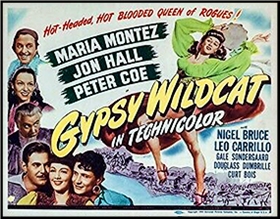
GYPSY WILDCAT. Universal Pictures, 1944. Maria Montez, Jon Hall, Peter Coe, Nigel Bruce, Leo Carrillo, Gale Sondergaard, Douglass Dumbrille. Director: Roy William Neill.

   Last month AMC ran a bunch of those “Arabian Nights” Movies, which I blush to admit I watched and enjoyed while other, worthier tapes, languished on my shelves.

   It doesn’t help a bit that these movies were mega-hits in the 40s, catapulted Jon Hall and Maria Montez to dubious stardom, and launched several mostly cheap and inferior imitations. I noted that Cobra Woman was directed by Robert Siodmak, in the bland, expressionless style that would become his trademark in the 60s, after all those wonderfully stylish films nour, and Gypsy Wildcat was done by that James-Whale-of-“B” -Movies — Roy William Neill — with all the panache poured into Frankenstein Meets the Wolfman and the Sherlock Holmes series.

   Of course, in Gypsy Wildcat, the plot kind of got away from the writers: First the Gypsies sing, then they get taken prisoner by Evil Baron Douglass Dumbrille (who at least always managed to have a good time with his villainy) but Jon Hall escapes. Then he joins them and they’re all caught, so they decide to sing. Then Jon Hall escapes again and comes back for Maria Montez and they both escape, but then they get caught. One of the Gypsies escapes, then they all decide to escape, and to cover up the noise of their escape, they sing.

   Having escaped, they prison the Guards, but then Douglass Dumbrille escapes with Maria Montez, so they chase after him, but while they’re gone, the guards escape and start chasing after the gypsies, who catch Doug just as the guards catch them and …

   Well, I guess that’s why they call it Escapist Entertainment. But Damn, that Movie sure moves around a lot!

— Reprinted from Shropshire Sleuth #71, May 1995.


REVIEWED BY BARRY GARDNER:


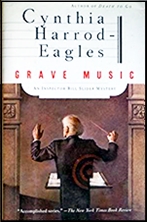
CYNTHIA HARROD-EAGLES – Grave Music. Inspector Bill Slider #3. Scribner’s, hardcover, 1995. Avon, paperback, 1996. Published previously in the UK as Dead End (Little Brown, hardover, 1994).

   This is the third of the series I’ve read. I had some problems with the first, but thought the second was a bit better.

   Life has been better for Inspector Bill Slider. His wife and mistress have left him more or less simultaneously. And his boss has hinted strongly that he should transfer. He hasn’t, and he’s paying for it. He and his ex-mistress, an orchestral musician, are thrown somewhat together again when a noted London conductor is murdered during a rehearsal. It’s one of those cases where the suspects include just about everyone who ever knew the dead man, who seems to have been thoroughly unlikable in every respect.

   This is a series that seems to me to have gotten steadily better. Bill Slider is a genuinely likeable and sympathetic character, his one-time philandering notwithstanding, and so is his lover Joanna. Harrod-Eagles tells a good, straightforward story in prose equally so. Her characters and dialog are her strengths; her plot was serviceable, but the identity of the murderer seemed obvious early on.

   These aren’t as gritty as John Harvey’s books, but they certainly aren’t light. I’d put them solidly in the mid-range of hard-edged British police stories.

— Reprinted from Ah Sweet Mysteries #19, May 1995.

   
      The Inspector Bill Slider series —

1. Orchestrated Death (1991)
2. Death Watch (1992)
3. Necrochip (1993) US title: Death to Go.
4. Dead End (1994) US title: Grave Music.
5. Blood Lines (1996)
6. Killing Time (1996)
7. Shallow Grave (1998)
8. Blood Sinister (1999)
9. Gone Tomorrow (2001)
10. Dear Departed (2004)
11. Game Over (2008)
12. Fell Purpose (2010)
13. Body Line (2011)
14. Kill My Darling (2012)
15. Blood Never Dies (2012)
16. Hard Going (2013)
17. Star Fall (2014)
18. One Under (2015)
19. Old Bones (2016)
20. Shadow Play (2017)
21. Headlong (2018)

REVIEWED BY DAVID VINEYARD:


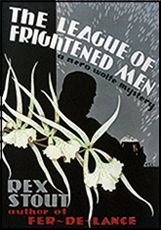
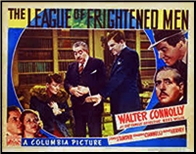
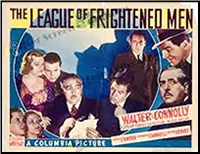
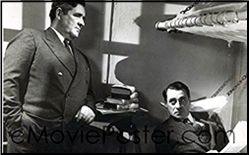
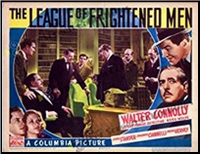
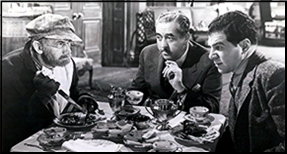
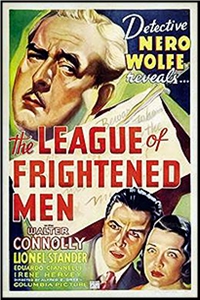
THE LEAGUE OF FRIGHTENED MEN. Columbia Pictures, 1937. Walter Connolly, Lionel Stander, Eduardo Ciannelli, Irene Hervey. Screenplay by Guy Endore, Eugene Solow, & Edward Chodorov, based on the novel by Rex Stout. Directed by Alfred E. Green.

   The bad things to begin with.

   And in all honesty they are pretty bad.

   Walter Connolly is simply awful as a nice, polite, annoyingly ambulatory Nero Wolfe (he was an even worse Father Brown), who unlike Edward Arnold in Meet Nero Wolfe, doesn’t even look fat enough for the part. He drinks hot cocoa instead of beer, and there is only a passing reference to food. We do passingly hear about orchids and see Wolfe using the phone to call Inspector Cramer from the greenhouse, and he punishes Cramer for “disrespecting the orchids,” but that and a bit of high-handed business from the book is about it far any glimpse of the real Wolfe goes save for one scene at the end.

   He’s not even rude and he doesn’t say ‘pfui’ once.

   This one even celebrates solving the case by taking Archie out for a drink.

   He does live in a fairly decent recreation of the brownstone, though.

   Fritz and Theodore don’t appear, instead Wolfe has a reformed crook named Butch as his butler, and if Sol and the boys don’t exactly show up, Archie has two “guys” he relies on.

   And again there is Lionel Stander as Archie Goodwin, so thick we cannot believe Wolfe would employee him much less rely on him. We open with Archie bored and goading Wolfe to go to a movie with him. No, not teasing Wolfe, not deliberately tweaking his eccentric boss, no, admiringly wondering why Wolfe won’t go to a movie with him.

   Archie is embarrassingly admiring of Wolfe throughout.

   That said, Stander this time gets to do some decent leg work, and if he is a low rent thug and not so comic relief, he still follows Stout’s plot enough to do some decent detective work, though considering how casually Wolfe moves in and out of the brownstone it is hard to imagine why he even needs Archie.

   Maybe he secretly wants to go see that murder mystery with him.

   He still comes off better than Cramer. Archie doesn’t fall through a door on his face eavesdropping.

   As in the book, Wolfe is approached by a member of a group of Harvard graduates who once took part in a hazing that crippled writer Paul Chapin. Now two of their members are dead, and they suspect Chapin is killing them off. Wolfe, in one thing at least like the real Wolfe, turns down the first millionaire in order to get all the “league of frightened men” to pay him.

   And who should walk in on his two canes appearing threatening and sinister as Wolfe is making his selling point than Paul Chapin (Eduardo Cianelli, who is excellent as the bitter wounded man despite an accent no one really explains)?

   There is another murder, and Chapin is caught red-handed, proving to Wolfe he can’t possibly be guilty.

   The film does not depart too much from the book in most things. It even ends with a gathering of the suspects, and Wolfe, typically highhanded, catching the killer out, as usual in a way that would be absolutely useless in a courtroom if the killer just bluffed Cramer and called a lawyer.

   I give Stout those scenes, I’ll give them to the movie.

   As in the book, the best scene may be the final meeting of Wolfe and the ungrateful Chapin. Wolfe’s appreciation of the wounded proud man is the closest we get to seeing the real Nero.

   As far as the mystery and plot, this one works better than the Arnold outing, and at least Connolly isn’t as annoyingly jolly as the chuckling Arnold (why is it so many actors play Wolfe as so much nicer and happier than Stout wrote him? William Conrad’s smiling was the worst part of his Wolfe).

   The good things: there is some atmospheric camera work, a generally good cast of suspects, all well versed in playing the main bad guy, a fairly literate script despite the portraits of Wolfe and Archie, and above all else Eduardo Ciannelli.

   But how anyone read those two books and ended up with Walter Connally and Lionel Stander as Nero Wolfe and Archie Goodwin…

   That’s a mystery even Wolfe’s father couldn’t solve.

   At least Eugene Pallette would have been fat and irritable enough, though I can’t quite wrap my head around William Powell as Archie or for that matter Errol Flynn.


TIME OF DEATH. TV Movie. Incendo, Canada, 2013. Kathleen Robertson, Gianpaolo Venuta, Sarah Power, Link Baker, Daniel Fathers. Director: Frédéric D’Amours. Currently streaming on Amazon.

   I went looking, but I’ve not found out much of anything about the production company behind this, other than it was a Canadian project and it was made for television. As far as IMDb is concerned, Canada might just as well be a foreign country.

   It’s one of those films that captures your attention for about 2/3 of the way through before verging off into a rather disappointing rest of the way. How it begins is as a detective story, then… well, I’ll get back to that. When the head of a tech company is murdered late at night, the Department of Defense sends an FBI agent to investigate. I’m not too clear on the details here, and writing down what I think happened, it’s even less clear, but when the agent is as good-looking as icy blonde Kathleen Robertson is, you are a little more forgiving about certain vageries of the story line.

   Which is what I think the producers of the film had in mind during their casting sessions. In any case she is (mis)matched up with a young cop on the local police force (Gianpaolo Venuta) who has been on the job for only two weeks. Sigh. Why do things like this happen to me, she thinks. They turn out to be a good pair, however, and the early part of the story they do a goodly amount of fine detective work together, as other high-ranking members of the firm are also killed, one by one, and always at the same time: 10:44.

   The detective business comes to an abrupt end, though, when the killer, feeling closed in upon, reveals him- or herself, and the rest of the movie takes on the guise of a less than ordinary thriller flick, as the pair try to stop the killer before he or she strikes again. Oh, well. It was a nice try until then.

   The movie is made with some style, though and Robertson and Venuta seem to have had a good time working together. The former even makes up with the latter’s superior officer who foisted him off on her. I suspect that the makers of this movie had a followup series in mind. It didn’t happen, but it could have.


« Previous PageNext Page »