BILL PRONZINI “A Cold Foggy Day.” First published in Ellery Queen’s Mystery Magazine April 1978. Collected in Small Felonies (St. Martin’s, hardcover, 1988).

   The story begins as two men arrive in San Francisco from Boston, with the younger noticeably having trouble with the cold. He is a native of Boston; his companion is from San Fransisco and doesn’t find anything about the weather worth complaining about. They are obviously working as a team and are on their way to find someone. From their tough guy attitude and demeanor, we soon begin to assume they have the worst in mind for the person they are looking for.

   And that is the crux of the tale, and I cannot tell you more about that. Who is it they need to find, and why?

   What I would like to tell you, though, and that is what I can do, is that while Pronzini is best known for his stories about, well, a certain Nameless PI, he is a writer worth reading for his many many non-series tales, of which this is one. He uses clear and uncomplicated language to tell the stories he tells — each word precisely the correct one — to keep his readers following along. As you will with this one, as much as I.

>   Guaranteed.

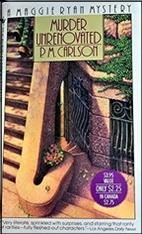
P. M. CARLSON – Murder Unrenovated, Maggie Ryan #4. Bantam, paperback original; 1st printing, January 1988.

   This novel takes Maggie Ryan back to 1972, and her fourth mystery adventure. She and her actor-husband Nick O’Connor are searching for a brownstone to buy and renovate in Brooklyn, but the one they find has both a rent-control tenant in the basement, and a body upstairs.

   Maggie and her husband have a cheerful lust for living and a love of people that is strictly contagious and romantic, more perfect than life, but the reading is fine. Only the ending is disappointing, as the killer, literally, is someone just brought in off the street.

— Reprinted from Mystery.File.5, May 1988.


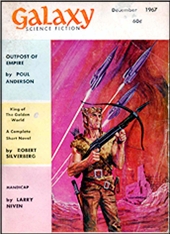
GALAXY SCIENCE FICTION – December 1967. EditorL Frederik Pohl. Cover artist: Gray Morrow. Overall rating: **½.

POUL ANDERSON “Out[pst of Empire.” Dominic Flandry. Novella. John Ridenour is sent as a troubleshooter to find out why the natives of Freehold seem to be rising up against the planet’s colonists, The situation is complicated by the was against Merseia because of Freehold’s strategic position near the empire’s boundary. Ridenour’s discovers, although slowly, that the natives, who have applied the scientific method to the problem of living in the wilderness, are more fit to represent the planet for Earth. Flower power!
   Anderson is inclined to long-winded explanations here – even his characters realize it – and the story begins in the middle, and continues with unbelievable sluggishness. Plus a singularly obtuse ending, as it makes its way to an effective solution, ruins the rest. **½

[Note: I am informed that this is a Dominic Flandry story, but since I didn’t mention him back when I wrote this review, I cannot tell you what his role in it is now.]

RICHARD WILSON “The South Waterford Rumble Club.” Aliens flood Earth with counterfeit money, Rather dumb, but I was hopeful until the end, (1)

ROBERT SILVERBERG “King of the Golden World.” A woman who marries an alien chieftain realizes her responsibilities. (3)

FRITZ LEIBER “Black Corridor.” A man’s choices, or what makes makes a man. Nothing to add except style, (4)

PHILIP LATHAM “The Red Euphoria Bands.” The diary of an astronomer who discovers a comet’s beneficial properties. (3)

JOHN BRUNNER “Galactic Consumer Report No. 3.” Non-fact article.Ish, (0)

LARRY NIVEN “Handicap.” Novelette. Known Space. Some races have intelligence, but have no means to implement it. The ending fails because Niven assumes familiarity with his created universe, A potentially higher rating otherwise. (4)

HARRY HARRISON “The Fairly Civil Service,” A civil service of the future. (2)

Rating: **

— May 1969 .

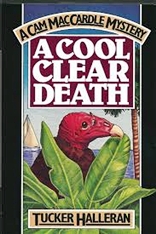
TUCKER HALLERAN – A Cool Clear Death. Cam MacCardle #1. St. Martin’s, hardcover, 1984; paperback, May 1986.

   Cam MacCardle, once a famous professional football star, turns private investigator in this, his first case, in which the wife of a quiet, unassuming stockbroker, is murdered. With no evidence against him except that he has no alibi, the police have settled on the husband as the killer.

   I hate to say it, but MacCardle is one of the slowest moving PI’s I’ve ever read about, and even he admits that luck has much to do with solving the case. It also takes something like 75 pages for him to tell his whole life story, The red herring smells, too.

— Reprinted from Mystery.File.5, May 1988.


PostScript: There was a second book in the series, Sudden Death Finish (St. Martin’s, hardcover, 1985) but that seems to have been all there’s ever been.

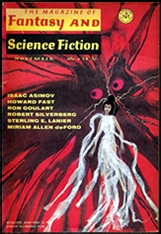
ROBERT SILVERBERG – When the Myths Went Home. The Magazine of Fantasy and Science Fiction, November 1969. Reprinted in World’s Best Science Fiction: 1970, edited by Donald A. Wollheim and Terry Carr (Ace, paperback, 1970). Collected in Moonferns and Starsongs (Ballantine, paperback, 1971).

   This particular tale, and a nifty one it is, takes place in a future far distant in time than ours. It is in fact, in terms of years, somewhere between 12400 and 12450, but still an age of new inventions and discoveries. The one of the latter that is of interest to the people of that time is one that can bring back to life people of fame and notoriety such as Cleopatra, Winston Churchill, Napoleon and more.

   The kind of people who are fun to have around, to talk to and interact with, but gradually the attraction wears off. More is wanted. Working on the problem is man named Leor, who  discovers that there is a way to bring back people who were perhaps not as real, starting (of course) with Adam. Then, and I’m quoting:

   “Leor continued to toil in his machine.

   “He brought forth Hector and Achilles, Orpheus, Perseus, Loki, and Absalom. He brought forth Medea, Cassandra, Odysseus, Oedipus. He brought forth Tooth, the Minotaur, Aeneas, Salome. He brought forth Shiva and Gilgamesh, Viracocha and Pandora, Pnapus and Astarte, Diana, Diomedes, Dionysus, Deucalion. The afternoon waned and the sparkling moons sailed into the sky, and still Leor labored. He gave us Clytemnestra and Agamemnon, Helen and Menelaus, Isis and Osiris. He gave us Damballa and Guede-nibo and Papa Legba. He gave us Baal. He gave us Samson. He gave us Krishna. He woke Quetzalcoatl, Adonis, Holger Dansk, Kali, Ptah, Thor, Jason, Nimrod, Set.

   “The darkness deepened and the creatures of myth jostled and tumbled on the stage, and overflowed onto the plain. They mingled with one another, old enemies exchanging gossip, old friends clasping hands, members of the same pantheon embracing or looking warily upon their rivals. They mixed with us, too, the heroes selecting women, the monsters trying to seem less monstrous, the gods shopping for worshippers.”


I   It was indeed an awesome accumulation of people. And yet, and yet, there comes a time when it was decided that they all must be sent back. Not an easy task, but at last it was done.

And then, and then … well, I won’t tell you, good or bad, but perhaps you can guess.

   This was written at a time in Silverberg’s career. 1969, while he was making the change from writing pulpy science fictional adventure tales to a more mature, “adult” kind of story for which he must most remembered  today. Myself, I still enjoy the former, tales which no one but the fiercest champion of such stories would recall at all. This is not one of them. It’s one of his “good” ones, or at least one of the early ones that foresaw what was to come.

A 1001 MIDNIGHTS Review
by Bill Pronzini


JOE GORES – Dead Skip. DKA Files #1. Random House, hardcover, 1972. Ballantine. paperback, August 1974. Mysterious Press, paperback, 1992.
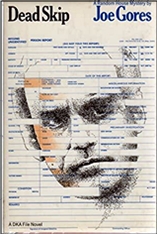
   While holding down a variety of jobs, one of them a stint as a San Francisco private investigator, Joe Gores published numerous (and generally hard-boiled) short stories in the 1950s and 1960s. One of these, “Sweet Vengeance” (Manhunt, July 1964) became the basis for his first novel, the violent suspense thriller, A Time of Predators (1969). Dead Skip is the first of three novels in the DKA File series (which also includes a dozen or so short stories) — a series Ellery Queen called “authentic as a fist in your face.”

   DKA stands for Daniel Kearny Associates, a San Francisco investigative firm modeled on the real agency for which Gores once worked. (It was Anthony Boucher who first suggested Gores utilize his Pl background as the basis for a fictional series.)
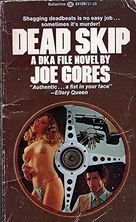
   DKA operates out of on old Victorian that used to be a specialty whorehouse, and specializes in the repossessing of cars whose owners have defaulted on loans from banks and automobile dealers. Kearny, the boss, is tough, uncompromising, but fair: his operatives, each of whom plays an important role in some if not all of the novels and stories. These include Larry Ballard (the nominal lead protagonist), Bart Heslip, Patrick Michael O’Bannon, Giselle Marc, and office manager Kathy Onoda.

   Dead Skip begins quietly enough, with Bart Heslip (who happens to be black) repossessing a car in San Francisco’s Richmond district and returning it to the DKA offices, where he files his report. But when he leaves he is struck down by an unknown assailant — and the following morning the other members of DKA arc confronted with the news that Bart is in a coma in a hospital intensive-care unit, the apparent victim of an accident in a repo’d Jaguar.

   Ban’s girlfriend, Corinne Jones, refuses to believe in the “accident” and convinces Ballard that Bart was the victim of violence. In spite of Kearny, who seems more concerned about the cost of the wrecked Jag than about Bart’s welfare (thus causing tension in the ranks), Ballard embarks on a search for Bart’s assailant and an explanation for the attack.
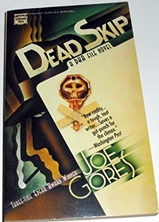
   Starting with the files on Bart’s recent repo jobs, he follows a twisting trail that takes him all over San Francisco and to the East Bay: involves him with a number of unusual characters, one of them a rock musician with a group calling itself Assault and Battery; and ends in a macabre confrontation that endangers not only Ballard’s life but that of Giselle Marc, in a house high above the former haven of the flower children, the Haight-Ashbury.

   The motivation for the attack on Bart is hardly new to crime fiction, and some of the villain’s other actions are likewise questionably motivated, but these minor flaws shouldn’t spoil anyone’s enjoyment of what is otherwise an excellent private-eye procedural. It is, in fact, strong stuff — realistic, powerful, “a traditional American crime novel, out of Black Mask, Hammett and Chandler” (New York Times).

   Even better are the other two novels in the series- — Final Notice (1973) and Gone, No Forwarding (1978).

———
   Reprinted with permission from 1001 Midnights, edited by Bill Pronzini & Marcia Muller and published by The Battered Silicon Dispatch Box, 2007.   Copyright © 1986, 2007 by the Pronzini-Muller Family Trust.

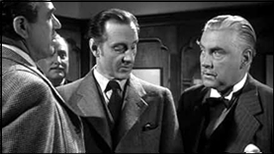
TERROR BY NIGHT. Universal Pictures, 1946. Basil Rathbone, Nigel Bruce, Alan Mowbray, Dennis Hoey, Renee Godfrey. Screenplay: Frank Gruber, based on characters created by Arthur Conan Doyle. Director: Roy William Neill.

   Sherlock Holmes is hired to guard the fabulous “Star of Rhodesia” diamond, being taken back to Scotland by train, but murder is committed under his nose instead. Dr. Watson tries his hand at investigating, in competition with Inspector Lestrade, to little avail.

   The first half of this movie is splendid – there is something about murder on a train to bring out the detective in anyone -– but the story falls apart when the perpetrator is identified with absolutely no detective work being done at all. Sheer frustration.

— Reprinted from Movie.File.2, April 1988.

JOHN BRUNNER – Double, Double. Ballantine, paperback original; 1st printing; January 1969.

   Although possibly based on a monster movie script that Brunner couldn’t peddle elsewhere (or hasn’t yet), this does have the benefit of that author’s deft characterization of stock situations and players.

   A rock group for the modern class spots the monster (see above) climbing from the sea. But of course their story is not believed. “High on LSD, no doubt!” Events soon prove them correct. Luckily there is also a marine research station in the immediate vicinity, and the nature of the beast is quickly discovered. Otherwise the monster(s) could have taken over the entire population, doubling as it goes.

   Brunner himself has to admit (page 203) that luck plays a large part in his plot, still enjoyable nonetheless. In a serious moment, consider: panic, or “the truth”?

Rating: ***½

— May 1969, slightly revised.

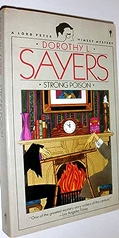
DOROTHY L. SAYERS – Strong Poison. Lord Peter Wimsey #5. Gollancz, UK, hardcover, 1930. Reprinted many times, including Perennial, paperback, 1987 (the edition read).

   In which Lord Peter Wimsey meets mystery writer Harriet Vane, under the most unusual circumstances for the beginning of a romance, for she is on trial, for murder, for killing her former lover, whom she lived with for nearly a year, without benefit of clergy.

   It’s a great start for a mystery story, and if it disappoints slightly in its outcome, it may be only natural. The puzzle, not as devious as it could be, eventually centers not on the actual murderer, but rather on how he managed to introduce arsenic into the victim’s system.

— Reprinted from Mystery.File.5, May 1988.

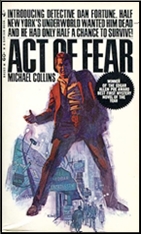
MICHAEL COLLINS – Act of Fear. Dan Fortune #1. Dodd Mead, hardcover, 1967. Bantam, paperback; 1st printing, April 1969. Playboy Press, paperback, 1980.

   Introducing PI Dan Fortune, the book being the winner of an Edgar by the MWA for Best First Novel. Partly autobiographical in nature, with Fortune’s own insights into people and the world. He has only one arm and wavers between the worst of society and those who at least live honestly and lawfully. Chelsea, the area of New York City to which he has returned, is not quite sure of him, for he has left them before. Fortune asks many questions of life, He also has some answers, so he keeps asking.

   Helping the friend of a boy who has disappeared puts the kid in more danger than before, and Fortune must intercede in a local mobster’s affairs to solve a couple of murders, Pressures from the boy’s miserable family matter less.

   Included are sad pictures of what people like and what they have to settle for,  The case is broken by the realization it is not what is true that matters, but what people think is true.

Rating: ****½

— May 1969 .

Next Page »