THE OUTLAW. RKO Radio Pictures, 1943. Jack Buetel, Jane Russell, Thomas Mitchell, Walter Huston. Directors: Howard Hughes, Howard Hawks (uncredited).

   A fanciful retelling of the legend of Billy the Kid, along with Pat Garrett, Doc Holliday, and a girl named Rio, I don’t know the entire story behind the making of the movie, nor the hype, but for 1943 (original release), it must have been a sizzler.

   Huston’s grizzled performance as Doc is superb, and while seemingly miscast, the shabby Tom Mitchell (as Garrett) has his moments as well. Beutel’s career went nowhere, but as Billy he is convincingly cunning, As for Jane Russell, I watched her every move.

— Reprinted from Movie.File.2, April 1988.
A 1001 MIDNIGHTS Review
by Toni Symons & Marcia Muller


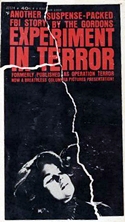
THE GORDONS – Operation Terror. Doubleday Crime Club, hardcover, 1961. Bantam #W2324, paperback, 1962, as Experiment in Terror.
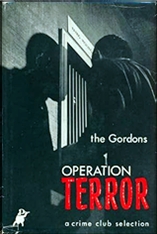
   The successful husband-and-wife team of Mildred and Gordon Gordon produced suspense fiction for almost forty years. Their books arc definitely formulaic, but they have the capacity to engage the reader’s full attention. An important clement in this formula is that of time running out: Something terrible is about to happen, and the hero must overcome seemingly insurmountable odds in order to save the situation.

   Of course the hero always succeeds, the situation is always saved, and the reader goes away thoroughly satisfied. All in all, reading such satisfying stories is not a bad way to spend one’s time — especially on a cold winter’s night when one would like a little manufactured terror.

   In the opening scene of this novel, Kelly Sherwood is accosted in her garage by a hoodlum intent on using her as an accomplice in robbing the bank where she works. Because she is young and has no next of kin but her sister, she is a likely victim. This man threatens death to her and her sister if she does not comply with his wishes, and he hurts her just enough to show that he means it. She is angry and frightened, but not too frightened to call the FBI.
   Next we meet Ripley of the FBI, and probably learn more than we’ll ever need (or hope) to know about him. And we also meet Toby Sherwood, the younger sister. She is a teenager, unpredictable and fresh, and full of life and fun and a sense of fairness. She also has an undying love for and loyalty to her older sister, who has raised her since their parents died some years ago. In the ensuing action, Kelly remains the bulwark of strength that past circumstances have forced her to be, Toby grows up, and Ripley — being Ripley — perseveres.

   This book is suspenseful, and has a rather well-thought-out plot and good (although in some cases overdone) character development. It is fast-paced, and even the villain has redeeming qualities.

   Operation Terror is a cut above other works by this collaborative team — finely crafted, with a realistic and contemporary setting. It was filmed in 1962 as Experiment in Terror, with a San Francisco setting and an ending that takes place during a Giants-Dodgers baseball game at Candlestick Park. Lee Remick and Glenn Ford had the starring roles, and Stefanie Powers portrayed the sister, but Ross Martin as an asthmatic villain steals the show.

———
   Reprinted with permission from 1001 Midnights, edited by Bill Pronzini & Marcia Muller and published by The Battered Silicon Dispatch Box, 2007.   Copyright © 1986, 2007 by the Pronzini-Muller Family Trust.

(

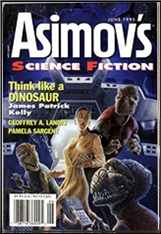
JAMES PATRICK KELLY “Think Like a Dinosaur.” First appeared in Asimov’s Science Fiction, June 1995. Reprinted in Year’s Best SF, edited by David G. Hartwell (Harper, paperback,1996) as well as other Best of Year anthologies. Collected in Think Like a Dinosaur and Other Stories (Golden Gryphon, hardcover, 2003). Nomintaed for both the Hugo and Nebula Awards for 1996.

   First things first. “The Cold Equations,” by writer Tom Godwin (Astounding SF, August 1954), is one of the most famous SF stories of all time. In it a young girl stows away on a space ship taking medicine to a planet that is in severe emergency mode without it. There is no margin for error on the ship, however, and the girl’s extra, unplanned for weight requires a horrible decision to be made: either the girl must be jettisoned from the ship, or the mission must be aborted.

   The choice made by the ship’s crew was immensely controversial, and while no longer no longer as discussed as it once was, the story and its aftermath is still considered one of  the great SFnal masterpieces of all time. (John W. Campbell, editor of the magazine, is said to have a great deal to do with the development of the story, and was frustrated with Godwin when he kept turning the story in with suggestions as to how to solve the problem.)

   In any case, I like to think of “Think Like a Dinosaur” as a companion tale. It is not exactly a sequel. There is no continuation of characters or location, only a common theme. It takes place in a research/relay station operated jointly by a human crew and a race evolved from dinosaur-like creatures. Live beings, presumably from both races, are sent to the far reached of space by disintegrating them and reconstructing them on far planets.

   But on one such attempt something goes wrong, and the girl on this side is still here, when she shouldn’t be, and a decision must be made. The dinos in charge say their way is the only way. The human staffer, more empathetic, thinks differently.

   It’s a good story, very well told, but whether it enjoys the awards it received, well, call me unconvinced. It’s a “been there, done that” sort of tale, and I can’t do better than leave it as that.

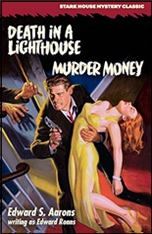
EDWARD RONNS – Murder Money. Phoenix Press, hardcover, 1938. Stark House Press, softcover, 2-in-1 edition with Death in a Lighthouse, 2025, under author’s real name Edward S. Aarons.

After a long and continuing career writing for the pulps, this is the author’s first published novel. It is also the first appearance of bespectacled Leo Storm, amateur dabbler in mysteries. (And also his last, in all likelihood.) The scene is Maine, and at stake are two sets of $250,00 in currency, plus an equal value in diamonds.

   This is the best Phoenix Press mystery I’ve ever read. which (given the relative ineptitude of the line) I hope is not an unfair statement. After the first couple of chapters (dreadful), it’s actually pretty good. Ronns (Edward S. Aarons) must have been reading his Hammett, because the ending is a smash-up corker.

— Reprinted from Mystery.File.5, May 1988, and slightly expanded upon.

TRACKER. CBS, “Klamath Falls.” CBS, 10 February 2024 (Season 1, Episode 1). Justin Hartley, Robin Weigert, Abby McEnany, Eric Graise, Fiona Rene. Based on the novel The Never Game by Jeffery Deaver. Director: Ken Olin.

Starring in this rather formulaic adventure series, now close to having finished three seasons, is Justin Hartley as Colter Shaw, a fellow who makes a living tracking down people and things for all kinds of reasons, with his own personal one being that he gets paid quite a bit of money for doing so.

I say “formulaic” because that’s all that’s to be seen in this, the first episode.

His task in this one, which I have now seen twice, is finding a young boy who’s assumed to having been kidnapped by his biological father, long estranged from his mother.  There’s more to the story than that, but the first time watching, the story line seemed all too thin for me, lost among all of the details of Shaw’s family, friends and previous life.

How these play out in the rest of the series I cannot tell you, but perhaps some of you who have been watching from the beginning can leave comments to tell us more.

If it were up to me to offer an opinion, I will say that I am surprised to see that it has survived three seasons, and leave it at that. No, not so. I will also tell you that I am considering watching another episode, and hope and trust that that particular good news will travel fast.

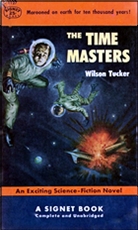
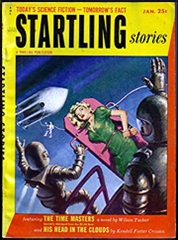
WILSON TUCKER – The Time Masters. Signet 1127, paperback; 1st printing thus, July 1954. Cover art by Jack Faragasso. Previously published in hardcover by Rinehart, 1953, and by Startling Stories, January 1954, probably in shorter form. Reprinted by Lancer Books, paperback, March 1972.

   For ten thousand years survivors of a wrecked alien spaceship wait for men to become capable of reaching the stars. At last a man and a woman confront each other at Oak Ridge, where scientists are readying the latest experimental rocket.

   That Gilbert Nash is/was the legendary Gilgamesh is fairly obvious, but the open hints he gives should make it clear to those investigating him as well, This is rather typical of the book’s standards, Scientific facts are outdated (as expected), but the rather poor ending is far-fetched,

   That the rocket is orbital rather than exploratory may be because of the scientific “secrecy” that Tucker emphasizes, yet it is entirely unbelievable that Carolyn did not know.

Rating: **

— May 1969.
A 1001 MIDNIGHTS Review
by Newell Dunlap.


CHARLES GOODRUM – Dewey Decimated. Crown, hardcover, 1977. Perennial, paperback, 1988. Nominated for 1978 Edgar Award, Best First Novel.

   For those who love both books and whodunits, this novel by Charles Goodrum should be required reading. It is the story of two murders, both committed and solved within the confines of Werner-Bok. one of the nation’s most famous libraries.

   Things were chaotic enough at Werner-Bok even before the murders — anonymous letters sent to the press had questioned the authenticity of two of the library’s rare manuscripts. But the murder of two staff members on top of this threatens to destroy the library’s reputation.

   Not that we know right away the two deaths are· murders (one is made to seem an accident, the other a suicide). But three people begin to suspect murder: Betty Creighton Jones, the public-relations officer; Ed George, a retired librarian and friend of Werner-Bok’ s director; and Steve Carson, a young researcher.

   These three amateur detectives join forces and go about hunting clues and questioning suspects. So we have a situation in which not only the sleuths and the murder victims, but all the suspects as well, are associated with the library.

   Goodrum, himself an eminent librarian, obviously knows the field as few others do. The library and rare-books information he gives us is interesting, although presented in great quantity for the sake of the information itself rather than advancing the story. But we do get caught up, along with the three amateur sleuths, in trying to puzzle out the murderer’s identity.

   Goodrum’s other novel is Carnage of the Realm (1979), which has a numismatic background.

         ———
   Reprinted with permission from 1001 Midnights, edited by Bill Pronzini & Marcia Muller and published by The Battered Silicon Dispatch Box, 2007.   Copyright © 1986, 2007 by the Pronzini-Muller Family Trust.
      

         The Edward George mystery series —

1. Dewey Decimated (1977)
2. Carnage of the Realm (1979)
3. The Best Cellar (1987)
4. A Slip of the Tong (1992)

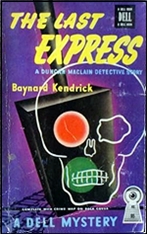
BAYNARD KENDRICK – The Last Express. Captain Duncan Maclain #1. Doubleday Crime Club, hardcover, 1937. Dell #95, mapback edition, 1945. Lancer, paperback, 1970.

   Although not Kendrick’s first book, this is the first adventure of Duncan Maclain. who is probably his most famous detective. and that largely because he is blind. What I’d never realized before is that Maclain is a private detective, not a policeman.

   There is also a germ of a decent story here, what with a dying message and a subterranean tour of New York City’s subway system, but it is so clumsily told it defies belief. What is obvious takes 50 pages to tell; inconsistencies are mostly ignored. Ptooie.

— Reprinted from Mystery.File.5, May 1988.

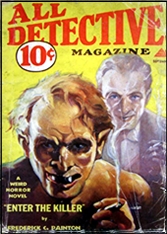
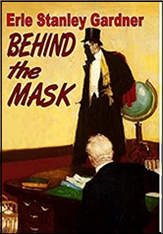
ERLE STANLEY GARDNER “Second Story Law.” Bob Crowder #1. First published in All Detective Magazine, September 1933. Collected in Behind the Mask (Pulpville Press, softcover, 2013).

   The story begins with a masked intruder making his way up a ladder and into the window of a room on the second floor of a large fancy manor house. Asleep in the room is a girl who does not immediately awaken, but soon enough she does – but her reaction is not what the masked intruder had obviously expected. She is cool and collected, asking him quietly what he is doing in her bedroom.

   Frustrated, he puts all but one object back – that being a silver-backed mirror, – and calls the police himself. He is a fellow by the name of Bob Crowder, and he has a plan. In the same house, a couple of nights before, the theft of much more valuable jewelry had taken place. The question is then, what is the connection and what is Crowder’s plan?

   In the early days of his writing career author Erle Stanley Gardner honed his writing craft by creating all kinds of heroes in hundreds of stories. A common theme is the kind of chap who solves a case by reading about it in the newspaper and figures out a way to cut himself in, and always in the most mysterious way possible.

   This is, of course, a prime example. We don’t learn a lot about out hero’s background – nothing, in fact – but then again what have we ever learned about the private life of Perry Mason? Not a lot, that’s for sure.

   No, throughout his writing career, Gardner never took his readers into details of his characters’ lives, even at the start. The story was the thing, and I can only imagine how much better this one probably was, compared to the other tales of the same issue it first appeared in.

   On the other hand, the skill set owned by Bob Crowder was admittedly rather limited, and Mr. Gardner had plenty of other characters to write about. The young adventurous Mr. Crowder appeared in only three other tales. You can find all four in the Behind the Mask collection.

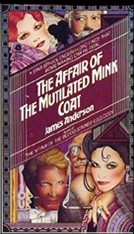
JAMES ANDERSON – The Affair of the Mutilated Mink Coat.Inspector Wilkins #2. Avon, paperback original; 1st printing, October 1981. Poisoned Pen Press, softcover, 1999

   A house party at Alderly, and all of the guests are either uninvited or there under false pretenses, or so it seems, and murder is inevitable. A classical 1930s British mystery with more dovetailed plot than anyone could hope for, all tied up with a witty twist.

   The humor is not forced, but understated, and is all the more obvious for it, Maybe the English do this best, The job done by a top detective called in from Scotland Yard, a great mind and s smug condescending man, is one not easily forgotten. A pure delight.

— Reprinted from Mystery.File.5, May 1988.

« Previous PageNext Page »