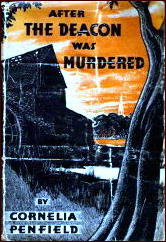
CORNELIA PENFIELD – After the Town Clerk Died. Typed manuscript with corrections made by hand. No date. Unpublished.
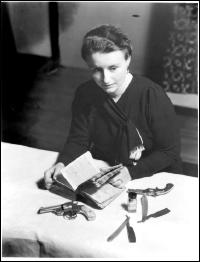
CORNELIA PENFIELD

Prologue: Cornelia Penfield was the author of two published works of detective fiction, both of which have recently been reviewed on this blog: After the Deacon Was Murdered and After the Widow Changed Her Mind. If you haven’t already, I’d recommend going back to read the earlier reviews (follow the links) before continuing:

   The Internet is wonderful. It’s terrific. It took only a few days to trace down the family of Mrs. Cornelia Penfield Lathrop. She died in 1938, and a son Robert died several years ago, but Marilyn Lathrop, Cornelia’s daughter-in-law, is still alive and well. She lives two towns over to the east of me, and I’m not sure exactly what she thought when she opened the letter I wrote her, asking if she indeed was who I thought she was. (No, I have that wrong. I wrote the letter to Robert Lathrop, as the telephone is in his name, and I wasn’t sure if it were Robert the son, still living, or perhaps Robert, a grandson.)

   In any case, she wrote back, saying yes, Cornelia was her mother-in law, and yes, she’d welcome a chance to talk to me on the phone. I called not too late the following evening, hoping to set up a time when we could talk longer. What happened instead was a conversation about Cornelia Penfield that lasted at least 30 minutes. I no longer remember whether I received the answer in the initial letter that she wrote me or in that conversation, but the question that I was simply itching to ask, given the first suitable opportunity, was “Do you know why the third book was never published?”

   What I didn’t expect, whenever it was that the question was asked, or at least not realistically, was the reply that manuscript still existed, and would I be interested in seeing it sometime? I think my mind went blank right about then, but you know what my reply had to have been.

   I went to see it, had a chance to have another lengthy conversation with Marilyn Lathrop and (which I never really anticipated) I was allowed to borrow it. I have kept it far too long. There were some extenuating circumstances, including a number of unexpected events that intervened and kept me from starting to read it, but I think the real reason I put off reading it for so long was that for me, it was a once-in-a-lifetime event, and I was simply relishing the anticipation much longer than I should have.

   As to the answer to the question as to why the book was rejected – and this is the family’s version of what happened – is that the publisher said it “wasn’t seamy enough.” When we get to the review proper, I’ll go into that, but later on Marilyn partially reconsidered, saying that perhaps “seamy” wasn’t the word that was used, but even if it wasn’t, it was close.

   What I didn’t realize right away, though, is that the title of the manuscript I have is NOT the title of the third book that was promised, and there is nothing in the story itself to suggest the title was changed, there being no doctor in the tale that I have.

   So there is a fourth novel, and it is still missing, and unless someone in the Lathrop family remembers something – a box or trunk never opened – we shall reluctantly have to assume that it no longer exists.

   It also seems possible that After the Town Clerk Died is a novel that was never sent to Putnam’s. It may have been that After What the Doctor Said was the one that was rejected, with the aforesaid comment attached, and that Town Clerk was abandoned before completion, almost but never quite finished.

   It is, I am sure, no longer possible to say. It is remarkable that the typed pages still exist. As a mystery, it needs some work. I’ve never tried to write a full-fledged detective novel, or even an unfledged one. Reading this, in what I’m going to continue to think of as being in the form of a rough first or second draft, gave me quite a bit of insight into the physical problems of doing so. Being sure that an event mentioned on page 233 (say) as having happened earlier on page 165, really occurred, for example, and that a clue discussed on page 198 (say) was mentioned and pointed out back on page 53.

   That’s what still needs some fixing, not a lot, and editors of detective story fiction deserve all the praise we can give them. (There are still a few of them, but not as many as before.)

   Jane Trimble, the semi-elderly genealogist who appeared in the two published books, also appears in this one, her primary focus being that of keeping her friend Gordon Burr from becoming a suspect in the death of a man in a suspicious fire. Burr is a writer who is not only having problems completing his latest book, but who is also having domestic troubles with his wife, and Jane cherishes them both.

   I don’t imagine retelling the plot in detail makes a lot of sense, as when is anyone else ever going to be able to read this as a work of detective fiction? I’ll retract a good deal of what I was going to say, and start painting things with a wider brush.

   But what I started to say still applies. Jane was hardly the detective of record in the first book at all, and it was something of a surprise to find that she appeared in the second. In the second one, Widow, she shared sleuthing duty with another character, but in this one, she is the primary detective, even to the extent that she is the one with a watchful eye out for trouble even before there is trouble to be had.

   And here lies a problem. It takes nearly 150 pages before the body of the dead man is discovered, and it takes a fairly talented mystery writer to keep the reader’s interest that long, with little or no “action” taking place. There are a lot of characters to identify, a lot of refined conversation to listen in on – this is suburban Connecticut, after all, and even in (say) 1935, the level or refinement was greater than many another part of the world.

   Once Jane’s detective activities begin in earnest, it is quite a complicated state of affairs the mystery finds itself in, and – here’s another problem – many of the clues happened or were discovered back in the earlier portion of the book when no one (but Jane) even suspected that they were clues. An alert reader might get glimpses of the essentials of the plot in its early going, but as the manuscript now stands, some strong rewriting seems to be very much necessary.

   There is a great to-do about who was where and saw what when, and even more about beards, false beards, who had one and who shaved one off and who hired someone to impersonate them who did or did not have a beard when he needed one. I may not have implied what I wanted to in that sentence. It is all very fascinating.

   Penfield’s great talent was in miniature characterization, burbling good humor, dialogue, and in the end, a kindly heart. The mystery, as in Widow, turns out to have been a minor affair, complicated by a myriad of factors, related and unrelated, but once again – with a sense of forgiveness for loose ends – it’s a charming affair that I’m glad to have had the pleasure to read. (By the way, the Town Clerk’s death is involved, but he died of natural causes, and his involvement comes only in a clever way, one that could have been known only by someone intimately involved with the problems of genealogical research, and as such, it may be a First. The entire series, in other words, and this one in particular, may be “One for the Books.”)

Postscript: I have debated for a while whether I should do this, and once again, since you’re reading this, you will know that the better argument won. Here’s a longish quote from pages 245-246, getting within a hundred pages from the end. It will give you a sense, I think, of Cornelia Penfield’s knowledge of the conventions of the mystery field, and how, as I’ve mentioned in the two previous reviews, how she liked to play around with them.

   Reviewing her evening with the Admiring Confidants, in the foggy dawn of a New York spring day, Jane felt she had not shone. How was it that fictional detectives made themselves the center of awestricken attention, summed up their findings in crisp dramatic sentences, and stated so authoritatively that the criminal must have done this and that as was clearly shown by these and those?

   How was it that invariably they enlisted the kindly and obsequious services of? (1) Scotland Yard (2) the Division of Investigation of the Department of Justice (3) the Police Department of the metropolis concerned – (Select (1), (2), or (3) giving reasons for choice and write in your own words a complete detailed description of methods employed by that organization.)

   By what magic did they also find various district attorneys, solicitors, barristers, photographers, experts in criminology and laboratory practice, reporters, butlers and valets to abet and assist the Super-Detective without wanting any reward beyond a kindly smile, who argued with him just sufficiently to point out his infallibility- and were content with being yes-men and filling about two hundred and ninety pages of escape literature?

   None of her own intense concentration and really intelligent work on the Dymchurch affair had to date earned her a darned thing — and might possibly, as Judge Whitaker had hinted, be bringing her activities suspiciously into the official limelight.

   However positive she might be that at least one of the theories so neatly worked out and counter-indexed in her notebook was a correct solution, just how was she going to submit the notebook to the Principal Official and secure his kind attention? After having, for reasons which at the time appeared to her sound, led him to believe her a romantic and muddleheaded moron?

   And coming down to her own friends from whom at least she had the right to expect some awed silent admiration, what had been their attitude?

   Merely a polite and passing interest in the least important phases of the whole affair – the beard and the altered entry – and in order to explain those she had had to battle against guppies and banal bunnies as conversational topics!

   Worse of all, Judge Whitaker upon whom she had relied for so much of encouragement and intelligent cooperation, had not only failed her utterly, but had expressed his opinion in tactful judicial terms that she was a Meddlesome Mattie, and had better let the state of Connecticut and the town of Dymchurch deal with their own affairs as they were so well equipped and prepared to do.

   â€œAh well,” said Jane, ringing the pantry service. “A bit of breakfast may chirk me up. I must hold to the thought that I am not a Super-Detective, but merely riding a hobby-horse I found grazing along the roadside: and that even so I am an unpretentious Jarrocks and not eligible to the Hunt Club: nor am I called upon to demonstrate haute école before a circus audience that thinks a balotade is probably an off-color French joke… But, all the same, if this sinister Langton person does do away with me and dispose of my body in a crematory way, won’t all the grown-ups be sorry and begin to appreciate the risk I am taking?”

   The pause-giving difficulty would be that she would not be around to hear the post-mortem regrets and to see Judge Whitaker turn her notebook pages with trembling fingers or to hear him say “Poor Jane! How little we appreciated all this clever work of hers!”

   She sipped her coffee and enjoyed one of the famous St. Crispin croissants and decided to live a while longer, Langton willing. Even though a few more deaths were needed to bring the Dymchurch quota up to a good Van Dine average.

   I’ve decided that if I’m going to do long quotes from the text, I ought to do it right. Here’s an earlier passage, from pages 35-38, in which Jane meets Don Wyckoff, a local attorney, who may or may not be representing either artist Jack Collins or his wife Julia in their upcoming divorce proceedings. As part of their conversation, some more light is shed on Jane’s detective proclivities:

   Wyckoff smiled diplomatically. “… But I can’t undertake to nurse Jack Collins all the time.”

   â€œAre you representing him or Julia in the oncoming action? Or doesn’t one ask?” Phyllis nibbled a cracker.

   â€œOne doesn’t – not at this moment.”

   â€œBut is Julia really going to carry it through, Don? I should almost think after all these years … tell the waitress no mayonnaise for me, please – just the diet dressing … I’m sorry, Don. Ethics always seem so silly among friends – professional ethics, I mean.”

   There was a slight frown on Wyckoff’s bland forehead and he addressed his next remark directly to Jane. “Judge Whitaker spoke of you as a triple A detective, Miss Trimble.”

   â€œI suppose he referred to the Gleason will case. That was simple genealogical research. Elementary.”

   â€œThe name is Wyckoff, not Watson. And I know an unfortunate lot about how much ability as well as research that sort of thing takes. Being myself mostly a digger-out of facts for others to profit by.”

   â€œOh, Don! Don’t be so ’umble. He’s in with the oldest, snootiest law firm in Tidewater, Jane – seven names and an ampersand on the door – and every one of the seven is a judge or a trustee or a receiver or something.”

   â€œExcept me and the ampersand. The only way I maintain my dignity out of office-boy hours is to keep a few clients of my own over here in Dymchurch.”

   He began to outline amusingly a case involving a farmer and his step-son. Phyllis listened with applauding phrases at the right moment. Jane divided her attention between the table in the alcove – as yet unclaimed – and his bland face and pleasant voice. She had rather a prejudice against young lawyers, so given as a rule to screening their uncertainties by bumptious pronouncements and bristling authority. Wyckoff was of another sort. He had an adaptable geniality that hinted of the politician – of experience in gaining the confidence of folk of all degrees. A tactful young man, she concluded, who had been about a bit, who was sure of himself but not irritatingly so, and who might will be exactly what her beloved old neighbor, Judge Whitaker had been in his green legal youth. The anecdote finished, he again referred to Jane’s detective experience.

   â€œIt’s been rather accidental and incidental,” she said. “If I ever tried real detecting, I’m afraid I’d be much more interested in a criminal’s heredity and background and other antecedents than in the crime and whodunit. In the long run, though, I suppose detection and genealogy require about the same amount of patience and imagination and experience – and luck – ”

   â€œThe ideal job of detection may,” laughed Wyckoff, “but the detectives I’ve met in real life depend principally upon a lack of delicacy and a certain flair for installing dictaphones, breaking down doors, and otherwise intruding on the private life of a sincere criminal. Not picturesque persons – and the less imagination the better. You ought to hear our local chief of police, Hal Flint, cuss out detective story detectives. So many of the young literary colonists scribble mystery novels and they keep looking Flint up and getting in his hair and asking him questions.”

   â€œAnd I suppose he replies in the same spirit as did the doctor whose dinner-partner wanted free medical advice and asked him what he did when he had a cold – he snorted at her and said ‘Same as everybody else ma’am. I cough and sneeze’ –”

   â€œExactly the way Flint feels. Routine and romance don’t team successfully. And what’s more, if your average detective has no imagination, your average criminal certainly has less. I’ve never met a master-mind, I never hope to see one – but if I do, I’ll call you in, Miss Trimble. I promise.”

   â€œThank you,” said Jane solemnly. “I’ll endeavor to cope genealogically.”

   One more quote. I hope I’m not overdoing this, but I’d like to demonstrate what I mentioned earlier about Cornelia Penfield’s knack for dialogue. Jane is talking to Mrs. Turner, the cook in the Burrs’ household. Her husband Jim is the Burr’s handyman, and Beulah is their daughter, whom they’ve been concerned about. Either I’m right, or I’m hopelessly wrong, but I think this is the way people actually talk, instead of in neat diagrammable sentences. From pages 76-77:

   â€œPerhaps I can give Mrs. Burr a few hints when she comes back,” concluded Jane. “She hasn’t, I know, the faintest idea of making it hard for you.”

   â€œI know she hasn’t. That’s why I’ve kep’ my mouth shut and tried to do my best. Of course I never thought I’d get to do housework for other folks, but we couldn’t have it nicer than we have here, with our own little house an’ all. And after stretchin’ an’ strainin’ so many years, it’s a real rest to spend somebody else’s money for a change … not but what I don’t try to manage just as close ’sif it was my own” – added Mrs. Turner conscientiously, “But Mr. and Mrs. Burr, they’ve never had to count every cent twice, and they both do like good victuals … if we only had Beulah back and Jim didn’t get upset so easy–”

   â€œAbout her?”

   â€œYes. That’s the whole trouble. Jim kep’ straight ’s string till she went off t’ New York, but people ’round here don’t give him credit for that. An’ I was hopin’ maybe if she did come home–” Mrs. Turner’s tight lip quivered – “You see, Miss Trimble, we lived out of Branford on a farm of our own when we was first married, and all the time Beulah was growin’ up we had all our own things nice. Then the bank closed in New Haven where we had our money, and the other bank foreclosed on a moggidge Jim had taken out to buy some more proputty with, and it was before they started the Home-Owners’ Loan or anything and we couldn’t beg or borrow a cent – so we lost our place and had to sell our furniture for what it’d bring – I had real nice walnut suites that had b’longed to my folks – and the best we could do was try to live with Jim’s step-uncle over Redding-way, but he’d never liked Jim – and his second wife didn’t get along with Beulah an’ we all had it pretty hard till Beulah took a notion to take her high-school cookin’ and so on seriously and get herself a job waitin’ on tables at the Tavern. She did real well with tips an’ all an’ then she found out there’d be this place for us all so we decided we’druther be independent an’ work for pay than keep on where we were … Only with Beulah gone and no relyin’ on Jim no more, I guess the Burrs is about ready to make a change. And if we haveta leave here, Jim’ll just get from bad to worse.”


In conclusion: Thanks again to Marilyn Lathrop for allowing me the use of the manuscript, and for the conversations we have had concerning her husband’s mother. Since Marilyn never knew her mother-in-law, her own knowledge is based on what Robert and other members of the family have told her over the years. Cornelia’s daughter Helen Harriet Petty is still living. She is in her late 80s, and the memories she has of her mother have been conveyed to me through Marilyn. A nephew, Fred Lathrop, is also still alive, and he has assisted me in proofreading the reviews and commentary above. He remembers her only as a young boy, recalling for the most part the years toward her death, when she was often bedridden with tuberculosis.

   My impression of Cornelia Lathrop, through these conversations, was that she was a very progressive woman, ahead of her time in many ways. Similar in nature, I believe, to Eleanor Roosevelt, a lady whom Cornelia is said to have met. Not many women in the 1920s, for example, would take her three children to live in France for well over a year without her husband, who stayed home working.

   She was always interested in the arts. Besides her brief involvement with Broadway, previously mentioned, in the mid-30s she also wrote several articles for Stage Magazine, including five in a 1936 series on famous Hollywood directors.

   The photo you see at the top of this article/review is a publicity shot taken by her mystery publisher, G. P. Putnam. It’s nice to be able to display it again.
— February 2004

REVIEWED BY MICHAEL SHONK:


BARBARY COAST. TV movie/pilot. ABC – Paramount, 4 May 1975. Created, Written and Produced by Douglas Heyes. Directed by Bill Bixby. Cast: William Shatner as Jeff Cable, Dennis Cole as Cash Conover, Richard Kiel as Moose Moran, Lynda Day George as Clio Du Bois, John Vernon as Robin Templar, Bobbie Jordan as Flame, Charles Aidman as Lt. Tully, Leo V. Gordon as Chief Keogh, Neville Brand as Florrie Roscoe, and Michael Ansara as Diamond Jack Bassiter.

   While the premise owed much to THE WILD WILD WEST, and the story was predictable, this Western Action TV Movie was entertaining in ways only 70s escapism nonsense could be.

   The opening credits visually established the setting and premise quickly and with near perfection. Barbary Coast was a lawless area of San Francisco, filled with saloons, mud thick streets, women who would seduce you out of your money, dancing girls who could knock you out with a kick if you got too close, cops on the take, people demanding justice even if it meant vigilante justice, and places where if you entered you would wake up on a boat to Shanghai China.

   Yet the mood of the opening was as upbeat as the music and the unsuspecting victims determined to have fun, such as the drunk who got tossed out of saloon after saloon but remained determined to find another place to drink.

   The Governor of California had sent undercover cop Jeff Cable in to investigate the Barbary Coast and recommend how to clean the place up. Jeff couldn’t resist taking on the corruption by himself, with some help from a few reluctant friends, chiefly Cash Conover, owner of the city’s most successful and honest casino, The Golden Gate.

   Captain Keogh and nearly all the local police were in the pocket of the local criminals. That is except honest Police Lieutenant Tully. While Moose Moran, the Golden Gate’s barker and bouncer assisted Cash and Jeff, others at the place apparently were not aware of Jeff’s activities and connection to Cash. Thumbs (Dave Turner), the piano player who would join the team in the series, was just a background character in this TV Movie.

   West Point graduate Jeff Cable had worked undercover for President Grant to help bring down the Ku Klux Klan in the south. Now Jeff learns some of the former members have arrived at the Barbary Coast to set up a group called the Crusaders.

   Crusaders’ leader, lawyer Robin Templar encourages a shootout in Cash’s Golden Gate, and then begins to collect donations from the “good people” of San Francisco demanding justice.

   Meanwhile, a down on her luck French aristocrat, ineptly portrayed by Lynda Day George, finds her dream of marrying a rich man’s son shattered when the young man is killed in the shootout. She brings trouble to unsuspecting Cash who helps her find a place to stay and work.

   Jeff Cable is the perfect role for William Shatner. The character’s love of disguises made hamminess an appropriate character trait. Shatner gives a surprisingly good performance giving each character he played a life of its own.

   Dennis Cole was as bland as usual. Yet he was convincing enough as Cash the superstitious gambler with a past. Cash had killed the son of the Louisiana Governor in a duel. Jeff knows this and threatens Cash to turn him over to the Louisiana authorities unless Cash helps him fight the crooks.

   Douglas Heyes (BEARCATS!) created, wrote and produced this TV Movie pilot. A favorite of Roy Huggins (MAVERICK) since their days working on CHEYENNE, Heyes used his experience writing for such series as MAVERICK and ALIAS SMITH AND JONES to recreate a similar light dramatic tone for the TV Movie.

   The production levels were high as Paramount turned their back lot into the Barbary Coast. The Golden Gate interiors were lush and included the casino, Conover’s upstairs office and bedroom, and Jeff’s secret lair hiding behind a secret door/fireplace worked by the hands of a clock. Extras filled the Golden Gate and half a dozen dancing girls danced and high kicked endlessly on stage.

   Art Director Jack F. DeShields and set decorator Reg Allen were deservedly nominated for an Emmy for Outstanding Art Direction or Scenic Design in a Dramatic Special or Feature Length Film Made For TV (they lost to ABC Theatre’s ELEANOR & FRANKLIN).

   Music for the TV Movie was by John Andrew Tartaglia. At times the background music brought back memories of the superior TV Western ALIAS SMITH & JONES. That was not surprising considering John Andrew Tartaglia also did music for that series.

   In the May 5, 1975 issue of “Broadcasting,” ABC had decided to add a Western to their upcoming Fall schedule in the Monday at 8pm time slot in front of MONDAY NIGHT FOOTBALL. There were three pilots up for the spot, Paramount’s BARBARY COAST, Universal’s BRIDGER and MGM’s HOW THE WEST WAS WON.

   BRIDGER starred James Wainwright and would air on ABC September 10, 1976. HOW THE WEST WAS WON starred James Arness aired January 19.1976 under the title THE MACAHANS. This lead to the HOW THE WEST WAS WON mini-series in 1977 and a weekly series in 1978 and 1979.

   By the next issue of “Broadcasting” (5/12/75), BARBARY COAST, called for a short time CASH AND CABLE, had made the Fall 1975-76 schedule.

NEXT: A LOOK AT BARBARY COAST THE WEEKLY SERIES AND WHAT WENT WRONG.

REVIEWED BY GEOFF BRADLEY:         


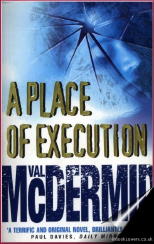
VAL McDERMID – A Place of Execution. Collins, UK, hardcover, 1999; paperback, 2000. St. Martin’s, US, hardcover, 2000; paperback, 2001.

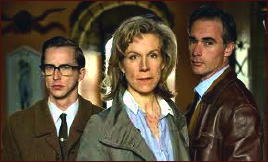
A PLACE OF EXECUTION. ITV, UK; 3 x 60m episodes: 22 Sept, 29 Sept, 6 Oct 2008. PBS, US, November 1 & 8, 2009. Lee Ingleby, Emma Cunniffe, Philip Jackson, Juliet Stevenson, Elizabeth Day, Tony Maudsley, Greg Wise, Poppy Goodburn, Mikey North, Danny Tennant. Based on the novel by Val McDermid. Director: Daniel Percival.

VAL McDERMID A Place of Execution

   In 1963, when the Manchester police are investigating the first disappearances caused by the real-life Ian Brady and Myra Hindley, a 13-year-old girl goes missing from her small isolated Derbyshire village.

   On hand when the call comes in is Detective Inspector George Martin, a man fast-tracked for promotion under the new graduate recruitment scheme. He becomes rather obsessed with the search for the missing girl, coordinating unsuccessful searches and then reacting with diligence when evidence starts to filter in slowly over the next few weeks.

   When an arrest is made, we follow the accumulation of evidence and then the formality of the trial and verdict. This takes us through almost 400 of the 550 pages in the paperback that I read.

   We then forward to the present day (or, at least, to 1998, when the book was written) and the story of Catherine Heathcote, a journalist who has taken time off to write a book about the about the case, co-operating with the now retired George Martin. With the book nearly finished, she receives a letter from him saying that he was withdrawing from the project ad insisting that she abandon it.

   Catherine now has to investigate the reasons why and this takes up the final part of the book.

   This is a very slow paced but enjoyable and rewarding book (after 200 pages very little has happened but I was enthralled and still reading enthusiastically).

   However I have to say that it was very well written and I thoroughly enjoyed the reading of it. (It was short-listed for the Gold Dagger in 1999 and the Edgar in 2001, and won the Anthony and Macavity Awards for that year.)

   I delayed watching the television adaptation of the novel (three one-hour parts, less adverts) because I wanted to read the book first. (It’s an awful dilemma because, as you all know, you gain the knowledge from one which can dilute the pleasure of the other, no matter which you experience – unless of course you leave a small gap, a few weeks seems to sufficient nowadays for me, in which case all knowledge of the original will be forgotten.)

VAL McDERMID A Place of Execution

   This is a superior production and one I would recommend. Some changes are made to the original. The journalist is now preparing a television piece (which gives her people to speak to: a televisual necessity since thoughts are difficult to get across) and is given a difficult teenage daughter with which to contend. Also many of the characters of the book are jettisoned and the action is streamlined (again necessary or the production would last much longer than the allotted 2½ hours or so).

   The switch between the 1963 scenes and the present day is well handled and well cast with corresponding actors chosen to portray the same actors in the differing eras.

   The coincidence I complained of in the book is eliminated but, unfortunately, another much more unacceptable coincidence is added to close the production. This is not enough to ruin what is an enjoyable adaptation, but it would have been better if it not been added.

CORNELIA PENFIELD – After the Widow Changed Her Mind. G. P. Putnam’s Sons; hardcover, 1933.

   Although she’s not the detective of record in either volume, Miss Jane Trimble of the author’s previous book, After the Deacon Was Murdered (reviewed here ) makes a return appearance in this one. (Since she was not designated as a Series Character in Al Hubin’s Crime Fiction IV, I immediately relayed this information on to him, which was gracefully accepted, as always.)

   Two other minor characters have equally minor (but nonetheless significant) roles in this one as well: Judge Whitaker and the unsavory reporter named Parsons. But with the lack of any other detective by designation in this one, Miss Trimble seems to play the role as sleuth as well as anyone else, along with her co-worker on the dead man’s proposed biography, a young college graduate and presently out-of-work advertising copywriter named Anne Exeter.

   It is Mrs. Prelton’s idea for the biography, coming five years after her husband’s mysterious death, but who has put her up to it, no one knows. Everyone who was at the gathering at Skyetower that evening then has been invited back, and no one dares refuse the widow’s change of heart – she had closed the mansion and had all but never mentioned the her husband’s name again.

   The backgrounds of all of the guests – many of whom have fallen on hard times in the meantime – are interwoven and tangled together in intricate fashion, and much of the delightful first half of the book is spent in unraveling the various threads of their lives. It is a Christie novel that the author is attempting, but with a homespun and not-so-prim New England sense of humor mixed abundantly in.

   A stuffed dog with a collar studded with diamonds also figures prominently in the early going – it seems to have been the basis for a smuggling scheme that the some of the people in the widow’s life (including a European prince from some small outpost overseas) have been involved in.

   From page 109:

    “You’ll excuse me, Prince, but I was reminded — did ye ever hear the story of the Englishman visitin’ here in this country who saw the little red bug?”

    “I fear I have not.”

    “Well, it was this way. This Englishman, he says ‘What’s that?’ says he. ”Tis a ladybug,’ says his American friend. The Londoner squints through his monocle like this and takes a closer look and then he turns and says, ‘Me word — how observant you Americans are!’ Haw-haw-haw!”

    The prince smiled with puzzled politeness and turned again to speak with Mrs. Prelton.

   The dead man, as it not very surprisingly turns out to be the case, did not have many friends, no matter how many guests were on hand during the fateful evening, and one gets one’s hopes up that this will really be a jewel of a mystery, or at least I did.

   But the ending is disappointing, wrapped up in much too quick fashion, with yards and yards of explanation to go with it, and yet not enough to explain why Jane’s drive over the mountain to look up some records on page 276 was exactly the right place for her to go, and at the right time, to get to the bottom of the mystery.

   Then again, a genealogist has to go where the records are, and if coincidentally it all connects with the matter of Mr. Prelton’s fatal fall from a window, then why not accept good fortune when it comes along?

   As in her first book, Cornelia Penfield also continues to play with the conventions of the general novel as well as the detective story itself. For the latter, read the last page. For the former, I’ll leave you with this from page 258, where Anne is talking to a young man she happens to be fond of:

    “Because I know what happens at house parties when an attractive young bachelor is found in a woman’s room alone — with another woman.”

    Anne stooped to sniff a yellow rose. Then she looked pleasantly up at him. “Really? What?”

    “A row of asterisks! I know!”

    “You’ve been around a lot, haven’t you, John? But you haven’t caught up on your prescribed reading. Modern authors don’t use asterisks. They Leave Nothing to the Imagination!”


PostScript.   Cornelia Penfield Lathrop was born in 1892 and died in 1938, five years after the two detective novels she wrote came out. From google.com I discovered that she was the producer of a Broadway play in 1923, and that she was very much someone was interested in local Connecticut history, if not genealogy herself. In 1930, for example, she was the author of work of non-fiction entitled Black Rock, the Seaport of Old Fairfield, Connecticut, 1644-1870. No copies are available on abebooks.com, but most every library of a certain size in the state seems to have a copy.

   But what’s most intriguing is the statement that appears opposite the title page of this second mystery, to the effect that “In Preparation” was her third, After What the Doctor Said. If your brain doesn’t start tingling like mine did, then maybe you’re reading the wrong blog. You have to wonder how far along the unpublished manuscript got, why it never got finished, or if finished, then why it was never published. My assignment for next time, then, is to investigate, find out more, and report back with everything I’ve learned.

— February 2004

REVIEWED BY MICHAEL SHONK:


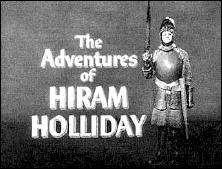
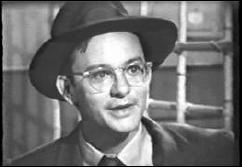
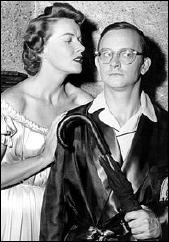
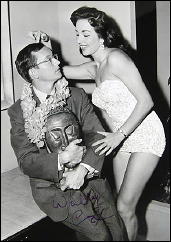
THE ADVENTURES OF HIRAM HOLLIDAY. California National Presentations, filmed for NBC, 1956-57. Based on the stories by Paul Gallico. Cast: Wally Cox as Hiram Holliday and Ainslie Pryor as Joel Smith. Produced by Philip Rapp.

THE ADVENTURES OF HIMAN HOLLIDAY

    The Adventures of Hiram Holliday is an amusing action spoof. The plots leaned to the absurd such as when Hiram stopped some foreign spies from turning Pearl Harbor to ice (“Hawaiian Humzah”). The humor was gentle and often based on misunderstanding or the odd image of Wally Cox as an action hero to rival Errol Flynn.

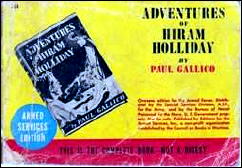
   The screen credit and announcer tells us the series was “based on stories by Paul Gallico.” Which is odd since The Adventures of Hiram Holliday was published as a book in 1939. More confusing is Billboard (May 12, 1956), reported the TV series was based on stories from the Saturday Evening Post. Paul Gallico was writing stories for that magazine during the fifties, so perhaps Hiram appeared as a serial in the Saturday Evening Post.

   Hiram Holliday was the copy editor for the newspaper New York Chronicle. Hiram catches an error that could have bankrupted the paper in libel charges. The grateful publisher Harrison Prentice sends Hiram on a trip around the world accompanied by reporter Joel Smith. On the way Hiram and Joel share one strange adventure after another with Hiram always the hero in the end and Joel failing for one reason or another to get the story published.

THE ADVENTURES OF HIMAN HOLLIDAY

   Wally Cox carried the show with his ability to make the absurd character of Hiram believable. It is Cox that makes the series funny and worth watching. He underplays the character, reacting to danger with a confident calmness. In one episode Hiram enters his room to find the femme fatale waiting for him. The room had been trashed and thoroughly searched. She tells Hiram she had been waiting for him. Hiram looked around and calmly replied he was glad she found something to do while waiting.

   The rest of the cast were limited by one-note characters of dubious logic and were played by actors of various talents, from Sebastian Cabot to Thor Johnson (aka Tor Johnson). Publisher Prentice (Thurston Hall) existed to scream at Joel. The mastermind would make mistake after mistake while blaming it all on his henchman or femme fatale. The femme fatales existed to seduce Hiram.

THE ADVENTURES OF HIMAN HOLLIDAY

   Each episode would begin with Hiram and Joel entering a new country. Hiram’s interest was always in scientific and academic challenges. In Hawaii, he wanted to visit a Professor to study a lost consonant of the language. In Hong Kong, Hiram’s quest was for the rare sea cucumber.

   Quickly, Hiram would stumble into an adventure while Joel was usually off somewhere eating. For reasons unexplained the misused laugh track thought Joel eating was hilarious, making it a bad running gag.

   Villains arrive, usually made up of a mastermind, femme fatale, and a henchman. Through comedic misunderstanding the bad guys believe they have to get rid of Hiram. Hiram innocence and complete honesty is disbelieved and he has to turn into an action hero, from fighting atop a speeding train to performing some feat such as a carnival high dive act that he had never done before but had read about.

   Ainslie Pryor failed to rise over the thankless role of Hiram’s traveling companion and best friend, Joel Smith who at times broke the fourth wall to talk to us. It was a difficult role. His character spent much of the time clueless and existed for Hiram to rescue or to take the brunt of the blame from the authorities for many of the misunderstanding that revolved around Hiram. In “Wrong Rembrandt.” Hiram had painted such a perfect copy of a Rembrandt the French police arrested Joel for art theft.

THE ADVENTURES OF HIMAN HOLLIDAY

   Production values were fine considering the era. Philip Rapp produced the series and wrote and directed many of the episodes. The show was funny but after a few episodes the situations became repetitive and the humor grew tired. How often can you laugh at Hiram winning swordfights with his umbrella?

   The series followed Wally Cox’s successful turn as Mr.Peepers. But that success didn’t carry over to Hiram Holliday. General Foods was the sponsor of The Adventures of Hiram Holliday and quickly regretted it.

    Hiram Holliday premiered October 3, 1956 on Wednesday at 8-8:30pm (Eastern). In Billboard (October 13,1956), according to rating service Trendex, NBC’s Hiram received a 11.4 compared to ABC’s Disneyland with 19.2 and CBS’s >Arthur Godfrey Show with 14.2.

THE ADVENTURES OF HIMAN HOLLIDAY

   Billboard (January 1, 1956) discussed some of the TV series in trouble. Shows the sponsors were unhappy with but had given a 26 episodes or 52 episodes commitment. This included General Food and Adventures of Hiram Holliday.

   January 28, 1957 issue of Broadcasting reported, “General Foods, N.Y. will drop its sponsorship of Hiram Holiday (sic) on NBC-TV, Wed. 8-8:30pm, and will become instead the alternate week sponsor of Wells Fargo (Monday, 8:30-9pm) effective March 18th.”

   On February 27, 1957, the twentieth episode of the series to air was the last on NBC. Reportedly, three more episodes were showed in England during syndication, leaving 23 episodes apparently filmed.

   Various episodes of the Adventures of Hiram Holliday are available on low budget DVD.

   And on You Tube, at the moment, is the episode, “Moroccan Hawk Moth.”

REVIEWED BY DAN STUMPF:


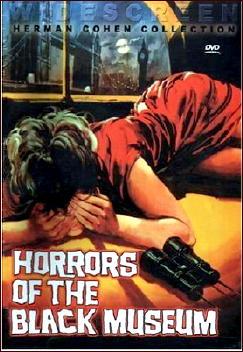
HORRORS OF THE BLACK MUSEUM

HORRORS OF THE BLACK MUSEUM. American-International Pictures, 1959. Michael Gough, June Cunningham, Graham Curnow, Shirley Anne Field, Geoffrey Keen, Gerald Anderson, John Warwick. Director: Arthur Crabtree.

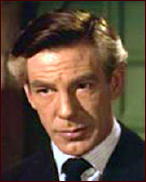
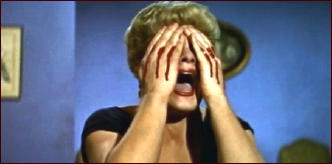
    Horrors of the Black Museum is a gaudy comic book of a movie, best enjoyed if you park your good taste and critical faculties with the gum under your seat. The story, by Herman Cohen and Aben Kandel (the team that brought us such classics as I Was a Teenage Werewolf, I Was a Teenage Frankenstein and Berserk) posits that a best-selling True Crime writer (Michael Gough, masticating the scenery with sadistic relish) gets his insights by committing the crimes himself — or having them committed by a young assistant in hypnotic thrall to him.

HORRORS OF THE BLACK MUSEUM

    The murders themselves are fairly grisly, including the opening bit (featured in all the previews) with a pair of booby-trapped binoculars, and are all practiced against lissome young ladies, but they have the redeeming value of being so far over the top (like Gough’s acting) as to provoke the odd chuckle.

    At one point, for instance, we are asked to believe that the killer snuck into a woman’s apartment and built a guillotine over her bed which she doesn’t see until she lies down in just the right position for it to — well you get the idea. Even better is Gough’s sanctum sanctorum, filled with acid vats, S/M apparatus and some sort of machine mounted with dials, lights and levers that seems to serve no function at all.

    Okay, admittedly the writing is perfunctory, and the acting mostly capable but undistinguished. There’s also some fairly prominent homophobia running through all this, what with the tastefully appointed bad guy keeping his handsome young assistant enslaved so they can victimize women. But I found Horrors suffused with a redeeming energy and engaging carelessness that kept me entertained throughout.

HORRORS OF THE BLACK MUSEUM

THE BACKWARD REVIEWER
William F. Deeck


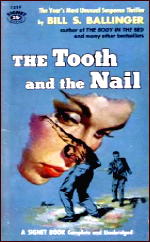
BILL S. BALLINGER The Tooth and the Nail

BILL S. BALLINGER – The Tooth and the Nail. Harper, hardcover, 1955. Signet #1319, 1956; cover by Robert Maguire.

   A damsel in mild distress captures the attention of Lew Mountain, professional magician, and he comes gallantly to her rescue. She arrives in New York with a hatbox, an exceptionally heavy small satchel, and no dollar to pay the cab driver. Soon she joins Mountain’s act and marries him.

   Inevitably, given the folly of the female in distress, tragedy ensues. Mountain then — and I give away nothing here, repeating only what the author says in the prologue — avenges murder, commits murder, and is murdered in the attempt.

   While I can’t wax as enthusiastic as some reviewers have over this novel, it definitely is an enjoyable reading experience.

— From The MYSTERY FANcier, Vol. 13, No. 4, Fall 1992.


J. ALLAN DUNN The Girl of Ghost Mountain

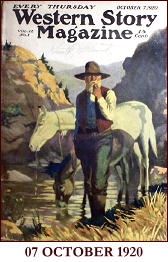
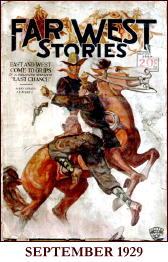
J. ALLAN DUNN – The Girl of Ghost Mountain. Small Maynard Co., hardcover, 1921. Serialized in Western Story Magazine in four parts, beginning with the 16 September 1920 issue; reprinted (I believe) as “The Ghost Mountain Girl” in Far West Stories, beginning with the July 1929 issue. Also currently available in various POD and ebook/online versions.

   Although I’ve billed this as a western novel in the heading for this review, The Girl of Ghost Mountain is much more a romance novel that takes place in the West. The date is never quite specified, but at the time it was written, it had to be the contemporaneous West.

   Prohibition is mentioned, for example, and the occasional automobile shows up or is made reference to. But there are plenty of cattle and horses too, so don’t be at all concerned in that regard. It’s still the West, although perhaps not the Frontier West.

J. ALLAN DUNN The Girl of Ghost Mountain

   Pete Sheridan is the new owner of the Circle S ranch, fresh from the east but acclimating to the west in fine fashion, while “Red” Jackson is his right hand man. They make a good team together, facing down bad guys with precision and aplomb, but they’re no match at all to the charms of the two ladies (one slimsy, the other near Amazonian) who settle in a hidden valley behind a waterfall up in the foothills of Ghost Mountain.

   The first two thirds of the book is the more interesting, as Red and Sherdian settle the hash of the main villain, a fellow named Hollister, an evil one through and through. Once he’s been vanquished and for good, with another 90 pages still to go, a stoic and enigmatic Chinese gentleman who’s been serving as their cook leads the pair to a cache of hidden gold.

   The path is not without its perils, but they are all easily overcome, as we (the reader) know at once will happen, including the prospects in the end (without giving anything at all away, I’m sure) of a double wedding soon in the offing.

   All things considered, while I enjoyed reading this one, something that kept niggling my mind is that a story entitled “The Ghost of Girl Mountain” might have had even greater possibilities, even though it’s obviously not the one Dunn intended. Sit back and think about it.

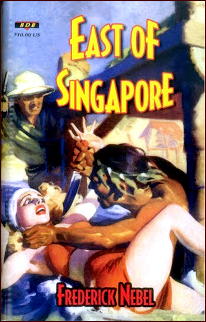
FREDERICK NEBEL – East of Singapore. Black Dog Books, chapbook, 2004. First published in Action Stories, July 1926, under the title “Somewhere East of Singapore.”

FREDERICK NEBEL East of Singapore

   Back before Tom Roberts and his associates at Black Dog Books were publishing their current array of perfect-bound paperbacks – all of which if you are a pulp fiction fan of all forms and varieties, I highly recommend to you – they produced a short series of tall saddle-stapled chapbooks, of which this is one.

   I don’t know what the print run might have been for these early examples of their production art, but I imagine it was small. The number of pulp collectors who might have purchased this particular one, to pick a prime example, is not very large, and I suspect that those who did buy one have kept them. At any rate, when I checked yesterday, there was not a single copy being offered for sale on the Internet.

   The original price was $10, and perhaps back in 2004, that was relatively steep for a 68 page paperback. Still, considering how long it would take you to find a copy of Action Stories from any month in 1926, and how much you’d probably have to fork over for it, the ten bucks outlay might seem OK after all.

   And if you were to get your hands on one, what then? You may ask. A mixed bag, if you were to ask me. Nebel’s prose is clear and descriptive and often a joy too read. Picking the book open and choosing a passage (from page 5, taking place in the streets of Singapore):

   Berk chuckled. He left the sailor quarter behind and soon found himself on the wide street of the bazaars – squat, solid buildings with the upper stories extending over the walk and forming a continuous shed. And red lanterns, and grotesque Chinese inscriptions in black on flaming red paper. Spicy odors of food from a restaurant reminded Berk that he was hungry. But he was broke, and so…

   And from page 28, as Jack Berk and his companion Marty Young, white men both, and young and daring, make their way through the Borneo jungle, searching for a treasure lode of buried jewels, on behalf of a beautiful girl:

   Yes, the outlaw Kyan band was slinking through the undergrowth in search of human heads. Ten in all, led by a ferocious fellow who wore pheasant feathers in his hair, a breech clout of bark-cloth and a sleeveless, vest-like garment of leopard’s skin. He was grotesquely tattooed and wore a string of boar’s teeth around his neck. His oblong shield was trimmed with tufts of human hair. He carried a spear with a beaten metal point and also a sampitan, or blow-pipe.

   That I mentioned that Berk and Young are white is important. The natives are “heathen rascals” (page 9) and from page 12: “A reckless disregard of odds has ever been the bright badge of those white men who have ventured among strange peoples and lifted the white man head and shoulders above his duskier brothers.”

   Please don’t forget that this was written in 1926. Fiction can often tell us more about ourselves than any history book ever could. The real flaw in this story is that it is all action, the outcome is foreordained from the beginning, and the final few chapters can be skimmed through with no fear of missing anything important. But if fast and furious jungle action is your wish, along with immersing yourself in the allure of the mysterious Far East, then this adventure caper has both, and in depth.

CORNELIA PENFIELD – After the Deacon Was Murdered. G. P. Putnam’s Sons; hardcover, 1933.

CORNELIA PENFIELD After the Deacon Was Murdered

   After the Deacon Was Murdered is the first of two mysteries written by this little known Connecticut author, and as such, is it (you may be wondering) forgotten gem? An honest answer has to be, “Almost, but not quite.” Forgotten, it is true, but while it has some weaknesses (and one near-fatal one), there are some very good moments to be found by plunging right in as well.

   Finding the murder victim, Jarius Hanford, in the small town of Deptford Center (near New Haven) is Geoffrey Hamilton, who is not vacationing there, but rather recovering from a nervous breakdown suffered the previous fall.

   Dashing down to the town center to report his discovery, the only person in the Town Hall is Jane Trimble, a genealogist by profession, working over some old records. The dead man is her uncle, but she receives the news with a surprising lack of distress. From page 7: “I’m not the least bit hysterical and I live among too many vital statistics to be easily upset by one more or less.”

   Nor is Miss Trimble the only interesting person in town. There is Grandpa Banks: “…eighty-five my next birthday, but sound as a dollar. Yessir!” As well as Judge Whitaker: “… without whom no one, it seemed, could take any initiative in the village,” Hamilton despairs to himself, amidst “the general footlessness of the whole conduct of the case!” And then Jane’s negro butler, Cæsar, who when asked if had heard of the deacon’s death, replies: “Yas’m. No’m. Why, the po’ old man. Howcome yo’ ask me about it, Miss Janey?”

   The investigation expands beyond the townspeople and the village folk, however. There is a gang of organized criminals working in the area — one of them is Big Slim Blivinsky — plus a fugitive from a mental institution, and a misguided newspaper reporter named Parsons who gets Hamilton even more involved than he’d intended.

   This is the sort of detective story, very popular at one time, in which an assortment of ever stranger things just keeps growing and growing, until you think that the author has no way out. But she does, more credit to her, and with more than a gentle hint that she’s gently spoofing some of the various conventions of the genre in several different way — including a last page refutation of Jane Trimble’s statement that “this has been one murder mystery with no love interest, thank Heaven!”

   Let’s back up a little. On page 137, Hamilton is talking to Dr. Newcomb about his health:

   â€œSo far, a little murder mystery seems to have agreed with me.”

   â€œPerhaps. We all enjoy fiction too much not to appreciate a few thrills in real life. I confess I like to sit back with a good detective story – Edgar Wallace, Dorothy Sayers, Earl Derr Biggers or this new chap – what’s his name – Michael Scott. Like his stuff?”

   â€œFairly well. I haven’t been reading much of the sort lately.”

   There is also a map, and it’s important to the solution of the case, as well as a good timetable and the establishment of solid alibis – or perhaps not. All in all, there’s an abundance of good stuff, but there’s a key aspect that’s missing, and that’s a strange unreasonable lack of curiosity at the proper time. Curious things happen, and no one – including (or maybe especially) Hamilton – asks the overtly obvious question, what’s going on?

   One case in point – and I hope I’ve made this interesting enough that you’re still with me – on page 78 Hamilton is going to bed after an exhausting day, and he finds fresh blood on his shoe. “It was stained and wet – wet with clotted blood, still fresh enough to show color on his finger.” And … he gets under the sheets and goes to sleep.

   The middle, then, is somewhat of a muddle, as you undoubtedly have gathered. It’s worth persevering, though, since the ending shows flashes of brilliance – and I have the strongest feeling that if you were to start over, from beginning to end, the whole accumulation of small hidden mysteries would all fit into place and make perfect sense after all.

   But the solution was agreeable enough, and the characters engaging enough, that after thinking about for a while, I finally decided discretion might be the wisest thing to hang on to here, and that the proverbial bird in the hand is not worth looking out for trouble when you needn’t.

   In other words, trying to be as clear as I can, if you can forgive the spots where the going is the weakest, you may find yourself enjoying this as much as I did.

   Maybe it’s because the whole affair takes place locally, a mere 70 years ago, and that always helps. But if you read only private eye and noirish pulp fiction, the chances are 80-20 that you should not even begin to take me up on this as a recommendation, no matter how well-intended I mean it to be.

— February 2004


NOTE:   My review of After the Widow Changed Her Mind, Mrs. Penfield’s second mystery novel, will be posted here soon.

« Previous PageNext Page »