Reviewed by DAVID L. VINEYARD:         


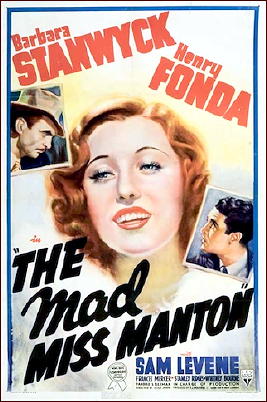
THE MAD MISS MANTON. RKO Radio Pictures, 1938. Barbara Stanwyck, Henry Fonda, Sam Levine, Frances Mercer, Stanley Ridges, Whitney Bourne, Ann Lester, Catherine O’Quinn, Linda Terry, Hattie McDaniel, James Burke, Paul Guilfoyle, Penny Singleton, Grady Sutton. Screenplay by Philip G. Epstein, based on a story by Wilson Collison. Directed by Leigh Jason.
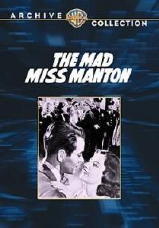
THE MAD MISS MANTON

   Melsa Manton (Barbara Stanwyck) is one in a long line of screwball heiresses who marched blithely though films of the nineteen-thirties and manage to hang on in one guise or another in films today.

   Frank Capra’s It Happened One Night (1934) started the vogue (before that rich heiresses had tended to be more predatory than zany), and here the genre gets a kick from another film that debuted the same year as It Happened One Night, The Thin Man.

   By 1938 RKO had already given us the definitive screwball heiress comedy in Katherine Hepburn in Howard Hawks Bringing Up Baby. The Mad Miss Manton isn’t quite in that class, but it is a fine mix of screwball comedy and comedy mystery played by an outstanding cast and with the kind of bright brittle and sparkling wit we can only regret real life heiresses and their entourage seldom display (hard to imagine Paris Hilton as Melsa Manton).

   As the film opens Melsa has left a costume party early and arrives home still in her Bo Peep costume to walk her six yapping Pomeranians before bedtime, but when she spies a man leaving the deserted Lane mansion and the dogs start acting strange she goes inside and finds a body, so she summons the police.

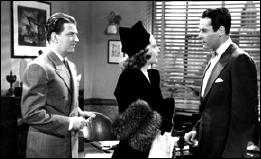
   Arriving on scene to find himself confronted by Bo Peep is Lt. Brent, Sam Levine, a character actor who made a career of sane exasperated cops plagued by the likes of Melsa Manton and Nick and Nora Charles. He’s dubious to begin with, and when no body can be found and he learns who Melsa is:
THE MAD MISS MANTON

    Brent: Oh — Melsa Manton, eh? Aren’t you one of the bunch who held the treasure hunt last week and stole a traffic signal?

    Melsa: Yes, but it was a treasure hunt for charity. We run a T.B. clinic.

    Brent: And aren’t you the dame who got an ambulance from Bellevue because one of your dogs had distemper?

    Melsa: Well, he was very sick and the veterinarian was out of town.

   It’s that kind of logic that gives cops ulcers. Which is why Lt. Brent is always sending someone out for a bicarbonate of soda.

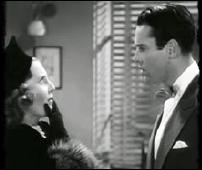
   To add insult to injury, newspaper editor Peter Ames (Henry Fonda) has begun a crusade against Melsa in his column in his newspaper, the latest installment of which brings Melsa storming in to sue him and slug him — and get slugged in return.

    Peter: I’m sorry, miss. I don’t as a rule go around slugging women, at least not as much as I’d like to. It was pure reflex — self preservation and all that.

   But as these things go, first they fight and then they romance, and one look at Melsa in the flesh is enough for Peter Ames, especially since he now has to convince her not to sue the paper for a million dollars just in case a corpse does show up and her wild tale proves true.
THE MAD MISS MANTON

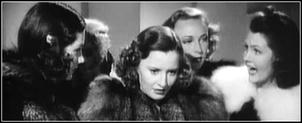
   Meanwhile Melsa summons her posse of rich girl friends, a bevy of silver fox clad beauties all as mad as Miss Manton for a war conference in her apartment to the bemusement of her maid, Hilda (Hattie McDaniel), especially when the killer returns the cloak Melsa lost at the murder scene with a knife and a threat penned to it.

    Hilda: Dat knife ain’t for openin’ lettahs. You look heah — you-all stay home and don’t go messin’ ’round in things what ain’t none of yo’ business. If somebody wants to go ’round murderin’ folks, t’ain’t none of yo’ concern.

   Racist, probably, and certainly stereotyped, but somehow I always found Miss McDaniel, Mantan Moreland, Stepin Fechit, and Willie Best the only sane voice of reason in this sort of film, or as Hattie’s Hilda adds: “You white folks don’ know what’s good for you.”

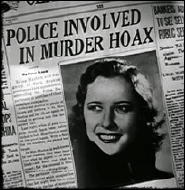
   Good advice, but you can be sure Melsa and her pals aren’t going to listen to it anymore than Brent or Peter will listen to her when she and her pals find playboy Ronnie Belden in his own refrigerator with a knife in his chest. When Brent tells her to keep the body on ice, believing she and her friends are up to their old tricks, they take the body and plant it in the lobby of Peter’s newspaper.

   That’ll teach him.
THE MAD MISS MANTON

   So Brent rounds the girls up and arrests them, only Peter calls Melsa’s father:

    Melsa: Who told you we were in jail?

    Popsie: Chap called Ames — Peter Ames.

    Helen (Frances Mercer): That’s a surprise! That’s light creeping in! After all when a man calls Melsa “Melsa.”

    Kit (Vicki Lester): Psychologists say that hate is only a few steps away from love.

    Myra (Linda Terry) It’s the lull in between that drives you crazy!

   But with a real body involved, Brent and Peter both have to take Melsa and her friends more seriously, but can’t convince them this isn’t a game. But Peter is drawn in and even ends up hiring a safecracker to help him investigate when the girls show up as he is about to check out a suspects office:

    Peter: Still — we’re all here for the same purpose. I brought in Mr. —

    Safecracker: No names, boss, no names!

    Helen: Are you a real crook?

    Safecracker (Olin Howard): The last lawyer that defended me said I was anti-social. I kind of like that better than crook.

    Peter: All right, Mr.X, let’s go to work.

    Safecracker: Naw, not in front of witnesses.

    Peter: She’s (Melsa) all right; she’s the girl I’m going to marry. You know, a wife can’t testify against her husband.

    Safecracker: Yeah, but she could testify against me.

    Melsa: I could marry you. As a matter of fact I’d prefer it.

    Safecracker: Looks like she isn’t going to marry you.

    Melsa: Why yes, I am going to marry him.

    Safecracker: What about the other dame?

    Helen: I’m going to be his second wife.
THE MAD MISS MANTON

   And so it goes, bright and brittle dialogue, a pretty good mystery, and a well done solution that ends with a royal melee in which the ladies are as much a hindrance as a help.

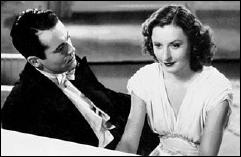
   Brent stops the killer and a bullet, but as Peter and Melsa bend over him to bring him to their eyes meet and:

    Peter: Darling!

    Melsa: Darling!

    Peter: Let’s get married soon.

    Melsa: Today.

    Peter: I’ll get a leave of absence. We’ll go to South America — stay there six months. Maybe we won’t ever come back.

    Melsa: Can you afford it?

    Peter: No — but you can.

    Melsa: I want to live on your income.

    Peter: That’s foolish. Who’s going to live on yours?
THE MAD MISS MANTON

   Murder to one side, there isn’t a serious bone in the film’s body, but it is a fast moving, bright and smart entry in the screwball heiress stakes and never pauses long enough to let you complain.

   Philip G. Epstein co-wrote Casablanca and his other screen credits include Mr. Skeffington, The Man Who Came to Dinner, The Strawberry Blonde, and Arsenic and Old Lace.

   The original screen story is from Wilson Collison, who among other things created Maisie, the heroine of the long running Ann Sothern film series, in his novel Dark Dame (1935). Leigh Jason directed many films and later television including Richard Diamond with David Jansen.

   Fast paced and wickedly clever, with a cast of stars all shining and hitting their marks, you may find yourself enjoying this much more than it merits, but by any standard it is an entertaining outing that is a model of the form.

   Watching directors struggle and fail today to produce this kind of clever film you have to wonder at the casual magic these films once produced. Like a good dessert champagne, this tickles your palates and lightens your mood, which is exactly what it was intended for.
THE MAD MISS MANTON

A REVIEW BY CURT J. EVANS:         


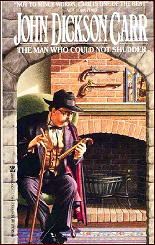
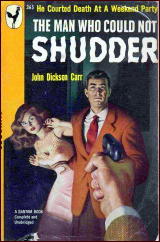
JOHN DICKSON CARR – The Man Who Could Not Shudder. Harper & Brothers, US, hardcover, 1940. UK edition: Hamish Hamilton, 1940. Reprinted many times, in both hardcover and soft, including and shown here: Bantam #365, 1949; Zebra, 1986.

JOHN DICKSON CARR The Man Who Could Not Shudder

   I wrote first-rate! in my paperback copy of this The Man Who Could Not Shudder back in 1993 — when as a young person I was first buying Carr, all those nice IPL, Harper and Zebra editions had come out, and Carr was very much alive and well in paperback, in contrast with today. On re-reading I really enjoyed this one, though this was one where I actually recalled most of the resolution as I read.

   This is the one involving the miracle problem of guest at a country house party who is shot in the study of the house by a gun that seemingly moves of its volition. Did I mention the house is supposed to be haunted? There are strange stories of an ankle grabbing ghost of a former owner of the house who died in 1820 and, from a hundred years later,of a chandelier-swinging, octogenarian butler who died when the chandelier crash down on him.

   Though is a haunted house tale, Carr does not lay on the Gothic shudders heavily this time. It’s a very modern haunted house, convincingly set in the late 1930s, with characters who act like real, normal people. (We do have one silly outburst of jealousy on the part of the narrator’s girlfriend, but that soon subsides.)

   A couple of the characters, including the egoistic current owner of the house and one of the female guests, who is the highly desired wife of the murder victim, are very well done. (Concerning the latter there’s some discussion about sex that is pretty explicit for the period.)

JOHN DICKSON CARR The Man Who Could Not Shudder

   Dr. Fell is on hand, but I didn’t find his mannerisms irritating here. Inspector Elliot appears too — Shudder is a prequel to his later appearances in The Crooked Hinge and, what I believe was his last appearance, The Black Spectacles.

   Shudder is one of Carr’s more John Rhodeian tales (I won’t say more, but Rhode readers who have read Shudder will know what I mean). It also takes place in John Street’s (the man who was John Rhode) personal territory: coastal, southern England.

   Written shortly after the two friends collaborated on Fatal Descent/Drop to His Death, Shudder is, like The Reader Is Warned, a novel I could see being discussed over pints by the two men.

   It’s also worth noting that the 1943 John Rhode novel, Men Die at Cyprus Lodge, involves a haunted house and some other bits similar to Shudder, though the plot turns out quite differently.

   The murder method in Shudder is, as usual with Carr, cleverly clued; and there’s the bonus as well of a triple twist solution. The reader who makes it through all these hoops will be clever indeed. One action by Fell I thought outrageous, but for me it was explained sufficiently by the end, when we also learn that justice has been done.

Editorial Comment:   Curt recently undertook the task of re-reading a number of books by John Dickson Carr. This is the second in a series of reviews he wrote as a result. He Who Whispers was the first to appear, and you can read it here.

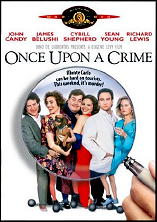
ONCE UPON A CRIME

ONCE UPON A CRIME. MGM, 1992. John Candy, James Belushi, Cybil Shepherd, Sean Young, Richard Lewis, George Hamilton. Director: Eugene Levy.

   The lives of several Americans traveling in Europe converge in Monaco, with several or all of them eventually suspected of murder. A comedy, as if you couldn’t tell from the cast.

   I was reminded of some of Inspector Clouseau’s earlier cases; Judy called it French farce. I agree, but I’d recommend this only if you can stand Richard Lewis.

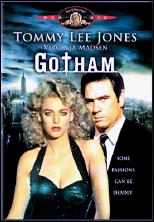
GOTHAM

GOTHAM. Showtime, 1988; made for cable-TV. Tommy Lee Jones, Virginia Madsen, Denise Stephenson, Frederic Forrest. Screenwriter/director: Lloyd Fonvielle.

   A down-on-the-heels PI named Eddie Mallard is hired by a man who wants his wife to stop following him around. The problem is that she has been dead for several years. A large box of jewels is also involved.

   Is this a ghost story or a mystery? I’m not quite sure, and no one in the movie was either, or so it seemed to me. Jones makes a great private detective, but I lost interest about halfway through.

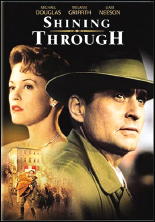
SHINING THROUGH

SHINING THROUGH. 20th Century Fox, 1992. Melanie Griffith, Michael Douglas, Liam Neeson, Joely Richardson, John Gielgud. Based on the novel by Susan Isaacs. Director: David Seltzer.

   A Brooklyn secretary, half-Irish, half-Jewish, somehow becomes a spy at the outbreak of World War II. More than that, since she knows German, she soon finds herself in Berlin trying to track down the factory making U-2 missiles.

   While the first hour or so shows some promise, the second half is hardly more than one preposterous escapade after another.

DECEIVED

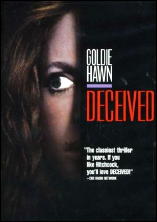
DECEIVED. Touchstone/Buena Vista, 1991. Goldie Hawn, John Heard, Ashley Peldon, Robin Bartlett, Tom Irwin. Director: Damian Harris.

   After five years of being happily married, a woman’s life is shattered when she discovers that her husband, now dead in an automobile accident, had been living a lie, under someone else’s name.

   First a detective story, then a thriller, the story doesn’t quite seem to know where it’s headed, but it still packs a pretty good wallop. Goldie Hawn, in a straight role, is fine. (Lots of smudged mascara.)

COMMENT: There are two movie guides that I usually take a look at after seeing a movie. (Sometimes before.) The first, by Leonard Maltin, says, “Hawn’s attempt to play it straight is too derivative (to say nothing of incredible) to carry much clout.” The other, by Steven H. Scheuer, says, “Well-acted, especially by Hawn who’s rock solid…”

   What does Maltin say about Melanie Griffith, in Shining Through? “Empathic performance by Griffith make(s) this palatable…” As for Scheuer: “Griffith is thoroughly unbelievable…”

   These guys (or whoever’s writing for them) are obviously not seeing the same movies. (Are they on the same planet?)

— Reprinted from Mystery*File #35, November 1993.


[UPDATE] 06-06-10. According to my records, I actually wrote these reviews in September of 1993. Do I remember watching any of four? No, only the briefest of scenes come back to me from any of them.

   I’m sure I still have these on video cassette, taped from the various premium movie channels we’d signed up for at the time. I’d be most anxious to give Gotham another try, if I could find it. It sounds like my kind of movie.

   Maltin, of course, is still around. Scheuer stopped doing his movie guide in 1993, but he started in 1958, long before Maltin was old enough to vote. (He was eight at the time.) What the varying opinions demonstrate is that it never hurts to have two points of view on a movie. When two such devoted film critics as Siskel and Ebert can have diametrically opposed takes on one — many times over — it’s obvious that there can be no such thing as 100% agreement on how good (or bad) a movie is.

THE BACKWARD REVIEWER
William F. Deeck


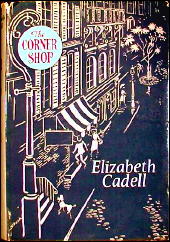
ELIZABETH CADELL – The Corner Shop. Morrow, US, hardcover, 1967. Reprint paperback, Bantam, 1970. Hodder & Stoughton, UK, 1966.

   If I had been asked, which I wasn’t, I doubt that The Corner Shop would be on my list of “crime fiction.” My opinion would be the same about the works of P. G. Wodehouse that are in Hubin’s bibliography.

ELIZABETH CADELL The Corner Shop

   But since Hubin led me to discover Cadell and others may discover the Master through the bibliography, I shall not complain.

   When Mrs. Lucille Abbey, who owns a secretarial agency with an excellent reputation, has had three of her top employees precipitately abandon a position. When she goes, at great and amusing physical effort, to discover why there was dissatisfaction, she meets Professor Hallam, whose specialty is lungs and who thinks she is applying for the secretarial position.

   He tells her that she wouldn’t suit him. “For one thing, you’re decorative, and while that wouldn’t distract me, it probably distracts you.”

   Professor Hallam is trying to transcribe his father’s notes but is being badgered by a Frenchman who wants to purchase Hallam’s mother’s paintings, which are worthless, in the Professor’s opinion.

   The paintings turn out to have disappeared, Mrs. Abbey goes to Paris to babysit her aunt’s shop and encounters the woman who may have stolen the paintings, Mrs. Abbey puts in an appeal for the Professor’s presence, and the Professor usually an unworldly man, gets everything straightened out, with a happy ending for some and a not disappointing ending for others.

   The Corner Shop is similar to Wodehouse’s works. It is, as all of his are, a farce romance or a romantic farce, with a plot simple yet complex. While they haven’t a great deal of depth, Cadell’s characters are nonetheless interesting and believable.

   She doesn’t write as well as Wodehouse. Who does? She’s a couple of rungs down the ladder, but still very near the top for this sort of book.

   Consider it crime fiction and enjoy it. Or don’t consider it crime fiction and enjoy it.

– From The MYSTERY FANcier, Vol. 10, No. 2, Spring 1988.


Editorial Comment: There are some 15 books by Elizabeth Cadell (1903-1989) under her own name in Al Hubin’s Revised Crime Fiction IV, and another three she wrote under the name of Harriet Ainsworth.

   You may have gathered (I did) that her books were included by Al with an asterisk, indicating only marginal crime content. Not so. Only one is, and that one is not this one. (On the other hand, she was the author of 52 novels in all, so it’s clear that crime and/or mystery fiction was hardly her primary playing field.)

   There is a website dedicated to her and her work, which is where I obtained the information just above. This page consists of covers of titles A through D only, but you can easily find the others.

   Another review of The Corner Shop can be found online here; two long paragraphs are quoted.

IT’S ABOUT CRIME
by Marvin Lachman

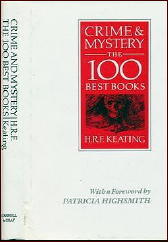
H. R. F. KEATING – Crime and Mystery: The 100 Best Books. Carroll & Graf, US, hardcover, November 1987; trade paperback, October 1996. Xanadu, UK, hardcover, 1987.

H. R. F. KEATING Crime and Mystery

– Reprinted from The MYSTERY FANcier,
       Vol. 10, No. 2, Spring 1988.

   H.R.F. Keating proves he is a man after my own heart by compiling a list of the one-hundred best mysteries in Crime and Mystery. One can quarrel with some of Keating’s selections; one always will with any list of “bests.”

   He leaves out R. Austin Freeman, Alice Tilton, and Stuart Palmer because they are not presently available, but they certainly are in the US, thanks to recent reprints. Keating does not include Dick Francis because he only writes stories of “pure suspense.” Yet, Francis includes plenty of crime and mystery in his plots and has even given us a series detective, Sid Halley.

   On the other hand, Keating does not like Nicholas Freeling (I don’t either) but includes him because he is considered “important.” There, Keating should have stuck with his personal taste.

   No one could make up a list of one-hundred books and expect total agreement. What is remarkable about Crime and Mystery is that most of Keating’s selections are remarkably sound, and his two-page essays on each are masterpieces of succinct criticism, with superb use of metaphor. This is an indispensable guide to the literature we like best.

Editorial Comment:   This is the second in a series of reviews in which Marv covered reference works published in 1987, books about the field of mystery and crime fiction. Preceding this one was Son of Gun in Cheek, by Bill Pronzini. You can find it here.

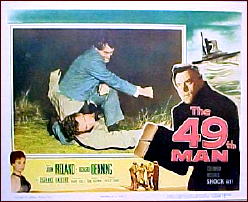
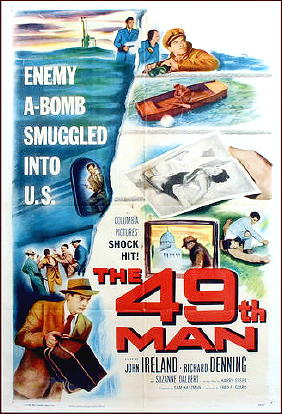
THE 49th MAN. Columbia Pictures, 1953. John Ireland, Richard Denning, Suzanne Dalbert, Robert Foulk, Mike “Touch” Connors, Richard Avonde, Peter Marshall, Geneviève Aumont. Director: Fred F. Sears.

THE 49th MAN John Ireland

   A less than semi-scary story told in semi-documentary style, a cautionary tale told in the midst of the Cold War. A kid in a hot road crashes off a road in the Southwest US, setting off a nationwide hunt for 47 other parts of atom bombs being smuggled into the US, piece by piece.

   Assigned to head up the investigation is John Williams (John Ireland), who reports to Richard Denning’s Paul Reagan back in Washington. Each of twelve bombs comes in four parts, one part per state. They come into the US by many different ways, and you’d be surprised how many of them are intercepted, mostly by chance, as far as I could tell.

   This is the semi-scary part, and you could even convince me that it’s scary without the prefix semi. The trail leads Williams to Marseilles, France, and a jazz bar, where — I can’t tell you more. The case is solved far too easily, if you were to ask me, but there is a twist toward the end that I can’t tell you about either, and a finale which is really a blow up job, bar none.

   Denning is as earnest in his role as usual, and Ireland, well, he’s as dour as he ever was. I’m not sure I’ve ever seen him smile in a film he was in, but I’m probably wrong about that. What I’m probably right about is that you will find as little of major interest in this movie as I did. Minor interest yes, but nothing more.

THE 49th MAN John Ireland

A TV Review by MIKE TOONEY:


“Four into Zero.” An episode of Kraft Suspense Theatre (Season 2, Episode 15). First air date: 18 February 1965. Jack Kelly (as Charles Glenn), Robert Conrad (Gary Kemp), Joe Mantell (Frankie Shields), Jesse White (Emil Glueck), Martha Hyer (Caroline Glenn), Sue Randall (Jane Crane), Ronnie Dapo (the boy), Hollis Irving (the mother), Murray Alper (the conductor). Teleplay: Don Brinkley. Story: Milt Rosen. Director: Don Weis.

FOUR INTO ZERO Robert Conrad

   When most of us talk about “making money,” we usually mean collecting a paycheck from an employer. Four men, however, are planning to make money — quite literally..

   The four are: Emil Glueck, an expert printer; Frankie Shields, an ex-acrobat with a drinking problem; Gary Kemp, a handsome playboy who knows how to wheedle information from young women; and Charles Glenn, who doesn’t really need to steal since he’s married to an incredibly wealthy woman, Caroline. Glenn chafes at the situation, however, and feels he has something to prove by masterminding this caper.

   To get the inside information he needs, Glenn has assigned Kemp to date Jane Crane, who works in a large bank in Chicago. From Kemp, Glenn learns that the currency printing plates for a South American country have recently been crafted and are due to be shipped to that banana republic on a train from Chicago to Los Angeles.

   The plan is simple: Get aboard the train, “borrow” the plates and run off a million dollars’ worth, return the plates as if nothing had happened, and convert the money to American long green at prevailing exchange rates. Piece of cake.

   However, while a plan might be simple in conception, it isn’t always easy in execution. The unexpected sometimes occurs, and that’s when one’s ability to adapt to changing circumstances is called for.

   Among the unanticipated developments: the presence on the train of a railroad inspector on holiday; that nosy little boy who manages to catch sight of Shields when he’s doing his acrobatic thing; Jane’s determination to find out why Kemp, her fiance, has apparently abandoned her and gone missing; the loose nails that roll out of sight; and that falling whiskey crate.

   The question is: Can this collection of oddballs pull off this caper, or will they soon be cooling their heels in federal prison ….?

   Despite the stated desperation of some of the characters, as viewers we never really feel it. Nevertheless, the caper itself is fascinating to watch, and the ending is surprisingly upbeat.

   Jack Kelly (1927-92) previously appeared in “The Name of the Game” (reviewed here). Martha Hyer (b. 1924) was in “Crimson Witness” (reviewed here). Robert Conrad (b. 1929) is best remembered for The Wild, Wild West (1965-69), but he had a P.I. series, Hawaiian Eye (1959-63), a short-lived spy series, A Man Called Sloane (1979), and gave Lt. Columbo a hard time in “An Exercise in Fatality” (1974).

    Joe Mantell (b. 1920) is a versatile actor; he can do comedy or drama, and was nominated for a Best Supporting Actor Oscar for Marty (1955). Jesse White (1917-97) almost always played it for laughs, but you could find him acting seriously on occasion (e.g., Witness to Murder, 1954); still, he has an unforgettable moment in Harvey (1950) when he’s reading the definition of a “pookah.”

A REVIEW BY JIM McCAHERY:
   

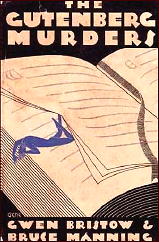
GWEN BRISTOW & BRUCE MANNING – The Gutenberg Murders. Mystery League, hardcover, 1931.

BRISTOW MANNING The Invisible Host

   Superior in every respect to its predecessor, this second Bristow-Manning novel introduces reporter Wade of New Orleans’ Morning Creole, D. A. Don Farrell of Orleans Parish, and Captain Murphy of Homicide.

   It all starts with the theft of a nine-leaf fragment of the Gutenberg Bible, stolen along with other rare books from the safe of the Sheldon Memorial Library. There are three victims burned alive (Wade almost becomes a fourth) and all possible suspects have airtight alibis, thus presenting a series of impossible crimes.

   All the major characters are presented by page twenty-two and include old Dr. Prentiss, head librarian and discoverer of the Gutenberg fragment; his handsome assistant Quentin Ulman and secretary Luke Dancy; his arch-rival Alfredo Gonzales, head trustee of the library; Alfredo’s wife Winifred and niece, medical student Marie Castillo; and sculptor Terry Sheldon, nephew of the library’s founder.

   While there is little physical action, characterization is much improved since The Invisible Host [reviewed here ], with some nice touches of humor to boot.

   Style and dialogue are both first rate, and the story moves along very nicely with fine narrative and descriptive writing. While I can’t personally vouch for the credibility of the murder method used in all the deaths, it’s certainly a humdinger. Sorry I can’t say any more on this score.

   Add a Chinese costume ball and pageant, shades of Euripides, and an old will codicil to round out the intrigue.

   The Mannings did only two more books after this (both in 1932 and for the Mystery League), Two and Two make Twenty-Two and The Mardi Gras Murders. Mr. Manning has since died [in 1965] and Mrs. Manning has become a highly popular novelist of historical romances under her maiden name.

— Reprinted from The Poisoned Pen, Vol. 2, No. 6, Nov-Dec 1979.


Editorial Comment:   Gwen Bristow Manning died in 1980, a year after this review was written. A list of the non-criminous novels she wrote on her own can be found on the Fantastic Fiction website.

A REVIEW BY JIM McCAHERY:
   

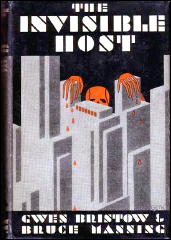
GWEN BRISTOW & BRUCE MANNING – The Invisible Host.   Mystery League, hardcover, 1930. Play: The Ninth Guest, by Owen Davis (on Broadway Aug-Oct 1930). Film: Columbia, 1934, as The Ninth Guest (with Genevieve Tobin & Donald Cook; director: Roy William Neill). Paperback reprint: Popular Library, 1975, as The Ninth Guest.

BRISTOW MANNING The Invisible Host

   Two of the earliest and most popular writers for the highly successful Mystery League were the husband-and-wife team of Gwen Bristow and Bruce Manning, both one-time reporters on rival newspapers in New Orleans.

   This first work is sheer melodrama at its best (if such is possible) as a cast of eight guests is invited by telegram to attend a penthouse surprise party in New Orleans; each guest is led to believe the party is in his/her honor. The only problem is that none of them are permitted to leave and death awaits each in turn, as their host explains to them over the radio.

   Any comparison with Dame Christie’s And Then There Were None stops here. There is a definite undercurrent of hostility between various members of the ill-fated gathering, and suspicion runs high as to who is actually behind the macabre dinner.

   The host challenges them to his life-or-death game over radio station WITS, promising himself as a final victim if he fails to kill them all, each of whose secrets and idiosyncrasies he seems to know so thoroughly.

   Against the prerequisite background of thunderstorm and candlelight with all avenues of escape blocked and eight coffins awaiting them on the patio, the guests fall one by one by various pre-arranged death devices, including poison, electricity, needles and (Pen readers take note) a final death by a poisoned pen.

   The host cleverly counts on his guests’ known habits to plan and even predict their various deaths.

   While necessarily shy on characterization, and requiring a more-than-normal amount of suspension of disbelief on the reader’s part, it would be unfair not to admit to some good surprises and a good overall job of construction on the part of the authors.

   You may recall having seen the 1934 Columbia film on television which was made from the play version, both of which were entitled The Ninth Guest — and there was one, by the way, but you’ll have to read the book if you want to find out who it was.

– Reprinted from The Poisoned Pen, Vol. 2, No. 6, Nov-Dec 1979.


Note:   David Vineyard reviewed this book a few posts back. Follow the link to find it. In the same issue of Poisoned Pen, Jim also reviewed Bristow and Manning’s The Gutenberg Murders, another Mystery League adventure. Look for it posted on this blog sometime soon.

Editorial Comment:   Jim McCahery died in 1995 at the age of 61, far too young. He lived in New Jersey and was an avid reader and collector of mystery fiction. He was also the author of two crime-solving cases of Lavina London, a retired radio star and amateur detective, books that were both published in the 1990s.

     I met Jim in person once or twice as a fellow member of DAPA-Em, and he was a close friend of Jeff Meyerson, who published The Poisoned Pen, and who has given me permission to reprint not only this, but other reviews that Jim wrote for him over the years.

REVIEWED BY NOEL NICKOL:         


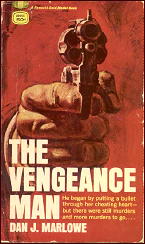
DAN J. MARLOWE – The Vengeance Man. Fawcett Gold Medal d1645, paperback original, 1966. Reprint paperbacks: Black Lizard, 1988; Stark House Press, 2007.

DAN J. MARLOWE The Vengeance Man

   Like his masterpiece The Name of the Game is Death, Dan J. Marlowe’s novel The Vengeance Man revolves around a small, insular community filled with intersecting characters and multiple hidden agendas. In fact, the book’s hard-boiled lead, Jim Wilson, makes a point of constantly calling out just how small his backwoods town is, and at certain key moments, turns the claustrophobia of the small town experience to his advantage.

   At first Marlowe paints Jim Wilson in broad strokes, portraying him as a typical criminal leading man — low on patience, tough as nails and borderline sociopathic. But as the novel progresses, the novel works to fill in details, giving us a much more personal take on Wilson’s personality. Details emerge on everything from a youth filled with abandonment and abuse to Wilson’s strange passive aggressive relationships with women.

   By about hundred pages in, you feel that first-person voice creeping under your skin. You can almost smell Wilson’s rage at a town that he feels betrayed him. And while you’re seeing the world through his revenge-tinted eyes, you can’t help but have a slight fear of whatever his next move might be. The result is something similar to the first-person work of Jim Thompson in novels like Hell of a Woman and The Nothing Man. A frightening insight into the killer mind the none-the-less manages to humanize at the same time. The effect can be chilling.

DAN J. MARLOWE The Vengeance Man

   The book opens with Wilson murdering both his cheating wife and her lover in a flea bag motel. After a carefully orchestrated, if somewhat unrealistic scheme sets him free, he unleashes a campaign of terror on the town — with the end goal of setting himself up as the most feared and powerful man in the community. A title he aims to usurp from his political string-pulling father-in-law, Judge Tom Harrington.

   As the story moves forward, we ping-pong between dueling political forces: politicians, bankers, and worst of all, banker’s wives. Of course, we know it’s going to end badly for Wilson. But trying to anticipate when the rug will get pulled, and who will do the pulling is something Marlowe has refined to a pretty fine science.

   Throughout the book Marlowe keeps the plot moving at a fast clip with the occasional detour for the sake of color and atmosphere. But there’s nothing even remotely indulgent. As for the quality of the writing, it recalls Gold Medal books at the top of their game: clean, simple and hard boiled.

DAN J. MARLOWE The Vengeance Man

   If there’s a fault to the book it’s the weak characterizations outside of Jim Wilson and his Femme Fatal counterpart. Tom Harrington, for example is built up throughout the first half of the novel as possibly the most dangerous man the south has ever seen. Yet by the time we finally meet him it seems as though Marlowe was unsure how to bring this to life. In the end we’re left unsure exactly what kind of threat he really posed.

   The same can be said of other characters throughout the book — from Wilson’s best friend, to his friend-with-benefits. The argument could probably be made that keeping these characters so peripheral helps establish an atmosphere where shocking revelations are truly shocking. But when you don’t have a preconceived notion about a character, surprising the reader with new information doesn’t end up being much of a surprise.

   Still, this is a small flaw and it shouldn’t dissuade you from reading one of Dan J. Marlowe’s best books outside of the Earl Drake series.

« Previous PageNext Page »