Fri 30 Apr 2010
Reviewed by David L. Vineyard: JAMES HADLEY CHASE – I’ll Get You for This.
Posted by Steve under Reviews[31] Comments
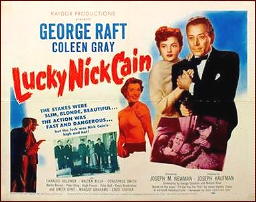
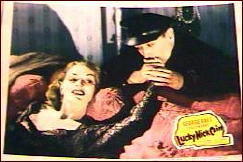
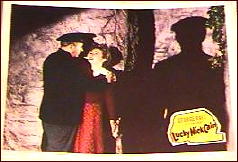
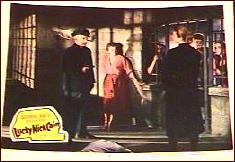
JAMES HADLEY CHASE – I’ll Get You For This. Jarrolds, UK, hardcover, 1946. Avon Monthly Novel #18, US, digest-sized paperback, 1951. Filmed as Lucky Nick Cain, 1951, with George Raft, Coleen Gray & Walter Rilla.
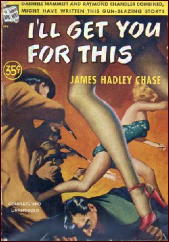
That’s Chester Cain, the hero of James Hadley Chase’s novel I’ll Get You For This, a gambler with a fast gun that would make Mike Hammer or Race Williams blink twice and a barely legal reputation. Like pulpster Gordon Young’s Don Everhard from an earlier age, he’s a fast shooting two-fisted professional gambler who is a law unto himself.
In I’ll Get You For This Cain has just arrived in Paradise Palm, a coastal beauty spot where he hopes to spend a little vacation time after a grueling few months of profitable gambling up north. He has a bankroll, and he’s in the mood to enjoy it.
And Paradise Palm seems just the kind of place to enjoy it all. The beaches are stacked with beautiful women if various states of extreme immodesty and even the cops call him sir. In fact, people couldn’t be nicer.
After I’d stared at the flowers, I concentrated on the women, driving in big luxury cars or walking along the sidewalks, or even riding bicycles. It was as good as an Earl Carrol show. There wasn’t a woman who hadn’t stripped down to the bare essentials. My eyes hadn’t overeaten themselves like this in years.
And if they don’t give him the key to the city or roll out the red carpet, they do just about everything short of that. The owner of the local casino, Don Speratza, even calls him up personally when he checks in at the hotel, to invite him for a night of recreational gaming and offer female companionship. Then Ed Killeano, the city administrator* calls up to tell him how glad they are to have him.
By now Cain’s a bit suspicious, but he’s willing to play along and see where all this is going. The only man who acts at all normal is John Herrick, a reform candidate who isn’t excited about trouble like Cain showing up in town.
But Cain doesn’t have long to worry about that when he is introduced to Miss Wonderly:
By the time I’d recovered my breath, she was standing at my side. Her perfume was Essence Imperiale Russe (the perfume that quickened the pulse of kings). I can’t begin to describe what it did to my pulse.
Speratza was looking at me anxiously. “Miss Wonderly,” he said, and raised his eyebrows…
Out of the corner of my eye I saw Speratza go off, and then I gave the whole of my attention to Miss Wonderly. I thought she was terrific. I liked the long wave of her hair, and her curves — particularly her curves. Her breasts were like Cuban pineapples.
“This calls for a drink,” I said, beckoning to the barman. “What part of Paradise did you escape from?”
“I didn’t escape,” she said, laughing, “I’m out on parole…”
That mention of the perfume brand may have been picked up from Peter Cheyney, whose heroes seemed to be hypnotized by the Narcisse Noir his femme fatales always wore. Later James Bond did this sort of brand name thing with a bit more style and flair, Fleming borrowing some of the Americanized elements of Cheyney and Chase for the Bond saga.
But paradise doesn’t remain paradise very long and it is only the next day when a hungover Cain finds himself in a place more familiar to him:
The reception clerk looked like he was going to throw up. His face was pale green.
“Mr. Chester Cain,” he said, in a far-away voice.
That seemed to give the ugly guy a buzz.
“Sure?” The reception clerk nodded.
The guy faced me. His flat puss was loaded with viciousness.
“We know all about you,” he said. “I’m Flaggerty of the Homicide Bureau. You’re in a hell of a jam, Cain.”
I knew I had to talk if it killed me.
“You’re crazy,” I said. “I didn’t do it.”
“When I find a rat with your reputation locked in with a murdered man I don’t have to look all that far to find his killer,” Flaggerty sneered. “You’re under arrest, and you’d better start talking.”
I tried to think, but my mind wasn’t working. I felt like hell, and my head throbbed and pounded.
It looks bad, especially since the dead man in question is Herrick — the one man in town who hadn’t offered Cain a glad hand and the key to the city. Killeano, the city administrator offers to help, but somehow Cain doesn’t trust him or his motives. Luckily for Cain they didn’t count on Clair Wonderly falling for him — she refuses to play the game even when the cops get rough.
Killeano looked at her as if he couldn’t believe his ears. His fat face went yellow with rage. “You bitch!” he said, and slapped her hard across her face.
And Cain lets them know he isn’t finished with them:
Cain ends up teaming with the Feds in the form of a G-Man name Hoskiss, and he and Clair bring down Killeano and Paradise Palms and the dirty racket they are running. (Hoskiss should be a T-Man since the scheme involves counterfeiting, but I suppose we have to give Brit Chase a pass on that mistake.)
But that’s not the end of it. As the gang are awaiting trial, Cain and Clair know they are in danger and try to go to ground, but the gang goes after them, and Cain has to resort to his old skills with a gun to protect them both while he hunts down Bat Thompson, the hood who killed Herrick and is now hunting Clair and him.
I pulled out my electric torch*. The beam lit up a nightmare scene. The girl lay on her side, bent back, half her face was shattered by the heavy bullet from Bat’s gun. Bat lay near her, his hand touched her naked foot. Blood seeped out of him like water from over-boiled cabbage I turned him over. He moved, blinked his eyes, snarled at me.
“So long, Bat,” I said, put the gun to his ear.
And Cain goes home to Clair confident that their reign of fear has ended:
I’ll Get You For This is mid-level Chase, violent and derivative, but compulsively readable and entertaining. Chase still has a following, with many of his books available as free e-books from various sources and his numerous books collectable. He even had his champions in George Orwell, who wrote about him in his famous article “Miss Blandish and Raffles,” and Chase’s friend Graham Greene, who included one of his works in a famous anthology of thrillers.
This despite the fact that Chase was twice accused of plagiarism — notably for his debut No Orchids For Miss Blandish, that sailed a bit too close to William Faulkner’s novel Sanctuary, and later having to apologize to Raymond Chandler for lifting whole passages from one of his books.
But then as Chase is recreating an entire world that existed only in books and films for him he may be forgiven if he sometimes recreated that world too closely.
That said, even in this one you know he lifted the name Wonderly from The Maltese Falcon. It was just a habit he couldn’t — or wouldn’t bother to — break.
Chase only visited the United States twice, but in general made good use of maps and a dictionary of slang in recreating a sort of fractured version of the hardboiled country of James M. Cain, Hammett, and Chandler. His work lacks the surrealism of Peter Cheyney’s Lemme Caution tales, despite which — or maybe because of which — Chase is great fun to read.
His best works sometimes read like a pastiche of a Gold Medal original or noir film.
His novels were great favorites (along with Peter Cheyney) in the famous French serie noir paperback series, and truthfully both he and Cheyney’s fractured Americanisms translated to French are a unique reading experience. Like Jerry Lewis, something may be lost in the translation back into English.
Chase wrote under several names, but other than Chase, was probably best known as Raymond Marshall.
For the most part his plots are clever if not surprising. They move fast, and at their best manage to recreate the kind of doomed noirish atmosphere of the James M. Cain book that first inspired him (The Postman Always Rings Twice) without achieving a single moment of authenticity.
In some ways you could call them the British crime equivalent of spaghetti westerns, the pulp formula boiled down to its purest elements by an eye that experienced it only through books and films.
I’ll Get You For This was made into a forgettable but mildly entertaining film, Lucky Nick Cain, with George Raft and filmed in Italy. It was relatively faithful to the basics of Chase’s plot, and was one of Raft’s better fifties outings.
___
(*) Careful readers will notice certain Anglicisms like city administrator instead of city manager or supervisor or electric torch for flashlight, and colours for colors creep in.
Previously reviewed on this blog:
No Orchids for Miss Blandish, by Bill Crider (1001 Midnights).
Hit and Run, by Steve Lewis.