EDMOND HAMILTON – The Weapon from Beyond. Starwolf #1. Ace G-639. Paperback original; 1st printing, 1967. Cover art by Jack Gaughan. Collected in Starwolf (Ace, paperback, 1982); and in Starwolves and the Interstellar Patrol (Baen, paperback, 2008).

   Space opera in the old tradition, but with an added measure of characterization and ideas.

   Margan Chane, ex-Starwolf, hunted by his former allies in pirating and raiding, joins a crew of mercenaries from Earth in a hunt for a weapon supposedly hidden in the depths of Corvus Nebula. There is no weapon, only the remains of a wrecked alien spaceship, but there are indication that a rescue fleet is on the way.

   The mercenaries, interesting in themselves, are the realization of Earth’s most valuable resources in a universe of riches: Men. Men capable of doing the job asked of them. Chane has to sort out his emotions in a personal conflict caused by his sudden change of environment, now having to be hunted and perhaps having to fight his old comrades on the side of fellow Earthmen, with one he can like and even respect.

   Humans of this future have their scientific research oriented toward weaponry, while the liens do not seem to have had to suffer and learn to turn away from violence. Which is better?

   Logically constructed, except that the mercenaries still expect to fin the “weapon” after landing when the enemy cruisers leave the planet “defenseless.” Otherwise, the story has both action and thoughtful passages in the right proportion. Most entertaining,

Rating: ****

— April 1969.

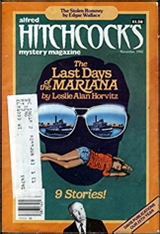
JOHN LUTZ “What You Don’t Know Can Hurt You.” Alo Nudger. First appeared in Alfred Hitchcock’s Mystery Magazine, November 1982. PWA Winner for Best Short Story. Collected in The Nudger Dilemmas (Five Star, 2001). Reprinted in The Shamus Winners, Volume I: 1982-1995, edited by Robert J. Randisi (Perfect Crime Books, 2010).

   Alo Nudger is the St. Louis-based PI with the nervous stomach who appeared in ten novels and nine or more short stories, of which this is the fourth. One theme in all of his appearances is his constant use of antacids whenever the going gets tough, but you should also know that whenever that happens — and it always does — he never falters or turns aside. He always carries through, no matter how tough the going gets.

   In this short tale he awakens on the floor of his office after having been visited by a couple of goons who had worked him over, followed by a female nurse, linebacker-sized, who, when his answers prove unsatisfactory, doses him with truth serum.

   No matter. He didn’t reveal anything about his clients, because none of the cases he’s working on are worth that kind of questioning.

   It is a mystery, but after a visit to the doughnut shop downstairs beneath his office, he begins to have a glimmer of what’s going on. I could tell you more, but I’m reluctant to, because that’s really all the story’s about: his learning what it is that’s going on as well as helping out a friend who needs help.

   In many ways this in only a minor tale in Alo Nudger’s career, but in other ways, you can think of it as one that tells you what kind of man he is.

Talking About Fredric Brown
by Dan Stumpf:


   Centuries hence, fans and academics may still be sorting through the cultural remnants of the Twentieth Century looking for something worthwhile. When they speak of Mysteries, I hope they will be kind.
   I hope that whoever they are, the literary historians of the future will pass lightly over those exaggerated grotesques that passed for Eccentric Detectives from the pens of authors who wrote as if they’d never in their lives met a Real Person. I hope they will skip over the showy blowhards who tried to pass off Violence as Realism and Platitudes as Philosophy.

   And perhaps they won’t even mention those puzzle-writers who mistook Contrivance for Cleverness.

   There now; Have I covered all the bases without actually offending anyone? What’s that? A word or two about the pretensions of Wordy Critics? Well, I think that may be going too far, so I’ll skip to the punch line.

   I hope, in short, that our Future Forefathers (?) will ignore all that overrated dreck and spend most of their time talking about Fredric Brown.
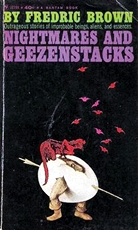
   No, not everything that Brown wrote was dipped in gold, and a lot of his stuff is awfully routine,  but when Brown was at his peak, no one could touch him tor speed and agility.  In the Science Fiction genre, Philip K. Dick sometimes came close to emulating  Brown’s    counter-logic (so neatly displayed in his short story collections Honeymoon in Hell and Nightmares and Geezenstacks), but in the realm  of the Clever Mystery — light, fast-paced  and ingenious — no one (not even that   ponderous puzzler Agatha Christie) ever came close.

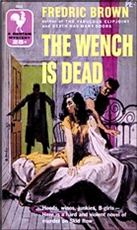
   A lot of trees have died in the last several years, sacrificed to weighty articles  demonstrating that Brown’s Content is a lot deeper than his Style would indicate, and I will admit that there’s quite a bit beneath the surface of books like Here Comes a Candle, The Wench Is Dead and Martians, Go Home.

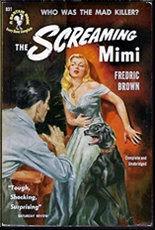
   I particularly like the fearful symmetry of The Screaming Mimi, which opens and closes with the hero talking to God and demonstrates along the way that God is not a particularly nice person. You could even string Brown’s short short stories together into a chapbook of commentary on the futility of Human Endeavor and I think be reminded irresistibly of the disciplined poetry of Omar Khayyam’s effort in that direction.

   But what impresses me most favorably about Fredric Brown is his sheer love of writing for its own sake, and his ability to communicate this love to the reader. Following the twists and turns of a Fredric Brown story recalls the thrill one gets from seeing Astaire dancing or Olivier doing Shakespeare or Gershwin playing Gershwin: The sheer felicity of a gifted artist doing what he loves best has an appeal all its own.

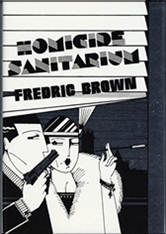
   This felicity comes across very appealingly indeed in Homicide Sanitarium  (Dennis McMillan, 1984), with an introduction by Bill Pronzini) a very welcome collection of previously unreprinted Brown stories that was followed by another half-dozen or so volumes in the same vein.
   Reading these tales, one gets some idea of what the Mystery Story can be at its best as well as a fascinating glimpse into the workings of Brown’s uniquely inventive mind.

   “Red-Hot and Hunted” for instance starts off as a moody chase story, then veers subtly into whodunit, as the Brown starts dropping subtle hints that All is not What It Seems, then wraps up with a fast, surprising but logical solution — it also shows Brown’s gift for creating plausible red herrings, characters who seem to have lives of their own outside the confines of the pages but who fit quite comfortably into the restrictions of even a short story plot.

   My other favorite in this collection, the title story, offers the engaging Brown-logic of an escaped Homicidal Maniac who hides out in a Sanitarium. There’s a lot more to this story  than merely the cute logic of what would have been a facile punch-line in the hands of a lesser writer.

   For Fredric Brown, the idea is a starting point, a place to begin his story and characters from. He is thus able to do a great deal with a very simple premise Not for  Brown the lugubrious machinations of a Mystery where Everybody Dun It or the character-flouting of a puzzle that makes a mockery of Motivation.
   He keeps one hand on his premise but the other one very firmly on plausible characterization and the result is writing in which even the most outrageous of crimes (and another story in this collection, “The Spherical Ghoul” features the most ludicrous puzzle I have come across in years) still does not insult the reader’s intelligence.

   Fredric Brown’s talent was probably a little too diffuse to earn him a very high place with most critics. Like Michael Curtiz, he seems to have crafted gems in almost every genre but never settled down to that predictable consistency that makes the works of Woolrich or Hitchcock so much easier (and therefore critically popular) to analyze.

   I hope, though, that in some golden future time, when some of the more grotesque “giants” of the Mystery have gone to a well-deserved obscurity that fans or academics or both will still be reading Brown.

— Reprinted from A Shropshire Sleuth #35.


NOTE: For more, much more from the pen (?) of Dan Stumpf, check out his own blog, filled with great fun and merriment at https://danielboydauthor.com/blog

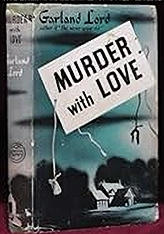
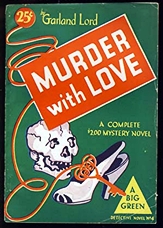
GARLAND LORD – Murder with Love. William Morrow, hardcover, 1943. Detective Book Club, hardcover reprint, 3-in-1 edition. Green #4, digest-sized paperback, circa 1945.

   What I’m going to do first, rather than do the research once again as to who the author of this rather good mystery novel is, or was, is to repeat the first paragraph of my review of their novel, Murder Plain and Fancy, published the same year. The two books were, not my review. Go here to read the complete review, and be sure to follow up by reading the comments as well.

   “Garland Lord was the joint pen name of husband and wife Isabel Garland (1903-1988) and Mindret Lord (1903-1955). They wrote four books together under this name, none with series characters, the first three for Doubleday’s Crime Club imprint. Isabel also wrote one book under her own name, apparently before they decided to team up together.”

   It is difficult to say where this book takes place, geographically, but except for a few pages at a neighbor’s home, all of the action takes place in an old mansion with lots of rooms and servants, with an elderly patriarch in charge. Add wealthy to that brief description, and that sums him up more than adequately, I think.

   And what he has done is call together a conclave of family and friends (including would-be lovers), with an impending announcement involving a new will that he has in mind. This is not a good idea, especially in mystery novels. And so it happens here, although it is not the old man who dies, although the attempt is made.

   Among the guests, the man at the top (not a miserably stingy fellow, by the way) has an estranged daughter who has come, and two adopted daughters, one of whom, named Roncevald, or Roncie for short. It is she who tells the story that follows, which does include two deaths, as well as several strange events, with Roncie the target of an apparent frame-up for the deeds.

   The mystery is a good one, and the true killer may come as a surprise, unless you reading and studying the tale more closely than I was, as the clues are there, sort of. When you think about the title, you also should also not be terribly surprised if I tell you there is almost as much romance in the story as there is detection, of which there is less than you might think.

   Unusual events happen, and while the participants are certainly aware of them, life does go on, as best it can. Garland Lord seems to have had the knack of making that happen, and make it seem natural. I enjoyed this one.

A 1001 MIDNIGHTS Review
by Bill Pronzini


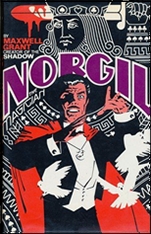
WALTER GIBSON – Norgil the Magician. Mysterious Press, hardcover, 1977.

   One of this century’s most prolific writers, Walter Gibson was the author of 282 pulp novels featuring the most famous of all superhero crime fighters, Lamont Cranston, a.k.a. the Shadow. All 282 of those book-length works were produced between 1931 and 1949 and first appeared in The Shadow Magazine under such titles as “The Shadow Laughs,” “The Mobsmen on the Spot,” “The Creeping Death,” “The Voodoo Master,” and “The Shadow, The Hawk, and The Skull.”

   Some forty of these have been reprinted over the years, most in paperback; a few of the shorter ones have appeared in pairs in such Doubleday hardcover titles as The Shadow: The Mask of Mephisto and Murder by Magic (1975) and in the recent Mysterious Press book The Shadow and the Golden Master (1984).

   Gibson also created another series character for the pulps — Norgil the Magician, whose adventures appeared in the magazine Crime Busters in the late 1930s and early 1940s. Norgil is a stage magician: “Like Blackstone or Calvert, both headliners at the time,” Gibson writes in his introduction to Norgil the Magician, the first of two Norgil collections, “he could switch from fifty-minute shows at movie houses to a full evening extravaganza, with an enlarged company.”

   Norgil is an anagram of the conjurer’s real name. Loring; he also can (and does) change it into Ling Ro, a name he uses “when called upon to perform wizardry in Chinese costume.”

   Each of the Norgil stories features a well-known stage illusion as its central plot device — a version of Houdini’s Hindu Needle Trick in “Norgil — Magician”; burial alive in a sealed casket in “The Glass Box”; the rising-card illusion in “Battle of Magic.”

   These eight stories are pulpy, to be sure (the prose almost embarrassingly bad in places), but that shouldn’t spoil most readers· enjoyment of them. The magic in each is authentic and presented with the requisite amount mystery — Gibson was himself a practicing magician — and Norgil’ s melodramatic methods and illusions make for good fun.

   Anyone who has read and enjoyed any of the Shadow novels will certainly want to read this collection, as well its successor, Norgil: More Tales of Prestidigitation ( 1978).

         ———
   Reprinted with permission from 1001 Midnights, edited by Bill Pronzini & Marcia Muller and published by The Battered Silicon Dispatch Box, 2007.   Copyright © 1986, 2007 by the Pronzini-Muller Family Trust.

REVIEWED BY MIKE TOONEY:


(Give Me That) OLD-TIME DETECTION. Autumn 2025. Issue #70. Editor: Arthur Vidro. Old-Time Detection Special Interest Group of American Mensa, Ltd. 34 pages (including covers).

   AS usual, Old-Time Detection (OTD) succeeds in keeping classic detective fiction alive and interesting. In this issue diversity is the theme, with coverage of detecfic authors from Conan Doyle to some of the latest practitioners of the genre being highlighted.

   First up is an EQMM interview with Robert Twohy, whose approach to writing is basically character-centric: “I’ve tried to write something to approach it [‘Red-Headed League’], and haven’t yet — but the fun is in the quest.” (See the Fiction selection below for more by this author.)

   J. Randolph Cox talks about Arthur Train, now almost forgotten but once very popular in the first decades of the 20th century.

   Next we have a reprint of Martin Edwards’s introduction to Peter Shaffer’s THE WOMAN IN THE WARDROBE, which Robert Adey later characterized as “the best post-war locked-room mystery . . . [with] a brilliant new solution.”

   Everybody has to start somewhere. Francis M. Nevins exhibits his usual high-quality scholarship in “The Pulp Origins of John D. MacDonald,” highlighting that soon-to-be-popular author’s early days: “MacDonald was the last great American mystery writer to hone his storytelling skills in the action-detective pulps as Hammett and Chandler and Gardner and Woolrich had done before him.”

   Jon L. Breen’s reviews of books (ten of them from the Walker Reprints Series) in “40-Plus Years Ago” take us from familiar mystery fiction old reliables like Pierre Chambrun, to obscure eccentrics like Inspector James and Sergeant Honeybody.

   In Part II of Michael Dirda’s “Mystery Novels So Clever You’ll Read Them Twice,” he points us to modern-day examples of stories that manage to surprise the reader. After all, he says, “A mystery that doesn’t surprise is hardly a mystery at all.”

   Arthur’s Fiction selection is Robert Twohy’s ingenious “A Masterpiece of Crime,” in which a police detective and a detecfic enthusiast solve a murder, with a certain very well-known detective making a cameo appearance.

   In world-class Agatha Christie expert Dr. John Curran’s latest “Christie Corner,” he informs us of the activities pertaining to the latest International Agatha Christie Festival, including a nostalgic look back at the Joan Hickson-Miss Marple TV series from forty years ago and a look forward to an upcoming print adaptation of Miss Marple; another upcoming TV “re-imagining” of Mrs. Christie’s popular married sleuthing duo, Tommy and Tuppence (“Sadly, Christie fans are all too aware of what ‘re-imagining’ means”); and yet another upcoming event next year, characterized as “the biggest exhibition held in the last twenty years to celebrate Christie’s writing,” timed to coincide with the centenary of THE MURDER OF ROGER ACKROYD.

   In “Collecting,” Arthur Vidro recounts the varied experiences of mystery and detecfic book collectors, one of whom undoubtedly speaks for a multitude: “It’s hard to say goodbye to favorites.”

   Next, in “Sherlock Holmes in Comics” Arthur deals on a personal level with the sporadic career of the Sage of Baker Street in that worthy’s four-color mass market exposures.

   Fifty years ago there was a mini-boom in Sherlock Holmes-related fiction and non-fiction paperbacks, and Charles Shibuk summarizes it in “The Sherlockian Revolution.”

   Next Arthur Vidro offers a mini-review of his first John Rhode novel and finds it most satisfactory.

   The readers have their say, especially about how the latest issue of OTD did not neglect the contributors to detective fiction from Fair Albion.

   And finally, Arthur confronts us with a mystery puzzle that anyone who’s been watching prime time crime TV programs for the last fifty years should find a cinch. (Yeah, right.)

   Be honest now. Considering everything you’ve just read, don’t you think that the Autumn ’25 OTD might be worth a look?

Subscription information:

– Published three times a year: Spring, summer, and autumn. – Sample copy: $6.00 in U.S.; $10.00 anywhere else. – One-year U.S, subscription rate increase starting with the next issue: $20.00. – One-year overseas: $45.00. – Payment: Checks payable to Arthur Vidro, or cash from any nation, or U.S. postage stamps or PayPal. Mailing address:

Arthur Vidro, editor
Old-Time Detection
2 Ellery Street
Claremont, New Hampshire 03743

Web address: vidro@myfairpoint.net

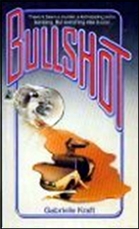
GABRIELLE KRAFT – Bullshot. Jerry Zalman #1. Pocket, paperback original; 1st printing, 1987.

   Jerry Zalman is an updated version of Perry Mason, you might say, a Beverly Hills lawyer with a zest for the good life (California style). He even finds his own bodies when business is slow, but he hot-tubs the girls he meets on the job, which Perry never did.

   Anybody who goes to bed with a blue-velvet sleep mask is not likely to becomes one of my favorite detective heroes. All that kept me reading was that this case involves a monumental collection of rock & roll memorabilia. [Otherwise], insipid. As bad as a made-for-TV movie.

— Reprinted from Mystery.File.4, March 1988.

The Jerry Zalman series —

1. Bullshot (1987)
2. Screwdriver (1988)
3. Let’s Rob Roy (1989)
4. Bloody Mary (1990)

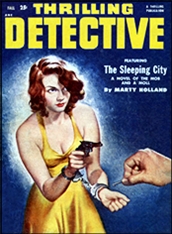
THRILLING DETECTIVE. Fall 1952. Overall rating: *½

MARTY HOLLAND “The Sleeping City.” Novel. Plainsclothesman Wade Reed is assigned as undercover job posing as a Chicago gunman in town to help out with a bank robbery, In spite of a fiancee waiting for him, he falls for a monster’s moll and nearly turns criminal. Capture means the girl’s death and Reed’s resignation from the force. The literary symbolism which is included is forced, generally trying too hard (2)

JOE BRENNAN “Dive and Die,” A stunt diver, recently returned from Korea, investigates the death of his former partner. (1)

JEAN LESLIE “Dead Man’s Shoes.” The sad history of a pair of shoes is traced. Almost Woolrichian in tone. (2)

WILLIAM G. BOGART “Death Lies Deep.” Novelet. Almost standard private eye story. Steve Morgan is hired by an old flame to find her husband, whom she has already killed. Guess who would be the fall guy? (1)

AL STORM “Alive by Mistake.” A writer becomes the center of a hurricane of death about him, as he hunts down a narcotics peddler. Bad writing, but has excitement. (1)

PHILIP KETCHUM “Backfire.” A kid is framed fo robbery and murder by his best friend. Mostly miserable. (1)

HARVEY WEINSTEIN “Two-for-One Dame.” Confused and confusing story of a treacherous blonde. (0)

WILLIAM L. JACKSON “Run of Luck.” Escaped killer fouls his own getaway, (2)

— March 1969.

   It is a certain time of the year, and a busy time, but I don’t remember as busy as I have been for the past few weeks, and I think the paucity of posts here over the same period of time shows it.

   I have been thinking about this today and have decided to take a week off and recharge myself. Maybe less than a week, but not more. It’s time to have a little more free time again. and a few days off from doing the blog is going to help make sure of it.

   Best wishes for those of you in the US over this Thanksgiving break, and for everyone else around the world as well!

TOO MANY GIRLS. RKO Pictures, 1940. Lucille Ball, Richard Carlson, Ann Miller, Eddie Bracken, Frances Langford, Desi Arnaz. Director: George Abbott.

   When four football players are hired as bodyguards for a wealthy man’s strong-willed daughter,they all go off to Pottawatomie College, where she meets a secret lover. As the semester goes on, however, she finds herself falling for someone else.

   One of the bodyguards, that is, and it isn’t Desi. Lucille Ball was a delectable long-legged damsel in her early days, and even if she doesn’t do her own singing here. she is still quite an eyeful. She is also the only reason anyone should watch this sappy movie.

— Reprinted from Movie.File.2, April 1988.


« Previous PageNext Page »