By profession a dedicated newspaperman and sportswriter, Charles Einstein also dabbled in writing mystery and crime fiction. He died last week, and a more fitting and heartfelt tribute to him could not be found anywhere than this one by crime writer Wallace Stroby, who was also his editor at The Newark Star-Ledger for several years, not to mention a very close friend.

   You should read the entire piece yourself, of course, and I hope you will, but to illustrate what kind of interesting family Mr. Einstein came from, here are couple of paragraphs I’ve taken the liberty of excerpting from it:

   “His father was Harry Einstein, a radio, vaudeville and film comedian who billed himself as ‘Parkyakarkus’ and was a regular on Eddie Cantor’s NBC broadcast (he also became posthumously famous for suffering a fatal heart attack at a Friar’s Club roast in 1958, when tablemate Milton Berle’s cries of ‘Is there a doctor in the house?’ were misconstrued as shtick).

   “Charlie had two half-brothers as well, from his father’s second marriage – Albert Einstein and Bob Einstein. Albert, of course, eventually became writer/director/comedian Albert Brooks, and Bob went on to cable fame as ‘Super Dave Osborn’ and is now a regular on HBO’s Curb Your Enthusiasm.”

   As a sportswriter, Charles Einstein was, among other honors, a lifetime member of the Baseball Writers Association of America. His works include four Fireside Books of Baseball, The New Baseball Reader, and (with Willie Mays) Born to Play Ball and My Life In and Out of Baseball.
Spur

   As a mystery writer, his resume, while significant, is not nearly as extensive. Here’s a slightly expanded version of Mr. Einstein’s entry in Crime Fiction IV, by Allen J. Hubin:

EINSTEIN, CHARLES (1926-2007)

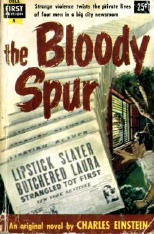
# The Bloody Spur (n.) Dell First Edition #5, pbo, 1953; reprinted as While the City Sleeps (Dell D86, 1956)
# Wiretap! (n.) Dell First Edition #76, pbo, 1955
# -The Last Laugh (n.) Dell First Edition A121, pbo, 1956
# No Time at All (n.) Simon & Schuster, hc, 1957. Dell, pb, 1958.
# The Naked City (co) Dell First Editon A180, pbo, 1959. Stories based on TV scripts by Stirling Silliphant.

• “And a Merry Christmas to the Force on Patrol”
• “Lady Bug, Lady Bug…”
• Line of Duty
• Meridian
• Nickel Ride
• The Other Face of Goodness
• Susquehanna 7-8367
• The Violent Circle

# The Blackjack Hijack (n) Random House, 1976. Fawcett Crest, pb, no date.

   I called his resume “significant,” and here are some details to back up that statement. First the movies, then the books the films were based on:

      THE MOVIES:

   The Bloody Spur was made into the RKO movie While the City Sleeps, 1956, directed by Fritz Lang. A top-notch film noir / social criticism film about the role of the media (newspapers vs. TV) while a serial killer is on the loose, it sounds as though it should be on DVD but for some reason, it does not seem to be. The movie stars Dana Andrews, George Sanders, Ida Lupino, Vincent Price, Rhonda Fleming, Howard Duff, Thomas Mitchell and Sally Forrest.
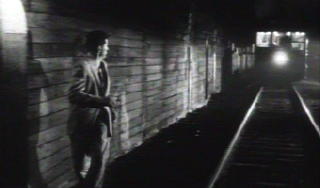
City

   No Time at All was filmed as an episode on Playhouse 90 in 1958. [See the cover of the paperback edition.] Available on video, an online description calls it: “A sort-of Airport of its time, this production tells of a stricken airliner that must make its way through the heaviest air traffic in the world without lights and radio. Among the cast members are William Lundigan, Jane Greer, Betsy Palmer, Keenan Wynn, Charles Bronson, Jack Haley, Buster Keaton, Chico Marx and Sylvia Sidney.”
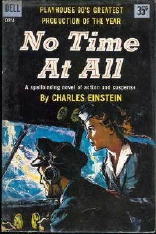
No Time

   The Blackjack Hijack was the basis for the TV movie Nowhere to Run, 1978, starring David Janssen, Stefanie Powers and Allen Garfield. Synopsis of the movie, paraphrased from IMDB: “To get out of his marriage with Marian, world-weary Harry plans to fake his death and assume a new identity. His wife gets suspicious and hires a private eye, but when Harry discovers this, he hires the PI to work for him instead.”

      THE BOOKS:

   The Bloody Spur. “‘Help me for gods sake.’ Later the doctors would use these words to decipher the riddle of a perverted killer. Right now, the lipstick scrawl signaled the start of New York’s greatest manhunt.
   “And in the city room of the fabulous Kyne News empire, four big-time newsmen went into action. All four knew that an exclusive beat on the killings would mean the top job at Kyne – and they were all hungry for the job. Hungry enough to buck the police, sell out their mistresses, and commit blackmail. Four decent men – corrupted by the blood spur of ambition.”

   Wiretap! “Men with a golden ear. In the city of Aimerly they were the cops, the city prosecutor, the rackets boss. Their electronic spies recorded the intimacies of boudoir and office – intimacies later priced, and paid for.in cash or blood. Then a judge who knew where all the bodies were buried got himself murdered. And Sam Murray, State Crime Commission, walked into a maze of tapped phones, secret cameras, hidden mikes. Various people tried to sidetrack Sam, with the help of two ladies who were specialists at their work. But when Sam kept pushing, they gave him a choice – rot in jail, or send the last honest man in town to do it for him.”

   The Last Laugh. “Sam Prior was an off-stage straight man for Carl Anda and Jay-Jay Bailey, whom readers should be careful not to confuse with real-life entertainers, living or dead. And he was a straight man for his wife Rachel, whom he should have left where he found her, singing with her hips at a Borscht Circuit hotel. He tells his own story in his own words, warm and wry and funny. He’s a nice guy, and in the dog-eat-dog world of professional comics, they eat nice guys for breakfast.”
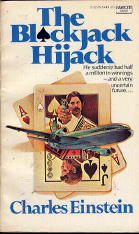
Hijack

   The Blackjack Hijack. About the author, taken from the dust jacket flap: “In a career that has included years as a wire-service newsman and feature writer in New York and Chicago, and as columnist and editor for two San Francisco dailies, Charles Einstein also has authored several hundred other works — books, screenplays, short stories, magazine articles. The Blackjack Hijack is his ninth novel and, he notes, the first in which he appears as a character in his own book, playing the part of an expert on the game of blackjack. Here art imitates life: in 1968 author Einstein published another book – now in its fourth printing and hailed by ranking computer programmers and other mathematicians as the best and simplest in the field — called How to Win at Blackjack. Both born in New England in the late 1920’s, the author and his wife first met as undergraduates at the University of Chicago, and with their four children, now all in their twenties, migrated subsequently from New York to Arizona to California.”
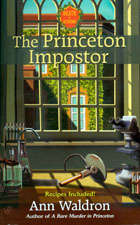
ANN WALDRON – The Princeton Imposter

Berkley, paperback original. First printing, January 2007

   This is the fifth mystery novel from Ann Waldron’s pen, all of them in her McLeod Dulaney series. According to her website, she’s also the author of a number of well-regarded biographies and a number of children’s books, both fiction and non.

   Like her fictional character – who’s female, by the way, which I’d better add in case you’re seeing her name for the first time and you’re not sure – Ann Waldron has been a journalist and writer her entire working career. For the record, here’s the list of all five of her mysteries, each of them taking place in and around Princeton University:

The Princeton Murders. Berkley, pbo; January 2003.
Death of a Princeton President. Berkley, pbo; February 2004.
Unholy Death in Princeton. Berkley, pbo; March 2005.
A Rare Murder in Princeton. Berkley, pbo; April 2006.
The Princeton Imposter. Berkley, pbo; January 2007.

   I imagine you see the pattern here as well as I do. Whenever McLeod Dulaney is on campus, that’s the semester you should be heading abroad or taking a sabbatical. McLeod herself is not a full-time faculty member; she’s an award-winning journalist and a visiting professor from Florida who teaches one course in journalism a year at Princeton University. Not so coincidentally, that is precisely where the author herself began working more than 30 years ago.

Imposter

   Which is why the love of the school and campus – the students, the staff and the professors, the legend and the lore – is as much of a key ingredient of the story as it is. The “imposter” in the title is Greg Pierre, one of McLeod’s better students, an older student who managed to gain admission to the university under an assumed name and falsified credentials. It seems that he’d previously been arrested in Wyoming – on false charges he says – and in order to come to New Jersey, he had to break parole.

   And soon after his arrest the fellow who turned him in is found murdered, a grad student in the chemistry department who (as it turns out) was highly unliked for a number of reasons, which makes for a long list of suspects. But when McLeod’s good friend in the police department, Lt. Nick Perry, seems to settle in on Pierre as the most likely of them – no surprise there – she thinks otherwise, and she sets out to prove it.

   Waldron writes in short, crisp, no-nonsense sentences, and McLeod Dulaney, in a number of ways her fictional alter ego, perhaps, conducts her investigation in very much the same style. Investigative journalists, by the nature of their profession, soon acquire the knack of asking questions in a way that people answering them sometimes reveal more than they intended, or if not, they quickly find another line of work. McLeod doesn’t need to worry on that account.

   On the other hand, while she does a whole lot of detecting, she does not do a whole lot of deducting. (One does not necessarily imply the other.) First she decides that this student is the guilty party, then that professor, and as a result, she always seems to be one step behind – she doesn’t ever seem to catch up. Which of course leads to the ending. In my book, it comes as a letdown, leaving the reader (me) feel caught standing on the wrong foot at the wrong time, or should that be the right time? It also feels cluttered — more for dramatic effect, I thought, than for any other reason.

   Overall, then? Here’s a book that’s well worth reading for anyone who’s fond of mysteries which either take place in academic locales or rank well above average in the writing department, or both. You can take my other caveat for whatever it might be worth.

— January 2007

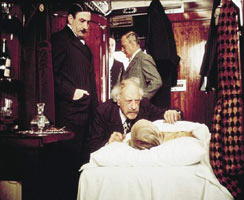
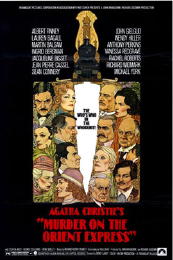
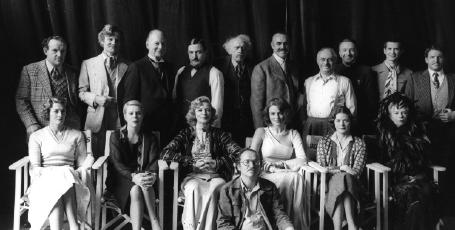
MURDER ON THE ORIENT EXPRESS. Paramount, 1974. Albert Finney, Lauren Bacall, Martin Balsam, Ingrid Bergman, Jacqueline Bisset, Jean-Pierre Cassel, Sean Connery, John Gielgud, Wendy Hiller, Anthony Perkins, Denis Quilley, Vanessa Redgrave, Rachel Roberts, Richard Widmark, Michael York, George Coulouris. Directed by Sidney Lumet.

Group

   They don’t make movies with all-star casts like this anymore, and maybe for a couple of good reasons. First of all, I don’t think you can convince me that in this modern, contemporary era of movie-making there are enough stars with the on-screen magnitude to match the ones you see above to make a film like this today.

   And secondly — and here’s a point in favor of the small-scale modern day casting — having too many stars can sometimes detract from the story and divert the audience’s attention away from it.

   Your eye sees the star, in other words, and you don’t see the character. The actors play roles rather than disappearing into parts. It probably can’t be helped in extravaganzas like this, but — and this is a rather subtle “but” — in thinking it over afterward, in terms of this grand, elaborate production of one of Agatha Christie’s masterpieces of deductive detective fiction, it may have even helped.

Still

   I’m sorry if I’m being cryptic here, but if you’ve seen the movie, it’s possible that you very well know what I mean.

   Before going on, and perhaps I shouldn’t admit it, but last night was the first time I’ve seen the film. I don’t know how I missed it when it first came out, or if I did, I’ve forgotten it completely, and I hardly believe I could have done that.

   So in what follows, you’re getting my opinion as it’s just been formed, with a “mature” eye, and not by the eye of a 30-something. (Notice that I put “mature” in quotes, keeping in mind that being old enough to collect Social Security does not necessarily imply mature.)

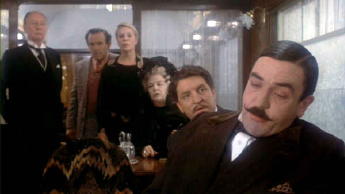
   Albert Finney as Poirot. Other than the later BBC productions with David Suchet, and I regret to say that I have seen only one of them, I think too many actors play Poirot as a comic character, what with his large assortment of eccentric mannerisms and sometimes faulty English.

   In the opening minutes of Orient Express, I could feel myself cringing at the anticipation of yet another performance played for laughs, but when Poirot gets down the business of solving the murder of a notorious crime figure traveling incognito on the train heading from Istanbul to England, he is exactly that. Down to business.

   The final scene, confronting the group of passengers who are the only suspects on the snowbound Express, takes at least 20 minutes of intense revelation, going over the clues and the deductions the Belgian detective made from them.

   I should have timed how long the scene actually takes. I know that I’ve read somewhere that filming the scene, in the restricted confines of the dining car, took several days. I can believe it.

Still2

   Luckily the flashback scenes, with the crime being reconstructed, piece by piece, break up the sequence of talking heads in a rhythm that slowly builds and builds upon itself.

   Even so, the lack of action that this approach entails means that there’s hardly action enough to suit modern day audiences, or am I only being cynical again?

   Finney is probably the only actor to play a detective concerned with clues and not the third-degree in back rooms to have been nominated for an Oscar, but on second thought, without going to check on it, there’s a finite chance that I’m wrong about that.

   But as for his performance, as regarded by others, according to IMDB: “An 84-year-old Agatha Christie attended the movie premiere in November of 1974. It was the only film adaptation in her lifetime that she was completely satisfied with. In particular, she felt that Albert Finney’s performance came closest to her idea of Poirot. She died fourteen months later, on January 12, 1976.”

   If she was pleased, then how I dare say anything otherwise? I can’t, and I don’t. As for the rest of the cast, while I enjoyed Lauren Bacall’s role as the the outspoken (and never stopping) American tourist more, it was Ingrid Bergman who actually won an Oscar, for her much briefer part as a semi-demented Swedish missionary lady. A good performance, even a very good one, but I have a feeling it may have been a slow year for the Academy.

   Should I say something about the plot, more than I have so far? Perhaps not, but this is a tour de force of some magnitude, based as it was on the kidnapping and murder of the Lindbergh baby. The book was first published in England in 1934, and as Murder in the Calais Coach in the US later the same year.

Poster

   Before the movie was shown on Turner Classic Movies, which is where I taped it from, the host, Robert Osbourne, pointed out that it took 40 years before the movie could pass the Movie Code. If you know the story, you will know why, and once again, that is all I am able to say about that.

   In terms of the detective work — well, let me tell you a story. Back when I was young, and maybe even younger than that, I decided that the next Agatha Christie novel I read, by golly I was going to take detailed notes and actually solve the murder myself. Well I did, and I didn’t.

   I was so upset at how the crime was committed and who did it that I literally threw the book across the room. Carefully, of course.

   The movie was extremely successful. Albert Finney was asked, but he turned down the opportunity to play Poirot again. Peter Ustinov, chosen in his place, played the part in Death on the Nile (1978), Evil Under the Sun (1982), and Appointment with Death (1988).

   He also appeared in three made-for-TV films: Thirteen at Dinner (1985), Dead Man’s Folly (1986), and Murder in Three Acts (1986). From what I remember — I haven’t seen any of these films in a while — I mostly regretted Ustinov in the role. Albert Finney, I think I could have gotten used to, now that I’ve had some time to think it over, and even more so as time goes on.

[UPDATE] 03-11-07. Looking back on my comments above, I regret not saying more about the opening terminal scene with the passengers boarding the train in the Istanbul station. Beautifully photographed, highly choreographed, and true to the period, it is nearly worth the price of admission in itself.

   Before I say anything more about it, though, I’m going to have to go back and watch it again. It was far too “visual” the first time, but for me, opening scenes often are. I find myself trying to make sure I’m not missing anything of the story while, at the same time, I’m struggling to take in everything there is to see. Delightful!

[A little bit later.] It was too hard to resist. I’ve just ordered the DVD from Amazon, the version with director Sidney Lumet’s commentary on “The Making of the Movie,” and who should know more how the movie was made than he?

   There’s good news tonight!

   Taken from publisher Fender Tucker’s latest email newsletter, Ramble House Rambler #52, along with the other upcoming mystery fiction he’s promising to go to press with soon, I was doubly delighted this evening to see the following:

   Two books by Wade Wright, author of the Paul Cameron series. ECHO OF FEAR and DEATH AT NOSTALGIA STREET. The author, who lives in South Africa, is working with Ramble House to bring back all of his mystery novels.

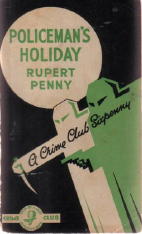
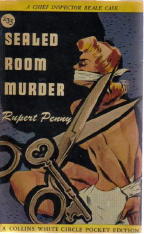
   Two novels from Rupert Penny, whose mysteries are filled with puzzles, time-charts, maps, railway schedules, etc. Thanks to friends in high places — Petaluma CA and Rockville MD — I was able to obtain copies of two hard-to-find titles: POLICEMAN’S HOLIDAY and POLICEMAN’S EVIDENCE. I’m working on them now.

   Delighted first of all because, as you may recall, John “Wade” Wright was interviewed here not too long ago. These will be the first US editions of any of his novels. It’s been a long wait, but it shouldn’t be too much longer. And if more are coming, as Fender seems to suggest, then all the better.

   As for Rupert Penny, he’s an author that I’ve always assumed to be a huge insiders’ secret. He wrote eight extremely scarce works of solid detective fiction between 1936 and 1941, and I’m lucky enough to have seven of them. I bought them back when they were still hard to find, but when you did, they were still relatively inexpensive. I don’t believe that I paid more than ten dollars for any one of them, but 30 to 35 years ago, ten dollars was a huge pile of change.

Holiday

   Only two of the books are available on ABE at the moment. There is one copy of Sealed Room Murder, a Canadian paperback in VG condition for $145, and six copies of Policeman’s Holiday, all in paperback also, with asking prices ranging from $65 (a very worn reading copy) to $165. I haven’t checked the other online listing sites, but right now, not a single hardcover first edition is being offered on ABE.

   The Ramble House editions will be the first time that any of Rupert Penny’s will be available in the US. To whet your appetite, here’s a synopsis of Sealed-Room Murder. If your reading tastes are anything like mine, this will be hard to resist. (Unfortunately it’s not one of the book currently on Fender’s schedule, but I think it will get your mind thinking in the right direction.)

RUPERT PENNY excels all his previous form with this highly successful murder mystery. Unlike most “sealed-room ” stories, the problem is perfectly clear-cut and extremely simple in its elements. Where other mysteries try to baffle the reader by their complexity, this one will baffle by its simplicity. The story of Harriet Steele and the family that was forced upon her, is good reading even when considered as a straight novel, the situation is very real, very familiar and always lively and amusing in spite of the undertone of grimness. The thoroughly ingenious and exciting crime is put before the reader with scrupulous fairness so that he has every possible chance of leaping to the solution that will prove completely satisfying.

Sealed

   From Allen J. Hubin’s Crime Fiction IV, to whet your taste buds even more, assuming perhaps that the first two sell well, and that Fender can locate copies of the rest of them to reprint:

PENNY, RUPERT; pseudonym of Ernest Basil Charles Thornett. Series Character in all titles: Insp. (Chief Insp.) Edward (Ted) Beale.

* The Talkative Policeman (n.) Collins 1936
* Policeman in Armour (n.) Collins 1937
* Policeman’s Holiday (n.) Collins 1937
* The Lucky Policeman (n.) Collins 1938
* Policeman’s Evidence (n.) Collins 1938
* She Had to Have Gas (n.) Collins 1939
* Sweet Poison (n.) Collins 1940
* Sealed-Room Murder (n.) Collins 1941

   As part of the review that Mary Reed just did of Mary Roberts Rinehart’s When a Man Marries, it was noted that a free online edition exists. Here’s a complete list of all of MRR’s books which can be found on the Project Gutenberg website.

   * = title in Crime Fiction IV, by Allan J. Hubin.

   ** = title listed as having marginal crime content in CFIV.


Project Gutenberg Titles by

Mary Roberts Rinehart


* The After House (1914)

The Amazing Interlude

Bab: A Sub-Deb

* The Bat: A Novel From the Play by Mary Roberts Rinehart & Avery Hopwood (1926)

** The Breaking Point (1922)

* The Case of Jennie Brice (1913)

* The Circular Staircase (1908)

* The Confession, a short novel co-published with Sight Unseen (1921)

** Dangerous Days (1919)

K

Kings, Queens, and Pawns: An American Woman at the Front

Long Live the King

** Love Stories (1919; short story collection)

* The Man in Lower Ten (1909)

A Poor Wise Man

* Sight Unseen, a short novel co-published with The Confession (1921)

The Street of Seven Stars

* Tish: The Chronicle of Her Escapades and Excursions (1916; short story collection, some criminous)

The Truce of God

* When There’s a Will (1912)

** When a Man Marries (1909)

   Following my recent review of Mary Roberts Rinehart’s The Yellow Room, mystery writer Mary Reed posted this on the Yahoo Golden Age of Detection list as a follow-up companion piece. The crime element in When a Man Marries is so slight that the book is not currently included in Allen J. Hubin’s Crime Fiction IV, but as Mary will suggest, perhaps it should be.

   When a Man Marries is available online in etext form at the Gutenberg Project. Mary also points out that some additional biographical information on Mrs. Rinehart can be found online, including this website as a prime example.

   Mary Reed has her own website, shared with her co-author Eric Mayer; you are cordially invited to stop by. Mary and Eric also did a Pro-File interview for the original Mystery*File website before it went on its current long hiatus.

— Steve

Rinehart

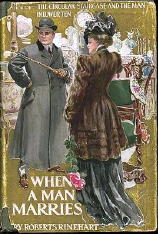
MARY ROBERTS RINEHART – When a Man Marries (Bobbs-Merrill; hc, 1909. Hardcover reprint: Grossett & Dunlap, no date. Wildside Press, trade ppbk, 2004)

   Being excessively fond of locked room mysteries, imagine my delight once I began reading When A Man Marries to find it based on a twist on same. Set in a house full of Bright Young Things (sent up mercilessly by the author, Mary Roberts Rinehart, whose The Circular Staircase is occasionally mentioned within these walls) the plot unspools as several BYT’s suddenly find themselves sequestered in a large house under quarantine because the butler has just been stricken with smallpox.

   Meantime, the protagonist has agreed to pretend to be the wife of the house owner. This came about because the BYTs are attending a dinner party at the house, during which their host learns his dragon of an aunt — who holds the purse strings — is coming for an unexpected visit. This rich aunt has not been told he is now divorced because then the flow of money would end (fortunately she hasn’t met the now ex-wife). Complications of course ensue including the rest of the servants decamping before the Board of Health quarantines the house, leaving in such haste they do not even bother to tell the master why they are leaving, the ungrateful things.

   There’s a policeman imprisoned in the furnace room, and no sooner is the house and its inhabitants securely locked down for the duration when valuable items such as jewelry start going missing … meanwhile, the ex-wife having arrived just before quarantine was declared is now concealed from the aunt’s eyes in the kitchen below stairs, Rich Aunt is also locked in the house with the entire bunch, and one of other Bright Young (Male) Things foolishly wagers a large sum the entire crew will get out of quarantine within 24 hours — quite illegally of course and talk about chronic lack of social conscience — plus there are newspapers reporters and photographers camping around the house as well as on the roof of the house next door to keep an interested public fully informed.

   It struck me as I read that it would have made a wonderful screwball comedy/mystery with Cary Grant playing the fellow imprisoned engineer from South America, who is most emphatically *not* a BYT. How could you not laugh out loud at the whole frothy affair?

   And I did, Oscar, I did.

[UPDATE] 03-09-07. When I asked Mary to say some more about the criminous content of When a Man Marries, this was her reply:

   I would describe this novel as a romantic comedy with mystery overtones, since the question of who pinched the jewelry plays a less prominent part than in other MRR works, and comes to prominence towards the end of the book. But little hints are planted here and there as I realised when I got to the solution and thought it over a bit.

   Thinking that Al Hubin might like to know this, I sent Mary’s comments on to him. Here’s what his response was, which was pretty much what I suspected it would be:

Steve,

   If anything I guess I err on the side of over-inclusion, and I think I’ll add this with a dash (Addenda #12).

Best,

Al

   Some additional comments on David Hume, discussed first in my review of Requiem for Rogues, with a followup post a few days later. From the Yahoo Golden Age of Detection group is this from Curt Evans:

Steve,

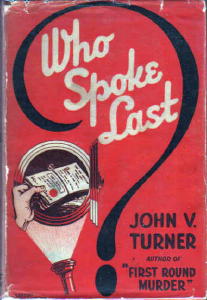
   Murder-Nine and Out involves the boxing world, as does, judging from the dust jacket (the book is for sale for $180 on ABE), Death Must Have Laughed. I would put Murder-Nine and Out in the detection school, as I would the two Ebenezer Buckles I read. But “tough” elements crop up, by which I mean elements associated more with thrillers than with the British genteel school of the Crime Queens. I’ve got another Turner, Who Spoke Last?, which seems to be about crooked financiers, but I have not read it yet. Amos Petrie’s Puzzle sounds interesting, but I have not found a copy.

Curt

Hume

   You’re right. Some of the books that Turner wrote, especially those not as by Hume, are very expensive and hard to find. Wait until you read this from Bill Pronzini, though, who has this to say, plus some show-and-tell afterward:

Steve

   Just read your blog piece on David Hume (John V. Turner). So happens I’ve been collecting his work for years, under his own name and his two pseudonyms. Attached is some biographical info, photos, and a sketch from the DJ’s of three of his U.K. mysteries. I can send you some cover scans as well, if you like — Humes, Bradys, and Turners.

   The Cardby novels are enjoyable Edgar Wallace type gangster stuff, and comprised his most popular series in England, but for my taste his other two series are better — the Reverend Ebenezer Buckles as by Nicholas Brady and the Amos Petries as by J.V. Turner. These are Golden Age fair-play mysteries with more spice than is usual in the breed.

   One of the Reverend Buckle tales, Ebenezer Investigates, for instance, deals with the murder of a pregnant young village woman who had relations with several different men; the subject matter was evidently considered too controversial for its day (1934) for Holt, which published a couple of the other Buckle mysteries, to bring it out here. One of the titles that Holt did publish, Carnival Murder (The Fair Murder in the UK), is a first-rate macabre puzzler set at a village fete at which a small traveling carnival is the main feature.

   Two of the Amos Petrie novels are “impossible crime” tales of some ingenuity; the best of them is First Round Murder (Death Must Have Laughed in the UK), which has a boxing background and concerns the baffling murder of a fighter in the midst of a bout.

Best,
Bill

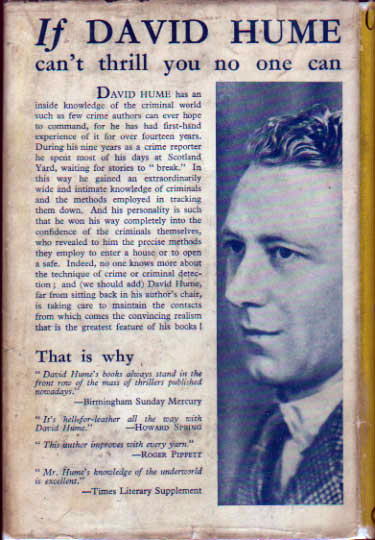
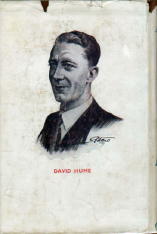
   I’ve used one of the cover scans to lead off this blog entry, and I used the back cover sketch of Hume�s face on the previous Hume-Turner post. I�ll post one of the back covers with the biographical info at the bottom of this post � I hope you can make out the print! The rest of the covers I’ve uploaded on a separate page where you can see them more clearly. Go take a look. It�s worth the trip!

Back Cover

[UPDATE] From Bill Pronzini: Attached are three more scans which you might want to include, two Humes and a Turner.

   Curt Evans is right about the grotesque elements of The Carnival Murder; grisly might even be a better word.

   Most of the other books I have by Turner under his three names are jacketless, unfortunately. One of these is the Turner title Curt mentioned, Amos Petrie’s Puzzle. It’s not as good as the two of the “impossibles,” First Round Murder and The House of Strange Guests, but still enjoyable. Concerns the murder at a country house party of the owner of three West End theatres, after the gent received an anonymous threatening note stating “Millionaires Must Die.” Theatre folk and film stars are among the suspects, and as usual with Turner’s detective novels, there are both bizarre and sexual aspects to the case. Amateur sleuth Petrie is on hand to solve it with the aid of his long-suffering friend, Inspector Ripple of Scotland Yard.

Best,

Bill

The covers page has been revamped, with the new scans added. Thanks! –Steve

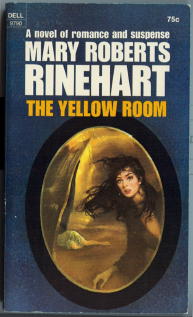
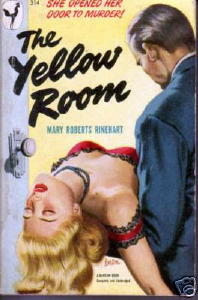
MARY ROBERTS RINEHART – The Yellow Room

Dell 9790; paperback reprint, later printing, April 1971. Hardcover, first edition: Farrar & Rinehart, 1945. Previously (?) published as an eight-part serial in The Saturday Evening Post, September 28 through October 27, 1945. Cassell & Co., UK hardcover, 1949; Thriller Book Club, UK hardcover, 1950.

Rinehart1

Bestseller B95, digest pb, 1947. Bantam 314, pb, April 1949. Other Dell paperback editions include: Dell D179, 1956; Dell 9790, October 1962; Dell 9790, 1967. Also: Zebra (Kensington), pb, 1973, 1988, 1990 (3rd pr.), 1991, 1996 (5th pr.). Included in Mary Roberts Rinehart: Three Complete Novels by America’s Mistress of Mystery [contents: The Bat, The Haunted Lady, and The Yellow Room] Zebra, pb, 1995.

   It is quite possible that I’ve missed a few editions of this book. In particular, there are at least nine listings on ABE of a hardcover edition from 1955 (Farrar & Rinehart), but whether that’s a misprint or no, I do not presently know. There may also have been a US hardcover book club edition, but with no definitive information to back this statement up, I have not included it. Suffice it to say, however, if you’d like to locate a copy of this book to read, even a hardcover edition, you shouldn’t have any trouble.

   Rinehart’s writing career, as least as far as her novels and collections are concerned, began with The Man in Lower Ten from Bobbs-Merrill in 1909, but the story’s even earlier appearance was in serialized form, in All-Story Magazine for January through April, 1906.

   According to various online sources which I haven’t attempted to verify, Rinehart suffered a severe heart attack in 1938 while living in Maine, and apparently was a semi-invalid for much of her later life. In any case, from that time on there were only four more novels to come from her pen – she never used a typewriter, according to one source – and of those, The Yellow Room is next to last. Only The Swimming Pool (1952) came later. (This statement excludes several collections of novelettes and short stories.) Still perhaps one of the most famous mystery writers of all time, Mary Roberts Rinehart died in 1958.

   Appearing after a three-year gap, following Haunted Lady in 1942, The Yellow Room was written when the author was 67, which may go a long way in explaining some apparent slippage in the her writing ability, or perhaps the flaws I saw were always present. I will have to rely on someone more familiar with her earlier work than I am to be able to say more.

   The book itself takes place in 1944, and the opening chapters go far in describing the general difficulties of life at home in wartime, what with rationing, limited travel opportunities, the absence of men except for the oldest and/or the feeblest, and the hardest of all – waiting for news of loved ones fighting (or reported missing) on the front lines. When Carol Spencer’s invalid mother wishes to move from New York City to the family’s summer home in Maine, it is up to Carol, with only three female servants to assist, to tackle the work involved in doing so.

   Little did she suspect or know – and yes, that’s the kind of book that Mrs. Rinehart is famous for writing – that she would find the house still shut up and not opened. Lucy, a local woman who is the housekeeper, she learns the next day, is in the hospital with a broken leg. Lights have been seen in the house, Carol is told, shining from the room where Lucy says she never was before her accident.

Rinehart2

   Another discovery occurs on page 27: Another woman is found dead in a linen closet, partially burned as if someone had been hoping to dispose of her body. When asked, Lucy’s story does not ring true; there is something she is not telling. And it is precisely here that the reader’s frustration begins, or at least they did with at least one reader: me. There are many, many questions that if asked are not answered, and there other questions that seem never to be asked, and if they were answered, at the right time and the right place, the mystery – one has the uncomfortable feeling – would, at that time and that place, simply cease to exist.

   Coming to Carol’s aid is her next-door neighbor, the worldly but still young Major Dane, who has been injured from work for US Intelligence, or so it seems. He has been recuperating in the area until deemed fit to go back to duty. The police, generally speaking, are of little or no help. Truth be said, they seem far more antagonistic toward Carol than any evidence seems to say they should be.

   By page 126 – I jotted a note to myself to this effect at this exact spot, so I am indeed able to be this precise – the facts, what there are of them, are so far muddled that the average reader, it seems to me, will either (A) have given up or (B) have shrugged their shoulders and allowed themselves to follow along, no more and no less, just to see where the author may be headed. There are 256 pages of small print, so at page 126, it is an important decision that must be made whether or not to stop or plunge on, keep going, and rely on the author’s name and reputation that the story may yet be salvaged.

   I often exaggerate, and the previous paragraph is one of those times, but not by much. Considering Major Dame, who by proximity feels himself becoming closer and closer to Carol, to be the primary detective, there are too many times when we (the reader) are not given total access to his thoughts, and too many other times when the point of view has shifted, and we (the still faithful reader) are shown scenes that Dane knows nothing about.

   Frustration, yes, but please (if you are ever the reader) keep the faith. The ending, with all of its revelations, is worth waiting for. Mrs. Rinehart has some nifty tricks up her sleeve for you. Even though the buildup to the final couple of chapters might have been more capably accomplished, and whether the end result is realistic or not, I think that even at this late stage in her career, in terms of pulling off the (almost) totally unexpected, she still had the right stuff. I feel quite justified in myself in sticking with Plan B.

— written in October 2006.


[UPDATE] 03-10-07. For more about Mary Roberts Rinehart, see Michael Grost’s informative article about her career as a writer on his extremely comprehensive Guide to Classical Mystery and Detection website.

   Following my review of Requiem for Rogues and my overview of author David Hume’s career, I received enough follow-up comments to warrant making an entire blog entry out of them. First from the Yahoo Golden Age of Detection group, here’s a reply from Curt Evans:

Steve,

   My survey of Turner did not indicate to me that he was a lost great. The Hume books seemed beat ’em up thrillers. The Turner and Brady books are more detection, with amateurs Amos Petrie and Ebenezer Buckle. It looks like Turner had his feet planted firmly in both schools of mystery fiction. I’ve read a couple of the Petries and Buckles, but the only one that stood out in any way for me was The Fair Murder, which had some quite exceptionally grotesque elements – it certainly is not cosy!

Curt

Hume

   In my review and other commentary, I wondered about Turner’s death at the young age of 45. Victor Berch discovered his obituary in the NY Times [dated 02-06-45], but nothing in it referred to the cause of his passing. He had died the day earlier. I’ll quote briefly from the obituary anyway:

   “Formerly a Fleet Street reporter, Mr. Turner left journalism to devote his time to writing thrillers, and while still in his early thirties was often called ‘the second Edgar Wallace.’ At one period he wrote a novel a fortnight.

   “Frequently he spent weeks at a time living in London’s underworld to mix with criminals.

   “A reviewer of [They Called Him Death, 1934/35] in The New York Times commented, ‘Swift action and plenty of it make this story a good example of the mystery-adventure type of thriller. If you prefer subtle deduction, you must look elsewhere.'”

   I also wondered about Mick Cardby and whether his father should be also included as a series character in Allen J. Hubin’s Crime Fiction IV. Al replied:

Steve,

   As for the Cardbys, Bill Lofts has this to say:

   “The business of Cardby & Son, private detectives of Henrietta Street, Covent Garden, had been built up with the trust of both police and crooks. Whilst Mick Cardby was the younger and more prominent, Cardby senior had spent twenty years of distinguished service at Scotland Yard, reaching the rank of Chief Inspector.”

   I owned 33 David Hume titles once upon a time, and I rather think I chose Cardby the younger because that’s the way the books were promoted … as Mick Cardby tales.

Best,

Al

   Altogether you’ve certainly convinced me that Mick Cardby, the son, is the principal player, with the father taking the lesser role. Mick Cardby books, they are!

   Many thanks to Curt, Victor and Al for filling in some of the details on J. V. Turner, a/k/a David Hume. As usual, gents, it’s been a pleasure.

   And by the not-so-insignificant way, I missed the quote from the Bill Lofts website the other day, and I shouldn’t have. And neither should you, if you are interested in mysteries published during the Golden Age of Detection and certainly no later than 1960.

   Entitled The Crime Fighters, by W. O. G. Lofts and Derek Adley, it’s yet another project that Al Hubin is working on, putting online an alphabetical listing of many of the fictional characters found in all of those books, beginning with Pat & Jean Abbott (Frances Crane) and ending with Inspector Furneaux (Louis Tracy).

   Um, yes. Unfortunately, only letters A through F are online and accounted for so far. It’s still worth your time visiting, and if you’re like me, you may stay a while.

   From the Introduction:

   This is essentially a bibliography of the following fictional characters:

      * the private detective
      * the private eye
      * the official police investigator
      * the amateur sleuth
      * the adventurer type of detective, such as Bulldog Drummond and Norman Conquest, who were always on the side of law and order, as well as Robin Hood types like the Saint who were active on both sides
      * the secret service agent of the Tiger Standish type, who nearly always worked with the Special Branch at Scotland Yard (but not those of the James Bond type, who were purely engaged in spying and espionage and rarely worked in collaboration with the police).

   Thus, in general, we cover the fighters of evil-doers, but of course not including the American super-hero of the Superman type. The closest we come to this type is The Shadow and Doc Savage, who, while having certain mystic powers, are nonetheless ordinary men.

   We have endeavoured in the main to include detectives and the like who have appeared in British publications, although we have found that most of those of any repute appearing in book form in this country have likewise appeared in the U.S., and of course the reverse is true.

   Was amazed to see your review of the Valery Shore paperback, Final Payment.
Reason: I’d begun to suspect the book didn’t exist, despite the listing in Hubin, because it has been on my paperback want list for maybe a dozen years and yours is the first copy I’ve ever seen. So happens I collect Major Books — in general, they were the Phoenix Press of 70s paperbacks, more than 50% qualifying as “alternative classics” — and Final Payment is one of only two MB mysteries that I don’t have. And judging by your review, it’s one of the few good ones MB published.

   Also noted your piece on Michael Knerr. I don’t have Travis, the book you reviewed, but do have and have read the Monarch, The Violent Lady. Pretty good adventure/mystery tale set mainly on a 49-foot yawl on a long Caribbean treasure cruise.

>> I almost hated to tell Bill that I paid either a dollar for the copy of Final Payment that I found, plus shipping — or was it a pound, since I bought it on eBay from a seller in England — but sometimes collectors tell each other stories like that. As I did so, I asked him about his overall interests in Major Books, and I guess he’s still talking to me, since he replied:

   I’m interested only in their fiction titles (excluding the pure romances). The other mystery I’m missing besides the Shore is The Breaking Point, by Keith Spore. I have all the MB Westerns, or at least all the ones I know about, and nearly all the Gothics and straight fiction titles.

>> Just in case you were wondering: I collect the Gothics and westerns from Major Books too. That makes at least three of us, since my good friend Dan Roberts collects everything that Major Books published, the straight romances and the non-fiction as well. (To the people we meet in the ordinary world, the three of us look as normal as anyone else.)

« Previous PageNext Page »