Hi Steve

Can you tell me whether your MR. CLACKWORTHY volume from Wildside contains any tales not collected in the two Chelsea House volumes of the 20’s? I have one of them but not the other.

Best wishes for 2007.

Doug Greene
>>>

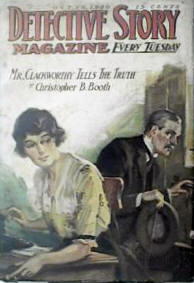
This may be more than the rest of the world wants to know, but after I wrote a review of the first Mr. Clackworthy collection, word got around, and I somehow became known as the expert on the character, who was created by Christopher B. Booth and who first appeared in a long series of stories for Detective Story Magazine. Little did anyone know that the stories in Mr. Clackworthy (Chelsea House, 1925) were all that I knew about the fellow, a gentleman con man who preyed on unscrupulous bankers, stockbrokers and other chiselers, thereby striking a certain chord in the hearts of thousands of readers in the Depression era. The stories were quite popular.
Mr. C

But the limited knowledge that I had certainly did not prevent me from being asked to provide the introduction to the recent Wildside collection of Clackworthy adventures — nor prevent me from accepting for that matter, either.

Which of course obliged me to not completely fake it. Even after the Wildside book was published, I continued to hunt around to find as much information as I could come up with. I have the first and third of the three volumes below, but not the second. The stories in the first of the two Chelsea House books are not identified by name. It’s what’s called a fix-up novel: a collection of stories combined into what is called a novel, but is, simply speaking, a collection of stories combined into a novel, some related to each other, others not.

I suspect, but do not know for sure, that the second Chelsea House collection is structured the same way. For the titles of the stories in both books, I am indebted to Gordon W. Huber’s Chelsea House: A Bibliography (June 2001), with the relevant data sent on to me by Don Davidson. For the first book, I matched the story lines with the titles that Gordon listed, his data coming directly from the Street and Smith files located at Syracuse University. (Street and Smith was the publisher of Detective Story Magazine, among tons of other pulp magazines and dime novels over the first half of the past century.)


THE MR. CLACKWORTHY STORY COLLECTIONS:

All of the stories below originally appeared in Detective Story Magazine. There has been no attempt to ascertain which Mr. Clackworthy stories have so far not been collected.

In the first collection, there is one more story than I can match up with a title. Two of the titles have been established by guesswork only, as indicated, and even so, all of the matching should be considered questionable.


MR. CLACKWORTHY
Chelsea House, hardcover, 1925.

Chapters 1-3. The Million Dollar Air Bag. March 9, 1920

Chapters 4-7. Blasted Reputations. March 23, 1920

Chapters 8-10. Painful Extraction. April 27, 1920

Chapters 11-13. The Comeback. May 11, 1920

Chapters 14-20?? Mr. Clackworthy Stakes a Friend. September 28, 1920

Chapters 21-24. Mr. Clackworthy Tells the Truth. October 19, 1920 (a)

Chapters 25-26. [unknown story title]

Chapters 27-28?? A Modern Lazarus. March 30, 1920

Chapters 29-32. Mr. Clackworthy Digs a Hole. July 16, 1921

(a) Contained in the Wildside collection below.


In the second collection, the following titles have been identified. They may not appear in this order in the book, which I have not seen.

MR. CLACKWORTHY, CON MAN
Chelsea House, hardcover, 1927.

Mr. Clackworthy Forgets His Tonic. January 14, 1922

When Mr. Clackworthy Needed a Bracer. January 21, 1922

Mr. Clackworthy and the Auto Rim. January 28, 1922

Mr. Clackworthy Sells a Gold Brick. March 25, 1922

Clackworthy Coddles a Contract. June 3, 1922

Mr. Clackworthy Pays His Income Tax. June 9, 1923

Mr. Clackworthy Takes a Dip in Rye. June 30, 1923

Mr. Clackworthy Tips a Teapot. April 19, 1924


In this latest collection, there seems to be only one overlap with either of the earlier ones.

THE ADVENTURES OF MR. CLACKWORTHY
Wildside Press. Hardcover & Trade Paperback, 2006.

Mr. Clackworthy Tells the Truth. October 19, 1920 (a)

Mr. Clackworthy Within the Law. August 13, 1921

Mr. Clackworthy’s Pipe Dream. March 11, 1922

Mr. Clackworthy Turns Chemist. December 17, 1921

Mr. Clackworthy Digs a Hole. July 16, 1921 (b)

Mr. Clackworthy Revives a Town. September 24, 1921

Mr. Clackworthy Sells Short. February 26, 1921 (b)

Mr. Clackworthy’s Pot of Gold. October 7, 1922.

(a) Appeared in the first Chelsea House collection. The story is also available online.

(b) The dates are in error as given on the copyright page. The ones given here are correct.
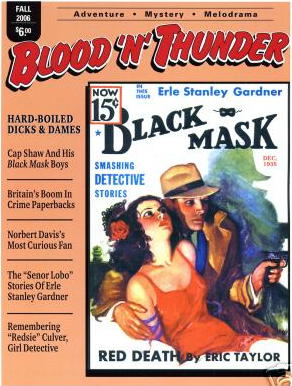
      Blood ‘n’ Thunder magazine is published more or less quarterly by Ed Hulse, and every issue seems to be better than the one before. This is a matter of perspective sometimes, and you may have to take into account that Ed’s coverage includes more than crime and mystery fiction, if that is all that is of interest to you. An overall statement found under the title on the first page reveals the magazine’s purpose a little more fully: Adventure. Mystery. Melodrama.

     Or maybe the title, Blood ‘n’ Thunder, says just about that as well, and wherever the above can be found, the pulps, the movies, chapter serials, old-time radio or the equivalent, Ed, his staff of several, and his crew of writers of many, will be there.

     But this issue is focused on the detective pulp magazines, and perhaps most on the best of them all, Black Mask.

bnt 16

     First up is Monte Herridge, writing about one of the many, many series characters who appeared in the pages of Detective Fiction Weekly: Senor Lobo, soldier of fortune. The author? If you are not well versed in matters pulpish, the answer may surprise you: Erle Stanley Gardner, best known of course as the creator of Perry Mason. Before Perry became an overnight success in the world of hardcover mystery fiction, Gardner produced tons of magazine stories about the adventures of men like Sidney Zoom, the Patent Leather Kid, Lester Leith and a host of others.

     Monte’s suggestion is that Leslie Charteris’s “The Saint” was a model for Senor Lobo, and I’d have to have read more of the latter’s exploits myself before I could agree. But if Monte has read them, and he says it’s so, then neither would I disagree, not one inch.

     I’d like to have seen a checklist of the Senor Lobo stories, which appeared between 1930 and 1934, but other than that, Monte’s flair for describing them makes the article second best only to reading the tales themselves.

     Ed Hulse himself contributes the next piece, one on the series of girl reporter Torchy Blane comedy-mysteries that turned out by Warner Brothers in the late 30s and early 1940s. Starring in most of them was the inimitable Gloria Farrell, and coincidentally enough, over the last week or so I’ve been watching many of them on a video tape that I made a while ago from Turner Classic Movies. They turn up every so often there, and when they do again, don’t miss them.

     What most people don’t realize, unless they — like you and I — well, I know about me, but I can’t be so sure about you — actually read the credits, is that Torchy Blane was based on a character from the pulps, and that the character from the pulps that she was based on was a man, a fellow named Kennedy, whose tales were told in Black Mask by one Frederick Nebel.

     Only the first of the Torchy Blane movies was taken from an actual pulp story, and that was the first one, Smart Blonde. My own opinion is that was the best one, containing more as it did actual crime detecting than it did humor, although the latter definitely was present. And humor became even more present as the series of movies went on.

     A double-starred feature is next for this issue, an interview of Joseph T. Shaw, editor of Black Mask in its heyday, taken from the pages of Writer’s Digest, October 1929. Shaw’s statement of what the magazine was looking for, and the ingredients that in his opinion made the magazine successful then, makes for fascinating reading today.

     Perhaps the most knowledgeable pulp historian around today, Will Murray is next, with an article on Grace Culver, a female sleuth whose stories are hard to find today, appearing as they did in the now highly collectible Shadow magazines, beginning in 1934 and continuing through 1937. Her exploits appeared under the byline of Roswell Brown, but Will’s research shows that the stories were really written by pulp author Jean Francis Webb. Another checklist might have been in order, but I’m only quibbling. A little.

     Whew. I’m only halfway through this issue. Next Alfred Jan contributes a companion piece to one written by Josef Hoffmann which appeared on the original M*F website a short while back. The subject of each is the connection between pulp writer Norbert Davis and famed philosopher Ludwig Wittgenstein. Alfred’s piece is more on Davis’s novels about Doan and Carstairs — the former a hard-boiled detective, the latter his Great Dane companion — than it is the pulps, but that certainly does not make it any less worth reading.

     Up next is Gary Lovisi, long-time publisher of Paperback Parade, who salutes the British gangster digests of the late 1940s and the 1950s. Authors such as Hank Janson, Roland Vane, Stephen Frances, and Darcy Glinto are prevalent in this piece, illustrated profusely by the covers of their books, which are probably as much the reason for their collectibility today as their contents. Unfortunately these covers are only in black and white. If they were in color, they would really knock your eye out. [For more on Darcy Glinto, aka Harold Kelly, and his long involved story and subsequent bibliography, do not miss John Fraser’s mammoth website devoted to the gentleman.]

     Closing up this issue, and perhaps saving the best for last, is a long article by the late E. R. Hagemann (reprinted from Clues magazine) about Cap Shaw, the aforementioned editor of Black Mask, and the process under which the stories for The Hard-Boiled Omnibus (Simon & Schuster, 1946) were chosen. It wasn’t easy. If you are a fan of hard-boiled fiction — and its authors — this is absolutely must reading.

     And so is the entire issue. Following the link at the top should be the easiest way to get a copy. I suggest you act quickly, though, as Ed sometimes runs out.

At present the entry for mystery writer Pat Stadley in Crime Fiction IV, by Allen J. Hubin, looks like this:

STADLEY, PAT (Anna May Gough) (1918- ); Reference: CA (Contemporary Authors)

* * * Autumn of a Hunter (Random, 1970, hc) [California] Collins, 1971. Also published as: The Murder Hunt. Major, 1977.
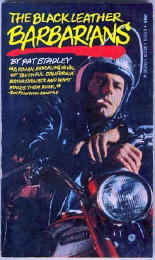
* * * The Black Leather Barbarians (Bobbs, 1960, hc) [Los Angeles, CA]
* * * -Daddy-O (Signet, 1960, pb)
* * _The Murder Hunt (Major, 1977, pb) See: Autumn of a Hunter (Random 1970).

Recently discovered is that Autumn of a Hunter was the basis for the TV movie The Deadly Hunt ( Four Star, 1971; scw: Eric Bercovici, Jerry Ludwig; dir: John Newland).

Searches and double-checking into birth and death dates never end as well. Taken from a recent email, Al reveals what he has learned most lately about Ms. Stadley:

This one is a bit confused, but here’s what I’ve found and what I’ve concluded. Stadley has a CA entry, which gives her birth as 8/31/1918 and her residence as Citrus Heights, California. On the other hand, the social security death benefits record has a Patricia A. Stadley, born 9/1/1917, died 2/27/2003 in Citrus Heights, California. I conclude that this is the author in question and I’m going to adopt the social security dates for CFIV.

A plot description for Autumn of a Hunter might read thusly: “A wealthy woman trying to outrun three hired killers in the woods of the high Sierras is trapped by a forest fire.”

… while the cover blurb on the Signet reprint of The Black Leather Barbarians certainly tells the would-be reader what’s in store:

Stadley

“A rough, revealing novel about youthful California motorcyclists and what makes them roar.” — San Francisco Chronicle.

   
The death date of Phyllis Gordon Demarest, an author now with two credits in Crime Fiction IV, was noted in a previous post on this blog, which concluded with some information provided by Victor Berch about Ms. Demarest’s parents, and her stepfather, actor William Demarest.  Thinking that that was not the end of the story, Victor continued his search into her past.  Here are the results of his investigation:


Some Background Notes on Phyllis Gordon Demarest
by Victor A. Berch


Thursday evening, January 4, 2007.

    Estelle Collette [note the spelling correction] appears to have been the stage name of Phyllis Gordon Demarest’s mother.  She was more than likely first married to Samuel Gordon (1871-1927), the English novelist. At what point in time and why they separated is unclear.  Nor is her real name known.

    In the 1920 U.S. Census, she is listed as Estelle Demarest, living with the actor Carl [William] Demarest as his wife. Living with them was William Demarest’s mother, Minnie [her actual name was Wilhelmina].  It is unclear at that point in time whether Estelle was actually married to Demarest.  Strangely enough, returning from a trip to England on board the S.S. Aquitania, which landed in New York on September 9, 1921, Estelle Collette, violinist, is among the manifest of aliens entering the U.S. As she was required to give the name and address of someone in the U.S. who could vouch for her, she gave the name of C. W. Demarest as her friend, while giving her home address as 16 Burgin Place, Long Island, an address different than that of William Demarest.

    In that same 1920 U.S. Census, Estelle lists her parents as being born in Russia; that is to say, somewhere in the then Russian Empire.  What her real name might have been still remains a mystery.  Samuel Gordon, born in Bavaria, came to England as a young boy.  His father, the Rev. Abraham Elias Gordon, was the leading cantor in the Great Synagogue of London.  I strongly doubt that Samuel Gordon would have married outside of his religion. This leads me to suspect that Estelle Collette was of the Jewish faith.


Friday morning, January 5, 2007.

    After rereading what I had written on Thursday, I was more convinced than ever that Phyllis Gordon Demarest’s mother, Estelle Collette, was indeed using that name as a stage name. That name kept popping up in the newspaper reviews of theatrical acts in which she appeared with William Demarest in the early 1920s.  But what was her real name?  The few theatrical reference books on stage/screen actors kept referring to her as the wife of William Demarest.  No birth or death dates were given for her. 

    Since it had been established that Phyllis Gordon Demarest was the daughter of the English novelist, Samuel Gordon, and the then Mrs. William Demarest, I felt that the answer might lie with Samuel Gordon.


Friday afternoon, January 5, 2007.

    I quickly found an obituary for Samuel Gordon in the New York Times .  He died in London on January 10, 1927.  There was no mention of a wife, but it did say that he was survived by a daughter.  Again, no mention of who she might be.  I then went to the London Times and it carried about the same news as the New York Times. No hint of a wife.

    It then occurred to me that, perhaps with a person of his stature in the Jewish community of England, an obituary could be found in the Jewish Chronicle of London.

    Sure enough, in the January 14, 1927 issue, there was an obituary.  It stated that Samuel Gordon was born September 10, 1871 in Buk, Bavaria [then part of the German Empire].  He had come to England at the age of 12, attending the City of London School and later Cambridge.   Further down, the obituary stated that in 1907 he had married Miss Esther Zichlin, “a violinist of great promise. There was one child of the marriage, a daughter.”  So!  At last, here was the real name of Estelle Collette.

    Who, then, was Esther Zichlin?  And when in 1907 did Samuel Gordon marry her?  I ran her name through the usual genealogical databases that I subscribe to and the only hit that I got was one that gave her marriage date as sometime in the April to June quarter of 1907.  Well, that certainly narrowed the time frame that I would need for examination of those issues of the Jewish Chronicle for a wedding announcement.

    Within a half an hour I did find an article announcing the marriage of Samuel Gordon and Esther Zichlin in the June 14, 1907 issue of the Jewish Chronicle.  They had been married on June 12th.  There were even  photographs of the bride and the groom.

    There was a short description of the wedding, but there was no mention of any relatives of the bride at the wedding.   She had been given away as a bride by Samuel Gordon’s father, the Rev. A. E. Gordon, and she was attended by the two-year old niece of the groom.  The best man was Samuel Gordon’s brother, Leo.

    Again I asked myself “Who was Esther Zichlin?” As Estelle Collette, she claimed to have been born in England.  As Estelle Demarest, the SSDI gave her birth and death dates as October 26, 1886 and November 19, 1968 and her birthplace was given as England.  Therefore, she should have appeared somewhere in either the 1891 or 1901 English Census.  Such was not the case.  Perhaps, when the 1911 English Census appears, we might learn Esther Gordon’s real nationality. (Unlike the US Census records, those wishing to access the English Census records are required to wait until 100 years have elapsed).

    I also ran the name Zichlin through other genealogical databases without any luck.  But there were quite a few Polish and Jewish last names for Zychlinski or Zychlinsky (a name meaning someone from the town of  Zychlin).  My conjecture about her early life is that she was born in Russia/Poland and sent to England as a young girl to advance her studies.

    There is one minor correction to be made in the the previous posting about Phyllis Gordon Demarest.  I’m not sure who is to blame for the mistranscription of PGD’s birth date.  She was born 3/31/1908, not 3/13/1908.  That date of birth was confirmed in the Jewish Chronicle of April 3, 1908.


Copyright © 2007 by Victor A. Berch.

Quoting from the online edition of the Fresno Bee:

Albert Isaac “Buzz” Bezzerides, born in Ottoman Turkey to an Armenian mother and Greek father, grew up in Fresno in the same era as author William Saroyan. […] Mr. Bezzerides, who moved to Southern California as an adult, fell and suffered a broken hip late last year. He died New Year’s Day in a Los Angeles hospital. He was 98.

Here is his entry in Crime Fiction IV, by Allen J. Hubin:

BEZZERIDES, A(lbert) I(saac) (1908- )

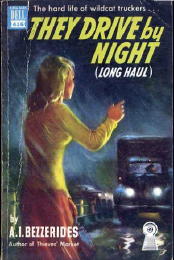
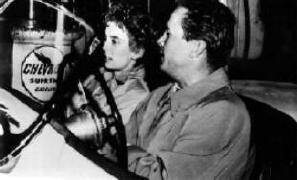
* * *Long Haul (Carrick, 1938, hc) Cape, 1938. Also published as: They Drive by Night. Dell, 1950 and Tough Guy. Lion, 1953. Film: Warner Bros., 1940, as They Drive by Night; released in Britain as The Road to Frisco (scw: Jerry Wald, Richard Macaulay; dir: Raoul Walsh).
* * _They Drive by Night (Dell, 1950, pb) See: Long Haul (Carrick 1938).
* * *Thieves Market (Scribner, 1949, hc) [San Francisco, CA] University of California (U.K.) pb, 1997. Film: TCF, 1949, as Thieves’ Highway (scw: A. I. Bezzerides; dir: Jules Dassin).
* * _Tough Guy (Lion, 1953, pb) See: Long Haul (Carrick 1938).

Dell pb

Only two books, but influential ones. “Like Saroyan,” the obituary in the Bee goes on to say, “Mr. Bezzerides wrote novels influenced by his life in the San Joaquin Valley during the early part of the last century.” Due to what novelist Anthony Neil Smith on his blog Crimedog One calls their inherent “trucker noir” quality, their impact on the world of cinema has been even greater.

Among the other credits you can find for him at www.imdb.com is
Kiss Me Deadly , a 1955 masterpiece of film noir starring Ralph Meeker as Mickey Spillane’s favorite PI, Mike Hammer, filmed in (as they say) glorious black-and-white. Mr. Bezzerides wrote the screenplay.

First line:   Mike Hammer: You almost wrecked my car! Well? Get in!

Meeker

In another genre, Mr. Bezzerides was also the creator of The Big Valley, the Barbara Stanwyck TV western series that ran for 112 episodes between 1965 and 1969. His roots in the San Joaquin Valley, where the Barkley ranch was located, had a good deal to do with that success of that series as well.

[Thanks to Vince Keenan on his blog for the original tip on Mr. Bezzerides’ passing.]

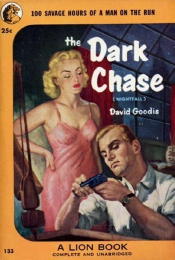
Today was the last day of GoodisCon 2007, and no, I wasn’t able to go, and whether there will be another, I have no idea. But here’s a question that occurs to me. What other mystery writer has had a convention dedicated to him and him alone?

null

I’ll qualify that by saying that Anthony Boucher is not an acceptable answer, as Bouchercons were always about more than Mr. Boucher. And as a brief aside, I suspect that many attendees of Bouchercons in recent years do not even know who Mr. Boucher was.

Searching on the Internet just now, I came across several sites relating to David Goodis that may be of interest, the first one of which may contain cover images of every edition of every book that Goodis wrote. (It does say “a selection,” so it’s more than likely that I’m exaggerating, but there are certainly quite a few for you to look at here, many of which I’ve never seen before. Not the one below, but many of the later editions and almost all of the foreign editions.)

Chase

You may have to follow the link at the bottom of the page that the link above leads you to. The first page that comes up contains a short biography of Goodis by Dave Moore. There are many other sites that I might send you to, but back in Crimesquad‘s archives I found another short biography and a review of Black Friday and Selected Stories (Serpent’s Tail, trade pb, July 2006).

It’s a book I missed when it came out. I’d put it on my birthday list, but then I’d have to wait another whole year. I’d rather not wait that long.

   Contents:

Black Friday. Novel. Lion 224, pbo, 1954.
“The Dead Laugh Last.” Goodis writing as David Crewe. 10 Story Mystery Magazine, October 1942.
“Come to My Dying!” Goodis writing as Logan C. Claybourne. 10 Story Mystery Magazine, October 1942.
“The Case of the Laughing Ghost.” Goodis writing as Lance Kermit. 10 Story Mystery Magazine, October 1942.
“Caravan to Tarim.” Collier’s, October 26, 1943.
“It’s a Wise Cadaver.” New Detective, July 1946.
“The Time of Your Kill.” Goodis writing as David Crewe. New Detective, November 1948.

I wonder what a copy of 10 Story Mystery Magazine for October 1942 goes for these days.

   
   —

UPDATE: It didn’t take long for a report to appear online from someone who was there. Who better to give with some details than crime novelist Duane Swierczynski (pronounced “sweer-ZIN-ski”) on his blog, which you should be reading as a matter of course anyway…

The book has not been published yet, at least not the revised edition. The manuscript was turned in sometime in middle of last year, but so far no date’s been set as to when it’s going to appear. When the Fourth Edition came out in 2003, the end date for the material covered was the year 2000. This is also when Al Hubin then began to look for someone to take over the task of editor and make sure that further editions would continue to appear. But when no takers were found, the decision was made that there would be no Fifth Edition.

Corrections and additions to the data in Crime Fiction IV continued to come in, however, and Al found himself unable to retire, as he’d planned, and the Revised Edition was the result. Rather than expand the bibliography chronologically, however, the cut-off date remained fixed at the year 2000.

Al was ready to retire again, but there was no end to the incoming flow of data, even with the closing date of 2000. He and I discussed this, and the upshot was he would continue to accumulate this addenda, but again only through 2000, and I would publish it on-line.

To that end, he has been sending me this addenda in parts, with eight such installments already on line at www.crimefictioniv.com. In his introduction to the addenda pages, Al fills in more of the details about the bibliography over the years, how it got started and how it grew.

As to my end, I’ve been taking advantage of the Internet, and as I go, I have been adding links and cover images not available in the printed editions. Links have been made to websites about the authors cited, and especially to www.imdb.com for every movie that Al has added as being based on a novel included in Crime Fiction IV.

Much of the Addenda included in parts 1 and 2 consists of connections to TV films, which had largely been neglected in early editions of CFIV. Using www.imdb.com, Leonard Mustazza’s The Literary Filmography and Alvin H. Marill’s Movies Made for Television as sources, many such TV movies have been identified and are now included.

Now in their enhanced form, and Internet-ready, as it were, Parts 1 and 2 have now been merged alphabetically in two sections, A through H and I through Z. I am now working on Part 3.

While the Addenda is hardly intended to replace the full Bibliography, my goal is also to have it stand on its own, as much as possible. To that end, I have been annotating some of the entries, especially when the authors are less well known. There is nothing I need to add to an entry of an author of the stature of Agatha Christie, for example. A link to one of the many websites about her should certainly suffice.

But for an author such as the following, the entry looks like this:

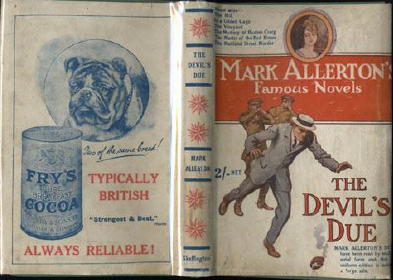
ALLERTON, MARK Pseudonym of William Ernest Cameron. As Allerton, the British author of ten works of crime fiction listed in the (Revised) CFIV, five indicated as marginal. Listed in The FictionMags Index are portions of three serialized novels from early American pulp magazines, only one of which is included in the (Revised) CFIV. The following are new entries.
The Devil’s Due. Skeffington, 1919
Her Hidden Husband. Thomson, 1927 [England]
-In a Gilded Cage. Skeffington, 1919
-The Master of Red House. Skeffington, 1919

Allerton

If possible, every entry might look like this, but it’s not, and they don’t, not yet. But if you’re even only mildly interested in the bibliography of crime fiction, please feel free to stop by, browse around, and see what is there.

Jamie Sturgeon and I saw the same book listed on eBay around the same time, and each of us sent the information hidden in the listing to Al Hubin, author of Crime Fiction IV: A Bibliography (Revised), within a day of each other.

Jamie was one step ahead of me, however, and he’d already been in touch with the seller, who told Jamie how he’d gotten his information about the author of the book, Donald Deane, about whom nothing has been known until now.

It turns out that there never was a “Donald Deane,” and that the three books attributed to him in CFIV were actually written by Mary Fair, a rather progressive lady living in the Eskdale lake district of England, nestled at the foot of that country’s highest mountains.

Following the link from her name to the website devoted to her, you’ll find her life’s accomplishments described in considerable detail. I’ll quote only a summary that was printed in a newspaper about her, shortly after her death:

“Archaeologist, welfare-worker, explorer, geneaolgist, naturalist, photographer, writer and lecturer … this familiar and friendly figure, sometimes half-tramp, sometimes professorial, trudging up the fells in foul or fair weather to deliver orange juice or medicinal oil out of her knapsack to some infant arrival in a remote farmhouse; or, at midnight, popping up disturbingly from behind a beck-side drystone wall, where she had been recording the seasonal note of an unusual owl. … we shall miss more than her erudition: we shall miss her friendly, twinkling eye, her crisp opinions- sometimes inventively ornamented and not infrequently critical- but particularly we shall miss her humanity: her readiness to give a knowledgeable helping hand wherever it was needed.”

Of course it is her connection to the world of crime and detective fiction that is of interest. I’ll add another quote below, if I may. (Sorry. I said only one quote, but I was wrong.)

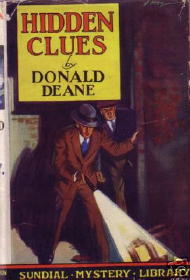
Oh, and by the way, she wrote detective novels, under the name Donald Deane. She never told anybody, but another of her friends, Whitehaven librarian Daniel Hay, solved the mystery. Published by John Hamilton of London, they were The Fifth Tulip (1930); The Luck of Luce (1931) and Hidden Clues: A Lakeland story (1932). Most of the manuscript for a fourth novel, set in Scotland, also survives, written in cheap exercise books.

Here’s a cover scan of the third of these books, taken from the eBay listing that helped lead to this discovery:

Deane

Another entry, it almost goes without saying, if anyone’s keeping track, in the ongoing list of female mystery writers who kept their identities hidden by using initials in their byines or under the names of men.

I might a little late in discovering this, but I just found an interview online with librarian Gary Warren Neibuhr, author of several landmark reference works in world of mystery fiction. It’s at Murderati and dated 12/29/07, but it can hardly be considered out of date.

Gary is the author of A Reader’s Guide to the Private Eye Novel (Reader’s Guides to Mystery Novels) (G. K. Hall, 1993) and Make Mine a Mystery: A Reader’s Guide to Mystery and Detective Fiction (Genreflecting Advisory Series) (Libraries Unlimited, 2003). I think both titles are probably self-explanatory, and if you don’t own them yourself, please make sure that you live close to a library that does. If they don’t, bug them until they do.

Gary’s most recent book is Read ‘Em Their Writes: A Handbook for Mystery and Crime Fiction Book Discussions (Libraries Unlimited, 2006). If the title doesn’t tell you exactly what the book’s about, it’s a self-help guide in helping you organize your own mystery discussion group, how to get participants, select titles, and so on. The interview concentrates most heavily on this, of course, but he talks about the other two books, too, as well as his own personal interests in mystery fiction. (Primarily private eye novels, it is not too surprising to learn: he has 6000 of them, he says, in his basement.)

Gary

One of the most popular articles that ever appeared on the original Mystery*File website was written by Gary about private eye Honey West, about whom if you know little, you should go read it, and right now.

One of the highlights of the original Mystery*File website was the bi-monthly column of mystery this-and-that contributed by Mike Nevins. Just after the site went on hiatus, Mike sent me his comments intended for online publication in October 2006. The column has been languishing in my files ever since, and it’s time someone other than Mike and I read it. Here it is.


FIRST YOU READ, THEN YOU WRITE
Mystery Commentary by Mike Nevins.


    I am one of the six people in America who have never read a Stephen King novel.  But at a recent library sale I picked up a copy of Danse Macabre (1981), the nonfiction book in which King celebrates the horror genre in the novels, stories, movies and TV series of his formative years.  Turns out he defines horror very broadly to include what many of us would call suspense or noir – and includes among his favorite authors in that category several of my own.  He particularly likes Psycho and several other Robert Bloch suspensers, describing them as “a powerful series of offbeat novels, which are only surpassed by the novels of Cornell Woolrich.”  Much later in his book, while rhapsodizing over the novels of Ira Levin, he says: “The only other writer…who had that wonderful ability to totally ambush the reader was the late Cornell Woolrich … but Woolrich did not have Levin’s dry wit.”  Whoever compiled the index for Danse Macabre missed both of these references to the Hitchcock of the written word (which are on pages 41 and 281 respectively) but caught a third (page 218), in which King praises the episode of TV’s anthology series Thriller based on the classic Woolrich story “Guillotine.”  If I ever do an updated edition of First You Dream, Then You Die, I must remind the publisher to ask King for a blurb.

***

    Hitchcock’s VERTIGO the inspiration for an episode of a TV Western show?  Sounds impossible, but it demonstrably happened.  “Incident at Alabaster Plain” (January 16, 1959) was the second broadcast episode of the classic Rawhide series starring Eric Fleming and Clint Eastwood.  It’s a tad slow but has some good guest stars – Mark Richman, Martin Balsam and, I kid you not, Troy Donahue – and features a fine action climax as our stars shoot it out with killers who have taken over a frontier monastery.  With his men wiped out, Richman as the psychotic gang leader runs up the stairs to the bell tower, pursued by Eastwood, and – well, you remember how Kim Novak wound up in VERTIGO.  The first season of Rawhide is now available on DVD, and well worth buying too.

***

    It’s well known that Hitchcock was an avid reader of crime and suspense fiction but would you believe that the foremost Soviet film-maker was too?  According to Marie Seton’s Sergei M. Eisenstein: A Life (1952), the director of POTEMKIN, ALEXANDER NEVSKY and IVAN THE TERRIBLE collected Van Dine, Christie and other classic mystery novelists and filled the margins of his copies with extensive annotations in English, French, German and Russian.  If we accept Seton’s account, Eisenstein studied the whodunit from the viewpoint of Christian mysticism, which in his last decades he believed in fervently, or at least fervently wished he could believe in.  He equated the search for truth in detective fiction with the search for the Holy Grail in Christian legend, and took the position that the great detectives of fiction discover the truth by intuition rather than reason.  Has anyone ever thought of collecting his notes on the genre as a book? 

***

    While I’m in a question-posing mood, here’s another.  What world-famous mystery writer first created James Bond?  Who wrote the story that begins: “With a serious effort James Bond bent his attention once more on the little yellow book in his hand.  On its outside the book bore the simple but pleasing legend, ‘Do you want your salary increased by L300 per annum?’”  No, 007 is not about to hit M for a raise and the author of these lines is not Ian Fleming, it’s Agatha Christie.  Her Bond is a silly-ass young Brit with a hoity-toity fiancee and a stolen jewel on his hands, and “The Rajah’s Emerald” (first collected in England in The Listerdale Mystery, 1934, and over here in The Golden Ball, 1971) tells how he disposes of both.

***

    Has anyone ever heard of an Ian Fleming spy novel called You Asked for It?  It’s the Popular Library paperback edition of Casino Royale, published in 1955 when Fleming was all but unknown.  “If he hadn’t been a tough operator, Jimmy Bond would never have risked” something or other, we are informed by the blurb on the back cover.  “But it was toughness that had landed Jimmy his job with the Secret Service.”  I suspect that the blurb alone makes this rare softcover worth a pretty penny more than the 8 1/3 cents I paid for it almost forty years ago in a secondhand store in upstate New York.  I wish I had a few paperbacks whose blurbs extolled the toughness of other hardboiled ops
like Hank Merrivale, Al Campion and Herc Poirot!

***

    Wanna hear about another strange paperback I picked up for pennies in my salad days?  Murder Is Insane by Glenn M. Barns, a Jonathan Press digest-sized reprint of the 1956 hardcover edition, is clearly marked “Unabridged” on both the front cover and the inside title page.  Buried amid the fine print of the copyright page, however, is the casually dropped news: “This book has been cut.”  Small wonder I’ve never read the book.

***

    Martin Scorsese’s THE DEPARTED, released a few weeks ago, strikes me as one of the most powerful films in the long career of arguably the finest living American director.  On the off chance that someone who stumbles upon this column has read nothing about the movie, I should mention that it stars Leonardo Di Caprio as a young cop serving as a police mole inside Boston’s Irish mob and Matt Damon as Leo’s Academy classmate and the mob’s mole inside the force, the one spy reporting to top cop Martin Sheen and the other to gangster chief Jack Nicholson.  It’s exceptionally violent and also exceptionally complex, with the climax so abrupt that I had to go on the Web to find out who fired the last shot that blew away the head of – but I’d be a toad if I said any more.

– Francis M. Nevins, October 2006       

« Previous PageNext Page »