JACK SLADE. Allied Artists/Monogram, 1953. Mark Stevens, Dorothy Malone, Barton MacLane, John Litel, Paul Langton, Harry Shannon, Jim Bannon, Lee Van Cleef. Director: Harold D. Schuster.

   The Jack Slade of this dark and gritty biopic has nothing to do wuth the Cactus Jack Slade played by Kirk Douglas in The Villain, a disaster of a film which David Vineyard reviewed here on this blog not too long ago. There was a real Jack Slade, however, whose life resembles to some small degree the character Mark Stevens portrays in this still mostly fictional adaptation.

   I don’t believe the dark and often broody Mark Stevens was the leading man in very many movies, and his performance in this one is one that needs to grow on you while you’re watching. His portrayal of a man who’s good with a gun and obsessed since early childhood with eliminating as many of the outlaws of the west as he can, a one man instrument of revenge, is riveting. He is, in the end, as much an outlaw as the many that he is killed.

   Unfortunately the script does the film in, trying to cram too much into a 90 minute movie, losing some significant points of continuity and telling more often than showing. Dorothy Malone is marvelous as the young exotic beauty who falls in love with him as soon as her eyes fall on him, but Barton MacLane as Jules Reni, Slade’s constant nemesis, is far too oafish and dim-witted to be believable.

   Lee Van Cleef, at least, in a role far too short, has the sense to back off when he sees Slade draw, saying “That’s fast enough.”


ALISON GORDON – The Dead Pull Hitter. Kate Henry #1. St. Martin’s Press, hardcover, 1989. Onyx, paperback, 1991.

   Kate Henry is a sportswriter covering the fictional Toronto Titans, and just as the team clinches their first playoff spot, both the designated hitter and the team’s star pitcher are both found murdered. Involved are drugs, blackmail and (just maybe) sex.

   Since Alison Gordon previously spent five years covering the real-life Blue Jays, she knows how to write, and this peek inside the locker room seems authentic, smell of sweaty socks and all. The mystery is less convincing, but Kate Henry is a character I’d like to meet again.


–Reprinted from Mystery*File #17, November 1989.

       The Kate Henry series —

The Dead Pull Hitter (1988)
Safe at Home (1990)
Night Game (1992)
Striking Out (1995)
Prairie Hardball (1997)

THE GREAT DIAMOND ROBBERY. MGM, 1953. Red Skelton, Cara Williams, James Whitmore, Kurt Kaznar. Director: Robert Z. Leonard.

   Sort of a quiet, sedate comedy, with Red Skelton playing a simple sort of soul who just happens to work for a diamond company. He is also an orphan, and the people he comes across who claim to be related are really (not surprisingly) a bunch of crooks.

   Read the title again and you will know everything there is to say about the story — except possibly that Cara Williams, who plays the girl who is supposed to be his sister, falls in love with him instead, and — you can finish it up from here. (Spotted in bit parts were Olan Soule and Jack Kruschen, long time radio actors.)

— Reprinted and very slightly revised from Movie.File.8, January 1990.


REVIEWED BY DAN STUMPF:         


ANGKOR. Mapel Pictures, 1935. Also released as FORRBIDDEN ADVENTURE, FORBIDDEN ADVENTURE IN ANGKOR, THE GORILLA WOMAN and PRIVATE LIFE OF INGAGI (!). With Wilfred Lucas and Fred Humes. Directed, at various times, by L.C. Cook and George Merrick. No writer credited.

   Another oddity, made up of some amazing film shot in 1912, the first motion picture record of the magnificent ruins at Angkor, when it was still a vine-covered ruin, before it became a tourist site — but

   With something added….

   Dwain Esper, the auteur of REEFER MADNESS, somehow got the original footage and hired George Merrick to shoot scenes with actors in false beards to match the original (more or less) and a half-dozen Hollywood hookers to run around topless as “native bearers.” Throw in a guy in a gorilla suit, and you got Cinematic Treasure.

   Like many low-budget cobble-jobs, ANGKOR is held together (sort of) by voice-over narration, here detailing a story about intrepid explorers in search of a cult of ape-worshipers, supposedly for the story behind the fall of the Khmer civilization. Okay.

   So we get the usual jungle-documentary stuff, silent and projected at the wrong speed, while the narrator talks about the harrowing trek, and invites us to watch cute fuzzy animal antics and a few staged scenes of dire peril. My favorite is a guy struggling for his life with a 12’ python (while, presumably, the cameraman looks on with clinical disinterest) until his fellow-bwana shows up, sees his pardner wrapped in the serpent’s coils, and shoots the snake from twenty feet away without injuring the struggling man he’s wrapped around – which if nothing else, shows a confidence in one’s marksmanship amounting to arrogance.

   At various places in the trek we break for scenes of the stand-ins, standing in as is their wont, in front of back-projected footage. Then we get to the native village where the plot thickens a bit. A sinister priest of an ape-worshiping sect (a monkey-monk?) warns the men not to help the white interlopers, and stalks off, leaving our stand-in heroes with the pleasant alternative of hiring the buxom ladies of the tribe as native barers.

   Esper got into trouble with the Breen Office at this point, and hit on the happy (?) solution of superimposing tree branches into the foreground whenever the ladies are on screen. This was passed by the censors, whereupon he showed the original version every chance he got. Stout fellow, that.

   Not content with mere fake-documentary sleaze, Esper then hired a guy in a gorilla suit to strut around trying to pick up jungle babes, who swoon over him – a theme first exploited in the notorious INGAGI (1930) which was still being shown to white-supremacist groups into the 1960s.

   I take a step back here, and muse on the vagaries of cinematic destiny, which transmutes an historic film record into racist titillation. We will remark on the ironies of fate and pass on.

   The result is a unique combination of spectacle and sleaze, a very bad film made remarkable by its own audacity, and while I wouldn’t recommend ANGKOR to anyone of any critical capacity at all, I have to say I enjoyed it more than I should admit.


LAWRENCE BLOCK – Time to Murder and Create. Matt Scudder #2. Dell, paperback original, 1977. Avon, paperback, 1991. Dark Harvest, hardcover, 1993.

   This book was published relatively early in Block’s career, hence the fact that when it first came out, it was as a lowly paperback original. The first hardcover edition didn’t come along until many years later, well after later books in the series had started to gather quite a lot of critical attention and acclaim.

   Many people like to go through a series in order, and because there has been some question about that, it was Block himself who has verified that Time to Murder and Create was the second to be written but the third to be published. Having that additional insight into the growth of a fictional character is a big plus to many fans, and Matt Scudder has become a guy who has lots of them.

   But just in case he’s someone who’s new to you, Scudder is an ex-cop who quit the force soon after accidentally killing a small child by a ricocheting bullet in the line of duty. He manages a small living acting as an unlicensed private investigator.

In this book he’s approached by an acquaintance generally known as Spinner. Spinner is not really a friend, but recently he seems to be doing well, as if he has come into some money.

   He has a favor to ask of Scudder, who after agreeing is given an envelope to be opened on the occasion of Spinner’s death.

   Not surprisingly, that’s exactly what happens. When Spinner’s body is pulled from the East River, Scudder opens the envelope and … you may be ahead of me. If you’ve already guessed that Spinner had been doing some blackmailing, you’d be right.

   He’d had his hooks into three people, as a matter of fact, and in all likelihood, one of them is responsible for his death. Scudder decides that it’s up to him to find out which one it is.

   It’s easy to tell that Block is the author of both the Scudder books and his “Burglar” series — the voice is exactly the same — but even as early in the series as this one is, it has a harder edge to it than any of the Bernie Rhodenbarr ever had.

   As always, or so it’s been my experience, the mystery itself may not be your primary reason for reading a book by Block. It’s the voice, the rhythm, the attitude, the take you out of your everyday problems, even if only for a short time. Two or three hours will do for me.

   Any of his books, including this one.

JOHN CREASEY – Model for the Toff. Richard Rollinson (The Toff) #36. Pyramid R-1134, paperback; 1st US printing, February 1965. Originally published in the UK by Hodder & Stoughton, hardcover, 1957.

   The first third of this 1950s Toff thriller is quite readable, but even then I was wondering if there was enough to the story to fill an entire book. It turned out that I was right. There wasn’t.

   Richard Rollinson, that upper class gent who dabbles in crime solving much as a dashing adventurer would, is hired by a famous dress designer who has been plagued by models quitting on him and others refusing to work for him. Someone is obviously trying to frighten them away, and succeeding. The question is, who? And why?

   The person responsible is vicious. Some of the models have had acid thrown on them. Others have been attacked by dogs. Even the Toff’s life is in danger, once he has taken the job. There are only a limited number of suspects, however, and any suspense that the story may have is mitigated severely by the fact that the stakes are so low.

   I’ve enjoyed other books in the series, but this one, not so much.

REVIEWED BY BARRY GARDNER:


DENNIS LEHANE – A Drink Before the War. Patrick Kenzie & Angie Gennaro #1. Harcourt & Brace, hardcover, 1994. HarperTorch, paperback, July 1996. Reprinted several times since.

   This is a first novel. Lehane was born and raised in Dorchester, Massachusetts, and still lives in the Boston area. He has worked as a teacher of writing and a counselor of abused children, and that’s all we know about him.

   Patrick Kenzie and Angie Gennaro are private detectives who are natives of Boston’s blue-collar Dorchester section, and still live there. The case that will change their lives starts simply enough: according to a prominent local politician, a black cleaning woman has stolen some important Statehouse documents from his office. He wants her found, and he wants them back.

   Finding the woman isn’t that difficult; that’s their profession. Finding the “documents” and staying alive are two other stories entirely. The crime leads to other crimes, everybody’s a victim, and Boston’s ghettos threaten to erupt into an apocalyptic gang war — with our intrepid stalkers in the middle of it.

   Well, hell. I thought I has my choice for Best First Novel of 1994 locked in months ago, with Mallory’s Oracle. Now along comes Lehane with A Drink Before the War, and all of a sudden the short list has grown by one, and I have to at least think about re-opening the polls.

   This is a powerful story and a superbly written one. It doesn’t break any new ground in the private detective patch, and the plot is a little more cowboy than I usually like, but my goodness it’s well done.

   Lehane does everything well, but what he does best are characters and prose. Kenzie and Gennaro are beautifully crafted protagonists. They have depth, and they come alive on the page. The book’s other characters are equally well crafted, though in less depth, with not a false note struck among them.

   It’s all done with some of the best prose I’ve read this year. It’s not lyrical, but it’s witty, strong, and evocative. The dialogue rings true, and Lehane brings the meaner, seedier part of Boston into the living room of your mind. The book is about damaged people and a damaged society, and who does what to whom, and how, and why.

   It’s bloody, and it’s hard, and I think it’ll stay with you a while. What it is more than anything else is good; astonishingly so for a first novelist, and I can’t wait for the encore, If this doesn’t win a First Novel Shamus the PWA will lose what little credibility they have with me.

— Reprinted from Ah Sweet Mysteries #17, January 1995.


[UPDATE.]   A Drink Before the War was not nominated for an Edgar, but as Barry suggested it should, it did win a Shamus from the PWA as Best First Novel for the year 1994.


      The Patrick Kenzie & Angie Gennaro series —

A Drink Before the War (1994)
Darkness, Take My Hand (1996)
Sacred (1997)
Gone, Baby, Gone (1998)
Prayers For Rain (1999)
Moonlight Mile (2010)

THE UNHOLY NIGHT. MGM, 1929. Ernest Torrence, Roland Young, Dorothy Sebastian, Natalie Moorhead (and Boris Karloff, uncredited). Director: Lionel Barrymore.

   This movie, only 60 years old [and now nearly 90], has almost everything. (If it were rated today, it would get a “G”, and so it can’t have everything.) What it does have is: a fog covering all of London, a series of murders — the victims all members of a British regiment from 1915 …

   … as well as a wealthy mansion, suspicious butlers, a legendary “green ghost,” a seance, a major with a scarred face, and a million pound legacy of hatred (left to the surviving members of the regiment by a former officer who was booted out). Stir and boil.

— Reprinted and very slightly revised from Movie.File.8, January 1990.


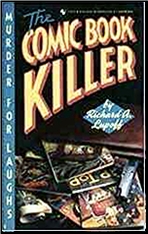
RICHARD LUPOFF – The Comic Book Killer. Bantam, paperback; 1st printing, February 1989. Previously published in hardcover by Offspring Press, 1988. This earlier edition also contains bound-in black & white comic pages and a separate full color comic book “Gangsters at War” in a slip case. (This specially created comic book has a crucial role in the story.) Also published by Borgo Press, paperback, 2012.

   I’m of two minds about this one. As the title indicates, this first real mystery that insurance adjuster Hobart Lindsey has ever had to deal with has to do with comic books, and comic book collecting in particular.

   Right up my alley! I’ve been collecting comics in one way or another since I was five — but not necessarily as “collectibles,” if you see what I mean, not hardly. This one begins when a comic book shop insured by Lindsey’s company reports the theft of $250,000 worth of comics.

   Lindsey is so unknowledgeable about comic books that he thinks the thief must have needed a truck to haul them away. The proprietor of the shop quickly disabuses of that idea. Only 35 books were stolen, and all of them could have fit in a single briefcase.

   Trying to make a good impression with his superiors, Lindsey decides to take an active role in the investigation. This puts him in close contact with Marvia Plum, the black (and definitely female) detective assigned to the case. An immediate attraction develops, which leads to more.

   Of two minds, I said. Making this one more difficult than I expected to enjoy is that I did not find Hobart Lindsey a very engaging protagonist. In the first few chapters especially I found him both callow and not particularly likeable.

   And we learn even less about Marvia Plum. An unanswered question I kept asking myself is what does she see in him. Worse, the only character I really related to is the first murder victim. There is also one huge coincidence that needs to be swallowed as well. For me, it didn’t spoil the book, but it didn’t go down all that easily either.

   A mixed bag, then, but there is no doubt that author Richard Lupoff knows his comic book history, and that was a big plus. If that’s a subject matter you’re interested in, I think you’ll find as much to like in that regard as I did.

      The Hobart Lindsey / Marvia Plum series —

The Comic Book Killer (1989)
The Classic Car Killer (1991)
The Bessie Blue Killer (1994)
The Sepia Siren Killer (1994)
The Cover Girl Killer (1995)
The Silver Chariot Killer (1997)
The Radio Red Killer (1997, Marvia Plum alone)
One Murder at a Time: The Casebook of Lindsey & Plum (2001; story collection)
The Emerald Cat Killer (2010)

REVIEWED BY DAVID VINEYARD:


RICHARD BEN SAPIR – The Far Arena. Seaview Books, hardcover, 1978. Dell, paperback, 1979.

   The body was quiet as an unborn thought in a dark universe, stopped on the bare side of life, stilled on its way to death by the cold.

   Lucius Aurelius Eugenianus, Roman gladiator and soldier has just been found in a state of suspended animation in the ice beneath the Queen Victoria Sea by a North Sea Oil drill bit that tears a bit of flesh from his thigh. The Texas born geologist who found the body carries it to Dr. Semyon Petrovitch an expert in cyronics in Oslo as a curiosity, but when Petrovich finds the body still has workable veins and frozen before death everything he has worked on for years seems to be coming to fruition.

   By a miracle when the body is thawed and normal temperature restored, it appears to live, though a tense several days are spent desperately trying to save the frozen specimen. It is at this point in the preceding we are introduced to our narrator, Eugenianus, who is about to wake up into a world beyond his comprehension and the worst case of jet lag in the history of the planet.

   Why am I not dead? Where is my death? I know death. It is a proud and free thing in a quiet place.

   Alternating at first with the third person narration of the attempt to bring this time traveler to life and the first person narration gradually introducing us to Eugenianus and his story, the thing that makes this novel work is just how compelling and interesting a character he is, a man who was both in and out of time in his own world even before reaching ours.

   The man dubbed John Carter by the doctors trying to keep him a secret until he can be awakened, Petrovitch hires a nun named Sister Olav who is a linguist to interpret his ravings, but all Eugenianus sees when he does awaken is a giant hovering over him, since he is of average size of his time and almost everyone in the modern world seems a giant to him, certainly the statuesque nun.

   The first half of the book when the doctors are struggling to save him and we are seeing his life unfold in his memories is fascinating enough, but the book really picks up when Eugenianus awakens and finds himself in a world as alien as another planet among people who have nothing in common with him. It’s here where Sapir manages the best of his satirical jabs at the pretenses and hypocrisy of the modern world as this simple creature from the past seeks some kind of peace in a world he neither wants nor understands.

   A nice balance is kept up between the techno-scientific side of the story (which for reasons Sapir likely didn’t take into account is uncomfortably close to the resurrection of Captain America in the Silver Age of Marvel Comics) and the personal stories of the main characters, Eugenianus, the geologist, Petrovitch, and Sister Olav.

   Sapir, who co-created Remo Williams, the Destroyer (co-writing at least sixty of the series), with Warren Murphy, left the series as Murphy did and turned to writing on his own using the name recognition from the critically praised men’s action series as a stepping stone. His first big title, The Quest, about a modern secret war over the Holy Grail, got great reviews and had big sales and was followed up by The Body (filmed with Antonio Banderas) about a shocking archaeological discovery, a spy novel, and this one, Far Arena.

   I’m not sure if this is his last book, but it is one of his last and had hardcover, book club, and paperback editions. While structured as a thriller, Far Arena is often a sharp satirical jab at modern society and a historical novel with a unique perspective as a modern thriller.

   The characters are well drawn, and the relationship that develops between Eugenianus and Sister Olav believably drawn. Eugenianus’s shock when he returns to Rome is one of the novel’s highlights, possibly the most devastating lesson in “you can’t go home again” you will encounter in a thriller.

   Far Arena is different, a variation on the Berkeley Square theme or Edwin Lester Arnold’s Phra the Phoenician (the John Carter reference has to do with the Edgar Rice Burrough’s character’s penchant for traveling across time and space in ethereal form) certainly, but an entertaining and even thoughtful read, just the sort of thing for a cool fall night on the run up to Halloween.
« Previous PageNext Page »