I was working in Part 9 yesterday, primarily in the L’s, when I came across a pair of authors who are twin sisters, a fact that hadn’t been pointed out before.

BURFORD, PAMELA. 1954- . Add date of birth and married name: Pamela Burford Loeser, q.v. Twin sister of Patricia Ryan, q.v. Under her maiden name, the author of many romance novel, primarily for Harlequin and its various imprints. Two of them are included in the (Revised) Crime Fiction IV. See below.
       His Secret Side. Harlequin, pb, 1996. Silhouette, UK, pb, 1998. [Investigating her best friend’s murder in Vermont, the last thing a woman expects is to be both attracted to and fearful of the small town’s doctor.]
      Twice Burned. Harlequin, pb, 1997. Silhouette, UK, pb, 1998. Setting: New York. [A young woman determined is forced to accept help from an FBI agent who wants to keep her locked away and safe.]
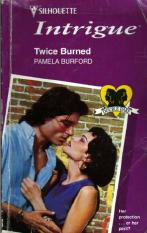
Pamela Burford- Twice Burned


HOPWOOD, BRENDA CECILIA. 1878-1959. Pseudonym: Patrick Leyton, q.v.

LEYTON, PATRICK. Add: pseudonym of Brenda Cecilia Hopwood, 1878-1959, q.v. Under this name, the author of 20 crime thrillers published in England between 1925 and 1948. Two were reprinted in the US; one is shown below. Note: This discovery was made by John Harrington, who has also found evidence that around 1919 the author legally changed the family name from Gregge-Hopwood to Hopwood only.
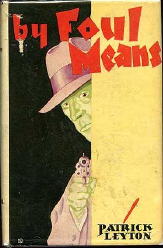
Patrick Leyton- By Foul Means


LIPKE, KAY. 1896- . Full name: Kathleen Bellows Lipke. Add year of birth. Author of one hard-to-find mystery novel included in the (Revised) Crime Fiction IV. See below. Another novel, Life Is for Living, appeared in the Philadelphia Inquirer book section on December 27, 1936; it appears to have criminous content.
      Rain on the Roof. Dial Press, hc, 1931. Methuen, UK, hc, 1932. Setting: California.
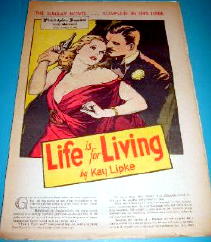
Lipke- Life Is for Living


LOEWENKOPF, SHELLY (ALAN). ca.1931- . Add middle name and tentative year of birth. Co-author of two books in the long-running Nick Carter paperback series, both included in the (Revised) Crime Fiction IV. See below.
       _Arms of Vengeance [as by Nick Carter]. Co-authored by Dennis Lynds. Jove, pb, 1989. [#255]
       _Law of the Lion [as by Nick Carter]. Co-authored by Dennis Lynds. Jove, pb, 1989. [#252]

LOESER, PAMELA BURFORD. 1954- . Add date of birth and married name of Pamela Burford, q.v.

RYAN, PATRICIA (née BURFORD). 1954- . Add date of birth and maiden name. Twin sister of romantic fiction writer Paula Burford, q.v. Also a writer of romances, two of them included in the (Revised) Crime Fiction IV. See below. As P. B. Ryan, later the author of a series of post-Civil War historical mysteries featuring Boston governess Nell Sweeney, the first being Still Life with Murder (Berkley, pb, 2003).
      A Burning Touch. Harlequin, pb, 1996. Mills, UK, pb, 1996. Setting: New Jersey. [India Cook offers her services to the police department; detective Jamie Keegan knows all about con artists.]
      Silken Threads. Topaz, hc, 1999. Setting: London, 1100s. [Graeham Fox is on a secret mission: rescuing his lord’s illegitimate daughter from the clutches of her abusive husband.]

Patricia Ryan- Silken Threads

FIRST YOU READ, THEN YOU WRITE
by Francis M. Nevins

   In the first edition of Cornell Woolrich’s The Bride Wore Black (1940), each of the novel’s five parts opens with a motto, whose respective sources are Rodgers & Hart, Guy de Maupassant, Cole Porter, and de Maupassant twice more. In the first paperback edition (Pocket Books #271, 1945), the first and third of these are dropped and replaced by lines attributed respectively to Poe and the social philosopher Herbert Spencer. The Poe couplet at the beginning of Part One reads as follows:

The Black Angel         How silent is the night — how clear and bright!
         I nothing hear, nor aught there is to hear me.

   Not long ago an Italian author who is preparing an anthology of essays on Woolrich emailed me to ask if I knew the source of that couplet, which doesn’t appear in any known poem of Poe’s.

   Splitting the first line into its component parts and calling on trusty Google produced one and only one hit. According to www.authspot.com, the quoted matter comes from the first verse of The Murderer, which is billed as an unpublished poem by Edger (sic) Allen (sic) Poe, rewritten (with many other misspellings) by one coyote103 and posted last March. But lines I quoted above must have been published before 1945 or whatever copyright-paranoid munchkin at Pocket Books substituted them for Woolrich’s Rodgers & Hart quotation couldn’t have known about them.

   A later email from my Italian correspondent solved the problem. The quoted couplet is part of a 70-line fragment first published almost forty years after Poe’s death in George W. Conklin’s Handy Manual (Chicago, 1887). No scholar today believes they were written by Poe but the first three lines ( “Ye glittering stars! How fair ye shine tonight/And O, thou beauteous moon! Thy fairy light/Is peeping thro those iron bars so near me”) are quoted in Thomas Ollive Mabbott’s definitive edition of Poe’s poetry (Harvard University Press, 1969).

   How Pocket Books came across them more than a quarter century earlier remains a mystery.

***

Let Us Live   The year The Bride Wore Black first came out is commonly considered the year when film noir came into being. But the more movies I see from the years immediately preceding 1940, the more I tend to question that consensus. Turner Classic Movies recently and for the first time ran Let Us Live (Columbia, 1939), directed by John Brahm and starring Henry Fonda and Maureen O’Sullivan.

   The storyline is pure Woolrich — perverse coincidence and police pressure on witnesses lead to two guys down on their luck being falsely convicted for bank robbery and murder and precipitate a race by the desperate fiancee of one of them to find the real criminals before it’s too late — and the visuals are as shadowy and menacing as anything in the downbeat classics of the Forties. If this isn’t film noir, toads fly.

***

The Dark Page   Devotees of films noir and their fictional sources will want to check out Kevin Johnson’s The Dark Page: Books That Inspired American Film Noir, 1940-1949. In this coffee-table book, recently published by Oak Knoll Press, each right-hand page is devoted to a lush full-color reproduction of the dust-jacket from one of the novels or story collections which was the source, sometimes very remotely, for a film noir from the Forties. Each left-hand page contains a technical description of the jacket and brief comments on the relevant book and film.

   Mr. Johnson, the owner of Baltimore’s Royal Books — whose website, www.royalbooks.com, is worth checking out — is working on a companion volume which will deal with the literary sources of various films noir released between 1950 and 1965. I understand he ll be present at NoirCon, which will be held in Philadelphia early in April. That website (www.noircon.com) is worth checking out too.

***

   Our Poetry Corner guest star for today is A. H. Z. Carr. Anyone remember him? He was born in 1902 and his early stories appeared in Harper’s, Saturday Evening Post and other top general fiction magazines of the Thirties, but he first registered on mystery readers’ radar when his “The Trial of John Nobody” was published in Ellery Queen’s Mystery Magazine (November 1950).

The Mighty Quinn   His fourth EQMM original, “Tyger! Tyger!” (October 1952), is perhaps the finest short crime story to deal centrally with poets and poetry. Malcolm Ridge, struggling to express his feelings about the Atomic Age, becomes prime suspect in the murder of the owner of a Russian restaurant in Greenwich Village and uses his skills as a poet not only to clear himself and identify the real killer but also to use the experience in conjuring up the exact words his poem-in-progress needed.

   Carr died in October 1971, about six months after his Finding Maubee won the Edgar for best first novel of 1970. Starring in the much later film version, 1989’s The Mighty Quinn, was the young Denzel Washington.

   Cover art unidentified, although there are two P’s in the upper and lower portions of a boxed H to the left of the lady’s leg (her right). I’ve lightened the image slightly for a better overall look.

Craig Rice- The Lucky Stiff


BANTAM. Simon & Schuster (Inner Sanctum), hardcover, 1945. Reprint hardcovers: Unicorn Mystery Book Club [four-in-one], 1946; World, 1947. Paperbacks: Armed Services Edition 914 [oblong binding]; Pocket 391, 1947; Bantam edition, June 1987.

      From the front cover:

   “Extra good.” — SATURDAY REVIEW

      From the back cover:

            dead girls have more fun

   The reporter at her trial wrote: “Anna Marie St. Clair, convicted murderess of Big Joe Childers, seemed like a woman carved out of stone.”

   A sentence of death by electrocution will do that to a murderess. The problem was, Anna had not, in fact, killed her lover. She’d been cruelly framed.

   Then, at the eleventh hour, the true murderer confesses. Anna becomes a free woman. A free woman with a frightening plan. She blackmails the authorities into reporting her execution. Now the world at large, including those who had sent her up, thinks she fried.

   Anna’s next step is to seek out gin-soaked, falling-in-love lawyer J. J. Malone. And with his exuberant approval, Anna sets out on a devilish trail of haunting revenge.

    “The wildest series of adventures that Craig Rice has yet put on paper.” — THE NEW YORK TIMES

[FOLLOWUP COMMENTS] 11-26-07. The back cover fails to report that Craig Rice’s other pair of sleuths, Jake and Helene Justus, are in this book, a significant oversight, I would say.

   As for me, I failed to report that there was a movie made of The Lucky Stiff, and the link will lead you to the IMDB page for it. Brian Donlevy played Malone, and Dorothy Lamour was Anna Marie St. Clair. Jake and Helene Justus were not in the movie, which does not seem to be available, either commercially or on the black market.

   The book itself is part of the online George A. Kelley collection, where you’ll find a detailed write-up of the entire story. For much more about Craig Rice’s career in mystery fiction, mostly of the comic variety, check out Mike Grost’s website. Magnificent!

   I was working in Part 8 of the online Addenda this afternoon, primarily in the J’s, but as often happens, this required jumping around and filling in some of the other entries as well.

BECKE, (GEORGE) LOUIS. 1855-1913. Most sources suggest that his name at birth was George Lewis Becke. Australian author of many novels and stories about the South Pacific. To the 15 novels and collections included in the (Revised) Crime Fiction IV, add the following:
       -The Mystery of the Laughlin Islands. With Walter (James) Jeffery, 1861-1922, q.v. Unwin, UK, hc, 1896. Setting: Ship.

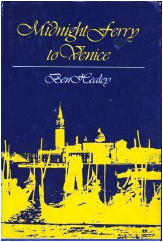
HEALEY, BEN(JAMIN JAMES). 1908-1988. Add year of death. Pseudonyms: J. G. Jeffreys, Jeremy Sturrock, qq.v. Artist and designer in British film industry. Under his own name, the author of 12 mystery novels listed in the (Revised) Crime Fiction IV published in the UK between 1965 and 1981. Series characters: (1) artist Paul Hedley and(2) art thief Harcourt d’Espinal, who generally worked separately but appeared together in Last Ferry from the Lido (Robert Hale, 1981) aka Midnight Ferry to Venice (Walker, 1982). Four of the books were published in the US.

Healey- Midnight Ferry


JEFFERY, WALTER (JAMES). 1861-1922. Add as a new author entry. Born in England; noted Australian writer & journalist. Co-author of one marginally crime-related title:
       -The Mystery of the Laughlin Islands, with (George) Louis Becke, 1855-1913, q.v. Unwin, UK, hc, 1896. Setting: Ship.

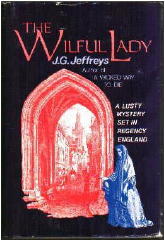
JEFFREYS, J. G. Pseudonym of Ben(jamin James) Healey, 1908-1988, q.v. Add year of death. Other pseudonym: Jeremy Sturrock, q.v. The first seven adventures of Jeremy Sturrock of the Bow Street Runners, a series set in Regency times, were first published in the UK as by Sturrock; then in the US under the Jeffreys byline. One of these is shown below; an additional title, The Thistlewood Plot (Walker, 1987) appeared only in the US.

Jeffreys- Wilful Lady


JILES, PAULETTE. 1943- . Ref: CA. Add as a new author entry. Born in Missouri; immigrated to Canada, 1969. Journalist, writer, memoirist, poet.
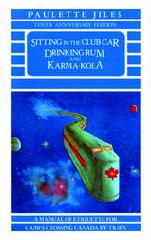
       -Sitting in the Club Car Drinking Rum and Karma-Kola. Polestar, Canada, pb, 1986. Setting: Canada, train. A novella (104 pages) subtitled: A Manual of Etiquette for Ladies Crossing Canada by Train. Described as “a parody of the 1940s detective novels of Raymond Chandler and Dashiell Hammett, [the story] follows its heroine as she avoids the payment of $50,000 in overdue bills by fleeing across country.” Illustrated with the Dome Car floor plan.

Jiles- Sitting in the Club Car


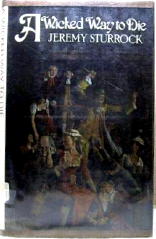
STURROCK, JEREMY. Pseudonym: Ben(jamin James) Healey, 1908-1988, q.v.. Add year of death. Other pseudonym: J. G. Jeffreys, q.v. The primary character in each of the books under this pen name was the same as the author’s, Jeremy Sturrock of the Bow Street Runners. A series set in Regency times, it displayed, says one online source, “a nice raunchy low-life vulgarity.” Seven books were published in the UK between 1972 and 1983; one of these is shown below. When published in the US the byline was given as J. G. Jeffreys. A final book appeared in 1987 only in the US.

Jeremy Sturrock- A Wicked Way to Die

   First in a series of cover artwork, mostly paperbacks, and all from my collection. The only criterion for this one and ones to come: These are books that I’ve found pleasures in various ways in having them in hand to look at, up close and personal.

   Artist: Kirwan:

Shoot the Piano Player

BLACK LIZARD. First published as Down There, Gold Medal, 1956. Reprinted as Shoot the Piano Player, Grove Press (Black Cat), 1962. Black Lizard edition, 1987. Introduction by Geoffrey O’Brien. Filmed as Tirez sur le pianiste; adapted and directed by François Truffaut.

      From the front cover (top):

    “David Goodis is the mystery man of hardboiled fiction — the poet of the losers.”

— Geoffrey O’Brien, Mystery Scene

   From the front cover (bottom):

      Eddie was a piano man on the skids, about as far from the top as he could slide. Then he met a girl, the right girl, and she gave it all back to him. He’d kill anyone who came between them.

      From the back cover:

   Eddie had been a big shot one, a concert pianist at the top of his profession, able to fill Carnegie Hall whenever he chose to perform. His brothers were in a different business, however; they were thieves, killers. Until now he’d been able to avoid them, to live his life in his own way. But things were different now; they’d been different since his wife and career went out the window. He hit bottom fast.

   Then this girl came along, and Eddie began the long, slow climb out of the gutter. When his brother Turley showed up Eddie knew it was bad news — he couldn’t say no to Turley, no matter how painful the consequences proved to be.

      “Action and thrills!”           — San Francisco Call Bulletin

      “Goodis’s characters are not just hard-boiled, they’re pickled and then deep frozen … bad-dream Bogarts on the far ledge of existence.”          — Mike Wallington

   Bill Pronzini, author of the long-running “Nameless” PI series, has been chosen by the Mystery Writers of America to receive their 2008 Grand Master Award.

Bill Pronzini- The Snatch

   To make this personal, although he and I have met only once, at a Pulpcon where he was a Guest of Honor several years ago, Bill and I have corresponded since the 1970s. Our common interests have always been detective pulp magazines and collecting obscure mystery fiction, both hardcover and paperback, and facts and information about their authors. Bill’s been a solid supporter of Mystery*File in all of its many shapes and forms, first as a print zine, then the web site, and now the blog.

   We’ve collaborated on several mystery-oriented projects together in recent years, most notably the annotated checklists we did with Victor Berch of the Guilt Edged mystery series from Dutton and the Ziff Davis Fingerprint series. I’m now assisting him in supplementing Bill Deeck’s book Murder at 3 Cents a Day (see the sidebar on the right) by uploading cover images of almost all of the mystery fiction that’s included in it.

   Word of this honor came in a news release from the MWA:

**********************************************************************
And the 2008 Grand Master is…

**********************************************************************

   Author Bill Pronzini has been selected to receive the coveted title of Grand Master, Mystery Writers of America’s (MWA’s) highest honor bestowed on an individual. He will be honored at the 62ndAnnual Edgar ® Awards banquet on Thursday May 1, 2008 at the Grand Hyatt Hotel in New York City. The “Edgars,” as they are commonly known, are named after Mystery Writers of America’s patron saint Edgar Allan Poe and are awarded to authors of distinguished works in more than a dozen categories.

   The Grand Master Award represents the supreme level of achievement in the mystery field and was established to acknowledge important contributions to the genre, as well as significant output of consistently high-quality material.

    “Bill Pronzini is not only a passionate author and reader of crime fiction–he is also one of the most ardent proponents of the genre,” said Daniel J. Hale, Executive Vice President of Mystery Writers of America. “For forty years he has distinguished himself with consistently high-quality writing and editing in all areas of the field, including creating one of the longest lasting detective series ever.”

   Bill Pronzini started down his path toward the Grand Master in 1969, when he embarked upon his professional writing career. Since then, Pronzini has experienced a prolific career, penning more than 70 novels and non-fiction books, including 32 novels in his popular “Nameless Detective” series and three novels written in collaboration with his wife Marcia Muller (MWA’s 2005 Grand Master).

   Pronzini is no stranger to critical acclaim for his achievements. He is a six-time Edgar nominee, including a nomination in 1987 with his wife Marcia Muller for Best Critical Biographical Work, 1001 Midnights: The Aficionado’s Guide to Mystery Fiction. He is also a recipient of three Shamus awards and the Lifetime Achievement Award from the Private Eye Writers of America. Pronzini’s suspense novel, Snowbound, was the recipient of the Grand Prix de la Litterature Policière as the best crime novel published in France in 1988.


Bill Pronzini- Savages

    — Thanks to Ed Lynskey for sending the MWA announcement along. See also The Rap Sheet for the coverage there, the best source for mystery-related news around anywhere on the web.

   The link in the first line above will take you to Kevin Burton Smith’s article about Bill on his Thrilling Detective website, complete with a long, and I think complete bibliography of all of Bill’s mystery-related activities: novels, short stories, anthologies and reference works.

   On DorothyL someone wondered if “Nameless” is the longest-running series character still operating today. I’m not sure, not having researched it completely, but for the record, Nameless first appeared in “It’s a Lousy World” aka “Sometimes There Is Justice,” which appeared in the August 1968 issue of Alfred Hitchcock’s Mystery Magazine). His first novel-length case was The Snatch, hardcover, Random House, 1971. Out earlier this year from Forge was the 31st in the series, Savages.

   Either way, it’s an honor well deserved, and to many of us, one that’s been too long in coming. Now is certainly a fine time, though. Congratulations, Bill!


UPDATE [11-16-07]. It all comes down to a matter of definition, as it almost always does. P. D. James’s Adam Dalgleish first saw the light of print in Cover Her Face, which came out in 1962, and most recently appeared in The Lighthouse, 2005. I’ve not read the latter. Is there anything in it to indicate that this was Dalgleish’s final performance? And even if so, there’s nothing to prevent an encore, is there?

   And there may be other characters with long careers whom I haven’t thought of yet. We may have to qualify “Nameless” as being the longest running PI series character who’s currently active. And it looks as though he’ll be around for a while yet. I sure damn hope so.

   I’m really rather reluctant to do this, but in the last day or so, I’ve had to decide that I have to. I’ve simply run out of time to do this blog the way I want to.

   I don’t know if you’ve noticed, but I’ve in effect been coasting for most of past month — what with my brief vacation trip to Michigan, a video card malfunction when I came back, then the break-in into my storage areas.

   This most recent problem has forced me to start moving massive amount of books around, which is what I’ve been doing all of this past week. But more than ever, it’s also made me realize that I actually do have massive amounts of books to move around. By massive, I mean in the high five figures. And most of them are books I didn’t even know I had.

   Along with moving books out of the garage, it’s time to do something about it. Some I will save, others will go up for sale on Amazon, and others will get donated to the local library. (I was going to say that others will get dumped, but the folks at the library sale can do that as easily as I.)

   I’m also always in the process of adjusting my thyroid medication. If it’s right one week, the next week’s it’s not. Doing the blog has been great fun, but on another level, it’s also stressful, which doesn’t help, and I’m constantly frustrated that I can’t do more.

   Tomorrow will mark the ten-month anniversary of the Mystery*File blog, and as I’ve mentioned before, I’ve been really pleased with some of the posts, and happy with all of them. (Well, I’ve deleted one or two, and you can’t see them, so those don’t count.)

   Hibernation means (for animals) being dormant for the winter months. It’s a little early for winter, and the dormancy here may or may not last longer than that, but even the most grumpy of growly bears arouses himself every once in a while during his siesta, and gets up and prowls around for a while before heading back to his cave again.

   I’ll do the same. In the sidebar on the right are a couple of projects I will be continuing to work on, and when there’s a major page added, I’ll be sure to announce it here. I’m referring first to Al Hubin’s Addenda to his Revised Crime Fiction IV, which I’m always in the process of annotating and embellishing; and secondly, I’m working with Bill Pronzini in adding more cover images to the Murder at 3 Cents a Day website.

   The latter’s been neglected in recent weeks, but I’ll start working on the books from Mystery House soon.

   Victor Berch and I have one or two other projects in progress. It’s extremely easy for us to keep coming up with others, and there’s no doubt that we will.

   Bruce Grossman just sent me another map to be included in the preceding post, and Jamie Sturgeon has said that he’s already come up with others. There’s no reason why I shouldn’t keep posting them here.

   In fact, figuratively speaking, I have drawer here in my desk that’s simply overflowing with reviews, checklists, paperback covers and other material to share with you, but alas, for now, for the reasons above and more, I’m simply not able.

   I wish it were otherwise, but not so.

   While I’ve been tending to other matters and haven’t been able to spend much time with Mystery*File this month, British mystery fan and bookseller Jamie Sturgeon has continued to send me examples of maps in mysteries as he’s come across them. I’ve been collecting some of my own, but where they are at the moment, I don’t know. (I’m a bit unorganized at the moment.)

   Rather than wait for me to add mine to his to create one long entry, I’ve finally decided to run only the four that he’s sent me most recently.

   First, he says, how about this double one from Fatal Friday by Francis Gerard?

Fatal Friday

Fatal Friday (Rich, 1937, hc) [Chief Insp. (Supt.) Sir John Meredith; England] Holt, 1937.


   Next, he went on to say, perhaps a day or so later, there’s this one in Riot Act by R Philmore:

Riot Act

Riot Act (Gollancz, 1935, hc) [C. J. Swan; England]


   Here’s one of the more elaborate maps Jamie says he’s ever seen in a crime novel, one that he sent me while my computer was down. It comes from Angel in the Case by Evelyn Elder (Milward Kennedy), a very scarce book. Some other Methuen books of the period have these maps on the front endpapers as well.

Angel in the Case

Angel in the Case (Methuen, 1932, hc) [England]


   And here’s a map from another Methuen title,The Pressure Gauge Murder, by F.W.B. von Linsingen, his only mystery:

The Pressure Gauge Mystery

The Pressure-Gauge Murder (Methuen, 1929, hc) [South Africa] Dutton, 1930.


— Bibliographic information taken from Crime Fiction IV, by Allen J. Hubin.


[UPDATE] 10-25-07. The British contingent of crime authors didn’t have a monopoly on maps in mysteries, of course. Bruce Grossman sent this one along, taken from Ellery Queen’s The Dutch Shoe Mystery. In particular, it’s from the softcover edition of Otto Penzler’s reprint, so we’re assuming that it’s the same as the one in the original First Edition.

The Dutch Shoe Mystery

The Dutch Shoe Mystery (Stokes, 1931, hc; Gollancz, UK, 1931) [Ellery Queen; New York City, NY]

A couple of my self-storage units were broken into this past weekend, as I discovered yesterday afternoon. The thieves got into about 160 units in all, I was told. They saw the boxes of books in mine, rummaged around for a while, then left. They smashed the door latch on one of the units, though, so it couldn’t be used. I had to move everything out of that one into the other, filling up the “aisle” I’d left, and leaving no room to move around at all. It wasn’t much fun.

Luckily it was a beautiful day.

   I didn’t think anything of it when it posted yesterday’s entry here, but somehow Google picked up on it very quickly, and today’s total number of visitors has surpassed that of any other day so far except (perhaps) the day the passing of Donald Hamilton was posted here first.

   No one’s come up with any of the answers yet, or if they have, they didn’t bother leaving them as comments. I deleted a couple that I thought were facetious, not that I’m against facetie or anything, but neither were the proposed answers particularly relevant either. (Sorry, guys.)

   Maybe some hints are in order? Don’t keep reading if you don’t want any help.

49 ACROSS: Author said to have influenced Hitchcock. [Three letters.] This one should be extremely easy for mystery fans. It’s exactly who should come to mind immediately, but I’d also have to concede that I don’t know how true it is.

   Let’s skip to 57 ACROSS: Holmesian tool. [Eight letters.] You have to watch out for two word phrases in one slot, and that’s the case here. I’ll break it up correctly as

         HA_D    _ _N_

and let me know if that helps. The “Holmes” referred to is Sherlock, by the way, not “Oliver Wendell.”

   I have a confession to make. Before I picked up on the answer, I had some letters going down through 51 ACROSS: Street boss. [Ten letters.] So I was asking you to do something that I didn’t quite do myself, but I was hoping that the primary focus of this blog would compensate for that, at least maybe in part.

   Hint: Two words again. Mystery fiction oriented. And a couple of letters:

         P_ _ _ _ M _ _ _ _

   You’ll know it when you get this one right, it will feel so good.

[UPDATE] 10-22-07. The answers are in this morning’s paper, so I may as well provide them too. See the comment.

« Previous PageNext Page »