REVIEWED BY WALTER ALBERT:         


TWO OF A KIND. Columbia, 1951. Edmond O’Brien, Lizabeth Scott, Terry Moore, Alexander Knox, Virginia Brissac, J. M. Kerrigan, Louis Jean Heydt. Director: Henry Levin. Shown at Cinecon 39, Hollywood CA, Aug-Sept 2003.

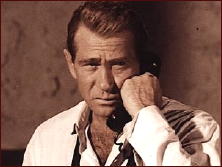
TWO OF A KIND Lizabeth Scott

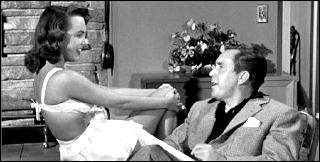
   This was scheduled to showcase Terry Moore, who was interviewed after the film. She’s a garrulous senior citizen now, very up-beat, but in her prime (and the film seems to have caught her in it) she was a busty, perky, sexy but wholesome-looking actress.

   This was, indeed, a nifty crime film and may even have had a bit of crackle, much of it due to the cast and the crisp direction of Levin.

   Alexander Knox is a shady lawyer, who manages the affairs of a wealthy couple whose only son disappeared many years ago. O’Brien is prepared to be that son and lay claim to their inheritance, while Scott is their partner-in-crime and Moore a ward of the wealthy couple.

   O’Brien is first-rate as the good/bad con-man, Knox is appropriately smooth and dissembling as the lawyer and Moore and Scott make an interesting contrast in sexpots.

Editorial Comments:   My own review of this film appeared earlier on this blog. Check it out here. A two-minute clip from the movie can be found here on YouTube. It’s the scene in which the three conspirators get together to plan strategies. It’s short, but while Terry Moore is everything that Walter says she is (see the photo above), the clip helps to show why, in my words, “this is Lizabeth Scott’s film all the way.”

TWO OF A KIND Lizabeth Scott

REVIEWED BY RAY O’LEARY:
   

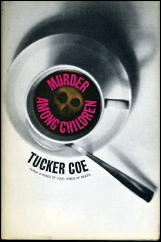
TUCKER COE – Murder Among Children. Random House, hardcover, 1967. Signet P4030, paperback, 1969. Five Star, hardcover, 2000, as by Donald E. Westlake writing as Tucker Coe.

TUCKER COE Murder Among Children

   Disgraced, reclusive, ex-cop Mitch Tobin is asked by Robin Kennely, a cousin he didn’t know he had, to talk to a Cop who keeps hanging around a Coffee House she and her friends are trying to make a go of. They don’t know what he’s after, just that he haunts the place like a bad odor.

   Mitch refuses at first, but is talked into taking the case by his wife. The next day he goes to the Coffee House and finds Robin coming from her boyfriend’s upstairs apartment, covered in blood and holding a knife.

   Upstairs, the Police find Robin’s boyfriend and a black prostitute stabbed to death and arrest Robin for murder. But then another partner in the Coffee House gets killed in a hit-and-run accident, and Mitch reluctantly decides he must go after the real killer.

   Hardly a work of groundbreaking originality here, but I found the character of Mitch Tobin, with his psychosymbolic brick wall, fairly interesting. Another point: Coe (Donald Westlake) works a Religious Cult into the plot, and it got me wondering whether one might make a list of PI novels involving weird sects. They seem to be almost as basic a convention as the trenchcoat and fedora.

      Previously on this blog:

Don’t Lie to Me, by Tucker Coe.     [A 1001 Midnights review by Bill Pronzini.]

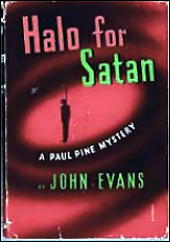
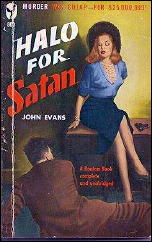
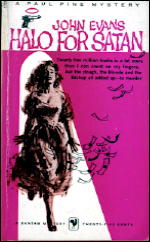
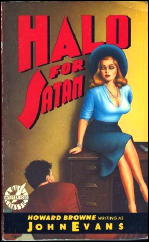
HOWARD BROWNE as JOHN EVANS – Halo for Satan. Quill, paperback, circa 1984. First published as by John Evans: Bobbs-Merrill, hardcover, 1948. Bantam #800, paperback, 1950; Bantam 1729, paperback, 1958.

JOHN EVANS Halo for Satan

   Over the years there have been mysteries written with the basic premise and understanding that the English language can be used to enhance the pure, unadulterated fun of reading. This is one of them.

   Paul Pine is a private eye, and even his client is an eye-opener and an eyebrow-raiser. And what Bishop McManus wants him to do is to track down a man who has offered to sell him a manuscript written, so he says, by Jesus Christ himself. The story goes on from there.

   Just before Pine finds the first body, he meets a girl. Page 38:

    I listened to the sound of high heels click into silence on the uncarpeted stairs. When there was nothing left but quiet, I lighted a cigarette and thought about Lola North. A slip of a girl who could put a flat-footed cop into his place, and who was probably proud of doing so. Maybe not, though. Maybe she was worrying a little over how easy the victory has been. And then again, maybe my sheriff’s star badge had been about as impressive as a grapefruit.

    A lovely girl, Lola North. Enough figure and not too many years and a face that could come back and haunt you and maybe stir your baser emotions. A girl who could turn out to be as pure as an Easter lily or steeped in sin and fail to surprise you either way.

   Later, going back into his office, Pine is given a good solid knock on the head. As he comes to, pages 63-64, he finds that there is another woman involved:

JOHN EVANS Halo for Satan

    I got a shoulder under my eyelids and heaved hard and they slid about halfway before they stuck again. It was like opening cottage windows after a rain. Pain gnawed at the back of head like rats in a granary.

    The hunk of ribbon and the smooth red hair were back again, with a face under them I hadn’t noticed before.

    It was a face to bring hermits down out of the hills, to fill divorce courts, to make old men read upon hormones. A face that could sell perfume or black lace undies and make kitchen aprons a drug on the market. Good skin under expert make-up to make it look even better. Brown eyes, with a silken sheen to them. Eyes with a careful, still look as though never just sure what the brain behind them was up to. A nose you never quite saw because her full lips kept pulling you away from it. Hair smooth on top and a medium bob in back that was pushed up here and there to make it casually terrific.

    And my aching head was supported pleasantly on a cloth-covered length of firm warm flesh that was one of the lady’s thighs.

    I said, “I laughed at a scene like this not more than an hour ago. I thought the usher was going to throw me out.”

    Her expression said she thought I was out of my head. I would have liked to be, after what had been done to it.

    “Are you all right?” It was the kind of voice the rest of her deserved: husky, full-throated, yet subdued.

    I said, “How do I know if I’m all right? I think I’ll kind of stand up.”

JOHN EVANS Halo for Satan

   Later on Lola North begins to tell Pine some of her story. Page 102:

    She turned her head to give me a long level stare. “In one way or another,” she said tightly, “I feel it’s largely my fault that my husband’s in trouble. I’m trying to make amends by getting him out of it. That’s why I followed him to Chicago.”

    I pushed what was left of my cigarette through the air vent and stretched as much of my frame as the limited space would allow. “Go ahead,” I said wearily, “and tell me. Pour out the words. My spirits are low and my ears are numb, but I’ll listen. Other people read books or go to the fights or walk in the sun or make love. But not poor old Pine. He just sits and listens.”

    She said stiffly, “This was your idea. You wanted to know these things,”

    “Yeah. Go ahead and tell them to me.”

   The next morning, Pine gets back to his office. Page 118:

    Nine-thirty was early for me to be at the office, any morning. But I had wakened about eight o’clock, dull-eyed and unhappy, and filled with a vast restlessness that had no answer.

    It was a dreary, rain-swept day, raining the kind of rain that comes out of a sky the color and texture of a flophouse sheet and goes on and on. I opened the inner-office window behind its glass ventilator, put my hat and trench coat on the customer’s chair and poked my shoe at the windrows of office junk left on the floor by yesterday’s prowler. The cleaning lady must have taken one look at the wreckage and gone downstairs to quit.

JOHN EVANS Halo for Satan

   On pages 130-131, Pine is at the home of the second woman:

    “Damn you,” she said. And then she laughed. “I’m not through with you yet, mister!”

    “What about Myles? Is he as broad-minded as he is rich?”

    She shrugged and she wasn’t laughing any more. “The hell with him,” she said recklessly. “I need young men — men with the sap of life in their veins and a good strong back. Myles is too old for me.”

    I said, “Another woman said almost the same thing to me last night. What’s the matter with you dames? You make a guy afraid of reaching his forties.”

   Later, after sitting around in his office with nothing happening for several hours, Pine starts to leave. Page 139:

    By eight-thirty I had all I could take. I had gone through everything in the paper except the want ads, there was a mound of cigarette butts in the ashtray, and my tongue tasted like something rejected by a scavenger. I glowered at my wrist watch, growled “Up the creek, brother!” for no reason at all and put on my trench coat and hat.

    The fat little dentist in the next office was locking his door for the day as I came out into the corridor. He nodded to me. “Good evening, Mr. Pine. You’re later than usual.”

    “And all for nothing,” I said. “I nearly came in to have you drill one of my teeth. Just for something to do.”

    His smile was a little sad in a dignified way. “I could have used the business, sir.”

Back in his office a little while later, on page 169:

    I dug out the McGivern mystery novel it finished it over half a pack of cigarettes. The women in it were beautiful and the private eye was brilliant. I would have like to be brilliant, too. I would even have liked to be reasonably intelligent. I put the book away.

   There is twist upon twist in the story that surrounds all these quotes, not all of them believable in the cold, clear eye of dawn, but they will make you sit up and take notice. Guaranteed.

— September 2003


Note:   The cover of the first Bantam paperback was “covered” earlier here on this blog.

REVIEWED BY DAN STUMPF:         


MURDER BY CONTRACT

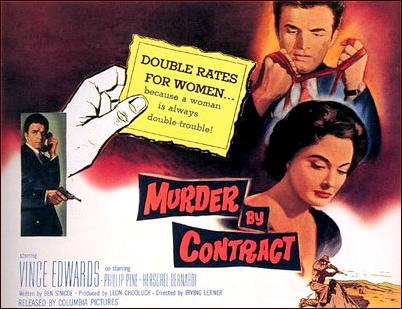
MURDER BY CONTRACT. Columbia Pictures, 1958. Vince Edwards, Phillip Pine, Herschel Bernardi, Caprice Toriel, Michael Granger, Cathy Browne. Director: Irving Lerner.

   Incredibly cheap, unbearably compelling, with Edwards an emotionless Hit Man who is gradually revealed as hopelessly hung up on the trivial details he thinks will become his undoing.

   Story and dialogue are terse and to-the-point as a speeding bullet, and the whole thing is filmed by Lucien Ballard (the second-best Cheap Cameraman in Hollywood) with an eye for Garish Modern that seems unusually perceptive for its time but was probably merely a matter of having to work on Location.

   This is cold, precise film-making at its very best and I recommend it highly.

Editorial Comment:   Murder by Contract is easily available on DVD. It’s one of the films included in the recent box set Columbia Pictures Film Noir Classics, Vol. 1 (The Big Heat / 5 Against the House / The Lineup / Murder by Contract / The Sniper).

MURDER BY CONTRACT

A 1001 MIDNIGHTS Review
by Thomas Baird


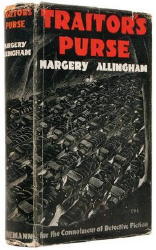
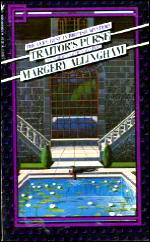
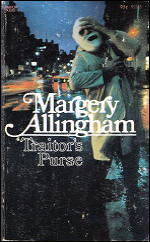
MARGERY ALLINGHAM Traitor's Purse

MARGERY ALLINGHAM – Traitor’s Purse. Doubleday Crime Club, US, hardcover, 1941. First published in the UK: Heinemann, hardcover, 1941. Reprinted many times, in both hardcover and paperback.

   England is at war. The country is threatened by a catastrophic stroke, and time is desperately short. All lines of investigation have gone slack, and only one man knows the enormity of the situation. Only one man has the faintest clue to the heart of the conspiracy. As the story opens, Albert Campion awakes in a hospital bed with total amnesia from a blow to the head.

   Hearing himself described as the killer of a policeman, he recklessly escapes and heads for the Bridge Institute, a research organization that is “a living brain factory.” The Masters of Bridge are a hereditary group who are the governors of the Institute, and Sir Henry Bull is one of the Senior Masters. When the secretary to the masters is killed, the police question Campion, who was the last man to see him alive.

MARGERY ALLINGHAM Traitor's Purse

   Campion’s investigations are invested with the psychology of paranoia. He walks a tightrope, of sifting clues while trying to reestablish his memory. Stanislaus Oates, head of the CID, has disappeared, and Campion can’t confide his memory loss to his love interest, Amanda, because of her trust in him.

   The only really practical help that comes his way is from his man, Magersfontein Lugg, who recognizes what a blow to the head can do and protects Campion from the police manhunt and from the gang of criminals on his track.

   The search for the traitor weaves through the criminal conspiracy and the institute itself (and by extension into the government) and leads into the cavernous heart of Nag’s Head, the rocky headland that looms over the town of Bridge.

   Many characters appear, disappear, and reappear throughout the saga, including friends and relations; the policemen Oates, Yeo, and Luke; and the spymaster L. C. Corkran.

MARGERY ALLINGHAM Traitor's Purse

   This story is Campion’s trial by fire — afterward he is a changed man. Later in his career, he has less to do and becomes a sort of consultant.

   After Allingham’s death, her husband continued the Campion adventures in three more novels. One novel that has received much critical approval, The Tiger in the Smoke (1952), in some ways seems overdrawn and overwritten.

   Other recommended titles by Allingham are Mystery Mile (1930), Look to the Lady (1931), Sweet Danger (1933), and More Work for the Undertaker (1948). Inducements to read them include the memorable names of characters, both major and minor, and of the various settings. And if you’re a fan of that Golden Age staple, a proper plan or map of the scene, these provide cartographic delight.

         ———
   Reprinted with permission from 1001 Midnights, edited by Bill Pronzini & Marcia Muller and published by The Battered Silicon Dispatch Box, 2007.   Copyright © 1986, 2007 by the Pronzini-Muller Family Trust.

A TV Movie Review by Michael Shonk


THE OUTSIDER. Made for TV “World Premiere” movie. NBC-TV/Huggins-Universal Productions, 21 November 1967. Cast: Darren McGavin as David Ross, Edmund O’Brien as Marvin Bishop, Sean Garrison as Collin Kenniston III, Shirley Knight as Peggy, Nancy Malone as Honora, Ann Sothern as Mrs. Kozzek, Joseph Wiseman as Ernest, Ossie Davis as Lt. Wagner. Music: Pete Rugolo. Director of Photography: Bud Thackery. Written and Produced by Roy Huggins. Directed by Michael Ritchie.
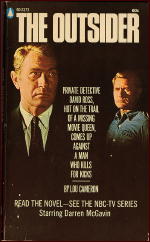
THE OUTSIDER Darren McGavin

   The Outsider is a story suitable for Black Mask magazine, a noirish tale of a loser PI on a simple case that spins out of control with a lying client, violence, betrayal, drugs, seedy L.A. music club life, a femme fatale, and doomed characters.

   The story opens (as will the later series episodes) with David Ross narrating over an action scene that takes place later in the story. Ross is in a car driven off a cliff. He survives and the narration says, “My name is David Ross, and you may be wondering how I got into a situation like this.”

   Flashback to the beginning. Rich business manager Marvin Bishop hires PI David Ross to find out if one of his employees, Carol is stealing from him.

   After spending the night trailing Carol, Ross is woken early by his client. Bishop is less than impressed by Ross. But Ross makes no apologies for his rundown apartment, that he is broke, never finished high school, has no office or secretary, and drives an old car.

   He tells Bishop about trailing Carol to a jazz club where she met her boyfriend Collin. Collin has no past beyond a few years ago when the cops caught him shaking down homosexuals.

   That night Ross walks into a trap. Collin uses a garrote on him and tries to learn why Ross is tailing them. Carol panics, spoils the trap, and the two run. Shortly after, Ross finds Carol dead in her bedroom. After he calls the cops, the phone rings, it is Collin.

   Ross picks up his rich girlfriend Honora, an expert in L.A. club scene. Honora knows Ross will never marry, that would mean joining the world and Ross will always be an outsider. They search for Collin and find him at a Rock music club. Ross and Collin fight. Ross leaves the unconscious Collin for the cops and heads to question his client.
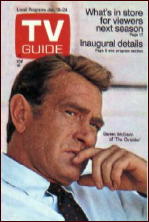
THE OUTSIDER Darren McGavin

   Bishop is unhappily married, and was having an affair with Carol. He had really hired Ross to learn if she was cheating on him. Bishop claims he did not kill Carol.

   Cops question Ross. Collin has an alibi. The cops then discover Ross had served six years in prison for killing a man. Ross explains he was 19 and riding freight trains when a yard bull caught him and started to beat him with a nightstick. Ross hit him once killing the man. He had received a full pardon.

   Ross has no idea what Collin is up to or who killed Carol. But Collin is equally curious about Ross. Ross finds Collin while Collin and the femme fatale are in the middle of an LSD trip supervised by Ernest the drug guru while Collin’s Mom watches TV game shows. But once available, Collin refuses to answer Ross’ questions.

   Frustrated, Ross returns home. Bishop arrives and tells Ross to drop the case. Ross refuses. Bishop leaves and is shot at the bottom of the stairs.

   The cops question Ross, but after a phone call, let him go.

   Ross returns home knowing Collin is waiting inside, when Ross outsmarts Collin, the femme fatale knocks Ross out from behind. They think he is dying and panic. They take him to the cliff for the scene from the opening as they send Ross and car over the cliff.

   There is a short gunfight. Ross then drives away with the femme fatale. He promises to help her escape if she tells him everything. She does. What she and Collin were doing had nothing to do with Carol’s murder and Bishop’s shooting. Ross hears on the car radio the cops have caught the killer. Ross takes the femme fatale to the cops. She reminds him of his promise to let her go. To which he happily replied, “I lied.”

THE OUTSIDER Darren McGavin

   Roy Huggins (Maverick, Run for Your Life) was at his best here as writer and producer. His dialog was as hardboiled as Philip Marlowe and the handling of the club scenes and drug use was less melodramatic than usual for TV. The Outsider also featured many examples of Huggins odd humor, such as Ross keeping his telephone in the refrigerator.

   Director Michael Ritchie (Prime Cut, Fletch) captured the noir style with a mix of 60’s b&w psychedelic style. He was nominated for a DGA award for this TV Movie.

   Darren McGavin (Mike Hammer, Kolchak: The Night Stalker) carried this movie as the admirable loser PI David Ross, a character without ego and comfortable with his limitations.

   The Outsider TV Movie was part of an experiment by Universal and NBC looking for better ways to find TV series. Universal’s “World Premiere” movies were a test for the 100-minute (plus commercials and stuff) format as a pilot. It resulted in three new series for NBC’s 1968 fall schedule, Dragnet 1967, Ironside, and The Outsider.

   In the book TV Creators: Conversations with America’s Top Producers of Television Drama by James L. Longworth (Syracuse University Press, 2002), Huggins discussed why he refused to be involved with The Outsider TV series:

    “After I shot the film, we had so much trouble editing out the “s” factor. That was short for “shit” factor … and although I really liked our star, Darren McGavin, he’s a nice guy, I just didn’t want to go through that. So I not only never had anything to do with The Outsider, but I never even saw it.”

   The “shit” factor was most likely the growing concern over violence on television. Huggins was wise to avoid the headaches that Gene Levitt would experience when he produced The Outsider series.

   Next time, we will examine The Outsider TV series.
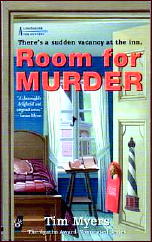
TIM MYERS – Room for Murder. Berkley, paperback original, September 2003.

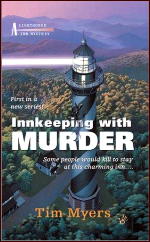
TIM MYERS Lighthouse series

   If you haven’t read any of the previous ones in the series — and this is the fourth so far — Alex Winston is an innkeeper, and he helps solve mysteries. What’s unusual about the inn is that it’s next to an exact replica of the Cape Hatteras Lighthouse, but snugly nestled in the scenic Blue Ridge Mountains, way over on the other end of the state.

   North Carolina, that is. It’s a terrific location to set the stage for some fine detective work, but as fine as the camaraderie between Alex and the local townspeople is; as fascinating as the busted romances between Mor and Emma, and Alex and Elise, are; and watching them getting patched up again — or do they? — and as interesting as being shown the vicissitudes of running a modern-day hostelry establishment is, there’s not a heck of a lot of time left in not too many pages to solve a murder or two.

   Emma’s ex is the first body to be found, followed by one of the two candidates for mayor of Elkton Falls, but the election must go on, and since it’s now a matter of husband running against wife (Tracy Shook vs. Connor Shook), the campaign is getting nastier and nastier, and that’s what’s on everyone’s mind.

   Which is all well and good, but perhaps you know what I’m thinking, and you might be right. The solution to the murders boils down to (a) a slip of the tongue on the part of the guilty party, (b) a wild leap in logic on the part of Alex, and (c) an unconvincing change of character on the part of the party in part (a).

   Nor is there anything fancy about Myers’ level of writing, pitched at, say, advanced middle school students. Which makes it sound terrible when it isn’t, but you shouldn’t read this book and expect to find much worth quoting to anyone sitting in the same room with you.

   And the book is entertaining, don’t mistake me there either. It’s just that as a mystery, it has awfully weak legs.

— September 2003


      The Alex Winston “Lighthouse Inn” series:

1. Innkeeping With Murder (2001)     [Agatha Award nominee, Best First Novel]

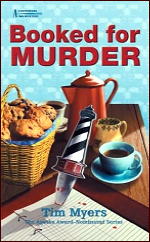
TIM MYERS Lighthouse series

2. Reservations for Murder (2002)
3. Murder Checks Inn (2003)

TIM MYERS Lighthouse series

4. Room For Murder (2003)
5. Booked for Murder (2004)

TIM MYERS Lighthouse series

6. Key to Murder (2010)
7. Ring for Murder (2011)

A 1001 MIDNIGHTS Review
by Marcia Muller


DAVID ALEXANDER

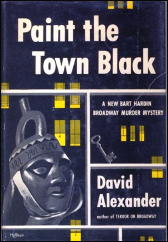
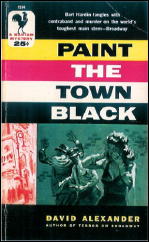
  DAVID ALEXANDER – Paint the Town Black. Random House, hardcover, 1954. Bantam 1534, paperback, 1956.

   Bart Hardin, managing editor of the Broadway Times, is in urgent need of $500. On the recommendation of an old friend, television commentator Mike Ainslie, he applies for a press-agent job with the Latin American Trade Alliance.

   Hired for the position, Hardin returns to his apartment over Bromberg’s Flea Circus and finds Ainslie’s tortured body in front of his fireplace. Hardin’s problems are compounded by the fact that he must break the news to Ainslie’s wife, Dorothy, with whom he is in love.

DAVID ALEXANDER

   The newspaperman’s personal involvement with both the murder and the trade alliance — which urgently wants to recover a fake pre-Columbian jug that Ainslie reportedly had in his possession prior to his death — leads him into encounters with a strange curio-shop owner, a psychologist who collects art, a strongman named Andes, and a chinless man with a penchant for sadism.

   Hardin is an engaging character: a denizen of Broadway who sports embroidered vests and a cynicism that is undermined by his ability (which he would term a flaw) to care deeply — be it for a murdered friend or his old blind dog.

   David Alexander’s portrayal of the people of Broadway gives full rein to their eccentricities, but stops short of being unbelievable. The plot is intricate, and all elements tie off neatly at the conclusion.

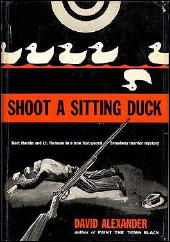
   Other notable Bart Hardin titles are Terror on Broadway (1954), Die, Little Goose (1956), Shoot a Sitting Duck (1957), and Dead, Man, Dead (1959).

DAVID ALEXANDER

   Alexander also created two other series of two books each. The first features the detective duo of Tommy Twotoes, an eccentric penguin fancier, and private eye Terry Rooke (Most Men Don’t Kill and Murder in Black and White, 1951); the second stars Broadway lawyer Marty Land, who also appears in the Hardin series (The Death of Daddy-O, 1960, and Bloodstain, 1961).

         ———
   Reprinted with permission from 1001 Midnights, edited by Bill Pronzini & Marcia Muller and published by The Battered Silicon Dispatch Box, 2007.   Copyright © 1986, 2007 by the Pronzini-Muller Family Trust.

A 1001 MIDNIGHTS Review
by Marcia Muller & Bill Pronzini


DAVID ALEXANDER

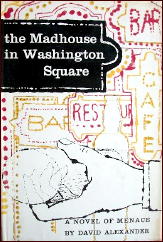
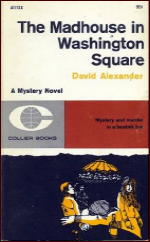
DAVID ALEXANDER – The Madhouse in Washington Square. J. B. Lippincott, hardcover, 1958. Collier 113, paperback, 1961.

   The Madhouse in Washington Square is a tavern frequented by a regular group of social misfits, one of whom is John Cossack, “a painter of barber poles … a barroom porter, a manufacturer of bombs, and something of a philosopher.”

   It is Cossack who finds failed writer Carley Dane beaten to death in Dane’s Greenwich Village cold-water flat. Any number of people had reason to kill the despicable writer, including most of the habitues of the Madhouse.

   Cossack doesn’t wish to see any of these people, his friends, behind bars. Besides, reporting the murder will interfere with preparations for his grand and compassionate scheme to blow up the tavern with one of his homemade bombs, thus putting its largely unhappy patrons — himself included — out of their collective misery.

DAVID ALEXANDER

   As Cossack’s scheme unfolds (and as circumstances force him to reluctantly assume the role of sleuth), Alexander introduces the reader to each habitue: Manley Ferguson, a frustrated artist; Helen Landers, a model who, when in her cups, suffers an overwhelming urge to do an impromptu striptease; wasted Peter Dotter, once rich and now a hopeless and pitiful alcoholic; Major Trevor, eighty-year-old veteran of the Boer War and World War 1, who supports himself by playing small character roles on the stage and on television; bitter old Martha Appleby, whose driving force for close to twenty years has been her hatred of Carley Dane.

   Other suspects include Bruno Madegliani, owner of the Madhouse, who loathes and mistrusts his customers and whose secret passion is to find the long-lost idol of his youth, a champion cyclist named the Great Goldoni; Penny Caldwell, a sensitive young poet who fancies herself another Emily Dickinson; and George Dabney Sturgis, a recently discharged soldier who came to New York just to meet Dane and received a rude welcome.

   Events set in motion in each of these characters’ lives during this crucial day are neatly resolved in the final pages; and Cossack reveals the identity of Dane’s murderer. As for his bomb … well, you’ll have to read the novel to find out whether or not the climax is literally an explosive one.

DAVID ALEXANDER

   In A Catalogue of Crime, Barzun and Taylor called The Madhouse in Washington Square “close to unreadable”; Barzun and Taylor obviously have no patience with eccentric prose styles and no empathy for eccentric characters.

   The fact is, the novel is not only readable but quite moving, owing in large part to David Alexander’s ability to sympathetically portray individuals whose lives and actions are far beyond the limits of rational human behavior. His treatment of these misfits is compassionate and gently humorous — and Madhouse is a kind of poignant tribute to all misfits, everywhere.

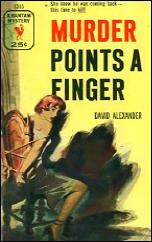
   Alexander’s other non-series novels are Murder Points a Finger (1953) and Pennies from Hell (1960). The latter, a tale of menace and persecution reminiscent of Hugo’s Les Miserables, is particularly good.

         ———
   Reprinted with permission from 1001 Midnights, edited by Bill Pronzini & Marcia Muller and published by The Battered Silicon Dispatch Box, 2007.   Copyright © 1986, 2007 by the Pronzini-Muller Family Trust.

REVIEWED BY WALTER ALBERT:         


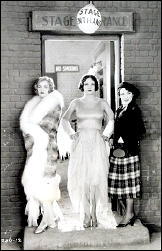
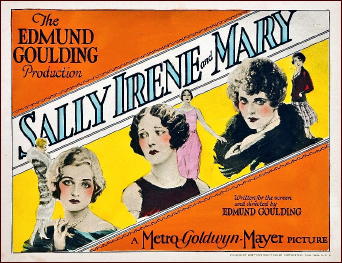
SALLY IRENE AND MARY

SALLY, IRENE AND MARY. MGM, 1925. Constance Bennett, Joan Crawford, Sally O’Neill, William Haines, Henry Kolker, Douglas Gilmore. Based on a play by Eddie Dowling. Director: Edmund Goulding. Shown at Cinecon 39, Hollywood CA, Aug-Sept 2003.

   I have fond, if vague, memories of the 1938 remake of this silent film that featured Alice Faye, Tony Martin, Fred Allen, Joan Davis, Jimmy Durante, and Gypsy Rose Lee (quite a cast!), but I had never seen the original film.

   Constance Bennett (Sally), Joan Crawford (Irene), and Sally O’Neill (Mary) are showgirls, with Sally the older and wiser gal who’s seen it all but is happy with her older lover who keeps her in luxury, and Irene and Mary the recent recruits, childhood friends from the same tenement background.

   The film alternates between the giddy, dangerous after hours parties and the tenement apartments where families fear they are losing their daughters to a sinful show business world. The adventure will end tragically for one of the tenement girls while the other will return to her childhood sweetheart.

   The scenes in which the showgirls talk and gossip among themselves are striking in their mixture of dreams and occasional rueful incursions of reality. Crawford is the standout, although Bennett is almost as fine in her “mother hen” portrayal.

SALLY IRENE AND MARY

« Previous PageNext Page »