SHERLOCK HOLMES IN CHINA. Beijing Film Studio, 1994. Original title: Fu er mo si yu zhong guo nu xia. Also released as Sherlock Holmes and the Chinese Heroine. Wang Chi, Hanson, Alex Vanderpor, Zongquah Xu. Directed by Wang Chi and Yunzhou Liu.
Don’t expect me to decipher the version I saw of this since it was in Chinese with Chinese subtitles, but basically the title says it all, Sherlock Holmes (Alex Vanderpor) and Watson (Zongquah Xu) are in 19th Century China on a case that of course involves Kung Fu and quite a bit of broad comedy at Holmes’s expense as a fish out of water, though still Sherlockian.
Holmes’s attempt at disguise as a tall gray eyed Chinese replete with pigtail is a major disaster as he and Watson duck out of a brawl that turns into an opportunity of director/star Wang Chi to show his fighting skills, but the real highlight of the film is when Holmes takes on a Kung Fu master with his own brand of Violin Fu — who knew the Japanese art of baritsu involved defeating your enemy with nothing but a bow and violin?
There is some sort of a case involved and a master criminal of sorts with Kung Fu skills, but that’s about all I could make out.
Vanderpor, wearing a black suit and stove pipe hat, who looks more as if he is trying out for Abe Lincoln than Sherlock Holmes, manages not to be too embarrassing, but there is no way this film is anything but a curiosity of the first order for Holmesians everywhere.
Desperate Holmes fans can find this on YouTube, or view it below, if you must. If nothing else it proves Holmes is universal if not always translatable.
H. C. BRANSON – The Pricking Thumb. John Bent #2. Simon & Schuster, hardcover, 1942. Bestseller Mystery B76, digest-sized paperback, 1946.
During his Ann Arbor days, Ross Macdonald (Kenneth Millar) was a close friend of H.C. Branson and an admirer of his work. It is easy to see why. Branson wrote literate, meticulously plotted (but flawed) novels in which the emphasis is on deep-seated conflicts that have their roots in the dark past.
Branson’s detective, John Bent, like Macdonald’s Lew Archer, is less a human being than a vehicle around which to build a narrative, a catalyst to mesh all the elements so that each novel’s final statement becomes clear.
In The Pricking Thumb, Bent is hired by an acquaintance, Marina Holland, to investigate the disappearance of her stepson, Bob, and the odd behavior of her husband, Gouvion. But when Bent arrives in the small town of New Paget (in an unnamed state, probably Michigan; a sense of place is almost nonexistent), he finds Gouvion dead of an apparently self-inflicted gunshot wound.
Also found dead this same night are Marina and Gouvion’s doctor, Brian Calvert, under circumstances that suggest the two might have been lovers. It appears to be a case of double homicide perpetrated by Gouvion, who then committed suicide. But there are too many inconsistencies, leading Bent to believe that it is instead a case of triple homicide. His search for the truth takes him along a tangled trail of relationships, old and new hatreds and jealousies, and not a little double-dealing.
There is a good deal of passion among the characters; unfortunately, there is very little in John Bent or in the writing. Bent is a virtual cipher, about whom we know only that he once practiced medicine. “Someone was feeding one of my patients arsenic,” he says to Marina Holland in the first chapter. “The only way I could cure him was to find out who it was and make them stop, which was a little more difficult than it sounds. At any rate, I ended up with a new profession.” The writing, while well crafted, is so detached and emotionless that the reader tends to lose interest.
Had Branson possessed more of Ross Macdonald’s talent, had he been able to make Bent more human and sympathetic, had he injected some passion and vividness into his work, he might have become an important figure in the mystery field. As it is, he is chiefly notable not for his work but for his relationship with Kenneth Millar.
Among his other novels, all featuring John Bent, are I’ll Eat You Last (1941), Case of the Giant Killer (1944), and The Leaden Bubble (1949).
I’ll Eat You Last (n.) Simon & Schuster, 1941.
The Pricking Thumb (n.) Simon & Schuster, 1942.
Case of the Giant Killer (n.) Simon & Schuster, 1944.
The Fearful Passage (n.) Simon & Schuster, 1945.
Last Year’s Blood (n.) Simon & Schuster, 1947.
The Leaden Bubble (n.) Simon & Schuster, 1949.
Beggar’s Choice (n.) Simon & Schuster, 1953.
THE PARTNERS. NBC/Universal Studios, in association with don/lee Productions, 1971-72. Cast: Don Adams as Detective Lennie Crooke, Rupert Crosse as Detective George Robinson, John Doucette as Captain Andrews, and Dick van Patten as Sergeant Higgenbottom. Executive Producer: Arne Sultan – Producers: Earl Barret and Lee Wolfberg. Created by Don Adams.
There are many reasons for a TV series to fail, and many series are doomed from the very start. Sometimes it can be as simple as being in the wrong place at the wrong time. Don Adams’ THE PARTNERS was one of those. You could say it missed it by that much.
Don Adams began as a successful standup comedian, a job he hated. One of his first major acting roles on TV was hotel detective Bryon Glick on THE BILL DANA SHOW. Would you believe that Adams and Bill Dana developed a character that began in Adams standup act and would become TV icon Maxwell Smart? The voice began as part of a comedy bit written by Bill Dana. Adams would mock the famous film scene in THE THIN MAN where the suspects were gathered together so William Powell’s Nick Charles could name the killer.
From there Adams and Dana evolved the character into Bryon Glick as seen on THE BILL DANA SHOW. A spin-off from MAKE ROOM FOR DADDY, THE BILL DANA SHOW aired on NBC (1963-65) and starred Dana as a hotel busboy and co-starred Jonathan Harris and Gary Crosby.
“Master of Disguise.” April 9, 1964. Written by Bill Persky and Sam Denoff. Directed by Coby Ruskin. Executive Producer:Sheldon Leonard in association with Danny Thomas. Guest Cast: Hilary Wontner. *** Hotels are being robbed so Glick the hotel detective takes on various disguises to catch the thief.
Adams was not the original choice for Maxwell Smart, Tom Poston was. After ABC rejected the original pilot. NBC was looking for something for Adams who was under contract to the network. Mel Brooks and Buck Henry then adapted Maxwell Smart for Don Adams and his style of comedy.
GET SMART was a hit for NBC and made Don Adams a star. So when Adams came up with an idea for a TV series, NBC was eager to listen. According to TV.com, in an (unidentified) 2004 interview Adams described his original premise as a cop show with partners similar to the hit film LETHAL WEAPON (1987). Adams would play the white cop not comfortable working with a black partner. THE PARTNERS would deal with the social issues of the day including racism.
THE PARTNERS would debut in the fall of 1971. ALL IN THE FAMILY had debuted in January 1971, and the style of TV comedy was changing. NBC and Universal Studios agreed to make the series but with a major change – the social commentary Adams wanted was gone and replaced with old style TV comedy featuring two bumbling not too bright cops – one white and one black – solving crimes by accident and driving their boss crazy.
NBC’s decision is understandable. It was Adams’ voice that made his comedy work, but it is a voice that would mock any attempt at dark comedy or drama. Imagine Don Adams playing Archie Bunker and you can understand why the network and studio wanted Adams to stay close to the character audience loved.
But Adams wanted to do a serious role (something he never got the chance to do). So while he agreed to a comedy in the style of BILL DANA SHOW and GET SMART he played Detective Sergeant Lennie Crooke straight and without his popular comedic voice. The series needed that voice.
“Waterloo At Napoleon.†October 9 1971. Written by Burt Styler. Directed by Gary Nelson. Guest Cast: Stacy Harris, Pepper Martin, Bob Hastings and Robert Karvelas. *** Lennie and George’s attempt to trap a money launderer goes wrong and messes up the FBI’s plan to catch a kidnapper.
The comedy had its moments but was too fanciful and silly for where TV comedy was going in the 70s. The future of TV comedy was the edginess of Norman Lear’s ALL IN THE FAMILY (and its spinoffs) to the realistic comedies of M*A*S*H and the MTM sitcoms (MARY TYLER MOORE, BOB NEWHART, etc).
The cast of THE PARTNERS included Rupert Crosse as Lennie’s partner George. The original choice for George was Godfrey Cambridge. The reason for dropping Cambridge according to Adams and the network was a “lack of chemistry between Adams and Cambridge.†But my guess it had more to do with the change in the premise from socially conscious comedy to old school safe comedy. While the pairing of Adams and Cambridge as cops dealing with issues such as racism may not have succeeded, it would have had a better chance than the watered-down version that made it to air.
Rupert Crosse was a good comedic actor but both he and Adams played their characters too low-key. Speaking of chemistry, Crosse and Adams never really connected unlike the chemistry Adams had with Bill Dana and GET SMART’s Barbara Feldon.
“How Many Carats in a Grapefruit?†October 16, 1971. Teleplay by Arne Sultan and Earl Barret. Story by Ferdinand Leon. Directed by Gary Nelson. Guest Cast: David Huddleston and Juanita Moore. *** Lennie and George arrive at the airport to pick up George’s Mother and unintentionally ruin another cop’s attempt to catch some jewel thieves.
The production look was cheap and studio bound, something common in 60s comedies, but was quickly being replaced by the three camera comedies of ALL IN THE FAMILY and (to premiere in 1975) BARNEY MILLER and the realistic sets worthy of a drama for M*A*S*H and the MTM comedies.
THE PARTNERS opening sequence was distinct from the common TV series opening. Each episode would open with a different theme and pictures, then the action would begin. The opening titles would appear slowly through the action, at times not ending until well into the first act. The great Lalo Schifrin (MISSION: IMPOSSIBLE) did each theme and the closing theme but the idea proved pointless and not worth the effort.
“Two Or False.†August 1971. Written by Bruce Howard. Directed by Earl Bellamy. Guest Cast: Yvonne Craig. *** A beautiful woman steals jewelry in front of employees of two different jewelry stores. Lennie and George catch her each time but can’t find the jewels.
This might have been funnier if they hadn’t given away the twist immediately. After we knew how Lennie and George were being tricked, there was little left but old predictable gags like the hallway chase scene.
There is a wonderful website called Classic Showbiz. It has a collection of incredible interviews with some of the people who worked during the 50s/60s era of nightclubs and TV comedies. Kliph Nesteroff has a talent for getting great stories from people such as Bernie Kopell, Dick Cavatt, Bill Persky, Sherwood Schwartz, Jack Carter, Bill Dana and more.
Several of the interviews mention Don Adams. Dick Gautier would only talk about Adams off the record while Buck Henry raved about Adams. Adams was a likable man to many while others hated to work with him.
For this review I will just highlight some of the dark side of Adams. For those who seek more information I recommend the two following posts by Nesteroff.
Adams was a successful standup comic who was a notorious joke thief, yet one of his most famous victims, Bob Newhart, became his friend and attended Don Adams memorial. In Newhart’s autobiography (I SHOULDN’T EVEN BE DOING THIS, Hachette, 2006), he wrote about how Adams’ widow asked him to tell the story about Adams stealing part of Newhart’s classic submarine commander bit.
Adams hated being a standup comedian. He considered getting laughs for a living humiliating. An unhappy man Adams main love was gambling, and because of his gambling he often had to fly to Las Vegas on a moments notice to do his standup act to pay off his gambling debts.
NBC would regret not doing Adams original premise. Ironically CBS shifted ALL IN THE FAMILY to a new time slot in the Fall 1971-72 season opposite THE PARTNERS. Socially relevant comedy ALL IN THE FAMILY was the number one show on TV for the 1971-72 season and for the five seasons after. ABC’s light-hearted comedy/music GETTING TOGETHER did not fare any better than THE PARTNERS.
THE PARTNERS aired a total of twenty episodes. The series premiered September 18, 1971 on Saturday at 8:00-8:30 and remained in that time slot until January 8,1972 when the cancelled series left the air. The series returned July 28 1972 and aired the rest of the unaired episodes through September 8, 1972 on Friday at 8pm as a summer fill-in for SANFORD AND SON. There was a TV movie CONFESSIONS OF A TOP CRIME BUSTER (UNIVERSAL, 1971), complied from THE PARTNERS episodes but I have been unable to find its original airdate or what episodes were used.
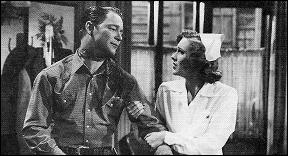
EYES OF TEXAS. Republic Pictures, 1948. Roy Rogers, Trigger, Lynne Roberts, Andy Devine, Nana Bryant, Roy Barcroft, Bob Nolan and the Sons of the Pioneers. Director: William Witney.
Whitneyesque. That’s the term I coined in my mind while watching a fairly brutal– comparatively speaking — fight scene in Eyes of Texas, a Roy Rogers film directed by veteran director William Whitney. (Apologies to anyone who coined this term before, but it certainly fits.) There’s just something exceptional about William Whitney’s fight choreography. You can see it as much in the serial The Crimson Ghost, for example, as in this programmer in which Rogers portrays a marshal tasked with investigating a mysterious death and possible insurance fraud.
True to the Roy Rogers formula, there’s some lighthearted comedy, songs by Bob Nolan and the Sons of the Pioneers, and the smartest horse in the movies — the one and only Trigger. But in Eyes of Texas, you also get a murder mystery, death by a pack of vicious dogs, a corrupt lawyer, and the rather lengthy Whitneyeque fight sequence referenced above in which Roy gets into an altercation with a gang of hired thugs in which he is bruised and battered, punched and roped. It’s gritty and set to the type of music that you’d expect to hear in an action-packed film serial.
Of course, a Roy Rogers movie of this era wouldn’t be the same without Andy Devine. In this film, he portrays a doctor caught between townsfolk who have turned on Roy Rogers and his longstanding affection for, and friendship with, Rogers. His blend of physical comedy and general ability to convey pathos when needed works well in this particular entry in the vast Rogers canon. Eyes of Texas may not be the best Western ever made, and it might not even be the best Roy Rogers film, but it’s an entertaining movie from Gower Gulch that punches well above its weight.
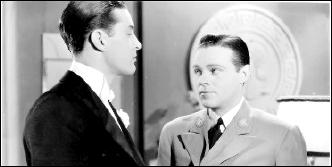
FOUR HOURS TO KILL. Paramount, 1935. Richard Barthelmess, Joe Morrison, Gertrude Michael, Helen Mack, Dorothy Tree, Roscoe Karns, Ray Milland, Charles C. Wilson, Henry Travers, Noel Madison. Screenplay by Norman Krasna, from his play, “Small Miracles.†Directed by Mitchell Leisen.
A taut and fast-moving Grand Hotel style film, set almost entirely in a theater lobby and done up with superlative Paramount polish.
Gangster Richard Barthelmess is being escorted to the death house by kindly detective Charles C. Wilson, and having four hours to wait between trains, the cop decides they should take in a Broadway show. We never see the show (someone at Paramount had the good sense not to turn this into a musical) but there’s enough drama going on in the lobby to fill four hours and then some.
For starters, the hat check boy (Morrison) is studying to get a law degree and marry his sweetheart (the lovely Helen Mack) but he’s being blackmailed by usherette Dorothy Tree, who wants him to cough up $200 for an abortion or marry her — this film has some surprising elements for a post-code flick.
Meanwhile, no-good Ray Milland is romancing the wealthy and married Gertrude Michael, Roscoe Karns keeps calling the Hospital to see if his wife has delivered their first baby, manager Henry Travers needs money, and Barthelmess is determined to get away and rub out Noel Madison, the hood who squealed on him. Amid all this, check-boy Morrison gets a chance to steal Miss Michael’s diamond pin, but gets caught and…..
The wonder is that writer Krasner and director Leisen manage to keep all this straight (it’s a much easier film to watch than synopsize) and put it across with speed and grace. Of course Mitchell Leisen was a past master of nimble direction but here he shows unusual suppleness in getting his characters onstage and off at opportune moments and moving the camera unobtrusively to catch the action at just the right moment.
Barthelmess’s escape has a fine, gritty quality to it, and there’s real suspense as he sneaks through the opulent corridors toward the end we all knew was coming. Even better though are the moments when the characters seem to really relate to each other, like a quiet conversation on the backstage steps as detective and hood share a cigarette and talk about family life, or the moment when Miss Michael realizes what a rotter Milland really is.
Remarkably, though Leisen and Krasner “open out†the play a bit with excursions to the men’s room, shots of the audience and bits of action outside the theater, it never looks like they’re moving just to be moving. This is a film I’ll remember and one I recommend highly. Still, I’m glad it wasn’t filmed in real time.
FIRST YOU READ, THEN YOU WRITE
by Francis M. Nevins
Recently I became interested in LES INCONNUS DANS LA MAISON (STRANGERS IN THE HOUSE), one of Georges Simenon’s stand-alone crime novels that was published in France and made into a French movie during the Nazi occupation. More recently I got interested in another, which was also first published in occupied France and adapted into an Occupation-era movie. Unlike the vast majority of Simenons, LE VOYAGEUR DE LA TOUSSAINT (1941) has never been published in the U.S.
My copy, one of the rattiest-looking in my collection, is of Geoffrey Sainsbury’s English translation, STRANGE INHERITANCE, issued by Routledge & Kegan Paul in 1950. I read it a number of years ago and recently read it again and for the life of me I still don’t see why American publishers passed on it.
At 222 closely printed pages it’s almost twice as long as a Maigret and has far more characters, although many of them are onstage briefly if at all. The protagonist is 19-year-old Gilles Mauvoisin, whose parents, a pair of mediocre music-hall performers, died in a common accident in Norway. (The proper name of the city where they died is Trondhjem, sometimes Anglicized as Trondheim, but Sainsbury renders it as Trondjhem.)
Gilles is smuggled back into the French port of La Rochelle, where his closest relatives make their home, and discovers that his uncle, the wealthy and much-hated Octave Mauvoisin, died a few months earlier. Under Octave’s will Gilles inherits everything provided he live in the same house with Octave’s much younger widow. (This accounts for the English title.)
It soon develops that the widow had had a long-standing affair with a local doctor whose wife is an invalid. When that woman suddenly dies, the novel just as suddenly morphs into crime fiction as suspicion spreads around La Rochelle that she was poisoned by her husband—and that Octave Mauvoisin was likewise poisoned by his wife. Gilles, married by now to a girl his own age but clearly in love with the new-found aunt who is ten years his senior, sets out to clear her before she’s put on trial.
Almost in the Maigret manner, Gilles and a police detective he pays to take early retirement and become his personal PI reconstruct a typical day in Octave’s life and thereby, also in the Maigret manner (i.e. without the kind of clues we find in Anglo-American classic whodunits), identify the real murderer. Simenon never convinced me that Gilles is the teen he’s made out to be but I do recommend the book—if you can find a copy!—and hope to see the movie someday.
***
More than thirty years ago I discovered by accident that James Atlee Phillips, better known as Philip Atlee the author of the Joe Gall espionage novels, had moved to St. Louis County not far from me. Phillips was known as a curmudgeon who in all the years he’d been writing had never sat down for an interview but, having much more chutzpah in my younger days, I got in touch with him and, for reasons that are still obscure to me (perhaps because he was about to turn 70 and felt it was time to give an account of himself) he agreed to sit down with me and a cassette recorder. Our conversation, first published in Espionage magazine in 1985 and included in my 2010 collection CORNUCOPIA OF CRIME, is the source for almost everything published anywhere about his life.
It’s easy enough to find good discussions of his Joe Gall novels but not so easy to learn about his first whodunit, written in ten days and published back in 1942 when he was still in his twenties and not reprinted even at the height of the popularity of the Gall series. THE CASE OF THE SHIVERING CHORUS GIRLS sounds from its title like a Perry Mason exploit but you don’t have to read any further than the dust jacket copy to realize that this book’s protagonist is not a Mason clone but a cross between Nero Wolfe and Baynard Kendrick’s then popular blind sleuth Captain Duncan Maclain.
After losing his eyesight in an auto smashup, the distinguished diplomat Henry Morton Wardlaw decides to devote his life to solving crimes without leaving his lavish Manhattan penthouse, where he even grows flowers, which he can smell but can’t see. Like Wolfe and Maclain he needs a leg man, or we might say eyes and ears, which he obtains by hiring two associates: Emery Landers, a jobless young law graduate of the University of Colorado, and George Caster Patterson, a Mike Mazurki-like hulk with a flair for photography.
They call each other Emmy and Bopeep and, when not sleuthing for Wardlaw, whom for no particular reason they call Judge, they spend their time bantering and getting plastered. The less said of these characters, if you want to call them that, the better.
Apparently Wardlaw and his team have carte blanche from the NYPD to investigate any crime that strikes their fancy. In SHIVERING CHORUS GIRLS it’s the sudden death of a juggler while performing in a night club located in the basement of a hotel. To explain how Jim Phillips came to conceive this book I need to quote from our conversation.
“[I]n 1939 I went to work in New York for Billy Rose…at the World’s Fair, where his Aquacade played to about 14,000,000 people in two years….I was a second-string publicity man….It was our job to get the Rose name and the Rose activities in as many New York newspaper columns every day as we could….I did a lot of submissions to Dorothy Kilgallen, Winchell, Leonard Lyons. We would send five or six items to these columnists and one of them, preferably the most interesting, would have Billy Rose’s name in it, so if we were lucky we got to plug him.
“My office was in the Paramount Hotel on the mezzanine floor, and we had the whole basement of the hotel for the Diamond Horseshoe night club [which was owned by Rose].
“I also used to ream out acres of background stuff about newspapers blowing through Times Square around the statue of Father Duffy at midnight.â€
So much for the origin of the club in the hotel basement, and for the source of the countless “background stuff†passages such as this one from the beginning of Chapter Three.
“The sun was rising when they came out of the Jewel Box and caught a cab. The city was beginning to stir, and although it was not quite six o’clock, people were hurrying down the streets. The subway stations were coughing up a thin stream of humanity, and the streetcars were jangling through Times Square with sleepy-eyed people riding on them.â€
A few of these passages even mention the statue of Father Duffy. The juggler’s death turns out of course to be murder, by a poison needle inserted in one of his clubs. (Shades of the first Nero Wolfe novel! In FER-DE-LANCE, which first appeared in 1934, Wolfe investigates the death of a college president on a golf course and discovers that the handle of one of his clubs had been gimmicked with a poison needle.)
In due course there’s another poison needle murder, this one committed with a sort of blowgun connected to a clarinet, and then there’s a third, which is more conventional. Emmy and Bopeep also encounter an attempted kidnaping on a night subway and a plethora of other incidents before Wardlaw pieces together the whole farrago, which depends on a coincidence worthy of Harry Stephen Keeler.
Even if Jim had given us a sorely needed map of the club and its backstage layout, no one would call this book a masterpiece. But it’s routinely readable and in a few spots—principally the brutal police third-degree of a gangster—it’s quite effective. I’m proud to have known the author, especially since during one of our talks he signed my first edition, which I had picked up for 49 cents years before I got to meet him.
***
On a long-distance Amtrak trip last month I packed in my carry-on bag THE COUNT OF NINE (1958), one of the dozens of novels starring irascible Bertha Cool and ingenious Donald Lam that Erle Stanley Gardner wrote as A.A. Fair between 1939 and his death in 1970. The C&L detective agency is hired by wealthy big-game hunter Dean Crockett II to protect the items in his valuable collection from being ripped off during a forthcoming dinner party.
Bertha checks out all the guests but at the end of the festivities both a 4-inch-tall jade Buddha and a 5-foot-long blowgun are found to be missing. Lam tracks down these items in record time and returns the blowgun to Crockett’s penthouse, where it’s apparently used a few hours later to kill him.
As usual in Fair novels, detection takes a back seat to scam artistry, with Donald encountering a clever tax-evasion scheme and a repulsive photographer with a playbook full of devices to get women to sleep with him. He also encounters some jewel thieves whom he scams into prison cells after they beat him to a pulp. Finally we return to the Crockett killing. Battered but unbowed and thanks to reasoning that leaves much to be desired, Donald exposes a murder weapon almost as bizarre as Phillips’ deadly clarinet.
Anthony Boucher in the New York Times Book Review (June 15, 1958) said that “[t]he pace of the story is inimitably Gardneresque†and especially admired what he called “the adroitness with which Donald so arranges facts that homicide can reach the right answer for all the wrong reasons.†Either he saw something I missed or he was in an especially generous mood that day.
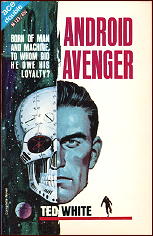
TED WHITE – Android Avenger. Ace Double M-123, paperback original; 1st printing, 1965. Published back-to-back with The Altar of Asconel, by John Brunner.
This was author-editor Ted White’s first solo novel — his first being a collaboration with Terry Carr entitled Invasion from 2500 (Monarch, 1965) under the byline of Norman Edwards. It’s by no means a major stand-out effort, far from it, but what it does have is momentum, and plenty of it.
It begins in Manhattan in the year 2017 (!) as an ordinary citizen named Bob Tanner does his regular civic duty (every fourteen months, on the average) of taking part in an Execution, a government sponsored event in which those deemed insane and a threat to society are strapped down and electrocuted by in front of 1000 citizens who push the buttons that do the deed.
The US has become a country of Compulsory Sanity, in other words. As every SF fan knows, however, there are pockets of resistance, or there will be. But I’m getting ahead of myself.
As Bob Tanner leaves the Arena, his responsibility done, he slips on the sliding walkways in the city, causing an open fracture in his leg. What the medics discover, to their amazement, is that instead of bones, Tanner has a metal skeleton, and that his body has a non-human ability to heal itself in hours and minutes instead of weeks and days.
Naturally Bob Tanner is scared out of his wits. (I would be, too.) But even more frightening to him, once he escapes and is on the run, is that he has a new-found ability to kill people he meets, even those he believes are friendly, beautiful women included, with a laser-like ray that emanates from his mouth.
Bob Tanner, it seems, is a killing machine, built by one man but under the control of another, and he is caught in between. The story is padded with some scenarios built by one side or another and that play out in his mind — I am not too clear about this — but as these are some of more interesting portions of this rather short book (113 pages), it’s padding that adds significantly to the overall ongoing thrust of the story.
Which ends on a high note, as good stories should, but there is definitely room for the question to be asked, “What comes next?” A question that may be answered in the sequel, The Spawn of the Death Machine (Paperback Library, 1968). Perhaps it will be as fun as this one to read.
KYRIL BONFIGLIOLI – Don’t Point That Thing At Me. Charlie Mortdecai #1. Weidenfield & Nicolson, UK, hardcover, 1972. Published in the US by Simon & Schuster, hardcover, 1973, as Mortdecai’s Endgame. Later published in the US under the British title by International Polygonics, paperback, 1990. Reprinted several times in various editions. Film:Mortdecai (2015), with Johnny Depp.
For the many who may have spent sleepless nights wondering what sort of novel P.G. Wodehouse might have produced had he tried his hand at a depraved, unwholesome, im- or amoral tale — that is to say, a novel wholly about aunts of the vilest antecedents — Don’t Point That Thing At Me will give you a good idea what the master might have written.
Describing the Hon. Charlie Mortdecai, sometime art dealer, is a difficult task, but there can be no doubt that he is one of the great antiheroes of the literature. Perhaps if you were to remove most of his good points from Jonathan Gash’s Lovejoy — including his sexual drive, if that’s a good point — and make Frank McAuliffe’s Augustus Mandrell a coward and a sybarite, and then merge the two characters, you might have Mortdecai, or then again you might not.
In this, Mortdecai’s first recorded adventure, he and his thug Jock, a sort of reverse Jeeves whose surname Mortdecai doesn’t recall but thinks it is probably Jock’s mother’s, have in their possession Goya’s “Duquesa de Wellington†and a scheme to smuggle it from England to the United States. The scheme involves a bit of blackmail, which gives rise to all sorts of nasty goings-on, or going-ons , if you prefer.
Everyone, with the exception of a few minor characters, is thoroughly despicable, with Mortdecai and Jock having a few redeeming virtues, if one could only think of them. Mortdecai himself says that he has, like the Woosters, a code, but he doesn’t tell us what it is.
Much mayhem, some torture, and as little sex as is possible — Mortdecai seems to lead a celibate life, although he is capable of indulging with a female, reluctantly — are contained herein, as well as some Lovejoyian asides on art. Torture, of course, isn’t funny, but somehow it produces laughs in Bonfiglioli’s hands.
(This novel won the John Creasey Memorial Award in 1974.)
— Reprinted from CADS 9, July 1988. Email Geoff Bradley for subscription information.
The Charlie Mortdecai series —
by Kyril Bonfiglioli:
Don’t Point That Thing at Me (1972)
Something Nasty in the Woodshed (1976)
After You with the Pistol (1979)
TERMINATOR 2: JUDGMENT DAY. TriStar Pictures, 1991. Arnold Schwarzenegger, Linda Hamilton, Edward Furlong. Director and co-screenwriter: James Cameron.
OK, I agree, The special effects are everything everyone has said they were. But I didn’t see the first film, and I still don’t have much of an idea of what the story is about. (Two killer cyborg robots come from the future, one to protect a young boy, Linda Hamilton’s son, the other to destroy him.)
There’s lots of shooting for the juvenile gun-freaks in the crowd, but since both Schwartzennegger and his nemesis are essentially indestructible, most of the shooting pretty pointless. If you like to see trucks smashing into everything in sight, and buildings being blown up, and people being shot, stabbed, dismembered and thrown away, this is certainly the movie for you.
— Reprinted from Nothing Accompliced #4, November 1993.
[UPDATE.] Within the past year I’ve seen the first movie of the series, and while I now understand the story, I don’t think I’d change anything else in what I said about this second one.
KYLE HOLLINGSHEAD – Ransome’s Move. Ace Double 38500, paperback original; 1st printing, 1971. Published back-to-back with Jemez Brand, by L. L. Foreman (reviewed here ).
I know nothing about Kyle Hollingshead, the author of this Ace Double western novel, other than the fact that he wrote six other westerns, all for Ace (list below), and that itinerant gambler slash con-man Santee Ransome is in at least two more of them.
He comes to Roaring Springs for a good reason, though. An old friend of his, Howard Giles, is in jail for killing the wife of the man who runs the town, Patrick Clancy. He’s been tried and convicted. The case against is open and shut, but Ransome does not believe it.
As he soon discovers, though, there are far more threads to the story than this, with several dozen characters clogging up only 120 pages of story, most of them coming on stage only once or twice before disappearing again. Given major short shrift is the mystery of the sheriff’s missing son (his wife just happens to be a old flame of Ransome’s).
Taking up much of the story is a charade being perpetrated on the teller of Clancy’s bank while Clancy is away. Word gets around that the old white-haired man who has come to town in a fancy private coach and large retinue is none other than Cornelius Vanderbilt. Tis not so. I wasn’t taken in, nor do I think I was meant to be.
It’s all in fun, but I think it would have helped if the book has been half the size longer, just to fit all of the story into it.
KYLE HOLLINGSHEAD – Bibliography:
Echo of a Texas Rifle (Ace Double, 1967)
The Franklin Raid / Ransome’s Debt (Ace Double, 1970)
Ransome’s Move (Ace Double, 1971)
Ransome’s Army (Ace,, 1974)
The Man on the Blood Bay (Ace, 1977)
Across the Border (ace, 1978)
Devoted to mystery and detective fiction — the books, the films, the authors, and those who read, watch, collect and make annotated lists of them. All uncredited posts are by me, Steve Lewis.