It was ten years ago today that my daughter and son-in-law got me started with a new way to spend my time: this blog. I didn’t have any particular goals in mind, only to use this space to talk about things that interested me, with a particular emphasis on mystery fiction.
And as time went on, other items of interest came along. Check out the categories in the right hand panel, and you’ll see what I mean. Nor have I been the only one to have used this space. I’ve invited a small host of others to talk about whatever has interested them as well. I’m happy to have been able to do so. I’d have run out of things to say long ago if I’d left it to be done on my own.
This is now post number 5525, and following those posts, 29,678 comments have been left. This does not include 8,564,846 spam comments no one has ever seen. For reasons that were important at the time, I almost shut this blog down at least twice. I’m glad I didn’t. Thank you all for stopping by as often as you have.
THE PARALLAX VIEW. Paramount Pictures, 1974. Warren Beatty, Paula Prentiss, William Daniels, Walter McGinn, Hume Cronyn. Screennplay: David Giler & Lorenzo Semple Jr., based on a novel by Loren Singer. Director: Alan J. Pakula.
[Since it’s really not possible to adequately discuss Alan J. Pakula’s hyper-paranoid thriller, The Parallax View, without giving away the ending, this review is going to contain a multitude of spoilers. So, if you’d rather watch the movie first, by all means go right ahead and then come right back. Okay, now that I’ve gotten that out of the way … on to the review.]
Whether you love it or hate it, I think you’re sure to agree with me that The Parallax View is by no means an ordinary film. Some who watched it upon its initial release in 1974 may have not really known what to think of it. It’s a political thriller, but one that defies that genre’s traditional narrative structure in which a flawed, but well-intentioned, protagonist (usually a cop, government agent, reluctant warrior forced back into action) takes on an opposing force (a terrorist group, corrupt cops, etc.) and eventually defeated it, but also loses something fundamentally important (his values, his soul, a woman he loves, etc.) in the process.
That’s definitely not the case in The Parallax View, a film in which the protagonist is neither a cop, nor is he eventually triumphant. Instead, the movie’s lead character is a hot-headed (and not overly sympathetic) second-rate journalist with more than a smidgen of antisocial tendencies.
More importantly, he is fundamentally doomed from the start. Simply put: he simply never has a chance. To that extent, The Parallax View fundamentally inverts the Hollywood formula wherein the audience is enticed into rooting for a sympathetic individual to triumph over a villain. Instead, the movie presents a scenario in which the individual not only fails to achieve his goal, but he does so in such a way that his very efforts will never be adequately preserved for posterity. And the villain, such as it is in this untraditional film, is an amorphous, faceless one.
Let me explain.
Warren Beatty portrays Joseph Frady, an intrepid, but hardly topnotch journalist. He doesn’t seem to have many friends and, from what little we know about him, he doesn’t seem to be capable of a stable romantic relationship. When the movie begins, Frady is in Seattle where a United States Senator is campaigning for the White House. Since he isn’t properly credentialed, he isn’t able to take the elevator up to the top where there is a fancy reception.
And maybe it was for the best, since the Senator ends up getting assassinated. What Frady doesn’t see (since he isn’t there as far as we can tell), but we as the viewer do see (this is important) is that there are actually two gunmen, both dressed as waiters. After the senator falls to the ground, security staff rush one of the gunmen and end up chasing him to the top of the structure, where he eventually plunges to his death. But they chased the wrong man. The real shooter got away. But that doesn’t stop a government committee, clearly modeled on the Warren Commission, from concluding that the assassination was the work of a single lone gunman.
Flash forward three years and Frady’s working for a California newspaper, covering low-level crimes and generally getting into trouble. He receives a visit from his ex-girlfriend, Lee Carter (Paula Prentiss), also a reporter. Notably, she was one of the reporters who was on the Space Needle that fateful day three years ago and witnessed the two “waiters†interacting with one another just moments before the shooting. She has some foreboding news for Frady, claiming that a lot of the people on the Space Needle that day have recently died in suspicious circumstances. Frady doesn’t buy it. He not only accepts the official version of events, but also thinks that Lee (Prentiss) is mentally unstable. All that changes when she ends up dead, the supposed victim of drug abuse.
Her death is the film’s inciting event, the one that leads the protagonist (Frady) to take action (investigate Lee’s death). Frady goes to see a friend, an ex-FBI agent so as to obtain a fake identity (that of a social misfit) that would allow him to discretely investigate the mysterious death of one of Lee’s colleagues who was also on the Space Needle.
After watching the movie as a whole, one begins to realize that Frady’s (Beatty) very first move may have fundamentally doomed him from the start. For by taking on the identity of a social misfit, Frady has positioned himself for eventual destruction. This begs the question that plagues the whole movie: at what point does Frady become the object of others’ machinations rather than an autonomous moral agent capable of shaping his own decisions within the world in which he finds himself?
Frady’s investigation, meandering as it is, eventually leads him to a print advertisement from some entity called the Parallax Corporation. They seem to be looking for a certain type of person to join their mysterious company. Frady soon concludes that Parallax is in the business of recruiting assassins and becomes determined to infiltrate the faceless corporation. His investigation leads him to take two personality tests to see if he is the right “fit†for Parallax. While the first is a written one, the second is both auditory and visual.
Frady is subject to a five-minute montage film in which words are overlaid with visual images of both patriotism and violence. Owing much to Soviet montage film theory, the film-within-a-film sequence (embedded below) fundamentally shifts the film away from a fairly predictable political thriller to something much more ambitious. Simply put, The Parallax View stops being a mere political thriller and more a meta-movie about film as an artistic and visual medium and the ways in which films can shape our understanding of the political world.
For what happens to Frady after he watches the montage is both bizarre, in a narrative sense, and an implied commentary on how people think they understand pivotal moments in political history. After a series of fairly off kilter sequences, Frady ends up at a Los Angeles convention center where another US Senator is preparing for a major campaign speech. He suspects, rather knows, that Parallax is going to make an attempt on this Senator’s life and he’s determined to stop them.
But he’s too late. The assassination goes forward. More shockingly, Frady immediately realizes that he has been set up as the patsy for the killing. He – or the social misfit whose identity he has assumed in order to investigate Parallax – is going to go down in history as the crazed lone gunman responsible for the killing. Just as in Seattle, a committee will conclude that he acted alone. Such is the conspiratorial view of history as presented in The Parallax View.
Yet, one need not even remotely subscribe to conspiratorial thinking to appreciate what Pakula attempted to pull off in this movie. For as I understand it, Frady was doomed from the moment he took on the fake identity. And here’s why: Parallax was never in the business of recruiting assassins. They are in the business of recruiting patsies, individuals with personality types who would make convincing fall guys for killings carried out by their professional cadres.
In some ways, that’s what’s most subversive about the movie. For if Parallax was in the business of recruiting patsies and not assassins, then Frady was simply just another pawn on Parallax’s chessboard. At some moment, he ceased being the lone individual struggling to find out the truth and just an object being molded into the perfect pasty. The key question – and one the movie never answers – is when. At what point does Parallax decide that Frady is going to be one of their fall guys?
Up to now, I’ve essentially focused my attention on the film’s plot. But the plot cannot be separated from the visual means by which the narrative unfolds. Much of the movie is filmed in wide shots, wherein individuals are subsumed in comparison to imposing structures such as the Space Needle, a dam, and an office building. Befitting the film’s title, much of the movie is about points of view and how the spectator’s point of view often determined what he perceives to be the truth. Owing much to film noir, The Parallax View is likewise preoccupied with what happens in the shadows, both figuratively and literally.
All of this leads me to a discussion that is sure to provoke some debate. Is The Parallax View a successful film or an overly ambitious well-intentioned failure? Or is it something in between? Is it merely pretentious or does it work at provoking the viewer into thinking critically about what he just watched? That surely depends upon your point of view or, more fundamentally, on what you think you just watched.
A track from this San Francisco-based group’s self-titled first album, released by Warner Brothers in 1971. There were four female vocalists in the group, each of whom had solos; I do not know who the singer is on this one:
LESLIE CHARTERIS – The Saint in New York. Doubleday Crime Club, US, hardcover, 1935, First published in the UK: Hodder & Stoughton, hardcover, 1935. Reprinted many times, including: Avon T-317 (1950s); IPL, November 1988.
I have a great fondness for this book, more perhaps, I have to confess, than its intrinsic reading value. Back in the 50s, after a few weeks of checking out “grownup” mysteries from the local library, the Avon edition credited above, itself a later printing, somehow found itself into my hands. It is among the first I ever read in paperback. I may have purchased it myself, based on the cover (shown below), or it may have have been given to me by my grandparents, who were great readers of mysteries and most conveniently lived next door.
This is a great book for a young teenaged boy to have come across quite serendipitously in the 1950s. Simon Templar (aka The Saint) is a character any boy can immediately identify with: insouciant, carefree, impetuous, daring, and afraid of nothing. He was able to be dragged into any underworld hangout of the worst hoodlums and gangsters that the great city of New York could offer, and act as though he hadn’t a care in the world.
That The Saint was also the luckiest guy in the world didn’t enter into it, although a recent reading of the IPL edition (also shown) made that abundantly clear to the adult version of me. [Warning: Plot Alerts ahead.] That he was saved (twice!) by a beautiful slip of a girl he had never met before was nothing less than an intoxicating dream come true to a teenaged boy, but something less so to an adult.
I also wonder, but not for very long, why it didn’t occur to my younger self that a vigilante for hire could come to New York and kill a short list of villains without remorse or more recrimination from the law was not the way the real world should work.
But Leslie Charteris was the kind of writer who could make you think it should. His often flamboyant overwriting can be difficult to parse if you read his words and sentences one at a time. What I discovered during this most recent re-reading is that if you were to take in large gulps of entire paragraphs all at once, you will be reading the adventures of The Saint exactly as they were meant to be read.
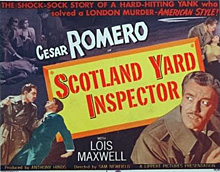
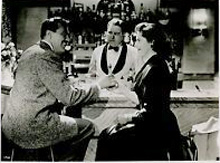
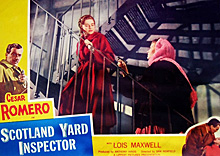
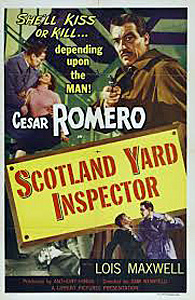
SCOTLAND YARD INSPECTOR. Lippert Films, US; Hammer Films, as Lady in the Fog; 1952. Cesar Romero, Lois Maxwell, Bernadette O’Farrell, Geoffrey Keen, Campbell Singer, Alastair Hunter. Based on the BBC radio serial Philip Odell: Lady in a Fog (1947), written by Lester Powell. Director: Sam Newfield.
This is another of those trans-Atlantic joint Lippert-Hammer productions that were mentioned in my recent review of Terror Street. (Follow the link and be sure to read the comments.) This time it’s Cesar Romero as the one American actor imported to give the film some name value.
Romero plays newspaper reporter Philip Odell, the title character of the radio series the movie was based on, not a Scotland Yard inspector at all. The radio series was popular enough that several more serials followed, through 1961, as well as five novels, all by author Lester Powell. On the radio, after missing his plane back to the US in the first series, Odell stayed on in England and became a PI, with Heather McMara as his trusty assistant (played by Bernadette O’Farrell in the movie).
It is McMara’s brother who is killed in the movie, the victim of a hit-and-run accident in the middle of a vicious London fog. She does not believe it was an accident, however, and when Scotland Yard’s Inspector Rigby (a minor role!) does not believe her, it is up to Odell to give her a most welcome helping hand.
The story — something to do with blackmail and a fatal fire thirteen years earlier — is fairly weak, and bolstering it with a few humorous scenes between Odell and a harried airline reservations clerk, for example, does not help. But Cesar Romero is his usual confident and suave self, with a ready smile whenever even when things begin to look dark, and this is what does help, giving the film a boost it otherwise would not have.
Also of note: Lois Maxwell, the future Miss Moneypenny, has a smallish but still significant role as the owner of a posh night club.
W. SOMERSET MAUGHAM – Christmas Holiday. Doubleday Doran & Co, hardcover, October 1939. Reprinted many times.
CHRISTMAS HOLIDAY. Universal Pictures, 1944. Deanna Durbin, Gene Kelly, Richard Whorf, Dean Harens, Gladys George, Gale Sondergaard, David Bruce. Screenwriter: Herman J. Mankiewicz, based on the novel by W. Somerset Maugham. Director: Robert Siodmak.
Raymond Chandler once commented favorably in passing on Somerset Maugham’s 1939 novel Christmas Holiday, which I happened upon at a flea market a week after reading Chandler’s comment. Okay, it has Murder in it, and even a bit of detective work, I guess, but it’s no more a Mystery than Anna Karenina is a Joke Book.
A young man goes to Paris over the Holidays to sow a wild oat or two, gets set up with a prostitute, and is so moved by her devotion and her personal tragedy that he forgets to sow any oats at all. Seems she was a poor working girl who got married to a nice young man who turned out to be a thief and a killer. And she’s working now as a hooker, partly to help him out in prison and partly because of the guilt she feels over his failures.
It’s a damfine novel, and I can see why Chandler enjoyed it; the central theme of a decent fellow doing a little bit of good without making a fuss about it must have appealed to him a lot.
Christmas Holiday was turned into a movie, kinda, by Universal in 1944, one of those films that runs roughshod over the source, then comes out completely different and quite enjoyable by its own lights.
The basic elements of Maugham’s novel are all there — a sardonic reporter introduces a callow young man to the prostitute wife of a convicted killer; the young man does her a small favor and learns something in the process — but the Universal execs, with the wisdom of their breed, hired writer Herman Mankiewicz to add lots of lurid bits to the proceedings, and got director Robert Siodmack to layer on dollops of sinister noir stylistics. The result is rather a far cry from what Maugham actually wrote, but it’s also an engagingly perverse and chilling film, despite the off-key casting of musical stars Gene Kelley and Deanna Durbin.
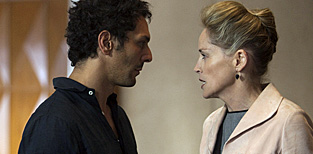
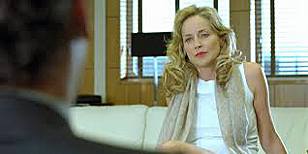
THE BURMA CONSPIRACY. French, 2011. Released in France as Largo Winch II. Tomer Sisley, Sharon Stone, Uklrich Turkur, Napskpaha (Mame) Nakapraste, Olivier Bartelemy, Laurent Terzieff, Nicholas Vaude, Clemens Schick, Dimitry Nazarov, Nirut Siridranya. Screenplay by Julien Rappeneau, Jerome Salle, and Jean Van Hamme. Based on the bande dessinees Largo Winch by Jean Van Hamme and Phillipe Francq. Directed by Jerome Salle.
If you tire of endless superheroes, spies, and cop buddy movies in your blockbuster action movie fare, The Burma Conspiracy, aka Largo Winch II, may be just what you are looking for.
A sequel to Largo Winch, which introduced the character of the Bosnian-born son of Yugoslav billionaire Nerio Winch, who inherits his father’s vast wealth and the W Group with over four hundred thousand employees worldwide, this French action film picks up where the first film left off.
Based on the international hit Belgian bande dessinees by writer Jean Van Hamme and artist Phillipe Francq we pick up as Largo (Tomer Sisley) is planning to sell the W Group and use all his wealth in a planned charitable foundation named for his father, and no sooner has he signed the papers to enable the sale than his yacht is invaded by UN investigators accusing him of involvement in the slaughter of a Karen tribe Burmese village, Kaipu, by war criminal General Kyaw Min (Nirut Siridranya) so that his father could buy their nickel rich land.
Now Largo, with a small band of loyal friends, his lawyer Dwight Cochrane (Ulrich Tukur), his valet Gauthier (Nicholas Vaude), Alexandre Jung (Laurent Terzieff) an old friend of his father, and Simon (Olivier Barthelemy) a ne’er-do-well friend he once saved in the Burmese jungle, has to get to the bottom of the conspiracy against him while evading prosecution by Francken, a vengeful billionaire businessman Nazatchov (Dimitry Nazarov) who is trying to buy the W Group, and a murderous mercenary Lazarevic who wants to kill him. And in a game like this, can anyone be trusted?
As Largo’s favorite Bosnian proverb goes: “A man with no enemies is no man at all.â€
Packed with action, intelligent characters who nevertheless don’t always act in their own best interest, and a surprising amount of heart for an action movie, the film is both picaresque and sharp. The hero is no superman, and needs rescuing as often as comes to the rescue. Tomer Sisley manages to be both strong and vulnerable as Largo, believable in the most outrageous action scenes.
The film is filled with spectacular action and stunts and extremely handsome locales from Geneva to Hong Kong, with action in the jungles of Burma and the streets of Bangkok, and set pieces including a jungle prison camp escape and a breathtaking skydiving battle and rescue. But unlike so many action films, this one takes time to develop characters, to allow for actual human beings to emerge, for humor and a touching romance, and actual suspense that for once waits until almost the last moment to reveal the villain behind Largo’s problems, whose motive is actually quite strong.
It’s nice for once to see a movie where the hero and not the entire civilized world is at stake, particularly one as stylish and smart as this. If this is the sequel, I’m even more anxious to see the first one. If you are looking for a fast moving action film with a big budget that neither insults your intelligence nor sprains your suspension of disbelief beyond repair, this may be the film for you.
Bubble Puppy was a psychedelic rock band from Texas in the late 60s and early 70s. Their biggest hit was “Hot Smoke & Sasafrass,” the first track on this, their only album under this incarnation (and name) of the group, from 1969:
Devoted to mystery and detective fiction — the books, the films, the authors, and those who read, watch, collect and make annotated lists of them. All uncredited posts are by me, Steve Lewis.