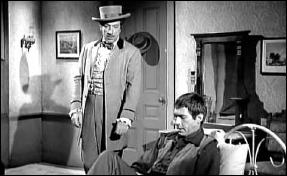
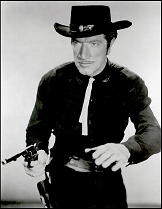
CHARLIE PARADISE. “The Tragic Flute.” An episode of Brenner, CBS, 19 July 1964 (Season 2, Episode 10). Ron Randell (Charlie Paradise). Guest star: Edward Binns as Roy Brenner, with Bob Pastene, Gerald S. O’Loughlin, Severn Darden, Rebecca Sand, Kathy Willard, Fred Gwynne. Story/screenplay: Peter Stone and James Yaffe. Director: Gerald Mayer.

   I’m listing this pilot for a proposed TV series the same way it is in the end credits. The opening title is for a series called Brenner (1959-64), with the name of the episode being “Charlie Paradise.” Edward Binns was the star of the series, playing a police lieutenant for the NYPD named Roy Brenner. Co-starring as Brenner’s son Ernie, a young patrolman for the department, was James Broderick; in the course of the series, they often found themselves working together.

   Son Ernie does not appear in this episode, however, the last of 26. When an old woman whom no one has seen in person for many years is found dead in her dilapidated apartment, Lt. Brenner, having no leads, essentially turns the case over to Charlie Paradise, the owner of a beatnik club in Greenwich Village, and the center of the bohemian art movement for the city, whether jazz, poetry or art.

   It’s an interesting story line, and Ron Randell fits his role well. The solution to the case is provided by an artist with integrity but living in abject poverty. There’s what’s essentially a dead man’s clue to the killer, which cleverly could be any of the suspects. I can’t imagine networks bigwigs relating much to either the setting or the characters living in it, however, and once and done was all they wrote for Charlie Paradise.

Note:   Based on what others have discovered about the series, all of the episodes were filmed in 1959, including this one, then spread out over the years as parts of summer replacement series. The 1964 date is the first and only time this episode was aired. Also, for more on the Brenner series itself, Ted Fitzgerald wrote up a review of it some seven years ago on this blog. Read it here.

JUDY FITZWATER – Dying to Remember. Fawcett, paperback original, August 2000.

   I’ve been winnowing out my collection of paperbacks over the past few weeks. Some are now up for sale, others are going to the local library or in other ways new homes are being found for them. This was going to be one of the latter until I saw that Jennifer Marsh, the detective in this, the fourth of now seven books in the series, the last after a gap of 12 years and available only on Kindle — whew, sorry — is a writer of mystery stories.

   An occupation for a fictional detective that I’ve always found interesting, so I retrieved it from the Pass Along pile, thinking it deserved a trial reading before I did so. Turns out, however, that while Jennifer, a young 30-something, has written nine mysteries, none of them have ever been published. False advertising by the back cover blurb writer right there, wouldn’t you say?

   But while this firmly places this book in the “cozy” category, reinforced by the presence of a wanna-be authors support group she’s a member of, there is an edge to this light-weight murder mystery that managed to keep me reading all the way to the end.

   Most of the opening portion of the book takes place at a high school reunion, with Jennifer reluctantly agrees to attend, and sure enough an old flame is there, bringing back memories of a prom night some 12 years ago. Along with many other members of the same class, most of whom Jennifer would just as soon forget, or she already has.

   But when the old flame is found dead in the parking lot outside the event, the verdict being an unfortunate suicide, Jennifer does not agree and takes it upon herself to do a little amateur sleuthing.

   High school is tough on a lot of people, but for others, it is the highlight of their life. The difference is where the edge comes in. Unfortunately it seems to me that what happens 12 years ago should have been checked into back then, not now, and the ending is one of these in which the heroine decides to tackle the killer head on, with no police in sight.

   So what did I decide? Is this one a keeper after all? No, but Jennifer Marsh is a character that I got to know rather well. She has spunk, and if the other books she’s in come along while I’m winnowing, I may check into her life again.

       The Jennifer Marsh series

1. Dying to Get Published (1995)

2. Dying to Get Even (1999)
3. Dying for a Clue (1999)
4. Dying to Remember (2000)
5. Dying to Be Murdered (2001)

6. Dying to Get Her Man (2002)
7. Dying Before ‘I Do’ (2014)

THE AVENGERS BEFORE DIANA RIGG –
PART TWO: MRS. CATHERINE GALE
by Michael Shonk.


THE AVENGERS, Seasons 2-3. ABC, (Associated British Corporation) Production for ITV, 1962-63. Cast: Patrick Macnee as John Steed and Honor Blackman as Mrs. Catherine Gale. Produced by Leonard White (Season 2), John Bryce (Seasons 2 and 3). Theme composed and performed by Johnny Dankworth.

      PART ONE (THE BEGINNINGS) can be read here.

   When we last left The Avengers we had looked at the first two seasons (or as the British say “series”) and all of John Steed’s closest partners except one, Mrs. Catherine Gale played by Honor Blackman.

   Originally Steed’s next main partner after Ian Hendry (Dr. David Keel) left the series at the end of Season One was to be a man named Charlie Gale. Then ABC Production executive Sydney Newman decided to make him a woman: Mrs. Catherine Gale.

   According to producer Leonard White, in his book Armchair Theatre – The Lost Years (Kelly Publications, 2003), writer Doreen Montgomery was brought in to help with developing White’s idea of a woman playing a male role. She did not last long writing for the series but helped establish the character Cathy Gale. Her only The Avengers script credit is for the episode “Warlock.” The episode was originally planned to introduce Cathy Gale to the audience but some scenes needed to be reshot and that pushed its air-date back.

   Despite Season Two starting to air episodes in May 1962, Honor Blackman was not cast as Cathy Gale until June 1962. Sydney Newman did not believe Blackman could handle the role. After shooting with Blackman began, Newman called her into his office and ordered her to play the part with less smiling and more seriousness or she would be fired. Blackman usually followed that bad advice, but one wonders how more popular Gale and Blackman would have become if they had let the character lighten up a little.

   Mrs. Catherine Gale was an intelligent widow, a scholar, and someone who had survived living in adventurous Africa. She would prove to be a type of female hero TV audiences had rarely seen before. Played by the sexy Honor Blackman, Gale feared no man including Steed, as we can see in the Season Two’s episode below:

   First a note about the YouTube videos used here. Each is the best available at the moment, but the videos are marred by the presence of a iris-shaped light in the center of the picture that was added by whoever downloaded these episodes.

https://www.youtube.com/watch?v=tmo-qOu8Fds

   â€œPropellant 23.” Teleplay by Jon Manchip White. Directed by Jonathan Alwyn. Produced by Leonard White. Guest Cast: Justine Lord, Catherine Woodville, Geoffrey Palmer and Ralph Nossek. *** A courier is set to hand over a top-secret package to Steed but is killed before Steed gets the item. The problem is Steed does not know what the package is or what it looks like.

   Baddies are everywhere in this above average Cold war thriller. Blackman and Macnee are fun to watch and while this was an episode before Blackman donned the black leather outfit it offers a nice scene where she uses the gun in her thigh holster. The episode’s greatest flaw was the low production values that was common for 1962.

   By Season Three, The Avengers was a major hit in United Kingdom and getting attention beyond the British TV viewer but still had yet to reach America. The series was still limited by its low production values and being videotaped live in black and white. The tone of the series was still dark and hardboiled, but the characters started to get more offbeat and the series focused on the engaging chemistry between Macnee and Blackman.

   It was the 60s London and the city was the center of a fashion revolution. The time was right for Cathy Gale and for her “Kinky Boots” …

… and fondness for black leather. Audiences loved Gale and Steed and especially what they were wearing as they beat up the bad guys.

   But this attention to a TV series because of its fashion was not by design, just a lucky by-product from the decision to feature more hand-to-hand combat such as Judo. It was impractical for Gale to perform the martial arts while wearing a dress, and normal slacks could not withstand the stress (as learned during shooting), so much to the audience’s delight black leather outfits were adopted.

   The third season continued to push the naughty boundaries of British TV in 1963. With original bosses network executive Sydney Newman and producer Leonard White gone, John Bryce would produce the third season.

   John Bryce was one of the series’ original story editors and had been involved in the group that created the series. In the middle of the second season he became the series producer and stayed until the end of Season Three. He returned to the series when Clemens and Albert Fennell left at the end of season six. Unable to reproduce the magic Clemens had with The Avengers, Bryce was fired after three episodes and a reluctant Clemens and Fennell were begged back.

   In the third season Gale became Steed’s only partner as she had earned the respect of Steed and his superiors (and approval of the viewers). Steed was becoming more appealing and stylish. Gone was the callous Steed who thought nothing about tossing an inexperienced Venus into situations she might not survive. Steed may have kept secrets from Cathy but he cared about her, and Cathy cared and trusted him.

https://www.youtube.com/watch?v=Jg122j7ojFg

   â€œThe Outside-In Man.” Written by Philip Chambers. Directed by Jonathan Alwyn. Produced by John Bryce. Guest Cast: Ronald Rudd, James Maxwell, and Beryl Baxter. *** A leader of a developing country is visiting England to sign an arms deal. Five years earlier the British government had tried to kill him and thought both of its agents had been killed in the attempt. Now one of the agents turns up alive and wants to finish his assignment.

   A good hardboiled spy thriller with a dark and true view of politics in the Cold War that takes for granted that the British government assassinated political opponents in foreign countries.

   The series popularity was growing and was attracting attention worldwide including America. Then Honor Blackman quit the series, getting the role of Pussy Galore for the James Bond film Goldfinger. Without a female star ABC shut down production while considering what to do next.

   Six months later ABC turned over The Avengers to Telemen Limited, headed by Julian Wintle. Wintle would hire Albert Fennell and Brian Clemens to produce Season Four. This would not be Brian Clemens first involvement with the series. Not only did he write five episodes in the third season, he wrote two episodes for Season One. He was among the group lead by network executive Sydney Newman and producer Leonard White who were involved in the creation of the series. Clemens made not have created The Avengers, but he made so many important changes in Season Four that perhaps we should give him a “developed by” credit.

   Beyond a new partner for Steed, other changes were made that would improve the series in Season Four such as replacing live on videotape with film and eventually black and white with color. The creative staff lead by Clemens would replace the serious hardboiled tone for a wacky playfulness. The character Steed would turn into a delightful wink at the American’s British male stereotype. Steed’s new partner was Mrs. Emma Peel played by Elizabeth Shepherd. But before Season Four would air, one more change would be made, a casting change that took a hit British TV series and made it a television icon that is still remembered today.

      SOURCES:

  Websites:

The Avengers Forever: http://theavengers.tv/forever

Avengers Declassified: http://declassified.theavengers.tv/introduction.htm

  Books:

The Strange Case of the Missing Episodes – The Lost Stories of THE AVENGERS Series 1 by Richard McGinlay, Alan Hayes and Alys Hayes (Hidden Tiger, 2013).

With Umbrella, Scotch and Cigarettes – An Unauthorized Guide to The Avengers Series 1 by Richard McGinlay and Alan Hayes (Hidden Tiger, 2014).


SALLY WRIGHT – Publish and Perish. Multnomah, softcover, 1997. Ballantine, mass market paperback, February 1999.

   If you like mysteries taking place in the world of academia, this is one of the better ones. This first in a series of six Ben Reese novels takes place in a small college town somewhere in Ohio, where the first death is that of his best friend, Professor Richard West, chair of the English Department.

   At first West is assumed to have died of a heart attack, but since he had just finished a mysterious trans-Atlantic phone call with Reese soon before he died, the latter returns home immediately, looking for answers to questions the police have not thought of asking yet.

   By trade, Ben Reese is an archivist for the school, making him a natural for adding detective to his résumé, but his background in commando-style pre-invasion work for the Army in World War II holds him in good stead as well. The story takes place in 1960, by the way, just as things were about to change drastically in the world of higher education. There are no panty raids in this book, but they were still around at the time, with in loco parentis still the philosophy of the day.

   Speaking for myself, I’d like to have known the dead man quite a bit more before he disappears from the book. He was a dedicated scholar, tough on his students, dogged in academic arguments, which were many, and a staunch believer in honesty, a fact which is what gets him killed. It is only as Reese works through West’s life that we get to know him better.

   As the author of this tale, Sally Wright also knows the ins and out of college-based squabbles, jealousies and other political maneuverings, so as I say, I enjoyed this one. Future books in the series move away from the academic scene, however. Reese’s occupation as an archivist will lead him all over the world, and I am curious to learn if the change is for the better.

       The Ben Reese series

1. Publish and Perish (1997)
2. Pride and Predator (1997)

3. Pursuit and Persuasion (2000)
4. Out of the Ruins (2003)

5. Watches of the Night (2008)
6. Code of Silence (2008)

Reviewed by DAN STUMPF:         


ERIC ALLEN – Hangtree Country. Pyramid G-329, paperback original, 1958; 2nd printing, March 1965.

   The first work of a prolific western author, but I’m afraid Hangtree Country will stay in my mind primarily because of a dreadful gaffe by the publisher.

   Author Eric Allen hangs his plot on a familiar peg, then handles it with some distinction. As the story opens, Buck Caldeen rides into town and surrenders himself to the local lawman. It seems he just killed a local nasty, with some justification perhaps, but this is the outskirts of Fort Smith Arkansas, and he can expect little in the way of empathy from Judge Parker.

   Flashback to a year earlier, and Buck Caldeen is riding into town after five years of ramblin’ — the result, it seems, of a romance gone bad. Buck no sooner gets back to his old stomping grounds than he learns that his brother Rube is in Judge Parker’s jail for shooting a man in the back. Moreover, Rube refuses to say anything about the killing, and it looks like he will soon end his days at the end of a rope.

   Unless of course Buck can find out the reason behind it all.

   What follows is nothing in the way of the great western writers like A.B. Guthrie or Milton Lott, but it is a bit out of the ordinary. No gunfights, bushwhackings or barroom dust-ups, just a feel of quiet tension and emotional growth as Buck scours the countryside looking for clues, witnesses and what-have-you, finds himself relating to those around him, understanding why his old romance turned so bad, and finally learning what made his fine and upstanding brother shoot a man in the back — and why he must die for it.

   These are the central themes of Hangtree Country: Why did Rube do it? And How can Buck discover the reason? And it coulda been a contender, as they say. Unfortunately, on the very first page of Pyramid’s first edition, the blurb page, right inside the cover, we read:

   â€œUS CALDENS ARE PROUD MEN, BUCK,” RUBE SAID

   â€œMaybe we got too much Cherokee blood—but we feel a very special way about our women. I had to kill Murch after what he did to Sally — make sure he couldn’t talk,” Rube went on. “He ran and I put every slug I had into his back.”

   â€œIf anybody knows why I shot Murch, you’re going to have to kill him, Buck — kill for the pride of the Caldeens.

   â€œI’ve killed for it — that’s why they’re hanging me in the morning.”

   And there you have it. Everything the hero is trying to learn for more than a hundred pages, everything the reader should be turning pages to find out, all laid out for you before the story even starts. Well crap.

   I’ve heard stories before of publishers doing dirt to their authors, but this one takes its own unique place. And I’m afraid it spoiled what might have been a pretty good read.

KING OF DIAMONDS. “The Wizard of Ice.” September 1961. (Episode 1, Season 1.) Syndicated: Ziv/United Artists. Broderick Crawford as John King and “introducing” Ray Hamilton as Casey. Guest Cast: Lola Albright, Telly Savalas, with: Bert Freed, John Anderson, John Marley, Joan Tabor, Sid Tomack, Juli Reding, Olan Soule, Clegg Hoyt, Frank Warren, Donald Eitner, Isabelle Dwan, Daran Marshall, Mike Masters, Dorothy Crehan, Tony Mafia. Executive Producer: Babe Unger. Associate Producer: Broderick Crawford. Writer-producer: John Robinson. Director: Irving Lerner.

   Michael Shonk wrote up a comprehensive overview of the entire series a couple of years ago on this blog, and you may want to go read that post first, including the comments, before going to read my own thoughts about this, the first episode. Just some things I thought might be interesting, plus the entire list of credits, which I jotted down in their entirety when the show was over, without realizing that perhaps I was duplicating Michael’s efforts.

   IMDb says John King’s young, handsome, buttoned-down assistant is Al Casey, while the Classic TV Archive says he was Casey O’Brien. He was referred to only as Casey in this first episode, so that’s still an open question. As to why Ray Hamilton was “introduced” in the opening credits, that’s also a small puzzle. He had parts in six earlier TV shows, starting in 1959. The roles were probably small, however. This would have been his first starring role. And also his last appearance on TV of any kind.

   Also note that Highway Patrol ended in 1959. This first episode of King of Diamonds could have been filmed then, or soon after, and not picked up for syndication until 1961. Also, for what it’s worth, IMDb lists Hamilton as appearing in only 13 of the overall 38 episodes.

   As for the series itself, Broderick Crawford plays John King, the gruff and rather burly head of security for a large international diamond corporation, and he’s the one who’s called right away when a staged automobile accident nets a gang of thieves two million dollars worth of uncut diamonds.

   There are a few twists and double-twists after that, mostly involving Lola Albright’s character, who wants the diamonds and doesn’t care how she gets them. This particular episode was filmed with very quick transition scenes and even quicker dialogue, so after a while it is easy to sit back and watch with no real need to pay close attention. They managed to get a lot of story crammed into only 30 minutes of running time, and as you can see, the cast was a large one.

   Some of the scenes take place in a nightclub with both King and Casey hanging around a good-looking young lady playing the piano. I’m sure this was not an idea wholly original to the series.

Reviewed by DAN STUMPF:         


TWO-GUN MAN FROM HARLEM. Merit Pictures, 1938. Herb Jeffrey, Marguerite Whitten, Mantan Moreland, Clarence Brooks, “Stymie” Beard, Spencer Williams, Mae Turner. Screenwriter-Director: Richard C. Kahn

   An all-black Western from the 1930s, beneath contempt for most critics, but I enjoyed it.

   Now I know many of you out there hang on my words with slavish devotion, but I should warn potential viewers that Two-Gun has its short-comings: bad script, bad acting, low budget, insipid stunt work and continuity gaffes that could give you whiplash — the usual results of a lack of time and money. There is, however, a magic in the movies that can transcend these things for those who are spiritually attuned or simply deficient in critical judgment, and I must be one or the other.

   Star Herb Jeffrey has real screen presence; and I mean when he walks in, he dominates the tawdry screen around him just as Bogart, Gable and Flynn ruled their more sumptuous surroundings. In his flashy cowboy-hero garb or “disguised” as a bad guy, he moves with that natural assurance that distinguishes the Western Hero, and he carries a tune (yes, this is a singing western) as well as any of them.

   Two-Gun is actually a re-make of a 1931 film, Two-Gun Caballero, a film now considered lost, though it may simply be hiding. Whatever the case, it’s B-Western boiler plate about a man accused of murder who flees the scene, assumes a new identity, and returns in disguise (not terribly convincing, but it seems to fool even those who knew him well) to sort things out.

   If you were charitable or trying to sell the film, you might refer to it as “noirish” since the killing in question is of a rancher done in by his wife’s lover — the old Postman Rings Twice thing — in her presence. The wife (Mae Turner) frames the hero to clear her paramour, but when she starts pressing her boyfriend for a commitment, he contracts with a local outlaw (Spencer Williams) to have her killed. Which is when our hero re-emerges, disguised as a notorious killer from Harlem—hence the title of the piece.

   But this flick is not so much Noir as simply Black. Academics might call it an attempt to translate the prominent cultural iconography of its day into distinctly ethnic terms. To the rest of us, it’s just a B-western made primarily by African-American actors, aimed at that segregated niche market in its day.

   Mantan Moreland is (surprise!) the comedy relief here, and at first I thought his capable talents were going to be wasted in an unrewarding part as Jeffrey’s side-kick with very little screen time and no worthwhile dialogue at all. Then, late in the picture, Jeffrey warns the local outlaw to get out and “…Don’t look back; remember what happened to Lot’s wife.”

   A few minutes later we’re back in the Outlaw Hideout, where Mantan has infiltrated the gang as a cook (?!) and bad-guy Spencer Williams pauses in the middle of some trifling skullduggery, turns to Mantan and says, “Hey. What happened to Lot’s wife?”

   Which is all the excuse this veteran funnyman needs to launch into an extended biblical riff about how Lot’s wife was running around on him “…and the neighbors started scandalizin’ on her (You know how they do.) and one day she was leaving her boyfriend’s place….. ‘Your husband’s coming, Honey!’…. commenced to running…. and it rained 40 days and 40 nights… and she sat down to rest and couldn’t move because she was turned to salt… more rain… salt melting…and that spot where she sat down is where Salt lake City is today.”

   And I guess it’s moments like that which will keep Two-Gun Man from Harlem on my mind long after much better films have been forgotten.

Reviewed by MIKE TOONEY:


MR. & MRS. MURDER. FremantleMedia Australia/Bravado Productions; Network Ten, Australia. 13 episodes (20 February to 15 May 2013). Shaun Micallef (Charlie Buchanan), Kat Stewart (Nicola Buchanan), Jonny Pasvolsky (Peter Vinetti), Lucy Honigman (Jess Chalmers), Ben Geurens (Alan), Georgina Naidu (Janine). Creators: Shaun Micallef, Tim Pye, Jason Stephens. Available on Acorn TV via Roku.

            “We’re the cleaners.”

   Like the Nick and Nora Charles films of the ’30s and ’40s and the Mr. & Mrs. North TV series of the ’50s, Mr. & Mrs. Murder is a comedy series with occasional detectival interruptions, falling into the lightweight —you could say featherweight — category. Very cozy, this one, with virtually no on-screen violence.

   Series creator and star Shaun Micallef seems to be Australia’s answer to Stephen Fry as he alternately dazzles and annoys everyone with his wit and breadth of knowledge. He plays Charlie, who runs an industrial cleaning service with his more down-to-earth wife Nicola. They seem to have an exclusive contract with the Melbourne police to clean up messy crime scenes, but they simply can’t suppress their natural inclinations to investigate unsolved murders.

   The police are embodied in the person of Detective Vinetti, who (as befits plot requirements) tolerates the Buchanans’ meddling in the investigations principally because they get quick results. (Of course, it’s just barely possible that Nicola’s strong resemblance to Vinetti’s ex-wife might have something to do with it.)

   Nicola’s long-suffering live-in niece Jess is often unwillingly shanghaied into helping Charlie and Nicola with their “investigations,” and when they’re stuck for technical help they go to Alan, a wheelchair-bound boffin.

   When we say “featherweight,” we’re not kidding. Most of the mystery plots in this series are paper thin and not really all that interesting. The only episode that comes close to being first-rate is the next-to-last one, “Zootopia,” which the IMDb describes this way: “The zoo’s big-cat keeper dies by human hand, and the hippo keeper has gone missing. From clues and conversations, coworkers emerge as suspects. The break comes when Charlie gets a chance for some inside investigation during a sleepover safari.”

   While there are several scenes in this short-lived series that are truly hilarious, if you’re looking for another Nick and Nora you might be disappointed; we feel, however, that it’s just enough fun to make it worthwhile.

REVIEWED BY BARRY GARDNER:


JOHN BIRKETT – The Queen’s Mare. Michael Rhineheart #2. Avon, paperback original; 1st printing, 1990.

   Michael Rhineheart is a blue-collar type private detective operating in Louisville, Kentucky. (Maybe he’s the reason that Haskell Blevins had to flee to Pigeon Fork to hang up his shingle.) He has a young secretary named McGraw who doesn’t like to be called one and who passionately yearns to join Rhineheart in detecting and is also assisted when he needs it by a much older private detective named Farnsworth.

   In this offering he is hired to act as go-between in the delivery of ransom money for a kidnapped mare and colt; but not just any mare and colt These are owned by one of the leading Bluegrass families, and are due to be part of an exhibition soon for the Queen of England.

   The family has the obligatory strange members and twisty past, and it’s soon obvious that the problems revolve around that past, the family, or both. The aged matriarch who hired Rhineheart is ambivalent about it all, and has problems of her own. The overall impact of the tale was diminished severely for me by an ending that I couldn’t believe in.

   I enjoyed the book while reading it, though. If Birkett isn’t in the top rank of PI writers, he nevertheless tells a good story, and the protagonists are likeable. People are perhaps a tad more willing to spill their guts on cue to our hero than reality would dictate, and there’s of course the obligatory personal friend on the police department, but he’s hardly alone in using (and over-using) these conventions.

   I enjoyed the first Rhineheart book, The Last Private Eye (Avon, 1988) also.

— Reprinted from Fireman, Fireman, Save My Books #2, July 1992.


Editorial Comment:   These are the only two books by John Birkett in Al Hubin’s Crime Fiction IV. The author died in 2009 in his early 70s.

THE AVENGERS BEFORE DIANA RIGG –
PART ONE: THE BEGINNINGS
by Michael Shonk.


THE AVENGERS, Seasons 1-2. ABC, (Associated British Corporation) Production for ITV, 1961-63. Patrick Macnee as John Steed (Seasons 1 and 2), Ian Hendry as Dr. David Keel (Season 1), Ingrid Hafner as Carol Wilson (Season 1), Julie Stevens as Venus Smith (Season 2), and Jon Rollason as Dr. Martin King (Season 2). Theme composed and performed by Johnny Dankworth. Produced by Leonard White (Seasons 1and 2), John Bryce (Season 2).

   The recent death of Patrick Macnee had me and anyone else who has watched TV in the last fifty years thinking about The Avengers. Most fans of the series, especially Americans, are familiar with Emma Peel and the later seasons of The Avengers, but not the early seasons. I have always been curious on what happened before Diana Rigg arrived.

   It began with the failed British TV series Police Surgeon that starred the popular and talented actor Ian Hendry as Dr. Geoffrey Brent. ABC was looking for something different from the “realistic and gloomy plays” that currently filled the schedule. Originally plans were to spin-off the character Dr. Brent but for a variety of reasons it was decided to drop any connection the new series might have to Police Surgeon. ABC’s head of programming Sydney Newman and Police Surgeon producer Leonard White decided to create a new series around Ian Hendry. Newman, White and a group of production people and writers would create The Avengers, a hardboiled thriller with a dark sense of humor that starred Hendry as Dr. David Keel. Patrick Macnee was hired as spy John Steed in a supporting role. The only other connection The Avengers had to Police Surgeon was actress Ingrid Hafner who played Police Surgeon Nurse Amanda Gibbs and The Avengers Nurse Carol Wilson.

   For years the episode “The Frighteners” was the only surviving episode from the first season (or in British terms the first series), but then the episode “Girl On the Trapeze” and the first act of the first episode “Hot Snow” were found in the UCLA TV/Film archive. It is not unusual now to find all three on YouTube in various conditions.

   Despite the lack of actual episodes, today we know much more about the first season. Reconstructions of the missing programs can be found at Alan Hayes’ website “The Avengers Declassified.”

   There is also a book The Strange Case of the Missing Episodes – The Lost Stories of The Avengers, Series 1, by Richard McGinlay, Alan Hayes and Alys Hayes (Hidden Tiger, 2013) that examines each of the Season One episodes in detail. Another book by McGinlay and Alan Hayes, With Umbrella, Scotch and Cigarettes – An Unauthorized Guide to The Avengers Series 1 (Hidden Tiger, 2014) examines behind the scenes of the first season. (I highly recommend both books, especially With Umbrella… for more details about the series than I can fit in here.)

   Also beloved audio producer Big Finish has begun to record audio recreations of the lost Season One episodes with Anthony Howell as Dr. Keel, Julian Wadham as John Steed and Lucy Briggs-Owen as Carol Wilson.

   The series first three seasons were shot live on videotape and in black and white. Because of a lack of worthy scripts and to gain more time Season One episode three was broadcast live and that would continue until episode ten returned to live on videotape.

   Because of the regional system of British TV, the actual airdates vary such as the first episode “Hot Snow” first aired in only two small regions (Midlands and North) on January 7, 1961 then in five other regions including London on March 18, 1961 and not transmitted at all in the final five regions. Because of this I have left the airdate off the episodes reviewed below.

   One note about the YouTube videos used here. Each is the best available at the moment, but the videos are marred by the unnecessary addition of a iris shape light in the center of the picture that was pointlessly added by whoever downloaded these episodes.

https://www.youtube.com/watch?v=8_CacBKW6zQ

   â€œThe Frighteners.” – Teleplay by Berkeley* Mather. Directed by Peter Hammond. Produced by Leonard White. Guest Cast: Willoughby Goddard, Philip Gilbert and Philip Locke. *** A rich father hires the Deacon and his “frighteners” to beat-up and scare off a man who wants to marry his daughter.

    * On-screen typo for Berkely Mather (author of Pass Beyond Kashmir (1960). The book almost adapted for film by Bond producers to star Sean Connery and Honor Blackman.)

   It is impossible to fairly critique this early episode after experiencing what would follow. Those who enjoy their crime melodrama’s hardboiled will enjoy this one. Ian Hendry turned in a fine performance as the reckless heroic Doctor Keel. But the series and Steed were still a work in progress. While Hendry was the star and the story focused on his character he was just one of many to assist the ruthless and flippant Steed. Perhaps the most noticeable difference between this The Avengers and those with Rigg was a lack of playfulness and fun.

   The first season of The Avengers was a mild success but was cut short by an Equity (actors) strike at ITV that began November 1961 and lasted until April 1962. Only twenty-six episodes were completed when the strike shut down production. Producer Leonard White and the writing staff continued to work on possible changes to the series. White had hoped to do thirty-nine episodes for the first season. In late 1961 White began to make plans to add a new female character to the cast, a jazz singer named Venus Smith. She and Dr. Keel would alternate episodes as Steed’s partner.

   As some point Ian Hendry broke his contract and left the series. Producer White would long hold out hope that Hendry might return if only for an occasional guest role.

   In February 1962 while the actors were still on strike, White briefed the writers about Season Two and its characters – John Steed as the lead, Venus Smith and Cathy Gale as his partners who would alternated episodes, and One-Ten (one of the men to give Steed his instructions – played by Douglas Muir in five episodes).

   The strike ended in April and The Avengers resumed production in May, despite not having yet cast the roles of Cathy Gale (Honor Blackman would get the part in June 1962) or Venus Smith. The first audition for the role of Venus was held in August 1962 and Angela Douglas (Carry On… film series) was hired. But then for some reason she was no longer available. A second audition was held August 31, 1962 and Julie Stevens was selected for the role of Venus Smith. But Steed needed some one to be his partner to resume shooting in May, and despite his hopes producer White finally realized Ian Hendry was not coming back.

   Enter Dr. Martin King played by Jon Rollason. An obvious fill-in for Ian Hendry who was now off making movies, Rollason lacked the talent and wit of Hendry. He lasted only three episodes – “Mission To Montreal,” “Dead On Course,” and “The Sell-Out.” All three episodes made use of first season scripts written for Hendry’s Dr. David Keel, “Mission To Montreal” was originally “Gale Force,” “Dead On Course” was “The Plane Wreckers,” while “Sell-Out” kept its original title. Little was changed except the characters’ names with Dr. David Keel becoming Dr. Martin King and Keel’s Nurse Carol Wilson (Ingrid Hafner) replaced by Judy (played by Gillian Muir).

https://www.youtube.com/watch?v=zuiZBJPzGH8

   â€œMission To Montreal.” Teleplay by Lester Powell. Directed by Don Leaver. Produced by Leonard White. Guest Cast: Patricia English, Iris Russell, and Mark Eden. *** When a sex-symbol star’s stand-in is killed in her dressing room the terrified actress quits and takes a cruise to Montreal.

   The episode was an average TV thriller about a cruise ship full of spies and various suspicious characters. While Rollason is instantly forgettable in the leading role, Macnee continued to make the callous Steed almost likable.

   Poor Julie Stevens. She had a nice voice but lacked a great deal as a performer and actress. It was not her fault the writers failed so epically with the character of Venus Smith.

   The idea of adding a jazz singer with the backdrop of the shady wicked world of the nightclub seemed to fit Steed’s work and the naughty second season. The additional music could enhance the current and popular soundtrack work of Johnny Dankworth. It would also allow more sexual situations, something both Newman and White wanted to add in the second season. Yet somehow they went from casting a CARRY ON girl as Venus Smith to inexperienced young Julie Stevens. Venus became a naïve not too bright twenty-year old – an anti-Mrs. Catherine Gale.

   The writers seemed lost what to do with Venus. She seemed to exist to get in the way and need rescued. There are episodes when we wonder why Venus is even there. In “A Chorus of Frogs,” Steed involves Venus in a dangerous mission without asking just so he would have a cabin to stay in when he stows away on a ship. The Steed-Venus relationship is as creepy as Steed would ever get as he flirts with her then ruthlessly toss the clueless young girl into situations that could cost Venus her life.

   Thankfully for all, Venus lasted only six episodes in the second season -“The Decapod,” “The Removal Man,” “Box of Tricks,” School of Traitors,” “Man In the Mirror,” and “A Chorus of Frogs.”

https://www.youtube.com/watch?v=nlI_V0XigtU

   â€œThe Removal Man.” Teleplay by Roger Marshall and Jeremy Scott. Directed by Don Leaver. Produced by Leonard White. Guest Cast: Edwin Richfield, Patricia Denys, George Roderick and The David Lee Trio (David Lee: piano, Spike Heatley: double bass, and Art Morgan: drums). Recurring Cast: Douglas Muir as One-Ten. *** Steed goes undercover to stop a gang of hired killers with high profile targets. One-Ten and Steed have arranged to have the unsuspecting Venus get hired to sing at one of the gang member’s nightclub.

   An above average hardboiled thriller with logic problems and an unlikable Steed. There is no real reason for Venus to be there except to sing and to have someone there to ruin undercover Steed’s plan. This episode is a good sample of the increased kinkiness of the second season with hints of nudity and sexual banter. The nightclub setting was underused and the music for the most part seemed to be filler for a too short script.

   Venus’s music numbers were: “An Occasional Man” (by Ralph Blane and Hugh Martin – originally for the film Girl Rush, 1955), “I May Be Wrong “ (by Henry Sullivan and Henry Ruskin, 1929) and “Sing For Your Supper” (by Richard Rogers and Lorenz Hart – originally for stage play “The Boys of Syracuse,” 1938).

   David K. Smith’s website “Avengers Forever” has a cheeky essay from this episode co-writer Roger Marshall about writing for The Avengers and some of his co-workers such as Brian Clemens.

   Producer Leonard White would leave the series during Season Two. Replacing White was John Bryce, one of the series story editors from the beginning. Executive Sydney Newman left to run BBC programming and help create Doctor Who and Adam Adamant Lives!

   Steed’s third and main partner in Season Two would save the series. Next we will examine the story of Mrs. Catherine Gale as played by Honor Blackman.

« Previous PageNext Page »