Reviewed by DAN STUMPF:         


FOG ISLAND. PRC Pictures, 1945. George Zucco, Lionel Atwill, Jerome Cowan, Sharon Douglas, Veda Ann Borg, John Whitney, Jacqueline DeWit, Ian Keith. Director: Terry O. Morse.

   It’s a bit of a jump from the mega-million conceits of The Firm [reviewed here ] to the marginal virtues of Fog Island, which cost about a buck-ninety-five to churn out and looks it, but here is a film to sink your teeth into; a stylish creaky Old-Dark-House thriller directed at penurious pace by someone named Terry Morse and offering a hand-picked cast of cinematic lesser-knowns including George Zucco, Lionel Atwill, Ian Keith, Veda Ann Borg and Jerome Cowan (best remembered as the short-lived half of the Spade-Archer partnership in The Maltese Falcon) at his slimiest.

   Before going on to rave about this thing, I should add perhaps that by nomic standards, Fog Island doesn’t amount to much. The script makes very little sense at ail, the sets – when there are any – seem about to topple any moment, and the whole affair is served up with a rushed look that seems cheap-jack even by PRC’s bottom-of-the-trash-can standards. But all of this detracts not a whit from the energy and charm of this little effort.

   Indeed they even help. Like the best efforts of Edgar Ulmer (a workhorse in the PRC stable himself), Fog Island amazes the viewer by the very fact of its existence. Watching it is like seeing a derelict car chug its clanking way down a super-highway – you can’t believe it’s actually moving right there in front of you much less understand what Keeps it going.

   For the record, Fog Island concerns itself with the efforts of recently-paroled embezzler Zucco to revenge himself on his unindicted co-conspirators, and their efforts to prise out of him the money they’re sure he squirreled away.

   As the plot unspools, hints are dropped here and there that Zucco and/or some of his cronies may or may not be guilty, but these are mostly left unresolved in the haste to get this thing in the can. What’s left is brilliantly atmospheric and astonishingly grim as Zucco, Atwill et. al. struggle, grasp and claw at each other to see who will emerge Wealthy… or Alive, anyway. Oh there’s a romantic sub-plot stuck in there somewhere, but Director Morse and writer Pierre Gendron (who worked on Ulmer’s masterful Bluebeard) clearly save most of their interest for the Baddies – who are all played by much more interesting actors anyway.

   The big Confrontation scene where Zucco and Atwill pull out all the dramatic stops and hammer away at each other (accent on Ham) with histrionic abandon has – no kidding – Real Chemistry, made all the more compelling by being shot practically in the dark to hide the cheapo sets. With nothing to distract us, the eyes are drawn irresistibly to the spectacle of two full-blooded (to put it mildly) performers face-to face and toe-to-toe in the thespic equivalent of a Knock-down drag-out prize fight.

   After this emotional high point, Fog Island drags,lurches and stumbles a bit to a conclusion that as I say, is surprisingly grim and well-realized for a B-Horror/Mystery Movie. The glimpse of impressive artistry someone heaped on this obscure thing while no one was looking makes me despair of facile, expensive things like The Firm.

   Which is not to say that Fog Island is as entertaining as the other. It isn’t. The only thing it has going for it is the gratuitous energy and enthusiasm of its creators. Which is enough for me.
REVIEWED BY BARRY GARDNER:


STEPHEN SOLOMITA – A Good Day to Die. Otto Penzler, hardcover, 1993. No paperback edition.

   Solomita has switched publishers, and given us a new lead after five novels featuring the maverick cop Stanley Moodrow. Roland Means is, like Moodrow, an NYC cop. Means is half Native American, and known as “Mean Mr. Means.” An eighteen year veteran, he has been exiled to Ballistics for his past sins, which are legion.

   He is offered a chance to get back on the street by assisting a black Captain, Vanessa Bouton, in her search for a serial killer known as “Mr. Thong” for reasons too indelicate to detail in this family journal. The NYPD is going crazy trying to catch him, but Bouton has her own ideas, and has gotten permission to form a two-person task force to try them out.

   At the beginning of the book, we see a blind Asian woman abducted by a man and a woman who are obviously psychotic. Can, the reviewer asked breathlessly, these cases be connected?

   This reads like vintage Solomita: hard, fast, and mean. There’s a tinge of Andrew Vachss here, too, due to Means’ background as an abused child, and much talk of many serial killers being similarly abused. The viewpoints alternate between Means and the blind captive, and the story moves along nicely.

   It’s action-adventure, well written and with enough characterization to keep it from being pure escapism; but barely enough, and not all of it struck me as believable. We’ll probably see more of Means and Bouton, though.

— Reprinted from Ah, Sweet Mysteries #9, September 1993.


[UPDATE] 01-19-15.   There were three more books in Solomita’s Stanley Moodrow series, but Barry guessed incorrectly in his final paragraph. For whatever reason, there was never a second Means and Bouton novel. The remainder of Solomita’s output, continuing through 2014 with The Striver, appears to have been standalones.

RICHARD HIMMEL – The Rich and the Damned. Gold Medal s735, paperback original; 1st printing, January 1958.

   Of the eight novels Richard Himmel wrote for Gold Medal, five of them recounted the adventures of Johnny Maguire, a hard-nosed Chicago-based lawyer who grew up in a working class, blue collar neighborhood. If we can take The Rich and the Damned as being representative of the earlier books, none of which I’ve read at any time less than 40 years ago, he’s still touchy about his background if anyone brings it up.

   I’m not sure how representative this book is, though. It’s the last of the five, and even though the blurb on the front cover says, “Johnny Maguire is back, and once again mixed up with molls, and murder,” there are no molls in this, not a one, and no murder, either. In fact, there not even a crime in this book, even though (from the titles) all of the earlier books had him tackling crime of all kinds and all corners.

   The closest that anything that resembles a crime in The Rich and the Dammed takes place is when a hoodlum from Maguire’s youth has him beaten up in a futile attempt to make him reveal the terms of a industrial mogul’s will after he dies.

   In therein lies the story. Maguire has been a sometimes bedmate with the dead man’s daughter, but she’s not the only person set to inherit. One son (or stepson) is of the prodigal variety, and has been disowned. The other is a scholarly wimp (my word) who suddenly finds some legs to stand on, thanks to a new lady friend, whose eyes are probably more on the father’s fortune. The other daughter has been sheltered from the world, particularly men and it takes all of Maguire’s will power to resist when she begs him to show her what she has been missing.

   The mobster is working on behalf of a competitor trying to take over the company, and the conditions of the will are important. Surprisingly to everyone, the will leaves equal portions of the stock to each of the four, even though it is Rourke, Maguire’s red-headed girl friend, who has ever shown any interest in the company, and in fact it is she who has been running the firm in recent years, having learned the ropes by starting at the bottom.

   And Maguire, respected by all four of the beneficiaries of the will, is the one caught in the middle, and it is his working class background that formulates his philosophies toward the problems of the wealthy and well-heeled. Does he take advantage of the situation and make himself one of them, one of the rich and powerful? Or does he stick to his basic roots and let them go on squabbling and their not-so-merry way?

   Believe it or not, Richard Himmel was a writer good enough to make all of this interesting, very much so. Johnny Maguire makes a decision, and the book ends. What happens from there, we’ll never know. This is the last anyone has heard anything about Johnny Maguire.

Bio-Bibliographic Notes:

    The Johnny Maguire series —

I’ll Find You. Gold Medal, 1950.
The Chinese Keyhole. Gold Medal, 1951.
I Have Gloria Kirby. Gold Medal, 1951.
Two Deaths Must Die. Gold Medal, 1954,
The Rich and the Damned. Gold Medal, 1958.

   There is little to be learned about Johnny Maguire on the Internet. I found a review of I’ll Find You on Bill Crider’s blog, and not much else. I don’t think Bill will mind if I quote from his comments, one line only: “Gangsters are involved, and there’s a murder, but this isn’t really a crime novel. In its own twisted way, it’s a love story in the Gold Medal vein, with the emphasis on speed, with lots of raw emotion, with plenty of melodrama.” Given that statement, maybe I shouldn’t have been as surprised as I was at the lack of criminal activity in this book also.

   As for the author himself, I found an online obituary for Richard Himmel to be very interesting. Besides being a writer, Himmel was for most of his life one of the country’s best known interior designers. Truth, believe it or not, is often stranger than fiction.

REVIEWED BY WALTER ALBERT:         


RAW DEAL. Eagle-Lion Films, 1948. Dennis O’Keefe, Claire Trevor, Marsha Hunt, John Ireland, Raymond Burr. Phototography: John Alton. Director: Anthony Mann.

   Claire Trevor, who narrates the film in her husky, bruised voice, helps O’Keefe escape from prison, and they head for the Big Bad Guy (Burr), taking with them O’Keefe’s sympathetic correspondent, Marsha Hunt.

   The film’s brutality is still startling, especially a scene in which effete gangster Burr, angry at a girl who has spilled liquor on him, ignites a warming-dish and throws it at her face.

The girl is off-camera but the shock of that gesture, in which almost everything is left to the viewer’s imagination, is still powerful.

   O’Keefe is an actor of limited resources, and Hunt is too pert and glossy, but Trevor is very fine as the rejected girl-friend. It’s a film of multiple betrayals, and is less smooth than The Big Combo [reviewed here ], but its very rawness adds to the impact.

— Reprinted from The MYSTERY FANcier, Vol. 6, No. 4, July-August 1982.


Reviewed by JONATHAN LEWIS:          


STOLEN FACE. Hammer Films, UK, 1952. Paul Henreid, Lizabeth Scott, André Morell, Mary Mackenzie, John Wood, Susan Stephen. Director: Terence Fisher.

   An English thriller with an unmistakably Gothic sensibility, Hammer Films’ Stolen Face stars Paul Henreid as Dr. Philip Ritter, an eminent but lonely physician, a plastic surgeon who believes that his scalpel will lead him down a path of happiness. Lizabeth Scott, in a dual role, portrays Alice Brent, an American pianist with whom Ritter (Henreid) falls in love and the facially reconstructed Lily Conover (Mary Mackenzie), a recidivist criminal.

   Directed by Terence Fisher, Stolen Face is a story of love, loss, and madness. When Ritter he learns Alice has supposedly chosen David (André Morell) over him, he is heartbroken and despondent.

   Enter the scalpel. Dr. Ritter is part of an experimental program at a local prison in which he reconstructs the faces of habitual criminals, sociopathic lowlifes. Give them a new face, a prettier face, a less ugly face and maybe, just maybe they won’t resort to a life of crime.

   If he can’t have the real Alice (Scott), Dr. Ritter will have a simulacrum. He chooses the grotesquely scarred Lily Conover as his target, for she will benefit from his surgery. But the price is that she will have a stolen face — Alice’s face.

   But Dr. Ritter isn’t done just yet. He ups the ante in his Frankenstein game. Not only does he give Lily Conover Alice’s face. He marries her. And let me tell you. It’s a rough marriage, for despite the new outward appearance Lily (now portrayed by Scott) goes back to her old ways, shoplifting, drinking, and chasing men. It’s all enough to put a murderous rage into Dr. Ritter.

   The final scenes of the film could be categorized as noir. There’s a train hurdling through the night, a death, and a tragic ending for one of the main characters.

   All told, Stolen Face is quirky little British thriller, a journey through a man’s descent into despair. It may be a journey where you pretty much know where you’re going from the outset, but it’s still an enjoyable ride.

An inquiry from Bill Bickley:

Hello- I’m trying to identify what book the painting I purchased recently was used on…any ideas?? I thought it was a Mack Bolan or Nick Carter but have gone through most of those covers online to no avail. Do you know or perhaps know someone who has an encyclopedic knowledge of these types of books you can show or post this for others to see and offer opinions/answers?? Thanks!

KELLEY ROOS – Murder on Martha’s Vineyard. Walker, hardcover, 1981; paperback, 1986.

   Readers in this part of the country [New England] are likely to pick this one up solely because of its title, read a page or two, and then find themselves suddenly hooked and being reeled in by one of the most suspenseful thrillers I’ve read in quite some time.

   The background turns out to be only incidental. Audrey and William Roos, the names behind the joint Kelley Roos by-line, are a couple of old pros, however, who know all the tricks in snagging the reader’s attention and, more importantly, in holding it.

   A young newlywed returns to the island with her new husband, only to find resentment still blazing on the part of one of the natives, who thinks she got off too easily when she was acquitted for the murder of her first husband.

   She hires an old, used-up private eye to help clear her name, and he does a pretty good job of detective work before he’s finished, but too late. Situations where kidnapping is involved always produce a tremendous amount of tension, and here’s no exception.

   I don’t want to give away too much, but while a good deal of what follows is predictable enough, you shouldn’t really expect a happy ending. Not completely, that is.

Rating: B plus.

— Reprinted from The MYSTERY FANcier, Vol. 5, No. 5, Sept-Oct 1981. This review also appeared earlier in the Hartford Courant.

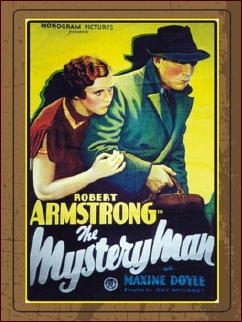
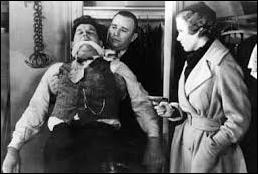
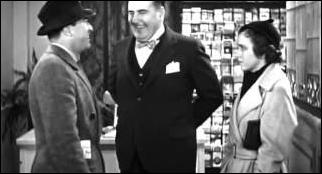
THE MYSTERY MAN. Monogram, 1935. Robert Armstrong, Maxine Doyle, Henry Kolker, LeRoy Mason, James Burke, Guy Usher. Director: Ray McCarey.

   I don’t know about you, but Robert Armstrong is the only name in the list of credits above that I recognized before watching this fairly mediocre crime drama — and even after watching it, for that matter. I didn’t recognize a single face, other than Armstrong’s.

   He plays Larry Doyle in this one, one of those brash reporters always at odds with his managing editor, even when he’s given a $50 bonus for the help he gave the police in solving their last case for him. The $50 disappears on a bender with the boys, and he ends up on a train to St. Louis rather than Chicago.

   In Chicago he befriends a young girl who is also out of funds, and together they scam a hotel, pawn a gun, watch a robbery taking place (committed by a notorious criminal know as “The Eel”), grab the loot, get blamed for the killing, go back to the pawnbroker who turned them in, and nab the Eel, making headline news. The end.

   Problem is, Armstrong was 45 when he made this movie, with a receding hairline, and Maxine Doyle was a mere slip of a lass and only 20 years old, young enough to be his daughter. The romance between the two is as unlikely as the screwy crime story the perpetrators of this movie put together.

   But what this still mildly amusing movie does do is remind you of the days (before my time) when a cup of coffee and three doughnuts would cost you 20 cents, and a young lady could have all of 10 cents on her and not be able to pay for it. This is where Larry Doyle comes in.
   

A 1001 MIDNIGHTS Review
by Marcia Muller


FRANKLIN BANDY – Deceit and Deadly Lies. Charter, paperback original, 1978.

   Kevin Maclnnes is known as the “Lie King.” A specialist with the Psychological Stress Evaluator (lie detector), he makes a living by taking voice readings of people and assessing their truthfulness. For a handsome fee, he will aid any client — governmental or private — in a situation where getting at the truth is paramount; and the fee goes to support his elegant but enigmatic mistress, Vanessa.

   One of the subjects Maclnnes is asked to evaluate is brought to him by a New York assistant district attorney; the client is a cabby who claims to have overheard two men talking about an assassination plot, something “really big.” The man apparently is telling the truth, and Maclnnes, spurred by a combination of patriotism (he is a former army officer) and curiosity, aids the authorities by embarking on a search for one of the men described — a search that nearly costs him his lover and his life.

   Maclnnes is interesting, and so is his work. In the course of the novel, he aids a businessman in making a low bid on a tract of land (and suffers sleepless nights when the seller kills himself); rigs a voice test in such a way as to prove a battered wife accidentally killed her husband (he knows she is really guilty, and he loses sleep over that, too); helps a wealthy Mexican family find where the killer of their young son has hidden his body; and bugs a bedroom conversation between himself and his mistress to evaluate whether she really loves him.

   The uncertain relationship with Vanessa is a thread through the story, as are Maclnnes’s fears about misusing his skills.

   For all its merits, this novel could stand to be about 100 pages shorter. It is padded with Harold Robbins-like descriptions of expensive clothing, hotels, gourmet meals, and brand names of liquors and wines.

   There is also a gratuitous side trip into Maclnnes’s attempt to cure a temporary bout of impotence with a call girl, which causes us to lose track of the main focus of the narrative — finding out who is to be assassinated and stopping the killers. But on the whole, it’s a good rainy day book for those who like their settings luxurious and their characters sophisticated, if a trifle stereotypical.

   This novel won the MWA Edgar for Best Paperback Original of 1978. In addition, Franklin Bandy has written The Blackstock Affair (1980) and The Farewell Party (1980).

         ———
   Reprinted with permission from 1001 Midnights, edited by Bill Pronzini & Marcia Muller and published by The Battered Silicon Dispatch Box, 2007.   Copyright © 1986, 2007 by the Pronzini-Muller Family Trust.

Bibliographic Notes:   The Blackstock Affair was the second and final recorded adventure of Kevin MacInnes. Bandy, who died in 1987, also wrote a book called The Shannonese Hustle (1978) and as Eugene Franklin (his first and middle names), three books in a series of cases solved by Berkeley Barnes and Larry Howe, about whom I know nothing.

Reviewed by Mark D. Nevins:


JOHN D. MacDONALD – The Dreadful Lemon Sky. Lippincott, hardcover, 1974. Fawcett Gold Medal Q3285, paperback, 1975. Reprinted many times, in both hardcover and soft.

   Continuing my reading of the Travis McGee series in order, and at this point rationing them because I like them so much, but there are so few left.

   The Dreadful Lemon Sky is a solid entry in the series — not one of the best, but very good. By now it seems that MacDonald has basically ditched the whole quasi-PI/“salvage expert” formula: one of McGee’s old girlfriends visits the Busted Flush and asks him to hold a hundred grand in cash for her, and in the event that she never comes back, get it to her younger sister.

   She never does come back, and moral Trav sees fit to get to the bottom of the mystery, which is a clever one, knotted up as McGee tales often are in petty local politics and petty characters, both politics and characters fleshed out with an uncommon level of attention and realism for a thriller novel.

   There are a few surprises here [SPOILER ALERT] including Trav’s houseboat The Busted Flush getting blown to smithereens (don’t worry, it gets fixed up), and as always MacDonald shows off some really nice writing, such as:

   The world looked strange. There were little halos around the edges of every tree and building. I did very deep breathing. It is strange to sleep for five days and five nights and have the world go rolling along without you. Just like it will keep on after you’re dead. The wide busy world of tire balancing, diaper changing, window washing, barn dancing, bike racing, nose picking, and bug swatting will go merrily merrily along. If they were never aware of your presence, they won’t be overwhelmed by your absence.

« Previous PageNext Page »