THE BACKWARD REVIEWER
William F. Deeck


AUSTIN LEE – Miss Hogg and the Missing Sisters. Jonathan Cape, UK, hardcover, 1961. No US edition.

AUSTIN LEE Miss Hogg

   The elderly ladies who live next door to Alan Johnston, middle-aged author of historical novels, have written a book about the old days in Ireland and are worried about parts of it perhaps being libelous. Thus they seek Johnston’s advice. Before he can read much of the book, his neighbors disappear and the manuscript is the only item taken from his house during a burglary.

   In addition, in the same neighborhood a death, possibly murder, with seemingly no connection to the disappearance or the burglary, has taken place. Johnston consults Miss Hogg, B.A., Private Investigator, and he, she, and Miss Hogg’s friend, Millie, travel to the elderly ladies’ childhood home, with both good and bad results.

   This novel takes place near the end of Miss Hogg’s career as a private investigator — it is the penultimate; the final one is fittingly titled Miss Hogg’s Last Case — and contains little about her as an individual. Her first name is an aberration on her mother’s part, she says, and she prefers to be known as ‘Hogg, tout conn. ” Her given name is revealed, though not by her, as Flora, about which someone remarks, I must say that Miss Hogg did not immediately suggest to one the goddess of the spring.”

   Whether Miss Hogg can be placed in the little-old-lady-detective category, I cannot say since her age is not provided. She is a former schoolteacher, but not as far as I could tell a retired one. Johnston, whose views are more elderly than he, makes for a somewhat amusing narrator.

   On the other hand, Miss Hogg really doesn’t come alive, the plot is minimal, and the murderer and the motive are patent. Nonetheless, while Austin Lee’s name is not going on my list of authors to look for, should I come across another of his Miss Hogg novels serendipitously, I would not hesitate to read it.

   Since Hubin’s bibliography does not mention it and there might be those who would like to know, I’ll note that Austin Lee was a clergyman.

— From The MYSTERY FANcier, Vol. 13, No. 2, Spring 1991.


      The Miss Flora Hogg series

Sheep’s Clothing. Cape, 1955.
Call in Miss Hogg. Cape, 1956.
Miss Hogg and the Bronte Murders. Cape, 1956.

AUSTIN LEE Miss Hogg

Miss Hogg and the Squash Club Murder. Cape, 1957.
Miss Hogg and the Dead Dean. Cape, 1958.
Miss Hogg Flies High. Cape, 1958.
Miss Hogg and the Covent Garden Murders. Cape, 1960.

AUSTIN LEE Miss Hogg

Miss Hogg and the Missing Sisters. Cape, 1961.
Miss Hogg’s Last Case. Cape, 1963.

DAN SLOTT (writer) and JUAN BOBILLO & MERCELO SOSA (artists) – “Dead Certain.” She-Hulk: Marvel Comics, Number 3, July 2004.

   You may or may not keep up with comic books, but no, they’re not 10 cents any more. (The price of this one is $2.99, but as a back issue, which by the time you read this, as late as it will surely be, I am sure you will be able to find a copy for far less than that.)

SHE HULK #3

   And the vast majority of most comic books run in long continued stories (“arcs”), which means that if you pick one up a random, it will be part two of six, and you won’t have a clue about what’s going on.

   This particular issue, though, is a rarity – a story told all in one issue (but with lots of personal interplay going on, adding to the characterization, but not harmful to the plot to any discernible degree if you skip over it).

   I’ll assume that everyone is familiar, to some degree or another, with The Incredible Hulk – the much longer-running comic book series which was the basis of a television series some years ago and then, much more recently, a semi-disaster of a full treatment movie overladen with special effects.

   This latest version of the She-Hulk book series comic bis but another in Marvel Comics’ long line of efforts to siphon off some of the male Hulk’s popularity by creating a successful female counterpart – and no, I’m not going to get into all of the other attempts.

   Suffice it to say, perhaps that I believe that She-Hulk’s alter ego has always been Jen Walters, who may or may not has always been a top-notch lawyer in her real life, but who has the ability to transform herself into a seven foot tall green-skinned amazonian super-hero. Unlike the Hulk, whose intelligence (and skin color) seems to vary at the whim of the writer at the time, She-Hulk seems to be as intelligent as Jen Walters, but (naturally) much more powerful.

SHE HULK #3

   Um, I seem to have lost some readers who have gone on the next review. If you’re still with me, I’ll speed things up a little, but a little background would seem to be useful in the context of why I’m even telling you about this particular issue.

   After aircraft engineer Bailey Briggs is brutally murdered – by trapping him in a wind tunnel with one of his test engines still running – the chief witness against the defendant at the subsequent trail is – the ghost of Bailey Briggs. I’ll repeat that. His ghost. I believe this may be a first – one for the books, you might say – but if you can say otherwise and prove me wrong, I’d certainly like to know about it.

   An interesting twist is that Jen Walters, working for the defense, does not believe Bailey Briggs’ ghost – and yes, the judge rules that precedent has been established for such a turn of events, at least in the Marvel Universe – but why would a dead man lie?

   With She-Hulk’s assistance in carrying out the investigation, a most satisfactory answer to that question is obtained, and you’ll have to read the story for yourself to discover what it is. Neatly done, it is.

PostScript:   In terms of the artwork, Jen Walters and She-Hulk are drawn more baby-faced in appearance than appeals to me, but in their own stylish way, the pair of artists responsible for this issue (pencils and inks) carry off their half of the story-telling with nearly as much aplomb as the gentleman who wrote the words.

— May 2004

Reviewed by DAVID VINEYARD:         


JEREMY LLOYD – The Further Adventures of Captain Gregory Dangerfield. Michael Joseph, UK, hardcover, 1973. St. Martin’s Press, US, hardcover, 1974. No paperback edition.

    Tock, tock, tick, tack, tock went the keys of the ancient Remington typewriter, and on the crisp white foolscap paper, marked only slightly by the tea stain on the top right hand corner, appeared in bold black type the startling information, THE GAME IS UP, MR. GATES, A NEW DETECTIVE NOVEL BY HENRY POTTS.

Captain Gregory Dangerfield JEREMY LLOYD

   Henry Wordsworth Potts writes detective stories, and none too successfully, that is until he borrows a typewriter, an old Imperial, to finish his latest opus, and discovers the machine is haunted.

   Much to his surprise his fingers leap across the keys and type out The Further Adventures of Captain Gregory Dangerfield, and a voice, strikingly like that of George Sanders, informs him that he is now under the control of the late P.W. Arnold, author of the Dangerfield series, and will not only write the book, but live them.

   And with that his everyday life at the boarding house at Ranliegh Road in Streatham becomes rife with international adventure, beautiful scantily clad women, and dastardly villains with Potts now dashing about in Dangerfield’s Bugatti Royale — the one given him by King Zog of Roumania…

   By turns increasingly funny, and increasingly mad, the book follows our poor Mr. Potts as he is plunged into Dangerfield’s world replete with super-villains, femme fatales, deadly traps, and increasingly embarrassing situations — like when he washes ashore on a tropical beach:

    “It was Zola,” penned the Author, “the girl whose message for help he had answered, and now her beautiful tear filled eyes shone with relief, and making the sign of the cross over her magnificent bosom, which strained for release beneath the thin material of her shirt, she waded into the surf to help the one man in the world who could save her…”

    “But Captain Gregory Dangerfield,” said P.W. Arnold admiringly, “with his incredible powers of recovery had already got his strength back, and holding Zola with his arms of steel, while she rained kisses on his handsome salty lips, he carried her to shore.”

    In any other circumstances Mr. Potts would have enjoyed Miss Martin’s attentions, but her hot kisses, some of them on his spectacles, made it hard to see.

    The Author, ignoring his plight, continued, ‘And so, looking like a Greek god, bearing Aphrodite in his arms, Dangerfield’s magnificent bronzed naked body emerged from the sea.”

    Mr. Potts spluttered and his heart missed a beat. He’d been pleased to hear he was bronzed; but naked! He clutched tightly to Miss Martin, he mustn’t put her down. But he certainly was naked … this was already an extremely dangerous situation.

   And in the true tradition of thrillers and spoofs things go from bad to worse for Mr. Potts, but at the same time he begins to rather enjoy being Captain Gregory Dangerfield.

    Sitting down in front of the old Imperial, and fighting the feeling of vertigo that assailed him as he remembered Mrs. Harris’ cleavage, he held out his hands and resigned himself to his fate.

   The Further Adventures of Captain Gregory Dangerfield is a pleasant romp through the fields of thriller fiction with Mr. Potts and his more pneumatic neighbors, a fine collection of super villains, and the ever inventive P. W. Arnold keeping the pot and Mr. Potts boiling.

   Jeremy Lloyd may be more familiar to you as the blonde Englishman who appeared on Laugh In and worked on the show as a writer.

   I don’t know that this one will be for all taste, but in the right mood and for anyone who has read enough of these, you may actually be sorry to see the last of Captain Dangerfield. I’d certainly rather spend an evening in his company (and that of Mr. Potts, P.W. Arnold, and the beautiful Zola and Mrs. Harris) than many of the tiresome lot of special forces louts who stumble through today’s thriller fiction.

    “Dangerfield,” said P.W. Arnold. “Caught by surprise, recovered and applied the Kemelmann Nerve Hold, known as I have mentioned before, to only one other person.”

They don’t write ’em like that anymore. Maybe they never did, but at least they wrote this one, one of those small treasures that you find in the rummage sale, and never forget.

REVIEWED BY WALTER ALBERT:         


SUBMARINE Jack Holt

SUBMARINE. Columbia, 1928. Silent film with sound effects. Jack Holt, Dorothy Revier, Ralph Graves, Clarence Burton, Arthur Rankin. Director: Frank Capra. Shown at Cinefest 26, Syracuse NY, March 2006.

   Ace deep-sea diver Jack Dorgan (Jack Holt) marries a woman he meets at a dancehall (Bessie, played by Dorothy Revier). When he’s called to work, Bessie, bored, goes out and meets Bob Mason (Ralph Graves), who, unknown to her, is Jack’s best friend.

   Jack returns unexpectedly, finds the two together and throws Bob out of the house. When Bob is trapped in a sunken submarine, Jack, the only diver who might be able to reach the sub, sulks at home, unwilling to help the man who betrayed his friendship. A chance discovery reveals Bessie’s duplicity and Jack races to the rescue of the crew.

SUBMARINE Jack Holt

   According to the program notes, this was Columbia’s first “A” picture, and Capra was brought on after Harry Cohn fired the original director. Capra obtains the assistance of the Navy, shooting on location in San Pedro with 100 Navy seamen as extras.

   The last third of the film keeps cutting from the trapped seamen to the rescue attempt, with the tension building until the final minutes of the film. Capra’s skill with actors makes the shopworn triangle believable and Holt, one of my two favorite actors when I was a kid (the other was Buck Jones), is every boy’s idea of a resourceful hero.

   Graves, hardly remembered today, is almost as good as Holt, and Revier is perfect as the girl you love to hate.

SUBMARINE Jack Holt

FIRST YOU READ, THEN YOU WRITE
by Francis M. Nevins


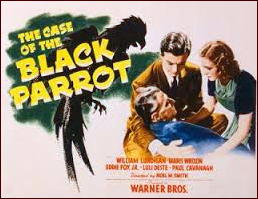
   I could have sworn I’d read all of Erle Stanley Gardner’s Perry Mason novels decades ago, but when I recently pulled out The Case of the Singing Skirt (1959) from my shelves nothing in it struck me as familiar.

MIKE NEVINS

   Club singer Ellen Robb is framed for theft and fired after refusing to help casino owner George Anclitas and his partner Slim Marcus trim wealthy Helman Ellis in a crooked poker game. Mason visits the casino and threatens Anclitas with a recent appellate decision holding that in a community property state like California a gambler’s spouse can recover any money the gambler lost.

   Later Ellen finds a Smith & Wesson .38 in her suitcase and, fearing that Anclitas is out to frame her for something more serious than theft, goes to Mason again. In her presence, Mason happens to have a phone conversation with another lawyer in which he cites several cases holding that if a person is shot by two different people and could have died from either wound, only the one who fired the second shot is guilty of murder.

   Without telling Ellen, Mason switches the gun she found in her bag for another of the same make and model that he happens to have in his safe. That evening he and Della Street secretly hide the gun he took from Ellen in the casino. Then Ellis’s wife Nadine is found shot to death — twice — aboard the couple’s yacht.

   The police find the switched gun in Ellen’s possession and arrest her. Ballistics tests prove what seems impossible on its face: that the switched gun fired at least one of the fatal shots. In the courtroom scene, which takes up almost half the book, a third gun enters the picture and Mason eventually exposes some stupendous weapon-juggling.

MIKE NEVINS

   Anthony Boucher in his review for the New York Times (September 27, 1959) called Singing Skirt “one of the most elaborate problems of Perry Mason’s career, with switchings and counterswitchings of guns that baffle even the maestro… This is as chastely classic a detective story as you’re apt to find in these degenerate days.”

   True enough. After finishing the book I whipped up a document which traces the wanderings of all three .38s and, unless I messed up somewhere, seems to establish that all the weapon-switching rhymes. (This document gives away so much of the plot that I won’t include it here, but if you’re interested, follow this link to a separate webpage.)

   But if Ellen had told Mason all she knew, the truth would have been obvious before the preliminary hearing even began. Why didn’t she? She had promised the real murderer she wouldn’t! Gardner’s need to camouflage this silliness explains why he jumps into court almost immediately after Ellen’s arrest, leaving out any subsequent conversations between Mason and his client.

   And if that aspect of the plot isn’t silly enough, how about the woman, never seen before, who marches unbidden into the courtroom at the end of Chapter Fourteen and confirms Mason’s solution?

   Gardner once said: “[E]very mystery story ever written has some loose threads… After all, on a trotting horse who is going to see the difference? The main thing is to keep the horse trotting and the pace fast and furious.”

   Well, I’m not sure that every mystery ever written has plot holes, but far too many of Gardner’s do. Nevertheless he remains a giant of the genre and one of the most important lawyer storytellers of the 20th century. Which is why he gets a chapter to himself in my next book.

***

   It’s called Judges & Justice & Lawyers & Law: Essays on Jurisfiction and Juriscinema and will be published later this year by Perfect Crime Books. At least six of its ten chapters deal with matters that should interest readers of this column: three on major American lawyer fiction writers (Melville Davisson Post, Arthur Train and, of course, Gardner) and another three on a trio of notable law-related movies (Cape Fear, Man in the Middle, The Penalty Phase).

   The longest chapter in the book is called “When Celluloid Lawyers Started to Speak” and covers law-related movies from the first years of talking pictures, many of which have a crime or mystery element.

   If you happen to groove on Westerns as well as whodunits, there are also chapters on law-related shoot-em-ups from the 1930s but after Hollywood began strictly enforcing its Motion Picture Production Code (July 1, 1934) and on what I like to call Telejuriscinema, which means law-related episodes of TV Western series from the Fifties and Sixties.

   I expect this gargantua to run close to 600 pages, the sort of book Harry Stephen Keeler once described as perfectly designed to jack up a truck with. As more information becomes available I’ll report it in future columns.

***

   Since one of the dozens of movies I discuss in the Celluloid Lawyers chapter may have played a role in Gardner’s work, I may as well close this column with a page or so from my book, as a sort of sneak preview of things to come.

MIKE NEVINS

   In the early Perry Mason novels, which were heavily influenced by Hammett and especially by The Maltese Falcon, we are allowed to see only what happens in Mason’s presence. But soon after the Saturday Evening Post began serializing the Masons prior to their book publication, scenes with other characters taking place before Perry enters the picture became commonplace.

   Where did Gardner get this notion? Quite possibly from a fascinating but little-known movie dating from the early years of talkies. The Trial of Vivienne Ware (Fox, 1932) was directed by William K. Howard from a screenplay based on Kenneth M. Ellis’ 1931 novel of the same name.

   It opens with the title character (Joan Bennett) and her fiancé, architect Damon Fenwick (Jameson Thomas) going to the Silver Bowl nightclub where Vivienne is insulted by Fenwick’s former lover, singer Dolores Divine (Lilian Bond).

   After taking Vivienne home, Fenwick returns to the club to pick up Dolores. The next day Vivienne sends Fenwick a letter she comes to regret. Several hours later the police arrest her for his murder. Representing her is attorney John Sutherland (Donald Cook), who is also in love with her — an element we never find in a Perry Mason novel.

   The trial, perhaps the most swift-paced in any movie, begins with a mountain of evidence against Vivienne. One: On the morning after the nightclub scene she visited Fenwick’s house, walked in on Dolores in sexy pajamas eating breakfast with him, and stalked out furious. Two: Immediately afterwards she sent Fenwick a letter which might be construed as threatening.

   Three: Her handkerchief was found near Fenwick’s body. Four: A neighbor claims to have seen her entering Fenwick’s house that night. Vivienne denies being anywhere near the house at the time of the murder but Sutherland doesn’t believe her. Nevertheless he puts her on the stand and she testifies as follows.

MIKE NEVINS

   One: Her letter to Fenwick was meant to break their engagement, not to threaten him. Two: She must have dropped her handkerchief during her breakfast visit to Fenwick’s house. Three: At the time of the murder she was at a hockey game which she left early because she felt ill.

   The district attorney (Alan Dinehart) cross-examines her so ruthlessly that she breaks down and sobs that even her own lawyer doesn’t believe her. At this point we find ourselves in the juristic Cloud Cuckoo Land that most Hollywood law films sooner or later enter: the prosecutor calls the defense lawyer as a witness! (How many times has Hamilton Burger pulled the same stunt with Mason?)

   Changing Vivienne’s plea from not guilty to self-defense, Sutherland testifies that he attended the hockey match with her and, when she left early, followed her to Fenwick’s house. On the next day of trial Sutherland proceeds as if he were still pleading his client not guilty. First he calls witnesses who put Dolores Divine at Fenwick’s house at the time of the murder.

   Then he calls Dolores herself, who testifies — as dozens of characters in Mason novels would do after her — that she found the body and said nothing about it but isn’t the murderer. (The film isn’t clear about this but apparently Vivienne, like so many of Mason’s clients, had done the same.)

   I won’t delve any further into the plot but at the end of the picture spectators are roaring, flashbulbs blazing, lawyer and client embracing, and the jury returning a verdict of — well, can’t you guess? All this in less than 60 minutes!

   We’ll never know if Gardner saw this movie, or perhaps read the novel it was based on, but the resemblance between the pattern here and that of so many middle-period Masons is remarkable.

IT IS PURELY MY OPINION
Reviews by L. J. Roberts


CYNTHIA HARROD-EAGLES – Hard Going. Severn House, hardcover, February 2014. Police procedural: DI Bill Slider, 16th in series.

HARROD EAGLE Hard Going

First Sentence:   Slider’s wheels were in dock.

   Although D.I. Bill Slider isn’t particularly looking forward to a week off from work, he hadn’t planned on a murder saving him from time in shopping malls. A well-known local philanthropist is dead. The evidence indicates he knew his killer. Coming up with suspects isn’t a problem. Discovering a motive and evidence proves to be much harder.

   From the very beginning, you are pulled in by the author’s voice and delightful, very dry, humor: “but Kate [Slider’s daughter] merely rolled her eyes. It was her response to everything. She must have eye-muscles like a boxer’s biceps, Slider thought.”

   It’s refreshing to have a DI who is not an angst-ridden. He’s divorced with two older kids, but remarried with a wife, baby, another on the way and a live-in dad. This provides us just enough exposure to, and the normal problems of, his home life. We see Slider’s kinship to Atherton, his second, and to his team.

   It is through Porson, Slider’s boss and something of a figure of fun that we see the author’s true mastery of language. One has to be truly dexterous to create the amazing malaprops she does and her incredible imagery.

   Hard Going at the heart of it all, is a true police procedural, proving you don’t need a lot of violence or profanity to still have a mystery with an edge and an excellent plot twist. Slider and his team follow the clues and shift through the evidence. I, for one, will continue to follow this very good series.

Rating:   Very Good.

THE BACKWARD REVIEWER
William F. Deeck


LAURENCE DWIGHT SMITH – Follow This Fair Corpse. Mystery House, hardcover, 1941; Mystery Novel of the Month #29, digest-sized paperback, n.d. [1941] as The Case of the Rented Coffin.

LAURENCE DWIGHT SMITH Follow This Fair Corpse

   With a publisher, mystery-novel authors, and agents gathered for a weekend, almost anything can happen. It doesn’t help matters that the publisher is a man who doesn’t read books, who takes nude photos of his girlfriends who then often become or are other people’s girlfriends, and who suspects his wife is trying to kill him.

   The publisher invites the writers to his mansion to propose a contest in which each writer will construct a novel from the same first chapter. Acting out the first chapter himself, the publisher apparently goes further than he had planned.

   On the scene is Dick Whelan, M.D., Smith’s series character. He is there at the behest of the police and is taking the place of a pseudonymous mystery writer who is a doctor. Not too demanding a task apparently; as a policeman remarks, “Any ass can fake being a writer.” At the end, Whelan solves a series of murders.

   This novel was not as enjoyable as I thought it would be from its amusing start; on the other hand, it’s a good mystery. In addition, there are some perhaps moot quotations about publishers — “You can’t leave anything to those damned fools!” — and detective-story writers and their work — “It’s always been a mystery to me why otherwise intelligent people read detective stories. Still, I suppose it’s no worse than going to the movies.”

— From The MYSTERY FANcier, Vol. 13, No. 2, Spring 1991.


Bibliographic Note:   The earlier case solved by Dr. Whelan was The Corpse with the Listening Ear (Mystery House, 1940).

REVIEWED BY DAN STUMPF:         


NOOSE. Pathé Pictures International, UK, 1948. Monogram Pictures, US, 1950, as The Silk Noose. Carole Landis, Joseph Calleia, Derek Farr, Stanley Holloway and Nigel Patrick. Screenplay: Richard Llewellyn. Director: Edmond T. Greville.

NOOSE Carole Landis

   An enjoyably lop-sided thing in which disparate elements (nasty gangsters, snappy dialogue, dead women, comedy, torture, slapstick, guilt, laughter) work against each other throughout to produce a film that is actually quite fun to watch.

   Carole Landis, in her penultimate film, stars as a plucky gal reporter of the Lois Lane school, working for the fashion department of a great metropolitan (London) newspaper, who tumbles onto the startling fact that there is Vice going on in town and someone’s making money off it.

   Dampened by her editor, deprecated by her fiancé and daunted by gangland, our heroine promptly smashes the rackets in about an hour and a half, with the assistance of her ex-commando boyfriend (Derek Farr) a bunch of his mates down at the boxing gymnasium, and the bemused gaze of Stanley Holloway as a crusty cop.

   I know it all sounds like pretty standard stuff but Noose is a film that has to be seen to be appreciated. Richard Llewellyn’s (yes, that Richard Llewellyn’s) dialogue carries a pleasant bite, and director Greville moves the action along at a nice clip, pausing long enough to savor a bite of suspenseful unpleasantness or evoke a slice of character, then moving right along.

NOOSE Carole Landis

   He does particularly well by Joseph Calleia as a gangland mastermind complete with a nasty personal assassin known as “the Barber” who scuttles about like some sort of loathsome land-bound crab with a perpetual and unsettling leer. And the fact that this nasty toad is played by the comedic Shakespearean trouper Hay Petrie only adds to the cachet.

   You may gather from the above that Noose is a grim exercise in Gangland procedure, and you’d be quite right; there are some bits of suspense and sadism that match anything you’re likely to see in American film noir. Imagine my surprise then when the story wraps up in a burst of farcical slapstick so silly one looks around for the Three Stooges to show up. It doesn’t spoil the film by any means, but it does edge it closer to Monty Python than Mickey Spillane.

   A few more points that deserve to be outed:

NOOSE Carole Landis

   One seldom praises the editing in a film because when it’s really good, editing goes unnoticed. But here it calls attention to itself with brassy charm as editor David Newhouse (who only did one other film) keeps changing scene by cutting from one moving figure to another moving in the same direction, or from one image to its mirror-twin, polishing the flashy narrative even brighter. One notices the editing in Noose and appreciates it.

   Then there’s Nigel Patrick as Calleia’s second-in-command, delivering a perfect performance in such a well-written part that at times it quite overbalances the whole film, and no one cares. Words can’t do it justice; you just have to see Patrick strutting about like a wind-up toy barking out staccato tongue-twisters to fall in love with him.

   And finally mention must be made of an actress in another throw-away part, Carol van Derman as a momentary object of Calliea’s attentions. She spends several minutes toward the end of this film stepping about in her step-ins, and she’s rather good at it.

NOOSE Carole Landis

Reviewed by DAVID VINEYARD:         

TED BELL – Phantom. William Morrow, hardcover, March 2012. Harper, paperback, August 2012.

   Phantom is the seventh novel in Ted Bell’s popular series about Lord Alex Hawke, latter day privateer, secret agent, dashing lover, fabulously wealthy aristocrat, and mover and shaker at ease in the corridors of power with presidents and kings — or at least Queen Elizabeth.

TED BELL Phantom

   Doc Savage at least had trouble talking to women, Tarzan was uncomfortable in civilization, and James Bond drank and smoked too much, but Hawke is not only wealthy and handsome, but has his own navy and special forces. His yacht the Blackhawke, named after his privateer ancestor, is armed like a destroyer and does everything but space flight. Hawke is easily the best equipped hero since the days of Arsene Lupin’s yacht and private submarine.

   Hawke doesn’t do it all alone, he has a team, and what a team. We begin with Pelham, his faithful servant and friend (he raised Hawke when Hawke’s parents were killed by pirates — see Hawke), who is basically Bruce Wayne’s Alfred. After Pelham comes his oldest friend Ambrose Congrieve, formerly of the Yard, and closer to John Dickson Carr’s Dr. Fell than any real Scotland Yard sleuth, a Sherlockian-quoting unlikely copper so far off of any realistic context as to be virtually alien.

   Next is Stokely ‘Stoke’ Jones Jr. ex US SEAL, and the most jive talking unlikely black man since George Baxt’s Pharaoh Love. The only reason I can see no one has been offended by this character is that they just haven’t read them. The cast is rounded out with Harry Brock, ex CIA; Nell Spooner, ex Special Branch and nanny to Hawke’s son by Russian Anastasia (her father tried to become the next Tsar — in Tsar — and was foiled by Hawke), Nell would willingly give aid and comfort to Hawke in a Biblical manner if he ever noticed; the head of MI6 Sir David Truelove; at least one American ambassador formerly head of the CIA; and, a Dubya like American president who trusts Hawke implicitly.

   In addition this all takes place against a background of a forelock-tugging Never-never-land of an England that didn’t really exist when P.G. Wodehouse was writing about it. (Hawke is a huge Wodehouse fan.) My willing suspension of disbelief gets sprained just thinking about it. If you want to see the society Bell is attempting to write about handled with artistry, savagery, and insight try Simon Raven or Anthony Powell. This wouldn’t pass for reality in a Monty Python sketch.

   In Phantom there is about half a book of leftover soap opera elements from Tsar to deal with including Hawke discovering Anastasia is still alive, traveling to Russia to save her, losing her again but discovering his son, Alexi, and his friends Stoke and Brock taking on a group of survivors of the royalist Russian plot out to kill Hawke and his son — their I Spy like banter easily the most annoying and flat in the genre. Sheldon Leonard has a lot to answer for.

   You can understand why the plot of Phantom doesn’t show so much as a hint of kicking in until page 118. (Even what went before the openings of movie serials didn’t last ten of the twenty minute chapter.)

   You see, Stoke is getting married to Fancha, a pop singing star, in his old home church in Louisiana by his old pastor (think Rex Ingram’s de Lawd from Green Pastures with a touch of Juano Hernandez) with Hawke his best man. After far too much of the wedding in the most unlikely parish in the state’s history, the happy couple take a cruise, and their ship is promptly sunk by a Russian submarine. (Someone in the Russian navy must have been on one of those cruises from hell we see on the news.)

   Not that the Russians intended to sink the cruise ship, they couldn’t help it. Their ship itself sank the floating tourist trap.

   Naturally our government doesn’t really buy that until one of our F-15‘s almost shoots down Air Force One.

   Who you gonna call?

   You got it.

   Cyber-warfare on an unimagined scale has broken out, and behind it lies a secret that will shake the world to its core. If you haven’t figured out that secret by now you haven’t seen a science fiction movie since the 1950‘s.

   Perseus, the worlds most powerful computer, has reached Singularity. True AI, and like all super computers that reach consciousness, it wants to rid the planet of that nasty virus called mankind and start over. Somewhere Fred Brown, who supposedly wrote the first such story, is tossing in his grave. (Scientist: “Is there a God?” — Computer: “There is now.”)

   You just know Hawke will have the usual good guy/bad guy tete-a-tete with Perseus before pulling the plug. Not bad, considering he was in a full-blown drunken state of abject depression in chapter one.

   I can’t tell if Bell is having us on or is completely serious, but I think he may actually be serious and think there once was an England like this. Hawke is a fantasy figure, but at some point you have to curb your imagination a little. I should have known I was in trouble in the first book (Hawke) when Hawke sashayed into a tough pub in white tie and top hat a la Simon Templar and chose to incite a brawl for fun.

   Ian Fleming wrote the James Bond novels in a whiskey-soaked Fleet Street drawl, layering a coating of fantasy over thinly disguised events and people from the war giving a twist a la the Fleming effect and an ear for the poetry of violence as well as an eye for memorable women; Trevanian was a savage social and political critic with a sharp eye and tongue and an ironic tone that dripped venom and wit in equal doses; Bell, despite impeccable credentials, writes Boy’s Own Paper tales on the level of Waldo the Wonderman and Nelson Lee. He is more Sax Rohmer than Fleming or Trevanian, and more Jack Armstrong than Rohmer.

   He does remind me of Sapper a bit. He never met a cliche he won’t embrace wholeheartedly.

   All this to one side, the Hawke books are great fun if you lower expectations and sit back for the ride. There is no substance to them, their relationship to the real world is roughly comparable to the relationship between Diet Coke and the real thing, merely disposable time wasters on the literary scale of a big summer movie blockbuster full of noise and movement, but they are wide screen 3D Technicolor diversions.

   That said, popcorn, cotton candy, hot dogs, corny dogs, and burgers may not be memorable but they will fill your tummy even if they are instantly forgotten. Don’t mistake these for anything more than they are and you will get your money’s worth.

   But twenty or thirty years down the line when they are still reading Ian Fleming and even Doc Savage, Bell and Hawke won’t even be a footnote — they are strictly literature as junk food. Here today, at the bottom of the trash can tomorrow.

Reviewed by JONATHAN LEWIS:         


THE TWILIGHT ZONE Straczynski

J. MICHAEL STRACZYNSKI – The Twilight Zone, Volume 1 #1: The Way Out. Dynamite Entertainment, comic book, 2014. Illustrated by Guiu Vilanova. Colored by Vinicius Andrade. Lettered by Rob Steen. Main cover by Francesco Franvavilla.

   Carol Kramer Serling, widow of the late Rod Serling, remarked in a 1987 interview that, for the legendary creator of The Twilight Zone, “the ultimate obscenity is not caring, not doing something about what you feel, not feeling! Just drawing back and drawing in; becoming narcissistic.” In many ways, that very spirit of refusing to turn away from perceived social injustice animates the narrative in the brilliantly executed first issue of J. Michael Stracyznski’s The Twilight Zone comic book series (2014).

   The tall, muscular, and blonde-haired Trevor Richman wears a suit and tie, works in New York finance, and cheats on his blonde-haired girlfriend, Natalie Kyle, with the dark-haired Sandra. He is about to be indicted for white-collar criminal offenses. Knowing it’s only amount of time before the FBI catches up with him, Richman seeks the services of the mysterious, gray-bearded Martin Wylde, whose firm developed a nanotechnology pill which, if ingested, transforms so completely that they assume complete new identities, complete with new blood type, eye color, and fingerprints.

   Richman takes the pills and transforms into a new man — literally. Thomas Riley (same initials!) has dark hair — similar to Sandra and unlike Natalie. When Richman/Riley goes in for a cleaning appointment, the dentist tells him that his jaw is changing on its own and that he basically appears to have a new dental profile.

   Riley, unlike his former self as Richman, does not wear a tie; instead, he wears jeans. Although, suffice it to say, he didn’t need to take a pill to do either of those things. Riley, it would seem, still has Richman’s personality and memories, leading the reader to believe that the change, dramatic as it was, was merely physical.

THE TWILIGHT ZONE Straczynski

   Even a casual reader would notice the strong political subtext in “The Way Out.” Cheating Wall Street bankers, like Richman, are villainous. Wylde’s clients, we learn, are tyrants and dictators, war criminals, torturers, and … “a growing number of people from the financial services industry.”

   And one can almost hear echoes of Serling, known for introducing the theme of racial equality into his work, in Richman/Riley’s response to an African-American, a patron of a coffee shop, who wants white collar criminals in jail: “The legal system doesn’t work the same way for people at the top as it does for — well, for everyone else, for the people with power, for the people who matter…there’s always a way out.”

THE TWILIGHT ZONE Straczynski

   Vilanova and Andrade’s visual rendering of the patron’s face, ostensibly reacting to Richman/Riley’s over-the-top statement, is stunning. Still, one wonders whether the characters deliberately refer to the “FEC” and the “Federal Exchange Commission” or whether this was an oversight on the part of the author who should have written “SEC” and “Securities and Exchange Commission” instead. (The FEC is the Federal Election Commission, not really relevant to this story.)

   Unlike far too many comic books appearing on the shelves these days, the first issue of The Twilight Zone is well written, deals with serious subject matter, and contains artwork and coloring that works exceptionally well with the story. There were a couple instances, however, where I had to double check whether I understood correctly which character was which. But those moments were few and far between.

   In conclusion, Stracyznski, who wrote for the 1985 television reboot of The Twilight Zone has written the type of story one could easily imagine appearing the television show bearing its name. A tale, it should be noted, which with a dramatic cliffhanger — one I certainly didn’t see coming. I’m planning on going to the comic book store later this week and purchasing the next few issues in the series. I want to know how it all turns out.

« Previous PageNext Page »