REVIEWED BY DAN STUMPF:         


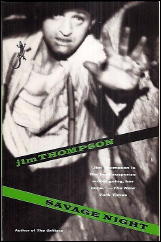
JIM THOMPSON Savage Night

JIM THOMPSON – Savage Night. Lion #155, paperback original, 1953. Reprinted several times, including Black Lizard Books, softcover, 1985, 1991.

   When a good friend described Jim Thompson as “over-rated” to me not too long ago, it occurred to me that I hadn’t actually read anything by Thompson in a quarter century. So I picked up his most nightmarish novel, Savage Night to have another look at it.

   Damn, it’s good.

   Night is the chilling story of a freakishly petite and young-looking hitman pressured into that preordained failure, the One Last Job. Charlie “Little” Bigger lands in a small town for a tough job that turns into a paranoid hell, then into a surreal spin where neither he nor the reader quite knows what’s going on we just realize something pretty awful is happening here, and when I applied the adjective nightmarish, it was with a full appreciation that Savage Night could stand right up there with the scariest of traditional “horror stories.”

   It also benefits from the kind of writing we look for most in two-bit novels: efficient prose that goes beyond prosaic efficiency to achieve a quality completely unlooked-for in pulp fiction:

JIM THOMPSON Savage Night

   Bigger sees a puritanical old woman and “I couldn’t figure why some dairy hadn’t hired her to sour their cream for them. ” A self important character gets a compliment and “swelled up like a poisoned pup.” And then there’s the short sequence where Thompson’s narrator enters a house:

    I pushed the sagging gate open. I climbed the rickety steps to the porch and rang the bell… I turned and glanced around the bare yard — too goddamned lazy to plant a little grass. I looked at the paint-peeled fence with half the pickets knocked off….

   Now that passage should be taught in every Creative Writing course in the Free World: a quickly-carried couple of sentences that (a) move the story along, (b) describe the setting, (c) tell us something about the guy who lives there, and (d) tell us something about the narrator at the same time.

   Amazing. This is the sort of writing that gave Thompson his belated reputation, and it serves very well for a tough, fast story that still scares me.

REVIEWED BY WALTER ALBERT:         


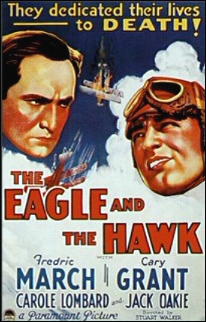
THE EAGLE AND THE HAWK

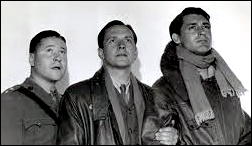
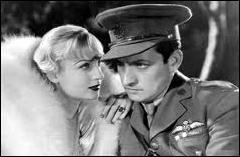
THE EAGLE AND THE HAWK. Paramount, 1933. Fredric March, Cary Grant, Jack Oakie, Carole Lombard, Guy Standing, Forrester Harvey, Kenneth Howell, Leyland Hodgson, Virginia Hammond, Yorke Sherwood, Adrienne D’Ambricourt, Lane Chandler, Dennis O’Keefe. Screenplay by Bogart Rogers and Seton I. Miller, from the story “Death in the Morning” by John Monk Saunders. Photography by Harry Fischbeck, with photographic effects by Farciot Edouart, assisted by Loyal Griggs. Director: Stuart Walker (also Mitchell Leisen, credited as associate director). Shown at Cinecon 44, Hollywood CA, Aug-Sept 2008.

   No film at the convention made a more powerful impression on me than this WWI drama of pilots manning two-man planes making reconnaissance flights over enemy territory in France, with a tailgunner photographing target installations.

THE EAGLE AND THE HAWK

   The flights are euphemistically called “observation flights,” but the incidence of downed planes or planes returning with the tailgunner killed by enemy fire is high. Jerry Young (Fredric March), an American whose unit has been transferred to France to serve with a British company, keeps returning successfully but is increasingly depressed by the significant numbers of tailgunner losses.

   The unit is joined by Henry Crocker (Cary Grant), a pilot from Young’s American unit who had been left behind at Young’s recommendation. The antagonism between the two charges the close quarters with a palpable electricity, but it is Crocker who is most aware of Young’s instability, leading to a stunning conclusion.

   This is a powerful portrait of the human costs of war, with brilliant performances by March and Grant. Grant, who, with no trace of his man-about-town persona, has the kind of role he wanted to play when he tired of his type-casting. I think he gives one of the great performances of his career in the film.

THE EAGLE AND THE HAWK

    I’ve had less time than usual to spend here at the computer the past couple of weeks, so it’s taken me longer than normal to get Part 41 of the online Addenda to the Revised Crime Fiction IV posted. Al Hubin sent it to me late last week, and it’s ready for viewing at last — corrected, amended and updated as of yesterday evening. (Follow the links.)

   As it happens now every three months or so, like clockwork, there are the usual additions: newly discovered series characters and settings for the novels, a few new authors and novels, dates of birth and death added or corrected. Loads and loads of facts and additional information about our favorite hobby: reading and collecting detective and mystery fiction, with a small portion of it, I’m happy to say, generated by the reviews and other discussions that take place on this blog.

THE BACKWARD REVIEWER
William F. Deeck


VIOLA BROTHERS SHORE – The Beauty-Mask Murder. Richard R. Smith, US, hardcover, 1930, 384 pages. UK: John Hamilton, hc, 1932, as The Beauty-Mask Mystery.

   Luckily for the innocent suspects in this case, Gwynn Leith is in Hanaford visiting her brother, His Honor the Mayor. If it had been left to the mayor and the police, a whole series of suspicious characters would have been arrested for the multiple murder — by an overdose of morphine; poison, and throat slitting — of an extremely unpleasant woman who was also most unattractive at the time of her death.

   A widow of uncertain age, Leith is a most intelligent woman with a low opinion of the male mentality. She is, as it were, an early feminist. Her involvement in the case keeps the innocent from being prosecuted by official stupidity. As she says:

    “The trouble with you men is that you would rather have an innocent victim than nobody at all. Just so the poor chap looks guilty enough to cover any obvious stupidity. That’s why I think women would be a great improvement on the force. Their quick sympathies would keep them from leaping at conclusions just to gratify their vanity and their insatiable craving for results.”

   Where Hanaford is located, I don’t know. A little research should find it, for it’s in a state in which the Grand Jury determines guilt or innocence. There can’t be many of those.

— From The MYSTERY FANcier, Vol. 12, No. 3, Summer 1990.


VIOLA BROTHERS SHORE

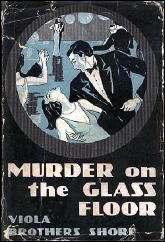
Bio-Bibliographic Notes:   Included in the Revised Crime Fiction IV, by Allen J. Hubin, is one other book by Viola Brothers Shore: Murder on the Glass Floor (Long & Smith, 1932). The most interesting Gwynn Leith is a character in it also, but so is someone called Colin Keats, a fellow whose appearance in The Beauty-Mask Murder Bill Deeck did not happen to mention.

   An online website devoted to Jewish authors has a page with a long biography of the author, Viola Brothers Shore (1890-1970), from which I excerpt the following:

    “While attending New York University, Viola Brothers Shore began her career as a writer in a range of disciplines. She wrote poetry, biography […], stories and articles published in College Humor, Collier’s, and Saturday Evening Post; [and] plays […] Her short stories, many about Jewish American lives of the day, were collected in The Heritage and Other Stories (1921).

    “Shore wrote silent movie titles and original stories for many motion pictures including The Kibitzer (1929) and Walking on Air (1936). […] She wrote numerous mystery stories, including The Beauty Mask Murder (1930) and Murder on the Glass Floor (1932) and won several Ellery Queen awards.”

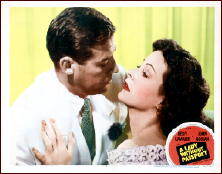
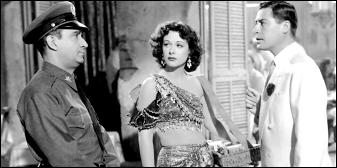
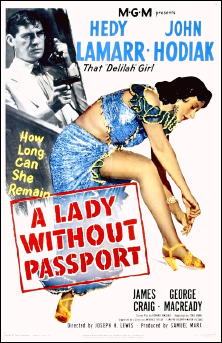
A LADY WITHOUT PASSPORT. MGM, 1950. Hedy Lamarr, John Hodiak, James Craig, George Macready, Steven Geray, Bruce Cowling, Nedrick Young, Steven Hill, Richard Crane. Director: Joseph H. Lewis.

A LADY WITHOUT PASSPORT

   This is one of those black and white semi-documentary movies about one of the various US law enforcement services that were common in the late 1940s and early 50s, in this case the Immigration Service.

   While the story value is rather low, if you were to ask me, that the director was Joseph H. Lewis means that there’s lots of entertainment value to be found in the staging, the lighting, the settings, the camera angles – everything that a director can do to make a dull thud of a movie interesting, Joseph Lewis (no relation) does.

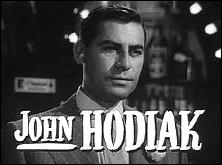
   John Hodiak is sent to Havana to get the goods on a sophisticated operation of smuggling illegal immigrants into the US through that port of entry, and in particular mastermind George Macready, who plays his part to the hilt. No one can act in as slick, sinister and evil a fashion as he!

A LADY WITHOUT PASSPORT

   The would-be immigrants are mostly refugees from war-torn Europe or criminals of various persuasions, and among them is Hedy Lamarr, as radiantly beautiful as she always was as a former prisoner of Nazi concentration camp.

   John Hodiak falls in love with her, of course, as who wouldn’t, and is even willing to give up his job for her, in light of the obviously untenable situation they find themselves in.

   The problem is, from the viewer’s point of view, is that Miss Lamarr is far too beautiful, with far too many fashionable clothes, to ever be accepted as a refugee from the Nazis with no legal place to escape to. Accept her at face value, for the sake of the story, or not at all. While I don’t know about you, I went with the first choice, but full honesty in reviewing, according to my Guild notes, requires me to point this particular dilemma out to you.

A LADY WITHOUT PASSPORT

   Havana makes a nice place to film a movie – many shots are on location – but speaking of unusual camera angles, as I was earlier, two scenes are most worthy of note:

   First, an confrontation on a busy Manhattan street at the beginning of the film, one that ends in the death of one of the participants, is filmed from inside an automobile, looking outward through the windows as the camera tracks the action; a second one, looking straight down from above as the passengers like ants make their way out of a downed plane in the Everglades and form themselves into groups, is a scene I’ve never seen from this particular perspective before.

A LADY WITHOUT PASSPORT

REVIEWED BY STAN BURNS:


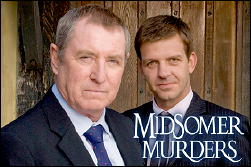
MIDSOMER MURDERS. BBC-TV; two from Season 11. John Nettles (DCI Tom Barnaby, Jason Hughes (DS Ben Jones), Jane Wymark (Joyce Barnaby), Barry Jackson (Dr Bullard). Based on the characters created by Caroline Graham.

MIDSOMER MURDERS

   In “Left for Dead” (24 May 2008), Detective Chief Inspector Barnaby investigates the death of a couple in an isolated house.

   They had totally cut themselves off from the surrounding community — no one had been invited into the house in years, and there was no electricity or running water. The woman appears to have died of natural causes, but the man seems to have been pushed down the stairs.

   Barnaby’s investigation becomes intertwined with a protest movement against highway construction, and the disappearance of a child 19 years before. This is the best one of these I have seen in awhile — harking back to the earlier movies in this series (these are too complex and well produced to be called episodes). It also reminded me a little of Jack Vance’s Bad Ronald.

   In the earlier “Shot at Dawn” (1 January 2008), a feud between two families going back to WWI results in the murder of the elder statesman of one of the families. But when Barnaby investigates he finds that the feud may not have been the cause of the murder — instead it may be the result of a disputed piece of land that can be developed into homes for a fortune.

   One of the better of the more recent ones, but the murderer is obvious. Still there are a lot of twists and turns getting to the end. If you don’t mind that the characters are more than a bit eccentric, I suspect you will like both of these.

Rating: B minus (both).

REVIEWED BY GEOFF BRADLEY:         


IDENTITY. “Second Life.” 28 April 2010. (Season 1, Episode 1.) ITV [UK]. Aidan Gillen, Keeley Hawes, Holly Aird, Elyes Gabel, Shaun Parkes, John Hopkins, Patrick Baladi. Creator/writer: Ed Whitmore. Director: Brendan Maher.

IDENTITY Aiden Gillen

   This was a six part series (one hour each, less adverts) based in a unit set up to combat identity theft. Detective Superintendent Martha Lawson (played by Keeley Hawes, fresh from Ashes to Ashes) is in charge and her leading detective, newly returned from a 15-year (yes, 15 year) undercover assignment is D.I. John Bloom (played by Aidan Gillen, fresh from The Wire, but here regaining his Irish accent). Bloom is quiet moody and enigmatic, but his contributions are, of course, the most telling.

   The series, though, is clearly going for big time transgressions. This first episode starts with a man who has shot a policeman from his bedroom window when they have been sent to arrest him after the car he had leased is used to kill a woman. He is, he pleads, after being shot by a police marksman, the victim of identity theft.

   Soon the unit has three linked cases, all involving murder, with an innocent man being gaoled. However, Bloom decides, the culprit is deliberately revealing his actions. But why?

   Like a lot of current programmes, this held the interest with a complex and intriguing story. Unfortunately the denouement, which I won’t go into, did little to sort out how it had all been achieved. Of course the perpetrator was a computer geek, but we have to take as read how he could have achieved his nefarious objectives and managed to maintain the lifestyle he had.

   Entertaining but don’t expect it to make sense.

THE SAINT IN JUNIOR HIGH
by Ron Goulart


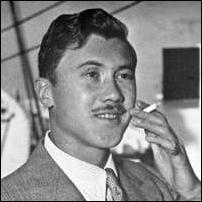
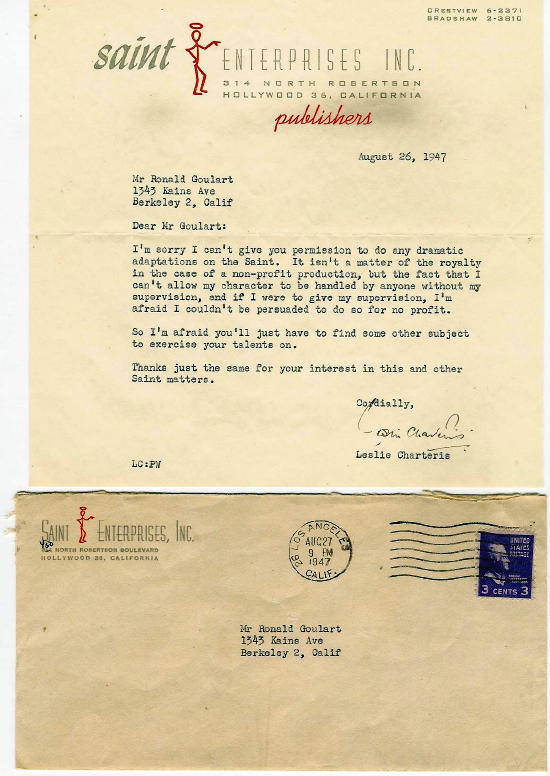
   I was fourteen when I wrote to Leslie Charteris asking him to allow me to adapt The Saint for the theater. The theater in question being the auditorium of Burbank Junior High School in Berkeley, California.

LESLIE CHARTERIS The Saint

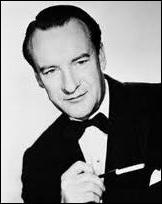
   Although the Saint I’d seen on the screen in the RKO B-Movies of a few years earlier was portrayed by the suave George Sanders, who was well over six feet tall, I had no doubt that I, who’d recently shot up to the impressive height of five foot four, could do a nifty job of portraying Simon Templar. I was equally certain that I could summon up sufficient suaveness.

   I’d discovered the Saint, that Robin Hood of Modern Crime, by way of the movies, but the advent of Pocket Books allowed me, for just two bits each, to get hold of most of novels and short story collections that had appeared since Charteris had created the character back in 1928.

   I liked not only the thriller aspects, and the mystery and crime elements but the humor in the books (which seems to have partially leaked out the last time I attempted to reread one). Charteris has said in the introduction to one of his books that one of his major influences was P. G. Wodehouse, another of my literary idols back in the days when I was starting to shave.
LESLIE CHARTERIS The Saint

   In that bygone era my contact with the entertainment world — books, radio, movies, comic books, etc. — was strictly as a consumer. I therefore assumed that it would be relatively simple when I was a few years older to become a novelist, a short story writer, a movie star, a radio actor, a playwright and a matinee idol, a cartoonist who drew gag cartoons, a syndicated comic strip and a comic book of his own.

   In junior high I was a sort of economy-size Orson Welles. I wrote play adaptations of Robin Hood, A Connecticut Yankee and A Christmas Carol and starred in each one. Seeing me, in green tights, cross swords with the Sheriff of Nottingham is probably one of the memories most of my fellow students have had a difficult time forgetting.

   I exchanged a few more letters with Charteris. I believe the first one was written when he was affiliated with his own paperback publishing company in Los Angeles. They were reissuing quite a few Saint books, plus new anthologies with stories about Hollywood, etc.
LESLIE CHARTERIS The Saint

   There was also one collecting radio scripts from various shows, including one from a Saint broadcast. I suggested to him that a whole book of Saint scripts would be a good idea. He responded that since the scripts were mostly adaptations of printed stories that probably wouldn’t attract a large enough audience.

   Quite a few years later, when I was editing The British Detective anthology for Signet, I thought it would be a good idea to include a Saint novelet, “The Million Pound Day.”

   Charteris replied that since his story was twice as long as most of the others, he should receive twice the offered fee of $500. So I missed a chance to be Leslie Charteris’s editor.

   When I was working on a Nostalgia Book Club book about radio detectives, I queried him as to who he thought the best actor to play his character on radio. He was residing on the Riviera at the time, possibly in a yacht. His fourth wife was the movie actress Audrey Long, frequently seen in the RKO B- Movies of the 1940s.

   He sent a helpful reply and mentioned that if I wrote him again I include return postage. The nostalgia line went out of business before I ever wrote the book.
LESLIE CHARTERIS The Saint

   Several men assayed the role of Simon Templar on the air. The show ran, off and on, from about 1945 to 1950. They included Edgar Barrier, Brian Aherne, Vincent Price (when I listened to him back then I didn’t notice what a smarmy Saint he made) and Tom Conway. The Saint’s creator told me the best man was the first one, Edgar Barrier.

   I noticed on Google that Charteris said the movie actors he thought should have been Templar were Ronald Colman, Cary Grant or Douglas Fairbanks, Jr. As for the actual chaps who played the part, he said “Louis Hayward and George Sanders were hopelessly miscast.”

   Raymond Chandler, by the way, said he thought the ideal actor to play Philip Marlowe was Cary Grant. You can’t beat suaveness.

Ron Goulart

LESLIE CHARTERIS Ron Goulart

August 26, 1947

Mr. Ronald Goulart
1343 Kains Ave
Berkeley 2, Calif

Dear Mr Goulart:

I’m sorry I can’t give you permission to any dramatic
adaptations on the Saint. It isn’t a matter of the royalty
in the case of a non-profit production, but the fact that I
can’t allow my character to be handled by anyone without
my supervision, and if I were to give my supervision, I’m
afraid I couldn’t be persuaded to do so for no profit.

So I’m afraid you’ll just have to find some other subject
to exercise your talents on.

Thanks just the same for your interest in this and other
Saint matters.

Cordially,

      [Signed]

Leslie Charteris

LC:PW


       Previously on this blog:

LESLIE CHARTERIS – The Brighter Buccaneer (reviewed by Art Scott)

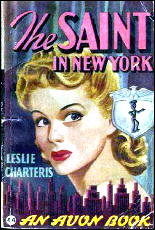
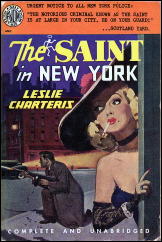
LESLIE CHARTERIS – The Saint in New York (reviewed by Art Scott)

LESLIE CHARTERIS – The Saint and the Templar Treasure (reviewed by Steve Lewis)
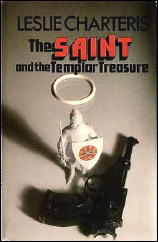
LESLIE CHARTERIS – The Saint and the Templar Treasure. Doubleday Crime Club, hardcover, 1979. UK edition: Hodder & Stoughton, hardcover, 1979. Developed by Graham Weaver from comic strips by Donne Avenelle.

LESLIE CHARTERIS The Saint and the Templar Treasure

   It isn’t any secret, but let’s give credit where credit is due. Few if any of the adventures of Simon Templar that have appeared in recent years have actually been written by Leslie Charteris. The title page says this one was the collaborative effort of Donne Avenell and Graham Weaver [see above] but (as I understand it) under Charteris’s close, keen-eyed supervision.

   The countryside in Treasure is authentically French, and the year is 1945, without a doubt a vintage one for Saintly activities. And just one sip will tell you that the flavor is unmistakably the heady one of Simon Templar’s younger days, filled to the brim with the sheer intoxicating joy of partaking in carefree adventure.

   A vineyard is in trouble. It could hardly be coincidence that the chateau is also possessed of a curse handed down since the days of our hero’s Templar forebears, and take a hand in it he must.

   Make no mistake about it, this is no whodunit in the traditional sense. Even if there were no word as “insouciant” to describe the Saint’s approach to detective work, the overwhelming need for its invention requires no further evidence than this.

— Reprinted from The MYSTERY FANcier, Vol. 3, No. 6, Nov/Dec 1979 (slightly revised).


A 1001 MIDNIGHTS Review
by Art Scott


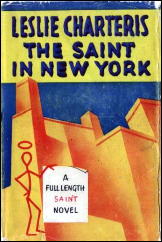
LESLIE CHARTERIS – The Saint in New York. Doubleday Crime Club, hardcover, 1935. First published in the UK:Hodder & Stoughton, hardcover, 1935. Reprinted many times since, in both hardcover and paperback. Film: RKO, 1938 (with Louis Hayward as Simon Templar, and Jonathan Hale as Inspector Fernack).

LESLIE CHARTERIS The Saint in New York

   This novel is perhaps the best of the tales in which Simon Templar adopts the role of Nemesis, dispensing summary justice to criminals. It is one of the grimmest tales in the Saint saga; it is a furiously paced, tightly crafted, wholly satisfactory blood-and-thunder thriller.

   Wealthy William Valcross offers the Saint $1 million to avenge the death of his son, who was murdered by a kidnap mob terrorizing New York. The Saint accepts the job, makes up a list of six big-time mobsters to be killed, and announces his intention to clean up the city to the newspapers.

   In three days of furious action, he makes good on his promise. Along the way he adds another name to his list, the mysterious “Big Fellow,” a Moriartyesque mastermind who pulls the strings behind the scenes; and encounters a woman of mystery, Fay Edwards, who saves his life when he’s taken for a ride.

   He also forms an uneasy alliance with John Henry Fernack, chief of New York detectives, who thereafter became a continuing character, reappearing whenever Templar’s travels take him to the States.

LESLIE CHARTERIS The Saint in New York

   The episode in which Templar, armed with only a knife and his wits, takes on a houseful of mobsters in order to save a kidnapped girl is as neatly choreographed and exciting an action sequence as is to be found anywhere in Charteris’s work. The book concludes with a dramatic surprise ending, in which the Saint learns the identity of the Big Fellow.

   The Saint in New York predates by some forty years a paperback landslide of similar one-man-against-the-mob novels written by Don Pendleton and his many imitators. It is unlikely that any have yet equaled this book for excitement; certainly none has come close in style.

   Other Saint books of note: Getaway (1932), The Misfortunes of Mr. Teal (1934) (ss), Saint Overboard (1936), The Happy Highwayman (1939) (ss), and The Saint in Miami (1940).

         ———
   Reprinted with permission from 1001 Midnights, edited by Bill Pronzini & Marcia Muller and published by The Battered Silicon Dispatch Box, 2007.   Copyright © 1986, 2007 by the Pronzini-Muller Family Trust.

« Previous PageNext Page »