REVIEWED BY GEOFF BRADLEY:         


LOUIS WILLIAMS – Tropical Murder. Tower, paperback original; 1st printing, 1981.

LOUIS WILLIAMS Tropical Murder

   This was the author’s only crime novel (according to Hubin), published as a paperback original in, presumably, small numbers. I came to it by a complicated route. I was asked about it by a correspondent who had seen it discussed it in Private Eyes: One Hundred and One Knights, by Robert A. Baker and Michael T. Nietzel, and subtitled “A Survey of American Detective Fiction 1922-1984” (Popular Press, US, 1985).

   It sounded interesting and I kept a eye out for it and eventually found a copy in the 10p each table outside a second-hand bookshop in Littleborough. That was probably 15 years ago and the book has been sitting on my shelves waiting for me to get round to it and now I have.

   Baker and Nietzel call it “powerful” and “The Best Unread PI Novel of the Past Decade,” saying that none of the critics they polled had read it. They compare the style to James Crumley, which I suppose should have caused me to stop since I seem to be the only reader in the world who is not enamoured by James Crumley’s work — I have read The Wrong Case and The Last Good Kiss but remain unenthusiastic — though I’m probably committing critical suicide by admitting it.

   Anyway, I found that although this story had some merits — the setting in Venezuela, with its local and American communities and the narrator, Bernardo Thomas, with a foot uncomfortably in both camps — I was underwhelmed by the wordiness of the whole, which dragged uncomfortably as I longed to get to the end, wishing I could rid myself of the compulsion to finish books I’ve started.

   I should have been warned by Baker and Nietzel, who also said, “The plot is secondary and a bit muddled,” but unfortunately I had finished the book before I read that.

Editorial Comment.   This, not too surprisingly, is a scarce book. There are only three copies available on ABE, for example, but also perhaps not too surprisingly, given the book is all but unknown, the two offered by US dealers are quite inexpensive ($5 or so). The asking price for one for sale by a dealer in the UK is rather high, and if you live in the US, adding in the shipping charge makes it prohibitively so.

    But I’m not worried. I happen to have a copy, and I even know which box it’s in. Since I happen to like James Crumley, I might even poke around and see if I can find it — the box, that is, then the book.

A REVIEW BY MARYELL CLEARY:
   

ROBERT BARNARD – Blood Brotherhood. Walker & Co., US, hardcover, 1978. Previously published in the UK: Collins Crime Club, hc, 1977. US paperback reprint: Penguin, 1983, 1992 (the former shown).

ROBERT BARNARD Blood Brotherhood

   It seems to me that mystery authors are more and more reaching for the outre to capture the interest, perhaps of publishers more than of the ordinary reader.

   A gathering of clergy at an Anglican monastery is an unlikely spot for a murder, and the people gathered there are an unlikely group of clergy: A money-hungry American evangelical; two Norwegian women of vastly different personalities; a status-hungry Anglican bishop; an impressive head of the monastery — these are some of the cast.

   Barnard does not spare the police, either, in his depiction of unpleasant people: the first police inspector assigned to the murder case is insane, quite literally. The hippie culture of the 70’s impinges on the monastery in a curious way: drugs and sex are part of this particular scene, as is the reversion of a black African bishop to his native ways.

   The book is redeemed somewhat by the Rev. Ernest Clayton, an average, normal clergyman who does not do anything heroic, just figures out the solution of the murdered brother at about the same time as the police. I’ve read much better Barnard.

– Reprinted from The Poisoned Pen, Vol. 6, No. 4, Fall 1986


      Previously reviewed on this blog —

ROBERT BARNARDA Little Local Murder (by Marv Lachman)

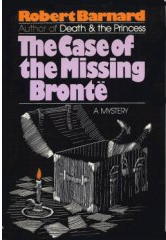
ROBERT BARNARD The Case of the Missing Brontë (by Steve Lewis)

HENRY WADE – The Hanging Captain. Perennial Library, reprint paperback; 1st printing, 1981. First published in the UK: Constable, hardcover, 1932. First US edition: Harcourt Brace, hc, 1933 (shown).

HENRY WADE The Hanging Captain

    Henry Wade is as unlikely an author as you could expect to find in your local paperback bookstore, and thanks should go to whoever at Perennial is responsible for seeing to it that he is. Who knows, maybe even John Rhode will be next!

    What Wade does best, at least in this particular example of his work, is to demonstrate that there is no reason why a good, solid detective story must also be dull. There is a lot of importance placed upon alibis and time-tables in this case, and with some splendid cooperation between Scotland Yard and the local police the murderer of Sir Herbert Sterron is inevitably brought to justice.

    WARNING: In what follows, certain aspects of the mystery will be discussed that may reveal information that you, the would-be reader, might wish not to know in advance.

    I am curious that the dead man’s mysterious affliction was never mentioned. In A Catalogue of Crime, Barzun and Taylor tell us it was syphilis, but it might be noted that it was the English edition that they read.

    This one fact explains a good deal. For example, it gives us the reason for the Sterron’s mysterious withdrawal from society some years before. And, what is more, it also adds a strong tinge of irony to the killer’s motive — the overriding reason he did what he did.

    Either I missed something, or I suspect that some alteration was done to the American version, which I assume this edition follows. If the latter, what’s lost is a fine opportunity to make the final, crushing blow the book would (and should) have had.

– From The MYSTERY FANcier, Vol. 6, No. 2, March/April 1982
        (the last two paragraphs substantially revised)


Editorial Comment:   Not only did Perennial publish this book by Wade, but they did at least the following as well: A Dying Fall (1955), The Litmore Snatch (1957), Mist on the Saltings (1933*) and New Graves at Great Norne (1947*). The dates given are for the first UK edition; those so indicated with an asterisk were first published in the US by Perennial.

   The reference to John Rhode was, I presume at this much later date, meant to be an inside joke. Perennial did indeed publish at least two books by Rhode in paperback: The Claverton Affair (1933) and Death in Harley Street (1946).

THE CROOKED WEB. Columbia Pictures, 1955. Frank Lovejoy, Mari Blanchard, Richard Denning. Screenwriter: Lou Breslow. Director: Nathan Juran.

THE CROOKED WEB Lovejoy

   If you take my advice, and I hope you do, don’t read any reviews of this movie anywhere you might see one. (Except this one of course.) Every last one of them that I’ve read gives the whole story away, or at least the part of it that counts. I’ll tell you more in a minute, but not – I guarantee you – anything you should not know ahead of time.

   Frank Lovejoy, the nominal star of this movie, has one of the most male distinctive voices I know, except for perhaps someone like Andy Devine, whom I’d have to concede can be recognized on an airport runway with 15 jet planes taking off or landing all at the same time.

   No, I mean in an everyday sense, a fellow with a voice of an everyday guy, talking in everyday tones – and I can still tell it’s Frank Lovejoy, no matter what movie, or more importantly, what radio show he may be in, and he was in quite a few.

   He plays the owner of a curbside hamburger joint in The Crooked Web, and Mari Blanchard is the carhop he’s engaged to. It’s established early on that Stan (he’s the man) is willing to take a gamble or two, so when Joanie’s brother (Richard Denning) comes through town with a secret deal in the works, he (Stan) is more than willing to cut himself in.

   Of course, as is always the case in low budget crime films like this one, things do not go exactly as Stan has planned, and here is where my warning comes in, and let me repeat: Do not read another review of this film. You might not even want to read the writing on the poster.

   Most reviewers of this film do not rate it very highly, and I agree. The last two-thirds of the movie is (are?) fairly ordinary indeed. Things do not go smoothly, though, and even though this is not a noir film, it has all of the trappings of one, so it is, as always, enjoyable seeing the protagonists work their way of their mishaps and other assorted screw-ups.

   Any leading roles that co-star Mari Blanchard ever had were, I believe, only in low-budget movies like this one, but she’s certainly easy enough on the eyes, speaking on behalf of the male half of the population. I found two posters for the movies, so you can see for yourself, although I’m not convinced that either pose she’s in is actually in the movie.

THE CROOKED WEB Lovejoy

THE BACKWARD REVIEWER
William F. Deeck


BARBARA LEONARD REYNOLDS – Alias for Death. Coward-McCann, hardcover, 1950.

BARBARA LEONARD REYNOLDS Alias for Death

   On her way by bus from Chicago to Dayton, Ohio, in 1945, Abigail Potter, prolific mystery writer under her own name and various pseudonyms, hears the plot for a perfect murder as planned by an Army corporal.

   By quick thinking, she discovers his real name and destination — Glen Falls, Ohio — and subscribes to the local paper awaiting news of an unexpected sudden death. Three years go by before one is reported, and then it is not the death of the person she believed was to be the corporal’s target.

   Knowing how the crime was committed and by whom, but not having any idea of why the victim was not whom she expected, Potter decides to go to Glen Falls, discover more about the crime, and unmask the murderer. However, all — indeed, very little — is not what she supposed, and she herself may have been the target of a poisoner.

   While not a first-class novel of a little-old-lady detective and not quite living up to its fine beginning, this is nonetheless good reading. Moreover, the author presented a situation that I considered nonsensical, explained it feebly, and thus caused me to overlook the essential pointer to the murderer. Excellent misdirection I thought, though it probably won’t fool anyone else.

BARBARA LEONARD REYNOLDS Alias for Death

   This was Reynolds’ only mystery. Why didn’t she write more?

– From The MYSTERY FANcier, Vol. 13, No. 3, Summer 1992.


Bio-Bibliographic Data:   As Bill says, this is the author’s only mystery. It’s a scarce book in nice condition; only good and/or ex-library copies can be more easily found — which I’ve done.

   There’s no information about Barbara Leonard Reynolds on the jacket, only the photo which you see to the left. Says Al Hubin of her in the Revised Crime Fiction IV: Born in Milwaukee (1915); lived in Ohio and then Hawaii. Year of death: 1990.

KEITH WOODCOTT – The Ladder in the Sky. Ace Double F-141, paperback original; 1st printing, 1962. [Paired with this novel, tête-bêche, is The Darkness Before Tomorrow, by Robert Moore Williams.]

   There was a time when every SF fan worthy of the title had to have a complete set of Astounding’s, and if not, then a set of Ace SF Doubles was almost as good a credential for getting yourself in the door.

KEITH WOODCOTT The Ladder in the Sky

   For the most part they were a direct carry over from the days of the pulp magazines, but gradually better authors and better writing came along – authors such as Samuel R. Delany and Ursula K. LeGuin – but even so, their early stories still showed their pulp roots.

   And so does The Ladder in the Sky. Woodcott was one of the pen names of the much better known John Brunner, an author who went on to win a Hugo award or two – but not in 1962, nor for this book, as enjoyable as I found it to be.

   The Ladder in the Sky one of those books that heads off in one direction, a totally familiar one for veteran SF-nal readers, but somewhere along the way, it jumps off the track and all but starts over. (I love it when that happens. Or at least I usually do.)

   Picked seemingly at random from literally a slum on the wrong side of tracks on a backwater planet, Kazan is kidnapped and forced by a sorcerer into a mystical if not magical sort of servitude to a black demon or devil for the standard year and a day. (See the cover as shown above.)

   The purpose? To gain the powers he needs to rescue the city’s true leader from his imprisonment in an impregnable fortress surrounded by a moat filled with strange and ferocious creatures.

   Easily done. And then? The rest of the tale. (See above.) Kazan has to learn what his powers are, what they can be used for – and what they can’t – and most importantly, how to get along with his fellow humans while he’s struggling with his own identity.

   These, I am sure, are concepts that resonated strongly with the SF readers of the day. The writing is acceptable, but unfortunately some of the characters are only caricatures of real people. Primitive, in fact. It may have been lack of space – the novel is only 137 pages long – or (more likely) this early in Brunner’s career he had the ideas but not yet the skills to carry them out.

   News of Robert B. Parker’s death on Monday quickly made the rounds of the mystery-oriented blogs yesterday. Three that I’d be especially pleased to send you to, since they largely reflect my own feelings, are Bill Crider’s blog, The Rap Sheet and Dwight Brown’s blog.

ROBERT B. PARKER

   There are two books that I consider the gems of my collection, and given the size of my collection, that’s saying a good deal. If there were a fire or other disaster here, these are the books I’d save first, after saving the really important things, that is.

   One is A Is for Alibi (Holt Rinehart & Winston, 1982), by Sue Grafton, and the other is The Godwulf Manuscript (Houghton Mifflin, 1973), by Robert B. Parker.

   Both are hardcover first editions in jacket, and both are in Very Fine condition. The reason that I consider them gems is not because they’re valuable, which I imagine they are, but that they’re both Key Books in the development of the Private Eye novel. (I’m not alone in believing this, which in turn is what makes them valuable.)

   Of the two, Godwulf came first, of course, and it was like a breath of fresh air in the PI sub-genre, which by the early 1970s was all but dead. It’s also the least typical of the Spenser books. Parker was channeling Chandler at the time (not a bad thing to do) and hadn’t developed his own voice yet. Susan Silverman didn’t come along until God Save the Child (1975), Book #2, and Hawk made his first appearance in Promised Land (1976), the fourth in the series.

ROBERT B. PARKER

   In the beginning, the opening lines of The Godwulf Manuscript:

   The office of the university president looked like the front parlor of a successful Victorian whorehouse. It was paneled in big squares of dark walnut, with ornately figured maroon drapes at the long windows. There was maroon carpeting and the furniture was black leather with brass studs. The office was much nicer than the classrooms; maybe I should have worn a tie.

   The photo of Mr. Parker you see above comes from the back cover of the same book. If you think that he looks a lot like Spenser did then, I do too, and maybe even more than you. I doubt that Spenser has aged much in the 37 years (and 39 books) since, maybe 10 years, no more.

   Look for his 39th adventure, Painted Ladies, later this year. I know I will.

[UPDATE] 01-22-10. Since posting this brief tribute to Robert B. Parker, I’ve been going through my files, trying to locate the reviews I wrote of his earlier books. I haven’t been entirely successful, but come to find out, I’d posted one on this blog last year, and I’d forgotten I had. This one’s a review of The Judas Goat. Check it out here.

JEREMIAH HEALY – Yesterday’s News. Harper, hardcover, July 1989. Reprint paperback: Pocket; 1st printing, September 1990.

JEREMIAH HEALY Yesterday's News

   A lot of people think highly of Boston-based PI John Francis Cuddy, and I wish I were one of them. I find both him and his cases rather bland, although I’m always hopeful whenever I decide to try another of them.

   This one falls into the same category, unfortunately, and it’s difficult to say exactly why. He’s hired by a female newspaper reporter to help her uncover a leak that led to the death of one of her sources — she’s working on a story involving corruption in the small seaport town of Nasharbor.

   She’s dead before he can get there. Suicide, the local police say. Cuddy knows better.

   Thus, a good beginning, a good picturesque locale, and the story seems only to inch on from there. Cuddy goes through the usual motions, gets a break on page 219, follows it up, and solves the case. And once he makes a deal — which he doesn’t call a deal– the whole affair is over, to everybody’s satisfaction, but mine.

   And there in a nutshell, I think maybe I answered my own question.

– This review first appeared in Deadly Pleasures, Vol. 1, No. 2, Summer 1993 (slightly revised).


[UPDATE.] 01-19-10.   I wish I could tell you that I read another one in the series and really enjoyed it, but I can’t. It’s my fault, though, since (as far as I can recall) I haven’t read another in the series, and I ought to.

       The John Francis Cuddy Series:

1. Blunt Darts (1984)

JEREMIAH HEALY

2. The Staked Goat (1986)
3. So Like Sleep (1987)
4. Swan Dive (1988)
5. Yesterday’s News (1989)
6. Right To Die (1991)
7. Shallow Graves (1992)
8. Foursome (1993)

JEREMIAH HEALY

9. Act Of God (1994)
10. Rescue (1995)

JEREMIAH HEALY

11. Invasion Of Privacy (1996)
12. The Only Good Lawyer (1998)
13. Spiral (1999)
14. The Concise Cuddy [Collection] (1998)
15. Cuddy Plus One [Collection] (2003)

JEREMIAH HEALY


REVIEWED BY WALTER ALBERT:         


LOVE DETECTIVES. Columbia, 1934. Frank Albertson, Armand Kaliz, Betty Grable, Gloria Warner, Tom Dugan, Heinie Conklin and Blanche Payson. A “Musical Novelty” directed by Archie Gottler. Shown at Cinecon 45, Hollywood CA, September 2009.

    Lest you think I’ve returned to my Southern Baptist roots in my enthusiasm for the spiritual virtues of The Miracle Man [reviewed here not so very long ago], I recommend to you (on the happy chance that it turns up on a cable channel in your vicinity), a sprightly musical short with no redeeming quality other than its obvious attempt to please.

    It certainly pleased me with its dancing chorines, slightly risque situations and repartee, and a story line of little consequence. This preceded the screening of The Miracle Man and is an example of the program committee’s wacky and rather endearing habit of scheduling entertainments of vastly different natures, in this case opening Friday’s screenings with a sexy romp that left the audience completely unprepared for the spiritual drama that followed it.

A REVIEW BY RAY O’LEARY:
   

COLIN DEXTER – The Dead of Jericho. St. Martin’s, US, hardcover, 1981. UK edition: Macmillan, hc, 1981. Reprinted many times, including Ivy, pb, December 1996 (shown).

COLIN DEXTER The Dead of Jericho

   Inspector Morse is attending a party where he meets Anne Scott and they begin a mild flirtation. Just when they are on the verge of leaving together, Morse is called away on police business. Anne gives him her address in Jericho, a section of Oxford (the town, not the university).

   It isn’t until six months later that Morse finds himself back in her neighborhood to attend a lecture. Calling on her, he finds her front door open but no one answers his calls. He leaves, though he suspects someone is in the house.

   After the lecture he discovers a commotion in her neighborhood and learns she has been found hanging in her kitchen. Though the official verdict is suicide, he decides to poke around on his own. A few days later, the local handyman who recently repaired a garden wall for her is found with his head bashed in.

   Morse is placed in charge and realizes that the two deaths are probably connected since the handyman recently deposited money in his account — money gained by blackmail.

   I suspect that this is one of Dexter’s lesser efforts in the series. Though the writing is serviceable, the plotting is weak, including the fact that [WARNING:] there are twins involved, a fact I realized long before Morse did.

   Also, there must be four or five times that Dexter uses the dreaded “had he but known” or words equivalent to that phrase. That’s something to be avoided.

« Previous PageNext Page »