REVIEWED BY WALTER ALBERT:         


EASY LIVING. Paramount, 1937. Jean Arthur, Ray Milland, Edward Arnold, Mary Nash, Luis Alberni, Franklin Pangborn, William Demarest. Screenplay by Preston Sturges, from a story by Vera Caspary. Director: Mitchell Leisen. Shown at Cinecon 45, Hollywood CA, September 2009.

EASY LIVING 1937

    Although this was described as a well known classic (at least to Cinephile attendees), I don’t recall seeing it in the 19 years I’ve been attending the convention, and after one viewing, I can tell you that it’s not a film I would easily forget.

    With a sizzling script by Preston Sturges and direction by Mitchell Leisen that never misses a comic beat, this is, in my opinion, a lost screwball masterpiece.

    When Wall Street tycoon Edward Arnold tosses the expensive sable coat his wife has bought off the balcony of their apartment, it lands on Jean Arthur, ruining her hat, and setting off a chain of improbable but hilarious events that will hit the headlines of every newspaper in the country, turn the stock market upside down, and, in the funniest set piece in the movie, turn an automat into a riotous madhouse.

    Arthur is a delightful madcap, Ray Milland an adroit comic and romantic foil, and every other actor in the film, from co-star Arnold down to the most insignificant walk-on player, performs flawlessly, like the mechanism in a classy Swiss watch.

A TV Review by MIKE TOONEY:


“Nothing Ever Happens in Linvale.” An episode of The Alfred Hitchcock Hour (Season 2, Episode 6). First air date: 8 November 1963. Fess Parker, Gary Merrill, Phyllis Thaxter, George Furth, Burt Mustin, Sam Reese. Teleplay: Richard Levinson and William Link; screenplay: Robert Twohy based on his story in Ellery Queen’s Mystery Magazine (title and issue unknown). Director: Herschel Daugherty.

   Mrs. Logan (Phyllis Thaxter), a widow living alone, is alarmed. From her upstairs bedroom window she has watched the suspicious behavior of her next door neighbor, Harry Jarvis (Gary Merrill), and feels it’s time to call in the authorities.

   In this instance, “the authorities” consist of mild-mannered Sheriff Ben Wister (Fess Parker) and his semi-official and somewhat excitable deputy Charlie (George Furth).

   Mrs. Logan details the late-night digging around she has seen Harry Jarvis doing, and concludes Jarvis has done in his wife and buried her in his backyard. The sheriff investigates as far as he can, but tells her that based on the evidence he has, Harry has done no wrong. Nevertheless, responding to Mrs. Logan’s urgings to DO something before this killer gets away with murder, he takes it upon himself to dig up Jarvis’s back yard, where he does find a body — but not the one he was expecting ….

   This story is a clever variation on Hitchcock’s Rear Window, but if you’ve seen that film you’ll be at a disadvantage here because of preconceptions and expectations that you may have brought with you from the movie — and I think the screenwriters are clearly counting on that. (To say more would be to say too much.)

   Among Gary Merrill’s crime/suspense screen credits are Where the Sidewalk Ends (1950), A Blueprint for Murder (1953), Witness to Murder (1954), and The Human Jungle (1954). He also commanded a bomber group in Twelve O’Clock High (1949) and was nearly eaten by a giant crab in Mysterious Island (1961).

   Amiable Fess Parker’s screen persona usually led him to being cast as good guys — e.g., Davy Crockett and Daniel Boone on TV — so he never had much of a chance at being a bad ’un.

   Phyllis Thaxter was equally adept at being a victim, a perpetrator, or just the girl next door. She appeared in a noir Western, Blood on the Moon (1948); in Act of Violence (1948), Women’s Prison (1955), as well as in nine Alfred Hitchcock TV series episodes (is that a record?). She was also Clark Kent’s adoptive mother in Superman (1978).

   Follow the link to Hulu to see why “Nothing Ever Happens in Linvale.”

TWO TICKETS TO LONDON. Universal Pictures, 1943. Michèle Morgan, Alan Curtis, C. Aubrey Smith, Barry Fitzgerald, Dooley Wilson, Sherlee Collier (the latter uncredited). Screenplay by Tom Reed, based on a story by Roy William Neill. Director: Edwin L. Marin.

TWO TICKETS TO LONDON (1943)

   It’s a good thing that Roy William Neill was a better producer and director (the Basil Rathbone Sherlock Holmes series, for example, and Black Angel) than he was at writing stories, if this film is an example, as there’s very little positive I can say about the story of Two Tickets to London, or in other words, next to nothing.

   The opening scenes are a little murky, deliberately so and not badly done, as we’re plunged right into the second act without so much as a hint of what happened in the first one.

   But details are gradually filled in: Dan Driscoll (Alan Curtis) is the First Mate of a ship that was sunk by a Nazi submarine; as one of the survivors, though, he’s in handcuffs and being taken by train back to London where he’ll go on trial for treason.

TWO TICKETS TO LONDON (1943)

   The train is bombed, however, and he makes good his escape, accompanied by a good-looking pub singer named Jeanne (Michèle Morgan), who’s frightened of him at first but gradually begins to believe in his innocence.

   And together they head to London where he hopes to obtain proof that he’s not the guilty party. You want more? Sorry. That’s it.

   I was hoping there would be more, but there’s not, and the pair’s adventures getting to London are about as interesting as watching paint dry, as the old saying goes.

   Or they would be, except for seven year old Sherlee Collier’s performance as a wonderfully precocious and charmingly polite schoolgirl who serves them tea along the way, and for the two primary actors themselves, who make something, if not a lot, out of very little.

   Michèle Morgan didn’t make many American films; luckily for her career she returned to her native France and became hugely famous there – and I think she still is.

   Alan Curtis, well, he wasn’t so lucky. He was in High Sierra before this one (1941) and starred in Phantom Lady afterward (1944, and reviewed here ), but otherwise all I see in his list of credits is a string of medium-good B-movies as well as many perhaps not so good. He died young in 1953 at the age of only 44.

TWO TICKETS TO LONDON (1943)

THE BACKWARD REVIEWER
William F. Deeck


MEDORA FIELD – Blood on Her Shoe. The Macmillan Co., hardcover, 1942. Paperback reprint: Popular Library #201, no date stated [1949].

MEDORA FIELD Blood on Her Shoe

   Despite the fact that her cousin, assumedly a levelheaded chap, calls to tell her not to come to St. Simon’s Island, Georgia, though with no explanation, Ann Carroll goes anyhow.

   Despite the fact she would rather not be there, she attends a ghost-seeking session at a graveyard, where murder occurs.

   Despite the murderer being still at large and she possessing, or so it is presumed, information that might identify the murderer, she visits a lonely farm house alone at dead of night.

   Despite nearly dying from that dunderheadedness, she goes later to the graveyard by herself to gather evidence.

   At the end of the novel, the young man she is in love with has been arrested for being AWOL and has assaulted the M.P.’s. This novel isn’t a matter of had-I-but-known. She does know, and she deserves all she gets, including her future husband.

– From The MYSTERY FANcier, Vol. 13, No. 3, Summer 1992.


       Bibliographic Data:    [Taken from the Revised Crime Fiction IV, by Allen J. Hubin.]

FIELD, MEDORA. Working byline of Medora Field Perkerson, 1892-1960. Born in Georgia; newspaper columnist in Atlanta as “Marie Rose.”

    Who Killed Aunt Maggie? Macmillan, hc, 1939. Film: Republic, 1940.
    Blood on Her Shoe. Macmillan, hc, 1942. Film: Republic, 1944, as The Girl Who Dared (with Lorna Gray, Peter Cookson).

REVIEWED BY WALTER ALBERT:         


MICHAEL GRUBER – Night of the Jaguar. Harper, paperback reprint, March 2007. Originally published in hardcover by William Morrow, March 2006. Trade paperback: Harper, November 2009.

MICHAEL GRUBER Jimmy Paz

   Jimmy Paz, formerly a crackerjack Miami homicide detective, works in his mother’s restaurant, but still consults, on occasion, for the police.

   Now, as a series of horrific murders begin to eliminate the shady members of a cartel that is planning to level a Colombian forest for the highly desirable lumber it contains, he’s drawn into the investigation, which seems to target an improbable giant jaguar as the killer.

   Jimmy’s mother is considered by the native community to have special powers that her son has inherited, a sensitivity to psychic forces that invade his dreams and those of his young daughter, a development that makes the case a very personal one for Jimmy Paz.

   There’s an environmental group with connections to the Colombian timber region, a Colombian shaman, and some very scary drug lords, with even scarier associates they bring in to settle with whoever or whatever is reducing their number very quickly.

   Gruber tends to overwrite, but, just when you think one of his too bright and too articulate characters is never going to shut up, the plot lunges ahead again with some slambang action that almost makes you forget the oases of boredom that crop up from time to time.

   This is the third in a series. I may read the first one, but if it’s as wordy as this one, I’ll probably close the book on the series.

    The Jimmy Paz Series —

        1. Tropic of Night (2003)

MICHAEL GRUBER Jimmy Paz

        2. Valley of Bones (2005)
        3. Night of the Jaguar (2006)

    Note: Subsequent books by Michael Gruber have not involved Jimmy Paz.

IT’S ABOUT CRIME
by Marvin Lachman

PATRICIA WENTHWORTH

    In 1961 Patricia Wentworth had her own fan club in the United States, testimony to the fact that devotees of the “little old lady” detective were out there. Apparently they still are, based on the frequency with which Wentworth’s books are reprinted.

    Her Maud Silver was perhaps the archetypal elderly female sleuth, from her white hair to her knitting needles. However, there was nothing soft about her. She became a consulting detective to supplement the meager income she received as a retired governess. She had a nimble brain and an inner toughness belying her mild exterior.

    Warner Paperbacks has recently sandwiched World War II and reprinted two of Silver’s best, Lonesome Road (1939) and Pilgrim’s Rest (1946). I recommend both, though I’d like to see some enterprising publisher give us an even better Wentworth, the long out-of-print nonseries book, also from her best period, Weekend with Death (1941).

– Reprinted from The MYSTERY FANcier, Vol. 10, No. 4, Fall 1988 (very slightly revised).


PATRICIA WENTHWORTH

Bibliographic Data:

    ●   Lonesome Road. Hodder & Stoughton, UK, hardcover, 1939. J. B. Lippincott, US, hc, 1939. Reprinted many times.

    ●   Pilgrim’s Rest. Hodder & Stoughton, UK, hardcover, 1948. J. B. Lippincott, US, hc, 1946. Reprinted many times.

    ●   Unlawful Occasions. Hodder & Stoughton, UK, hardcover, 1941. US title: Weekend with Death. J. B. Lippincott, hc, 1941. US paperback reprint: Popular Library 29, early 1940s. Very scarce.

REVIEWED BY TINA KARELSON:         


GEORGE BAXT – The Dorothy Parker Murder Case. International Polygonics; reprint paperback; 1st printing, April 1986. Hardcover edition: St. Martin’s Press, 1984. Trade paperback reprint: IPL, November 1989.

GEORGE BAXT

   It’s 1926, and the story opens with Mrs. Parker once again attempting suicide. Her witty-melancholy POV leads the reader through an investigation into the death of George S. Kaufman’s latest illicit girlfriend. She and Alec Woollcott bring in police detective Jacob Singer to help, and the romp is afoot.

   Rudolph Valentino’s death works into the story, as does the murder of Hollywood director William Desmond Taylor. The habitués of the Algonquin round table and figures from New York’s rowdy Prohibition nightlife populate the story.

   It’s quippy, colorful and fun, and there’s enough real investigation going on to make the plot plausible. Mysteries that utilize historical figures as sleuths and supporting players can seem contrived, but Baxt makes it make perfect sense.

   The historical aspect works, too; this feels like what 1920s literary New York might really have been like. Recommended — enthusiastically if you’re a fan of the era.

REVIEWED BY DAN STUMPF:         


DARKEST AFRICA Clyde Beatty

DARKEST AFRICA. Republic, 1936. [15-episode serial] Clyde Beatty, Manuel King, Elaine Shepard, Lucien Prival, Ray Corrigan (the latter uncredited). Directors: B. Reeves Eason & Joseph Kane.

    Darkest Africa is the first serial to come from that redoubtable studio and a harbinger of thrills to come, with splendidly tacky sets, narrow escapes, fights, chases, wild animals, flying batmen… this has it all, except maybe a coherent plot.

    The story, such as it is, spins loosely around Baru the Jungle Boy (played by chubby little Manuel King, “The World’s Youngest Animal Trainer”) seeking to rescue his sister — inexplicably named Valerie — from some lost city in the jungle. Baru is aided in his quest by Clyde Beatty, the hero of the piece, playing a fictionalized version of himself, fairly capably, and by Bonga, the killer ape who follows Baru with Slave-like devotion, according to the writers.

    So you can pretty much see from the outset this is going to be a busy time for all concerned, and it’s highly entertaining as well — in a distinctly campy way.

DARKEST AFRICA Clyde Beatty

    The Lost City of Joba and its flying bat-men provide a haunting visual motif, and the high-calibre stunt-work just keeps coming.

    If I may offer one gripe, though, in the lion/tiger fighting scenes, Clyde Beatty seems to spend a lot of his time with his back to the camera. I’m not trying to besmirch the reputation of “The World’s Greatest Animal Trainer” by suggesting he used a stuntman or anything — I’m just saying he spends a lot of time with his back to the camera.

DARKEST AFRICA Clyde Beatty

    Incidentally, the part of Bonga, the Killer-Ape-with-a-Heart-of-Gold, is played by Ray “Crash” Corrigan, an actor with a strange double-barreled career; under his own name, Corrigan starred in B-Westerns at Republic and Monogram, always playing the easy-going man of action, quick with gun and fists, indispensable to movies like these.

    It didn’t hurt that he also owned the ranch and mock-western town where most of these things were filmed.

    That was only half of the story, though; “Crash” owned a rather nice Gorilla suit, and while he was acting the Western Hero, he supplemented his income by playing the Hairy Menace in numerous jungle flicks, serials, horror films etc.

DARKEST AFRICA Clyde Beatty

    The hirsutely-suited thespian can be seen in things as diverse as Killer Ape, Tarzan, Pride and Prejudice, White Gorilla (where he also plays the White Hunter and literally chases himself) and he capped off his career as the rubber monster in It — The Terror from Beyond Space (the film that inspired Alien) where he can be seen moving his mask into place as he chases the cast around the space-ship.

    Getting back to Darkest Africa, Corrigan’s performance is probably the best acting in it, and he is rewarded with two or three death scenes (the writers apparently lost track of things — or maybe they just like Ape Death Scenes), all of which he acquits admirably.

A TV Review by MIKE TOONEY:


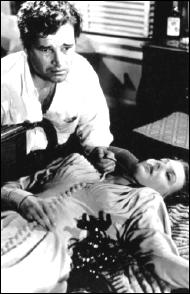
“See the Monkey Dance.” An episode of The Alfred Hitchcock Hour (Season 3, Episode 5). First air date: 9 November 1964. Efrem Zimbalist, Jr., Roddy McDowall, Patricia Medina, George Pelling, Shari Lee Bernath. Original teleplay: Lewis Davidson. Director: Joseph M. Newman.

    George (Roddy McDowall) is returning home to a caravan (trailer) situated on leased farm land in what could be western England. When his train makes a short station stop, he hurries to a phone booth to call his lover (Patricia Medina), a woman who is married to another man. They’ve planned to spend the weekend in close proximity to each other while hubby is away.

    But when George returns to the train, someone else has entered the carriage: a strange, nervous, querulous little man with horn-rimmed glasses (Efrem Zimbalist, Jr.), an attache case containing a Webley revolver that George doesn’t see, and a bad attitude. It’s not long before the new guy initiates a bout of verbal bickering with George. After a while, George concludes this fellow is simply crazy, and when their train reaches its stop he leaves, glad to be rid of this madman.

    It’s only a short walk to his caravan, and George makes good time there; he knows his lover should be arriving soon, and straightens up the place. But there’s something going on outside. When he opens the window, there’s that same crazy man, digging a hole just a few feet from the trailer. When George moves to object, however, the strange man pops open his case and reveals the gun. George quickly realizes that he’s not just digging a hole; he’s digging a grave ….

    This episode has an unusually witty script, with a couple of plot twists that someone who’s been paying close attention might anticipate. Nevertheless, it’s great fun to see McDowall and Zimbalist in a battle of wits and wills; in addition, Zimbalist pulls off a British accent quite well here.

    Efrem Zimbalist, Jr. played Agent Lew Erskine in the ’60s-’70s series The F.B.I and was the voice of Alfred the butler in the Batman animated series. Most viewers remember Roddy McDowall from the “Planet of the Apes” series of films; some may recall his turn in Evil Under the Sun (1982).

    You can see “See the Monkey Dance” on Hulu (follow the link).

REVIEWED BY WALTER ALBERT:         


HE FELL IN LOVE WITH HIS WIFE. Pallas Pictures/Paramount, 1916. Forrest Stanley, Florence Rockwell, Page Peters, Lydia Yeamans Titus, Howard Davis. Director: William Desmond Taylor. Shown at Cinecon 45, Hollywood CA, September 2009.

HE FELL IN LOVE WITH HIS WIFE

    A charming film that, as the program notes pointed out, is one of the few surviving films of director Taylor, victim of a sensational ’20s murder that destroyed more than one career.

    A rustic comedy in which a widowed farmer (Stanley), after a disastrous series of attempts to hire a responsible housekeeper, in desperation enters into a marriage of convenience with Rockwell, fleeing a loveless and abusive marriage after she discovers that her husband is a bigamist.

    True love eventually develops, but only after some dramatic events, the most crucial of which is the arrival of Rockwell’s duplicitous husband to reclaim his wife.

    A superb print of a film that neatly balances comedy and drama, this has elements of Victorian melodrama that, under Taylor’s astute direction, take on a distinctly more modern look. One of the highlights of the weekend’s program.

« Previous PageNext Page »