Excerpted from an online obituary at Zenit.org:

RALPH McINERNY

       Ralph McInerny Dies at Age 80

SOUTH BEND, Indiana, JAN. 29, 2010 – Prominent Catholic author, professor and cultural commentator Ralph McInerny died today at the age of 80.

Ralph McInerny was a professor of philosophy and the Michael P. Grace Professor of Medieval Studies at the University of Notre Dame

He was an acknowledged expert on the writings of St. Thomas Aquinas, and a prolific author. He penned over two dozen scholarly books, many more scholarly essays, and over 80 novels.

He wrote the popular book series Father Dowling Mysteries, which became a successful television program starring Tom Bosley and Tracy Nelson.

          …

   Here’s a list of his Father Dowling books. There isn’t much doubt that in our world of mystery fiction, these are the ones he’ll be remembered for the longest:

     The Father Dowling series

1. Her Death of Cold (1977)

RALPH McINERNY

2. Bishop as Pawn (1978)

RALPH McINERNY

3. The Seventh Station (1977)
4. Lying Three (1979)
5. The Second Vespers (1980)
6. Thicker Than Water (1981)
7. A Loss of Patients (1982)
8. The Grass Widow (1983)
9. Getting a Way with Murder (1984)

RALPH McINERNY

10. Rest in Pieces (1985)
11. The Basket Case (1987)
12. Abracadaver(1989)
13. Four on the Floor (1989)
14. Judas Priest (1991)
15. Desert Sinner (1992)
16. Seed of Doubt (1993)

RALPH McINERNY

17. A Cardinal Offense (1994)
18. The Tears of Things (1996)
19. Grave Undertakings (2000)
20. Triple Pursuit (2001)
21. Prodigal Father (2002)
22. Last Things (2003)
23. Requiem for a Realtor (2004)
24. Blood Ties (2005)

RALPH McINERNY

25. The Prudence of Flesh (2006)
26. The Widow’s Mate (2007)
27. Ash Wednesday (2008)
28. The Wisdom of Father Dowling (2009)
29. Stained Glass (2009)

RALPH McINERNY

   As Monica Quill, he wrote 10 books in a series of equally light mysteries solved by Sister Mary Teresa, and under his own name: six books about lawyer Andrew Broom, 13 mysteries with the University of Notre Dame as the background if not an active participant itself, two books with Egidio Manfredi as the leading player, and most recently (2009) two books in his Rosary Chronicle series. Not to mention another long list of standalone novels and story collections, and three anthologies edited, including Murder Most Catholic (2002) with Martin H Greenberg.

FATHER DOWLING

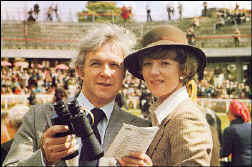
   The television series Father Dowling Mysteries of the TV series (and add Mary Wicke to Tom Bosley and Tracy Nelson as one of the continuing stars) was first aired as an NBC made-for-TV movie in 1987 and its weekly run did not begin until 1989. After one season the show moved from NBC to ABC, where it lasted another two season.

   Tom Bosley played Father Dowling, while Tracy Nelson played his assistant in solving crimes, Sister Stephanie ‘Steve’ Oskowski. Also appearing in all 44 episodes was Mary Wicke as Father Dowling’s always fussing housekeeper, Marie.

   The series has not yet been released on commercial DVDs — and why not?

   Not only has Old Time Radio collector and historian Randy Riddle posted an episode of Casey, Crime Photographer I’d not heard before, but it’s a locked room mystery to boot. Casey, played by Staats Cotsworth in this program, was based on the character created by mystery writer George Harmon Coxe.

   Here’s Randy, as he describes it on his podcast/blog:

    “In this post, we hear ‘Woman of Mystery,’ program 61 in the series, broadcast on the Armed Forces Radio Service as Crime Photographer and originally heard on CBS on November 9, 1950. It’s one of those ‘locked room’ mysteries, where Casey’s keen sense of observation come in handy to discover how a woman was murdered.”

   Unfortunately Casey solves the mystery only seven minutes into the program — or does he? Listen and see.

REVIEWED BY DAN STUMPF:         


LUCAS WEBB – Eli’s Road. Doubleday, hardcover, 1971. Reprint paperback: Popular Library, no date stated.

LUCAS WEBB Eli's Road

    I went back to the used book store to buy the copy of Green Ice they’ve had there for years, and got distracted once again. This time by a novel called Eli’s Road, by Lucas Webb.

    Considering the quality of this thing, I’m surprised Webb and his novel aren’t better known. It starts off a bit awkward, but soon gets the reader involved in a 1st person narrative spanning ante-bellum Kansas to 1880s Wyoming.

   Webb does a remarkable job of keeping his narrator believable from the time he writes as a callow teen-ager till he ends up in stoic middle-age, quite a feat of style, and the story: Bloody Kansas, rogue mountain men, orphan girls, pro-slavers, store-keepers, abolitionists, border ruffians, emigrants, freed slaves … and the mysterious Brother Frank.

   Seek it out.

[Editorial Comment]   I wish I had a copy of the paperback reprint to show you. The jacket of the hardcover edition, which perhaps sold to libraries and no one else, is rather plain and uninspiring, to say the least. The paperback is a lot more colorful and inviting, if you’re a fan of western sagas, and it has a quote from noted author Stephen Longstreet to boot:   “The Best Novel of the American West since The Big Sky.” No small praise.

     Lucas Webb is stated on the Web to be the pen name of Michael Burgess. Burgess is also well-noted as bibliographer R. Reginald (Cumulative Paperback Index, 1939-1959, among many others).

   But while Burgess did use Lucas Webb at least once as a pseudonym, an online bibliography for him does not include either Eli’s Road or one later novel under the Lucas Webb byline, a book called Stribling (Doubleday, 1973), about which I have found very little to date, only one quote:   “But there was no place to go to farm or settle; the farms were being deserted, the big combines tractoring out the shacks and the little fields…”

A TV Review by MIKE TOONEY:


“The Rise and Fall of Eddie Carew.” An episode of Kraft Suspense Theatre (Season 2, Episode 30). First air date: 24 June 1965. Dean Jones, Sheilah Wells, Alan Hewitt, Jerome Cowan, Harry Townes, Ken Lynch, Stanley Adams, Ian Wolfe, John Hubbard, Barry Kelley. Story: Robert Thom; adaptation: Don Brinkley. Director: Joseph Pevney.

“Alas, that love, so gentle in his view, should be so tyrannous and rough in proof.”

               — Romeo and Juliet

   Senile nonagenarian Ellis Stone (Ian Wolfe) manages to get himself locked in the vault of his own bank; unless he’s very good at holding his breath, by the time the electronic lock opens the door three days hence he’ll be very dead.

   The bank manager, in full panic mode, phones Sam Becker (Jerome Cowan), the public relations man for “our party.” He immediately sees the PR disaster (not to mention the financial catastrophe) that he and his cronies would suffer if dotty old Stone, a million-dollar-a-year party contributor, were to go toes up.

   In a moment of inspiration, he plumps for making use of the talents of Eddie Carew (Dean Jones), “The Human Can Opener,” currently serving time in the state pen.

   But Dr. Farley (Harry Townes), the prison psychiatrist, has been making progress weening Eddie away from his compulsion to steal and is flatly opposed to letting Eddie anywhere near piles of money. It would be, as he says, like having an alcoholic become a wine taster.

   The prison warden (Alan Hewitt) overrules the doctor, however, and takes Eddie to the bank. Before he goes, Eddie tries to warn everyone of what could happen; but even his girlfriend, Sally McClure (Sheilah Wells), encourages him to do this because she has faith in his rehabilitation.

   Eddie is now in a position to call the shots: no prison uniform (“something in charcoal gray” would be nice) or handcuffs, deciding who can be present when he does the job (others can be a distraction), and especially having “the best jelly man in the business,” Pinky Ferguson (Stanley Adams), assist him.

   Yes, you guessed it: Eddie has ideas that go way beyond rescuing the old guy, which he almost betrays when he first lays eyes on the safe. (“Well,” says Becker, “is he going to open it or make love to it?”)

   What Eddie doesn’t know is that before the sun rises he will have to crack this same safe three times: once out of greed, once out of duty (and self-interest), and once out of love ….

   This one has a great comic cast as well as normally serious actors doing a humorous turn. Dean Jones is well-known for the many Disney films he’s appeared in. Stanley Adams always seemed to be an affable fast-talker just on the other side of the law (e.g., Cyrano Jones in the immensely popular Star Trek episode “The Trouble with Tribbles”).

   And Ken Lynch must have played a cop hundreds of times over the years. Jerome Cowan was a low-rent version of William Powell; he could do light comedy (Gomer Pyle, U.S.M.C.), but most movie fans remember him as Miles Archer in The Maltese Falcon and the spineless architect in The Fountainhead.

   Even when reading is impossible, the presence of books acquired produces such an ecstasy that the buying of more books than one can read is nothing less than the soul reaching towards infinity… we cherish books even if unread, their mere presence exudes comfort, their ready access, reassurance.

            — A. E. Newton

A 1001 MIDNIGHTS Review
by Susan Dunlap:


ROBERT BARNARD – The Case of the Missing Brontë. Hardcover edition: Scribner’s, 1983. Reprinted in paperback several times by Dell: 1984, 1986, 1989. Penguin, paperback, November 1994. First published in the UK: Collins Crime Club, 1983, as The Missing Brontë.

Missing Bronte

   This is the third novel featuring Superintendent Perry Trethowen of Scotland Yard. It begins with the detective and his wife returning from a visit to his very peculiar aristocratic family (who are displayed to fine advantage in Death by Sheer Torture, 1981).

   Their car breaks down in a small village, Hutton-Le-Dales, and since they must spend the night there, they do the true British thing — they go to the local pub. No sooner do they settle in than an elderly lady accosts them and announces that she has inherited what appears to be an unpublished manuscript of a novel possibly authored by one of the Bronte sisters. And no sooner do they leave town than the woman is attacked and the manuscript stolen.

   Trethowen returns to Hutton-Le-Dales, delighted to be associated with literary matters rather than being thought of only as the policeman with the kinky family — something that happens all too often. His investigations lead him to an unholy preacher (trained in Los Angeles!), the professors of a local last-resort college (here Barnard, a professor himself, is delightfully scathing in his caricatures), and book collectors from two continents, to say nothing of a pair of Norwegian toughs.

   Characters in a Barnard book rarely have flattering things to say about each other — and for good reason. Trethowen views humanity with a disdainful eye, which makes for much wary humor. The plot of The Case of the Missing Brontë is solid, and the book-collecting background intriguing.

   A two-time nominee for an MWA Best Novel Edgar, Barnard has written such other delightful novels as Death of a Mystery Writer (1979), Death of a Literary Widow (1980), Death and the Princess (1982), and Out of the Blackout (1985).

         ———
   Reprinted with permission from 1001 Midnights, edited by Bill Pronzini & Marcia Muller and published by The Battered Silicon Dispatch Box, 2007.   Copyright © 1986, 2007 by the Pronzini-Muller Family Trust.

A 1001 MIDNIGHTS Review
by Susan Dunlap:


ROBERT BARNARD – Blood Brotherhood. Walker & Co., US, hardcover, 1978. Previously published in the UK: Collins Crime Club, hc, 1977. US paperback reprint: Penguin, 1983, 1992 (the latter shown).

ROBERT BARNARD Blood Brotherhood

   Robert Barnard’s element is exposing the underside of the pompous and the powerful, be they royalty, clergy, academics, or pillars of the community.

   The unique thing about his books is not how witty they are (though that in itself makes them worth reading) but that each one is very different. (Indeed, Death in a Cold Climate, 1980, is not humorous; its intriguing quality is its setting in the north of Norway, where Barnard once taught English.)

   Blood Brotherhood takes the reader into the cloistered Anglican community of St. Botolph’s, where an international group of clerics (an American with an unmuted passion for fundraising; an African bishop who has occasional lurchings into un-Christian tribal customs; assorted Britons; and two Norwegians who, to the horror of the host, turn out to be women) meet to discuss the rarefied matters of the spirit.

   At a time “when the heather lay like a purple blanket over the moorlands, and a large proportion of the local population were baking uncomfortably and loathing the food on the Costa del Sol,” the clerics entertain less than holy thoughts, particularly about the more attractive of the Norwegian women.

   One of their number is stabbed to death, and the unholy problem is left for the pious group to unravel. Barnard’s characters, while created to show various peculiarities — such as the overly hip youth pastor or the television bishop — exist not as stereotypes but as individuals who have grown up into their chosen roles. Entertaining.

         ———
   Reprinted with permission from 1001 Midnights, edited by Bill Pronzini & Marcia Muller and published by The Battered Silicon Dispatch Box, 2007.   Copyright © 1986, 2007 by the Pronzini-Muller Family Trust.

Note: Maryell Cleary’s review of this book appears here earlier on this blog.

A REVIEW BY MARYELL CLEARY:
   

ROBERT BARNARD Death of a Perfect Mother

ROBERT BARNARD – Death of a Perfect Mother.

Charles Scribner’s Sons, US, hardcover, 1981. Paperback reprint: Dell, 1985. Previously published in the UK as Mother’s Boys: Collins Crime Club, 1981.

   Who killed Lill Hodsden? Thick-skinned, loud-mouthed, high-tempered Lill, bane of the local merchants and her neighbors; lusty Lill, who knows how to trade sexual favors for a telly and maybe a car; tempestuous Lill, who can’t get along with her daughter or her mother but whose two grown sons adore her so she says.

   Gordon and Brian seem to be the perfect sons, but the reader finds them plotting to kill her in Chapter One. They can only get away from their vulgar, doting mother by getting rid of her, they say. But when she’s found strangled, it develops that there are plenty of others with motives for getting Lill out of the way.

   Barnard’s mordant humor makes the process of finding out whodunit a pleasurable read.

– Reprinted from The Poisoned Pen, Vol. 6, No. 4, Fall 1986


BRAD LATHEM – The Hook #1: The Gilded Canary. Warner, paperback original; 1st printing, September 1981.

BRAD LATHAM The Gilded Canary (Hook #1)

   Warner has been publishing books in several of its various new “Men of Action” series for some time now, and for mystery fans, here is the first appearance of the one that might seem the most promising. “The Hook” is Bill Lockwood, a 1930’s private eye who is as tough with his fists as he is energetic in bed.

   There seems to be little else to say. Lockwood’s case, as he investigates the theft of some jewelry from a rich girl singer named Muffy Dearborn, is nothing less than a flimsy excuse for him to jump in and out of a bed or two and beat up a few hoodlums in between with his patented left hook.

   There are a few good moments — once in a while I got a fleeting impression that there was some intelligent thought put into the writing of this mediocre excuse for a book — but they quickly pass.

   On the other hand, the result is probably exactly what Warner had in mind when they commissioned it.

– From The MYSTERY FANcier, Vol. 6, No. 2, March/April 1982
        (slightly revised)


[UPDATE] 01-28-10.   Whew. I seldom put down a book as solidly as this, and this review took me a bit by surprise when it turned up next to be put online. I thought of tempering the tone down a notch or two, but this is what my reaction was some 28 years ago, and (without re-reading the book) I decided at length that I ought to stand by it.

   There were, in all, five in the series. Here, taken from the Revised Crime Fiction IV, by Allen J. Hubin, is a complete list:

          LATHAM, BRAD. Pseudonym of David J. Schow.

    1. The Gilded Canary (n.) Warner, pbo, Sept 1981.
    2. Sight Unseen (n.) Warner, pbo, Sept 1981.
    3. Hate Is Thicker Than Blood (n.) Warner, pbo, Dec 1981.
    4. The Death of Lorenzo Jones (n.) Warner, pbo, 1982.
    5. Corpses in the Cellar (n.) Warner, pbo, June 1982.

ROBERT MOORE WILLIAMS – The Darkness Before Tomorrow. Ace Double F-141, paperback original; 1st printing, 1962. [Paired with this novel, tête-bêche, is The Ladder in the Sky, by Keith Woodcott (aka John Brunner).]

   Dan Stumpf and David Vineyard were briefly exchanging comments about “hack” writers earlier this month. It all depends on one’s definition, of course, and while you can say that a hack writer is one without talent and/or one who merely cranks out the wordage for the money, everyone has a different concept of what’s talent and what’s not and/or how many cranks are needed to make a hack.

ROBERT MOORE WILLIAMS Darkness Before Tomorrow.

   When it comes to Science Fiction hacks, though, for some reason Robert Moore Williams comes to mind. Not that I’ve read anything by him in nearly 50 years, but I’m sure I have, and it must have stuck with me, since (rightly or wrongly, but with no malice intended) I’ve tended to use his fiction as more or less my yardstick of hackwork.

   Titles such as Conquest of the Space Sea (1955) and Zanthar of the Many Worlds (1967) might suffice as examples, but in all honestly, since I haven’t read them, I can hardly dwell on them.

   I will point out that Robert Moore Williams’ SF career started considerably earlier than did, say, John Brunner’s, whose novel on the other side of this Ace Double I reviewed here not so long ago. Brunner first novel was published in 1951, I believe, but it wasn’t until the late 1950s that anyone began to take notice of him.

   In comparison, Williams’ first story appeared in Astounding SF in 1937, and he had a long list of other pulp stories to his credit before he turned to paperback fiction in the 1950s. But no matter; even in 1962 his pulp roots show. The Darkness Before Tomorrow has, I am sorry to say, very little in it for which I might recommend it to you.

   The opening couple of chapters are adequate, however, and indeed maybe even more than adequate. The story begins in the year 1980 or so, with the action going on immediately, allowing the characters to be introduced on the fly.

   Someone, as it happens, has discovered a new kind of weapon that kills without making a wound of any kind. Scientist George Gillian stumbles across a body killed in such a way and hence into a crossfire between the villains and the pair who are resisting them, a brother and sister (Eck and Sis) whose side Gillian quickly joins.

   If I were to tell you that the head villain is a ruthless gangster named Ape Abrussi, and his headquarters are in what’s called Mad Mountain, you will know at once what kind of story this is. It is also the story of aliens walking among us (with small horns on the foreheads and goat-like eyes), with only good intentions (it is assumed), and no, Ape is not one of them. It turns out that he came across his new weapon only by accident, and now that he has, his intentions are to rule the world.

   In a novel like this, of course, good luck with that.

   And so, the big question is: Is this the work of a hack? “Hackery” is such a pejorative term I’d hate to say yes, but I have a feeling that by many people’s standards, the answer is is probably in the affirmative. Williams is good in describing places and things, conjuring up loads of atmosphere for the former and having an excellent eye for detail on the latter.

   But what he’s not so good at are essential things, such as working with people and complex relationships between them — nor is the dialogue they speak anything but stiff. Williams is not so good at science, either, but he’s good at waving his hands and making believe that he does.

   But you could say pretty much the same sort of things about 90% of the writers who wrote for the pulps. What most of them could do, though, those who were successful at it — and I’d place Robert Moore Williams among them — was to write stories that made readers keep on reading them. It worked for me!

« Previous PageNext Page »